

The DOI matches its Crossref record; 39 of the 39 references it cites were found in a registry or an index.
Sharing Detailed Research Data Is Associated with Increased Citation Rate
Open accessAbstract
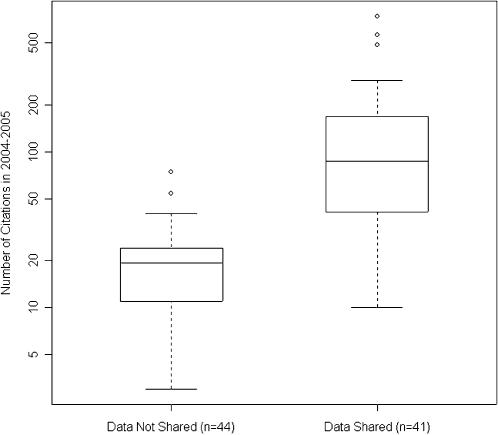
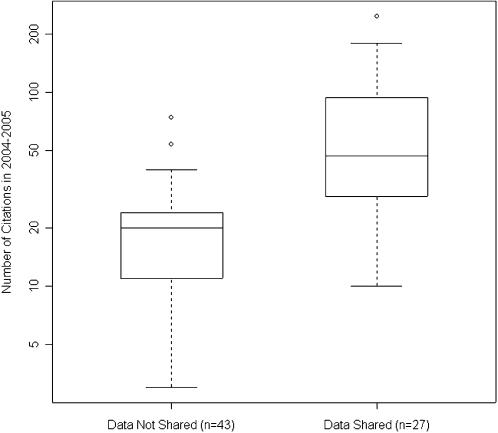
BACKGROUND: Sharing research data provides benefit to the general scientific community, but the benefit is less obvious for the investigator who makes his or her data available. PRINCIPAL FINDINGS: We examined the citation history of 85 cancer microarray clinical trial publications with respect to the availability of their data. The 48% of trials with publicly available microarray data received 85% of the aggregate citations. Publicly available data was significantly (p = 0.006) associated with a 69% increase in citations, independently of journal impact factor, date of publication, and author country of origin using linear regression. SIGNIFICANCE: This correlation between publicly available data and increased literature impact may further motivate investigators to share their detailed research data.
Overview
The claims and statistics of this paper haven’t been checked yet.
Run the check — free, no account needed. It reads the open-access text and checks the sources it cites.
Integrity signals
Registry
Cites
Statistics
Figures
Verification
Claims the paper makes
The claims and statistics of this paper haven’t been checked yet.
Run the check — free, no account needed. It reads the open-access text and checks the sources it cites.
Claims other papers make about this one
Each is checked against this paper’s own text: does it say what the citing paper says it does?
The cited source says what the claim attributes to it.
In the citing paper
“Journal articles with accompanying data may be cited more frequently [248,249].”
From Reporting animal research: Explanation and elaboration for the ARRIVE guidelines 2.0 (2020) · cites this paper as [248]
In the citing paper
“Data sharing is also associated with an increased number of citations.87 88”
From SPIRIT 2025 explanation and elaboration: updated guideline for protocols of randomised trials (2025) · cites this paper as [87]
Self-check
Percentages, sums and reported differences re-computed from the paper’s own numbers.
The self-check needs the paper’s full text.
Citations
Cites
R: A Language and Environment for Statistical Computing
R Core Team (2000) · doi:10.32614/r.manuals · Cited by 355,893
Gene Expression Omnibus: NCBI gene expression and hybridization array data repository
Edgar, R. (2002) · Nucleic Acids Research · doi:10.1093/nar/30.1.207 · Cited by 13,288
Minimum information about a microarray experiment (MIAME)-toward standards for microarray data
Brazma, A., Hingamp, P., Quackenbush, J., Sherlock, G., Spellman, P., Stoeckert, C., Aach, J., Ansorge, W., Ball, C. A., Causton, H. C., et al. (2001) · Nature Genetics · doi:10.1038/ng1201-365 · Cited by 4,109
ONCOMINE: A Cancer Microarray Database and Integrated Data-Mining Platform
Rhodes, D. R., Yu, J., Sundaram, S. K., Deshpande, N., Varambally, R., Ghosh, D., Barrette, T. R., Pander, A., & Chinnaiyan, A. M. (2004) · Neoplasia · doi:10.1016/s1476-5586(04)80047-2 · Cited by 3,719
Why the impact factor of journals should not be used for evaluating research
Seglen, P. O. (1997) · BMJ · doi:10.1136/bmj.314.7079.497 · Cited by 2,447
Reporting Recommendations for Tumor Marker Prognostic Studies (REMARK)
McShane, L. M., Altman, D. G., Sauerbrei, W., Taube, S. E., Gion, M., & Clark, G. M. (2005) · JNCI: Journal of the National Cancer Institute · doi:10.1093/jnci/dji237 · Cited by 2,162
ArrayExpress--a public repository for microarray gene expression data at the EBI
Parkinson, H. (2004) · Nucleic Acids Research · doi:10.1093/nar/gki056 · Cited by 1,077
Citation Advantage of Open Access Articles
Eysenbach, G. (2006) · PLoS Biology · doi:10.1371/journal.pbio.0040157 · Cited by 829
Do Open-Access Articles Have a Greater Research Impact?
Antelman, K. (2004) · College & Research Libraries · doi:10.5860/crl.65.5.372 · Cited by 678
The Stanford Microarray Database
Sherlock, G. (2001) · Nucleic Acids Research · doi:10.1093/nar/29.1.152 · Cited by 528
Relative Citation Impact of Various Study Designs in the Health Sciences
Patsopoulos, N. A. (2005) · JAMA · doi:10.1001/jama.293.19.2362 · Cited by 498
Design and implementation of microarray gene expression markup language (MAGE-ML)
Spellman, P. T., Miller, M., Stewart, J. E., Troup, C., Sarkans, U., Chervitz, S., Bernhart, D., Sherlock, G. J., Ball, C. A., Lepage, M., et al. (2002) · Genome biology · doi:10.1186/gb-2002-3-9-research0046 · Cited by 439
Predictive ability of DNA microarrays for cancer outcomes and correlates: an empirical assessment
Ntzani, E., & Ioannidis, J. P. A. (2003) · The Lancet · doi:10.1016/s0140-6736(03)14686-7 · Cited by 323
Diamond, A. M. (1986) · The Journal of Human Resources · doi:10.2307/145797 · Cited by 296
Selective reporting biases in cancer prognostic factor studies.
Kyzas, P., Loizou, K. T., & Ioannidis, J. (2005) · Journal of the National Cancer Institute · doi:10.1093/jnci/dji184 · Cited by 226
Authors and open access publishing
Swan, A., & Brown, S. (2004) · Learned Publishing · doi:10.1087/095315104323159649 · Cited by 219
The Stanford Microarray Database accommodates additional microarray platforms and data formats
Ball, C. A. (2004) · Nucleic Acids Research · doi:10.1093/nar/gki006 · Cited by 196
Check, E. (2004) · Nature · doi:10.1038/429496a · Cited by 167
Riley, R. D., Abrams, K. R., Sutton, A. J., Lambert, P. C., Jones, D. R., Heney, D., & Burchill, S. A. (2003) · British Journal of Cancer · doi:10.1038/sj.bjc.6600886 · Cited by 165
CIBEX: Center for Information Biology gene EXpression database
Ikeo, K., Ishi-i, J., Tamura, T., Gojobori, T., & Tateno, Y. (2003) · Comptes Rendus Biologies · doi:10.1016/j.crvi.2003.09.034 · Cited by 165
One-stop shop for microarray data
Brāzma, A., Robinson, A. J., Cameron, G. N., & Ashburner, M. (2000) · Nature · doi:10.1038/35001676 · Cited by 157
Weale, A. R., Bailey, M., & Lear, P. A. (2004) · BMC Medical Research Methodology · doi:10.1186/1471-2288-4-14 · Cited by 157
GUPTA, D. K. D., Saul, M. I., & Gilbertson, J. R. (2004) · American Journal of Clinical Pathology · doi:10.1309/e6k3-3gbp-e5c2-7fyu · Cited by 147
Sharing Publication-Related Data and Materials: Responsibilities of Authorship in the Life Sciences
Cech, T. R., Eddy, S. R., Eisenberg, D. S., Hersey, K. M., Holtzman, S. H., Poste, G. H., Raikhel, N. V., Scheller, R. H., Singer, D. B., & Waltham, M. (2003) · PLANT PHYSIOLOGY · doi:10.1104/pp.900068 · Cited by 139
Cyberinfrastructure: Empowering a "Third Way" in Biomedical Research
Buetow, K. H. (2005) · Science · doi:10.1126/science.1112120 · Cited by 136
Fienberg, S. E., Martin, M. E., & Straf, M. L. (2013) · Cited by 114
GUPTA, D. K. D., Saul, M., & Gilbertson, J. R. (2004) · American Journal of Clinical Pathology · doi:10.1309/e6k33gbpe5c27fyu · Cited by 109
Evangelou, E., Trikalinos, T. A., & Ioannidis, J. P. A. (2005) · The FASEB Journal · doi:10.1096/fj.05-4784lsf · Cited by 92
Importance of Communication Between Producers and Consumers of Publicly Available Experimental Data
Liotta, L. A., Lowenthal, M. S., Mehta, A. I., Conrads, T. P., Veenstra, T. D., Fishman, D. A., & Petricoin, E. (2005) · JNCI Journal of the National Cancer Institute · doi:10.1093/jnci/dji053 · Cited by 88
Zelen, M., Fienberg, S. E., Martin, M. E., & Straf, M. L. (1987) · Journal of the American Statistical Association · doi:10.2307/2289493 · Cited by 71
McCain, K. W. (1995) · Science Communication · doi:10.1177/1075547095016004003 · Cited by 64
Funding high-throughput data sharing
Ball, C. A., Sherlock, G. J., & Brāzma, A. (2004) · Nature Biotechnology · doi:10.1038/nbt0904-1179 · Cited by 50
Supplementary data need to be kept in public repositories
Santos, C., Blake, J. A., & States, D. J. (2005) · Nature · doi:10.1038/438738a · Cited by 32
Mandatory submission of microarray data to public repositories: how is it working?
Ventura, B. (2005) · Physiological Genomics · doi:10.1152/physiolgenomics.00264.2004 · Cited by 18
To Give or Not to Give? That Is the Question
Theologis, A., & Davis, R. W. (2004) · PLANT PHYSIOLOGY · doi:10.1104/pp.104.043083 · Cited by 11
Re: Reporting Recommendations for Tumor Marker Prognostic Studies (REMARK)
Popat, S., & Houlston, R. S. (2005) · JNCI Journal of the National Cancer Institute · doi:10.1093/jnci/dji445 · Cited by 9
(2003) · Nature Immunology · doi:10.1038/ni0203-93 · Cited by 3
A new system for direct submission of data to the nucleotide sequence data banks.
(1987) · PubMed Central · Cited by 2
Cited by
Sorted by citations
Reporting animal research: Explanation and elaboration for the ARRIVE guidelines 2.0
Percie du Sert, N., Ahluwalia, A., Alam, S., Avey, M. T., Baker, M., Browne, W. J., Clark, A., Cuthill, I. C., Dirnagl, U., Emerson, M., et al. (2020) · PLOS Biology · doi:10.1371/journal.pbio.3000411 · Cited by 2,677
Nosek (2012) · doi:10.1177/1745691612459058 · Cited by 1,301
Increasing value and reducing waste: addressing inaccessible research
Chan, A.-W., Song, F., Vickers, A., Jefferson, T., Dickersin, K., Gøtzsche, P. C., Krumholz, H. M., Ghersi, D., & van der Worp, H. B. (2014) · The Lancet · doi:10.1016/s0140-6736(13)62296-5 · Cited by 887
Big data and the future of ecology
Hampton, S. E., Strasser, C. A., Tewksbury, J. J., Gram, W. K., Budden, A. E., Batcheller, A. L., Duke, C. S., & Porter, J. H. (2013) · Frontiers in Ecology and the Environment · doi:10.1890/120103 · Cited by 930
Factors Affecting Number of Citations: A Comprehensive Review of the Literature
Tahamtan, I., Safipour Afshar, A., & Ahamdzadeh, K. (2016) · Scientometrics · doi:10.1007/s11192-016-1889-2 · Cited by 912
Metadata
- Authors
- Piwowar, H. A., Day, R. S., & Fridsma, D. B.
- Affiliations
- University of Pittsburgh (US)
- Corresponding author
- Piwowar, Heather A.
- Venue
- PLoS ONE
- Publisher
- Public Library of Science (PLoS)
- Published
- 2007-03-21
- Volume
- 2
- Issue
- 3
- Pages
- e308
- ISSN
- 1932-6203 (ISSN-L)
- PMC
- PMC1817752
- OpenAlex
- W2046766973
- Cited by
- 881
- References
- 39
- Citations by year
- 2026: 17 · 2025: 25 · 2024: 35 · 2023: 49 · 2022: 71 · 2021: 71 · 2020: 73 · 2019: 40 · 2018: 68 · 2017: 54 · 2016: 61 · 2015: 64 · 2014: 47 · 2013: 74 · 2012: 40
- FWCI
- 50.78
- Type
- journal article
- Language
- en
- Open access
- gold
- doi.org
- Locations
- PLoS ONE (publishedVersion, cc-by)
- Europe PMC (PubMed Central) (publishedVersion, cc-by)
- PubMed Central (publishedVersion, cc-by)
- PubMed (publishedVersion)
- D-Scholarship@Pitt (University of Pittsburgh) (acceptedVersion)
- RePEc: Research Papers in Economics (submittedVersion)
- DOAJ (DOAJ: Directory of Open Access Journals) (submittedVersion, cc-by-sa)
- Figshare (submittedVersion, cc-by)
- Funders
- National Institutes of Health
- U.S. National Library of Medicine (T15LM007059)
- Topics
- Physical Sciences › Computer Science › Information Systems › Research Data Management Practices
- Social Sciences › Library and Information Sciences › scientometrics and bibliometrics research
- Social Sciences › Library and Information Sciences › Academic Publishing and Open Access
- Keywords
- research data sharing, data availability, citation impact, public data, journal impact factor
- MeSH terms
- Clinical Trials as Topic, Cost-Benefit Analysis, Humans, Neoplasms, Periodicals as Topic, Publications, Regression Analysis, Internet, Oligonucleotide Array Sequence Analysis, Information Dissemination, Biomedical Research, Journal Impact Factor
About these checks
Registry, retraction, Cites and statistics results are computed, not judged, with one exception: a printed reference that no index lists is read once by a model before it counts as a citation error. Claims are extracted by a model and kept only when their quote appears verbatim in the text; each cited source is then checked, with a model’s help, for whether it says what the claim relies on. Those verdicts can be wrong — read the claim’s quote and the cited source before relying on one.
Statistics and arithmetic are recomputed, not judged.
Confidence bands are shown only for fields calibrated on our annotated test set. None is calibrated yet, so no band is shown.
What counts as a claim ›How we measure confidence ›How we check this ›
Are you an author, or do you see a problem with this page? Request a review
