

Quadrupling Muscle Mass in Mice by Targeting TGF-ß Signaling Pathways
Open accessThe DOI matches its Crossref record; 26 of the 27 references it cites were found in a registry or an index.
Abstract
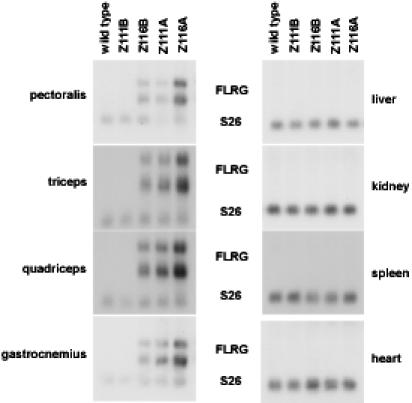
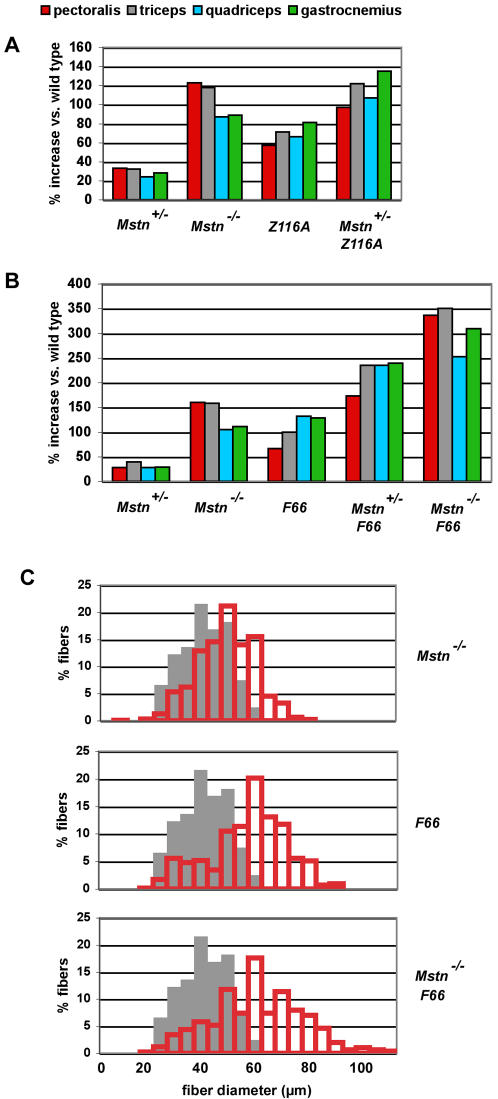
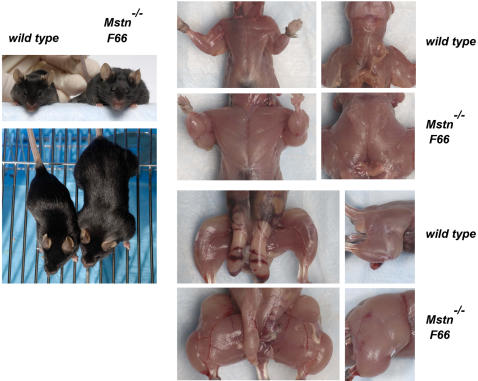
Myostatin is a transforming growth factor-beta family member that normally acts to limit skeletal muscle growth. Mice genetically engineered to lack myostatin activity have about twice the amount of muscle mass throughout the body, and similar effects are seen in cattle, sheep, dogs, and a human with naturally occurring loss-of-function mutations in the myostatin gene. Hence, there is considerable interest in developing agents capable of inhibiting myostatin activity for both agricultural and human therapeutic applications. We previously showed that the myostatin binding protein, follistatin, can induce dramatic increases in muscle mass when overexpressed as a transgene in mice. In order to determine whether this effect of follistatin results solely from inhibition of myostatin activity, I analyzed the effect of this transgene in myostatin-null mice. Mstn(-/-) mice carrying a follistatin transgene had about four times the muscle mass of wild type mice, demonstrating the existence of other regulators of muscle mass with similar activity to myostatin. The greatest effect on muscle mass was observed in offspring of mothers homozygous for the Mstn mutation, raising the possibility that either myostatin itself or a downstream regulator may normally be transferred from the maternal to fetal circulations. These findings demonstrate that the capacity for increasing muscle growth by manipulating TGF-beta signaling pathways is much more extensive than previously appreciated and suggest that muscle mass may be controlled at least in part by a systemic mode of action of myostatin.
Overview
The claims and statistics of this paper haven’t been checked yet.
Free: it reads the open-access text and checks the first 5 claims that cite a source we can check. Create a free account to check every claim.
Integrity signals
Registry
Cites
Statistics
Figures
Verification
Claims the paper makes
The claims and statistics of this paper haven’t been checked yet.
Free: it reads the open-access text and checks the first 5 claims that cite a source we can check. Create a free account to check every claim.
Claims other papers make about this one
Each is checked against this paper’s own text: does it say what the citing paper says it does?
The source backs part of the claim, not all of it — or backs it for a different population, condition or comparison.
In the citing paper
“The function of MSTN in muscle is at least partially redundant with that of another TGF-β family member, activin A (13–16).”
From Targeting myostatin/activin A protects against skeletal muscle and bone loss during spaceflight (2020) · cites this paper as [14]
Experimental — accuracy not yet measuredThe cited source says what the claim attributes to it.
In the citing paper
“If the loss of myostatin is combined with the overexpression of a follistatin transgene, then muscle mass quadruples, suggesting that myostatin is not the only muscle mass regulator in the TGFβ-Smad system (79).”
From The Hippo signal transduction network for exercise physiologists (2016) · cites this paper as [79]
Self-check
Percentages, sums and reported differences re-computed from the paper’s own numbers.
The self-check needs the paper’s full text.
Citations
Cites
Regulation of skeletal muscle mass in mice by a new TGF-p superfamily member
McPherron, A. C., Lawler, A. M., & Lee, S.-J. (1997) · Nature · doi:10.1038/387083a0 · Cited by 4,013 · cited 1×
“gene have about a doubling of skeletal muscle mass throughout the body as a result of a combination of muscle fiber hyperplasia and hypertrophy”
Self-citationDouble muscling in cattle due to mutations in the myostatin gene
McPherron, A. C., & Lee, S.-J. (1997) · Proceedings of the National Academy of Sciences · doi:10.1073/pnas.94.23.12457 · Cited by 2,039 · cited 1×
“The function of myostatin appears to have been conserved across species, as inactivating mutations in the myostatin gene have been demonstrated to cause increased muscling in cattle [8–11] , sheep [12], dogs [13] and humans [14].”
Self-citationRegulation of myostatin activity and muscle growth
Lee, S.-J., & McPherron, A. C. (2001) · Proceedings of the National Academy of Sciences · doi:10.1073/pnas.151270098 · Cited by 1,616
Self-citationA deletion in the bovine myostatin gene causes the double–muscled phenotype in cattle
Grobet, L., Royo Martin, L. J., Poncelet, D., Pirottin, D., Brouwers, B., Riquet, J., Schoeberlein, A., Dunner, S., Ménissier, F., Massabanda, J., et al. (1997) · Nature Genetics · doi:10.1038/ng0997-71 · Cited by 1,556 · cited 1×
“can also lead to significant muscle growth. Hence, myostatin appears to play as least two distinct roles, one to regulate the number of muscle fibers that are formed during development and a second to regulate growth of muscle fibers postnatally. The function of myostatin appears to have been conserved across species,…”
Myostatin Mutation Associated with Gross Muscle Hypertrophy in a Child
Schuelke, M., Wagner, K. R., Stolz, L. E., Hübner, C., Riebel, T., Kömen, W., Braun, T., Tobin, J. F., & Lee, S.-J. (2004) · New England Journal of Medicine · doi:10.1056/nejmoa040933 · Cited by 1,399
Self-citationClop, A., Marcq, F., Takeda, H., Pirottin, D., Tordoir, X., Bibé, B., Bouix, J., Caiment, F., Elsen, J.-M., Eychenne, F., et al. (2006) · Nature Genetics · doi:10.1038/ng1810 · Cited by 1,260
Mutations in myostatin ( GDF8 ) in Double-Muscled Belgian Blue and Piedmontese Cattle
Kambadur, R., Sharma, M., Smith, T. P. L., & Bass, J. J. (1997) · Genome Research · doi:10.1101/gr.7.9.910 · Cited by 1,204 · cited 1×
“The function of myostatin appears to have been conserved across species, as inactivating mutations in the myostatin gene have been demonstrated to cause increased muscling in cattle [8–11] , sheep [12], dogs [13] and humans [14].”
Induction of Cachexia in Mice by Systemically Administered Myostatin
Zimmers, T. A., Davies, M. V., Koniaris, L. G., Haynes, P., Esquela, A. F., Tomkinson, K. N., McPherron, A. C., Wolfman, N. M., & Lee, S.-J. (2002) · Science · doi:10.1126/science.1069525 · Cited by 907
Self-citationFunctional improvement of dystrophic muscle by myostatin blockade
Bogdanovich, S., Krag, T. O. B., Barton, E. R., Morris, L. D., Whittemore, L.-A., Ahima, R. S., & Khurana, T. S. (2002) · Nature · doi:10.1038/nature01154 · Cited by 831
Mosher, D. S., Quignon, P., Bustamante, C. D., Sutter, N. B., Mellersh, C. S., Parker, H. G., & Ostrander, E. A. (2007) · PLoS Genetics · doi:10.1371/journal.pgen.0030079 · Cited by 826
Cited by
Items 301–325 of 325
Izboljševanje zmogljivosti v poklicnem športu: Goljufanje ali nova faza razvoja?
Pustovrh, T. (2010) · Revus · doi:10.4000/revus.1257
[Sudden death of a 22-month-old infant due to hyperglycemic accident].
Cau, G., Yacoub, M., Faure, H., & Faure, J. (1968) · PubMed · Cited by 1
Marron, K. (2007) · Lab Animal · doi:10.1038/laban1007-8b
Hakam, C. E. (2016) · theses.fr (ABES) · doi:10.70675/30f5f251zc2acz4d9aza506za14b1af42c34 · Cited by 1
Yılmaz, Ö. Ö., & Aslan, B. T. (2023) · doi:10.69860/nobel.9786053359050.6
Lisko, I. (2008) · Jyväskylä University Digital Archive (University of Jyväskylä)
Radfar, B., Bagheri, R., Ghobadi, H., Hematabadi, A., Askari, B., Rashidlamir, A., & Dutheil, F. (2026) · Nutrients · doi:10.3390/nu18040611
Evaluation de régulateurs positifs de la croissance musculaire chez un modèle dystrophique murin
Guiraud, S. (2011) · theses.fr (ABES) · doi:10.70675/0c021d5bz542bz442bzbb0cz66c3d0b5c31d
Skeletal muscle growth and maintenance depend on BMP signaling
Schirwis, E. (2014) · theses.fr (ABES) · doi:10.70675/7234357bz1f9dz4a42za02cz799ec1dedf12
Gallot, Y. S. (2013) · theses.fr (ABES) · doi:10.70675/1d35ea8az3ecaz447cz97b5ze73af4144e29
“…142 Protéine Référence Décorine (Miura et al., 2006) Follistatine (Lee & McPherron, 2001; Zimmers et al., 2002; Amthor et al., 2004) FLRG (Hill et al., 2002; Lee, 2007) GASP‐1 …”
The function of Activin receptor type IIB signaling in adult skeletal muscle
Relizani, K. (2014) · theses.fr (ABES) · doi:10.70675/20978d43z02f0z4a1ezb428zf5dab86d9abf
“McPherron, AC, Lawler, AM and Lee, SJ (1997) Regulation of skeletal muscle mass in mice by a new TGF‐beta superfamily member. Nature 387:83‐90. 2. Lee, SJand McPherron, AC (2001) Regulation of myostatin activity and muscle growth. Proc Natl Acad Sci U S A 98:9306‐9311. 3. Lee, SJ, Reed, LA, Davies, MV, Girgenrath, S,…”
InfluentialPagano, A. F. (2016) · theses.fr (ABES) · doi:10.70675/b2e8ea4ez5cd3z43a4zae84z3a8e6d8c661f
“…que d’autres groupes postulent que la blessure tendineuse induit également une blessure neurologique entrainant par la suite le développement d’infiltrations graisseuses (Gerber et al., 2004, Grumet et al., 2009, Gupta & Lee, 2007, Rowshan et al., 2010, Rubino et al., 2007, Safran et al., 2005).”
BackgroundEvaluation de peptides régulateurs positifs de la masse musculaire
Shafey, N. E. (2014) · theses.fr (ABES) · doi:10.70675/58061adbze0dfz4309zafc4za044df2c7bed
Régulation de la différenciation du muscle strié squelettique par la voie let-7 – E2F5
Kropp, J. (2014) · theses.fr (ABES) · doi:10.70675/be453338z38dfz4271z9254z0bda2183ac81 · Cited by 1
Régulation des fonctions musculaires par les glucocorticoïdes et les androgènes
Ueberschlag-Pitiot, V. (2016) · theses.fr (ABES) · doi:10.70675/a58edbdfz7b09z4c07z8fcfz350445fbb29c
Parenté, A. (2019) · theses.fr (ABES) · doi:10.70675/3d9a23f5z3546z46f1z957cz5d167994539d
Jollet, M. (2020) · theses.fr (ABES) · doi:10.70675/ee9d8194z0dd3z46e4z8de0z4e5992bb08a0 · Cited by 1
Identification of new levers to fight muscle atrophy : benefit of the hibernating brown bear model
Cussonneau, L. (2022) · theses.fr (ABES) · doi:10.70675/1a11a81bzf829z4ba2zba9az6f3f4841c773
Guilhot, C. (2022) · theses.fr (ABES) · doi:10.70675/c046dd68z96f3z4aa5zafe6z81dcc388bcfa
Mallard, J. (2022) · theses.fr (ABES) · doi:10.70675/f8b2c96bzc4cdz4249z8e59z5f87c7ca2462
Li, Y., 姜, 珊., Wang, Y., Sun, T., 沈玉帮, Li, J., Liu, Y., Wang, Y., Lin, Y., Li, F., et al. (2026) · Aquaculture and Fisheries · doi:10.1016/j.aaf.2026.08.009
SHINR, D. D. P. M. (2021) · International Journal of Multidisciplinary Research and Studies
Metadata
- Authors
- Lee, S.-J.
- Affiliations
- Johns Hopkins University (US)
- Corresponding author
- Lee, Se-Jin
- ORCID
- Lee, Se-Jin
- Venue
- PLoS ONE
- Publisher
- Public Library of Science (PLoS)
- Published
- 2007-08-29
- Volume
- 2
- Issue
- 8
- Pages
- e789
- ISSN
- 1932-6203 (ISSN-L)
- PMC
- PMC1949143
- OpenAlex
- W2097171062
- Cited by
- 316
- References
- 27
- Citations by year
- 2026: 7 · 2025: 5 · 2024: 7 · 2023: 8 · 2022: 12 · 2021: 13 · 2020: 19 · 2019: 11 · 2018: 18 · 2017: 12 · 2016: 18 · 2015: 13 · 2014: 26 · 2013: 23 · 2012: 20
- FWCI
- 10.62
- Type
- journal article
- Language
- en
- Open access
- gold
- doi.org
- Locations
- PLoS ONE (publishedVersion, cc-by)
- PubMed Central (publishedVersion, cc-by)
- PubMed (publishedVersion)
- DOAJ (DOAJ: Directory of Open Access Journals) (submittedVersion, cc-by-sa)
- Funders
- Muscular Dystrophy Association
- Johns Hopkins University
- National Institutes of Health
- National Institute of Arthritis and Musculoskeletal and Skin Diseases (U54AR052646, US4AR052646)
- Eunice Kennedy Shriver National Institute of Child Health and Human Development (R01HD035887)
- Topics
- Life Sciences › Biochemistry, Genetics and Molecular Biology › Molecular Biology › Muscle Physiology and Disorders
- Life Sciences › Biochemistry, Genetics and Molecular Biology › Molecular Biology › TGF-β signaling in diseases
- Life Sciences › Agricultural and Biological Sciences › Animal Science and Zoology › Meat and Animal Product Quality
- Keywords
- myostatin, follistatin, TGF-beta signaling, muscle mass, skeletal muscle growth, transgenic mice, maternal-fetal transfer, systemic signaling, muscle hypertrophy
- MeSH terms
- Animals, Mice, Transgenic, Mutation, Proteins, Signal Transduction, Muscle, Skeletal, Follistatin-Related Proteins, Mice, Myostatin
About these checks
Registry, retraction, Cites and statistics results are computed, not judged, with one exception: a printed reference that no index lists is read once by a model before it counts as a citation error. Claims are extracted by a model and kept only when their quote appears verbatim in the text; each cited source is then checked, with a model’s help, for whether it says what the claim relies on. Those verdicts can be wrong — read the claim’s quote and the cited source before relying on one.
Statistics and arithmetic are recomputed, not judged.
Confidence bands are shown only for fields calibrated on our annotated test set. None is calibrated yet, so no band is shown.
What counts as a claim ›How we measure confidence ›How we check this ›
Are you an author, or do you see a problem with this page? Request a review
Data sources
Bibliographic data: Semantic Scholar, OpenAlex, Crossref.
Contains information from the Semantic Scholar Academic Graph Datasets, made available under the ODC Attribution License (ODC-BY 1.0).
Semantic Scholar’s data is described in: Kinney, R., et al. (2023). The Semantic Scholar Open Data Platform. arXiv:2301.10140.
