

The DOI matches its Crossref record; 28 of the 28 references it cites were found in a registry or an index.
Chimpanzees Share Forbidden Fruit
Open accessAbstract
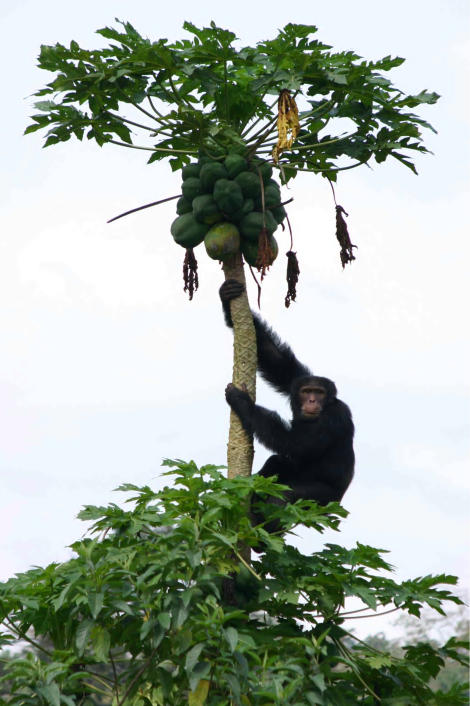
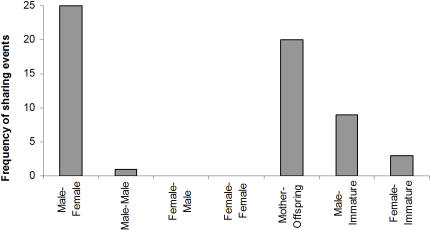
The sharing of wild plant foods is infrequent in chimpanzees, but in chimpanzee communities that engage in hunting, meat is frequently used as a 'social tool' for nurturing alliances and social bonds. Here we report the only recorded example of regular sharing of plant foods by unrelated, non-provisioned wild chimpanzees, and the contexts in which these sharing behaviours occur. From direct observations, adult chimpanzees at Bossou (Republic of Guinea, West Africa) very rarely transferred wild plant foods. In contrast, they shared cultivated plant foods much more frequently (58 out of 59 food sharing events). Sharing primarily consists of adult males allowing reproductively cycling females to take food that they possess. We propose that hypotheses focussing on 'food-for-sex and -grooming' and 'showing-off' strategies plausibly account for observed sharing behaviours. A changing human-dominated landscape presents chimpanzees with fresh challenges, and our observations suggest that crop-raiding provides adult male chimpanzees at Bossou with highly desirable food commodities that may be traded for other currencies.
Overview
The claims and statistics of this paper haven’t been checked yet.
Run the check — free, no account needed. It reads the open-access text and checks the sources it cites.
Integrity signals
Registry
Cites
Statistics
Figures
Verification
Claims the paper makes
The claims and statistics of this paper haven’t been checked yet.
Run the check — free, no account needed. It reads the open-access text and checks the sources it cites.
Claims other papers make about this one
Each is checked against this paper’s own text: does it say what the citing paper says it does?
In the citing paper
“Food sharing in chimpanzees, however, is not restricted to meat but has also been reported with non-meat foods, for example honey [52], or large fruits such as Carica papaya [57] or Treculia africana [52].”
From Food sharing is linked to urinary oxytocin levels and bonding in related and unrelated wild chimpanzees (2014) · cites this paper as [57]
Self-check
Percentages, sums and reported differences re-computed from the paper’s own numbers.
The self-check needs the paper’s full text.
Citations
Cites
(1982) · Medical Entomology and Zoology · Cited by 1,329
The Chimpanzees of the Taï Forest: Behavioural Ecology and Evolution
Boesch, C., & Boesch-Achermann, H. (2000) · doi:10.1093/oso/9780198505082.001.0001 · Cited by 1,079
Hunting behavior of wild chimpanzees in the Taï National Park
Boesch, C., & Boesch, H. (1989) · American Journal of Physical Anthropology · doi:10.1002/ajpa.1330780410 · Cited by 976
Cooperative hunting in wild chimpanzees
Boesch, C. (1994) · Animal Behaviour · doi:10.1006/anbe.1994.1285 · Cited by 650 · cited 1×
“Additionally, as meat is typically energetically costly and risky to acquire for chimpanzees, sharing with others may advertise an individual’s strength and prowess [11]; simply possessing a desirable item may draw positive attention to an individual, enhancing the latter’s social status [12,13].”
BackgroundFood sharing and reciprocal obligations among chimpanzees
de Waal, F. Β. Μ. (1989) · Journal of Human Evolution · doi:10.1016/0047-2484(89)90074-2 · Cited by 463
Why do chimpanzees hunt and share meat?
Mitani, J. C., & Watts, D. P. (2001) · Animal Behaviour · doi:10.1006/anbe.2000.1681 · Cited by 451 · cited 1×
“Within chimpanzee communities that engage in hunting, meat is reportedly used as a ‘social tool’ [5]; alliances and affiliative relationships are cemented by gifts of meat.”
BackgroundTutin, C. E. G. (1979) · Behavioral Ecology and Sociobiology · doi:10.1007/bf00293242 · Cited by 449 · cited 1×
“or to establish or strengthen an affiliative relationship and thus increase future mating opportunities”
BackgroundThe Predatory Behavior of Wild Chimpanzees
Teleki, G. (1973) · Medical Entomology and Zoology · Cited by 395
Chimpanzee politics: power and sex among apes
(1998) · Choice Reviews Online · doi:10.5860/choice.36-1584 · Cited by 363
Meat sharing among the Gombe chimpanzees: harassment and reciprocal exchange
Gilby, I. C. (2006) · Animal Behaviour · doi:10.1016/j.anbehav.2005.09.009 · Cited by 287 · cited 1×
“range from cognitively simple explanations, such as begging intensity”
Background
Research works printed but not linked: 2
- ATC Feistner, 1989, Food-sharing in primates: a critical review., 21
- E Bethell, 2000, Active plant food division and sharing by wild chimpanzees., Primate Report, 56, 67
Cited by
Sorted by citations
Items 101–137 of 137
First report of food sharing among nicobar long-tailed macaques
Mazumder, J., & Kaburu, S. (2020) · Quaternary International · doi:10.1016/j.quaint.2020.11.049 · Cited by 4
“To date, there has been evidence to support both the reciprocal exchange hypothesis (capuchin monkey: de Waal, 1997; chimpanzee: Mitani and Watts, 2001; Hockings et al., 2007; Gomes and Boesch, 2011) and the harassment hypothesis (chimpanzee: Stevens and Stephens, 2002; chimpanzee: Gilby, 2006; reviewed in Stevens and…”
BackgroundInfluentialAquino, I. D., González‐Santoyo, I., Link, A., & Muñóz-Delgado, J. (2022) · Behaviour · doi:10.1163/1568539x-bja10180 · Cited by 3
Couturier, C., Lacroux, C., Okimat, J. P., Asalu, E., & Krief, S. (2022) · Journal of Mammalogy · doi:10.1093/jmammal/gyac094 · Cited by 3
Edwards, W. I., Popescu, V. D., Guma, N., Agaba, H., Balyesiima, G., Nakami, L., & Stevens, N. J. (2023) · Frontiers in Ecology and Evolution · doi:10.3389/fevo.2023.1267688 · Cited by 3
Kano, F., Yamanashi, Y., & Tomonaga, M. (2012) · PSYCHOLOGIA · doi:10.2117/psysoc.2012.9 · Cited by 3
“Similarly, under natural conditions, the purposeful use of food resources to obtain grooming, sex, and social support have often been reported in this species (Gomes & Boesch, 2009; Hockings et al., 2007; Mitani & Watts, 2001).”
BackgroundFoods of Association: Biocultural Perspectives on Food and Beverages that Mediate Sociability
Etkin, N. L. (2019) · University of Arizona Press eBooks · doi:10.2458/azu_uapress_9780816539321 · Cited by 2
Food altruism in human beings: facts and factors
Rebato, E. (2015) · doi:10.3920/978-90-8686-820-9_27 · Cited by 2
Tomasello, M., & Call, J. (2024) · Oxford University Press eBooks · doi:10.1093/oso/9780198910626.003.0004 · Cited by 1
Comparison of Social Behaviors
Nakamura, M. (2011) · Primatology monographs · doi:10.1007/978-4-431-53921-6_27 · Cited by 1
Emotion, Brain Lateralization, and Social Relations: A Neurosociological Theory of the Basic Emotion
TenHouten, W. D. (2025) · Handbooks of sociology and social research · doi:10.1007/978-3-031-95615-7_9 · Cited by 1
Evolution of Primate Social Cognition
Tomasello, M., & Call, J. (2024) · Oxford University Press eBooks · doi:10.1093/oso/9780198910626.003.0006 · Cited by 1
de Waal, F. Β. Μ. (2018) · Wiley eBooks · doi:10.1002/9781119362081.ch4 · Cited by 1
Puga‐Gonzalez, I. (2017) · Springer eBooks · doi:10.1007/978-3-319-47829-6_1565-1 · Cited by 1
Chimpanzee Personhood: Supporting Scientific Documentation
Balcombe, J. P. (2012) · WBI Studies Repository
Capuchin Monkeys (Cebus apella) Fail To Be Equitable In An Ultimatum Game
Smith, M. F. (2014) · Bucknell Digital Commons (Bucknell University)
Hockings, K. J., Yamakoshi, G., Kabasawa, A., & Matsuzawa, T. (2010)
Self-citationHockings, K. J., Anderson, J. R., & Matsuzawa, T. (2009)
Self-citationThe Biopolitics of the Great Apes
van der Dennen, J. M. G. (2013) · Research in biopolitics · doi:10.1108/s2042-9940(2013)0000011009
How did altruism and reciprocity evolve in humans?: Perspectives from experiments on chimpanzees
Yamamoto, S., & Tanaka, M. (2009)
Yamamoto, S. (2017) · Japanese Journal of Animal Psychology · doi:10.2502/janip.67.2.3
Matsumoto, T., & Sakuragi, H. (2018) · Pan Africa News · doi:10.5134/233029
“Most of the food items shared among non-kin adults include meat and cultivated food (Boesch & Boesch 1989; Hockings et al. 2007; Ohashi 2007).”
Background(2015) · Wiley eBooks · doi:10.1002/9781119118206.biblio
Cognitive Development in Chimpanzees
Matsuzawa, T. (2010) · Elsevier eBooks · doi:10.1016/b978-0-12-813251-7.00103-6
Self-citationPuga‐Gonzalez, I. (2022) · Springer eBooks · doi:10.1007/978-3-319-55065-7_1565
Social Behaviors of Nulliparous Adolescent Female Bonobos
Idani, G. (2023) · Springer eBooks · doi:10.1007/978-981-99-4788-1_16
Tomasello, M., & Call, J. (2024) · Oxford University Press eBooks · doi:10.1093/oso/9780198910626.003.0007
Tomasello, M., & Call, J. (2024) · Oxford University Press eBooks · doi:10.1093/oso/9780198910626.003.0002
Social Strategies and Communication
Tomasello, M., & Call, J. (2024) · Oxford University Press eBooks · doi:10.1093/oso/9780198910626.003.0003
Call, J., & Tomasello, M. (2024) · Oxford University Press eBooks · doi:10.1093/oso/9780198910626.002.0003
Call, J., & Tomasello, M. (2024) · Oxford University Press eBooks · doi:10.1093/oso/9780198910626.002.0004
Theory of Mind and Metacognition
Tomasello, M., & Call, J. (2024) · Oxford University Press eBooks · doi:10.1093/oso/9780198910626.003.0005
Introduction to Social Cognition
Call, J., & Tomasello, M. (2024) · Oxford University Press eBooks · doi:10.1093/oso/9780198910626.002.0006
The complexity of the food transition: a social simulation perspective
Jager, W. (2024) · Socio-Environmental Systems Modeling · doi:10.18174/sesmo.18592
Toxoplasma in a natural population of chimpanzeesPreprint
Chabry, M., Hobaiter, C., Zuberbühler, K., & Koella, J. C. (2025) · bioRxiv (Cold Spring Harbor Laboratory) · doi:10.1101/2025.02.18.638806
Comparative cognitive science: The 30 years of Ai project
Matsuzawa, T. (2009) · Japanese Journal of Animal Psychology · doi:10.2502/janip.59.1.12
Self-citationThe Investigation of Prosocial Behavior in a Tool Task by Capuchin Monkeys (Cebus Apella)
Parrish, A. E. (2022) · Digital Archive @ GSU · doi:10.57709/2109554
Metadata
- Authors
- Hockings, K. J., Humle, T., Anderson, J. R., Biro, D., Sousa, C., Ohashi, G., & Matsuzawa, T.
- Affiliations
- University of Stirling (GB)
- University of Wisconsin–Madison (US)
- University of Oxford (GB)
- Kyoto University (JP)
- Corresponding author
- Hockings, Kimberley J.
- Venue
- PLoS ONE
- Publisher
- Public Library of Science (PLoS)
- Published
- 2007-09-12
- Volume
- 2
- Issue
- 9
- Pages
- e886
- ISSN
- 1932-6203 (ISSN-L)
- PMC
- PMC1964537
- OpenAlex
- W2139162770
- Cited by
- 138
- References
- 28
- Citations by year
- 2025: 4 · 2024: 14 · 2023: 5 · 2022: 8 · 2021: 4 · 2020: 3 · 2019: 3 · 2018: 5 · 2017: 9 · 2016: 5 · 2015: 8 · 2014: 9 · 2013: 8 · 2012: 11
- FWCI
- 13.78
- Type
- journal article
- Language
- en
- Open access
- gold
- doi.org
- Locations
- PLoS ONE (publishedVersion, cc-by)
- PubMed Central (publishedVersion, cc-by)
- PubMed (publishedVersion)
- Portuguese National Funding Agency for Science, Research and Technology (RCAAP Project by FCT) (submittedVersion, cc-by)
- Portuguese National Funding Agency for Science, Research and Technology (RCAAP Project by FCT) (submittedVersion, other-oa)
- DOAJ (DOAJ: Directory of Open Access Journals) (submittedVersion, cc-by-sa)
- Figshare (submittedVersion, cc-by)
- Kent Academic Repository (University of Kent) (submittedVersion)
- Funders
- Ministry of Education, Culture, Sports, Science and Technology (#16002001)
- University of Stirling
- Japan Society for the Promotion of Science (16002001)
- Topics
- Life Sciences › Agricultural and Biological Sciences › Ecology, Evolution, Behavior and Systematics › Primate Behavior and Ecology
- Life Sciences › Agricultural and Biological Sciences › Ecology, Evolution, Behavior and Systematics › Animal Behavior and Reproduction
- Physical Sciences › Environmental Science › Ecology › Wildlife Ecology and Conservation
- Keywords
- chimpanzees, food sharing, wild plant foods, crop raiding, social bonds, showing off, male-female interaction, Bossou, anthropogenic landscapes, primate social behavior
- MeSH terms
- Animals, Behavior, Animal, Pan troglodytes, Female, Male, Social Behavior
About these checks
Registry, retraction, Cites and statistics results are computed, not judged, with one exception: a printed reference that no index lists is read once by a model before it counts as a citation error. Claims are extracted by a model and kept only when their quote appears verbatim in the text; each cited source is then checked, with a model’s help, for whether it says what the claim relies on. Those verdicts can be wrong — read the claim’s quote and the cited source before relying on one.
Statistics and arithmetic are recomputed, not judged.
Confidence bands are shown only for fields calibrated on our annotated test set. None is calibrated yet, so no band is shown.
What counts as a claim ›How we measure confidence ›How we check this ›
Are you an author, or do you see a problem with this page? Request a review
