

Haptic Guidance Improves the Visuo-Manual Tracking of Trajectories
Open accessThe DOI matches its Crossref record; 18 of the 19 references it cites were found in a registry or an index.
Abstract
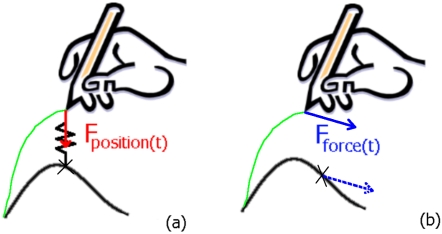
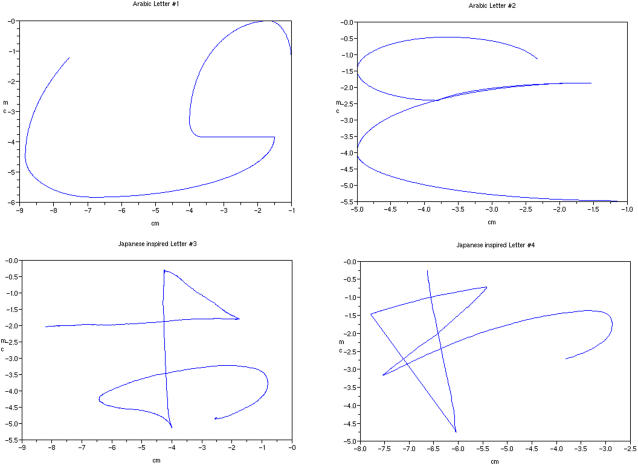
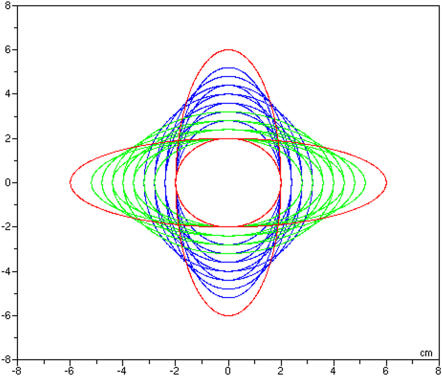
BACKGROUND: Learning to perform new movements is usually achieved by following visual demonstrations. Haptic guidance by a force feedback device is a recent and original technology which provides additional proprioceptive cues during visuo-motor learning tasks. The effects of two types of haptic guidances-control in position (HGP) or in force (HGF)-on visuo-manual tracking ("following") of trajectories are still under debate. METHODOLOGY/PRINCIPALS FINDINGS: Three training techniques of haptic guidance (HGP, HGF or control condition, NHG, without haptic guidance) were evaluated in two experiments. Movements produced by adults were assessed in terms of shapes (dynamic time warping) and kinematics criteria (number of velocity peaks and mean velocity) before and after the training sessions. Trajectories consisted of two Arabic and two Japanese-inspired letters in Experiment 1 and ellipses in Experiment 2. We observed that the use of HGF globally improves the fluency of the visuo-manual tracking of trajectories while no significant improvement was found for HGP or NHG. CONCLUSION/SIGNIFICANCE: These results show that the addition of haptic information, probably encoded in force coordinates, play a crucial role on the visuo-manual tracking of new trajectories.
Overview
The claims and statistics of this paper haven’t been checked yet.
Free: it reads the open-access text and checks the first 5 claims that cite a source we can check. Create a free account to check every claim.
Integrity signals
Registry
Cites
Statistics
Figures
Verification
Claims the paper makes
The claims and statistics of this paper haven’t been checked yet.
Free: it reads the open-access text and checks the first 5 claims that cite a source we can check. Create a free account to check every claim.
Claims other papers make about this one
Each is checked against this paper’s own text: does it say what the citing paper says it does?
The cited source says what the claim attributes to it.
In the citing paper
“However, force control facilitated learning of kinematic aspects in terms of movement fluidity-that is, number of velocity peaks and mean velocity.”
From Augmented visual, auditory, haptic, and multimodal feedback in motor learning: A review (2013) · cites this paper as Bluteau et al., 2008
Experimental — accuracy not yet measuredThe cited source says what the claim attributes to it.
In the citing paper
“Neither of the controllers facilitated learning of shape aspects of the writing task.”
From Augmented visual, auditory, haptic, and multimodal feedback in motor learning: A review (2013) · cites this paper as Bluteau et al., 2008
The cited source says what the claim attributes to it.
In the citing paper
“In a study on drawing different shapes, Bluteau et al. (2008) showed that the addition of haptic to visual concurrent feedback did not further enhance learning of shape drawing.”
From Augmented visual, auditory, haptic, and multimodal feedback in motor learning: A review (2013) · cites this paper as Bluteau et al., 2008
The cited source says what the claim attributes to it.
In the citing paper
“Instead, movement fluidity was improved by additional haptic guidance, but only if it was force controlled and not position controlled (Bluteau et al., 2008).”
From Augmented visual, auditory, haptic, and multimodal feedback in motor learning: A review (2013) · cites this paper as Bluteau et al., 2008
Self-check
Percentages, sums and reported differences re-computed from the paper’s own numbers.
The self-check needs the paper’s full text.
Citations
Cites
Motor Control and Learning: A Behavioral Emphasis
Schmidt, R. A. (1982) · Cited by 4,770
Internal models for motor control and trajectory planning.
Kawato, M. (1999) · Current Opinion in Neurobiology · doi:10.1016/s0959-4388(99)00028-8 · Cited by 2,685 · cited 1×
“We could also discuss these results with respect to different internal representation stages of motor knowledge, which evolve from children to adults (creation of internal representation-internal inverse models [18] or generalized motor plan- or adjustment of this knowledge).”
ResultIndependent learning of internal models for kinematic and dynamic control of reaching
Krakauer, J. W., Ghilardi, M.-F., & Ghez, C. (1999) · Nature Neuroscience · doi:10.1038/14826 · Cited by 784 · cited 1×
“observed that HGP increased mean velocity with children. This suggests that HGP may be less suitable for adults since adults would have better knowledge of the shape they had to draw and better kinesthetic control of their upper limbs. The global superiority of HGF over HGP suggested that learned information for this…”
MethodThe law relating the kinematic and figural aspects of drawing movements
Lacquaniti, F., Terzuolo, C., & Viviani, P. (1983) · Acta Psychologica · doi:10.1016/0001-6918(83)90027-6 · Cited by 674 · cited 3×
“principles [9,10,11]: The homothety principle which states that the trajectory keeps its shape characteristics whatever its size, and the isochrony principle which states that the velocity for tracing increases as function of its size.”
BackgroundTrajectory determines movement dynamics
Viviani, P., & Terzuolo, C. (1982) · Neuroscience · doi:10.1016/0306-4522(82)90277-9 · Cited by 551
Is movement variability important for sports biomechanists?
Bartlett, R., Wheat, J., & Robins, M. (2007) · Sports Biomechanics · doi:10.1080/14763140701322994 · Cited by 538 · cited 1×
“This proposes that a motor learning task (as drawing) would be improved by variability of required movements as evidenced in sports [19].”
BackgroundHaptic guidance: experimental evaluation of a haptic training method for a perceptual motor skill
Feygin, D., Keehner, M., & Tendick, R. (2003) · Proceedings 10th Symposium on Haptic Interfaces for Virtual Environment and Teleoperator Systems. HAPTICS 2002 · doi:10.1109/haptic.2002.998939 · Cited by 394 · cited 2×
“Virtual simulators, in which haptic and visual cues are provided, seem to be an efficient way to teach complex movements [2-5].”
BackgroundA developmental study of the relationship between geometry and kinematics in drawing movements.
Viviani, P., & Schneider, R. (1991) · Journal of Experimental Psychology: Human Perception and Performance · doi:10.1037//0096-1523.17.1.198 · Cited by 246 · cited 3×
“principles [9,10,11]: The homothety principle which states that the trajectory keeps its shape characteristics whatever its size, and the isochrony principle which states that the velocity for tracing increases as function of its size.”
BackgroundHaptic Feedback Enhances Force Skill Learning
Morris, D., Tan, H., Barbagli, F., Chang, T., & Salisbury, K. (2007) · Second Joint EuroHaptics Conference and Symposium on Haptic Interfaces for Virtual Environment and Teleoperator Systems (WHC'07) · doi:10.1109/whc.2007.65 · Cited by 208 · cited 3×
“These results were consistent with our hypotheses and within previous literature [12,13].”
BackgroundResultA robotic teacher of Chinese handwriting
Teo, C. L., Burdet, E., & Lim, H. P. (2003) · Proceedings 10th Symposium on Haptic Interfaces for Virtual Environment and Teleoperator Systems. HAPTICS 2002 · doi:10.1109/haptic.2002.998977 · Cited by 142 · cited 1×
“Finally, other studies in adults [2,4] confirmed the positive effect of visuo-haptic training sessions using proportional derivative position controller but most of them mainly describe the technical aspects.”
Background
Research works printed but not linked: 1
- Niels R 2004 Dynamic Time Warping: An intuitive way of handwriting recognition? Radboud University Nijmegen, Faculty of Social Sciences, Department of Artificial Intelligence/Cognitive Science Master's thesis
Cited by
Items 101–151 of 151
CalliSmart: an Adaptive Informed Environment for Intelligent Calligraphy Training
Frenoy, R., Thouvenin, I., Soullard, Y., & Gapenne, O. (2016) · HAL · Cited by 4
Control of Dual-User Teleoperation Systems Design, Stability Analysis, and Performance Evaluation
Khademian, B. (2010) · QSpace (Queen's University Library) · Cited by 4
de Boisferon, A. H., Bluteau, J., & Gentaz, É. (2010) · Sciyo eBooks · doi:10.5772/9781 · Cited by 4
“These results indicate that multisensory training promotes more effective learning of the information than unisensory training (Ernst & Bülthoff, 2004; Bluteau et al., 2008; Fredembach et al., 2009).”
BackgroundMethodInfluentialSelf-citationContinuous Skin-Stretch Feedback for Rendering 3D Vector Information
Han, I., & Park, J. (2020) · IEEE Access · doi:10.1109/access.2020.3015095 · Cited by 3
Assistive Sensory Feedback for Trajectory Tracking in Augmented Reality
Wang, I.-J., Yeh, L., Chu, C., & Huang, Y. (2023) · Journal of Computing and Information Science in Engineering · doi:10.1115/1.4062543 · Cited by 3
Improvement of collaborative selection in 3D complex environments
Girard, A., Ammi, M., Simard, J., & Auvray, M. (2012) · IEEE Haptics Symposium · doi:10.1109/haptic.2012.6183803 · Cited by 3
“To go beyond these constraints, we propose using a haptic guidance in position (HGP) [15] to physically indicate to the partner, through a suitable motion, the 3D position of the target.”
MethodHaptic Devices as Objective Measures for Motor Skill
Narber, C., Đurić, Z., & Gerber, L. H. (2012) · Conference on Human System Interactions · doi:10.1109/hsi.2012.19 · Cited by 3
“These tasks have been very simple; for example, training in a single plane (letter writing [3], [8], [1]) or training a simple path that has no functional purpose (reaching for virtual points in space [2], [4]).”
BackgroundInfluentialEvaluation of a mixed controller that amplifies spatial errors while reducing timing errors
Marchal–Crespo, L., Baumann, T., Fichmann, D., Maassen, S., Duarte, J. E., & Riener, R. (2016) · Annual International Conference of the IEEE Engineering in Medicine and Biology Society (EMBC) · doi:10.1109/embc.2016.7591883 · Cited by 4
“Training with haptic guidance increased speed and smoothness [10] and enhanced learning of a discrete time-critical task [11].”
BackgroundThe Learning Benefits of Haptic Guidance Are Age-Dependent
Marchal–Crespo, L., van Raai, M. A., Rauter, G., Wolf, P., & Riener, R. (2014) · Biosystems & biorobotics · doi:10.1007/978-3-319-08072-7_15 · Cited by 3
Cognitive and Physiological Intent for the Adaptation of Motor Prostheses
Nataraj, R., Sanford, S., Liu, M., Walsh, K., Wilder, S., Santo, A., & Hollinger, D. S. (2020) · Springer eBooks · doi:10.1007/978-3-030-38740-2_8 · Cited by 4
Image-based robotic steering of advanced flexible endoscopes and instruments
Reilink, R. (2013) · doi:10.3990/1.9789036535267 · Cited by 3
“Haptic cues can be used to improve the physician’s performance [9,10].”
BackgroundA language of tactile motion instructions for physical activities
Spelmezan, D., & Borchers, J. (2011) · RWTH Publications (RWTH Aachen) · Cited by 5
Haptic guidance: Advancements, challenges, and future directions in human-computer interaction
Sirwal, S. A., Ahmad, B., & Koul, M. H. (2026) · Proceedings of the Institution of Mechanical Engineers Part C Journal of Mechanical Engineering Science · doi:10.1177/09544062261416177 · Cited by 7
“279,280 In these contexts, guidance supports users who lack internal models of the task dynamics and must rely on external cues to form accurate motor plans.”
Haptic feedback in violin education as a case study of robotic exoskeleton-mediated motor learning
Campo, A., Peperoni, E., Capitani, S. L., Conti, R., Crea, S., Stefano, N. D., Tommaso, F. D., Giovacchini, F., Gener, C., Grazi, L., et al. (2026) · Scientific Reports · doi:10.1038/s41598-026-39226-8 · Cited by 3
“In general, however, haptic methods tend to outperform non-guided training 12 and are often at least as effective as audiovisual or auditory feedback in teaching the spatial 13 , temporal 14–16 , and spatiotemporal 16 aspects of motor tasks.”
Teaching Motor Skills Without a Motor: A Semi-Passive Robot to Facilitate Learning
Augenstein, T. E., Remy, C. D., Claflin, E. S., Ranganathan, R., & Krishnan, C. (2023) · IEEE Transactions on Haptics · doi:10.1109/toh.2023.3330368 · Cited by 2
“These previous studies have found that haptic guidance only facilitates learning of timing-based tasks (e.g., when to initiate a movement) and does not improve learning of spatial variables such as accuracy [32], [35], [35], [36], [37], [38], [39], [40], [41], [42].”
BackgroundDeveloping Architecture of Haptik Visual Jawi (HV-Jawi)
Amin, M. M., Zaman, H. B., & Ahmad, A. (2013) · Lecture notes in computer science · doi:10.1007/978-3-319-02958-0_66 · Cited by 4
Quantifying task similarity for skill generalisation in the context of human motor control
Sebastian, G., Fong, J., Crocher, V., Tan, Y., Oetomo, D., & Mareels, I. (2016) · International Conference on Control, Automation, Robotics and Vision (ICARCV) · doi:10.1109/icarcv.2016.7838705 · Cited by 5
Learning force patterns with a multimodal system using contextual cues
Rodríguez-Arce, J., Gutiérrez, T., Portillo-Rodríguez, O., & Sánchez, E. (2017) · International Journal of Human-Computer Studies · doi:10.1016/j.ijhcs.2017.10.007 · Cited by 7
Effect of local-adaptive haptic guidance on a path-following task
Moon, H.-S., & Seo, J. (2017) · International Conference on Control, Automation and Systems (ICCAS) · doi:10.23919/iccas.2017.8204403 · Cited by 2
How can we improve the Training of Laparoscopic Surgery thanks to the Knowledge in Robotics?
Candalh-Touta, N., & Szewczyk, J. (2017) · HAL · Cited by 2
Haptic guidance lowers cognitive demand during the learning of unfamiliar handwriting tasks
Park, W., Κορρές, Γ., Al-Omari, M., & Eid, M. A. (2025) · Computers in Human Behavior Reports · doi:10.1016/j.chbr.2025.100771 · Cited by 1
Developing visual haptic application for learning Jawi handwriting skills
Amin, M. M., Zaman, H. B., & Ahmad, A. (2013) · International Conference on Innovations in Information Technology · doi:10.1109/innovations.2013.6544410 · Cited by 1
“Several visual haptic applications have been developed for training or teaching and learning handwriting of various language characters such as for cursive Latin, Japanese, Chinese, Arabic, Tamil and Persian, but not yet of Jawi script.”
BackgroundMethodInfluentialOn sensorimotor function and the relationship between proprioception and motor learning
Wong, J. D. (2012) · Scholarship@Western (Western University) · Cited by 1
Somatosensory anticipation of curvature in a haptic virtual environment
Tramper, J. J., Stephens, S., & Flanders, M. (2012) · IEEE Haptics Symposium · doi:10.1109/haptic.2012.6183788 · Cited by 1
“Research pertaining to surgical applications is generally focused on the haptic cues that can assist visual control [1, 2] rather than on purely somatosensory guidance mechanisms.”
Methodology for Translating Upper Extremity Motion to Haptic Interfaces
Vishnoi, N., Narber, C., Đurić, Z., & Gerber, N. L. (2012) · Conference on Human System Interactions · doi:10.1109/hsi.2012.35 · Cited by 1
“Recently, work has been reported ([7], [8]) which justifies that haptic training improves learning of motor-skills.”
BackgroundKim, Y., & Harders, M. (2015) · Atlantis Press eBooks · doi:10.2991/978-94-6239-133-8_60 · Cited by 1
George, L., Marchal, M., Glondu, L., & Lécuyer, A. (2014) · Biosystems & biorobotics · doi:10.1007/978-3-642-54707-2_3 · Cited by 1
Supporting Unskilled People in Manual Tasks through Haptic-Based Guidance
Covarrubias, M., Bordegoni, M., Cugini, U., & Gatti, E. (2013) · IGI Global eBooks · doi:10.4018/978-1-4666-2491-7.ch018 · Cited by 2
Mutis, I., Оберемок, М., & Purushotham, N. (2023) · Proceedings e report · doi:10.36253/979-12-215-0289-3.14 · Cited by 1
Jolly, C., Huron, C., & Gentaz, É. (2014) · L’Année psychologique · doi:10.3917/e.anpsy.143.0421 · Cited by 5
Toussaint, B.-M., Luengo, V., Vadcard, L., & Tonetti, J. (2014) · OpenEdition (OpenEdition) · Cited by 1
Capacitive Touch Sensitive Vibro-Haptic Typing Training System for the Visually Impaired
Kalra, S., Jain, S., & Agarwal, A. (2019) · Journal of Information Technology Research · doi:10.4018/jitr.2020010101 · Cited by 1
Haptic Applications for People with Limited Motor Skills
Voutsakelis, G., Kokkonis, G., & Kontogiannis, S. I. (2020) · World Symposium on Communication Engineering (WSCE) · doi:10.1109/wsce51339.2020.9275575 · Cited by 1
“Kindergarten children with writing problems, dysgraphia, [39] as well as adult participants [40] have also been helped to practice writing following the outlines of the letters using a haptic interface.”
BackgroundGesture Controlled Tactile Augmented Reality Interface for the Visually Impaired
Kalra, S., Jain, S., & Agarwal, A. (2021) · Journal of Information Technology Research · doi:10.4018/jitr.2021040107 · Cited by 4
Intégration de données haptiques brutes dans des systèmes experts de diagnostic des connaissances
Lallé, S., & Luengo, V. (2011) · HAL · Cited by 1
Marchal–Crespo, L. (2009) · Bern Open Repository and Information System (University of Bern) · doi:10.7892/boris.117120 · Cited by 2
LEARNING THROUGH HAPTICS: HAPTIC FEEDBACK IN SURGICAL EDUCATION
Pinzon, D. (2016) · ERA: Education and Research Archive (University of Alberta) · doi:10.7939/r3jh3dd0g · Cited by 1
Haptic training for a visuomotor fetch & pursue task
Morasso, P., Casadio, M., & Squeri, V. (2013) · Annual International Conference of the IEEE Engineering in Medicine and Biology Society (EMBC) · doi:10.1109/embc.2013.6610455
Short paper : Role of force-cues in path following of 3D trajectories in Virtual Reality.
Bluteau, J., Gentaz, É., Yohan Payan, A., & Coquillart, S. (2009)
Self-citationSupporting Unskilled People in Manual Tasks through Haptic-Based Guidance
Covarrubias, M., Bordegoni, M., Cugini, U., & Gatti, E. (2013) · IGI Global eBooks · doi:10.4018/978-1-4666-4422-9.ch048
Feng, F., & Stockman, T. (2020) · arXiv (Cornell University) · doi:10.48550/arxiv.2002.06655
Electro-tactile Stimulation for Augmenting Finger Motoric Learning
Pamungkas, D. S., & Turnip, A. (2020) · Advances in Science Technology and Engineering Systems Journal · doi:10.25046/aj050616 · Cited by 2
“Some researchers utilize these stimuli to enhance the method to train the motoric skills, for example, playing the piano [1,2], writing Japanese characters [3], writing Arabic and Japanese characters [4], and typing the Braille alphabet [5].”
BackgroundMethodIntrinsic and extrinsic noise in motor skill acquisition
Zhang, Z. (2018) · Digital Repository Service (Northeastern University) · doi:10.17760/d20316412
Humans Versus Robots: Converting Golf Putter Trajectories for Robotic Guidance
Bested, S. R., Crainic, V. A., Manson, G. A., & Tremblay, L. (2023) · Journal of Motor Learning and Development · doi:10.1123/jmld.2022-0031
“To implement robotic guidance trials successfully, Manson and colleagues (2014) used a similar protocol as employed by Bluteau, et al. (2008).”
Sheikder, C., Zhang, W., Chen, X., Li, F., Liu, Y., He, X., Zuo, Z., & Tan, X. (2025) · SSRN Electronic Journal · doi:10.2139/ssrn.5408345
Accelerating Teleoperation Skill Acquisition through Visuo-Haptic Replay
Ribeiro, F., Park, J., Asada, M., & Öztop, E. (2026) · IEEE/SICE International Symposium on System Integration (SII) · doi:10.1109/sii64115.2026.11404713
“The existing works on the effect of passive visuo-haptic feedback prior to visuomotor learning are limited, and focus on simple tasks such as rotation adaptation [7] or do not strictly use passive visuo-haptic playback, but rather have human participants learn with haptic guidance [3].”
Assistance à l'Apprentissage de la Dextérité en Laparoscopie
Candalh-Touta, N. (2018) · theses.fr (ABES) · doi:10.70675/8005f6a6zb0a8z4bb4zb904zb7f1784ae575 · Cited by 2
Véron‐Delor, L. (2021) · theses.fr (ABES) · doi:10.70675/598a3c6azf105z4d06z8a87z9c98de7ae8a0 · Cited by 3
Parcours attentionnel chez le scripteur expert
Doan, P. (2021) · theses.fr (ABES) · doi:10.70675/f0235041z4f7fz4d0az860ez83d3a2c38682 · Cited by 1
Connan, J.-F. (2023) · theses.fr (ABES) · doi:10.70675/20cceec4ze100z4bffzb3d5z9d7bbf4eb2f9
Apprentissage, évaluation et rééducation de l’écriture
Véron-Delor, L., Pinto, S., Eusebio, A., et al. (2025) · De Boeck Supérieur eBooks · doi:10.3917/dbu.conna.2025.01.0233
Metadata
- Authors
- Bluteau, J., Coquillart, S., Payan, Y., & Gentaz, E.
- Affiliations
- Université Pierre Mendès France (FR)
- Institut national de recherche en sciences et technologies du numérique (FR)
- Venue
- PLoS ONE
- Publisher
- Public Library of Science (PLoS)
- Published
- 2008-03-12
- Volume
- 3
- Issue
- 3
- Pages
- e1775
- ISSN
- 1932-6203 (ISSN-L)
- PMC
- PMC2258003
- OpenAlex
- W2142784426
- Cited by
- 153
- References
- 19
- Citations by year
- 2026: 3 · 2025: 3 · 2024: 3 · 2023: 5 · 2022: 2 · 2021: 10 · 2020: 8 · 2019: 7 · 2018: 7 · 2017: 5 · 2016: 9 · 2015: 9 · 2014: 15 · 2013: 21 · 2012: 15
- FWCI
- 5.34
- Type
- journal article
- Language
- en
- Open access
- gold
- doi.org
- Locations
- PLoS ONE (publishedVersion, cc-by)
- PubMed Central (publishedVersion, cc-by)
- PubMed (publishedVersion)
- arXiv (Cornell University) (submittedVersion)
- HAL (submittedVersion, other-oa)
- RePEc: Research Papers in Economics (submittedVersion)
- DOAJ (DOAJ: Directory of Open Access Journals) (submittedVersion, cc-by-sa)
- arXiv (Cornell University)
- Topics
- Life Sciences › Neuroscience › Cognitive Neuroscience › Motor Control and Adaptation
- Life Sciences › Neuroscience › Cognitive Neuroscience › Tactile and Sensory Interactions
- Physical Sciences › Engineering › Mechanical Engineering › Teleoperation and Haptic Systems
- Keywords
- haptic guidance, trajectory tracking, force feedback, proprioception, position control, movement fluency, movement kinematics, dynamic time warping
- MeSH terms
- Adolescent, Adult, Humans, Movement, Vision, Ocular
About these checks
Registry, retraction, Cites and statistics results are computed, not judged, with one exception: a printed reference that no index lists is read once by a model before it counts as a citation error. Claims are extracted by a model and kept only when their quote appears verbatim in the text; each cited source is then checked, with a model’s help, for whether it says what the claim relies on. Those verdicts can be wrong — read the claim’s quote and the cited source before relying on one.
Statistics and arithmetic are recomputed, not judged.
Confidence bands are shown only for fields calibrated on our annotated test set. None is calibrated yet, so no band is shown.
What counts as a claim ›How we measure confidence ›How we check this ›
Are you an author, or do you see a problem with this page? Request a review
Data sources
Bibliographic data: Semantic Scholar, OpenAlex, Crossref.
Contains information from the Semantic Scholar Academic Graph Datasets, made available under the ODC Attribution License (ODC-BY 1.0).
Semantic Scholar’s data is described in: Kinney, R., et al. (2023). The Semantic Scholar Open Data Platform. arXiv:2301.10140.
