

The DOI matches its Crossref record; 23 of the 23 references it cites were found in a registry or an index.
Identification of a Novel Risk Locus for Multiple Sclerosis at 13q31.3 by a Pooled Genome-Wide Scan of 500,000 Single Nucleotide Polymorphisms
Open accessAbstract
Multiple sclerosis is a chronic inflammatory demyelinating disease of the central nervous system with an important genetic component and strongest association driven by the HLA genes. We performed a pooling-based genome-wide association study of 500,000 SNPs in order to find new loci associated with the disease. After applying several criteria, 320 SNPs were selected from the microarrays and individually genotyped in a first and independent Spanish Caucasian replication cohort. The 8 most significant SNPs validated in this cohort were also genotyped in a second US Caucasian replication cohort for confirmation. The most significant association was obtained for SNP rs3129934, which neighbors the HLA-DRB/DQA loci and validates our pooling-based strategy. The second strongest association signal was found for SNP rs1327328, which resides in an unannotated region of chromosome 13 but is in linkage disequilibrium with nearby functional elements that may play important roles in disease susceptibility. This region of chromosome 13 has not been previously identified in MS linkage genome screens and represents a novel risk locus for the disease.
Overview
The claims and statistics of this paper haven’t been checked yet.
Run the check — free, no account needed. It reads the open-access text and checks the sources it cites.
Integrity signals
Registry
Cites
Statistics
Figures
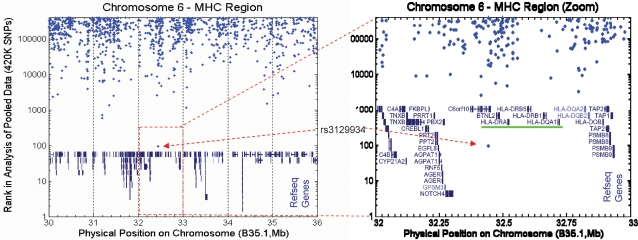
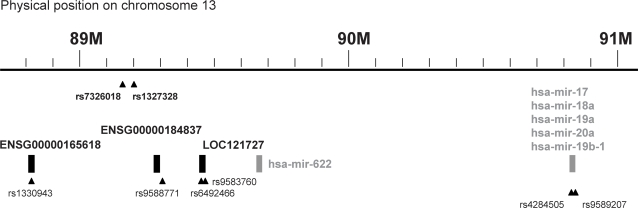
Verification
Claims the paper makes
The claims and statistics of this paper haven’t been checked yet.
Run the check — free, no account needed. It reads the open-access text and checks the sources it cites.
Claims other papers make about this one
Each is checked against this paper’s own text: does it say what the citing paper says it does?
The source backs part of the claim, not all of it — or backs it for a different population, condition or comparison.
In the citing paper
“by 2011, common variants in 26 genomic loci had been associated with MS risk and independently replicated”
From Genome‐wide association studies of multiple sclerosis (2018) · cites this paper as [34]
Experimental — accuracy not yet measured
Self-check
Percentages, sums and reported differences re-computed from the paper’s own numbers.
The self-check needs the paper’s full text.
Citations
Cites
New diagnostic criteria for multiple sclerosis: Guidelines for research protocols
Poser, C. M., Paty, D. W., Scheinberg, L., McDonald, W. I., Davis, F. A., Ebers, G. C., Johnson, K. P., Sibley, W. A., Silberberg, D. H., & Tourtellotte, W. W. (1983) · Annals of Neurology · doi:10.1002/ana.410130302 · Cited by 7,384
c-Myc-regulated microRNAs modulate E2F1 expression
O'Donnell, K. A., Wentzel, E. A., Zeller, K. I., Dang, C. V., & Mendell, J. T. (2005) · Nature · doi:10.1038/nature03677 · Cited by 2,347
Immunology of multiple sclerosis
Sospedra, M., & Martin, R. (2005) · Annual Review of Immunology · doi:10.1146/annurev.immunol.23.021704.115707 · Cited by 2,149
Self-citationRisk Alleles for Multiple Sclerosis Identified by a Genomewide Study
(2007) · New England Journal of Medicine · doi:10.1056/nejmoa073493 · Cited by 1,746
de Bakker, P. I. W., McVean, G., Sabeti, P. C., Miretti, M. M., Green, T., Marchini, J., Ke, X., Monsuur, A. J., Whittaker, P., Delgado, M., et al. (2006) · Nature Genetics · doi:10.1038/ng1885 · Cited by 766
for the Multiple Sclerosis Genetics Group, Gregory, S. G., Schmidt, S., Seth, P., Oksenberg, J. R., Hart, J., Prokop, A., Caillier, S. J., Ban, M., Goris, A., et al. (2007) · Nature Genetics · doi:10.1038/ng2103 · Cited by 657
The E2F1–3 transcription factors are essential for cellular proliferation
Wu, L., Timmers, C. D., Maiti, B., Saavedra, H. I., Sang, L., Chong, G. T., Nuckolls, F., Giangrande, P. H., Wright, F. A., Field, S. J., et al. (2001) · Nature · doi:10.1038/35106593 · Cited by 620
HLA class II‐associated genetic susceptibility in multiple sclerosis: A critical evaluation
Olerup, O., & Hillert, J. A. (1991) · Tissue Antigens · doi:10.1111/j.1399-0039.1991.tb02029.x · Cited by 483
Variation in interleukin 7 receptor α chain (IL7R) influences risk of multiple sclerosis
Lundmark, F., Duvefelt, K., Iacobaeus, E., Kockum, I., Wallström, E., Khademi, M., Oturai, A., Ryder, L. P., Saarela, J., Harbo, H. F., et al. (2007) · Nature Genetics · doi:10.1038/ng2106 · Cited by 483
Haines, J. L. (1998) · Human Molecular Genetics · doi:10.1093/hmg/7.8.1229 · Cited by 281
Murga, M., Fernández-Capetillo, Ó., Field, S. J., Moreno, B., Borlado, L. R., Fujiwara, Y., Balomenos, D., Vicario, A., Carrera, A. C., Orkin, S. H., et al. (2001) · Immunity · doi:10.1016/s1074-7613(01)00254-0 · Cited by 173
Genetic basis for clinical expression in multiple sclerosis
The Multiple Sclerosis Genetics Group, Barcellos, L. F., Oksenberg, J. R., Green, A. J., Bucher, P., Rimmler, J. B., Schmidt, S., Garcia, M., Lincoln, R., Pericak‐Vance, M. A., et al. (2002) · Brain · doi:10.1093/brain/awf009 · Cited by 154
Pearson, J. V., Huentelman, M. J., Halperin, R. F., Tembe, W., Melquist, S., Homer, N., Brun, M., Szelinger, S., Coon, K. D., Zismann, V., et al. (2006) · The American Journal of Human Genetics · doi:10.1086/510686 · Cited by 152
Self-citationPolymorphic miRNA-mediated gene regulation: contribution to phenotypic variation and disease
Georges, M., Coppieters, W. R., & Charlier, C. (2007) · Current Opinion in Genetics & Development · doi:10.1016/j.gde.2007.04.005 · Cited by 140
Multiple sclerosis genetics: leaving no stone unturned
Oksenberg, J. R., & Barcellos, L. F. (2005) · Genes and Immunity · doi:10.1038/sj.gene.6364237 · Cited by 124
Faust, P. L., Banka, D., Siriratsivawong, R., Ng, V. G., & Wikander, T. M. (2005) · Journal of Inherited Metabolic Disease · doi:10.1007/s10545-005-7059-y · Cited by 82
Villoslada, P., Barcellos, L. F., Río, J., Begovich, A. B., Tintoré, M., Sastre‐Garriga, J., Baranzini, S. E., Casquero, P., Hauser, S. L., Montalbán, X., et al. (2002) · Journal of Neuroimmunology · doi:10.1016/s0165-5728(02)00215-1 · Cited by 75
Morcillo-Suárez, C., Alegre, J., Sangrós, R., Gazave, É., de Cid, R., Milne, R. L., Amigo, J., Ferrer-Admetlla, A., Moreno‐Estrada, A., Gardner, M. J., et al. (2008) · Bioinformatics · doi:10.1093/bioinformatics/btn241 · Cited by 71
Self-citationIglesias, A. H. (2004) · Journal of Neuroimmunology · doi:10.1016/j.jneuroim.2004.01.017 · Cited by 67
Identification of novel mutations inPEX2,PEX6,PEX10,PEX12, andPEX13in Zellweger spectrum patients
Krause, C., Rosewich, H., Thanos, M., & Gärtner, J. (2006) · Human Mutation · doi:10.1002/humu.9462 · Cited by 57
The HLA locus and multiple sclerosis in Sicily
Brassat, D., Salemi, G., Barcellos, L. F., McNeill, G., Proia, P., Hauser, S. L., Oksenberg, J. R., & Savettieri, G. (2005) · Neurology · doi:10.1212/01.wnl.0000149765.71212.0a · Cited by 55
Rane, S., Sayed, D. H., & Abdellatif, M. (2007) · Cell Cycle · doi:10.4161/cc.6.15.4551 · Cited by 34
Novel mutations in the PEX12 gene of patients with a peroxisome biogenesis disorder
Gootjes, J., Schmohl, F., Waterham, H. R., & Wanders, R. J. A. (2003) · European Journal of Human Genetics · doi:10.1038/sj.ejhg.5201090 · Cited by 22
Cited by
Sorted by citations
Trait-associated SNPs are more likely to be eQTLs: annotation to enhance discovery from GWAS
Nicolae, D. L., Gamazon, E., Zhang, W., Duan, S., Dolan, M. E., & Cox, N. J. (2010) · PLoS Genetics · doi:10.1371/journal.pgen.1000888 · Cited by 1,292
Integration of Genetic and Immunological Insights into a Model of Celiac Disease Pathogenesis
Abadie, V., Sollid, L. M., Barreiro, L. B., & Jabrì, B. (2011) · Annual Review of Immunology · doi:10.1146/annurev-immunol-040210-092915 · Cited by 529
Nylander, A., & Hafler, D. A. (2012) · Journal of Clinical Investigation · doi:10.1172/jci58649 · Cited by 495
Sawcer, S. J., Franklin, R. J. M., & Ban, M. (2014) · The Lancet Neurology · doi:10.1016/s1474-4422(14)70041-9 · Cited by 432
Genome-Wide Association Analysis in Primary Sclerosing Cholangitis
Karlsen, T. H., Franke, A., Melum, E., Kaser, A., Hov, J. R., Balschun, T. C., Lie, B. A., Bergquist, A. M., Schramm, C., Weismüller, T. J., et al. (2009) · Gastroenterology · doi:10.1053/j.gastro.2009.11.046 · Cited by 365
Metadata
- Authors
- Comabella, M., Craig, D. W., Camiña-Tato, M., Morcillo, C., Lopez, C., Navarro, A., Rio, J., BiomarkerMS Study Group, Montalban, X., & Martin, R.
- Affiliations
- Vall d'Hebron Hospital Universitari (ES)
- Translational Genomics Research Institute (US)
- Universitat Pompeu Fabra (ES)
- Institució Catalana de Recerca i Estudis Avançats (ES)
- National Institutes of Health (US)
- Corresponding author
- Comabella, Manuel
- Venue
- PLoS ONE
- Publisher
- Public Library of Science (PLoS)
- Published
- 2008-10-22
- Volume
- 3
- Issue
- 10
- Pages
- e3490
- ISSN
- 1932-6203 (ISSN-L)
- PMC
- PMC2566815
- OpenAlex
- W2105655586
- Cited by
- 105
- References
- 23
- Citations by year
- 2025: 1 · 2024: 2 · 2023: 2 · 2022: 2 · 2021: 3 · 2020: 3 · 2019: 5 · 2018: 6 · 2017: 3 · 2016: 5 · 2015: 5 · 2014: 8 · 2013: 15 · 2012: 9
- FWCI
- 8.54
- Type
- journal article
- Language
- en
- Open access
- gold
- doi.org
- Locations
- PLoS ONE (publishedVersion, cc-by)
- PubMed Central (publishedVersion, cc-by)
- PubMed (publishedVersion)
- DOAJ (DOAJ: Directory of Open Access Journals) (submittedVersion, cc-by-sa)
- Figshare (submittedVersion, cc-by)
- Topics
- Health Sciences › Medicine › Clinical Neurology › Multiple Sclerosis Research Studies
- Life Sciences › Biochemistry, Genetics and Molecular Biology › Genetics › Genetic Associations and Epidemiology
- Life Sciences › Biochemistry, Genetics and Molecular Biology › Genetics › Genetic Mapping and Diversity in Plants and Animals
- Keywords
- multiple sclerosis, genetic susceptibility, single nucleotide polymorphisms, linkage disequilibrium, replication cohort
- MeSH terms
- Chromosomes, Human, Pair 13, Genotype, HLA-DQ Antigens, HLA-DR Antigens, Humans, Multiple Sclerosis, Cohort Studies, Linkage Disequilibrium, Genome, Human, Genetic Predisposition to Disease, Oligonucleotide Array Sequence Analysis, Polymorphism, Single Nucleotide, White People, Genome-Wide Association Study
About these checks
Registry, retraction, Cites and statistics results are computed, not judged, with one exception: a printed reference that no index lists is read once by a model before it counts as a citation error. Claims are extracted by a model and kept only when their quote appears verbatim in the text; each cited source is then checked, with a model’s help, for whether it says what the claim relies on. Those verdicts can be wrong — read the claim’s quote and the cited source before relying on one.
Statistics and arithmetic are recomputed, not judged.
Confidence bands are shown only for fields calibrated on our annotated test set. None is calibrated yet, so no band is shown.
What counts as a claim ›How we measure confidence ›How we check this ›
Are you an author, or do you see a problem with this page? Request a review
