

Placebo Response of Non-Pharmacological and Pharmacological Trials in Major Depression: A Systematic Review and Meta-Analysis
Open accessThe DOI matches its Crossref record; 72 of the 74 references it cites were found in a registry or an index.
Abstract
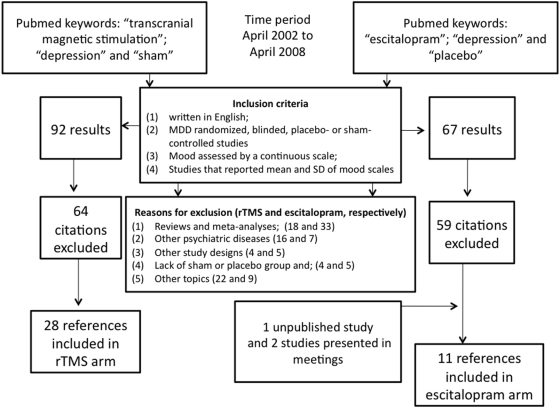
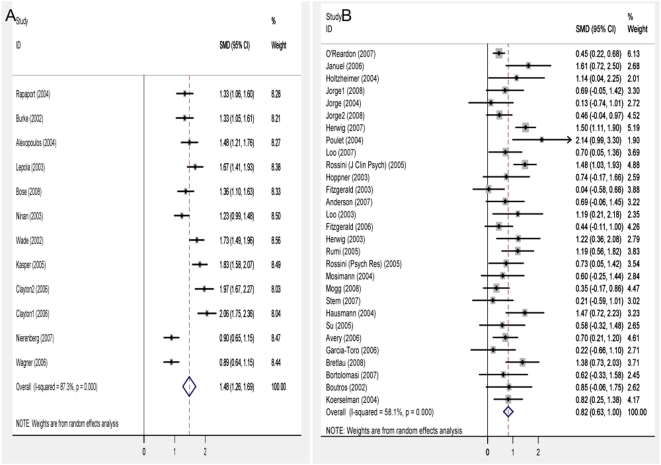
BACKGROUND: Although meta-analyses have shown that placebo responses are large in Major Depressive Disorder (MDD) trials; the placebo response of devices such as repetitive transcranial magnetic stimulation (rTMS) has not been systematically assessed. We proposed to assess placebo responses in two categories of MDD trials: pharmacological (antidepressant drugs) and non-pharmacological (device- rTMS) trials. METHODOLOGY/PRINCIPAL FINDINGS: We performed a systematic review and meta-analysis of the literature from April 2002 to April 2008, searching MEDLINE, Cochrane, Scielo and CRISP electronic databases and reference lists from retrieved studies and conference abstracts. We used the keywords placebo and depression and escitalopram for pharmacological studies; and transcranial magnetic stimulation and depression and sham for non-pharmacological studies. All randomized, double-blinded, placebo-controlled, parallel articles on major depressive disorder were included. Forty-one studies met our inclusion criteria - 29 in the rTMS arm and 12 in the escitalopram arm. We extracted the mean and standard values of depression scores in the placebo group of each study. Then, we calculated the pooled effect size for escitalopram and rTMS arm separately, using Cohen's d as the measure of effect size. We found that placebo response are large for both escitalopram (Cohen's d - random-effects model - 1.48; 95%C.I. 1.26 to 1.6) and rTMS studies (0.82; 95%C.I. 0.63 to 1). Exploratory analyses show that sham response is associated with refractoriness and with the use of rTMS as an add-on therapy, but not with age, gender and sham method utilized. CONCLUSIONS/SIGNIFICANCE: We confirmed that placebo response in MDD is large regardless of the intervention and is associated with depression refractoriness and treatment combination (add-on rTMS studies). The magnitude of the placebo response seems to be related with study population and study design rather than the intervention itself.
Overview
The claims and statistics of this paper haven’t been checked yet.
Free: it reads the open-access text and checks the first 5 claims that cite a source we can check. Create a free account to check every claim.
Integrity signals
Registry
Cites
Statistics
Figures
Verification
Claims the paper makes
The claims and statistics of this paper haven’t been checked yet.
Free: it reads the open-access text and checks the first 5 claims that cite a source we can check. Create a free account to check every claim.
Claims other papers make about this one
Each is checked against this paper’s own text: does it say what the citing paper says it does?
The source backs part of the claim, not all of it — or backs it for a different population, condition or comparison.
In the citing paper
“methodological issues, including aspects of study design and conduct (i.e., issues with identifying appropriate patients, large multi-site trials, multiple raters) that have been previously proposed as possible reasons for negative clinical trials in MDD”
From A randomized, double-blind, duloxetine-referenced study comparing efficacy and tolerability of 2 fixed doses of vortioxetine in the acute treatment of adults with MDD (2015) · cites this paper as Brunoni et al., 2009
Experimental — accuracy not yet measuredThe source backs part of the claim, not all of it — or backs it for a different population, condition or comparison.
In the citing paper
“Thus, to our knowledge, our review provides the first comprehensive insight into the control group response in non-pharmacological interventions in depression.”
From Challenges establishing the efficacy of exercise as an antidepressant treatment: a systematic review and meta-analysis of control group responses in exercise randomised controlled trials (2016) · cites this paper as [19]
Experimental — accuracy not yet measuredThe cited source says what the claim attributes to it.
In the citing paper
“The authors [19] found a similar increased control group improvement (SMD=-0.8) to ourselves”
The cited source says what the claim attributes to it.
In the citing paper
“response rates to placebo can be high in clinical trials of MDD (Brunoni et al, 2009;Walsh et al, 2002)”
From Lisdexamfetamine Dimesylate Augmentation in Adults With Persistent Executive Dysfunction After Partial or Full Remission of Major Depressive Disorder (2014) · cites this paper as Brunoni et al, 2009
In the citing paper
“A large placebo response has also been reported in non-pharmacological interventions for depression, with a recent meta-analysis demonstrating an effect size of 0.82 (95% CI 0.63 to 1) for control group responses in trials of repetitive transcranial magnetic stimulation [19].”
2 more claims about this paper
Create a free account to see every claim other papers make about this one.
Self-check
Percentages, sums and reported differences re-computed from the paper’s own numbers.
The self-check needs the paper’s full text.
Citations
Cites
Bias in meta-analysis detected by a simple, graphical test
Egger, M., Smith, G. D., Schneider, M., & Minder, C. (1997) · BMJ · doi:10.1136/bmj.315.7109.629 · Cited by 56,722 · cited 1×
“We also performed sensitivity analysis, cumulative regression and assessed publication bias using Beggmodified funnel plot and Egger test [24] for each analysis.”
MethodRush, A. J., Trivedi, M. H., Wisniewski, S. R., Nierenberg, A. A., Stewart, J. W., Warden, D., Niederehe, G., Thase, M. E., Lavori, P. W., Lebowitz, B. D., et al. (2006) · American Journal of Psychiatry · doi:10.1176/ajp.2006.163.11.1905 · Cited by 5,643
Schulz (1995) · doi:10.1001/jama.1995.03520290060030 · Cited by 5,634 · cited 1×
“Unsuccessful blinding biases the results as expectation effects and intervention confidence will be lost [45,46,47,48], therefore diminishing placebo response.”
BackgroundMoher, D., Pham, B., Jones, A., Cook, D. J., Jadad, A. R., Moher, M., Tugwell, P., & Klassen, T. P. (1998) · The Lancet · doi:10.1016/s0140-6736(98)01085-x · Cited by 3,560 · cited 1×
“Unsuccessful blinding biases the results as expectation effects and intervention confidence will be lost [45,46,47,48], therefore diminishing placebo response.”
BackgroundKirsch, I., Deacon, B. J., Huedo-Medina, T. B., Scoboria, A., Moore, T. J., & Johnson, B. T. (2008) · PLoS Medicine · doi:10.1371/journal.pmed.0050045 · Cited by 2,442 · cited 4×
“The main finding of our study is that both placebo interventions are associated with a large effect size in major depressive disorder, which is in line with previous studies: Walsh et al. [1] reviewed 75 depression trials and concluded that placebo response is substantial and increasing over years; Stein et al. [35] i…”
BackgroundInfluentialSelective publication of antidepressant trials and its influence on apparent efficacy
Turner, E. H., Matthews, A. M., Linardatos, E., Tell, R. A., & Rosenthal, R. (2008) · New England Journal of Medicine · doi:10.1056/nejmsa065779 · Cited by 2,435 · cited 1×
“However, our study is in line with previous meta-analyses that showed similar placebo responses in major depression studies [1,52], assessed a significant number (1714) of patients and included unpublished studies; therefore this hypothesis is less likely.”
ResultPlacebo Response in Studies of Major Depression: Variable, Substantial, and Growing
Walsh, B. T., Seidman, S. N., Sysko, R., & Gould, M. (2002) · JAMA · doi:10.1001/jama.287.14.1840 · Cited by 1,109 · cited 4×
“7% [1] and that drug-placebo differences might be relatively small in patients with MDD due to the large placebo response [2].”
BackgroundResultInfluentialSham device v inert pill: randomised controlled trial of two placebo treatments
Kaptchuk, T. J., Stason, W. B., Davis, R. B., Legedza, A. R. T., Schnyer, R. N., Kerr, C. E., Stone, D. A., Nam, B. H., Kirsch, I., & Goldman, R. H. (2006) · BMJ · doi:10.1136/bmj.38726.603310.55 · Cited by 532 · cited 2×
“inert pill trial [37] and in a metaanalysis comparing subcutaneous placebo with oral placebo from acute migraine [38].”
BackgroundSelf-citationDo medical devices have enhanced placebo effects?
Kaptchuk, T. J., Goldman, P., Stone, D. A., & Stason, W. B. (2000) · Journal of Clinical Epidemiology · doi:10.1016/s0895-4356(00)00206-7 · Cited by 463 · cited 2×
“placebo response than placebo pills [8,36].”
BackgroundSelf-citationFitzgerald, P. B., Brown, T. L., Marston, N. A. U., Daskalakis, Z. J., de Castella, A., & Kulkarni, J. (2003) · Archives of General Psychiatry · doi:10.1001/archpsyc.60.9.1002 · Cited by 458 · cited 1×
“For rTMS studies that used MADRS scores as the primary outcome, we used the values of HDRS scores reported in secondary outcomes when this was possible [26,28,29,30,31]; in four studies this was not possible [20,32,33,34] and therefore we imputed missing HDRS scores regressing for other variables.”
Method
Cited by
Items 101–173 of 173
Bouwknecht, J. A. (2014) · European Journal of Pharmacology · doi:10.1016/j.ejphar.2014.09.051 · Cited by 27
Antonelli, M., & Donelli, D. (2018) · Health & Social Care in the Community · doi:10.1111/hsc.12681 · Cited by 26
Pro-inflammatory diet and depressive symptoms in the healthcare setting
Belliveau, R., Horton, S., Hereford, C., Ridpath, L. C., Foster, R., & Boothe, E. (2022) · BMC Psychiatry · doi:10.1186/s12888-022-03771-z · Cited by 25
“For example, a meta-analysis of randomized, double-blinded, placebo-controlled studies found that escitalopram and repetitive transcranial magnetic stimulation trials both had significant responses to placebo [2, 3].”
BackgroundXu, G., Xiao, Q., Huang, B., Lei, H., Yin, Z., Huang, L., Zhou, Z., Tian, H., Huang, F., Liu, Y., et al. (2023) · Neuropsychobiology · doi:10.1159/000527903 · Cited by 21
A Possible Antidepressive Effect of Dietary Interventions: Emergent Findings and Research Challenges
Ceolin, G., Breda, V., Koning, E., Chinna‐Meyyappan, A., Gomes, F. A., Moreira, J. D., Gerchman, F., & Brietzke, E. M. (2022) · Current Treatment Options in Psychiatry · doi:10.1007/s40501-022-00259-1 · Cited by 23
Why do some promising brain-stimulation devices fail the next steps of clinical development?
Edelmuth, R., Nitsche, M. A., Battistella, L. R., & Fregni, F. (2010) · Expert Review of Medical Devices · doi:10.1586/erd.09.64 · Cited by 22
Self-citationJurvelin, H., Takala, T., Nissilä, J., Timonen, M., Rüger, M., Jokelainen, J. J., & Räsänen, P. K. (2014) · BMC Psychiatry · doi:10.1186/s12888-014-0288-6 · Cited by 23
Combination of noninvasive brain stimulation with pharmacotherapy
Brunoni, A. R., Valim, C., & Fregni, F. (2011) · Expert Review of Medical Devices · doi:10.1586/erd.10.62 · Cited by 23
Self-citationKotzalidis, G. D., CASALE, A. D., Simmaco, M., Pancheri, L., Brugnoli, R., Paolini, M., Gualtieri, I., Ferracuti, S., Savoja, V., Cuomo, I., et al. (2018) · Current Neuropharmacology · doi:10.2174/1570159x16666181026163922 · Cited by 22
Exercise and Epstein's target for treatment of depressive symptoms: a randomized study
Cecchini-Estrada, J.-A., Méndez-Giménez, A., Cecchini, C., Moulton, M., & Rodríguez, C. (2015) · International Journal of Clinical and Health Psychology · doi:10.1016/j.ijchp.2015.05.001 · Cited by 19
Nishida, M., Kikuchi, S., Nisijima, K., & Suda, S. (2017) · The Journal of ECT · doi:10.1097/yct.0000000000000352 · Cited by 19
Salazar-Fraile, J., Verdú, E. S., Pérez‐Hoyos, S., Tabarés‐Seisdedos, R., & Gómez-Beneyto, M. (2018) · Frontiers in Psychiatry · doi:10.3389/fpsyt.2018.00416 · Cited by 21
Li, C., Cheng, C., Lin, H., Yeh, S. H., Jeng, J., Wu, H.-T., Bai, Y., Tsai, S., Su, T., & Fitzgerald, P. B. (2023) · Asian Journal of Psychiatry · doi:10.1016/j.ajp.2023.103686 · Cited by 20
Munjuluri, S., Bolin, P. K., Lin, Y. T. A., Garcia, N. L., Gauna, L. M., Nguyen, T., & Salas, R. (2020) · Chronic Stress · doi:10.1177/2470547020966561 · Cited by 23
Bourla, A., Chaneac, E., Poulet, E., Haffen, É., Ogorzelec, L., Guinchard, C., Ferreri, F., & Mouchabac, S. (2019) · L Encéphale · doi:10.1016/j.encep.2019.07.003 · Cited by 20
Hu, X., Zhang, T., Ma, H., Zhou, X., Wang, H., Wang, X., Cheng, C., Li, Y., Duan, R., Zhang, B., et al. (2022) · Frontiers in Psychiatry · doi:10.3389/fpsyt.2022.935491 · Cited by 16
Psilocybin for depression: Considerations for clinical trial design
O’Donnell, K. C., Mennenga, S. E., & Bogenschutz, M. P. (2019) · Journal of Psychedelic Studies · doi:10.1556/2054.2019.026 · Cited by 18
Placebo effect of rTMS on post-stroke motor rehabilitation: a meta-analysis
Jin, Y., Pu, T., Guo, Z., Jiang, B., & Mu, Q. (2020) · Acta Neurologica Belgica · doi:10.1007/s13760-020-01460-w · Cited by 15
Transcranial magnetic stimulation has no placebo effect on motor learning
Jelić, M. B., Stevanović, V. B., Milanović, S., Ljubisavljević, M., & Filipović, S. R. (2013) · Clinical Neurophysiology · doi:10.1016/j.clinph.2013.02.024 · Cited by 14
“In keeping with this, sham TMS procedures were shown to cause, through their placebo effect, quite prominent clinical effects in several medical conditions (see e.g. Brunoni et al., 2009; Mansur et al., 2011).”
MethodPersonality traits and recovery from major depressive disorder
Kronström, K., Salminen, J. K., Hietala, J. A., Kajander, J., Vahlberg, T. J., Markkula, J., Rasi-Hakala, H., & Karlsson, H. (2010) · Nordic Journal of Psychiatry · doi:10.3109/08039488.2010.487571 · Cited by 13
Psychiatric Medication Withdrawal: Survivor Perspectives and Clinical Practice
Hall, W. (2018) · Journal of Humanistic Psychology · doi:10.1177/0022167818765331 · Cited by 17
Sabet, J. A., Ekman, M. S., Lundvall, A. S., Risérus, U., Johansson, U., Öström, Å., Adamsson, V., Cao, Y., Msghina, M., & Brummer, R. J. (2021) · Nutrients · doi:10.3390/nu13030902 · Cited by 13
Pharmacogenomics and Placebo Response in a Randomized Clinical Trial in Asthma
Wang, R., Croteau‐Chonka, D. C., Silverman, E. K., Loscalzo, J., Weiss, S. T., & Hall, K. T. (2019) · Clinical Pharmacology & Therapeutics · doi:10.1002/cpt.1646 · Cited by 12
Is the response to rTMS largely the result of non-specific effects?
Malhi, G. S., & Bell, E. (2021) · Australian & New Zealand Journal of Psychiatry · doi:10.1177/00048674211016043 · Cited by 14
Langenecker, S. A., Crane, N. A., Jenkins, L. M., Phan, K. L., & Klumpp, H. (2018) · Current Behavioral Neuroscience Reports · doi:10.1007/s40473-018-0140-2 · Cited by 11
Wang, M., Lu, S., Hao, L., Xia, Y., Shi, Z., & Su, L. (2024) · Frontiers in Psychiatry · doi:10.3389/fpsyt.2024.1377257 · Cited by 16
“Accumulating number of clinical studies and meta-analyses have reported placebo effects existing in the treatment of psychiatric disorders such as depression (17, 20), resistant obsessive-compulsive disorder (21), primary insomnia (22), and auditory hallucinations (23).”
BackgroundResultLin, C., Huang, C., & Chen, C. (2017) · The International Journal of Neuropsychopharmacology · doi:10.1093/ijnp/pyx114 · Cited by 11
“, 2002); second, it has been demonstrated that patients with severe depression and with treatment-resistant depression present a lower placebo response (Khan et al., 2002; Brunoni et al., 2009).”
BackgroundCan an Educational Handout Enhance Placebo Analgesia for Experimentally-Induced Pain?
Tang, C. W., & Colagiuri, B. (2013) · PLoS ONE · doi:10.1371/journal.pone.0077544 · Cited by 12
Svěrák, T., Linhartová, P., Gajdoš, M., Kuhn, M., Látalová, A., Lamoš, M., Ustohal, L., & Kašpárek, T. (2022) · Frontiers in Psychiatry · doi:10.3389/fpsyt.2021.770353 · Cited by 18
“The placebo effect is usually relatively high in rTMS studies (69), and there is a risk that this study was influenced as discussed above.”
BackgroundGallop, L., Westwood, S. J., Hemmings, A., Lewis, Y. D., Campbell, I. C., & Schmidt, U. H. (2024) · European Child & Adolescent Psychiatry · doi:10.1007/s00787-024-02475-x · Cited by 13
“As evidence shows that placebo response decreases with increasing treatment resistance [121 ], one way to address this is to recruit a more severe, treatment-resistant, homog - enous patient population in RCTs using rTMS in CYP with psychiatric disorders, as this is more likely to separate active…”
Dalhuisen, I., Smit, F., Spijker, J., van Oostrom, I., van Exel, E. R., van Mierlo, H. C., de Waardt, D., Arns, M., Tendolkar, I., & van Eijndhoven, P. (2022) · BMC Psychiatry · doi:10.1186/s12888-022-03732-6 · Cited by 12
Mikellides, G., Michael, P., Psalta, L., Stefani, A., Schuhmann, T., & Sack, A. T. (2022) · International Journal of Clinical and Health Psychology · doi:10.1016/j.ijchp.2022.100351 · Cited by 10
The Placebo Effect and Its Clinical Associations in Gambling Disorder
Grant, J. E., & Chamberlain, S. R. (2017) · Annals of Clinical Psychiatry · doi:10.1177/104012371702900303 · Cited by 9
“The differences between our results and studies of other men-GAMBLING tal illnesses in which younger age and previous treatment were meaningful predictors of placebo response 28,30,39,40 could reflect the particular characteristics of our participant population or the disorder itself.”
Veraart, J. K. E., Smith-Apeldoorn, S. Y., van der Meij, A., Spijker, J., Schoevers, R. A., & Kamphuis, J. (2025) · Journal of Psychopharmacology · doi:10.1177/02698811251332831 · Cited by 10
Tan, X. W., Abdin, E., & Tor, P. C. (2021) · Pilot and Feasibility Studies · doi:10.1186/s40814-021-00845-9 · Cited by 8
Duration of untreated illness in gambling disorder
Grant, J. E., & Chamberlain, S. R. (2023) · CNS Spectrums · doi:10.1017/s1092852923002444 · Cited by 8
Deep Brain Stimulation (DBS) in Treatment-Resistant Depression (TRD): Hope and Concern
Asir, B., Boscutti, A., Fenoy, A. J., & Quevedo, J. (2024) · Advances in experimental medicine and biology · doi:10.1007/978-981-97-4402-2_9 · Cited by 7
Ørbo, M. C., Høier, S., Vangberg, T. R., Csifcsák, G., Grønli, O., & Aslaksen, P. M. (2024) · Trials · doi:10.1186/s13063-024-08606-8 · Cited by 7
“Although a decrease in depressive symptoms is expected in the sham group due to the placebo effects [22] we anticipate that the physiological effects of iTBS will surpass placebo responses within the parameters of the current study design [23].”
BackgroundTao, Y., Duan, X., Liu, P., Wang, M., Li, S.-X., Luo, T.-T., Xing, H., & Huang, Y. C. (2025) · World Journal of Pediatrics · doi:10.1007/s12519-025-00983-7 · Cited by 6
Krystal, A. D., Blier, P., Culpepper, L., Nierenberg, A. A., Takaesu, Y., Kubota, N., Moline, M. L., Malhotra, M., Pinner, K., & Yardley, J. (2024) · Neuropsychopharmacology Reports · doi:10.1002/npr2.12509 · Cited by 6
Differential Placebo Responses for Pharmacotherapy and Neurostimulation in Late-Life Depression
Wathra, R. A., Mulsant, B. H., Reynolds, C. F., Lenze, E. J., Karp, J. F., Daskalakis, Z. J., & Blumberger, D. M. (2022) · Neuromodulation Technology at the Neural Interface · doi:10.1016/j.neurom.2021.10.019 · Cited by 5
Sham acupuncture is not a placebo treatment - implications and problems in research
Birch, S. (2012) · Cited by 5
Gonzalez-Olvera, J. J., Ricardo-Garcell, J., García‐Anaya, M., Terres, E. M., Reyes-Zamorano, E., & Armas-Castañeda, G. (2013) · Salud Mental · doi:10.17711/sm.0185-3325.2013.030 · Cited by 4
Is a Combination of Pharmacotherapy and Psychotherapy Superior to Each Alone?
Choi, K., & Kim, Y. (2017) · Springer eBooks · doi:10.1007/978-981-10-6577-4_21 · Cited by 4
What are the Best Placebo Interventions for the Treatment of Pain?
Meißner, K., & Linde, K. (2013) · Elsevier eBooks · doi:10.1016/b978-0-12-397928-5.00023-4 · Cited by 4
He, Y., Li, Z., Cao, L., Han, M., Tu, J., Deng, H., Huang, Z.-M., Geng, X., & Wu, J. (2023) · Psychiatry Research · doi:10.1016/j.psychres.2023.115297 · Cited by 3
Ivanova, A., Zhang, Z., Thompson, L., Yang, Y., Kotz, R. M., & Fang, X. (2015) · Journal of Biopharmaceutical Statistics · doi:10.1080/10543406.2015.1092028 · Cited by 3
“Other evidence suggests that placebo effect in non-pharmacological trials is on par with pharmacological trials (Brunoni et al., 2009).”
BackgroundSchoemaker, J. H., Kilian, S., Emsley, R. A., & Vingerhoets, A. J. J. M. (2018) · Neurology Psychiatry and Brain Research · doi:10.1016/j.npbr.2018.04.002 · Cited by 3
Jones, B. D. M., Weissman, C. R., Razza, L. B., Husain, M. I., Brunoni, A. R., & Daskalakis, Z. J. (2021) · BMJ Open · doi:10.1136/bmjopen-2020-041349 · Cited by 5
Self-citationBrunoni, A. R. (2012) · Digital Library of Theses and Dissertations (Universidade de São Paulo) · doi:10.11606/t.47.2012.tde-03122012-110639 · Cited by 6
Self-citationAgitation in Patients with Dementia - Challenges in Diagnosis and Treatment
Sommer, O. H. (2010) · NVA (Nasjonalt vitenarkiv) · Cited by 3
Commentary on the Cochrane Review of Acupuncture for Depression
Schnyer, R. N. (2011) · EXPLORE · doi:10.1016/j.explore.2011.02.013 · Cited by 2
Can Deep Brain Stimulation Be a Promising Treatment for Treatment-Resistant Depression?
Nazanin, A., & Ijeuma, N. (2023) · International Journal of Depression and Anxiety · doi:10.23937/2643-4059/1710036 · Cited by 2
The role of mindsets in placebo effects and healthcare
Gasteiger, C., & Crum, A. J. (2025) · Handbook of clinical neurology · doi:10.1016/b978-0-443-29884-4.00001-7 · Cited by 2
“…the outcomes of medical procedures and treatments, demonstrated across various domains, such as pain (Benedetti et al., 1998; Colloca, 2019), depression (Brunoni et al., 2009), functional gastrointestinal disorders (Bosman et al., 2021), and Parkinson disease (De la Fuente-Fernández et al., 2001).”
Reyhanli, A., Ortega-Márquez, J., Pastora-Sesín, C., Perin, J. P., Gianlorenço, A. C., Camargo, L., & Fregni, F. (2026) · Biomedicines · doi:10.3390/biomedicines14030532 · Cited by 2
“…(SMDs approximately − 0.3 to − 0.4) and did not demonstrate progressive strengthening over time, indicating that sham stimulation does not produce cumulative or durable clinical change, consistent with prior systematic reviews using sham neuromodulation in different medical conditions [49–51].”
InfluentialSelf-citationA Bit of Shame and a Proud Sham
Segev, A., & Bloch, Y. (2012) · Brain stimulation · doi:10.1016/j.brs.2012.11.002 · Cited by 1
Mental and behavioural disorders
Benedetti, F. (2020) · Oxford University Press eBooks · doi:10.1093/oso/9780198843177.003.0012 · Cited by 1
How animal signals inform us about behavior
Overall, K. L. (2011) · Journal of Veterinary Behavior · doi:10.1016/j.jveb.2010.12.004 · Cited by 1
Brunoni, A. R. (2012)
Self-citationEffekte, Bedingungen und Anwendung von Placebos
Werner, C., Hasler, S., Birkhäuer, J., & Gaab, J. (2016) · PSYCH up2date · doi:10.1055/s-0042-100680
[Treatment of depression with transcranial magnetic stimulation].
Chaouachi, M. A., Verbanck, P., & Kornreich, C. (2013) · PubMed
Contagious Depression: A Social Transmission Hypothesis
Samberg, H. (2016)
PSICOSSOMÁTICA NA SAÚDE COLETIVA
Cruz, M. Z. (2011)
Pollock, M. S. (2010) · Summit (Simon Fraser University) · Cited by 1
Mikellides, G. (2023) · Research Publications (Maastricht University) · doi:10.26481/dis.20230911gm
Matched vs Nonmatched Placebos in a Randomized Trial of COVID-19 Treatments
Reis, G., Savassi, L. C. M., Ferreira, T. S., Reis, L. L. F., Simplicio, M. I. C., Ribeiro, L. B., Silva, E. A. D. S. M., Lat, P. K., Harari, O., Forrest, J. I., et al. (2024) · JAMA Network Open · doi:10.1001/jamanetworkopen.2024.10335
Confidence Interval Estimation for Continuous Outcomes in Cluster Randomization Trials
Taleban, J. (2011) · Scholarship@Western (Western University)
Kletzel, S., Alsakaji, R., Umbarger, A., Walker, S., Aaronson, A. L., Herrold, A., Colletta, K., Bhaumik, D., Weaver, F., & Pape, T. B. (2025) · JMIR Research Protocols · doi:10.2196/77241
“The placebo effect is a significant issue to consider in PD research in general and specifically in TMS [58,59] due to dopaminergic system involvement in expectation and reward processing.”
Non-implantable neuromodulation therapies compared to conventional treatments for major depression
Lima, V. F. B., Silva, V. A., Pelosof, R., Malfatti, V., Cretaz, E., Vidal, K. S. M., Brunoni, A. R., & Cavenaghi, V. B. (2026) · Expert Review of Clinical Pharmacology · doi:10.1080/17512433.2026.2626459
“Compared to oral antidepressants, which are often associated with significant side effects such as sexual dysfunction, gastrointestinal disturbances, and weight gain, all of which are common reasons for discontinuation [82], rTMS offers the advantage of milder and transient adverse effects.”
Self-citationSghirripa, S., Graetz, L. J., Chau, A. C. M., Jenkinson, M., Hillier, S., & Hordacre, B. G. (2026) · Journal of Affective Disorders · doi:10.1016/j.jad.2026.121759
Therapeutic Applications of rTMS in Migraine Prophylaxis
Siokas, V., Marogianni, C., Liampas, I., Sokratous, M., Tsirelis, D., Dardioti, S., Tsika, A., Stamati, P., & Dardiotis, E. (2026) · Journal of Integrative Neuroscience · doi:10.31083/jin52992
Escaping the Negative Attentional Bias in Depression with Real-Time NeurofeedbackPreprint
Lubianiker, N., Woods, B., Nitchie, F. J., Batzdorf, A. S., Mennen, A. C., Lin, Q., Norman, K. A., Turk‐Browne, N. B., & Sheline, Y. I. (2026) · medRxiv · doi:10.64898/2026.09.30.26363896
Problemy z placebo i ślepą próbą magnetycznej stosowanych w psychiatrii
Zyss, T., Dudek, D., Zięba, A., Hese, R. T., Krawczyk, A., Gorczyca, P. W., & Sobiś, J. (2011) · PRZEGLĄD ELEKTROTECHNICZNY
Metadata
- Authors
- Brunoni, A. R., Lopes, M., Kaptchuk, T. J., & Fregni, F.
- Affiliations
- Beth Israel Deaconess Medical Center (US)
- Harvard University (US)
- Corresponding author
- Fregni, Felipe
- Venue
- PLoS ONE
- Publisher
- Public Library of Science (PLoS)
- Published
- 2009-03-18
- Volume
- 4
- Issue
- 3
- Pages
- e4824
- ISSN
- 1932-6203 (ISSN-L)
- PMC
- PMC2653635
- OpenAlex
- W2057880023
- Cited by
- 173
- References
- 74
- Citations by year
- 2026: 5 · 2025: 4 · 2024: 6 · 2023: 8 · 2022: 8 · 2021: 13 · 2020: 8 · 2019: 9 · 2018: 12 · 2017: 6 · 2016: 6 · 2015: 15 · 2014: 10 · 2013: 16 · 2012: 13
- FWCI
- 1.18
- Type
- journal article
- Language
- en
- Open access
- gold
- doi.org
- Locations
- PLoS ONE (publishedVersion, cc-by)
- PubMed Central (publishedVersion, cc-by)
- PubMed (publishedVersion)
- Portuguese National Funding Agency for Science, Research and Technology (RCAAP Project by FCT) (publishedVersion)
- Digital Access to Scholarship at Harvard (DASH) (Harvard University) (submittedVersion, cc-by)
- RePEc: Research Papers in Economics (submittedVersion)
- DOAJ (DOAJ: Directory of Open Access Journals) (submittedVersion, cc-by-sa)
- Figshare (submittedVersion, cc-by)
- Funders
- National Center for Complementary and Integrative Health (K24AT004095)
- Topics
- Life Sciences › Neuroscience › Cognitive Neuroscience › Pain Management and Placebo Effect
- Life Sciences › Neuroscience › Neurology › Transcranial Magnetic Stimulation Studies
- Health Sciences › Medicine › Pharmacology (medical) › Treatment of Major Depression
- Keywords
- placebo response, major depressive disorder, repetitive transcranial magnetic stimulation, escitalopram, antidepressants, treatment-resistant depression, adjunctive therapy
- MeSH terms
- Major Depressive Disorder, Double-Blind Method, Humans, Placebos, Citalopram, Selective Serotonin Reuptake Inhibitors, Antidepressive Agents, Second-Generation
About these checks
Registry, retraction, Cites and statistics results are computed, not judged, with one exception: a printed reference that no index lists is read once by a model before it counts as a citation error. Claims are extracted by a model and kept only when their quote appears verbatim in the text; each cited source is then checked, with a model’s help, for whether it says what the claim relies on. Those verdicts can be wrong — read the claim’s quote and the cited source before relying on one.
Statistics and arithmetic are recomputed, not judged.
Confidence bands are shown only for fields calibrated on our annotated test set. None is calibrated yet, so no band is shown.
What counts as a claim ›How we measure confidence ›How we check this ›
Are you an author, or do you see a problem with this page? Request a review
Data sources
Bibliographic data: Semantic Scholar, OpenAlex, Crossref.
Contains information from the Semantic Scholar Academic Graph Datasets, made available under the ODC Attribution License (ODC-BY 1.0).
Semantic Scholar’s data is described in: Kinney, R., et al. (2023). The Semantic Scholar Open Data Platform. arXiv:2301.10140.
