

Placebo Response of Non-Pharmacological and Pharmacological Trials in Major Depression: A Systematic Review and Meta-Analysis
Open accessThe DOI matches its Crossref record; 72 of the 74 references it cites were found in a registry or an index.
Abstract
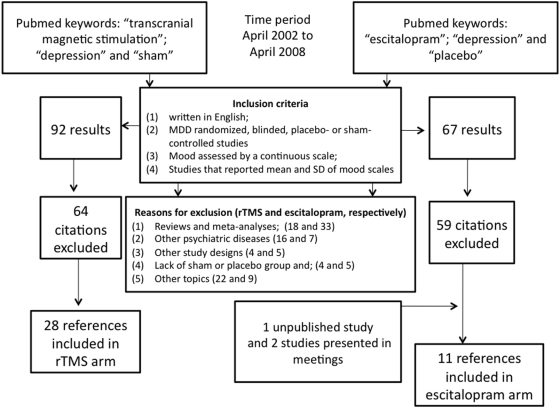
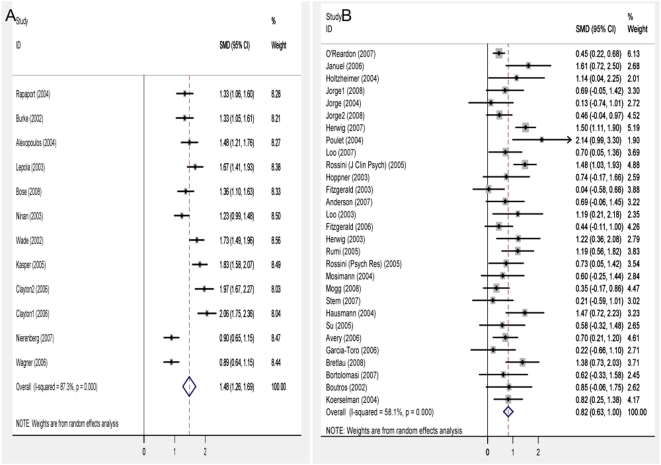
BACKGROUND: Although meta-analyses have shown that placebo responses are large in Major Depressive Disorder (MDD) trials; the placebo response of devices such as repetitive transcranial magnetic stimulation (rTMS) has not been systematically assessed. We proposed to assess placebo responses in two categories of MDD trials: pharmacological (antidepressant drugs) and non-pharmacological (device- rTMS) trials. METHODOLOGY/PRINCIPAL FINDINGS: We performed a systematic review and meta-analysis of the literature from April 2002 to April 2008, searching MEDLINE, Cochrane, Scielo and CRISP electronic databases and reference lists from retrieved studies and conference abstracts. We used the keywords placebo and depression and escitalopram for pharmacological studies; and transcranial magnetic stimulation and depression and sham for non-pharmacological studies. All randomized, double-blinded, placebo-controlled, parallel articles on major depressive disorder were included. Forty-one studies met our inclusion criteria - 29 in the rTMS arm and 12 in the escitalopram arm. We extracted the mean and standard values of depression scores in the placebo group of each study. Then, we calculated the pooled effect size for escitalopram and rTMS arm separately, using Cohen's d as the measure of effect size. We found that placebo response are large for both escitalopram (Cohen's d - random-effects model - 1.48; 95%C.I. 1.26 to 1.6) and rTMS studies (0.82; 95%C.I. 0.63 to 1). Exploratory analyses show that sham response is associated with refractoriness and with the use of rTMS as an add-on therapy, but not with age, gender and sham method utilized. CONCLUSIONS/SIGNIFICANCE: We confirmed that placebo response in MDD is large regardless of the intervention and is associated with depression refractoriness and treatment combination (add-on rTMS studies). The magnitude of the placebo response seems to be related with study population and study design rather than the intervention itself.
Overview
The claims and statistics of this paper haven’t been checked yet.
Free: it reads the open-access text and checks the first 5 claims that cite a source we can check. Create a free account to check every claim.
Integrity signals
Registry
Cites
Statistics
Figures
Verification
Claims the paper makes
The claims and statistics of this paper haven’t been checked yet.
Free: it reads the open-access text and checks the first 5 claims that cite a source we can check. Create a free account to check every claim.
Claims other papers make about this one
Each is checked against this paper’s own text: does it say what the citing paper says it does?
The source backs part of the claim, not all of it — or backs it for a different population, condition or comparison.
In the citing paper
“methodological issues, including aspects of study design and conduct (i.e., issues with identifying appropriate patients, large multi-site trials, multiple raters) that have been previously proposed as possible reasons for negative clinical trials in MDD”
From A randomized, double-blind, duloxetine-referenced study comparing efficacy and tolerability of 2 fixed doses of vortioxetine in the acute treatment of adults with MDD (2015) · cites this paper as Brunoni et al., 2009
Experimental — accuracy not yet measuredThe source backs part of the claim, not all of it — or backs it for a different population, condition or comparison.
In the citing paper
“Thus, to our knowledge, our review provides the first comprehensive insight into the control group response in non-pharmacological interventions in depression.”
From Challenges establishing the efficacy of exercise as an antidepressant treatment: a systematic review and meta-analysis of control group responses in exercise randomised controlled trials (2016) · cites this paper as [19]
Experimental — accuracy not yet measuredThe cited source says what the claim attributes to it.
In the citing paper
“The authors [19] found a similar increased control group improvement (SMD=-0.8) to ourselves”
The cited source says what the claim attributes to it.
In the citing paper
“response rates to placebo can be high in clinical trials of MDD (Brunoni et al, 2009;Walsh et al, 2002)”
From Lisdexamfetamine Dimesylate Augmentation in Adults With Persistent Executive Dysfunction After Partial or Full Remission of Major Depressive Disorder (2014) · cites this paper as Brunoni et al, 2009
In the citing paper
“A large placebo response has also been reported in non-pharmacological interventions for depression, with a recent meta-analysis demonstrating an effect size of 0.82 (95% CI 0.63 to 1) for control group responses in trials of repetitive transcranial magnetic stimulation [19].”
2 more claims about this paper
Create a free account to see every claim other papers make about this one.
Self-check
Percentages, sums and reported differences re-computed from the paper’s own numbers.
The self-check needs the paper’s full text.
Citations
Cites
Bias in meta-analysis detected by a simple, graphical test
Egger, M., Smith, G. D., Schneider, M., & Minder, C. (1997) · BMJ · doi:10.1136/bmj.315.7109.629 · Cited by 56,722 · cited 1×
“We also performed sensitivity analysis, cumulative regression and assessed publication bias using Beggmodified funnel plot and Egger test [24] for each analysis.”
MethodRush, A. J., Trivedi, M. H., Wisniewski, S. R., Nierenberg, A. A., Stewart, J. W., Warden, D., Niederehe, G., Thase, M. E., Lavori, P. W., Lebowitz, B. D., et al. (2006) · American Journal of Psychiatry · doi:10.1176/ajp.2006.163.11.1905 · Cited by 5,643
Schulz (1995) · doi:10.1001/jama.1995.03520290060030 · Cited by 5,634 · cited 1×
“Unsuccessful blinding biases the results as expectation effects and intervention confidence will be lost [45,46,47,48], therefore diminishing placebo response.”
BackgroundMoher, D., Pham, B., Jones, A., Cook, D. J., Jadad, A. R., Moher, M., Tugwell, P., & Klassen, T. P. (1998) · The Lancet · doi:10.1016/s0140-6736(98)01085-x · Cited by 3,560 · cited 1×
“Unsuccessful blinding biases the results as expectation effects and intervention confidence will be lost [45,46,47,48], therefore diminishing placebo response.”
BackgroundKirsch, I., Deacon, B. J., Huedo-Medina, T. B., Scoboria, A., Moore, T. J., & Johnson, B. T. (2008) · PLoS Medicine · doi:10.1371/journal.pmed.0050045 · Cited by 2,442 · cited 4×
“The main finding of our study is that both placebo interventions are associated with a large effect size in major depressive disorder, which is in line with previous studies: Walsh et al. [1] reviewed 75 depression trials and concluded that placebo response is substantial and increasing over years; Stein et al. [35] i…”
BackgroundInfluentialSelective publication of antidepressant trials and its influence on apparent efficacy
Turner, E. H., Matthews, A. M., Linardatos, E., Tell, R. A., & Rosenthal, R. (2008) · New England Journal of Medicine · doi:10.1056/nejmsa065779 · Cited by 2,435 · cited 1×
“However, our study is in line with previous meta-analyses that showed similar placebo responses in major depression studies [1,52], assessed a significant number (1714) of patients and included unpublished studies; therefore this hypothesis is less likely.”
ResultPlacebo Response in Studies of Major Depression: Variable, Substantial, and Growing
Walsh, B. T., Seidman, S. N., Sysko, R., & Gould, M. (2002) · JAMA · doi:10.1001/jama.287.14.1840 · Cited by 1,109 · cited 4×
“7% [1] and that drug-placebo differences might be relatively small in patients with MDD due to the large placebo response [2].”
BackgroundResultInfluentialSham device v inert pill: randomised controlled trial of two placebo treatments
Kaptchuk, T. J., Stason, W. B., Davis, R. B., Legedza, A. R. T., Schnyer, R. N., Kerr, C. E., Stone, D. A., Nam, B. H., Kirsch, I., & Goldman, R. H. (2006) · BMJ · doi:10.1136/bmj.38726.603310.55 · Cited by 532 · cited 2×
“inert pill trial [37] and in a metaanalysis comparing subcutaneous placebo with oral placebo from acute migraine [38].”
BackgroundSelf-citationDo medical devices have enhanced placebo effects?
Kaptchuk, T. J., Goldman, P., Stone, D. A., & Stason, W. B. (2000) · Journal of Clinical Epidemiology · doi:10.1016/s0895-4356(00)00206-7 · Cited by 463 · cited 2×
“placebo response than placebo pills [8,36].”
BackgroundSelf-citationFitzgerald, P. B., Brown, T. L., Marston, N. A. U., Daskalakis, Z. J., de Castella, A., & Kulkarni, J. (2003) · Archives of General Psychiatry · doi:10.1001/archpsyc.60.9.1002 · Cited by 458 · cited 1×
“For rTMS studies that used MADRS scores as the primary outcome, we used the values of HDRS scores reported in secondary outcomes when this was possible [26,28,29,30,31]; in four studies this was not possible [20,32,33,34] and therefore we imputed missing HDRS scores regressing for other variables.”
Method
Cited by
Lefaucheur, J.-P., André-Obadia, N., Antal, A., Ayache, S. S., Baeken, C., Benninger, D. H., Cantello, R. M., Cincotta, M., de Carvalho, M., De Ridder, D., et al. (2014) · Clinical Neurophysiology · doi:10.1016/j.clinph.2014.05.021 · Cited by 2,119
Brunoni, A. R., Valiengo, L., Baccaro, A., Zanão, T. A., de Oliveira, J. F., Goulart, A., Boggio, P. S., Lotufo, P. A., Benseñor, I. M., & Fregni, F. (2013) · JAMA Psychiatry · doi:10.1001/2013.jamapsychiatry.32 · Cited by 601
Self-citationAnimal Models of Depression: Molecular Perspectives
Krishnan, V., & Nestler, E. J. (2011) · Current Topics in Behavioral Neurosciences · doi:10.1007/7854_2010_108 · Cited by 528
“Due to high placebo response rates (Brunoni et al. 2009) and side effect concerns, monoamine-based agents still constitute a significant proportion of “new” antidepressants being tested in clinical trials (Mathew et al. 2008).”
BackgroundSmith, C. A., Hay, P. P., & MacPherson, H. (2010) · Cochrane Database of Systematic Reviews · doi:10.1002/14651858.cd004046.pub3 · Cited by 323
A randomized, double-blind, placebo-controlled trial of antidepressants in Parkinson disease
Richard, I. H., McDermott, M. P., Kurlan, R., Lyness, J. M., Como, P. G., Pearson, N., Factor, S. A., Juncos, J., Serrano Ramos, C., Brodsky, M., et al. (2012) · Neurology · doi:10.1212/wnl.0b013e3182516244 · Cited by 338
Differential Effectiveness of Placebo Treatments: A Systematic Review of Migraine Prophylaxis
Meissner, K., Fässler, M., Rücker, G., Kleijnen, J., Hróbjartsson, A., Schneider, A., Antes, G., & Linde, K. (2013) · JAMA Internal Medicine · doi:10.1001/jamainternmed.2013.10391 · Cited by 301
Facing depression with botulinum toxin: A randomized controlled trial
Wollmer, M. A., de Boer, C., Kalak, N., Beck, J., Götz, T., Schmidt, T., Hodzic, M., Bayer, U., Kollmann, T., Kollewe, K., et al. (2012) · Journal of Psychiatric Research · doi:10.1016/j.jpsychires.2012.01.027 · Cited by 278
Rethinking the role of sham TMS
Duecker, F., & Sack, A. T. (2015) · Frontiers in Psychology · doi:10.3389/fpsyg.2015.00210 · Cited by 264
“…begin with, placebo effects have indeed been observed in many TMS treatment studies for various brain-related disorders including major depression (Brunoni et al., 2009), epilepsy (Bae et al., 2011), obsessive-compulsive disorder (Mansur et al., 2011), and Parkinson’s disease (Okabe et al., 2003).”
BackgroundO’Connell, N. E., Cossar, J., Marston, L., Wand, B. M., Bunce, D., Moseley, G. L., & De Souza, L. H. (2012) · PLoS ONE · doi:10.1371/journal.pone.0047514 · Cited by 264
Smith, C. A., Armour, M., Lee, M. S., Wang, L.-Q., & Hay, P. J. (2018) · Cochrane Database of Systematic Reviews · doi:10.1002/14651858.cd004046.pub4 · Cited by 244
Palm, U., Schiller, C., Fintescu, Z., Obermeier, M., Keeser, D., Reisinger, E., Pogarell, O., Nitsche, M. A., Möller, H.-J., & Padberg, F. (2012) · Brain Stimulation · doi:10.1016/j.brs.2011.08.005 · Cited by 235
“This higher degree of therapy-resistance in our patients might also have contributed to the rather low placebo response rate.(29) Very little data have been published on tDCS in treatment resistant depression.”
BackgroundTranscranial direct current stimulation (tDCS) in unipolar vs. bipolar depressive disorder
Brunoni, A. R., Ferrucci, R., Bortolomasi, M., Vergari, M., Tadini, L., Boggio, P. S., Giacopuzzi, M., Barbieri, S., & Priori, A. (2011) · Progress in Neuro-Psychopharmacology and Biological Psychiatry · doi:10.1016/j.pnpbp.2010.09.010 · Cited by 226
Self-citationPlacebo effects in psychiatry: mediators and moderators
Weimer, K., Colloca, L., & Enck, P. (2015) · The Lancet Psychiatry · doi:10.1016/s2215-0366(14)00092-3 · Cited by 219
Transcranial magnetic stimulation in the treatment of substance addiction
Gorelick, D. A., Zangen, A., & George, M. S. (2014) · Annals of the New York Academy of Sciences · doi:10.1111/nyas.12479 · Cited by 195
Zhou, X., Keitner, G. I., Qin, B., Ravindran, A. V., Bauer, M., Del Giovane, C., Zhao, J., Liu, Y., Fang, Y., Zhang, Y., et al. (2015) · International Journal of Neuropsychopharmacology · doi:10.1093/ijnp/pyv060 · Cited by 197
“biological validity of illness, baseline severity of illness, chronicity of the index episode of depression, age of participants, medical and psychiatric comorbidity) and study design (probability of receiving placebo, trials durations, study outcome measures) rather than the intervention itself (Brunoni et al., 2009;…”
BackgroundKekic, M., Boysen, E., Campbell, I. C., & Schmidt, U. (2016) · Journal of Psychiatric Research · doi:10.1016/j.jpsychires.2015.12.018 · Cited by 184
“…outcomes; however, the improvements observed in open-label investigations are unlikely to be the result of placebo mechanisms alone since many of the patients involved in these studies were treatment-resistant, and refractoriness is associated with lower placebo responding (Brunoni et al., 2009).”
BackgroundKaster, T. S., Daskalakis, Z. J., Noda, Y., Knyahnytska, Y., Downar, J., Rajji, T. K., Levkovitz, Y., Zangen, A., Butters, M. A., Mulsant, B. H., et al. (2018) · Neuropsychopharmacology · doi:10.1038/s41386-018-0121-x · Cited by 174
Razza, L. B., Moffa, A. H., Moreno, M. L., Carvalho, A. F., Padberg, F., Fregni, F., & Brunoni, A. R. (2018) · Progress in Neuro-Psychopharmacology and Biological Psychiatry · doi:10.1016/j.pnpbp.2017.10.016 · Cited by 172
“This result is in line with previous studies on rTMS and antidepressant pharmacotherapy (Brunoni et al., 2009; Rutherford and Roose, 2013).”
BackgroundResultInfluentialSelf-citationDwyer, J. B., Landeros-Weisenberger, A., Johnson, J. A., Londono Tobon, A., Flores, J. M., Nasir, M., Couloures, K., Sanacora, G., & Bloch, M. H. (2021) · American Journal of Psychiatry · doi:10.1176/appi.ajp.2020.20010018 · Cited by 165
Repetitive Transcranial Magnetic Stimulation in Chronic Pain: A Review of the Literature
Galhardoni, R., Correia, G. S., Araujo, H., Yeng, L. T., Fernandes, D. T., Kaziyama, H. H., Marcolin, M. A., Bouhassira, D., Teixeira, M. J., & de Andrade, D. C. (2015) · Archives of Physical Medicine and Rehabilitation · doi:10.1016/j.apmr.2014.11.010 · Cited by 160
Revisiting the therapeutic effect of rTMS on negative symptoms in schizophrenia: A meta-analysis
Shi, C., Yu, X., Cheung, E. F. C., Shum, D. H. K., & Chan, R. C. K. (2014) · Psychiatry Research · doi:10.1016/j.psychres.2013.12.019 · Cited by 144
“It has been reported that there is a large placebo response in the treatment effect of rTMS on depression (Brunoni et al., 2009).”
Lefaucheur, J. P., André‐Obadia, N., Poulet, E., Devanne, H., Haffen, É., Londero, A., Cretin, B., Leroi, A., Radtchenko, A., Saba, G., et al. (2011) · Neurophysiologie Clinique · doi:10.1016/j.neucli.2011.10.062 · Cited by 187
“en 2009 [57] abordé cette question en étudiant l’effet placebo dans les tudes escitalopram et les études rTMS.”
BackgroundIntensive HF-rTMS treatment in refractory medication-resistant unipolar depressed patients
Baeken, C., Vanderhasselt, M., Remue, J., Herremans, S. C., Vanderbruggen, N., Zeeuws, D., Santermans, L., & Raedt, R. D. (2013) · Journal of Affective Disorders · doi:10.1016/j.jad.2013.07.008 · Cited by 156
Leuchter, A. F., Cook, I. A., Feifel, D., Goethe, J. W., Husain, M., Carpenter, L. L., Thase, M. E., Krystal, A. D., Philip, N. S., Bhati, M. T., et al. (2015) · Brain Stimulation · doi:10.1016/j.brs.2015.05.005 · Cited by 137
Jain, R., Mahableshwarkar, A. R., Jacobsen, P. L., Chen, Y., & Thase, M. E. (2013) · International Journal of Neuropsychopharmacology · doi:10.1017/s1461145712000727 · Cited by 132
“Many issues such as study population, dose and aspects of study design and conduct (including the inclusion of inappropriate subjects) may contribute to a large placebo response masking potential effects of treatment and have been previously proposed as possible reasons for negative clinical trials in MDD (Bridge et a…”
Jones, B. D. M., Razza, L. B., Weissman, C. R., Karbi, J., Vine, T., Mulsant, L. S., Brunoni, A. R., Husain, M. I., Mulsant, B. H., Blumberger, D. M., et al. (2021) · JAMA Network Open · doi:10.1001/jamanetworkopen.2021.25531 · Cited by 121
Self-citationDesmyter, S., Duprat, R., Baeken, C., Van Autreve, S., Audenaert, K., & van Heeringen, K. (2016) · Frontiers in Human Neuroscience · doi:10.3389/fnhum.2016.00480 · Cited by 120
“Taking into account the potentially large placebo-effects in this population, the treatment protocol has the advantage over previous reports in being sham-controlled (Brunoni et al., 2009; Gibbons et al., 2012).”
BackgroundJoffe, H., Petrillo, L. F., Koukopoulos, A., Viguera, A. C., Hirschberg, A., Nonacs, R., Somley, B., Pasciullo, E., White, D. P., Hall, J. E., et al. (2011) · The Journal of Clinical Endocrinology & Metabolism · doi:10.1210/jc.2010-2503 · Cited by 118
Fregni, F., Imamura, M., Chien, H. F., Lew, H., Boggio, P., Kaptchuk, T., Riberto, M., Hsing, W. T., Battistella, L., & Furlan, A. (2010) · American Journal of Physical Medicine & Rehabilitation · doi:10.1097/phm.0b013e3181bc0bbd · Cited by 109
“A recent meta-analysis on major depression, however, did not find differences between placebo pill and use of a sham device (transcranial magnetic stimulation).(33) A similar contradictory result was found in an acutecare study that found no difference between parenteral medication and oral medication.”
ResultSelf-citationDiefenbach, G. J., Bragdon, L. B., Zertuche, L., Hyatt, C. J., Hallion, L. S., Tolin, D. F., Goethe, J. W., & Assaf, M. (2016) · British Journal of Psychiatry · doi:10.1192/bjp.bp.115.168203 · Cited by 112
Dell’Osso, B., Camuri, G., Castellano, F., Vecchi, V., Benedetti, M., Bortolussi, S., & Altamura, A. C. (2011) · Clinical Practice & Epidemiology in Mental Health · doi:10.2174/1745017901107010167 · Cited by 105
“Of note, Brunoni and colleagues [59] have recently (2009) published a meta-analysis in order to assess the magnitude of the placebo response in MD.”
BackgroundThe Effect of Hyperbaric Oxygen on Symptoms after Mild Traumatic Brain Injury
Wolf, G., Cifu, D., Baugh, L., Carne, W., & Profenna, L. (2012) · Journal of Neurotrauma · doi:10.1089/neu.2012.2549 · Cited by 102
“30 Secondly, while Harch’s work did focus on mTBI, all other studies have focused exclusively on the effects of HBO 2 on acute moderate-severe TBI.”
Weimer, K., Colloca, L., & Enck, P. (2015) · Gerontology · doi:10.1159/000365248 · Cited by 101
Burke, M. J., Kaptchuk, T. J., & Pascual‐Leone, Á. (2019) · Annals of Neurology · doi:10.1002/ana.25387 · Cited by 118
“analysis tried to address this question retrospectively by comparing the placebo pill group from escitalopram medication trials to the sham device group from TMS depression trials.(43) This study found no significant difference in the magnitude of the 2 placebo groups’ responses, but the study was hampered by many met…”
InfluentialSelf-citationBaptista, A. F., Fernandes, A. M., Sá, K. N., Okano, A. H., Brunoni, A. R., Lara-Solares, A., Iskandar, A. J., Guerrero, C., Amescua-García, C., Kraychete, D. C., et al. (2019) · PAIN Reports · doi:10.1097/pr9.0000000000000692 · Cited by 130
Self-citationThe impact of HF-rTMS treatment on serotonin2A receptors in unipolar melancholic depression
Baeken, C., De Raedt, R., Bossuyt, A., Van Hove, C., Mertens, J., Dobbeleir, A., Blanckaert, P., & Goethals, I. (2011) · Brain Stimulation · doi:10.1016/j.brs.2010.09.002 · Cited by 101
Mahableshwarkar, A. R., Jacobsen, P. L., Chen, Y., Serenko, M., & Trivedi, M. H. (2015) · Psychopharmacology · doi:10.1007/s00213-014-3839-0 · Cited by 98
“Overall, in the MDD development program, vortioxetine has been studied at doses from 5 to 20 mg. Efficacy has been replicated at the 5-, 10-, and 20-mg doses in adults, and a dedicated elderly study demonstrated efficacy at 5 mg (Alvarez et al. 2012; Katona et al. 2012; Henigsberg et al. 2012; Baldwin et al. 2012a; Ba…”
BackgroundInfluentialGrall-Bronnec, M., & Sauvaget, A. (2014) · Neuroscience & Biobehavioral Reviews · doi:10.1016/j.neubiorev.2014.10.013 · Cited by 96
Enck, P., & Klosterhalfen, S. (2019) · Frontiers in Neuroscience · doi:10.3389/fnins.2019.00160 · Cited by 110
Burke, M. J., Romanella, S. M., Mencarelli, L., Greben, R., Fox, M., Kaptchuk, T. J., Pascual‐Leone, Á., & Santarnecchi, E. (2021) · Molecular Psychiatry · doi:10.1038/s41380-021-01397-3 · Cited by 99
Self-citationLeuchter, A. F., Hunter, A. M., Tartter, M., & Cook, I. A. (2014) · British Journal of Psychiatry · doi:10.1192/bjp.bp.113.140343 · Cited by 86
“Individuals entering this study were aware that they might be assigned to a treatment condition that did not involve the use of medication, and it is not certain that they are representative of people with MDD who would enter clinical trials for MDD. Future studies should investigate participants’ attitudes and expect…”
InfluentialHovington, C. L., McGirr, A., Lepage, M., & Berlim, M. T. (2013) · Annals of Medicine · doi:10.3109/07853890.2013.783993 · Cited by 85
Brunoni, A. R., Teng, C. T., Correa, C. F., Imamura, M., Brasil-Neto, J. P., Boëchat‐Barros, R., Rosa, M. A., Caramelli, P., Cohen, R. B., Porto, J. A. D., et al. (2010) · Arquivos de Neuro-Psiquiatria · doi:10.1590/s0004-282x2010000300021 · Cited by 100
Self-citationNeurophysiological, psychological and behavioural correlates of rTMS treatment in alcohol dependence
Del Felice, A., Bellamoli, E., Formaggio, E., Manganotti, P., Masiero, S., Cuoghi, G., Rimondo, C., Genetti, B., Sperotto, M., Corso, F., et al. (2016) · Drug and Alcohol Dependence · doi:10.1016/j.drugalcdep.2015.11.018 · Cited by 82
“A strong placebo effect is often reported in therapeutic trials carried out in the field of addictions (Brunoni et al., 2009); in our study the correlation of depression reduction with EEG modifications hints indeed to a real modulation of the neurophysiological mechanisms.”
Kedzior, K. K., Reitz, S. K., Azorina, V., & Loo, C. (2015) · Depression and Anxiety · doi:10.1002/da.22339 · Cited by 82
“Compared to studies in which no rTMS was administered during the follow-up period, the longer term effect of rTMS after open-label extensions could be confounded by placebo effects.[14] Although the acute effect of rTMS has been comprehensively addressed in at least 19 quantitative metaanalyses (published between 2001…”
MethodMotor cortex stimulation for chronic neuropathic pain: results of a double-blind randomized study
Hamani, C., Fonoff, E. T., Parravano, D. C., da Silva, V. A., Galhardoni, R., de Mônaco, B. A., Navarro, J., Yeng, L. T., Teixeira, M. J., & de Andrade, D. C. (2021) · Brain · doi:10.1093/brain/awab189 · Cited by 84
Zis, P., Shafique, F., Hadjivassiliou, M., Blackburn, D., Venneri, A., Iliodromiti, S., Mitsikostas, D.-D., & Sarrigiannis, P. G. (2020) · Neuromodulation: Technology at the Neural Interface · doi:10.1111/ner.12946 · Cited by 77
Use of Repetitive Transcranial Magnetic Stimulation for Treatment in Psychiatry
Aleman, A. (2013) · Clinical Psychopharmacology and Neuroscience · doi:10.9758/cpn.2013.11.2.53 · Cited by 78
Madhoo, M., Keefe, R. S., Roth, R. M., Sambunaris, A., Wu, J., Trivedi, M. H., Anderson, C. S., & Lasser, R. (2014) · Neuropsychopharmacology · doi:10.1038/npp.2013.334 · Cited by 74
“Neuropsychopharmacology Fourth, response rates to placebo can be high in clinical trials of MDD (Brunoni et al, 2009; Walsh et al, 2002); however, the consistent observation of superiority of LDX over placebo across self-reports and informant reports provides additional support for our positive…”
BackgroundQuah-Smith, I., Smith, C., Crawford, J. D., & Russell, J. (2013) · Journal of Affective Disorders · doi:10.1016/j.jad.2012.11.058 · Cited by 72
Cepeda, M. S., Berlin, J. A., Gao, C. Y., Wiegand, F., & Wada, D. R. (2012) · Pain Medicine · doi:10.1111/j.1526-4637.2012.01340.x · Cited by 71
Dollfus, S., Lecardeur, L., Morello, R., & Etard, O. (2016) · Schizophrenia Bulletin · doi:10.1093/schbul/sbv076 · Cited by 68
Brunoni, A. R., Valiengo, L. D. C. L., Baccaro, A., Zanao, T. A., de Oliveira, J. F., Vieira, G. P., Bueno, V. F., Goulart, A. C., Boggio, P. S., Lotufo, P. A., et al. (2010) · Contemporary Clinical Trials · doi:10.1016/j.cct.2010.09.007 · Cited by 76
Self-citationPhilip, N. S., Ridout, S. J., Albright, S. E., Sanchez, G., & Carpenter, L. L. (2016) · Journal of Traumatic Stress · doi:10.1002/jts.22065 · Cited by 70
Stubbs, B., Vancampfort, D., Rosenbaum, S., Ward, P. B., Richards, J., Ussher, M., & Schuch, F. B. (2016) · Sports Medicine · doi:10.1007/s40279-015-0441-5 · Cited by 66
“In the first stage of our search strategy, 35 RCTs were identified from a previous review [21].”
BackgroundInfluentialKrause, M., Gutsmiedl, K., Bighelli, I., Schneider-Thoma, J., Chaimani, A., & Leucht, S. (2019) · European Neuropsychopharmacology · doi:10.1016/j.euroneuro.2019.07.130 · Cited by 65
“…inconsistency was tested with three different aproaches: the loop-specific approach that tests inconsistency in very closed loop of evidence ( Bucher et al., 1997) ; the sideplitting method that tests for each comparison’s discrepancies etween direct and indirect evidence obtained by the…”
Browne, P. D., Bolte, A. C., der Vaart, I. B.-V., Claassen, E., & de Weerth, C. (2021) · Scientific Reports · doi:10.1038/s41598-021-81204-9 · Cited by 71
Brunoni, A. R., & Fregni, F. (2011) · International Journal of Methods in Psychiatric Research · doi:10.1002/mpr.338 · Cited by 65
“Along these lines, a recent meta‐analysis showed that the placebo sham response is similar to a placebo pill response (Brunoni et al., 2009).”
BackgroundResultInfluentialSelf-citationRepetitive transcranial magnetic stimulation treats postpartum depression
Garcia, K. S., Flynn, P., Pierce, K. J., & Caudle, M. (2010) · Brain Stimulation · doi:10.1016/j.brs.2009.06.001 · Cited by 63
“However, recent studies have shown that a placebo response is lower in rTMS trials in which it is not used as an add-on therapy.(28,41) Second, our population was not treatment refractory and many had responded successfully to treatment in previous episodes.”
ResultAn estimate of placebo effect of repetitive transcranial magnetic stimulation in epilepsy
Bae, E. H., Theodore, W. H., Fregni, F., Cantello, R. M., Pascual‐Leone, Á., & Rotenberg, A. (2011) · Epilepsy & Behavior · doi:10.1016/j.yebeh.2010.12.005 · Cited by 63
Self-citationEitan, R., Fontaine, D., Benoît, M., Giordana, C., Darmon, N., Israel, Z., Linesky, E., Arkadir, D., Ben-Naim, S., Iserlles, M., et al. (2018) · Journal of Psychiatric Research · doi:10.1016/j.jpsychires.2017.09.026 · Cited by 62
“The placebo response in depression is large in both pharmacological and nonpharmacological interventions [Brunoni et al, 2009].”
BackgroundAccelerated intermittent theta burst stimulation in major depressive disorder: A systematic review
Neuteboom, D., Zantvoord, J. B., Goya‐Maldonado, R., Wilkening, J., Dols, A., van Exel, E. R., Lok, A., de Haan, L., & Scheepstra, K. W. F. (2023) · Psychiatry Research · doi:10.1016/j.psychres.2023.115429 · Cited by 70
The Role of Expectation and Beliefs on the Effects of Non-Invasive Brain Stimulation
Braga, M., Barbiani, D., Andani, M. E., Villa‐Sánchez, B., Tinazzi, M., & Fiorio, M. (2021) · Brain Sciences · doi:10.3390/brainsci11111526 · Cited by 64
“These findings are in concert with another meta-analysis [37], in which a comparison between the placebo response of pharmacological trials with antidepressant drugs (escitalopram) and the placebo response of rTMS trials showed large”
BackgroundResultInfluentialCohen, D., Consoli, A., Bodeau, N., Purper-Ouakil, D., Deniau, E., Guile, J.-M., & Donnelly, C. (2010) · Journal of Child and Adolescent Psychopharmacology · doi:10.1089/cap.2009.0047 · Cited by 60
“In adults, placebo response has received greater attention (Enck et al. 2008), particularly in the context of MDD studies finding a high placebo response rate both in pharmacological and non-pharmacological trials (Brunoni et al. 2009).”
Christmas, D., Steele, J. D., Tolomeo, S., Eljamel, M. S., & Matthews, K. (2013) · Journal of Affective Disorders · doi:10.1016/j.jad.2013.05.080 · Cited by 57
“Placebo response rates also generally reduce in such circumstances (Brunoni et al., 2009) and the expected response rate for active treatment-as-usual in this population is expected to be no more than 13% (George et al.”
BackgroundBroadbent, H. J., van den Eynde, F., Guillaume, S., Hanif, E. L., Stahl, D., David, A. S., Campbell, I. C., & Schmidt, U. (2011) · The World Journal of Biological Psychiatry · doi:10.3109/15622975.2010.541281 · Cited by 57
“Placebo effects are important in medical research (for example see Moseley et al. 2002), including psychiatry (Schatzberg and Kraemer 2000; Mayberg et al. 2002; Brunoni et al. 2009).”
BackgroundLorenzo-Luaces, L. (2015) · Epidemiology and Psychiatric Sciences · doi:10.1017/s2045796015000542 · Cited by 55
“However, there is evidence that a high placebo response rate in depression trials is present even in patients with more complex clinical pictures (Brunoni et al. 2009).”
BackgroundRothschild, A. J., Mahableshwarkar, A. R., Jacobsen, P. L., Yan, M., & Sheehan, D. V. (2012) · European Neuropsychopharmacology · doi:10.1016/j.euroneuro.2012.07.011 · Cited by 58
“It is widely recognized that clinical trials in patients with mood disorders conducted in recent years have produced smaller effect sizes, variable outcomes, and higher placebo response rates than those conducted in the past (Undurraga and Baldessarini, 2012; Khin et al., 2011; Hidalgo et al., 2007; Brunoni et al., 20…”
ResultAge predicts low-frequency transcranial magnetic stimulation efficacy in major depression
Aguirre, I., Carretero, B., Ibarra, O., Kuhalainen, J., Martínez, J., Ferrer, A., Salvá, J., Roca, M., Gili, M., Montoya, P., et al. (2010) · Journal of Affective Disorders · doi:10.1016/j.jad.2010.10.038 · Cited by 62
“Nor dowe think that younger patients have a greater placebo response as previous studies have found no such association (Brunoni et al., 2009).”
ResultDrug withdrawal-induced depression: Serotonergic and plasticity changes in animal models
Renoir, T., Pang, T. Y., & Lanfumey, L. (2011) · Neuroscience & Biobehavioral Reviews · doi:10.1016/j.neubiorev.2011.10.003 · Cited by 57
The sweetest pill to swallow: How patient neurobiology can be harnessed to maximise placebo effects
Jubb, J., & Bensing, J. M. (2013) · Neuroscience & Biobehavioral Reviews · doi:10.1016/j.neubiorev.2013.09.006 · Cited by 63
Dwyer, J. B., Landeros‐Weisenberger, A., Johnson, J. A., Tobón, A. L., Flores, J. M., Nasir, M., Couloures, K. G., Sanacora, G., & Bloch, M. H. (2022) · FOCUS The Journal of Lifelong Learning in Psychiatry · doi:10.1176/appi.focus.22020004 · Cited by 52
Kronström, K., Karlsson, H., Nabi, H., Oksanen, T., Salo, P., Sjösten, N., Virtanen, M., Pentti, J., Kivimäki, M., & Vahtera, J. (2010) · Journal of Affective Disorders · doi:10.1016/j.jad.2010.10.003 · Cited by 59
“High optimism may enhance placebo effects (Geers et al., 2005, 2007; Morton et al., 2009; Brunoni et al., 2009) to the treatment interventions received.”
BackgroundVoetterl, H., Sack, A. T., Olbrich, S., Stuiver, S., Rouwhorst, R., Prentice, A., Pizzagalli, D. A., van der Vinne, N., van Waarde, J. A., Brunovský, M., et al. (2023) · Nature Mental Health · doi:10.1038/s44220-023-00160-7 · Cited by 51
“It is known that placebo response can be substantial in antidepressant trials 36,37 and a diminished response to the active antidepressant treatment has been reported in studies that include a placebo arm 38 .”
Placebo aiTBS attenuates suicidal ideation and frontopolar cortical perfusion in major depression
Baeken, C., Wu, G.-R., & van Heeringen, K. (2019) · Translational Psychiatry · doi:10.1038/s41398-019-0377-x · Cited by 46
Demétrio, F. N., Rennó, J., Gianfaldoni, A., Gonçalves, M. A., Halbe, H. W., Filho, A. H. G. V., & Gorenstein, C. (2011) · Archives of Women s Mental Health · doi:10.1007/s00737-011-0241-3 · Cited by 45
“Indeed, the pattern of placebo response seen in this study mirrors that observed in antidepressant trials, where an initial response is likely placebo mediated, while sustained effects are likely the effects of response to therapy (Brunoni et al. 2009).”
Sauvaget, A., Bulteau, S., Guilleux, A., Leboucher, J., Pichot, A., Valrivière, P., Vanelle, J.-M., Sébille-Rivain, V., & Grall-Bronnec, M. (2018) · Journal of Behavioral Addictions · doi:10.1556/2006.7.2018.14 · Cited by 45
Agomelatine for the treatment of major depressive disorder
Carney, R. M., & Shelton, R. C. (2011) · Expert Opinion on Pharmacotherapy · doi:10.1517/14656566.2011.607812 · Cited by 45
Determinants of sham response in tDCS depression trials: a systematic review and meta-analysis
Smet, S. D., Nikolin, S., Moffa, A. H., Suen, P. J. C., Vanderhasselt, M., Brunoni, A. R., & Razza, L. B. (2021) · Progress in Neuro-Psychopharmacology and Biological Psychiatry · doi:10.1016/j.pnpbp.2021.110261 · Cited by 53
Self-citationUllrich, H., Kranaster, L., Sigges, E., Andrich, J., & Sartorius, A. (2012) · Neuropsychobiology · doi:10.1159/000339561 · Cited by 40
Lagueux, É., Bernier, M., Bourgault, P., Whittingstall, K., Mercier, C., Léonard, G., Laroche, S., & Tousignant‐Laflamme, Y. (2017) · Clinical Journal of Pain · doi:10.1097/ajp.0000000000000522 · Cited by 48
Fregni, F., Brunoni, & Jr, F. (2009) · Therapeutics and Clinical Risk Management · doi:10.2147/tcrm.s5751 · Cited by 40
Self-citationCohen, R. B., Brunoni, A. R., Boggio, P. S., & Fregni, F. (2010) · The Journal of Nervous and Mental Disease · doi:10.1097/nmd.0b013e3181ef2175 · Cited by 38
“Thus, rTMS could be an advantageous augmentation therapy for refractory BD patients; likewise it might be for refractory unipolar depression (Brunoni et al., 2009a; Brunoni & Fregni, in press).”
BackgroundResultSelf-citationHerwig, U., Cárdenas‐Morales, L., Connemann, B. J., Kammer, T., & Schönfeldt‐Lecuona, C. (2010) · Neuroscience Letters · doi:10.1016/j.neulet.2010.01.003 · Cited by 43
Lin, Y., Chang, C.-C., Huang, C. C., Tzeng, N., Kao, Y., & Chang, H. (2020) · Journal of Affective Disorders · doi:10.1016/j.jad.2020.11.030 · Cited by 38
Fässler, M., Meißner, K., Kleijnen, J., Hróbjartsson, A., & Linde, K. (2014) · Journal of Clinical Epidemiology · doi:10.1016/j.jclinepi.2014.11.018 · Cited by 35
Treating major depression and comorbid disorders with transcranial magnetic stimulation
Thompson, L. (2020) · Journal of Affective Disorders · doi:10.1016/j.jad.2020.07.025 · Cited by 35
“A large placebo response has been observed in several MDD treatment methods, including TMS; sham-controlled studies may help to determine whether significant treatment effects can properly be attributed to TMS intervention (Brunoni et al., 2009; Duecker and Sack, 2015).”
BackgroundPhilip, N. S., Leuchter, A. F., Cook, I. A., Massaro, J., Goethe, J. W., & Carpenter, L. L. (2018) · Depression and Anxiety · doi:10.1002/da.22862 · Cited by 35
“Here, we observed that lower levels of medication resistance predicted superior response to sham, consistent with the literature on sham response in the antidepressant neuromodulation literature (e.g., reviewed in Brunoni, Lopes, Kaptchuk, & Fregni, 2009).”
MRI-guided dmPFC-rTMS as a Treatment for Treatment-resistant Major Depressive Disorder
Dunlop, K., Gaprielian, P., Blumberger, D. M., Daskalakis, Z. J., Kennedy, S. H., Giacobbe, P., & Downar, J. H. (2015) · Journal of Visualized Experiments · doi:10.3791/53129 · Cited by 40
Lang, S., Gan, L. S., Yoon, E. J., Hanganu, A., Kibreab, M., Cheetham, J., Hammer, T., Kathol, I., Sarna, J. R., Martino, D., et al. (2020) · Frontiers in Neurology · doi:10.3389/fneur.2020.584374 · Cited by 32
“This improvement in both sham and real stimulation may be attributed to the known placebo effect of TMS (64), or it may be due to a learning effect incurred by undergoing repeated assessments (despite using alternative forms).”
BackgroundKambeitz, J. P., Goerigk, S. A., Gattaz, W. F., Falkai, P., Benseñor, I. M., Lotufo, P. A., Bühner, M., Koutsouleris, N., Padberg, F., & Brunoni, A. R. (2020) · Journal of Affective Disorders · doi:10.1016/j.jad.2020.01.118 · Cited by 37
Self-citationOberman, L. M., Hynd, M., Nielson, D. M., Towbin, K. E., Lisanby, S. H., & Stringaris, A. K. (2021) · Frontiers in Psychiatry · doi:10.3389/fpsyt.2021.642847 · Cited by 32
“Increasing placebo response over time may be an outgrowth of public/media attention, technologically more sophisticated devices (such as neuronavigation), enrollment of patients who are not “treatment resistant” (163, 164), and improved disguising of sham coils (165).”
BackgroundXu, Y., Zhang, Y., Zhao, D., Tian, Y., & Yuan, T. (2023) · Nature Mental Health · doi:10.1038/s44220-023-00118-9 · Cited by 34
Dumas, R., Richieri, R. M., Guedj, É., Auquier, P., Lançon, C., & Boyer, L. (2012) · Health and Quality of Life Outcomes · doi:10.1186/1477-7525-10-87 · Cited by 33
Ciobanu, C., Girard, M. F., Marin, B., Labrunie, A., & Malauzat, D. (2013) · Journal of Affective Disorders · doi:10.1016/j.jad.2013.03.024 · Cited by 30
Ozcan, S., Gıca, Ş., & Güleç, H. (2020) · Psychiatry Research · doi:10.1016/j.psychres.2020.112873 · Cited by 29
Shuganjieyu capsule for major depressive disorder (MDD) in adults: a systematic review
Zhang, X., Kang, D., Zhang, L., & Peng, L. (2014) · Aging & Mental Health · doi:10.1080/13607863.2014.899975 · Cited by 28
The Application of Persuasion Theory to Placebo Effects
Geers, A. L., Briñol, P., Vogel, E. A., Aspiras, O. G., Caplandies, F. C., & Petty, R. E. (2018) · International review of neurobiology · doi:10.1016/bs.irn.2018.01.004 · Cited by 31
Wu, G., Wang, X., & Baeken, C. (2019) · Human Brain Mapping · doi:10.1002/hbm.24828 · Cited by 28
“Although the placebo response to rTMS treatment seems to be of a similar magnitude as those of psychopharmacotherapy (Brunoni et al., 2009), recent work suggests that such placebo effects may be part of the clinical efficacy of rTMS in depressed patients (Baeken, Wu, & van Heeringen, 2019; Razza et…”
BackgroundLocher, C., Kossowsky, J., Gaab, J., Kirsch, I., Bain, P. A., & Krummenacher, P. (2015) · Journal of Affective Disorders · doi:10.1016/j.jad.2015.03.062 · Cited by 24
Metadata
- Authors
- Brunoni, A. R., Lopes, M., Kaptchuk, T. J., & Fregni, F.
- Affiliations
- Beth Israel Deaconess Medical Center (US)
- Harvard University (US)
- Corresponding author
- Fregni, Felipe
- Venue
- PLoS ONE
- Publisher
- Public Library of Science (PLoS)
- Published
- 2009-03-18
- Volume
- 4
- Issue
- 3
- Pages
- e4824
- ISSN
- 1932-6203 (ISSN-L)
- PMC
- PMC2653635
- OpenAlex
- W2057880023
- Cited by
- 173
- References
- 74
- Citations by year
- 2026: 5 · 2025: 4 · 2024: 6 · 2023: 8 · 2022: 8 · 2021: 13 · 2020: 8 · 2019: 9 · 2018: 12 · 2017: 6 · 2016: 6 · 2015: 15 · 2014: 10 · 2013: 16 · 2012: 13
- FWCI
- 1.18
- Type
- journal article
- Language
- en
- Open access
- gold
- doi.org
- Locations
- PLoS ONE (publishedVersion, cc-by)
- PubMed Central (publishedVersion, cc-by)
- PubMed (publishedVersion)
- Portuguese National Funding Agency for Science, Research and Technology (RCAAP Project by FCT) (publishedVersion)
- Digital Access to Scholarship at Harvard (DASH) (Harvard University) (submittedVersion, cc-by)
- RePEc: Research Papers in Economics (submittedVersion)
- DOAJ (DOAJ: Directory of Open Access Journals) (submittedVersion, cc-by-sa)
- Figshare (submittedVersion, cc-by)
- Funders
- National Center for Complementary and Integrative Health (K24AT004095)
- Topics
- Life Sciences › Neuroscience › Cognitive Neuroscience › Pain Management and Placebo Effect
- Life Sciences › Neuroscience › Neurology › Transcranial Magnetic Stimulation Studies
- Health Sciences › Medicine › Pharmacology (medical) › Treatment of Major Depression
- Keywords
- placebo response, major depressive disorder, repetitive transcranial magnetic stimulation, escitalopram, antidepressants, treatment-resistant depression, adjunctive therapy
- MeSH terms
- Major Depressive Disorder, Double-Blind Method, Humans, Placebos, Citalopram, Selective Serotonin Reuptake Inhibitors, Antidepressive Agents, Second-Generation
About these checks
Registry, retraction, Cites and statistics results are computed, not judged, with one exception: a printed reference that no index lists is read once by a model before it counts as a citation error. Claims are extracted by a model and kept only when their quote appears verbatim in the text; each cited source is then checked, with a model’s help, for whether it says what the claim relies on. Those verdicts can be wrong — read the claim’s quote and the cited source before relying on one.
Statistics and arithmetic are recomputed, not judged.
Confidence bands are shown only for fields calibrated on our annotated test set. None is calibrated yet, so no band is shown.
What counts as a claim ›How we measure confidence ›How we check this ›
Are you an author, or do you see a problem with this page? Request a review
Data sources
Bibliographic data: Semantic Scholar, OpenAlex, Crossref.
Contains information from the Semantic Scholar Academic Graph Datasets, made available under the ODC Attribution License (ODC-BY 1.0).
Semantic Scholar’s data is described in: Kinney, R., et al. (2023). The Semantic Scholar Open Data Platform. arXiv:2301.10140.
