

The DOI matches its Crossref record; 175 of the 176 references it cites were found in a registry or an index; none of the 51 sources its claims cite is checked for support yet.
Body awareness: construct and self-report measures.
Open accessAbstract
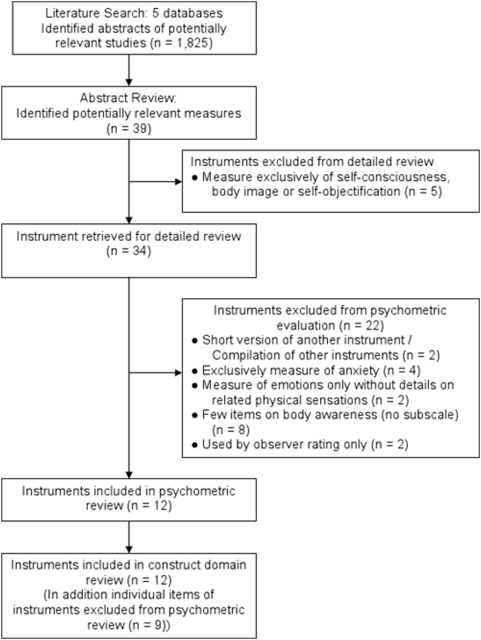
OBJECTIVES: Heightened body awareness can be adaptive and maladaptive. Improving body awareness has been suggested as an approach for treating patients with conditions such as chronic pain, obesity and post-traumatic stress disorder. We assessed the psychometric quality of selected self-report measures and examined their items for underlying definitions of the construct. DATA SOURCES: PubMed, PsychINFO, HaPI, Embase, Digital Dissertations Database. REVIEW METHODS: Abstracts were screened; potentially relevant instruments were obtained and systematically reviewed. Instruments were excluded if they exclusively measured anxiety, covered emotions without related physical sensations, used observer ratings only, or were unobtainable. We restricted our study to the proprioceptive and interoceptive channels of body awareness. The psychometric properties of each scale were rated using a structured evaluation according to the method of McDowell. Following a working definition of the multi-dimensional construct, an inter-disciplinary team systematically examined the items of existing body awareness instruments, identified the dimensions queried and used an iterative qualitative process to refine the dimensions of the construct. RESULTS: From 1,825 abstracts, 39 instruments were screened. 12 were included for psychometric evaluation. Only two were rated as high standard for reliability, four for validity. Four domains of body awareness with 11 sub-domains emerged. Neither a single nor a compilation of several instruments covered all dimensions. Key domains that might potentially differentiate adaptive and maladaptive aspects of body awareness were missing in the reviewed instruments. CONCLUSION: Existing self-report instruments do not address important domains of the construct of body awareness, are unable to discern between adaptive and maladaptive aspects of body awareness, or exhibit other psychometric limitations. Restricting the construct to its proprio- and interoceptive channels, we explore the current understanding of the multi-dimensional construct and suggest next steps for further research.
Overview
AI snapshot
Written from the paper’s full text.
TL;DR
This systematic review assessed self-report instruments for body awareness and found that existing measures have limited psychometric quality and do not cover key dimensions of the construct. The authors propose a four-domain, 11-sub-domain model and conclude that a new multidimensional instrument is needed.
Key findings
- From 1,825 abstracts, 39 instruments were screened; 12 were included for psychometric evaluation and 27 were excluded.
- Only two instruments were rated as high standard for reliability and four for validity; the BAQ was strongest with 18 psychometric “stars,” followed by PBCS (15), BVS (15), and SBC (13).
- Four domains with 11 sub-domains emerged: Perceived Body Sensations, Attention Quality, Attitude, and Mind-Body Integration. Neither a single instrument nor a compilation of several covered all dimensions, and key domains potentially differentiating adaptive from maladaptive body awareness were missing.
- The BAQ was uni-dimensional and explicitly excluded attention to pain sensations and emotions; the 5-item PBCS mostly measured one sub-domain, sensations of distress, worry and tension; only one body awareness instrument (SBA) included a single item for mode of attention (mindfulness versus labeling thought).
Methods
- Systematic search of PubMed, PsycInfo, EMBASE, HAPI, and Digital Dissertations in April–May 2007; abstracts were screened, and instruments were excluded if they exclusively measured anxiety, covered emotions without related physical sensations, used observer ratings only, or were unobtainable.
- Two reviewers independently compared psychometric characteristics using a structured evaluation adapted from McDowell, reaching consensus with a third reviewer when needed.
- Four reviewers iteratively reviewed the anonymized item pool from included instruments plus selected mindfulness items, starting with 7 domains and refining them into 4 domains and 11 sub-domains.
Limitations
- The paper states that no gold standard exists for criterion validity in body awareness, that none of the self-report measures had been validated against an objective measure, and that construct validation is incremental.
- The paper states that item wording often did not clearly discriminate between dimensions, that key dimensions were missing in most instruments, and that no single or compiled instrument satisfactorily covered all dimensions; the BPQ also lacked obtainable supporting publication by its author.
- Evident from the text: the review was restricted to proprioceptive and interoceptive channels and excluded exteroceptive/body image aspects, and the search was conducted in 2007, so later instruments are not included.
Model-written summary. Check it against the paper before relying on it.
Integrity signals
Registry
Cites
Statistics
Figures
Verification
Claims the paper makes
36 No basis given · 33 Not checked yet · 20 Own result · 17 Own interpretation · 7 Own method
A result the paper reports from its own data — it cites no other source for it, so there is none to check. The quote shows it is in the paper.
In the paper
“Key domains that might potentially differentiate adaptive and maladaptive aspects of body awareness were missing in the reviewed instruments.”
§ Body Awareness: Construct and Self-Report Measures > Abstract > Results
hedged- Asserted: passes — The authors put it forward as true.
- Checkable: passes — It can be checked against evidence.
- Load-bearing: passes — The paper’s conclusions depend on it.
- Based: passes — The paper gives a reason why it holds.
A result the paper reports from its own data — it cites no other source for it, so there is none to check. The quote shows it is in the paper.
In the paper
“Neither a single nor a compilation of several instruments covered all dimensions.”
§ Body Awareness: Construct and Self-Report Measures > Abstract > Results
plain- Asserted: passes — The authors put it forward as true.
- Checkable: passes — It can be checked against evidence.
- Load-bearing: passes — The paper’s conclusions depend on it.
- Based: passes — The paper gives a reason why it holds.
A result the paper reports from its own data — it cites no other source for it, so there is none to check. The quote shows it is in the paper.
In the paper
“Only two were rated as high standard for reliability, four for validity.”
§ Body Awareness: Construct and Self-Report Measures > Abstract > Results
plain- Asserted: passes — The authors put it forward as true.
- Checkable: passes — It can be checked against evidence.
- Load-bearing: unclear — It is unclear whether the paper’s conclusions depend on it.
- Based: passes — The paper gives a reason why it holds.
A result the paper reports from its own data — it cites no other source for it, so there is none to check. The quote shows it is in the paper.
In the paper
“Four domains of body awareness with 11 sub-domains emerged.”
§ Body Awareness: Construct and Self-Report Measures > Abstract > Results
plain- Asserted: passes — The authors put it forward as true.
- Checkable: passes — It can be checked against evidence.
- Load-bearing: passes — The paper’s conclusions depend on it.
- Based: passes — The paper gives a reason why it holds.
A result the paper reports from its own data — it cites no other source for it, so there is none to check. The quote shows it is in the paper.
In the paper
“Only two instruments have been used more than a few times.”
§ Body Awareness: Construct and Self-Report Measures > Results > Summary of Results of Psychometric Evaluation
plain- Asserted: passes — The authors put it forward as true.
- Checkable: passes — It can be checked against evidence.
- Load-bearing: passes — The paper’s conclusions depend on it.
- Based: passes — The paper gives a reason why it holds.
A result the paper reports from its own data — it cites no other source for it, so there is none to check. The quote shows it is in the paper.
In the paper
“Twelve instruments satisfied our inclusion criteria for the psychometric review (Figure 1).”
§ Body Awareness: Construct and Self-Report Measures > Results
plain- Asserted: passes — The authors put it forward as true.
- Checkable: passes — It can be checked against evidence.
- Load-bearing: passes — The paper’s conclusions depend on it.
- Based: passes — The paper gives a reason why it holds.
The paper states this without a source or data behind it here, so there is nothing to check it against. The quote shows it is in the paper.
In the paper
“Two instruments have been applied to both research and clinical use.”
§ Body Awareness: Construct and Self-Report Measures > Results > Summary of Results of Psychometric Evaluation
plain- Asserted: passes — The authors put it forward as true.
- Checkable: passes — It can be checked against evidence.
- Load-bearing: unclear — It is unclear whether the paper’s conclusions depend on it.
- Based: passes — The paper gives a reason why it holds.
In the paper
“Similarly, the PBCS [135] with its 5 items assesses primarily a single dimension.”
- Also stated in: § Discussion · plain
“The PBCS [135] with its 5 items assesses primarily a single dimension.”
§ Body Awareness: Construct and Self-Report Measures > Results > Summary of Results of Psychometric Evaluation
What the sources say
- Not checked yetcites [135] Miller LC Murphy R Buss AH 1981 Consciousness of body: Private and public. Journal of Personality and Social Psychology 41 397 406
plain- Asserted: passes — The authors put it forward as true.
- Checkable: passes — It can be checked against evidence.
- Load-bearing: passes — The paper’s conclusions depend on it.
- Based: passes — The paper gives a reason why it holds.
- Also stated in: § Discussion · plain
A result the paper reports from its own data — it cites no other source for it, so there is none to check. The quote shows it is in the paper.
In the paper
“In summary, few of the instruments have strong psychometric properties for rigorous research or clinical applications.”
§ Body Awareness: Construct and Self-Report Measures > Results > Summary of Results of Psychometric Evaluation
plain- Asserted: passes — The authors put it forward as true.
- Checkable: passes — It can be checked against evidence.
- Load-bearing: passes — The paper’s conclusions depend on it.
- Based: passes — The paper gives a reason why it holds.
- Probably not a substantial claim. 29
- It may state two separate claims as one. 27
- The quote only partly states this claim. 1
A result the paper reports from its own data — it cites no other source for it, so there is none to check. The quote shows it is in the paper.
In the paper
“From 1,825 abstracts, 39 instruments were screened.”
§ Body Awareness: Construct and Self-Report Measures > Abstract > Results
plain- Asserted: passes — The authors put it forward as true.
- Checkable: passes — It can be checked against evidence.
- Load-bearing: fails — The paper’s conclusions may not depend on it.
- Based: passes — The paper gives a reason why it holds.
Probably not a substantial claim. The paper’s conclusions may not depend on it.
A result the paper reports from its own data — it cites no other source for it, so there is none to check. The quote shows it is in the paper.
In the paper
“12 were included for psychometric evaluation.”
§ Body Awareness: Construct and Self-Report Measures > Abstract > Results
plain- Asserted: passes — The authors put it forward as true.
- Checkable: passes — It can be checked against evidence.
- Load-bearing: fails — The paper’s conclusions may not depend on it.
- Based: passes — The paper gives a reason why it holds.
Probably not a substantial claim. The paper’s conclusions may not depend on it.
In the paper
“Regarding their dimensions, the BAQ [142] is one-dimensional and explicitly excludes attention to pain sensations and emotions.”
§ Body Awareness: Construct and Self-Report Measures > Results > Summary of Results of Psychometric Evaluation
What the sources say
- Not checked yetcites [142] Shields SA Mallory MA Simon A 1989 The Body Awareness Questionnaire: reliability and validity. J Pers Assess 53 802 815
plain- Asserted: passes — The authors put it forward as true.
- Checkable: passes — It can be checked against evidence.
- Load-bearing: unclear — It is unclear whether the paper’s conclusions depend on it.
- Based: passes — The paper gives a reason why it holds.
It may state two separate claims as one.
A result the paper reports from its own data — it cites no other source for it, so there is none to check. The quote shows it is in the paper.
In the paper
“The systematic search yielded a total of 1,825 abstracts and identified 39 instruments related to body awareness.”
§ Body Awareness: Construct and Self-Report Measures > Results
plain- Asserted: passes — The authors put it forward as true.
- Checkable: passes — It can be checked against evidence.
- Load-bearing: unclear — It is unclear whether the paper’s conclusions depend on it.
- Based: passes — The paper gives a reason why it holds.
It may state two separate claims as one.
A result the paper reports from its own data — it cites no other source for it, so there is none to check. The quote shows it is in the paper.
In the paper
“27 instruments were excluded (Table 1).”
§ Body Awareness: Construct and Self-Report Measures > Results
plain- Asserted: passes — The authors put it forward as true.
- Checkable: passes — It can be checked against evidence.
- Load-bearing: fails — The paper’s conclusions may not depend on it.
- Based: passes — The paper gives a reason why it holds.
Probably not a substantial claim. The paper’s conclusions may not depend on it.
A result the paper reports from its own data — it cites no other source for it, so there is none to check. The quote shows it is in the paper.
In the paper
“Two instruments (BAQ, PBCS) fulfilled a high standard for reliability and four (BAQ, BVS, PBCS, SBC) for validity (characterized with three or more “*”s in Table 4).”
§ Body Awareness: Construct and Self-Report Measures > Results > Summary of Results of Psychometric Evaluation
plain- Asserted: passes — The authors put it forward as true.
- Checkable: passes — It can be checked against evidence.
- Load-bearing: passes — The paper’s conclusions depend on it.
- Based: passes — The paper gives a reason why it holds.
It may state two separate claims as one.
None of the sources cited for this claim have been checked yet.
In the paper
“Instruments specifically designed to measure mindfulness, such as the uni-dimensional Mindful Attention Awareness Scale (MAAS) [126], the Kentucky Inventory of Mindfulness Skills (KIMS) [117], and its successor the Five-Facet Mindfulness Scale (FFMS) [70], include items regarding awareness specifically of internal body sensations but do not provide subscales for body awareness (Table 7).”
§ Body Awareness: Construct and Self-Report Measures > Results > Summary of Conceptual Review
What the sources say
- Not checked yetcites [126] Brown KW Ryan RM 2003 The benefits of being present: mindfulness and its role in psychological well-being. J Pers Soc Psychol 84 822 848 12703651
- Not checked yetcites [117] Baer RA Smith GT Allen KB 2004 Assessment of mindfulness by self-report: the Kentucky inventory of mindfulness skills. Assessment 11 191 206 15358875
- Not checked yetcites [70] Baer RA Smith GT Hopkins J Krietemeyer J Toney L 2006 Using self-report assessment methods to explore facets of mindfulness. Assessment 13 27 45 16443717
plain- Asserted: passes — The authors put it forward as true.
- Checkable: passes — It can be checked against evidence.
- Load-bearing: passes — The paper’s conclusions depend on it.
- Based: passes — The paper gives a reason why it holds.
It may state two separate claims as one.
The paper states this without a source or data behind it here, so there is nothing to check it against. The quote shows it is in the paper.
In the paper
“If we add up the psychometric “stars” each instrument qualified for (including one for more than a few studies it was used in and one for clinical use, thus allowing for a maximum of 23 “stars”) we find the BAQ (18) as the strongest instrument, followed by PBCS (15), BVS (15), and SBC (13).”
§ Body Awareness: Construct and Self-Report Measures > Results > Summary of Results of Psychometric Evaluation
plain- Asserted: passes — The authors put it forward as true.
- Checkable: passes — It can be checked against evidence.
- Load-bearing: passes — The paper’s conclusions depend on it.
- Based: passes — The paper gives a reason why it holds.
It may state two separate claims as one.
The paper states this without a source or data behind it here, so there is nothing to check it against. The quote shows it is in the paper.
In the paper
“Perceived body sensations or the ability to note changes in body processes, to identify inner sensations (e.g. a tight muscle, fatigue, warmth, pain) and to discern subtle bodily cues indicating varying functional states of the body or its organs and the emotional/physiological state. This dimension is the primary sensory, physiological aspect of body awareness with its early, mostly pre-conscious”
§ Body Awareness: Construct and Self-Report Measures > Results > Emerging Key Dimensions of the Body Awareness Construct
plain- Asserted: passes — The authors put it forward as true.
- Checkable: passes — It can be checked against evidence.
- Load-bearing: passes — The paper’s conclusions depend on it.
- Based: passes — The paper gives a reason why it holds.
Probably not a substantial claim. It may state two separate claims as one.
The paper states this without a source or data behind it here, so there is nothing to check it against. The quote shows it is in the paper.
In the paper
“KIMS and FFMQ contain subscales labeled “Observing”; however, these subscales include items for the awareness of thoughts and external stimuli (sights, sounds, smells) that disqualified them from our psychometric review.”
§ Body Awareness: Construct and Self-Report Measures > Results > Summary of Conceptual Review
plain- Asserted: passes — The authors put it forward as true.
- Checkable: passes — It can be checked against evidence.
- Load-bearing: passes — The paper’s conclusions depend on it.
- Based: passes — The paper gives a reason why it holds.
It may state two separate claims as one.
A result the paper reports from its own data — it cites no other source for it, so there is none to check. The quote shows it is in the paper.
In the paper
“Five instruments were administered in patients but only one in patients with pain (PBCS).”
§ Body Awareness: Construct and Self-Report Measures > Results > Summary of Results of Psychometric Evaluation
plain- Asserted: passes — The authors put it forward as true.
- Checkable: passes — It can be checked against evidence.
- Load-bearing: unclear — It is unclear whether the paper’s conclusions depend on it.
- Based: passes — The paper gives a reason why it holds.
It may state two separate claims as one.
In the paper
“The MAAS includes a single item (item 5), which is missing from the factor analysis by Baer [70] without explanation, might load on the ‘observing’ facet of mindfulness and was included in the conceptual review.”
§ Body Awareness: Construct and Self-Report Measures > Results > Summary of Conceptual Review
What the sources say
- Not checked yetcites [70] Baer RA Smith GT Hopkins J Krietemeyer J Toney L 2006 Using self-report assessment methods to explore facets of mindfulness. Assessment 13 27 45 16443717
hedged- Asserted: passes — The authors put it forward as true.
- Checkable: passes — It can be checked against evidence.
- Load-bearing: unclear — It is unclear whether the paper’s conclusions depend on it.
- Based: passes — The paper gives a reason why it holds.
It may state two separate claims as one.
The paper states this without a source or data behind it here, so there is nothing to check it against. The quote shows it is in the paper.
In the paper
“Multiple reformulations of the dimensions and sub-domains aided in simplifying the ordering of items but could not overcome this limitation.”
§ Body Awareness: Construct and Self-Report Measures > Results > Summary of Conceptual Review
plaindirect- Asserted: passes — The authors put it forward as true.
- Checkable: passes — It can be checked against evidence.
- Load-bearing: passes — The paper’s conclusions depend on it.
- Based: passes — The paper gives a reason why it holds.
It may state two separate claims as one.
The paper states this without a source or data behind it here, so there is nothing to check it against. The quote shows it is in the paper.
In the paper
“Also, item 22 in the ‘describe’ facet addresses body sensations. Therefore, 7 items qualified for our conceptual review.”
§ Body Awareness: Construct and Self-Report Measures > Results > Summary of Conceptual Review
plaindirect- Asserted: passes — The authors put it forward as true.
- Checkable: passes — It can be checked against evidence.
- Load-bearing: passes — The paper’s conclusions depend on it.
- Based: passes — The paper gives a reason why it holds.
Probably not a substantial claim. It may state two separate claims as one.
A result the paper reports from its own data — it cites no other source for it, so there is none to check. The quote shows it is in the paper.
In the paper
“The following four inter-related dimensions emerged (Table 5):”
§ Body Awareness: Construct and Self-Report Measures > Results > Emerging Key Dimensions of the Body Awareness Construct
plaincorrelational- Asserted: passes — The authors put it forward as true.
- Checkable: passes — It can be checked against evidence.
- Load-bearing: passes — The paper’s conclusions depend on it.
- Based: passes — The paper gives a reason why it holds.
The quote only partly states this claim.
The paper states this without a source or data behind it here, so there is nothing to check it against. The quote shows it is in the paper.
In the paper
“Second, according to the dimensions and sub-domains emerging from our qualitative review, in most instruments, item wording does not clearly discriminate between dimensions reflecting a lack of systematic measurement development.”
§ Body Awareness: Construct and Self-Report Measures > Discussion
plain- Asserted: passes — The authors put it forward as true.
- Checkable: passes — It can be checked against evidence.
- Load-bearing: passes — The paper’s conclusions depend on it.
- Based: passes — The paper gives a reason why it holds.
It may state two separate claims as one.
The paper states this without a source or data behind it here, so there is nothing to check it against. The quote shows it is in the paper.
In the paper
“the SSAS includes two items for ‘neutral sensations’ (1C), and three for ‘bothersomeness of symptoms’ (1D).”
§ Body Awareness: Construct and Self-Report Measures > Results > Summary of Conceptual Review
plain- Asserted: passes — The authors put it forward as true.
- Checkable: passes — It can be checked against evidence.
- Load-bearing: unclear — It is unclear whether the paper’s conclusions depend on it.
- Based: passes — The paper gives a reason why it holds.
It may state two separate claims as one.
The paper states this without a source or data behind it here, so there is nothing to check it against. The quote shows it is in the paper.
In the paper
“Numerous instruments were exclusively developed to measure anxiety or assess body image.”
§ Body Awareness: Construct and Self-Report Measures > Discussion
plain- Asserted: passes — The authors put it forward as true.
- Checkable: passes — It can be checked against evidence.
- Load-bearing: passes — The paper’s conclusions depend on it.
- Based: passes — The paper gives a reason why it holds.
It may state two separate claims as one.
The paper states this without a source or data behind it here, so there is nothing to check it against. The quote shows it is in the paper.
In the paper
“Third, most current definitions of body awareness appear to be dominated by the concern that heightened body awareness necessarily leads to somatosensory amplification, worsens symptoms of anxiety and hypochondriasis, and is maladaptive for clinical outcomes, such as pain.”
§ Body Awareness: Construct and Self-Report Measures > Discussion
hedgeddirect- Asserted: passes — The authors put it forward as true.
- Checkable: passes — It can be checked against evidence.
- Load-bearing: passes — The paper’s conclusions depend on it.
- Based: fails — The paper may give no reason why it holds.
Probably not a substantial claim. The paper may give no reason why it holds. It may state two separate claims as one.
A result the paper reports from its own data — it cites no other source for it, so there is none to check. The quote shows it is in the paper.
In the paper
“The broadest coverage of our dimensions and the total of eleven sub-domains are provided by BIS with 10, SBC with 7, and BAM with 5 sub-domains, respectively.”
§ Body Awareness: Construct and Self-Report Measures > Results > Summary of Conceptual Review
plain- Asserted: passes — The authors put it forward as true.
- Checkable: passes — It can be checked against evidence.
- Load-bearing: unclear — It is unclear whether the paper’s conclusions depend on it.
- Based: passes — The paper gives a reason why it holds.
It may state two separate claims as one.
The paper states this without a source or data behind it here, so there is nothing to check it against. The quote shows it is in the paper.
In the paper
“However, among uni-dimensional definitions of body awareness, the dimensions queried by the items vary considerably across instruments and represent different aspects of the construct.”
§ Body Awareness: Construct and Self-Report Measures > Discussion
plain- Asserted: passes — The authors put it forward as true.
- Checkable: passes — It can be checked against evidence.
- Load-bearing: passes — The paper’s conclusions depend on it.
- Based: passes — The paper gives a reason why it holds.
It may state two separate claims as one.
The paper states this without a source or data behind it here, so there is nothing to check it against. The quote shows it is in the paper.
In the paper
“Body awareness is considered by most authors to be a single, mostly undifferentiated construct.”
§ Body Awareness: Construct and Self-Report Measures > Discussion
plain- Asserted: passes — The authors put it forward as true.
- Checkable: passes — It can be checked against evidence.
- Load-bearing: passes — The paper’s conclusions depend on it.
- Based: fails — The paper may give no reason why it holds.
Probably not a substantial claim. The paper may give no reason why it holds.
None of the sources cited for this claim have been checked yet.
In the paper
“Only two instruments have strong psychometric properties and were used in more than a few studies: BAQ and PBCS.”
- Also stated in: § Discussion · boosted
“Several instruments demonstrate strong psychometric properties (BAQ, PBCS).”
§ Body Awareness: Construct and Self-Report Measures > Discussion
What the sources say
- Not checked yetcites [142] Shields SA Mallory MA Simon A 1989 The Body Awareness Questionnaire: reliability and validity. J Pers Assess 53 802 815
- Not checked yetcites [135] Miller LC Murphy R Buss AH 1981 Consciousness of body: Private and public. Journal of Personality and Social Psychology 41 397 406
boosted- Asserted: passes — The authors put it forward as true.
- Checkable: passes — It can be checked against evidence.
- Load-bearing: passes — The paper’s conclusions depend on it.
- Based: passes — The paper gives a reason why it holds.
It may state two separate claims as one.
- Also stated in: § Discussion · boosted
The paper states this without a source or data behind it here, so there is nothing to check it against. The quote shows it is in the paper.
In the paper
“This iterative process continuously refined our operational definition into a conceptual model with explicit domains and sub-domains.”
§ Body Awareness: Construct and Self-Report Measures > Methods > Iterative Conceptual Review Process and Construct Refinement
plaindirect- Asserted: passes — The authors put it forward as true.
- Checkable: passes — It can be checked against evidence.
- Load-bearing: passes — The paper’s conclusions depend on it.
- Based: passes — The paper gives a reason why it holds.
Probably not a substantial claim.
The paper states this without a source or data behind it here, so there is nothing to check it against. The quote shows it is in the paper.
In the paper
“To this date, it remains unclear whether any mind-body approach, meditation or others enhance forms of body awareness other than heartbeat detection, or whether increases in body awareness translate to all of its aspects, or whether these approaches enhance body awareness at all.”
§ Body Awareness: Construct and Self-Report Measures > Discussion
plain- Asserted: passes — The authors put it forward as true.
- Checkable: passes — It can be checked against evidence.
- Load-bearing: passes — The paper’s conclusions depend on it.
- Based: passes — The paper gives a reason why it holds.
It may state two separate claims as one.
None of the sources cited for this claim have been checked yet.
In the paper
“Sensitivity is increased in patients with irritable bowel syndrome in conjunction with hypervigilance, and a systematic desensitization was associated with improved symptoms [156], [157].”
§ Body Awareness: Construct and Self-Report Measures > Discussion
What the sources say
- Not checked yetcites [156] Drossman DA Ringel Y Vogt BA Leserman J Lin W 2003 Alterations of brain activity associated with resolution of emotional distress and pain in a case of severe irritable bowel syndrome. Gastroenterology 124 754 761 12612913
- Not checked yetcites [157] Naliboff BD Berman S Suyenobu B Labus JS Chang L 2006 Longitudinal change in perceptual and brain activation response to visceral stimuli in irritable bowel syndrome patients. Gastroenterology 131 352 365 16890589
plaincorrelational- Asserted: passes — The authors put it forward as true.
- Checkable: passes — It can be checked against evidence.
- Load-bearing: unclear — It is unclear whether the paper’s conclusions depend on it.
- Based: passes — The paper gives a reason why it holds.
It may state two separate claims as one.
The paper states this without a source or data behind it here, so there is nothing to check it against. The quote shows it is in the paper.
In the paper
“In addition to further studies of single-modality of interoception, objective measures of trans-modal interoception might be developed in the near future, for which currently no gold standard is available.”
§ Body Awareness: Construct and Self-Report Measures > Discussion
plain- Asserted: passes — The authors put it forward as true.
- Checkable: passes — It can be checked against evidence.
- Load-bearing: passes — The paper’s conclusions depend on it.
- Based: passes — The paper gives a reason why it holds.
Probably not a substantial claim.
None of the sources cited for this claim have been checked yet.
In the paper
“Gastrointestinal (GI) distension has been used to study gastrointestinal interoceptive sensitivity [154], [155].”
§ Body Awareness: Construct and Self-Report Measures > Discussion
What the sources say
- Not checked yetcites [154] Holzl R Erasmus LP Moltner A 1996 Detection, discrimination and sensation of visceral stimuli. Biol Psychol 42 199 214 8770379
- Not checked yetcites [155] Stephan E Pardo JV Faris PL Hartman BK Kim SW 2003 Functional neuroimaging of gastric distention. J Gastrointest Surg 7 740 749 13129550
plain- Asserted: passes — The authors put it forward as true.
- Checkable: passes — It can be checked against evidence.
- Load-bearing: fails — The paper’s conclusions may not depend on it.
- Based: passes — The paper gives a reason why it holds.
Probably not a substantial claim. The paper’s conclusions may not depend on it.
In the paper
“Heightened body awareness can be adaptive and maladaptive.”
§ Body Awareness: Construct and Self-Report Measures > Abstract > Objectives
What the sources say
- Not checked yetcites [43] Watkins E Teasdale JD 2004 Adaptive and maladaptive self-focus in depression. J Affect Disord 82 1 8 15465571
plain- Asserted: passes — The authors put it forward as true.
- Checkable: passes — It can be checked against evidence.
- Load-bearing: passes — The paper’s conclusions depend on it.
- Based: passes — The paper gives a reason why it holds.
It may state two separate claims as one.
What the paper did — it cites no source for this, so there is none to check. The quote shows it is in the paper.
In the paper
“the original items were independently reviewed by two reviewers (WM and VG).”
§ Body Awareness: Construct and Self-Report Measures > Methods > Systematic Review Step 2: In-depth Instrument Review
plain- Asserted: passes — The authors put it forward as true.
- Checkable: passes — It can be checked against evidence.
- Load-bearing: fails — The paper’s conclusions may not depend on it.
- Based: passes — The paper gives a reason why it holds.
Probably not a substantial claim. The paper’s conclusions may not depend on it.
None of the sources cited for this claim have been checked yet.
In the paper
“Awareness of physical sensations associated with emotions is a key element for affect regulation and for the sense of self [34], [38]–[40].”
§ Body Awareness: Construct and Self-Report Measures > Introduction
What the sources say
- Not checked yetcites [34] Bechara A Naqvi N 2004 Listening to your heart: interoceptive awareness as a gateway to feeling. Nat Neurosci 7 102 103 14747831
- Not checked yetcites [38]–[40]
plaincorrelational- Asserted: passes — The authors put it forward as true.
- Checkable: passes — It can be checked against evidence.
- Load-bearing: passes — The paper’s conclusions depend on it.
- Based: passes — The paper gives a reason why it holds.
Probably not a substantial claim. It may state two separate claims as one.
In the paper
“self-awareness or the awareness of symptoms in depressed patients can be adaptive or maladaptive according to “distinct and incompatible modes of mind”; a ruminative self-focus appears to be maladaptive whereas focusing attention directly on immediately experienced feelings appears to be adaptive [43].”
§ Body Awareness: Construct and Self-Report Measures > Introduction
What the sources say
- Not checked yetcites [43] Watkins E Teasdale JD 2004 Adaptive and maladaptive self-focus in depression. J Affect Disord 82 1 8 15465571
hedgedcorrelational- Asserted: passes — The authors put it forward as true.
- Checkable: passes — It can be checked against evidence.
- Load-bearing: fails — The paper’s conclusions may not depend on it.
- Based: passes — The paper gives a reason why it holds.
Probably not a substantial claim. The paper’s conclusions may not depend on it. It may state two separate claims as one.
In the paper
“Construct validation can only be established incrementally and is a continuing process aiding in our understanding and revision of the construct [124].”
§ Body Awareness: Construct and Self-Report Measures > Methods > Psychometric Assessment
What the sources say
- Not checked yetcites [124] Sechrest L 2005 Validity of measures is no simple matter. Health Serv Res 40 1584 1604 16178997 PMC1361215
plain- Asserted: passes — The authors put it forward as true.
- Checkable: fails — It may be too vague to check against evidence.
- Load-bearing: fails — The paper’s conclusions may not depend on it.
- Based: passes — The paper gives a reason why it holds.
Probably not a substantial claim. It may be too vague to check against evidence. The paper’s conclusions may not depend on it.
What the paper did — it cites no source for this, so there is none to check. The quote shows it is in the paper.
In the paper
“two reviewers (VG, WM) independently compared the psychometric characteristics of the reviewed measurements until consensus was reached in all categories.”
§ Body Awareness: Construct and Self-Report Measures > Methods > Psychometric Assessment
plain- Asserted: passes — The authors put it forward as true.
- Checkable: passes — It can be checked against evidence.
- Load-bearing: passes — The paper’s conclusions depend on it.
- Based: passes — The paper gives a reason why it holds.
Probably not a substantial claim.
What the paper did — it cites no source for this, so there is none to check. The quote shows it is in the paper.
In the paper
“When initial consensus about an instrument could not be reached, the opinion of a third reviewer (JD) was sought and discussed until unanimous agreement was reached.”
§ Body Awareness: Construct and Self-Report Measures > Methods > Systematic Review Step 2: In-depth Instrument Review
plain- Asserted: passes — The authors put it forward as true.
- Checkable: passes — It can be checked against evidence.
- Load-bearing: fails — The paper’s conclusions may not depend on it.
- Based: passes — The paper gives a reason why it holds.
Probably not a substantial claim. The paper’s conclusions may not depend on it.
In the paper
“the dominant view in medical and behavioral science considers heightened awareness of somatic information as potentially distressing and maladaptive.”
§ Body Awareness: Construct and Self-Report Measures > Introduction
What the sources say
- Not checked yetcites [3] Cioffi D 1991 Beyond attentional strategies: cognitive-perceptual model of somatic interpretation. Psychol Bull 109 25 41 2006227
hedgedconditional- Asserted: passes — The authors put it forward as true.
- Checkable: passes — It can be checked against evidence.
- Load-bearing: passes — The paper’s conclusions depend on it.
- Based: passes — The paper gives a reason why it holds.
Probably not a substantial claim.
A conclusion the paper draws from its own results — it cites no other source for it, so there is none to check. The quote shows it is in the paper.
In the paper
“These findings seem to contradict the traditional understanding of body awareness and suggest that body awareness is a complex, multi-dimensional construct in need of more nuanced conceptualization.”
§ Body Awareness: Construct and Self-Report Measures > Introduction
hedged- Asserted: passes — The authors put it forward as true.
- Checkable: unclear — It is unclear whether it could be checked against evidence.
- Load-bearing: passes — The paper’s conclusions depend on it.
- Based: passes — The paper gives a reason why it holds.
It may state two separate claims as one.
What the paper did — it cites no source for this, so there is none to check. The quote shows it is in the paper.
In the paper
“the abstracts of all identified publications were screened for relevance by two reviewers (WM and VG).”
§ Body Awareness: Construct and Self-Report Measures > Methods > Systematic Review Step 1: Screening of Abstracts
plain- Asserted: passes — The authors put it forward as true.
- Checkable: passes — It can be checked against evidence.
- Load-bearing: fails — The paper’s conclusions may not depend on it.
- Based: passes — The paper gives a reason why it holds.
Probably not a substantial claim. The paper’s conclusions may not depend on it.
In the paper
“The psychometric properties of each scale were rated using a structured evaluation according to the method of McDowell.”
§ Body Awareness: Construct and Self-Report Measures > Abstract > Review methods
What the sources say
- Not checked yetcites McDowell
plain- Asserted: passes — The authors put it forward as true.
- Checkable: passes — It can be checked against evidence.
- Load-bearing: fails — The paper’s conclusions may not depend on it.
- Based: passes — The paper gives a reason why it holds.
Probably not a substantial claim. The paper’s conclusions may not depend on it.
In the paper
“mindfulness encompasses more than awareness of inner sensations by including awareness of cognitive thoughts of any kind, which are not excluded from the body awareness construct [71].”
§ Body Awareness: Construct and Self-Report Measures > Introduction
What the sources say
- Not checked yetcites [71] Kerr C 2002 Translating “mind-in-body”: two models of patient experience underlying a randomized controlled trial of qigong. Cult Med Psychiatry 26 419 447 12572768
plain- Asserted: passes — The authors put it forward as true.
- Checkable: passes — It can be checked against evidence.
- Load-bearing: fails — The paper’s conclusions may not depend on it.
- Based: passes — The paper gives a reason why it holds.
Probably not a substantial claim. The paper’s conclusions may not depend on it.
In the paper
“few attempts have been made to measure changes in body awareness associated with such interventions [108], and to link intervention-related changes in body awareness to clinical outcomes.”
§ Body Awareness: Construct and Self-Report Measures > Introduction
What the sources say
- Not checked yetcites [108] Villien F Yu M Barthelemy P Jammes Y 2005 Training to yoga respiration selectively increases respiratory sensation in healthy man. Respir Physiol Neurobiol 146 85 96 15733782
plaincorrelational- Asserted: passes — The authors put it forward as true.
- Checkable: passes — It can be checked against evidence.
- Load-bearing: passes — The paper’s conclusions depend on it.
- Based: passes — The paper gives a reason why it holds.
It may state two separate claims as one.
None of the sources cited for this claim have been checked yet.
In the paper
“There is very preliminary experimental support for the notion that interoceptive accuracy might have trait and state aspects that co-vary across modalities [111], [112] reflecting a general sensitivity for visceral processes.”
§ Body Awareness: Construct and Self-Report Measures > Introduction
What the sources say
- Not checked yetcites [111] Zoellner LA Craske MG 1999 Interoceptive accuracy and panic. Behav Res Ther 37 1141 1158 10596462
- Not checked yetcites [112] Whitehead WE Drescher VM 1980 Perception of gastric contractions and self-control of gastric motility. Psychophysiology 17 552 558 7443922
hedgedcorrelational- Asserted: passes — The authors put it forward as true.
- Checkable: passes — It can be checked against evidence.
- Load-bearing: fails — The paper’s conclusions may not depend on it.
- Based: passes — The paper gives a reason why it holds.
Probably not a substantial claim. The paper’s conclusions may not depend on it.
What the paper did — it cites no source for this, so there is none to check. The quote shows it is in the paper.
In the paper
“all instruments identified in the first step were anonymized”
§ Body Awareness: Construct and Self-Report Measures > Methods > Systematic Review Step 2: In-depth Instrument Review
plain- Asserted: passes — The authors put it forward as true.
- Checkable: passes — It can be checked against evidence.
- Load-bearing: fails — The paper’s conclusions may not depend on it.
- Based: passes — The paper gives a reason why it holds.
Probably not a substantial claim. The paper’s conclusions may not depend on it.
None of the sources cited for this claim have been checked yet.
In the paper
“The Body Awareness Rating Scale [127], [128] is an observer-based rating scale that judges the functionality of various visually observed movement patterns; it is exclusively used by specially trained physical therapists in Scandinavian countries, requires extensive training which, to our knowledge, is not available, translated or used outside these countries and had mixed results for inter-examin”
§ Body Awareness: Construct and Self-Report Measures > Results
What the sources say
- Not checked yetcites [127] Friis S Skatteboe UB Hope MK Vaglum P 1989 Body awareness group therapy for patients with personality disorders. 2. Evaluation of the Body Awareness Rating Scale. Psychother Psychosom 51 18 24 2602528
- Not checked yetcites [128] Roxendal G 1992 BAS-skalan med BAS halsa [The Body Awareness Scale and the Body Awareness Scale-Health] Lund (in Swedish) Studentlitteratur
- Not checked yetcites [129]–[131]
hedged- Asserted: passes — The authors put it forward as true.
- Checkable: passes — It can be checked against evidence.
- Load-bearing: unclear — It is unclear whether the paper’s conclusions depend on it.
- Based: passes — The paper gives a reason why it holds.
It may state two separate claims as one.
What the paper did — it cites no source for this, so there is none to check. The quote shows it is in the paper.
In the paper
“No limits were placed on language, country or time of publication.”
§ Body Awareness: Construct and Self-Report Measures > Methods
plain- Asserted: passes — The authors put it forward as true.
- Checkable: passes — It can be checked against evidence.
- Load-bearing: fails — The paper’s conclusions may not depend on it.
- Based: passes — The paper gives a reason why it holds.
Probably not a substantial claim. The paper’s conclusions may not depend on it.
What the paper did — it cites no source for this, so there is none to check. The quote shows it is in the paper.
In the paper
“we conducted a systematic search of 5 electronic databases to identify articles reporting the use of body awareness-related instruments: PubMed, PsycInfo, EMBASE, HAPI, and the Digital Dissertations Database.”
§ Body Awareness: Construct and Self-Report Measures > Methods
plain- Asserted: passes — The authors put it forward as true.
- Checkable: passes — It can be checked against evidence.
- Load-bearing: fails — The paper’s conclusions may not depend on it.
- Based: passes — The paper gives a reason why it holds.
Probably not a substantial claim. The paper’s conclusions may not depend on it.
A conclusion the paper draws from its own results — it cites no other source for it, so there is none to check. The quote shows it is in the paper.
In the paper
“Intriguingly, only one instrument dedicated to body awareness (SBA) included a single item to measure the quality or mode of attention, mindfulness versus labeling thought (2C), that seems to make all the difference between body awareness being adaptive or maladaptive.”
§ Body Awareness: Construct and Self-Report Measures > Results > Summary of Conceptual Review
hedgeddirect- Asserted: passes — The authors put it forward as true.
- Checkable: passes — It can be checked against evidence.
- Load-bearing: passes — The paper’s conclusions depend on it.
- Based: fails — The paper may give no reason why it holds.
Probably not a substantial claim. The paper may give no reason why it holds.
A conclusion the paper draws from its own results — it cites no other source for it, so there is none to check. The quote shows it is in the paper.
In the paper
“Thus these scales are limited by their focus on patients with specific diagnoses or lack a more systematic and comprehensive, multidimensional construct development.”
§ Body Awareness: Construct and Self-Report Measures > Discussion
plain- Asserted: passes — The authors put it forward as true.
- Checkable: passes — It can be checked against evidence.
- Load-bearing: passes — The paper’s conclusions depend on it.
- Based: passes — The paper gives a reason why it holds.
It may state two separate claims as one.
In the paper
“It has been suggested that benefits from mind-body interventions may be derived from an uncoupling of a ‘narrative self-focus’ from an ‘experiential awareness focus’ [109];”
§ Body Awareness: Construct and Self-Report Measures > Discussion
What the sources say
- Not checked yetcites [109] Farb NA Segal ZV Mayberg H Bean J McKeon D 2007 Attending to the present: mindfulness meditation reveals distinct neural modes of self-reference. Soc Cogn Affect Neurosci 2 313 322 18985137 PMC2566754
hedgedconditional- Asserted: fails — The authors may not put it forward as true.
- Checkable: passes — It can be checked against evidence.
- Load-bearing: fails — The paper’s conclusions may not depend on it.
- Based: passes — The paper gives a reason why it holds.
Probably not a substantial claim. The authors may not put it forward as true. The paper’s conclusions may not depend on it.
A conclusion the paper draws from its own results — it cites no other source for it, so there is none to check. The quote shows it is in the paper.
In the paper
“There is a great need to develop an instrument that overcomes these limitations.”
§ Body Awareness: Construct and Self-Report Measures > Discussion
plain- Asserted: passes — The authors put it forward as true.
- Checkable: fails — It may be too vague to check against evidence.
- Load-bearing: passes — The paper’s conclusions depend on it.
- Based: passes — The paper gives a reason why it holds.
Probably not a substantial claim. It may be too vague to check against evidence.
A conclusion the paper draws from its own results — it cites no other source for it, so there is none to check. The quote shows it is in the paper.
In the paper
“Although heart beat has the advantage of being less susceptible to voluntary manipulations when compared i.e. with respiration, none of the body awareness training approaches we reviewed focus on heart rate perceptions.”
§ Body Awareness: Construct and Self-Report Measures > Discussion
plaincorrelational- Asserted: passes — The authors put it forward as true.
- Checkable: passes — It can be checked against evidence.
- Load-bearing: fails — The paper’s conclusions may not depend on it.
- Based: passes — The paper gives a reason why it holds.
Probably not a substantial claim. The paper’s conclusions may not depend on it.
A conclusion the paper draws from its own results — it cites no other source for it, so there is none to check. The quote shows it is in the paper.
In the paper
“Similar to the research of pain, in the immediate future broader clinical research in the field of body awareness will also have to rely on self report.”
§ Body Awareness: Construct and Self-Report Measures > Discussion
plain- Asserted: passes — The authors put it forward as true.
- Checkable: fails — It may be too vague to check against evidence.
- Load-bearing: passes — The paper’s conclusions depend on it.
- Based: passes — The paper gives a reason why it holds.
Probably not a substantial claim. It may be too vague to check against evidence.
The paper relies on this without support.
A 'gold standard' for assessing criterion validity in measures of body awareness does not exist.
“A “gold standard” for assessing criterion validity in measures of body awareness does not exist.”
The paper relies on this without support.
The four domains and 11 sub-domains identified by the interdisciplinary team constitute the complete or correct set of dimensions of body awareness.
“Following a working definition of the multi-dimensional construct, an inter-disciplinary team systematically examined the items of existing body awareness instruments, identified the dimensions queried and used an iterative qualitative process to refine the dimensions of the construct.”
The paper relies on this without support.
Therapeutic approaches claiming to enhance body awareness frequently suffer from a lack of theory and methodologically weak research.
“These approaches are often categorized as mind-body approaches and/or manual therapies [83] and enjoy a growing popularity in the Western world [59] but frequently suffer from a lack of theory and methodologically weak research behind esoteric formulations and unfounded statements of benefits.”
The paper relies on this without support.
There is a great need to study practices of interoception and body awareness and their potential clinical benefits.
“Although there is a great need to study practices of interoception and body awareness and their potential clinical benefits, few attempts have been made to measure changes in body awareness associated with such interventions [108]”
The paper relies on this without support.
Aspects of mindfulness constitute a key element of body awareness.
“as they have been widely used in the mindfulness literature, and aspects of mindfulness appear to constitute a key element of body awareness.”
Claims other papers make about this one
Each is checked against this paper’s own text: does it say what the citing paper says it does?
The cited source doesn’t support the claim as written.
In the citing paper
“One of the consequences of attentional focus in mindfulness meditation is the increase in body awareness by practitioners attending to internal perceptions, developing their understanding of subtle sensations and perceptions of their body [34, 35], with studies based on self-administered questionnaires showing a significant increase in body awareness in practiced meditators (see [36]).”
From Mindful emotion regulation: Exploring the neurocognitive mechanisms behind mindfulness (2015) · cites this paper as [36]
Checked by a reasoning model — may be wrong.
Experimental — accuracy not yet measuredThe source backs part of the claim, not all of it — or backs it for a different population, condition or comparison.
In the citing paper
“Although we do not have a detailed map of the somatosensory areas of the brain that process sensations from fasciae, they play an important role in the overall sense of “inner body awareness” that involves brain areas linked to emotions, such as the insula and cingulate cortices [17].”
From Fascia Mobility, Proprioception, and Myofascial Pain. (2021) · cites this paper as [17]
Experimental — accuracy not yet measuredThe source backs part of the claim, not all of it — or backs it for a different population, condition or comparison.
In the citing paper
“For instance, the BA literature, which is slanted toward a clinical population, suggests that heightened awareness of bodily sensations often serves as markers for a variety of mental disorders including anxiety, panic disorder, depression, eating disorders, somatization, and others (Cioffi, 1991; Pollatos et al., 2008, 2009; Mehling et al., 2009; Herbert and Pollatos, 2014; Mallorquí-Bagué et al.”
From Mindfulness, Interoception, and the Body: A Contemporary Perspective (2019) · cites this paper as Mehling et al., 2009
Experimental — accuracy not yet measuredThe source backs part of the claim, not all of it — or backs it for a different population, condition or comparison.
In the citing paper
“One problem as Mehling et al. (2009) point out is that terms, such as body awareness or somatic awareness, are often used interchangeably with interoception or interoceptive awareness.”
From Mindfulness, Interoception, and the Body: A Contemporary Perspective (2019) · cites this paper as Mehling et al., 2009
Experimental — accuracy not yet measuredThe source backs part of the claim, not all of it — or backs it for a different population, condition or comparison.
In the citing paper
“Dispositional mindfulness may promote more adaptive interoceptive attentional styles and enhance or illuminate discriminative capacities related to various bodily sensations (Mehling et al., 2009; Hanley et al., 2017).”
From Mindfulness, Interoception, and the Body: A Contemporary Perspective (2019) · cites this paper as Mehling et al., 2009
Experimental — accuracy not yet measured
The cited source says what the claim attributes to it.
In the citing paper
“Body awareness involves a focus on and awareness of internal bodily sensations [9].”
The cited source says what the claim attributes to it.
In the citing paper
“An abnormal increase in body awareness can be maladaptive [9] and is, in general, also related to anxiety disorders [10–14].”
In the citing paper
“However, most standardized questionnaires do not fully use this potential, either because they assess only one dimension of IA (e.g., Body Awareness Questionnaire, Shields et al., 1989; Private Body Consciousness Scale, Miller et al., 1981) or because they assess different aspects together in one scale (see Mehling et al., 2009, for a review).”
From Differential changes in self-reported aspects of interoceptive awareness through 3 months of contemplative training (2015) · cites this paper as Mehling et al., 2009
In the citing paper
“Body awareness has been proposed as a potential mechanism for the therapeutic effects of mindfulness and is considered an integral part of the mindfulness construct (Mehling et al., 2009; Hölzel et al., 2011; Farb et al.,”
From Effects of mindfulness-based cognitive therapy on body awareness in patients with chronic pain and comorbid depression (2016) · cites this paper as Mehling et al., 2009
Self-check
Percentages, sums and reported differences re-computed from the paper’s own numbers.
Each contradiction between two passages listed here was confirmed by an independent check.
Rated minor: it would not touch a result — a value no result rests on, a p-value that stays on the same side of the significance level, or a conflict that is clerical, resolved elsewhere in the paper, or outside its own findings.
In the paper
§ Body Awareness: Construct and Self-Report Measures > Methods > Systematic Review Step 1: Screening of Abstracts
“| Barsky et al. [122] | Somato-Sensory Amplification Scale | SSAS | 3 |”
§ Body Awareness: Construct and Self-Report Measures > Results > Summary of Conceptual Review
“| | Number of body awareness-related items | 7 | 5 | 6 | 10 | 1 | 8 | 4 | 5 | 10 | 5 |”
Rated minor: it would not touch a result — a value no result rests on, a p-value that stays on the same side of the significance level, or a conflict that is clerical, resolved elsewhere in the paper, or outside its own findings.
In the paper
§ Body Awareness: Construct and Self-Report Measures > Results > Summary of Conceptual Review
“| | Sub domains covered (out of 10) | 3 | 3 | 3 | 2 | 1 | 2 | 3 | 4 | 4 | 4 |”
§ Body Awareness: Construct and Self-Report Measures > Results > Summary of Conceptual Review
“| | Sub domains covered (out of 11) | 10 | 4 | 5 | 4 | 3 | 3 | 3 | 3 | 7 | 1 | 2 | 2 |”
Citations
Cites
An inventory for measuring clinical anxiety: Psychometric properties.
Beck, A. T., Epstein, N., Brown, G., & Steer, R. A. (1988) · Journal of Consulting and Clinical Psychology · doi:10.1037/0022-006x.56.6.893 · Cited by 14,407
The benefits of being present: Mindfulness and its role in psychological well-being
Brown, K. W., & Ryan, R. M. (2003) · Journal of Personality and Social Psychology · doi:10.1037/0022-3514.84.4.822 · Cited by 13,448
The assessment of anxiety states by rating
HAMILTON, M. (1959) · British Journal of Medical Psychology · doi:10.1111/j.2044-8341.1959.tb00467.x · Cited by 11,455
Journal of personality and social psychology
Armstrong, J. (1988) · International Journal of Forecasting · doi:10.1016/0169-2070(88)90126-4 · Cited by 10,544
Using Self-Report Assessment Methods to Explore Facets of Mindfulness
Baer, R. A., Smith, G. T., Hopkins, J., Krietemeyer, J., & Toney, L. (2006) · Assessment · doi:10.1177/1073191105283504 · Cited by 7,511 · cited 1×
“. How does body awareness relate to mindfulness? The most comprehensive measure of mindfulness is based on a five-factor model with the following labels: 1) Non-reactivity to inner experience; 2) observing/noticing/attending to sensations/perceptions/thoughts/feelings; 3) Acting with awareness/automatic pilot/concentr…”
Method(2008) · Medical Entomology and Zoology · Cited by 7,477
Mindfulness: A proposed operational definition.
Bishop, S. R., Lau, M., Shapiro, S., Carlson, L., Anderson, N. D., Carmody, J., Segal, Z. V., Abbey, S., Speca, M., Velting, D., et al. (2004) · Clinical Psychology: Science and Practice · doi:10.1093/clipsy.bph077 · Cited by 7,234
How do you feel — now? The anterior insula and human awareness
(Bud) Craig, A. D. (2009) · Nature Reviews Neuroscience · doi:10.1038/nrn2555 · Cited by 6,657 · cited 1×
“Awareness of internal physical sensations has been linked with activations in specific brain areas including the right anterior insula and cingulate cortices [36] and the pathways for a multi-level integrated representation of innerbody experience have been clarified [29,37].”
BackgroundHow do you feel? Interoception: The sense of the physiological condition of the body
Craig, A. D. (2002) · Nature Reviews Neuroscience · doi:10.1038/nrn894 · Cited by 6,006
The feeling of what happens: body and emotion in the making of consciousness
(2000) · Choice Reviews Online · doi:10.5860/choice.37-6553 · Cited by 6,001
Research works printed but not linked: 5
- [83]NIH-NCCAM 2005 Conference on the Biology of Manual Therapies June 9–10, 2005 Natcher Conference Center National Institutes of Health Bethesda, Maryland. http://nccamnihgov/news/upcomingmeetings/manual-conferencehtm
- [109]Farb NA Segal ZV Mayberg H Bean J McKeon D 2007 Attending to the present: mindfulness meditation reveals distinct neural modes of self-reference. Soc Cogn Affect Neurosci 2 313 322 18985137 PMC2566754
- [143]Snell WJ Johnson G 1997 The Multidimensional Health Questionnaire. American Journal of Health Behavior 21 33 42
- [145]Price CJ Thompson EA 2006 Measuring dimensions of body connection: Body awareness and bodily dissociation. in press: J Altern Complement Med PMC3029599 18047441
- [149]Khalsa SS Rudlauf D Damasio A Davidson RJ Lutz A 2007 To feel or not to feel: interoceptive awareness in experienced meditators. poster at Annual Scientific Meeting of American Psychosomatic Society PMC2637372 18503485
Cited by
Sorted by citations
Items 301–400 of 653
Herbert, C. (2023) · Current Psychology · doi:10.1007/s12144-022-04121-8 · Cited by 13
Mindfulness for adaptation to analog and new technologies emergence for long-term space missions
Roy, B. L., Martin‐Krumm, C., & Trousselard, M. (2023) · Frontiers in Space Technologies · doi:10.3389/frspt.2023.1109556 · Cited by 11
Lape, E. C., Hudak, P. L., Davis, A. M., & Katz, J. N. (2019) · ACR Open Rheumatology · doi:10.1002/acr2.1014 · Cited by 9
Training in ChiRunning to reduce blood pressure: a randomized controlled pilot study
McDermott, K. A., Kumar, D., Goldman, V. M., Feng, H., Mehling, W. E., Moskowitz, J. T., Souza, R. B., & Hecht, F. M. (2015) · BMC Complementary and Alternative Medicine · doi:10.1186/s12906-015-0895-x · Cited by 9
Self-citationBody Awareness Rating Questionnaire: Measurement properties
Dragesund, T., Råheim, M., & Strand, L. I. (2012) · Physiotherapy Theory and Practice · doi:10.3109/09593985.2011.642068 · Cited by 9
van Beugen, S., Ograczyk, A., Ferwerda, M., Smit, J. V., Zeeuwen-Franssen, M. E. J., Kroft, E. B. M., Jong, E. E. D., Zalewska-Janowska, A., Donders, A., van de Kerkhof, P., et al. (2015) · Acta Dermato-Venereologica · doi:10.2340/00015555-1977 · Cited by 11
Rossignol, M., Philippot, P., & Vögele, C. (2016) · Santé mentale au Québec · doi:10.7202/1036971ar · Cited by 9
P05.61. The multidimensional assessment of interoceptive awareness (MAIA)
Mehling, W. E., Price, C. J., Daubenmier, J. J., Bartmess, E. N., Acree, M., Gopisetty, V., & Stewart, A. L. (2012) · BMC Complementary and Alternative Medicine · doi:10.1186/1472-6882-12-s1-p421 · Cited by 9
Self-citationScharfen, H., & Memmert, D. (2024) · Consciousness and Cognition · doi:10.1016/j.concog.2024.103700 · Cited by 10
Misterska, E., Tomaszewski, M., Górski, F., Gapsa, J., Słysz, A., & Głowacki, M. (2024) · Journal of Clinical Medicine · doi:10.3390/jcm13216422 · Cited by 9
Seeking Proxies for Internal States as a Possible Alternative for Rationality and Experientiality
Jokić, B. R., & Purić, D. (2021) · SAGE Open · doi:10.1177/2158244020986533 · Cited by 8
Ortega-Otero, M., Montesinos, F., & Charrabe, L. (2023) · Frontiers in Psychology · doi:10.3389/fpsyg.2023.1182222 · Cited by 10
Taylor-Swanson, L. J., Pike, K. C., Mitchell, E. S., Herting, J. R., & Woods, N. F. (2018) · Menopause The Journal of The North American Menopause Society · doi:10.1097/gme.0000000000001272 · Cited by 8
Doğan, H., & Çaltekin, M. D. (2021) · Journal of Turkish Society of Obstetric and Gynecology · doi:10.4274/tjod.galenos.2021.72547 · Cited by 8
Crivelli, D., Ruocco, M. D., Balena, A., & Balconi, M. (2021) · Brain Sciences · doi:10.3390/brainsci11121599 · Cited by 8
Rethinking Teacher Education for the 21st Century
Lauwers, G. M. L. V., Kowalczuk‐Walędziak, M., Korzeniecka-Bondar, A., & Danilewicz, W. (2019) · Verlag Barbara Budrich eBooks · doi:10.3224/84742241 · Cited by 9
Body awareness mediates the relationship between body mass index and lipid profiles in adolescents
Açık, M., & Yılmaz, F. Ç. (2022) · Journal of Diabetes & Metabolic Disorders · doi:10.1007/s40200-022-01021-3 · Cited by 8
Anlam Bilimsel Bir Fiil Kategorisi Olarak Mental Fiiller
AKSOY, G. B. (2022) · Dil Araştırmaları · doi:10.54316/dilarastirmalari.1088067 · Cited by 8
Huang, Y., Huang, Y.-T., & Yen, N. (2023) · Frontiers in Psychology · doi:10.3389/fpsyg.2023.1011584 · Cited by 9
Development and psychometric testing of the S wedish version of the B ody A wareness Q uestionnaire
Lööf, H., Johansson, U., Henriksson, E. W., Lindblad, S., & Saboonchi, F. (2012) · Journal of Advanced Nursing · doi:10.1111/jan.12020 · Cited by 8
The psychometric properties of the Scale of Body Connection (SBC) in a Portuguese sample
Neves, C. F., Price, C. J., & Carvalheira, A. A. (2017) · Psychology Community & Health · doi:10.5964/pch.v6i1.223 · Cited by 8
Self-citationBody perception in a sample of nonclinical youngsters with joint hypermobility
Bulbena‐Cabré, A., Pailhez, G., Cabrera, A., Baeza‐Velasco, C., Porges, S. W., & Bulbena, A. (2017) · Ansiedad y Estrés · doi:10.1016/j.anyes.2017.07.002 · Cited by 8
One ‘knows’: self-rated health and telomere length among ex-prisoners of war
Tsur, N., Levin, Y., Abumock, H., & Solomon, Z. (2018) · Psychology and Health · doi:10.1080/08870446.2018.1509977 · Cited by 8
Özcan, N. A., & Sünbül, Z. A. (2020) · Current Psychology · doi:10.1007/s12144-020-00912-z · Cited by 9
Verdonk, C., Trousselard, M., Medani, T., Vialatte, F., & Dreyfus, G. (2022) · Frontiers in Physiology · doi:10.3389/fphys.2022.915134 · Cited by 7
Çankaya, M., Takı, F. N., & Tarhan, E. (2024) · International Journal of Adolescent Medicine and Health · doi:10.1515/ijamh-2024-0003 · Cited by 7
Kłosowska, J., Cieśla, A., Szymańska, D., Jankowska, A., & Prochwicz, K. (2024) · Journal of Psychiatric Research · doi:10.1016/j.jpsychires.2024.09.040 · Cited by 7
Kim, S.-Y., & Baek, S.-G. (2015) · Journal of Digital Convergence · doi:10.14400/jdc.2015.13.10.587 · Cited by 7
Ratcliffe, N., & Newport, R. (2016) · Cognitive Neuropsychiatry · doi:10.1080/13546805.2016.1231112 · Cited by 7
Tanaka, C., Wakaizumi, K., Kosugi, S., Tanaka, S., Matsudaira, K., Morisaki, H., Mimura, M., & Fujisawa, D. (2021) · BMJ Open · doi:10.1136/bmjopen-2020-044303 · Cited by 11
Cavaggioni, L., Gilardini, L., Redaelli, G., Croci, M., Capodaglio, P., Gobbi, M., & Bertoli, S. (2021) · Healthcare · doi:10.3390/healthcare9111451 · Cited by 9
Smit, M. J., Emck, C., Scheffers, M., van Weeghel, J., & Beek, P. J. (2023) · Journal of Intellectual & Developmental Disability · doi:10.3109/13668250.2022.2158725 · Cited by 7
James, D. L., Larkey, L., Evans, B. C., Sebren, A., Goldsmith, K., Ahlich, E. M., Hawley, N. A., Kechter, A., & Sears, D. D. (2023) · Menopause The Journal of The North American Menopause Society · doi:10.1097/gme.0000000000002262 · Cited by 9
The relation between body awareness and track and field athletes’ goal setting
Kesilmiş, İ., & Öztürk, R. Y. (2018) · Journal of Human Sciences · doi:10.14687/jhs.v15i4.5504 · Cited by 8
Kiloatar, H., & Kurt, G. (2023) · Journal of obstetrics and gynaecology research · doi:10.1111/jog.15822 · Cited by 6
Body Aware: Adolescents’ and Young Adults’ Lived Experiences of Body Awareness
Pérez-Peña, M., Notermans, J., Petit, J., der Gucht, K. V., & Philippot, P. (2024) · Psychologica Belgica · doi:10.5334/pb.1295 · Cited by 7
First-person thought is associated with body awareness in daily life
MacVittie, A. L., Kochanowska, E., Kam, J. W. Y., Allen, L., Mills, C., & Wormwood, J. B. (2024) · Scientific Reports · doi:10.1038/s41598-024-75885-1 · Cited by 8
van de Kamp, M. M., Scheffers, M., Emck, C., Cuijpers, P. J., & Beek, P. J. (2025) · Journal of Clinical Psychology · doi:10.1002/jclp.23776 · Cited by 6
Payne-Allen, K. J., & Pfeifer, G. (2022) · Journal of Social and Personal Relationships · doi:10.1177/02654075221099654 · Cited by 6
Multidisciplinary Assessment of Interoceptive Awareness, Version 2 (MAIA-2)
Mehling, W. E., Todd, J., & Schuman‐Olivier, Z. (2022) · Springer eBooks · doi:10.1007/978-3-030-77644-2_40-1 · Cited by 7
Self-citationJanssen, M., Heerkens, Y. F., HEIJDEN, B. I. J. M. V. D., Korzilius, H. P. L. M., Peters, P., & Engels, J. A. (2024) · Mindfulness · doi:10.1007/s12671-024-02477-5 · Cited by 12
Cardile, D., Buono, V. L., Corallo, F., Quartarone, A., & Calabrò, R. S. (2025) · Frontiers in Neurology · doi:10.3389/fneur.2024.1497052 · Cited by 6
Oliveira, M., da‐Silva, M., de Carvalho, L. S., Ribeiro‐Carreira, A., Pereira, A. R., Sampaio, A., Coutinho, J. F. P., & González-Villar, A. J. (2025) · Brain Topography · doi:10.1007/s10548-025-01122-1 · Cited by 7
Serrada, I., Williams, L. J., Hordacre, B. G., & Hillier, S. (2022) · Disability and Rehabilitation · doi:10.1080/09638288.2022.2123053 · Cited by 6
Viglino, F., Sellami, M., Broglio, F., Scuntero, P., Padovan, A., Maulini, C., Beccuti, G., Bragazzi, N., Barattucci, M., Kuvačić, G., et al. (2022) · Journal of Personalized Medicine · doi:10.3390/jpm12111865 · Cited by 6
The Use of Wearable Technologies and Body Awareness: A Body–Tool Relationship Perspective
Suh, A., Li, R., & Liu, L. (2016) · Communications in computer and information science · doi:10.1007/978-3-319-40548-3_65 · Cited by 6
Chen, A., Carriere, R., & Kaplan, S. J. (2017) · Journal of Medical Internet Research · doi:10.2196/jmir.7673 · Cited by 6
Effects of oral alcohol administration on heat pain threshold and ratings of supra-threshold stimuli
Capito, E. S., Lautenbacher, S., Wolstein, J. R., & Horn‐Hofmann, C. (2020) · Scandinavian Journal of Pain · doi:10.1515/sjpain-2019-0144 · Cited by 7
Imagined paralysis alters somatosensory evoked-potentials
Palluel, E., Falconer, C. J., Lopez, C., Marchesotti, S., Hartmann, M., Blanke, O., & Mast, F. W. (2020) · Cognitive Neuroscience · doi:10.1080/17588928.2020.1772737 · Cited by 6
Subjective experience ofDohsa-hourelaxation: a qualitative study
Fujino, H. (2013) · Asia Pacific Journal of Counselling and Psychotherapy · doi:10.1080/21507686.2013.775170 · Cited by 6
Intervención grupal desde un enfoque sensoriomotriz para reducir la intensidad del dolor crónico
Cantero-Braojos, M. Á., Cabrera‐León, A., López-González, M. A., & Saúl, L. Á. (2018) · Atención Primaria · doi:10.1016/j.aprim.2017.07.006 · Cited by 6
Yetişkin Bireylerde Vücut Farkındalığı ve Antropometrik Ölçümlerle İlişkisi
Koçyiğit, E., Arslan, N., & Köksal, E. (2018) · Journal of Nutrition and Dietetics · doi:10.33076/2018.bdd.317 · Cited by 6
Kühnapfel, C., Fingerhut, J., Brinkmann, H., Ganster, V., Tanaka, T., Specker, E., Mikuni, J., Güldenpfennig, F., Gartus, A., Rosenberg, R., et al. (2022) · doi:10.31234/osf.io/kx86d · Cited by 6
Kalisvaart, H., Kloth, S. A. M., van Busschbach, J. T., & Geenen, R. (2022) · Psychiatry Research · doi:10.1016/j.psychres.2022.114661 · Cited by 5
Changes in Body Awareness in Yoga Interventions: A Systematic Review
Garnsey, C. L., Gnall, K., Osherow, E. K., & Park, C. L. (2025) · Complementary Therapies in Clinical Practice · doi:10.1016/j.ctcp.2025.101977 · Cited by 5
Kowal, K., Zatorski, M. P., & Kwiatkowski, A. (2021) · PLoS ONE · doi:10.1371/journal.pone.0249397 · Cited by 5
Smartwatch step counting: impact on daily step-count estimation accuracy
Düking, P., Strahler, J., Forster, A., Wallmann-Sperlich, B., & Sperlich, B. (2024) · Frontiers in Digital Health · doi:10.3389/fdgth.2024.1400369 · Cited by 7
The Conceptualization and Measurement of Interoception
Desmedt, O., Corneille, O., & Luminet, O. (2024) · Springer eBooks · doi:10.1007/978-3-031-68521-7_2 · Cited by 6
Body awareness in healthy subjects – a qualitative study
Kjolstad, G., Gyllensten, A. L., & Gard, G. E. (2020) · European Journal of Physiotherapy · doi:10.1080/21679169.2020.1845792 · Cited by 5
Mediators of improved PTSD symptoms in veterans and civilians following a yoga program
Davis, L. W., Schmid, A. A., Daggy, J., & Yang, Z. (2023) · Acta Neuropsychiatrica · doi:10.1017/neu.2023.5 · Cited by 6
Interoceptive awareness and therapist characteristics
Ovalle, A., Fischer, C., Dagnino, P., & Vaccarezza, S. (2023) · Counselling and Psychotherapy Research · doi:10.1002/capr.12701 · Cited by 5
Perceived Helpfulness and Unfolding Processes in Body-Oriented Therapy Practice
Price, C. J., Krycka, K. C., Breitenbucher, T., & Brown, N. (2011) · Indo-Pacific Journal of Phenomenology · doi:10.2989/ipjp.2011.11.2.5.1164 · Cited by 8
Self-citationValidação portuguesa do multidimensional assessment of interoceptive awareness (maia)
Salvador, V. F., Berenguer, C., Ribeiro, C., & Costa, R. M. (2020) · Psychology Community & Health · doi:10.5964/pch.v8i1.298 · Cited by 5
Kabir, R. S. (2019) · Hiroshima University Acedemic Information Repository (Hiroshima University) · doi:10.15027/48517 · Cited by 5
Psychometric Properties and Factor Structure of Body Awareness Questionnaire
Taherifar, Z., Assistant Professor, D. O. P., DehghaniArani, F., Assistant Professor, D. O. P., Mootabi, F., Assistant Professor, F. R. I., Fata, L., Assistant Professor, I. U. O. M. S., AghababaeiNajar, Z., & B. S. in Psychology of Exceptional Children, S. B. U. (2019) · Biannual Journal of Contemporary Psychology · doi:10.29252/bjcp.14.1.69 · Cited by 6
What Do We Perceive? Interoceptive Sensibility
Köteles, F. G. (2021) · Springer eBooks · doi:10.1007/978-3-030-63201-4_5 · Cited by 5
Development and preliminary validation of the sport injury-related growth inventory
Santi, G., Carraro, A., Mellalieu, S. D., & Wadey, R. (2023) · International Journal of Sport and Exercise Psychology · doi:10.1080/1612197x.2023.2214141 · Cited by 9
Kaplan, S. J., Chen, A., & Carriere, R. (2017) · Proceedings of the Association for Information Science and Technology · doi:10.1002/pra2.2017.14505401023 · Cited by 5
The role of mind-body awareness in the outcomes of complementary and alternative medicine (CAM)
Sirois, F. M., Bann, C., & Walsh, E. G. (2018) · European Journal of Integrative Medicine · doi:10.1016/j.eujim.2018.07.008 · Cited by 5
Tomaiuolo, F., Cerritelli, F., Sestieri, C., Keys, J., Paolucci, T., Sensi, S. L., Ferretti, A., & Pizzi, S. D. (2025) · Brain Research Bulletin · doi:10.1016/j.brainresbull.2025.111375 · Cited by 4
Qiu, S., Ruan, C., & Wang, Y. (2025) · Frontiers in Psychology · doi:10.3389/fpsyg.2025.1545461 · Cited by 5
Is this real? Susceptibility to deepfakes in machines and humans
Pehlivanoglu, D., Zhu, M., Zhen, J., Gagnon-Roberge, A. A. C. M., Kern, R., Woodard, D., Cahill, B. S., & Ebner, N. C. (2026) · Cognitive Research Principles and Implications · doi:10.1186/s41235-025-00700-y · Cited by 16
Hashimoto, Y., Kawakami, R., Gando, Y., Sawada, S. S., Matsudaira, K., & Naito, H. (2022) · International Journal of Sport and Health Science · doi:10.5432/ijshs.202222 · Cited by 4
Chapman, H. E., & Stewart, A. E. (2024) · BMC Research Notes · doi:10.1186/s13104-024-06894-6 · Cited by 4
Self-citationZhao, Z., Liu, K., Lyu, S., Wang, S. J., Chak, Y. H., & Wang, H. (2025) · Health Informatics Journal · doi:10.1177/14604582251363546 · Cited by 4
Sheard, R., & Davidson, A. (2023) · Journal of Bodywork & Movement Therapies · doi:10.1016/j.jbmt.2023.06.002 · Cited by 5
Kovács, Z., Atombosiye, E., Hegyi, G., & Szőke, H. (2024) · Medicina · doi:10.3390/medicina60010184 · Cited by 4
Kästner, A., & Petzke, F. (2024) · Frontiers in Pain Research · doi:10.3389/fpain.2024.1288758 · Cited by 5
Evaluation of Mindfulness Eating Apps
Guluzade, L., & Sas, C. (2023) · Electronic workshops in computing · doi:10.14236/ewic/bcshci2023.29 · Cited by 4
Varkey, E., Gottfridsson, R., Grimby‐Ekman, A., Sellius, A. B., Östman, M., & Andréll, P. (2024) · Journal of Rehabilitation Medicine – Clinical Communications · doi:10.2340/jrmcc.v7.13374 · Cited by 4
Daniel, M., & Guttmann, J. (2024) · The Arts in Psychotherapy · doi:10.1016/j.aip.2024.102202 · Cited by 4
Mendes, K. M., & Muehlenkamp, J. J. (2025) · Suicide and Life-Threatening Behavior · doi:10.1111/sltb.70000 · Cited by 5
Schwartz, K., Ganster, F. M., Voracek, M., & Tran, U. S. (2025) · Psychosomatic Medicine · doi:10.1097/psy.0000000000001381 · Cited by 6
Erle, T. M., Mitschke, V., & Schultchen, D. (2020) · Personality and Individual Differences · doi:10.1016/j.paid.2020.110493 · Cited by 4
Fujikawa, T., Kabir, R. S., & Haramaki, Y. (2022) · Frontiers in Psychology · doi:10.3389/fpsyg.2022.785385 · Cited by 4
Tosun, M., Güner, R. Y., YURTSEVEN, E. D., Özpınar, S., & Akyol, M. (2022) · Turkiye Klinikleri Journal of Dermatology · doi:10.5336/dermato.2021-87742 · Cited by 4
Mukherjee, A. S., & Barr, M. (2022) · British Journal of Health Psychology · doi:10.1111/bjhp.12642 · Cited by 4
James, D. L., Larkey, L., Goldsmith, K., Evans, B. C., Sebren, A., & Hawley, N. A. (2023) · Journal of Clinical and Translational Science · doi:10.1017/cts.2023.621 · Cited by 4
Entspannung: Neuropsychobiologische Aspekte einer vernachlässigten Selbstverständlichkeit
Ross, U. H. (2010) · Schweizerische Zeitschrift für Ganzheitsmedizin / Swiss Journal of Integrative Medicine · doi:10.1159/000284116 · Cited by 5
Sági, A., Szekeres, Z., & Köteles, F. G. (2012) · Mentálhigiéné és Pszichoszomatika · doi:10.1556/mental.13.2012.3.2 · Cited by 7
Effect of a body awareness therapy in young healthy.
Fregonesi, C. E. P. T., Pelai, E. B., Palma, M. R., Pinto, M. D. C., Salgado, A. S. I., & Mantovani, A. M. (2014) · Manual Therapy Posturology & Rehabilitation Journal · doi:10.17784/mtprehabjournal.2014.12.183 · Cited by 4
Young, H. A., Davies, J., & Benton, D. (2019) · doi:10.31234/osf.io/2azer · Cited by 4
Bornemann, B., Herbert, B. M., & Singer, T. (2017) · MindRxiv (OSF Preprints) · doi:10.31231/osf.io/7ytr9 · Cited by 4
Changes in interoception before and after treatment in patients with alcohol use disorder
Shimohara, C., Kagaya, A., Akita, T., Tsukue, R., Shimohara, A., Machizawa, M. G., Yamawaki, S., Tanaka, J., & Okamura, H. (2024) · Neuropsychopharmacology Reports · doi:10.1002/npr2.12491 · Cited by 3
Price, C. J., Colgan, D. D., Blakeney, E. A., Pennings, J. S., Davidson, C. A., & Hansen, K. A. (2025) · Global Advances in Integrative Medicine and Health · doi:10.1177/27536130251331029 · Cited by 3
Self-citationKeskin, M., Turkan, M., Gozluklu, G., Camlica, B., Gogeren, F., Aydin, M. K., & Kaya, D. Ö. (2025) · Pain Management Nursing · doi:10.1016/j.pmn.2025.03.007 · Cited by 3
Xie, J., Jin, M., & Wang, B. (2025) · Psychology of sport and exercise · doi:10.1016/j.psychsport.2025.102980 · Cited by 3
Laurin, A., Bottemanne, H., Bulteau, S., Haj, M. E., Sauvaget, A., & Deschamps, T. (2026) · Neuroscience & Biobehavioral Reviews · doi:10.1016/j.neubiorev.2026.106546 · Cited by 8
Navarro-Moreno, V., Zamora, Á., Herrero, R., Miragall, M., Parola, G., Saccone, V., & Baños, R. M. (2026) · Journal of Pain Research · doi:10.2147/jpr.s579981 · Cited by 3
Predictors of pain catastrophizing in women with systemic lupus erythematosus
Kınıklı, G., Bal, G. A., Aydemir-Guloksuz, E. G., & Kınıklı, G. (2022) · Revista da Associação Médica Brasileira · doi:10.1590/1806-9282.20220298 · Cited by 3
Metadata
- Authors
- Mehling, W. E., Gopisetty, V., Daubenmier, J., Price, C. J., Hecht, F. M., & Stewart, A.
- Affiliations
- University of California, San Francisco (US)
- University of Washington (US)
- Corresponding author
- Mehling, Wolf E.
- Venue
- PLoS ONE
- Publisher
- Public Library of Science (PLoS)
- Published
- 2009-05-19
- Volume
- 4
- Issue
- 5
- Pages
- e5614
- ISSN
- 1932-6203 (ISSN-L)
- PMC
- PMC2680990
- OpenAlex
- W1989241987
- Cited by
- 653
- References
- 176
- Citations by year
- 2026: 37 · 2025: 64 · 2024: 66 · 2023: 54 · 2022: 58 · 2021: 58 · 2020: 50 · 2019: 33 · 2018: 42 · 2017: 43 · 2016: 38 · 2015: 33 · 2014: 24 · 2013: 23 · 2012: 16
- FWCI
- 5.57
- Type
- journal article
- Language
- en
- Open access
- gold
- doi.org
- Locations
- PLoS ONE (publishedVersion, cc-by)
- PubMed Central (publishedVersion, cc-by)
- PubMed (publishedVersion)
- RePEc: Research Papers in Economics (submittedVersion)
- DOAJ (DOAJ: Directory of Open Access Journals) (submittedVersion, cc-by-sa)
- Funders
- Mount Zion Health Fund
- National Center for Complementary and Integrative Health (K23AT002298)
- Topics
- Health Sciences › Medicine › Psychiatry and Mental health › Psychosomatic Disorders and Their Treatments
- Social Sciences › Decision Sciences › Management Science and Operations Research › Psychometric Methodologies and Testing
- Social Sciences › Psychology › Clinical Psychology › Eating Disorders and Behaviors
- Keywords
- body awareness, proprioception, interoception, self-report measures, psychometric properties, construct definition, scale reliability and validity, chronic pain, obesity, post-traumatic stress disorder
- MeSH terms
- Humans, Psychometrics, Self-Assessment
About these checks
Registry, retraction, Cites and statistics results are computed, not judged, with one exception: a printed reference that no index lists is read once by a model before it counts as a citation error. Claims are extracted by a model and kept only when their quote appears verbatim in the text; each cited source is then checked, with a model’s help, for whether it says what the claim relies on. Those verdicts can be wrong — read the claim’s quote and the cited source before relying on one.
A language model drew the claims from the paper on 2026-10-10, under version 3 of the claim definition (model deepseek-v4.1-flash, prompt extract-v3).
A second model labelled each claim on 2026-10-10 (model jev-1.13-20260917, definition revision gold-guideline-v0.2).
Statistics and arithmetic are recomputed, not judged.
Confidence bands are shown only for fields calibrated on our annotated test set. None is calibrated yet, so no band is shown.
What counts as a claim ›How we measure confidence ›How we check this ›
Are you an author, or do you see a problem with this page? Request a review
