

The DOI matches its Crossref record; 124 of the 124 references it cites were found in a registry or an index.
Human Fear Conditioning and Extinction in Neuroimaging: A Systematic Review
Open accessAbstract
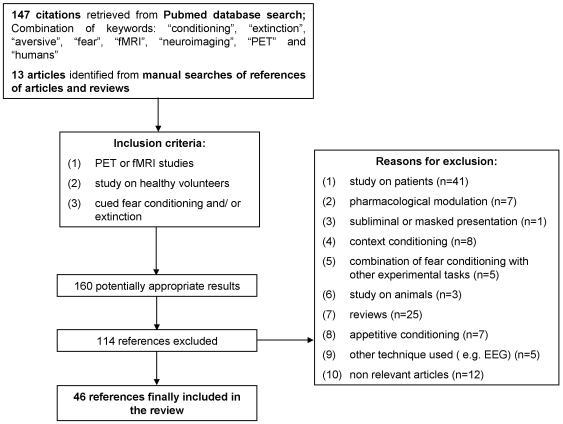
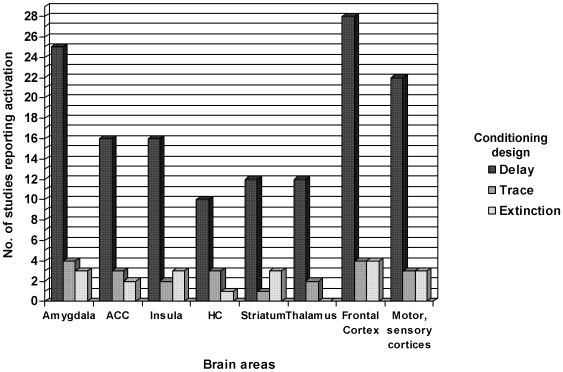
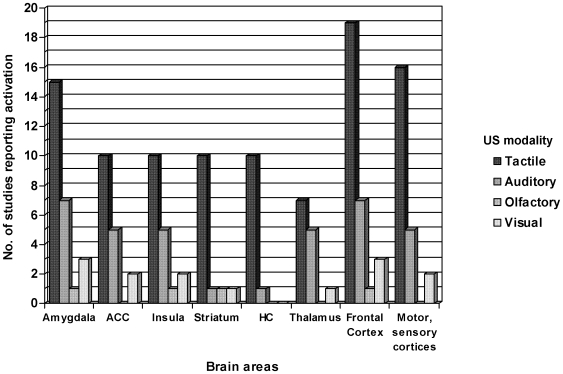
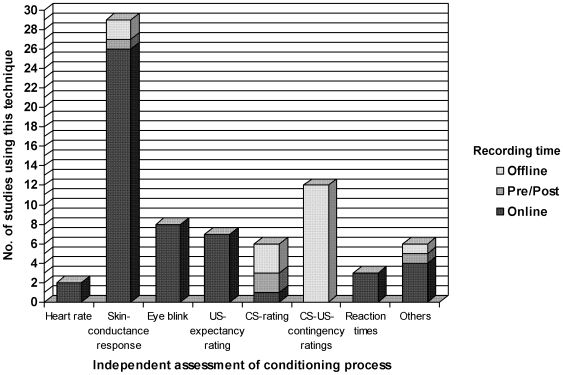
Fear conditioning and extinction are basic forms of associative learning that have gained considerable clinical relevance in enhancing our understanding of anxiety disorders and facilitating their treatment. Modern neuroimaging techniques have significantly aided the identification of anatomical structures and networks involved in fear conditioning. On closer inspection, there is considerable variation in methodology and results between studies. This systematic review provides an overview of the current neuroimaging literature on fear conditioning and extinction on healthy subjects, taking into account methodological issues such as the conditioning paradigm. A Pubmed search, as of December 2008, was performed and supplemented by manual searches of bibliographies of key articles. Two independent reviewers made the final study selection and data extraction. A total of 46 studies on cued fear conditioning and/or extinction on healthy volunteers using positron emission tomography or functional magnetic resonance imaging were reviewed. The influence of specific experimental factors, such as contingency and timing parameters, assessment of conditioned responses, and characteristics of conditioned and unconditioned stimuli, on cerebral activation patterns was examined. Results were summarized descriptively. A network consisting of fear-related brain areas, such as amygdala, insula, and anterior cingulate cortex, is activated independently of design parameters. However, some neuroimaging studies do not report these findings in the presence of methodological heterogeneities. Furthermore, other brain areas are differentially activated, depending on specific design parameters. These include stronger hippocampal activation in trace conditioning and tactile stimulation. Furthermore, tactile unconditioned stimuli enhance activation of pain related, motor, and somatosensory areas. Differences concerning experimental factors may partly explain the variance between neuroimaging investigations on human fear conditioning and extinction and should, therefore, be taken into serious consideration in the planning and the interpretation of research projects.
Overview
The claims and statistics of this paper haven’t been checked yet.
Run the check — free, no account needed. It reads the open-access text and checks the sources it cites.
Integrity signals
Registry
Cites
Statistics
Figures
Verification
Claims the paper makes
The claims and statistics of this paper haven’t been checked yet.
Run the check — free, no account needed. It reads the open-access text and checks the sources it cites.
Claims other papers make about this one
Each is checked against this paper’s own text: does it say what the citing paper says it does?
In the citing paper
“These networks include the amygdala as well as middle and anterior parts of the cingulate cortex”
From Oxytocin Facilitates Pavlovian Fear Learning in Males (2016) · cites this paper as Sehlmeyer et al, 2009
In the citing paper
“previous findings showing that the ACC has a crucial role within a general neural fear circuit (Hariri et al, 2003) as well as within the framework of Pavlovian fear conditioning (see reviews by Milad et al, 2007;Sehlmeyer et al, 2009).”
From Oxytocin Facilitates Pavlovian Fear Learning in Males (2016) · cites this paper as Sehlmeyer et al, 2009
In the citing paper
“We therefore conclude that in spite of the considerable methodological diversity that exists across individual fearconditioning studies, these studies consistently evoke a common large-scale brain activation response.17”
From Neural signatures of human fear conditioning: an updated and extended meta-analysis of fMRI studies (2016) · cites this paper as [17]
Self-check
Percentages, sums and reported differences re-computed from the paper’s own numbers.
The self-check needs the paper’s full text.
Citations
Cites
LeDoux, J. E. (2000) · Annual Review of Neuroscience · doi:10.1146/annurev.neuro.23.1.155 · Cited by 8,444
Pain Affect Encoded in Human Anterior Cingulate But Not Somatosensory Cortex
Rainville, P., Duncan, G. H., Price, D. D., Carrier, B., & Bushnell, M. C. (1997) · Science · doi:10.1126/science.277.5328.968 · Cited by 2,629
Phelps, E. A., Delgado, M. R., Nearing, K. I., & LeDoux, J. E. (2004) · Neuron · doi:10.1016/j.neuron.2004.08.042 · Cited by 1,753
Neurobiology of Pavlovian fear conditioning
Maren, S. (2001) · Annual Review of Neuroscience · doi:10.1146/annurev.neuro.24.1.897 · Cited by 1,543
LaBar, K. S., Gatenby, J. C., Gore, J. C., LeDoux, J. E., & Phelps, E. A. (1998) · Neuron · doi:10.1016/s0896-6273(00)80475-4 · Cited by 1,402
Milad, M. R., Wright, C. I., Orr, S. P., Pitman, R. K., Quirk, G. J., & Rauch, S. L. (2007) · Biological Psychiatry · doi:10.1016/j.biopsych.2006.10.011 · Cited by 1,197
The conditioning theory of fearacquisition: A critical examination
Rachman, S. (1977) · Behaviour Research and Therapy · doi:10.1016/0005-7967(77)90041-9 · Cited by 1,191 · cited 1×
“Fear conditioning has proven to be an extremely robust, rapid, and precise experimental approach for studying the neurobiological substrates of fear [2,7–15], while fear extinction most probably represents the main therapeutic ingredient of exposure-based psychotherapies.”
BackgroundDissociating pain from its anticipation in the human brain
Ploghaus, A., Tracey, I., Gati, J. S., Clare, S., Menon, R. S., Matthews, P. M., & Rawlins, J. N. P. (1999) · Science · doi:10.1126/science.284.5422.1979 · Cited by 1,151
Vuilleumier, P., & Pourtois, G. (2007) · Neuropsychologia · doi:10.1016/j.neuropsychologia.2006.06.003 · Cited by 1,115
Prevalence and incidence studies of anxiety disorders: A systematic review of the literature
Somers, J. M., Goldner, E. M., Waraich, P., & Hsu, L. (2006) · The Canadian Journal of Psychiatry · doi:10.1177/070674370605100206 · Cited by 1,114
Research works printed but not linked: 2
- [2]Pavlov IP 1927 Conditioned reflexes Oxford, England Oxford University Press
- [85]Jenkins HM Barnes R Barrera FJ 1981 Why autoshaping depends on trial spacing. Locurto CM Terrace HS Gibbon J Autoshaping and conditioning theory New York Academy Press 255 284
Cited by
Sorted by citations
The integration of negative affect, pain and cognitive control in the cingulate cortex
Shackman, A. J., Salomons, T. V., Slagter, H. A., Fox, A. S., Winter, J. J., & Davidson, R. J. (2011) · Nature Reviews Neuroscience · doi:10.1038/nrn2994 · Cited by 2,082
The contextual brain: implications for fear conditioning, extinction and psychopathology
Maren, S., Phan, K. L., & Liberzon, I. (2013) · Nature Reviews Neuroscience · doi:10.1038/nrn3492 · Cited by 1,547
Pape, H.-C., & Pare, D. (2010) · Physiological Reviews · doi:10.1152/physrev.00037.2009 · Cited by 994
Lonsdorf, T. B., Menz, M. M., Andreatta, M., Fullana, M. A., Golkar, A., Haaker, J., Heitland, I., Hermann, A., Kuhn, M., Kruse, O., et al. (2017) · Neuroscience & Biobehavioral Reviews · doi:10.1016/j.neubiorev.2017.02.026 · Cited by 837
Hannibal, K. E., & Bishop, M. D. (2014) · Physical Therapy · doi:10.2522/ptj.20130597 · Cited by 729
Metadata
- Authors
- Sehlmeyer, C., Schöning, S., Zwitserlood, P., Pfleiderer, B., Kircher, T., Arolt, V., & Konrad, C.
- Affiliations
- University of Münster (DE)
- Philipps University of Marburg (DE)
- Corresponding author
- Konrad, Carsten
- Venue
- PLoS ONE
- Publisher
- Public Library of Science (PLoS)
- Published
- 2009-06-10
- Volume
- 4
- Issue
- 6
- Pages
- e5865
- ISSN
- 1932-6203 (ISSN-L)
- PMC
- PMC2692002
- OpenAlex
- W2064135174
- Cited by
- 543
- References
- 123
- Citations by year
- 2026: 10 · 2025: 21 · 2024: 18 · 2023: 23 · 2022: 18 · 2021: 31 · 2020: 28 · 2019: 30 · 2018: 33 · 2017: 34 · 2016: 46 · 2015: 45 · 2014: 45 · 2013: 63 · 2012: 37
- FWCI
- 2.46
- Type
- journal article
- Language
- en
- Open access
- gold
- doi.org
- Locations
- PLoS ONE (publishedVersion, cc-by)
- PubMed Central (publishedVersion, cc-by)
- PubMed (publishedVersion)
- DOAJ (DOAJ: Directory of Open Access Journals) (submittedVersion, cc-by-sa)
- Funders
- Bundesministerium für Bildung und Forschung
- Topics
- Life Sciences › Neuroscience › Cognitive Neuroscience › Memory and Neural Mechanisms
- Life Sciences › Neuroscience › Cognitive Neuroscience › Neural and Behavioral Psychology Studies
- Social Sciences › Psychology › Experimental and Cognitive Psychology › Anxiety, Depression, Psychometrics, Treatment, Cognitive Processes
- Keywords
- fear conditioning, fear extinction, associative learning, anxiety disorders, amygdala, insula, anterior cingulate cortex, hippocampus, trace conditioning, methodological heterogeneity, brain activation patterns
- MeSH terms
- Adult, Amygdala, Avoidance Learning, Brain, Brain Mapping, Conditioning, Psychological, Electrophysiology, Extinction, Psychological, Fear, Female, Hippocampus, Humans, Magnetic Resonance Imaging, Male, Middle Aged
About these checks
Registry, retraction, Cites and statistics results are computed, not judged, with one exception: a printed reference that no index lists is read once by a model before it counts as a citation error. Claims are extracted by a model and kept only when their quote appears verbatim in the text; each cited source is then checked, with a model’s help, for whether it says what the claim relies on. Those verdicts can be wrong — read the claim’s quote and the cited source before relying on one.
Statistics and arithmetic are recomputed, not judged.
Confidence bands are shown only for fields calibrated on our annotated test set. None is calibrated yet, so no band is shown.
What counts as a claim ›How we measure confidence ›How we check this ›
Are you an author, or do you see a problem with this page? Request a review
