

Neuropeptide Y Knockout Mice Reveal a Central Role of NPY in the Coordination of Bone Mass to Body Weight
Open accessThe DOI matches its Crossref record; 30 of the 30 references it cites were found in a registry or an index.
Abstract
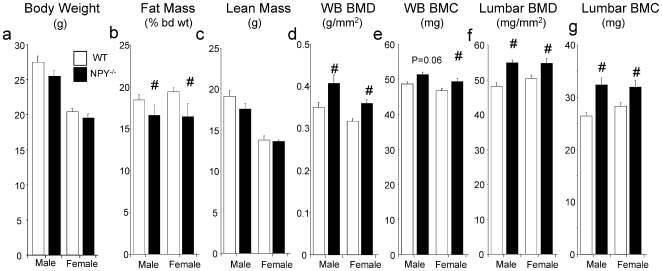
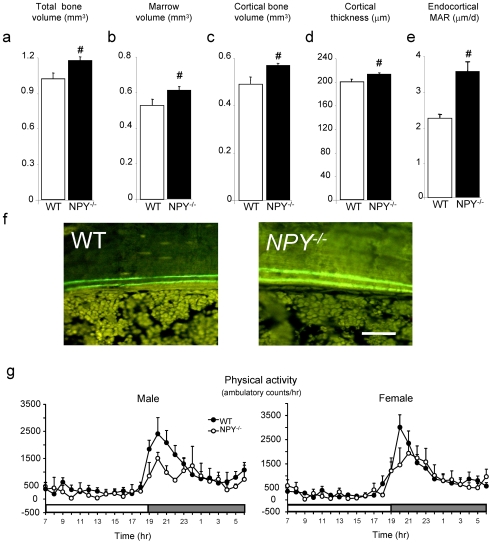
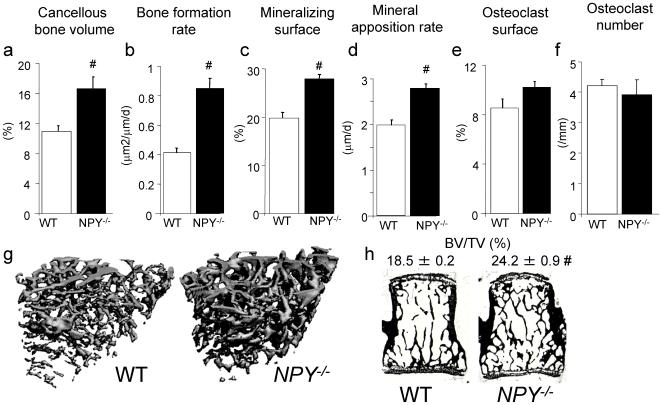
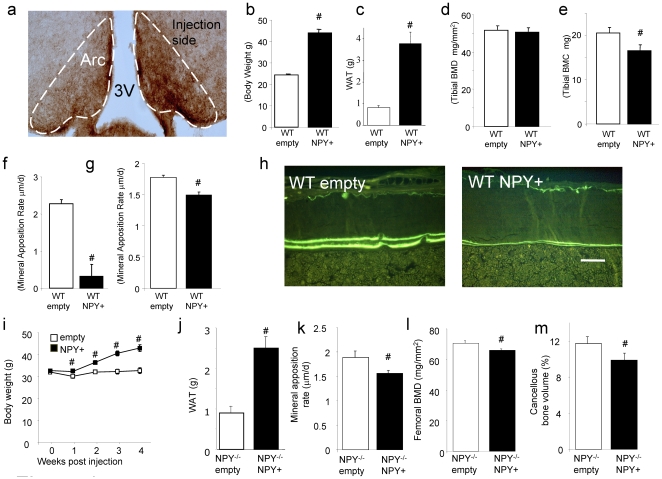
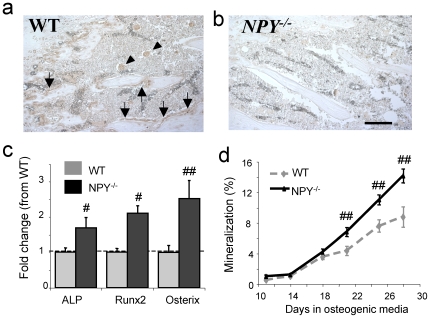
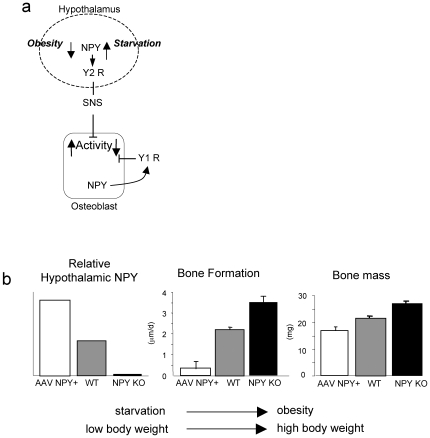
Changes in whole body energy levels are closely linked to alterations in body weight and bone mass. Here, we show that hypothalamic signals contribute to the regulation of bone mass in a manner consistent with the central perception of energy status. Mice lacking neuropeptide Y (NPY), a well-known orexigenic factor whose hypothalamic expression is increased in fasting, have significantly increased bone mass in association with enhanced osteoblast activity and elevated expression of bone osteogenic transcription factors, Runx2 and Osterix. In contrast, wild type and NPY knockout (NPY (-/-)) mice in which NPY is specifically over expressed in the hypothalamus (AAV-NPY+) show a significant reduction in bone mass despite developing an obese phenotype. The AAV-NPY+ induced loss of bone mass is consistent with models known to mimic the central effects of fasting, which also show increased hypothalamic NPY levels. Thus these data indicate that, in addition to well characterized responses to body mass, skeletal tissue also responds to the perception of nutritional status by the hypothalamus independently of body weight. In addition, the reduction in bone mass by AAV NPY+ administration does not completely correct the high bone mass phenotype of NPY (-/-) mice, indicating the possibility that peripheral NPY may also be an important regulator of bone mass. Indeed, we demonstrate the expression of NPY specifically in osteoblasts. In conclusion, these data identifies NPY as a critical integrator of bone homeostatic signals; increasing bone mass during times of obesity when hypothalamic NPY expression levels are low and reducing bone formation to conserve energy under 'starving' conditions, when hypothalamic NPY expression levels are high.
Overview
The claims and statistics of this paper haven’t been checked yet.
Free: it reads the open-access text and checks the first 5 claims that cite a source we can check. Create a free account to check every claim.
Integrity signals
Registry
Cites
Statistics
Figures
Verification
Claims the paper makes
The claims and statistics of this paper haven’t been checked yet.
Free: it reads the open-access text and checks the first 5 claims that cite a source we can check. Create a free account to check every claim.
Claims other papers make about this one
Each is checked against this paper’s own text: does it say what the citing paper says it does?
In the citing paper
“Thus the ob/ob mouse may be an accurate representation of the skeletal response to reduced leptin signaling, implicating both adrenergic and NPYmediated pathways in regulating hypocaloric responses in bone.”
From Effects of Leptin on the Skeleton (2018) · cites this paper as [103]
In the citing paper
“viral-mediated overexpression of NPY in the hypothalamus led to marked increases in food intake and in gains white adipose tissue mass”
From Effects of Leptin on the Skeleton (2018) · cites this paper as [103]
In the citing paper
“Hypothalamic NPY signaling is an important part of the central regulation of bone by leptin, most prominently in cortical bone, reducing bone mass in leptin-deficient states.”
From Effects of Leptin on the Skeleton (2018) · cites this paper as [103]
Self-check
Percentages, sums and reported differences re-computed from the paper’s own numbers.
The self-check needs the paper’s full text.
Citations
Cites
The Mouse Brain in Stereotaxic Coordinates
Paxinos, G. (2001) · Cited by 13,440
mouse brain in stereotaxic coordinates
Franklin, K. B. J., & Paxinos, G. (1997) · Cited by 3,258
Leptin Inhibits Bone Formation through a Hypothalamic Relay
Ducy, P., Amling, M., Takeda, S., Priemel, M., Schilling, A. F., Beil, F. T., Shen, J., Vinson, C., Rueger, J. M., & Karsenty, G. (2000) · Cell · doi:10.1016/s0092-8674(00)81558-5 · Cited by 2,077 · cited 3×
“Possible redundancy in the functions of NPY-like ligands may explain why initial examination of NPY deficient mice suggested no skeletal changes [12], a finding contradictory to experiments showing significant increases in bone mass following loss of NPYproducing neurons from the arcuate nucleus of the hypothalamus us…”
BackgroundResultLeptin Regulates Bone Formation via the Sympathetic Nervous System
Takeda, S., Elefteriou, F., Levasseur, R., Liu, X., Zhao, L., Parker, K. L., Armstrong, D., Ducy, P., & Karsenty, G. (2002) · Cell · doi:10.1016/s0092-8674(02)01049-8 · Cited by 1,735 · cited 1×
“activation of central, hypothalamic relays via efferent sympathetic nervous output which directly modulates osteoblast activity [1–3].”
BackgroundHildebrand, T., Laib, A., Müller, R., Dequeker, J., & Rüegsegger, P. (1999) · Journal of Bone and Mineral Research · doi:10.1359/jbmr.1999.14.7.1167 · Cited by 1,303
Glenn Stanley, B., Kyrkouli, S. E., Lampert, S., & Leibowitz, S. F. (1986) · Peptides · doi:10.1016/0196-9781(86)90149-x · Cited by 849 · cited 1×
“and energy homeostasis [4].”
Attenuation of the Obesity Syndrome of ob/ob Mice by the Loss of Neuropeptide Y
Erickson, J. C., Hollopeter, G., & Palmiter, R. D. (1996) · Science · doi:10.1126/science.274.5293.1704 · Cited by 801 · cited 1×
“Leptin down-regulates NPY expression in the hypothalamus and in this way reduces appetite and normalises energy expenditure [5].”
BackgroundY-receptor subtypes—how many more?
Blomqvist, A. G., & Herzog, H. (1997) · Trends in Neurosciences · doi:10.1016/s0166-2236(96)01057-0 · Cited by 529 · cited 1×
“Amongst the 5 known Y-receptors (Y1, Y2, Y4, Y5 and in certain species also Y6) [7,8], NPY mediates its effects on energy homeostasis via hypothalamic Y1 and Y2 receptors [6].”
BackgroundSelf-citationRelationships between fat and bone
Reid, I. R. (2008) · Osteoporosis International · doi:10.1007/s00198-007-0492-z · Cited by 475 · cited 1×
“Given the strong and positive association between increases in body weight and bone mass, in part due to mechanical effects of weight bearing [14], it is notable that tibial BMC was reduced by 19% (p,0.”
BackgroundRegional distribution of Y‐receptor subtype mRNAs in rat brain
Parker, R. M. C., & Herzog, H. (1999) · European Journal of Neuroscience · doi:10.1046/j.1460-9568.1999.00553.x · Cited by 411 · cited 1×
“In situ hybridisation was carried out as previously described with minor modifications [26] on 5 mm sections of decalcified sagittal section of the distal femur.”
MethodSelf-citation
Cited by
The contribution of bone to whole-organism physiology
Karsenty, G., & Ferron, M. (2012) · Nature · doi:10.1038/nature10763 · Cited by 537
“In broader terms this revealed for the first time a central control of bone mass; its existence has now been verified by other laboratories studying how neuropeptide Y or neuromedin U regulate bone mas”
ResultImpact of the Autonomic Nervous System on the Skeleton
Elefteriou, F. (2018) · Physiological Reviews · doi:10.1152/physrev.00014.2017 · Cited by 241
“In the CNS, increased level of NPY in the hypothalamus reduces bone mass and osteoblast activity (19, 21), whereas inhibition of central NPY signaling induces bone gain (22, 173).”
BackgroundEffects of Leptin on the Skeleton
Reid, I. R., Baldock, P. A., & Cornish, J. (2018) · Endocrine Reviews · doi:10.1210/er.2017-00226 · Cited by 215
Self-citationNerves in Bone: Evolving Concepts in Pain and Anabolism
Brazill, J. M., Beeve, A. T., Craft, C. S., Ivanusic, J. J., & Scheller, E. L. (2019) · Journal of Bone and Mineral Research · doi:10.1002/jbmr.3822 · Cited by 205
“NPY acts both centrally and peripherally to influence bone metabolism as deletion of NPY results in increased bone formation that is only partially rescued by re‐addition of NPY to the hypothalamus.((129)) Central control of bone metabolism mediated by NPY is through an inhibitory effect on Y2 expressing neurons; hypo…”
BackgroundNeuropeptide Y receptors: how to get subtype selectivity
Pedragosa-Badia, X., Stichel, J., & Beck-Sickinger, A. G. (2013) · Frontiers in Endocrinology · doi:10.3389/fendo.2013.00005 · Cited by 191
“…roles of NPY are decreased bone www.frontiersin.org February 2013 | Volume 4 | Article 5 | 1 “fendo-04-00005” — 2013/1/31 — 23:14 — page 2 — #2 formation (Baldock et al., 2009; Sousa et al., 2012), regulation of mood and anxiety disorders, the modulation of stress responses (Heilig, 2004), and…”
Background
Metadata
- Authors
- Baldock, P. A., Lee, N. J., Driessler, F., Lin, S., Allison, S., Stehrer, B., Lin, E.-J. D., Zhang, L., Enriquez, R. F., Wong, I. P. L., McDonald, M. M., During, M., Pierroz, D. D., Slack, K., Shi, Y. C., Yulyaningsih, E., Aljanova, A., Little, D. G., Ferrari, S. L., Sainsbury, A., Eisman, J. A., & Herzog, H.
- Affiliations
- Garvan Institute of Medical Research (AU)
- Georgetown University Medical Center (US)
- Children's Hospital at Westmead (AU)
- University of Auckland (NZ)
- University Hospital of Geneva (CH)
- Corresponding author
- Herzog, Herbert
- ORCID
- Venue
- PLoS ONE
- Publisher
- Public Library of Science (PLoS)
- Published
- 2009-12-22
- Volume
- 4
- Issue
- 12
- Pages
- e8415
- ISSN
- 1932-6203 (ISSN-L)
- PMC
- PMC2794533
- OpenAlex
- W2060955024
- Cited by
- 164
- References
- 29
- Citations by year
- 2026: 2 · 2025: 8 · 2024: 5 · 2023: 11 · 2022: 14 · 2021: 7 · 2020: 11 · 2019: 11 · 2018: 17 · 2017: 5 · 2016: 13 · 2015: 8 · 2014: 15 · 2013: 7 · 2012: 14
- FWCI
- 3.90
- Type
- journal article
- Language
- en
- Open access
- gold
- doi.org
- Locations
- PLoS ONE (publishedVersion, cc-by)
- PubMed Central (publishedVersion, cc-by)
- PubMed (publishedVersion)
- The Sydney eScholarship Repository (The University of Sydney) (submittedVersion)
- DOAJ (DOAJ: Directory of Open Access Journals) (submittedVersion, cc-by-sa)
- Archive ouverte UNIGE (University of Geneva) (submittedVersion, other-oa)
- Archive ouverte UNIGE (University of Geneva) (submittedVersion, cc-by)
- Funders
- Medical Research Council
- National Health and Medical Research Council (481355, 427638)
- Topics
- Life Sciences › Biochemistry, Genetics and Molecular Biology › Molecular Biology › Bone Metabolism and Diseases
- Health Sciences › Medicine › Orthopedics and Sports Medicine › Bone health and osteoporosis research
- Life Sciences › Neuroscience › Endocrine and Autonomic Systems › Regulation of Appetite and Obesity
- Keywords
- neuropeptide Y, bone mass, hypothalamus, energy homeostasis, obesity, osteoblasts, Runx2, Osterix, bone formation, fasting, body weight, AAV gene delivery
- MeSH terms
- Animals, Body Weight, Bone and Bones, Female, Hypothalamus, Male, Models, Biological, Neuropeptide Y, Organ Size, Osteogenesis, Phenotype, Signal Transduction, Mice, Knockout, Adiposity, Mice
About these checks
Registry, retraction, Cites and statistics results are computed, not judged, with one exception: a printed reference that no index lists is read once by a model before it counts as a citation error. Claims are extracted by a model and kept only when their quote appears verbatim in the text; each cited source is then checked, with a model’s help, for whether it says what the claim relies on. Those verdicts can be wrong — read the claim’s quote and the cited source before relying on one.
Statistics and arithmetic are recomputed, not judged.
Confidence bands are shown only for fields calibrated on our annotated test set. None is calibrated yet, so no band is shown.
What counts as a claim ›How we measure confidence ›How we check this ›
Are you an author, or do you see a problem with this page? Request a review
How to cite
Cite CoChat for the checks on this page, and the paper for its own findings.
- This page
- CoChat. (2026). Citation check: Neuropeptide Y Knockout Mice Reveal a Central Role of NPY in the Coordination of Bone Mass to Body Weight. https://app.cochat.ai/papers/10.1371/journal.pone.0008415
- The paper
- Baldock, P. A., Lee, N. J., Driessler, F., Lin, S., Allison, S., Stehrer, B., Lin, E.-J. D., Zhang, L., Enriquez, R. F., Wong, I. P. L., McDonald, M. M., During, M., Pierroz, D. D., Slack, K., Shi, Y. C., Yulyaningsih, E., Aljanova, A., Little, D. G., Ferrari, S. L., . . . Herzog, H. (2009). Neuropeptide Y Knockout Mice Reveal a Central Role of NPY in the Coordination of Bone Mass to Body Weight. PLoS ONE. https://doi.org/10.1371/journal.pone.0008415
Data sources
Bibliographic data: Semantic Scholar, OpenAlex, Crossref.
Contains information from the Semantic Scholar Academic Graph Datasets, made available under the ODC Attribution License (ODC-BY 1.0).
Semantic Scholar’s data is described in: Kinney, R., et al. (2023). The Semantic Scholar Open Data Platform. arXiv:2301.10140.
