

Anandamide Suppresses Proliferation and Cytokine Release from Primary Human T-Lymphocytes Mainly via CB2 Receptors
Open accessThe DOI matches its Crossref record; 31 of the 31 references it cites were found in a registry or an index.
Abstract
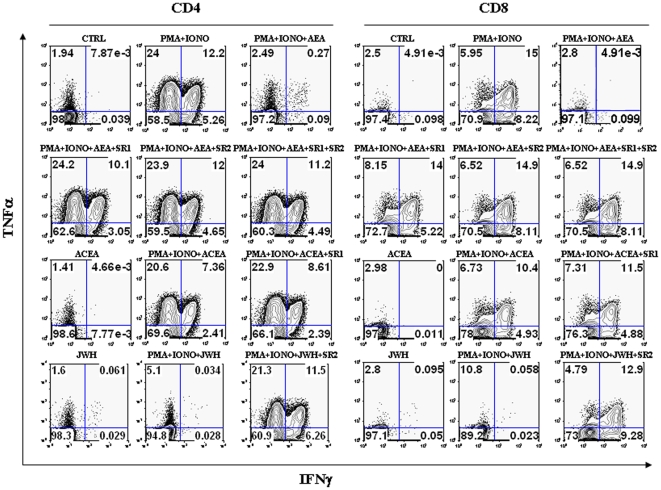
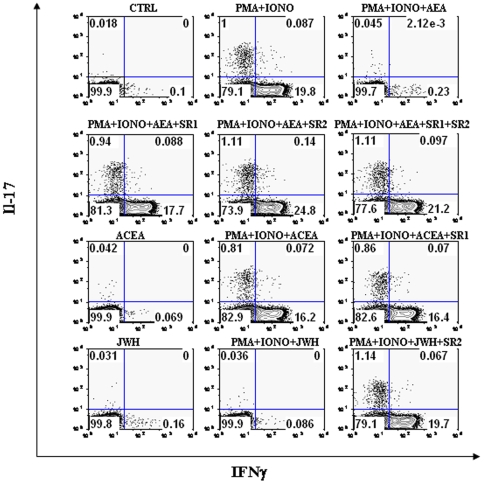
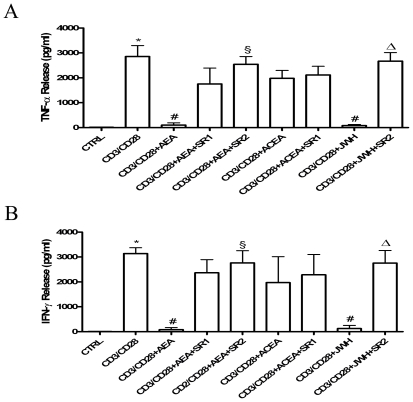
BACKGROUND: Anandamide (AEA) is an endogenous lipid mediator that exerts several effects in the brain as well as in peripheral tissues. These effects are mediated mainly by two types of cannabinoid receptors, named CB(1)R and CB(2)R, making AEA a prominent member of the "endocannabinoid" family. Also immune cells express CB(1) and CB(2) receptors, and possess the whole machinery responsible for endocannabinoid metabolism. Not surprisingly, evidence has been accumulated showing manifold roles of endocannabinoids in the modulation of the immune system. However, details of such a modulation have not yet been disclosed in primary human T-cells. METHODOLOGY/SIGNIFICANCE: In this investigation we used flow cytometry and ELISA tests, in order to show that AEA suppresses proliferation and release of cytokines like IL-2, TNF-alpha and INF-gamma from activated human peripheral T-lymphocytes. However, AEA did not exert any cytotoxic effect on T-cells. The immunosuppression induced by AEA was mainly dependent on CB(2)R, since it could be mimicked by the CB(2)R selective agonist JWH-015, and could be blocked by the specific CB(2)R antagonist SR144528. Instead the selective CB(1)R agonist ACEA, or the selective CB(1)R antagonist SR141716, were ineffective. Furthermore, we demonstrated an unprecedented immunosuppressive effect of AEA on IL-17 production, a typical cytokine that is released from the unique CD4+ T-cell subset T-helper 17. CONCLUSIONS/SIGNIFICANCE: Overall, our study investigates for the first time the effects of the endocannabinoid AEA on primary human T-lymphocytes, demonstrating that it is a powerful modulator of immune cell functions. In particular, not only we clarify that CB(2)R mediates the immunosuppressive activity of AEA, but we are the first to describe such an immunosuppressive effect on the newly identified Th-17 cells. These findings might be of crucial importance for the rational design of new endocannabinoid-based immunotherapeutic approaches.
Overview
The claims and statistics of this paper haven’t been checked yet.
Free: it reads the open-access text and checks the first 5 claims that cite a source we can check. Create a free account to check every claim.
Integrity signals
Registry
Cites
Statistics
Figures
Verification
Claims the paper makes
The claims and statistics of this paper haven’t been checked yet.
Free: it reads the open-access text and checks the first 5 claims that cite a source we can check. Create a free account to check every claim.
Claims other papers make about this one
Each is checked against this paper’s own text: does it say what the citing paper says it does?
The cited source says what the claim attributes to it.
In the citing paper
“In addition it inhibits T cell proliferation and production of TNF-α and IFN-γ by CD4+ and CD8+ T cells and IL-17 by Th17 cells [108].”
From Transition from inflammation to proliferation: a critical step during wound healing (2016) · cites this paper as [108]
Self-check
Percentages, sums and reported differences re-computed from the paper’s own numbers.
The self-check needs the paper’s full text.
Citations
Cites
International Union of Pharmacology. XXVII. Classification of Cannabinoid Receptors
Howlett, A. C., Barth, F., Bonner, T. I., Cabral, G., Casellas, P., Devane, W. A., Felder, C. C., Herkenham, M., Mackie, K., Martin, B. R., et al. (2002) · Pharmacological Reviews · doi:10.1124/pr.54.2.161 · Cited by 2,819
Pharmacology of cannabinoid CB1 and CB2 receptors
Pertwee, R. G. (1997) · Pharmacology & Therapeutics · doi:10.1016/s0163-7258(97)82001-3 · Cited by 1,470 · cited 1×
“These receptors are differentially distributed among cells, with CB1R being preferentially expressed in the brain and in other neural tissues, whilst CB2R is found mainly in cells of the immune system [4,5].”
BackgroundThe cannabinoid system and immune modulation
Klein, T. W., Newton, C., Larsen, K., Lu, L., Perkins, I., Nong, L., & Friedman, H. (2003) · Journal of Leukocyte Biology · doi:10.1189/jlb.0303101 · Cited by 524 · cited 1×
“regulating and fine-tuning several processes, including neuroprotection [6] and immune responses [7].”
BackgroundThe roles of IL‐17A in inflammatory immune responses and host defense against pathogens
Iwakura, Y., Nakae, S., Saijo, S., & Ishigame, H. (2008) · Immunological Reviews · doi:10.1111/j.1600-065x.2008.00699.x · Cited by 513 · cited 1×
“In the present study we sought to better define the role of AEA in modulating immune functions of primary human T cells, with a special focus on the key regulators of autoimmune inflammation: Th17 lymphocytes [17].”
BackgroundBiochemistry and pharmacology of endovanilloids
Starowicz, K., Nigam, S., & Di Marzo, V. (2007) · Pharmacology & Therapeutics · doi:10.1016/j.pharmthera.2007.01.005 · Cited by 383 · cited 5×
“Incidentally, it should be recalled that AEA is also an endogenous agonist of type-1 vanilloid receptors (TRPV1) [19].”
BackgroundInfluentialHillard, C. J., Manna, S., Greenberg, M. J., DiCamelli, R., Ross, R. A., Stevenson, L. A., Murphy, V., Pertwee, R. G., & Campbell, W. B. (1999) · The Journal of Pharmacology and Experimental Therapeutics · doi:10.1016/s0022-3565(24)38289-8 · Cited by 374 · cited 1×
“In addition, there are reports that even AEA might not act as a physiological agonist of CB2R [25], although this endocannabinoid has been shown to exert manifold CB2R-dependent activities in experimental paradigms, and more recently its localization within biological membranes has led to a reconsideration of its role…”
BackgroundMaresz, K., Pryce, G., Ponomarev, E. D., Marsicano, G., Croxford, J. L., Shriver, L. P., Ledent, C., Cheng, X., Carrier, E. J., Mann, M. K., et al. (2007) · Nature Medicine · doi:10.1038/nm1561 · Cited by 363 · cited 1×
“Using animal models of MS like experimental autoimmune encephalomylelitis (EAE), CB1R and CB2R have been shown to be specific markers of MS plaque cell subtypes [21]; furthermore, CB1R has been proven to mediate suppression of CNS autoimmune inflammation on neurons, whilst CB2R had the same anti-inflammatory role on a…”
MethodAnandamide Induces Apoptosis in Human Cells via Vanilloid Receptors
Maccarrone, M., Lorenzon, T., Bari, M., Melino, G., & Finazzi-Agrò, A. (2000) · Journal of Biological Chemistry · doi:10.1074/jbc.m005722200 · Cited by 347 · cited 1×
“In addition, AEA decreases mitogeninduced T and B cell proliferation [13], suppresses CD8 T lymphocyte migration [14], and induces apoptosis in macrophages [15] and dendritic cells [16].”
BackgroundSelf-citationFelder, C. C., Nielsen, A., Briley, E. M., Palkovits, M., Priller, J., Axelrod, J., Nguyen, D. N., Richardson, J. M., Riggin, R. M., Koppel, G. A., et al. (1996) · FEBS Letters · doi:10.1016/0014-5793(96)00891-5 · Cited by 326 · cited 1×
“cells, macrophages, microglia, and lymphocytes [9].”
Production of nitric oxide by glial cells: Regulation and potential roles in the CNS
Murphy, S. (2000) · Glia · doi:10.1002/(sici)1098-1136(20000101)29:1<1::aid-glia1>3.0.co;2-n · Cited by 314
Cited by
Items 201–236 of 236
Nerol enhances lipid synthesis in human sebocytes via cannabinoid receptor-2-mediated MAPK signaling
Zhao, Q., Liu, Z., Wang, Y., Li, T., Wang, J., Li, Y., Li, C., Zhai, C., Zouboulis, C. C., Ding, X., et al. (2025) · Journal of Pharmacological Sciences · doi:10.1016/j.jphs.2025.04.008 · Cited by 3
Mohammadpour-Asl, S., Parvin, A., Akbari‐Gharalari, N., Asadi, N., Pooryai, A., & Roshan‐Milani, S. (2025) · Life Sciences · doi:10.1016/j.lfs.2025.123778 · Cited by 2
Raeispour, M., Prisinzano, M., Seidita, I., Romeo, L., Nardi, E., Castiglione, F., Bruni, P., Petraglia, F., Bernacchioni, C., & Donati, C. (2025) · The FASEB Journal · doi:10.1096/fj.202502415r · Cited by 3
“It is worth noting that both AEA and 2-AG exert anti-inflammatory effects reducing the production of pro-inflammatory cytokines in immune cells [51–53].”
The endocannabinoid system, immunomodulation, and LPS-induced inflammation
Lloyd, E., Nguyen, N. T., & Hellman, J. (2023) · Elsevier eBooks · doi:10.1016/b978-0-323-90877-1.00024-3 · Cited by 4
Biosynthesis of endocannabinoids and phytocannabinoids
Maghembe, R. S., Makaranga, A., & Nyandoro, S. S. (2024) · Elsevier eBooks · doi:10.1016/b978-0-323-95927-8.00013-x · Cited by 2
A Cannabinoid 2-Selective Agonist Inhibits Allogeneic Skin Graft Rejection In Vivo
Jayarajan, S. N., Meissler, J. J., Adler, M. W., & Eisenstein, T. K. (2022) · Frontiers in Pharmacology · doi:10.3389/fphar.2021.804950 · Cited by 3
Brain Imaging of Cannabinoid Receptors
Casteels, C., Bormans, G. M., & Laere, K. V. (2014) · Elsevier eBooks · doi:10.1016/b978-0-12-418677-4.00003-8 · Cited by 4
Onu, I., Buculei, I., Ionescu, C. G., Stanca, D. N., Voicu, B., & Iordan, D. A. (2023) · BRAIN BROAD RESEARCH IN ARTIFICIAL INTELLIGENCE AND NEUROSCIENCE · doi:10.18662/brain/14.2/456 · Cited by 2
“Increased 2-AG signaling at peripheral CB1 receptors has antinociceptive effects, but CB2, too, is thought to be involved in inhibiting pro-nociceptive actions of immune cells (Brownjohn & Ashton, 2012; Cencioni et al., 2010; Han et al., 2009; Hao et al., 2010; Nomura et al., 2011; Racz et al., 2008; Salio et al., 200…”
BackgroundEndocannabinoid System in a Planarian Model
Mustonen, K. L. (2010) · University of North Texas Digital Library (University of North Texas) · doi:10.12794/metadc33188 · Cited by 2
Cannabis Compounds: Potential Therapy for Neurological Disease
Babayeva, M., & Loewy, Z. G. (2024) · IntechOpen eBooks · doi:10.5772/intechopen.1005770 · Cited by 2
Diaz, D. L., Vazquez, T., Kodali, N., Bashir, M. M., Grinnell, M., Dhiman, R., Keyes, E., Dan, J., Kleitsch, J., Stone, C. J., et al. (2026) · Journal of Investigative Dermatology · doi:10.1016/j.jid.2025.12.020 · Cited by 2
Jin, M. C., Liu, X., Kim, M. R., & Sok, D. (2013) · European Journal of Lipid Science and Technology · doi:10.1002/ejlt.201300006 · Cited by 1
Immunomodulatory properties of cannabinoids; a molecular insight
Maghembe, R. S., Mollel, J. T., & Nyandoro, S. S. (2024) · Elsevier eBooks · doi:10.1016/b978-0-323-95927-8.00010-4 · Cited by 1
Cannabinoids as Multitarget Drugs for the Treatment of Autoimmunity in Glaucoma
Lakshmi, P. K., Pawar, R. S., Katare, Y. K., & Sudheesh, M. S. (2025) · ACS Pharmacology & Translational Science · doi:10.1021/acsptsci.4c00583 · Cited by 1
Endogene Cannabinoide und das Endocannabinoidsystem
Grotenhermen, F. (2017) · Springer eBooks · doi:10.1007/978-3-642-55125-3_39 · Cited by 1
Endogene Cannabinoide und das Endocannabinoidsystem
Grotenhermen, F. (2016) · Springer eBooks · doi:10.1007/978-3-642-55214-4_39-1 · Cited by 2
The Effects of Cannabinoids on Immune Cells, Responses and Diseases
Constantinescu, C. S., & Tănăsescu, R. (2012) · Springer eBooks · doi:10.1007/978-3-7091-0888-8_11
The effects of cannabinoids on insulin secretion
Anderson, R. L. (2011) · Nottingham ePrints (University of Nottingham)
n-3 Fatty acid derived endocannabinoids: a new link between fish oil and inflammation
Balvers, M. G. J. (2012) · doi:10.18174/202605
“Such a shift in balance can also explain the reported decrease in the levels of the endocannabinoids anandamide (arachidonoyl ethanolamine; AEA) and 2-arachidonoylglycerol (2-AG) following exposure to DHA or EPA [13, 14].”
BackgroundMethodInfluentialSiniscalco, D. (2017) · PNEI REVIEW · doi:10.3280/pnei2017-001004
Erratum: Cannabinoid Receptor 2 Signalling Bias Elicited by 2,4,6-Trisubstituted 1,3,5-Triazines
Frontiers Production Office (2019) · Frontiers in Pharmacology · doi:10.3389/fphar.2019.00418
Gish, A., Wiart, J., Turpin, É., Allorge, D., & Gaulier, J. (2021) · Annales de Toxicologie Analytique · doi:10.1016/j.toxac.2021.07.004
Hati, D. K., Sahu, P. K., & Patro, S. K. (2024) · Research Journal of Pharmacy and Technology · doi:10.52711/0974-360x.2024.00036 · Cited by 2
Targeting the endocannabinoid system in HAND
Yadav-Samudrala, B. J., & Fitting, S. (2024) · Elsevier eBooks · doi:10.1016/b978-0-323-99744-7.00013-4
Anandamide: From modulation of neuronal excitation to antimicrobial activities—What is in common?
Sionov, R. V., & Steinberg, D. (2024) · Elsevier eBooks · doi:10.1016/b978-0-443-19081-0.00017-2
Dedam, J.-P. H., Fogel, M., & Fogel, E. (2025) · Springer eBooks · doi:10.1007/978-3-031-87484-0_9
Dedam, J.-P. H., Fogel, M., & Fogel, E. (2025) · Springer eBooks · doi:10.1007/978-3-031-87484-0_3
Cannabinoids in immune system-related diseases: From bench to clinic
Zhang, W., Chen, B., Cao, Y., Lei, W., Zhao, H., Yang, Y., & Tang, J. (2025) · Chinese Medical Journal · doi:10.1097/cm9.0000000000003818
“[70] In a mouse model of immune-mediated liver inflammation, AEA or inhibition of FAAH effectively reduced cytokine levels, mitigated liver damage, and increased the number of regulatory T (Treg) cells.”
Boury‐Esnault, N., Marschal, C., Probst, J.-M. K., & Barnathan, G. (2002) · INFM-OAR (INFN Catania) · doi:10.5281/zenodo.155630
Influence de la réponse IL-17 dans la physiopathologie du foie
Guillot, A. (2014) · theses.fr (ABES) · doi:10.70675/93867442zef10z413bz8ac0z49dbe1889857
Cannabinoids in autoimmune diseases: mechanistic insights and translational challenges
Khan, Y. A., Anas, M., Khan, F., Ali, M., Al-Zharani, M. M., Nasr, F. A., Qamar, W., & Rahman, S. (2026) · Biochemical Pharmacology · doi:10.1016/j.bcp.2026.118032
Rosero, A. M., Ríos-Serna, L. J., & Cañas, C. A. (2026) · Frontiers in Immunology · doi:10.3389/fimmu.2026.1848747 · Cited by 1
Mitochondrial dysfunction and autophagy activation underlie NK cell impairment induced by Cannabis
Bolduc, A.-A., Tremblay, T., Almutairi, M. H., Semlali, A., & Loubaki, L. (2026) · PLoS ONE · doi:10.1371/journal.pone.0350750
Marty, J. R., Crawford, R. B., Blevins, L. K., Gulick, P., & Kaminski, N. E. (2026) · Journal of Pharmacology and Experimental Therapeutics · doi:10.1016/j.jpet.2026.105010
Kim, K. C., & Lee, J. H. (2026) · Mediators of Inflammation · doi:10.1155/mi/6535590
Metadata
- Authors
- Cencioni, M. T., Chiurchiù, V., Catanzaro, G., Borsellino, G., Bernardi, G., Battistini, L., & Maccarrone, M.
- Affiliations
- Fondazione Santa Lucia (IT)
- University of Teramo (IT)
- University of Rome Tor Vergata (IT)
- Corresponding author
- Battistini, Luca
- Maccarrone, Mauro
- ORCID
- Venue
- PLoS ONE
- Publisher
- Public Library of Science (PLoS)
- Published
- 2010-01-14
- Volume
- 5
- Issue
- 1
- Pages
- e8688
- ISSN
- 1932-6203 (ISSN-L)
- PMC
- PMC2809084
- OpenAlex
- W1991262879
- Cited by
- 235
- References
- 29
- Citations by year
- 2026: 8 · 2025: 9 · 2024: 19 · 2023: 9 · 2022: 15 · 2021: 11 · 2020: 14 · 2019: 13 · 2018: 7 · 2017: 10 · 2016: 18 · 2015: 20 · 2014: 20 · 2013: 22 · 2012: 21
- FWCI
- 14.33
- Type
- journal article
- Language
- en
- Open access
- gold
- doi.org
- Locations
- PLoS ONE (publishedVersion, cc-by)
- PubMed Central (publishedVersion, cc-by)
- PubMed (publishedVersion)
- IRIS Research product catalog (Sapienza University of Rome) (submittedVersion, cc-by)
- DOAJ (DOAJ: Directory of Open Access Journals) (submittedVersion)
- Archivio Istituzionale della Ricerca - Università degli Studi dell Aquila (submittedVersion)
- Funders
- Ministero della Salute
- Topics
- Health Sciences › Medicine › Pharmacology (medical) › Cannabis and Cannabinoid Research
- Health Sciences › Medicine › Pharmacology (medical) › Inflammatory mediators and NSAID effects
- Health Sciences › Nursing › Nutrition and Dietetics › Fatty Acid Research and Health
- Keywords
- anandamide, endocannabinoids, CB2 receptor, CB1 receptor, T cells, immunosuppression, T cell proliferation, cytokine production, IL-17, Th17 cells, JWH-015, SR144528, SR141716, ACEA
- MeSH terms
- Rimonabant, Arachidonic Acids, Base Sequence, Camphanes, Enzyme-Linked Immunosorbent Assay, Flow Cytometry, Humans, Piperidines, Pyrazoles, T-Lymphocytes, Cytokines, DNA Primers, Microscopy, Confocal, Reverse Transcriptase Polymerase Chain Reaction, Receptor, Cannabinoid, CB2, Cell Proliferation, Polyunsaturated Alkamides, Endocannabinoids
About these checks
Registry, retraction, Cites and statistics results are computed, not judged, with one exception: a printed reference that no index lists is read once by a model before it counts as a citation error. Claims are extracted by a model and kept only when their quote appears verbatim in the text; each cited source is then checked, with a model’s help, for whether it says what the claim relies on. Those verdicts can be wrong — read the claim’s quote and the cited source before relying on one.
Statistics and arithmetic are recomputed, not judged.
Confidence bands are shown only for fields calibrated on our annotated test set. None is calibrated yet, so no band is shown.
What counts as a claim ›How we measure confidence ›How we check this ›
Are you an author, or do you see a problem with this page? Request a review
Data sources
Bibliographic data: Semantic Scholar, OpenAlex, Crossref.
Contains information from the Semantic Scholar Academic Graph Datasets, made available under the ODC Attribution License (ODC-BY 1.0).
Semantic Scholar’s data is described in: Kinney, R., et al. (2023). The Semantic Scholar Open Data Platform. arXiv:2301.10140.
