

Internet Treatment for Depression: A Randomized Controlled Trial Comparing Clinician vs. Technician Assistance
Open accessThe DOI matches its Crossref record; 53 of the 57 references it cites were found in a registry or an index.
Abstract
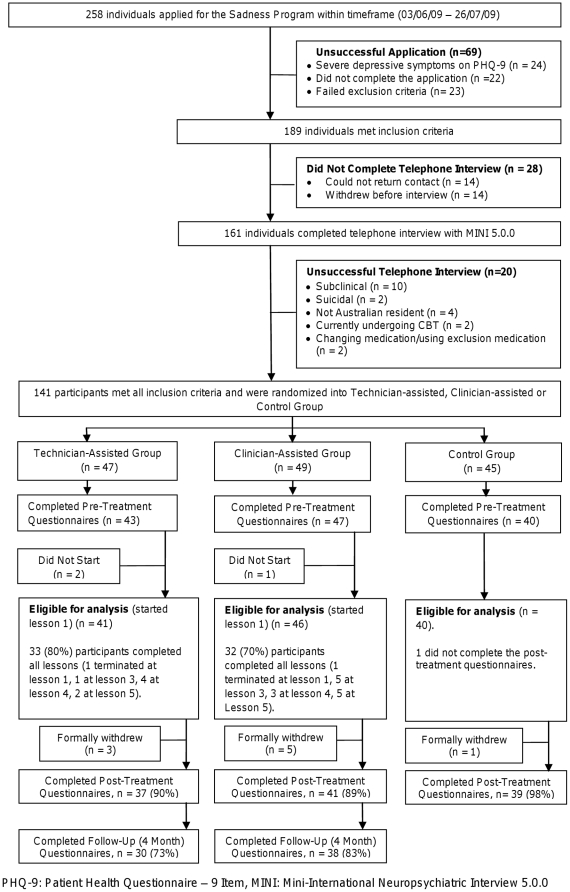
BACKGROUND: Internet-based cognitive behavioural therapy (iCBT) for depression is effective when guided by a clinician, less so if unguided. QUESTION: Would guidance from a technician be as effective as guidance from a clinician? METHOD: Randomized controlled non-inferiority trial comparing three groups: Clinician-assisted vs. technician-assisted vs. delayed treatment. Community-based volunteers applied to the VirtualClinic (www.virtualclinic.org.au) research program, and 141 participants with major depressive disorder were randomized. Participants in the clinician- and technician-assisted groups received access to an iCBT program for depression comprising 6 online lessons, weekly homework assignments, and weekly supportive contact over a treatment period of 8 weeks. Participants in the clinician-assisted group also received access to a moderated online discussion forum. The main outcome measures were the Beck Depression Inventory (BDI-II) and the Patient Health QUESTIONnaire-9 Item (PHQ-9). Completion rates were high, and at post-treatment, both treatment groups reduced scores on the BDI-II (p<0.001) and PHQ-9 (p<0.001) compared to the delayed treatment group but did not differ from each other. Within group effect sizes on the BDI-II were 1.27 and 1.20 for the clinician- and technician-assisted groups respectively, and on the PHQ-9, were 1.54 and 1.60 respectively. At 4-month follow-up participants in the technician group had made further improvements and had significantly lower scores on the PHQ-9 than those in the clinician group. A total of approximately 60 minutes of clinician or technician time was required per participant during the 8-week treatment program. CONCLUSIONS: Both clinician- and technician-assisted treatment resulted in large effect sizes and clinically significant improvements comparable to those associated with face-to-face treatment, while a delayed treatment control group did not improve. These results provide support for large scale trials to determine the clinical effectiveness and acceptability of technician-assisted iCBT programs for depression. This form of treatment has potential to increase the capacity of existing mental health services. TRIAL REGISTRATION: Australian New Zealand Clinical Trials Registry ACTRN12609000559213.
Overview
The claims and statistics of this paper haven’t been checked yet.
Free: it reads the open-access text and checks the first 5 claims that cite a source we can check. Create a free account to check every claim.
Integrity signals
Registry
Cites
Statistics
Figures
Verification
Claims the paper makes
The claims and statistics of this paper haven’t been checked yet.
Free: it reads the open-access text and checks the first 5 claims that cite a source we can check. Create a free account to check every claim.
Claims other papers make about this one
Each is checked against this paper’s own text: does it say what the citing paper says it does?
The cited source doesn’t support the claim as written.
In the citing paper
“Other studies on the combination of online sessions and personal support only investigated support through e-mail, or instant messaging (e.g. [19,36-38]).”
From Blending online therapy into regular face-to-face therapy for depression: content, ratio and preconditions according to patients and therapists using a Delphi study (2014) · cites this paper as [38]
Checked by a reasoning model — may be wrong.
Experimental — accuracy not yet measuredThe source backs part of the claim, not all of it — or backs it for a different population, condition or comparison.
In the citing paper
“Similarly, the level of training did not impact the effectiveness of a digital intervention for depression [96].”
From The therapeutic alliance in digital mental health interventions for serious mental illnesses: narrative review (2020) · cites this paper as [96]
Experimental — accuracy not yet measuredThe source backs part of the claim, not all of it — or backs it for a different population, condition or comparison.
In the citing paper
“Moreover, outcomes for DMHTs supported by non–mental health specialists do not differ from outcomes for DMHTs supported by mental health specialists (43), which allows for task-shifting options to lower levels of licensure, education requirements, and cost.”
From Banbury forum consensus statement on the path forward for digital mental health treatment (2021) · cites this paper as [43]
Experimental — accuracy not yet measuredThe source backs part of the claim, not all of it — or backs it for a different population, condition or comparison.
In the citing paper
“Characteristics of the intervention that may improve adherence to the intervention include a strong theoretical foundation [41], perceived personal relevance to the user [65,66], perceived effectiveness [67,68], tailoring [69,70], persuasive technologies [71], credibility [72,73], social networking [74,75], and regular “push factors” including human support [76-78] and/or periodic prompts (eg, by”
From Web-Based Interventions for Behavior Change and Self-Management: Potential, Pitfalls, and Progress (2012) · cites this paper as [77]
Experimental — accuracy not yet measuredThe source backs part of the claim, not all of it — or backs it for a different population, condition or comparison.
In the citing paper
“In a series of studies, Titov and colleagues have found that support administered from a technician can be equivalent to the support provided by a psychologist [26,27].”
From The promise and pitfalls of the internet for cognitive behavioral therapy (2010) · cites this paper as [27]
Experimental — accuracy not yet measured
6 more claims about this paper
Create a free account to see every claim other papers make about this one.
Self-check
Percentages, sums and reported differences re-computed from the paper’s own numbers.
The self-check needs the paper’s full text.
Citations
Cites
The PHQ-9: Validity of a brief depression severity measure
Kroenke, K., Spitzer, R. L., & Williams, J. B. W. (2001) · Journal of General Internal Medicine · doi:10.1046/j.1525-1497.2001.016009606.x · Cited by 44,910
(1998) · The Journal of Clinical Psychiatry · Cited by 19,139
KESSLER, R. C., ANDREWS, G., COLPE, L. J., HIRIPI, E., MROCZEK, D. K., NORMAND, S.-L. T., WALTERS, E. E., & ZASLAVSKY, A. M. (2002) · Psychological Medicine · doi:10.1017/s0033291702006074 · Cited by 10,327 · cited 9×
“Large (.0.80) within-group effect sizes (ESs) were found for both treatment groups on the K-10 and SDS. Clinical Significance: Remission, Recovery, and Reliable Clinical Change.”
MethodInfluentialSelf-citation(1998) · PubMed · Cited by 10,216
Jacobson, N. S., & Truax, P. (1991) · Journal of Consulting and Clinical Psychology · doi:10.1037/0022-006x.59.1.12 · Cited by 7,770 · cited 1×
“This was defined as the proportion of participants who met the criteria of statistically reliable change as described in Jacobson and Truax [46] and who also demonstrated a reduction in BDI-II scores of at least 10 points, a magnitude of change that has been used in similar research [47].”
MethodThe mini international neuropsychiatric interview
Lecrubier, Y., Sheehan, D., Hergueta, T., & Weiller, E. (1998) · European Psychiatry · doi:10.1016/s0924-9338(99)80239-9 · Cited by 5,872
Moher, D., Schulz, K. F., & Altman, D. G. (2001) · BMC Medical Research Methodology · doi:10.1186/1471-2288-1-2 · Cited by 2,755 · cited 1×
“The present CONSORT-Revised compliant randomized controlled trial (RCT)”
MethodMoher, D. (2001) · JAMA · doi:10.1001/jama.285.15.1987 · Cited by 2,545
Psychometric properties of the credibility/expectancy questionnaire
Devilly, G. J., & Borkovec, T. D. (2000) · Journal of Behavior Therapy and Experimental Psychiatry · doi:10.1016/s0005-7916(00)00012-4 · Cited by 2,295 · cited 4×
“The SDS is a 3 item measure of disability with scores ranging from 0–30 and the CEQ is a widely used measure of the expectancies or perception of treatment credibility.”
MethodInfluentialCredibility of analogue therapy rationales
Borkovec, T. D., & Nau, S. D. (1972) · Journal of Behavior Therapy and Experimental Psychiatry · doi:10.1016/0005-7916(72)90045-6 · Cited by 1,553 · cited 4×
“The SDS is a 3 item measure of disability with scores ranging from 0–30 and the CEQ is a widely used measure of the expectancies or perception of treatment credibility.”
MethodInfluential
Research works printed but not linked: 2
- Titov N Andrews G Schwencke G Solley K Johnston L 2009 An RCT comparing two types of support on severity of symptoms for people completing Internet-based cognitive behavior therapy for social phobia. Aust N Z J Psychiatry 43 920 926 · DOI · Paper page
- American Psychiatric Association 1994 Diagnostic and Statistical Manual of Mental Disorders (4th ed.). Washington, DC American Psychiatric Association 886
Cited by
Items 301–400 of 406
Peut-on faire une TCC sans thérapeute ? Composantes actives des TCC informatisées pour la dépression
Iakimova, G., Dimitrova, S., & Burté, T. (2016) · L Encéphale · doi:10.1016/j.encep.2016.08.006 · Cited by 34
Elite Academy Soccer Players’ Perceptions Towards Cognitive Behavioral Therapy
Wilkins, L., Sweeney, J., Zaborski, Z., Nelson, C., Tweddle, S., Beukes, E. W., & Allen, P. M. (2018) · Journal of Clinical Sport Psychology · doi:10.1123/jcsp.2018-0026 · Cited by 8
Punna, M., Lappalainen, R. I., Kettunen, T., Lappalainen, P., Muotka, J. S., Kaipainen, K., Villberg, J. J., & Kasila, K. (2021) · Journal of Contextual Behavioral Science · doi:10.1016/j.jcbs.2021.04.007 · Cited by 11
Donker, T., Cuijpers, P., Stanley, D., & Danaher, B. (2015) · Identifying Perinatal Depression and Anxiety · doi:10.1002/9781118509722.ch15 · Cited by 7
Computerised self help for depression in primary care
Dowrick, C. F. (2015) · BMJ · doi:10.1136/bmj.h5942 · Cited by 7
Shiri, R., Varje, P., & Toppinen‐Tanner, S. (2025) · Journal of Psychosomatic Research · doi:10.1016/j.jpsychores.2025.112140 · Cited by 9
Pigeon, W. R., Bishop, T. M., Bossarte, R. M., Schueller, S. M., & Kessler, R. C. (2023) · Contemporary Clinical Trials · doi:10.1016/j.cct.2023.107306 · Cited by 6
Mental Health Engagement Network: Innovating Community-Based Mental Healthcare
J, R. A. H. (2013) · Journal of General Practice · doi:10.4172/2329-9126.1000143 · Cited by 7
“Another study which evaluated the use of an online cognitive behavioural therapy (CBT) treatment for depression found a reduction in symptoms of depression and an improvement in clinical outcomes of those who received the intervention [15].”
BackgroundKornfield, R., Lattie, E. G., Nicholas, J., Knapp, A. A., Mohr, D. C., & Reddy, M. C. (2023) · Proceedings of the ACM on Human-Computer Interaction · doi:10.1145/3610093 · Cited by 7
“…who are not mental health specialists can effectively provide coaching for internet-based cognitive behavioral therapy (iCBT), these applied the same basic coaching protocol developed for mental health clinicians, apart from technicians being trained not to give clinical advice [98,113].”
BackgroundBuss, J., Lorenzo‐Luaces, L., Banks, G., Horani, D., Rutter, L. A., & Wasil, A. R. (2020) · doi:10.31234/osf.io/2jwgd · Cited by 6
Bert, F., Moro, G. L., Giacomini, G., Minutiello, E., & Siliquini, R. (2023) · Health Promotion International · doi:10.1093/heapro/daad006 · Cited by 5
Internet-Delivered Psychotherapy for Anxiety Disorders and Depression
Titov, N., Dear, B. F., & Andersson, G. (2014) · Focus · doi:10.1176/appi.focus.12.3.299 · Cited by 5
Self-citationMartyn-Nemeth, P. A., Duffecy, J. L., Quinn, L., Reutrakul, S., Steffen, A. D., Burke, L., Withington, M. H. C., Irsheed, G. A., Perez, R., Park, M., et al. (2022) · Trials · doi:10.1186/s13063-022-06565-6 · Cited by 8
“Coached interventions typically show larger effect sizes than unguided interventions, likely due to improved adherence [52].”
BackgroundSilverman, A. L., Ferguson, I., Bullis, J. R., Bajwa, H., Mei, S., & Beard, C. (2025) · Journal of Mood and Anxiety Disorders · doi:10.1016/j.xjmad.2025.100106 · Cited by 7
“…of brief check-ins with a supportive person (e.g., bachelors-level coach, therapist), completed synchronously via phone or videoconference call, or asynchronously via email or text message, to review the user ’ s progress, answer questions about the program, and encourage program use [39,42,48].”
Focusing on Accessibility of Evidence-Based Treatments for Obsessive-Compulsive Disorder
Lattie, E. G., & Stamatis, C. A. (2022) · JAMA Network Open · doi:10.1001/jamanetworkopen.2022.1978 · Cited by 5
Krause, K., Gürtler, D., Bischof, G., Rumpf, H.-J., Lucht, M., John, U., & Meyer, C. (2016) · Zeitschrift für Psychiatrie, Psychologie und Psychotherapie · doi:10.1024/1661-4747/a000270 · Cited by 10
Internet-Based Therapies for Child and Adolescent Emotional and Behavioral Problems
Spence, S. H., March, S., Vigerland, S., & Serlachius, E. (2016) · Springer eBooks · doi:10.1007/978-3-319-06083-5_11 · Cited by 8
Cognitive Behavioral Therapy Online for Adult Depression: A 10 Year Systematic Literature Review
Stavropoulos, V., Cokorilo, S., Kambouropoulos, A., Collard, J. J., & Gomez, R. (2019) · Current Psychiatry Research and Reviews · doi:10.2174/1573400515666190628125914 · Cited by 4
Townsend, A. N., Hertz, A. G., D’Souza, J. M., & Wiese, A. D. (2022) · Advances in Psychiatry and Behavioral Health · doi:10.1016/j.ypsc.2022.05.003 · Cited by 5
Nomeikaitė, A., Andersson, G., Dear, B. F., Dumarkaitė, A., Geležėlytė, O., Truskauskaitė‐Kunevičienė, I., & Kazlauskas, E. (2023) · Cognitive Behaviour Therapy · doi:10.1080/16506073.2023.2214699 · Cited by 5
“Moreover, research shows that ICBT can be just as effective when support is provided by a clinician or technician (Titov et al., 2009, 2010).”
Wahle, F., & Kowatsch, T. (2014) · AIS Electronic Library (AISeL) · Cited by 8
ICBT for Panic Disorder and Agoraphobia: From the Computer at Home to Real-Life ‘In Vivo’ Exposure
van Ballegooijen, W., Klein, B., & Lindefors, N. (2016) · Springer eBooks · doi:10.1007/978-3-319-06083-5_3 · Cited by 6
Prasartpornsirichoke, J., Pityaratstian, N., Poolvoralaks, C., Sermruttanawisith, N., Polpakdee, K., Pholphet, K., & Buathong, N. (2025) · Frontiers in Psychiatry · doi:10.3389/fpsyt.2025.1502406 · Cited by 10
Demetry, Y., Lindegaard, T., Geranmayeh, A., Amiri, M. A., Wasteson, E., Andersson, G., & Shahnavaz, S. (2026) · Journal of Behavioral and Cognitive Therapy · doi:10.1016/j.jbct.2026.100576 · Cited by 5
“With regard to clinical significance, we used the percentage change method, which has been utilized in previous research (Richards & Suckling, 2009; Titov et al., 2010).”
Spence, S. H., March, S., & Donovan, C. L. (2019) · Cambridge University Press eBooks · doi:10.1017/9781108235655.005 · Cited by 4
Expanding the Reach of Evidence-Based Psychotherapy Through Remote Technologies
Poznanski, B., Silva, K., Conroy, K., Georgiadis, C., & Comer, J. S. (2020) · Issues in clinical child psychology · doi:10.1007/978-3-030-44226-2_25 · Cited by 4
“…shown to improve engagement and adherence (Mohr et al., 2013a; Tate & Zabinski, 2004), yet the type of support (e.g., support over the phone versus online forum) has not been shown to impact outcomes (Titov et al., 2010), and the optimal “ dose ” of this supportive accountability remains unclear.”
BackgroundBjornstad, G. J., Sonthalia, S., Rouse, B., Freeman, L., Hessami, N., Dunne, J. H., & Axford, N. (2024) · Campbell Systematic Reviews · doi:10.1002/cl2.1376 · Cited by 8
Digital Mental Health Interventions: Impact and Considerations
Shelton, C. R., Kotsiou, A., & Hetzel‐Riggin, M. D. (2021) · Advances in human and social aspects of technology book series · doi:10.4018/978-1-7998-6453-0.ch008 · Cited by 4
Vernmark, K. (2017) · doi:10.3384/diss.diva-142389 · Cited by 7
“format should the support have, what level of expertise is necessary for therapists and what should be included in the content of the communication (Baumeister, Reichler, Munzinger, & Lin, 2014; Mohr, Cuijpers, & Lehman, 2011; Titov et al., 2010).”
BackgroundBrotto, L. A., Stephenson, K. R., Marshall, N., Balvan, M., Okara, Y., & Mahar, E. A. (2025) · Journal of Medical Internet Research · doi:10.2196/69828 · Cited by 2
“This finding aligns with prior research suggesting that digital interventions can complement traditional care models and offer value to health care providers in overburdened systems [52].”
Banbury Forum Consensus Statement on the Path Forward for Digital Mental Health Treatment
Mohr, D. C., Azocar, F., Bertagnolli, A., Choudhury, T., Chrisp, P., Frank, R. G., Harbin, H. T., Histon, T., Kaysen, D. L., Nebeker, C., et al. (2025) · FOCUS The Journal of Lifelong Learning in Psychiatry · doi:10.1176/appi.focus.25023021 · Cited by 2
Self-citationBrunner, I. C., Støme, L. N., & Kenter, R. M. F. (2026) · Internet Interventions · doi:10.1016/j.invent.2026.100983 · Cited by 2
“Several studies provided booster sessions after completed treatment, e.g. (Spence et al., 2011; Andrews, 2010; Clark et al., 2023b).”
Difficult to Treat Depression: Focus on Approach, Algorithms, and Access
Karp, J. F., Brinton, R. D., Fournier, J. C. J., Harding, L., Jha, M. K., Lenze, E. J., Mathew, S. J., Meltzer-Brody, S. E., Mohr, D. C., Riva‐Posse, P., et al. (2024) · The Journal of Clinical Psychiatry · doi:10.4088/jcp.psprmdd2408ah · Cited by 5
“40 It is important to distinguish between wellness apps, which support lifestyle change but do not require evidence, and digital therapeutics, which aim to treat or prevent a disease or disorder and are supported by evidence.”
Graham, A. K., Ortega, A., Rooper, I. R., & Smith, A. C. (2025) · FOCUS The Journal of Lifelong Learning in Psychiatry · doi:10.1176/appi.focus.20250001 · Cited by 2
Exploring the Efficacy of Distance Treatment for Anxiety and Anxiety Sensitivity
Olthuis, J. V. (2013) · DalSpace (Dalhousie University) · Cited by 2
The Use of Technology to Augment Clinical Care in Depression and Anxiety Disorders: An Evidence Map
Maher, A. R., Apaydin, E. A., Raaen, L. B., Motala, A., Shanman, R., & Hempel, S. (2019) · RAND Corporation eBooks · doi:10.7249/rr2177 · Cited by 2
Stéphan, F., Galudec, M. L., Tritschler-LeMaître, M.-H., Berrouiguet, S., & Walter, M. (2014) · Journal de Thérapie Comportementale et Cognitive · doi:10.1016/j.jtcc.2014.05.002 · Cited by 3
Brief Discussion on Current Computerized Cognitive Behavioral Therapy
Cai, H., Wei, S., Han, X., Xu, L., Sha, X., & Hu, B. (2015) · Lecture notes in computer science · doi:10.1007/978-3-319-23344-4_41 · Cited by 2
The Role of Technology in the Treatment of Depression
Pedrelli, P., Bentley, K. H., Howe, E. S., & Shapero, B. G. (2018) · Springer eBooks · doi:10.1007/978-3-319-97241-1_14 · Cited by 2
Effectiveness of Internet Based Psychotherapeutic Intervention in Common Psychiatric Disorders
Bisen, S. S., & Deshpande, Y. (2018) · International Journal of Cyber Behavior Psychology and Learning · doi:10.4018/ijcbpl.2018040104 · Cited by 2
Digital Therapies for Insomnia
Jackson, M. L., Meaklim, H., & Mason, E. C. (2023) · Springer eBooks · doi:10.1007/978-3-031-10698-9_6 · Cited by 2
Beintner, I., & Jacobi, C. (2019) · Internet Interventions · doi:10.1016/j.invent.2018.11.004 · Cited by 5
Sasseville, M., LeBlanc, A., Tchuente, J., Boucher, M., Dugas, M., Mbemba, G. I. C., Barony, R., Chouinard, M., Beaulieu, M., Beaudet, N., et al. (2021) · medRxiv · doi:10.1101/2021.04.12.21255333 · Cited by 2
“Titov(100) 2010 Australia Major depressive disorder 141 Internet or website/Email (SMS) Depression/Distress”
BackgroundPugh, N. E. (2014) · oURspace (University of Regina) · doi:10.82465/5755 · Cited by 6
Cognitive-Behavioral Therapy: Next Generation of Treatments
Mundy, E. A., & Hofmann, S. G. (2014) · FOCUS The Journal of Lifelong Learning in Psychiatry · doi:10.1176/appi.focus.12.3.267 · Cited by 3
The Impact of the Internet in Twenty-First Century Addictions: An Overview
Bisen, S. S., & Deshpande, Y. (2019) · IGI Global eBooks · doi:10.4018/978-1-5225-8900-6.ch025 · Cited by 1
Duddeck, L., Stolz, T., Zottl, C., Berger, T., & Boettcher, J. (2025) · JMIR Formative Research · doi:10.2196/62781 · Cited by 1
“Different forms of guidance have been studied, including nonprofessional guidance, technical support, or diagnostic interviews [16-20], with promising results.”
Goldschmidt, A. B., Ortega, A., Rooper, I. R., Obleada, K. T., Chapa, D. A. N., Silverberg, B., Stalvey, E., Camino, M. K., Levine, M. D., Yu, L., et al. (2025) · Contemporary Clinical Trials · doi:10.1016/j.cct.2025.108192 · Cited by 1
Ocampo-Plazas, M. L., Alvarez, C. E., Williams, J., Kao, Y., & Tamplain, P. M. (2026) · Journal of Motor Learning and Development · doi:10.1123/jmld.2025-0072 · Cited by 1
Wright, J. H., Chan, S. R., & Mishkind, M. C. (2022) · Springer eBooks · doi:10.1007/978-3-031-11984-2_9 · Cited by 2
Ardi, Z., Eseadi, C., Yuniarti, E., Yendi, F. M., & Murni, A. W. (2024) · Universal Journal of Public Health · doi:10.13189/ujph.2024.120101 · Cited by 3
Prior, K., Baillie, A., Newton, N. C., Lee, Y. Y., Deady, M., Gückel, T., Wade, L., Rapee, R. M., Hudson, J. L., KAY‐LAMBKIN, F. J., et al. (2024) · Addiction · doi:10.1111/add.16522 · Cited by 1
精神疾患に対するコンピュータ・インターネット精神療法:定性的レビュー
竹島望, & 範雄, 渡. (2014) · 総合病院精神医学 · doi:10.11258/jjghp.26.245 · Cited by 1
Kim, S., Lax, L., Ross, D., Ng, D. P., Grossi, D., Gupta, R., Sockalingham, S., Masón, R., & Taylor, V. H. (2017) · Journal of Biocommunication · doi:10.5210/jbc.v41i2.7005 · Cited by 1
Web‐Based Supervision in Internet‐Delivered Affect‐Focused Psychodynamic Therapy
Rousmaniere, T. G., & Renfro-Michel, E. L. (2016) · Wiley eBooks · doi:10.1002/9781119268499.ch15 · Cited by 1
Mamukashvili-Delau, M., Koburger, N., Dietrich, S., & Rummel‐Kluge, C. (2022) · Research Square · doi:10.21203/rs.3.rs-1816188/v1 · Cited by 1
eHealth cognitieve gedragstherapie voor patiënten met chronische somatische aandoeningen
van Beugen, S., van Middendorp, H., van der Vaart, R., Ferwerda, M., & Evers, A. W. M. (2015) · TSG - Tijdschrift voor gezondheidswetenschappen · doi:10.1007/s12508-015-0030-x · Cited by 1
“Hoewel eCGt interventies in onderzoeken veelal begeleid worden door psychologen (in opleiding), laten nieuwe inzichten zien dat de begeleiding van geprotocolleerde interventies niet noodzakelijk gedaan hoeft te worden door een klinisch opgeleide therapeut; in eerdere studies onder patiënten met gegeneraliseerde angsts…”
Social Media, Patients and Health Care: What's the Story?
Abògúnr̀in, Ṣ., & Lombard, L. (2014)
Wie wirksam sind internetbasierte Programme?
Meyer, B., Jacob, G. A., & Weiss, M. (2014) · NeuroTransmitter · doi:10.1007/s15016-014-0587-7
Donker, T., Warmerdam, L., van Straten, A., & Cuijpers, P. J. (2011) · GZ - Psychologie · doi:10.1007/s41480-011-0083-7
Uitkomstonderzoek en mechanismen van verandering: twee handen op één buik?
Koster, E. H. W. (2011) · GZ - Psychologie · doi:10.1007/s41480-011-0038-z
School-based subjective wellbeing intervention for adolescents
Colla, L. (2016)
La cyberthérapie dans le traitement de l’hyperphagie boulimique : recension de la littérature
St-Amour, N., Léveillée, S., & Wilkins, J. (2016) · Revue québécoise de psychologie · doi:10.7202/1040104ar · Cited by 1
“Intégrés correctement, les résultats de plusieurs études (Mitchell et al., 2008; Robinson et al., 2010; Titov et al., 2010) dénotent que ces interventions s’avèrent aussi efficaces que des services en face à face pour divers problèmes en santé mentale dont les troubles alimentaires (Hedman et al.,…”
BackgroundA Framework for Designing and Evaluating Internet Interventions to Improve Tinnitus Care
Beukes, E. W., Andersson, G., Manchaiah, V. K. C., Allen, P. M., & Baguley, D. (2018) · Advances in medical technologies and clinical practice book series · doi:10.4018/978-1-5225-8191-8.ch006
“Titov et al. (2009; 2010) also found no difference in outcome when guidance was provided by a technician instead of a health professional.”
Smout, M., Harris, J. K., & Furber, G. (2019) · Australian Psychologist · doi:10.1111/ap.12387 · Cited by 1
Doss, B. D., Feinberg, L. K., Rothman, K., Roddy, M. K., & Comer, J. S. (2019) · Gezinstherapie Wereldwijd · doi:10.1007/s12440-019-00096-4
Sambandet mellan patienters eget arbete i internetformedlad KBT och behandlingsutfall
Tall, N., & Årbro, T. (2011) · DiVA (Digitala Vetenskapliga Arkivet)
A Framework for Designing and Evaluating Internet Interventions to Improve Tinnitus Care
Beukes, E. W., Andersson, G., Manchaiah, V. K. C., Allen, P. M., & Baguley, D. (2021) · IGI Global eBooks · doi:10.4018/978-1-7998-8052-3.ch007
Andersson, G. (2015) · Wiley eBooks · doi:10.1002/9781118625392.wbecp079
Effectiveness of Internet Based Psychotherapeutic Intervention in Common Psychiatric Disorders
Bisen, S. S., & Deshpande, Y. (2020) · IGI Global eBooks · doi:10.4018/978-1-7998-3432-8.ch060
Westas, M. (2022) · Linköping University medical dissertations · doi:10.3384/9789179293796
Borghouts, J. W., Eikey, E. V., Leon, C. D., Schueller, S. M., Schneider, M. L., Stadnick, N. A., Zheng, K., Wilson, L., Caro, D., Mukamel, D. B., et al. (2022) · doi:10.2196/preprints.43192
Mazzaferro, M. M. (2022) · Graduate Student Journal of Psychology · doi:10.52214/gsjp.v19i.10023
“This instrument has been shown to have adequate internal consistency (>0.8; Kim & Lee, 2019; Titov et al., 2010), a one-factor replicable structure (Kim & Lee, 2019; Titov et al., 2010), and satisfactory convergent validity (Kim & Lee, 2019; Beard et al., 2016).”
BackgroundInfluentialLevy, L. S., & Lowe, K. B. (2023) · Elsevier eBooks · doi:10.1016/b978-0-323-91497-0.00155-7
Analysis of an online structured cognitive – behavioural psychotherapy program
Dinu, R. (2018) · Romanian Journal of Psychiatry & Psychotherapy · doi:10.37897/rjpp.2018.3.6
Desroches, M. L. (2023) · Evidence-Based Nursing · doi:10.1136/ebnurs-2023-103736
Li, S., Gao, S., Shi, X., Guo, Y., & Xu, T. (2023) · Research Square · doi:10.21203/rs.3.rs-3479766/v1
The Efficacy of an Online Act Intervention for Anxiety: An Outcome Randomized Control TrialPreprint
Tulbure, B. T., Tirica, Ș., Dolot, L. I., Marian, Ș., Sălăgean, N., & Rusu, A. (2023) · SSRN Electronic Journal · doi:10.2139/ssrn.4651512
Eriksson‐Liebon, M. (2024) · Linköping University medical dissertations · doi:10.3384/9789180755597
iCCBT, an Interactive Approach of CBT for Online Psychological Intervention
Liao, Y., Liu, F., Lin, L., Hou, M., She, Y., Wu, H., Hu, B., & Wu, Q. (2024) · International Conference on Computer Supported Cooperative Work in Design (CSCWD) · doi:10.1109/cscwd61410.2024.10580063 · Cited by 1
Counsellors’ Experiences on Providing Online Counselling in Malaysia: A Qualitative Study
Jong, P. C., Taha, N. M., & Karim, N. A. (2024) · International Journal of Academic Research in Business and Social Sciences · doi:10.6007/ijarbss/v14-i7/21959
“This “invisibility” helps clients overcome mental health stigmas and feel more comfortable seeking online counselling (Titov et al., 2010).”
BackgroundDigital Interventions for Bipolar Disorder
Enrique, Á., Akkol‐Solakoglu, S., Matthews, M. L., & Richards, D. (2024) · Springer eBooks · doi:10.1007/978-3-031-63349-2_10
Mehta, S., Barua, U., Nugent, M., Hansen, K., Sondhi, L., Upper, R., Wolfe, D. L., Roh, E., Sequeira, K., Teasell, R. W., et al. (2025) · Journal of Rehabilitation Medicine · doi:10.2340/jrm.v57.40898 · Cited by 1
Depresyonda Kısa Süreli Rehberli İnternet Temelli Bilişsel Davranışçı Terapi: Olgu Sunumu
Avcil, C. (2025) · Ayna Klinik Psikoloji Dergisi · doi:10.31682/ayna.1463995
Navigating Workplace Grief-Building Compassionate Support Systems
Şentürk, F. K. (2025) · IGI Global eBooks · doi:10.4018/979-8-3373-1005-3.ch017
Digitale relatie-interventies: stand van zaken in het veld en aanwijzingen voor de toekomst
Knopp, K. C., Schnitzer, J. S., Khalifian, C. E., Grubbs, K. M., Morland, L. A., & Depp, C. A. (2025) · Gezinstherapie Wereldwijd · doi:10.1007/s12440-025-00251-0
“De klinische kwalificaties en vaardigheden van de coach lijken geen groot voordeel op te leveren vergeleken met administratief contact (Baumeister et al. 2014; Titov et al. 2010, 2015).”
Self-Guided Mental Health Interventions for Premenstrual Mood Symptoms
Gordon, J. L., & Chenji, S. (2025) · Current Psychiatry Reports · doi:10.1007/s11920-025-01645-1 · Cited by 1
“For example, one RCT comparing iCBT with or without automated emails providing reminders and encouragement to participants found that such emails increase intervention efficacy [ 44].”
Godorecci, K., Zhang, C. S., Riddle, D. B., Onyeka, O. “., Schneider, S. C., Berry, L. N., Goin‐Kochel, R. P., Storch, E. A., & Guzick, A. G. (2025) · Journal of Autism and Developmental Disorders · doi:10.1007/s10803-025-07075-5
Thomas, E. B. K., Nettleton, S., O’Hara, M. W., & ALEXANDER, B. K. (2025) · doi:10.2196/preprints.89998
Sasseville, M., LeBlanc, A., Tchuente, J., Boucher, M., Dugas, M., Mbemba, G. I. C., Barony, R., Chouinard, M., Beaulieu, M., Beaudet, N., et al. (2023) · Figshare · doi:10.6084/m9.figshare.22767515
Sasseville, M., LeBlanc, A., Tchuente, J., Boucher, M., Dugas, M., Mbemba, G. I. C., Barony, R., Chouinard, M., Beaulieu, M., Beaudet, N., et al. (2023) · Figshare · doi:10.6084/m9.figshare.22767530
Sasseville, M., LeBlanc, A., Tchuente, J., Boucher, M., Dugas, M., Mbemba, G. I. C., Barony, R., Chouinard, M., Beaulieu, M., Beaudet, N., et al. (2023) · Figshare · doi:10.6084/m9.figshare.22767518
Westas, M., Mourad, G., Andersson, G., Neher, M., Lundgren, J., & Johansson, P. (2022) · Figshare · doi:10.6084/m9.figshare.19654717
Sasseville, M., LeBlanc, A., Tchuente, J., Boucher, M., Dugas, M., Mbemba, G. I. C., Barony, R., Chouinard, M., Beaulieu, M., Beaudet, N., et al. (2023) · Figshare · doi:10.6084/m9.figshare.22767521
Metadata
- Authors
- Titov, N., Andrews, G., Davies, M., McIntyre, K., Robinson, E., & Solley, K.
- Affiliations
- UNSW Sydney (AU)
- St Vincent's Hospital Sydney (AU)
- Corresponding author
- Titov, Nickolai
- Venue
- PLoS ONE
- Publisher
- Public Library of Science (PLoS)
- Published
- 2010-06-08
- Volume
- 5
- Issue
- 6
- Pages
- e10939
- ISSN
- 1932-6203 (ISSN-L)
- PMC
- PMC2882336
- OpenAlex
- W2056813394
- Semantic Scholar
- 433011dba85527e73ea0ec22c25ce00808babfdc
- Cited by
- 406
- References
- 57
- Citations by year
- 2026: 6 · 2025: 16 · 2024: 19 · 2023: 26 · 2022: 27 · 2021: 26 · 2020: 17 · 2019: 28 · 2018: 20 · 2017: 39 · 2016: 34 · 2015: 24 · 2014: 37 · 2013: 40 · 2012: 23
- FWCI
- 41.93
- Type
- journal article
- Language
- en
- Open access
- gold
- doi.org
- Locations
- PLoS ONE (publishedVersion, cc-by)
- PubMed Central (publishedVersion, cc-by)
- PubMed (publishedVersion)
- RePEc: Research Papers in Economics (submittedVersion)
- DOAJ (DOAJ: Directory of Open Access Journals) (submittedVersion, cc-by-sa)
- Figshare (submittedVersion, cc-by)
- Topics
- Social Sciences › Psychology › Applied Psychology › Digital Mental Health Interventions
- Social Sciences › Psychology › Experimental and Cognitive Psychology › Anxiety, Depression, Psychometrics, Treatment, Cognitive Processes
- Health Sciences › Medicine › Public Health, Environmental and Occupational Health › Telemedicine and Telehealth Implementation
- Keywords
- internet-based cognitive behavioral therapy, depression, major depressive disorder, treatment completion, treatment delay, non-inferiority, mental health service capacity
- MeSH terms
- Adult, Aged, Depression, Female, Health Personnel, Humans, Male, Middle Aged, Surveys and Questionnaires, Treatment Outcome, Internet
About these checks
Registry, retraction, Cites and statistics results are computed, not judged, with one exception: a printed reference that no index lists is read once by a model before it counts as a citation error. Claims are extracted by a model and kept only when their quote appears verbatim in the text; each cited source is then checked, with a model’s help, for whether it says what the claim relies on. Those verdicts can be wrong — read the claim’s quote and the cited source before relying on one.
Statistics and arithmetic are recomputed, not judged.
Confidence bands are shown only for fields calibrated on our annotated test set. None is calibrated yet, so no band is shown.
What counts as a claim ›How we measure confidence ›How we check this ›
Are you an author, or do you see a problem with this page? Request a review
Data sources
Bibliographic data: Semantic Scholar, OpenAlex, Crossref.
Contains information from the Semantic Scholar Academic Graph Datasets, made available under the ODC Attribution License (ODC-BY 1.0).
Semantic Scholar’s data is described in: Kinney, R., et al. (2023). The Semantic Scholar Open Data Platform. arXiv:2301.10140.
