

Timing of Intervention Affects Brain Electrical Activity in Children Exposed to Severe Psychosocial Neglect
Open accessThe DOI matches its Crossref record; 23 of the 23 references it cites were found in a registry or an index.
Abstract
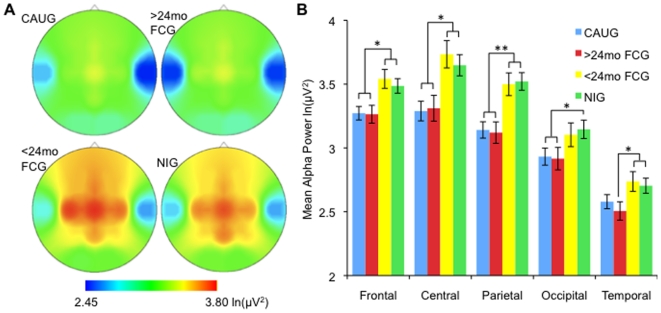
BACKGROUND: Early psychosocial deprivation has profound effects on brain activity in the young child. Previous reports have shown increased power in slow frequencies of the electroencephalogram (EEG), primarily in the theta band, and decreased power in higher alpha and beta band frequencies in infants and children who have experienced institutional care. METHODOLOGY/PRINCIPAL FINDINGS: We assessed the consequences of removing infants from institutions and placing them into a foster care intervention on brain electrical activity when children were 8 years of age. We found the intervention was successful for increasing high frequency EEG alpha power, with effects being most pronounced for children placed into foster care before 24 months of age. CONCLUSIONS/SIGNIFICANCE: The dependence on age of placement for the effects observed on high frequency EEG alpha power suggests a sensitive period after which brain activity in the face of severe psychosocial deprivation is less amenable to recovery.
Overview
The claims and statistics of this paper haven’t been checked yet.
Free: it reads the open-access text and checks the first 5 claims that cite a source we can check. Create a free account to check every claim.
Integrity signals
Registry
Cites
Statistics
Figures
Verification
Claims the paper makes
The claims and statistics of this paper haven’t been checked yet.
Free: it reads the open-access text and checks the first 5 claims that cite a source we can check. Create a free account to check every claim.
Claims other papers make about this one
Each is checked against this paper’s own text: does it say what the citing paper says it does?
The source backs part of the claim, not all of it — or backs it for a different population, condition or comparison.
In the citing paper
“Brain structure and functioning at 8 and 12 years also were enhanced by the intervention [38–41].”
From Alternatives for abandoned children: Insights from the Bucharest Early Intervention Project (2017) · cites this paper as [40]
Experimental — accuracy not yet measuredThe cited source says what the claim attributes to it.
In the citing paper
“First, resting electroencephalogram (EEG) power, especially in the high-frequency alpha band, has been shown to normalize among FCG compared with CAUG by age 8 (22), and persists to age 12 (23).”
From Long-term effects of institutional rearing, foster care, and brain activity on memory and executive functioning (2019) · cites this paper as [22]
In the citing paper
“The effect of timing of placement in foster care became clear by the time the children were 8-years-old; infants placed into foster care before 24 months were indistinguishable from children in the community while those placed after 24 months were identical to the CAUG”
From Normalization of EEG activity among previously institutionalized children placed into foster care: A 12-year follow-up of the Bucharest Early Intervention Project (2016) · cites this paper as Vanderwert et al., 2010
In the citing paper
“When children were observed at age 8 those placed into foster care before 24 months were indistinguishable to never institutionalized children in alpha power (Vanderwert et al., 2010).”
From Normalization of EEG activity among previously institutionalized children placed into foster care: A 12-year follow-up of the Bucharest Early Intervention Project (2016) · cites this paper as Vanderwert et al., 2010
In the citing paper
“EEG abnormalities in children who experienced institutional deprivation include increases in relative power in lower frequency bands and decreased power in high-frequency bands (Marshall et al, 2004(Marshall et al, , 2008;;Tarullo et al, 2011;Vanderwert et al, 2010) compared with typically developing children.”
From Deviations from the expectable environment in early childhood and emerging psychopathology (2015) · cites this paper as Vanderwert et al, 2010
Self-check
Percentages, sums and reported differences re-computed from the paper’s own numbers.
The self-check needs the paper’s full text.
Citations
Cites
EEG alpha and theta oscillations reflect cognitive and memory performance: a review and analysis
Klimesch, W. (1999) · Brain Research Reviews · doi:10.1016/s0165-0173(98)00056-3 · Cited by 6,889
Cognitive Recovery in Socially Deprived Young Children: The Bucharest Early Intervention Project
Nelson, C. A., Zeanah, C. H., Fox, N. A., Marshall, P. J., Smyke, A. T., & Guthrie, D. (2007) · Science · doi:10.1126/science.1143921 · Cited by 951
Self-citationBarry, R. J., Clarke, A. R., & Johnstone, S. J. (2003) · Clinical Neurophysiology · doi:10.1016/s1388-2457(02)00362-0 · Cited by 819 · cited 1×
“The patterns of elevated power in low frequency and decreased power in high-frequency EEG observed in these studies have been interpreted as representing a maturational lag in the development of the EEG [1,7–10].”
BackgroundDevelopment of the EEG from 5 months to 4 years of age
Marshall, P. J., Bar-Haim, Y., & Fox, N. A. (2002) · Clinical Neurophysiology · doi:10.1016/s1388-2457(02)00163-3 · Cited by 633 · cited 2×
“Furthermore, activity in higher frequencies like alpha and beta have long been associated with improved cognitive performance, attention state, and arousal in human infants, children, and adults [13–16].”
BackgroundSelf-citationChugani, H. T., Behen, M. E., Muzik, O., Juhász, C., Nagy, F., & Chugani, D. C. (2001) · NeuroImage · doi:10.1006/nimg.2001.0917 · Cited by 584
Eluvathingal, T. J., Chugani, H. T., Behen, M. E., Juhász, C., Muzik, O., Maqbool, M., Chugani, D. C., & Makki, M. (2006) · Pediatrics · doi:10.1542/peds.2005-1727 · Cited by 451
ZEANAH, C. H., NELSON, C. A., FOX, N. A., SMYKE, A. T., MARSHALL, P., PARKER, S. W., & KOGA, S. (2003) · Development and Psychopathology · doi:10.1017/s0954579403000452 · Cited by 447 · cited 3×
“…intervening years between assessments, there were changes in the living arrangements for a number of children within the CAUG and FCG (e.g. see ref [6]); for the following analyses, we employed an intent-to-treat approach, whereby the data were treated as if each child had remained within their…”
BackgroundMethodInfluentialSelf-citationBeckett, C., Maughan, B., Rutter, M., Castle, J., Colvert, E., Groothues, C., Kreppner, J., Stevens, S., O'Connor, T. G., & Sonuga-Barke, E. J. S. (2006) · Child Development · doi:10.1111/j.1467-8624.2006.00898.x · Cited by 377 · cited 1×
“Other studies of the long-term outcomes of children having adverse early experiences have shown significant ‘‘catch-up’’ in IQ and cognitive abilities after prolonged and intensive interventions [17–19].”
BackgroundThe Effects of Global Severe Privation on Cognitive Competence: Extension and Longitudinal Follow-up
O’Connor, T. G., Rutter, M., Beckett, C., Keaveney, L., Kreppner, J. M., & the English and Romanian Adoptees Study Team (2000) · Child Development · doi:10.1111/1467-8624.00151 · Cited by 353
A Comparison of the Electroencephalogram between Institutionalized and Community Children in Romania
Marshall, P. J., Fox, N. A., & Group, B. C. (2004) · Journal of Cognitive Neuroscience · doi:10.1162/0898929042304723 · Cited by 268 · cited 3×
“For each band absolute power was computed by taking the natural logarithm of power, similar to the procedures at the baseline and 42-month follow-up assessment [1,5].”
BackgroundMethodSelf-citation
Cited by
Items 101–200 of 202
Dick, F., Lloyd‐Fox, S., Blasi, A., Elwell, C. E., & Mills, D. (2013) · Wiley eBooks · doi:10.1002/9781394259588.ch2 · Cited by 15
Practice and Policy Regarding Child Neglect: Lessons from Studies of Institutional Deprivation
Zeanah, C. H., & King, L. S. (2022) · Annual Review of Developmental Psychology · doi:10.1146/annurev-devpsych-121020-031658 · Cited by 10
Self-citationEarly institutionalized care disrupts the development of emotion processing in prosody
Chinn, L. K., Ovchinnikova, I. V., Sukmanova, A. A., Davydova, A. O., & Grigorenko, E. L. (2021) · Development and Psychopathology · doi:10.1017/s0954579420002023 · Cited by 11
Action in Development: Plasticity, Variability, and Flexibility
Rachwani, J., Hoch, J. E., & Adolph, K. E. (2020) · Cambridge University Press eBooks · doi:10.1017/9781108351959.017 · Cited by 17
The importance of responsive parenting for vulnerable infants
Korom, M., & Dozier, M. (2021) · Advances in child development and behavior · doi:10.1016/bs.acdb.2021.03.001 · Cited by 16
Susukida, R., Crum, R. M., Hong, H., Stuart, E. A., & Mojtabai, R. (2018) · International Journal of Methods in Psychiatric Research · doi:10.1002/mpr.1609 · Cited by 9
Examining the Technical Adequacy of the Ages & Stages Questionnaires: INVENTORY
Clifford, J. R., Chen, C.-I., Xie, H., Chen, C., Murphy, K., Ascetta, K. E., Frantz, R. J., & Hansen, S. G. (2018) · Infants & Young Children · doi:10.1097/iyc.0000000000000124 · Cited by 9
Infant Object Manipulation and Play
Tamis‐LeMonda, C. S., & Lockman, J. J. (2020) · Cambridge University Press eBooks · doi:10.1017/9781108351959.019 · Cited by 10
Bick, J. R., Lipschutz, R. S., Tabachnick, A. R., Biekman, B. D., Katz, D., Simons, R. F., & Dozier, M. (2022) · Developmental Psychobiology · doi:10.1002/dev.22249 · Cited by 14
Perego, G., Caputi, M., & Ogliari, A. L. (2015) · Child & Youth Care Forum · doi:10.1007/s10566-015-9340-z · Cited by 11
“In a follow-up conducted at 8 years of age, brain electrical activity in the alpha band of children placed in foster care before their second birthday did not differ from never-institutionalized children, as they showed comparable alpha power contributions over frontal, central, and parietal regions (Vanderwert et al.…”
BackgroundRakhlin, N., Hein, S. D., Doyle, N. M., Hart, L. A., Koposov, R. A., Macomber, D., Ruchkin, V. V., Strelina, A., Tan, M., & Grigorenko, E. L. (2017) · American Journal of Orthopsychiatry · doi:10.1037/ort0000146 · Cited by 12
Infant Vocal Learning and Speech Production
Warlaumont, A. S. (2020) · Cambridge University Press eBooks · doi:10.1017/9781108351959.022 · Cited by 13
The Development of Infant Feeding
Mennella, J. A., Forestell, C. A., Ventura, A. K., & Fisher, J. O. (2020) · Cambridge University Press eBooks · doi:10.1017/9781108351959.010 · Cited by 12
Zhukova, M., Ovchinnikova, I. V., Logvinenko, T. I., & Grigorenko, E. L. (2020) · New Directions for Child and Adolescent Development · doi:10.1002/cad.20333 · Cited by 8
Dagan, O., & Sagi‐Schwartz, A. (2020) · Cambridge University Press eBooks · doi:10.1017/9781108351959.025 · Cited by 12
Does experimental research support psychoanalysis?
Cohen, D. (2011) · Journal of Physiology-Paris · doi:10.1016/j.jphysparis.2011.09.010 · Cited by 11
“Also, impact of deprivation can be evidenced through EEG (Vanderwert et al., 2010; McLaughlin et al., 2010) as well as brain imaging (Mehta et al.”
BackgroundTroller‐Renfree, S. V., Gray, K. N., Sandre, A., Hart, E. R., Sperber, J. F., Dettmer, A. M., Meyer, J. S., & Noble, K. G. (2025) · Developmental Psychobiology · doi:10.1002/dev.70068 · Cited by 8
Early Deprivation and Developmental Psychopathology
Esposito, E. A., & Gunnar, M. R. (2014) · Springer eBooks · doi:10.1007/978-1-4614-9608-3_19 · Cited by 7
A Forgotten Population: Estimating the Number of Children Outside of Households in Cambodia
Rubenstein, B. L., & Stark, L. (2016) · Global Social Welfare · doi:10.1007/s40609-016-0051-7 · Cited by 7
“ing up in institutional care have smaller amounts of gray and white matter and lower levels of electrical activity (Bick et al. 2015; Vanderwert et al. 2010).”
Understanding and Evaluating the Moral World in Infancy
Hamlin, J. K., & Sitch, M. J. (2020) · Cambridge University Press eBooks · doi:10.1017/9781108351959.028 · Cited by 6
Maternal Stress and Early Neurodevelopment: Exploring the Protective Role of Maternal Growth Mindset
Elansary, M., Pierce, L. J., Wei, W. S., McCoy, D. C., ZUCKERMAN, B. S., & Nelson, C. A. (2021) · Journal of Developmental & Behavioral Pediatrics · doi:10.1097/dbp.0000000000000998 · Cited by 7
Self-citationNelson, C. A., Fox, N. A., & Zeanah, C. H. (2016) · Wiley eBooks · doi:10.1002/9781119125556.devpsy418 · Cited by 5
Self-citationWeissmark, M. S. (2020) · doi:10.1093/oso/9780190686345.001.0001 · Cited by 5
Mitsven, S. G., Messinger, D. S., Moffitt, J., & Ahn, Y. A. (2020) · Cambridge University Press eBooks · doi:10.1017/9781108351959.027 · Cited by 6
Alpha electroencephalogram (EEG) asymmetry among toddlers in foster care
Blaisdell, K. N., Barker, T. V., Giuliano, R. J., & Fisher, P. A. (2020) · Development and Psychopathology · doi:10.1017/s0954579420001212 · Cited by 4
O’Connor, T. G. (2016) · Wiley eBooks · doi:10.1002/9781119125556.devpsy105 · Cited by 6
Damsteegt, R. C., van IJzendoorn, M. H., Out, D., & Bakermans‐Kranenburg, M. J. (2014) · BMC Psychology · doi:10.1186/s40359-014-0051-2 · Cited by 4
“In another study, children who had been institutionalized had significantly smaller EEG alpha power than children who had been placed in foster care (Vanderwert et al. 2010), and had significantly smaller cortical gray and white matter volume and smaller posterior corpus callosum volume, whereas placement in foster ca…”
BackgroundThe Infant’s Visual World: The Everyday Statistics for Visual Learning
Jayaraman, S., & Smith, L. B. (2020) · Cambridge University Press eBooks · doi:10.1017/9781108351959.020 · Cited by 4
Maurer, D. M. (2020) · Cambridge University Press eBooks · doi:10.1017/9781108351959.006 · Cited by 4
Fox, N. A., Almas, A. N., Degnan, K. A., Nelson, C. A., & Zeanah, C. H. (2011) · Journal of Child Psychology and Psychiatry · doi:10.1111/j.1469-7610.2011.02449.x · Cited by 3
Self-citationInfant Learning in the Digital Age
Rusnak, S. N., & Barr, R. (2020) · Cambridge University Press eBooks · doi:10.1017/9781108351959.016 · Cited by 4
Glennen, S. L. (2021) · Journal of Communication Disorders · doi:10.1016/j.jcomdis.2021.106127 · Cited by 5
Hayne, H., & Herbert, J. S. (2020) · Cambridge University Press eBooks · doi:10.1017/9781108351959.012 · Cited by 3
Oliveira, P. (2024) · Frontiers in Behavioral Neuroscience · doi:10.3389/fnbeh.2024.1332898 · Cited by 4
“This result was obtained in two different samples (Marshall et al., 2004; Vanderwert et al., 2010; Tarullo et al., 2011; Debnath et al., 2020), spanning a long period of development from the toddler years up until 16 years of age.”
ResultThe impact of a monthly unconditional cash transfer on child brain activity: A 4-year follow-up
Troller‐Renfree, S. V., Costanzo, M. A., Duncan, G. J., Magnuson, K., Gennetian, L. A., Yoshikawa, H., Black, S. R., Karhson, D. S., Georgieff, M. K., Nelson, J. M., et al. (2026) · Developmental Cognitive Neuroscience · doi:10.1016/j.dcn.2026.101673 · Cited by 5
“…maternal stress (Troller-Renfree et al., 2020, 2023), socioeconomic status(Maguire and Schneider, 2019; Otero et al., 2003), and psychosocial deprivation(Bick et al., 2022; Debnath, Tang, et al., 2020; Marshall et al., 2004; Sheridan et al., 2012; Tan, Tang, et al., 2023; Vanderwert et al., 2010).”
Self-citationLurie, L. A., Gruhn, M. A., Garrisi, K., McLaughlin, K. A., Humphreys, K. L., Zeanah, C. H., Fox, N. A., Nelson, C. A., & Sheridan, M. A. (2025) · Developmental Science · doi:10.1111/desc.70043 · Cited by 2
Self-citationKatus, L., & Lloyd‐Fox, S. (2025) · Infant Behavior and Development · doi:10.1016/j.infbeh.2025.102128 · Cited by 4
Fetal and Infant Neurobehavioral Development
Monk, C. E., & Hane, A. A. (2014) · Oxford University Press eBooks · doi:10.1093/oxfordhb/9780199778072.013.20 · Cited by 3
Embodied Brain Model for Understanding Functional Neural Development of Fetuses and Infants
Yamada, Y., Kanazawa, H., & Kuniyoshi, Y. (2020) · Cambridge University Press eBooks · doi:10.1017/9781108351959.001 · Cited by 5
Environmental Stimulation Modulating the Pathophysiology of Neurodevelopmental Disorders
Kondo, M., & Hannan, A. J. (2019) · Elsevier eBooks · doi:10.1016/b978-0-12-812777-3.00003-9 · Cited by 2
Herrera, A. M. (2014) · University of Minnesota Digital Conservancy (University of Minnesota) · Cited by 3
The Development of Touch Perception and Body Representation
Bremner, A. J. (2020) · Cambridge University Press eBooks · doi:10.1017/9781108351959.009 · Cited by 3
Koltcheva, N. (2025) · IGI Global eBooks · doi:10.4018/979-8-3693-9689-6.ch004 · Cited by 1
Experience-dependent development of vagal circuitry in rodents and humans
Panvini, S., Kamitakahara, A. K., Rinaman, L., & Levitt, P. R. (2026) · Neuroscience & Biobehavioral Reviews · doi:10.1016/j.neubiorev.2026.106728 · Cited by 2
Accounting for the Developing Brain
Wolff, J. J. (2016) · Springer eBooks · doi:10.1007/978-3-319-28492-7_29 · Cited by 1
Diversity and Ethnic Conflicts
Weissmark, M. S. (2020) · Oxford University Press eBooks · doi:10.1093/oso/9780190686345.003.0008 · Cited by 1
Amso, D., & Tummeltshammer, K. S. (2020) · Cambridge University Press eBooks · doi:10.1017/9781108351959.007 · Cited by 2
Early Knowledge About Space and Quantity
Newcombe, N. S. (2020) · Cambridge University Press eBooks · doi:10.1017/9781108351959.015 · Cited by 1
Iyer, P. A. (2014) · UTA ResearchCommons (University of Texas Arlington) · Cited by 1
Adaptation et neurosciences II : adaptation biologique, psychique, sociale et psychopathologie
Desseilles, M. (2016) · Santé mentale au Québec · doi:10.7202/1036978ar · Cited by 1
“…montré que la privation psychosociale, linguistique et sensorielle avait un effet tant sur la structure que sur la fonction du cerveau avec, par exemple, respectivement une diminution du volume total du cerveau et des modifications dans l’activité électrique du cerveau (Vanderwert et al., 2010).”
BackgroundThe effects of disruptions in care on wellbeing in orphans
Gray, C. L. (2018) · Carolina Digital Repository (University of North Carolina at Chapel Hill) · doi:10.17615/xjnr-7z18 · Cited by 1
Infant Word Learning and Emerging Syntax
Levine, D., Hirsh‐Pasek, K., & Golinkoff, R. M. (2020) · Cambridge University Press eBooks · doi:10.1017/9781108351959.023 · Cited by 3
Infants’ Perception of Auditory Patterns
Cirelli, L. K., & Trehub, S. E. (2020) · Cambridge University Press eBooks · doi:10.1017/9781108351959.008 · Cited by 1
The Mirror Neuron System and Social Cognition
Fox, N. A., Salo, V. C., Debnath, R., Morales, S., & Smith, E. G. (2020) · Cambridge University Press eBooks · doi:10.1017/9781108351959.018 · Cited by 1
Self-citationBonifacino, N., & Martínez, C. P. (2021) · NACIENDO Revista Española de Psicología y Psicopatología Perinatal e Infantil · doi:10.52961/01.ofva1865 · Cited by 1
Oakes, L. M. (2020) · Cambridge University Press eBooks · doi:10.1017/9781108351959.014 · Cited by 1
Frogley, C. L. (2016) · University of Surrey Open Research repository · Cited by 3
Nature and Nurture in Parental Care
Royle, N. J., & Moore, A. J. (2019) · Wiley eBooks · doi:10.1002/9781119313663.ch7 · Cited by 2
The developmental psychopathology of stress exposure in childhoodPreprint
Doom, J. R. (2018) · PsyArXiv (OSF Preprints) · doi:10.31234/osf.io/6szy5 · Cited by 1
The Impact of a Monthly Unconditional Cash Transfer on Child Brain Activity: A 4-Year Follow-upPreprint
Troller‐Renfree, S. V., Costanzo, M. A., Duncan, G. J., Magnuson, K., Gennetian, L. A., Yoshikawa, H., Black, S., Karhson, D. S., Georgieff, M., Nelson, J. M., et al. (2025) · SSRN Electronic Journal · doi:10.2139/ssrn.5433785 · Cited by 1
Self-citationOliveira, P., Fearon, P. R. M., Belsky, J., Mesquita, A. R., Sampaio, A., Pinal, D., & Soares, I. (2022) · Journal of Child Psychology and Psychiatry · doi:10.1111/jcpp.13728 · Cited by 7
Estimating child separation in emergencies: Results from
Stark, L., Rubenstein, B. L., Mansourian, H., Spencer, C., Noble, E., & Chisolm‐Straker, M. (2016)
Anxiety and Trauma-Related Disorders
Thompson, K. C., & Morris, R. J. (2016) · Advancing responsible adolescent development · doi:10.1007/978-3-319-29343-1_11
Cerebral Metabolism, Brain Imaging and the Stress Response
Ebmeier, K. P., & Zsoldos, E. (2019) · Elsevier eBooks · doi:10.1016/b978-0-12-813146-6.00003-5 · Cited by 1
Stelzer, F., Cervigni, M., & Martino, P. (2012) · Revista Mexicana de Investigación en Psicología · doi:10.32870/rmip.v4i1.515
Weissmark, M. S. (2020) · Oxford University Press eBooks · doi:10.1093/oso/9780190686345.003.0007
Weissmark, M. S. (2020) · Oxford University Press eBooks · doi:10.1093/oso/9780190686345.003.0006
Weissmark, M. S. (2020) · Oxford University Press eBooks · doi:10.1093/oso/9780190686345.003.0001
Weissmark, M. S. (2020) · Oxford University Press eBooks · doi:10.1093/oso/9780190686345.003.0005 · Cited by 1
Weissmark, M. S. (2020) · Oxford University Press eBooks · doi:10.1093/oso/9780190686345.003.0009
Jantz, P. B. (2020) · Support for Learning · doi:10.1111/1467-9604.12310 · Cited by 1
Lampl, M. (2020) · Cambridge University Press eBooks · doi:10.1017/9781108351959.002
Hespos, S. J., & Anderson, E. M. (2020) · Cambridge University Press eBooks · doi:10.1017/9781108351959.013 · Cited by 1
Dual Language Exposure and Early Learning
Brito, N. H. (2020) · Cambridge University Press eBooks · doi:10.1017/9781108351959.024
Reh, R. K., & Werker, J. F. (2020) · Cambridge University Press eBooks · doi:10.1017/9781108351959.021 · Cited by 1
Development During Infancy in Children Later Diagnosed with Autism Spectrum Disorder
Falck‐Ytter, T., & Jones, E. J. H. (2020) · Cambridge University Press eBooks · doi:10.1017/9781108351959.005
Dynamic Epigenetic Impact of the Environment on the Developing Brain
Champagne, F. A. (2020) · Cambridge University Press eBooks · doi:10.1017/9781108351959.003 · Cited by 1
Nekkanti, A. K. (2021) · PsyArXiv (OSF Preprints) · doi:10.31234/osf.io/g9yx6
Lockman, J. J., & Tamis‐LeMonda, C. S. (2020) · Cambridge University Press eBooks · doi:10.1017/9781108351959.031
Reactive Attachment Disorder and Disinhibited Social Engagement Disorder
Scott, E. L., Keary, C. J., King, J. M., Zeanah, C. H., & McDougle, C. J. (2018) · Oxford University Press eBooks · doi:10.1093/med/9780190457136.003.0002
Self-citationWeissmark, M. S. (2020) · Oxford University Press eBooks · doi:10.1093/oso/9780190686345.003.0002
Weissmark, M. S. (2020) · Oxford University Press eBooks · doi:10.1093/oso/9780190686345.003.0004
Weissmark, M. S. (2020) · Oxford University Press eBooks · doi:10.1093/oso/9780190686345.003.0003
Lockman, J. J., & Tamis‐LeMonda, C. S. (2020) · Cambridge University Press eBooks · doi:10.1017/9781108351959.030
Weissmark, M. S. (2020) · Oxford University Press eBooks · doi:10.1093/oso/9780190686345.003.0010
Présentation. Enseigner et apprendre les langues africaines ou en langues africaines
Samari, G. D., MOHAMADOU, O., & Métangmo-Tatou, L. (2023) · doi:10.46711/jeynitaare.2023.2.1.1
Frey, M. (2023) · Elsevier eBooks · doi:10.1016/b978-3-437-21307-6.00021-5
Bortfeld, H., & Bunge, S. A. (2024) · Cambridge University Press eBooks · doi:10.1017/9781108595827.006
Weissmark, M. S. (2020) · Oxford University Press eBooks · doi:10.1093/oso/9780190686345.002.0007
Weissmark, M. S. (2020) · Oxford University Press eBooks · doi:10.1093/oso/9780190686345.002.0004
Weissmark, M. S. (2020) · Oxford University Press eBooks · doi:10.1093/oso/9780190686345.002.0015
Weissmark, M. S. (2020) · Oxford University Press eBooks · doi:10.1093/oso/9780190686345.002.0008
Weissmark, M. S. (2020) · Oxford University Press eBooks · doi:10.1093/oso/9780190686345.002.0003
Weissmark, M. S. (2020) · Oxford University Press eBooks · doi:10.1093/oso/9780190686345.002.0005
Barbosa‐Torres, C., Bueso‐Izquierdo, N., Arévalo‐Martínez, A., & Manso, J. M. M. (2025) · Acta Neuropsychiatrica · doi:10.1017/neu.2025.19
“…(Humphreys et al ., 2015), cognitive skills (Humphreys et al ., 2022), the neurobiology of the processing of emotions (Moulson et al ., 2009), alterations in the structure of the brain (Vanderwert et al ., 2010), or electroencephalographic comparisons with other minors (Marshall et al ., 2004).”
InfluentialCentering the Young Child: A Developmental Case for Child Welfare Reform
Harden, B. J., & Zeanah, C. H. (2025) · Families in Society The Journal of Contemporary Social Services · doi:10.1177/10443894251328144 · Cited by 1
“Following psychosocial neglect in the first 3 years of life, these EEG abnormalities persist from early childhood through adolescence (Debnath et al., 2020; Vanderwert et al., 2016; Vanderwert et al., 2010).”
Self-citationEmotional neglect in childhood modulates aperiodic offset in the left pars orbitalis in adulthood
Inoue, S., Otsuru, N., Ikarashi, H., Iimuro, K., Nagasaka, K., Shirozu, H., & Onishi, H. (2026) · Frontiers in Neuroscience · doi:10.3389/fnins.2025.1719462
“…a human study demonstrated that early institutionalization—an environment characterized by caregiver deprivation and mother–child separation—was associated with reduced alpha power, including the frontal region, which is thought to reflect inhibitory processes (Vanderwert et al., 2010).”
Berührung in der Eltern-Kind-Beziehung
Friedrich, Y., & Croy, I. (2026) · Springer eBooks · doi:10.1007/978-3-642-54061-5_37-1
Metadata
- Authors
- Vanderwert, R. E., Marshall, P. J., Nelson, C. A., Zeanah, C. H., & Fox, N. A.
- Affiliations
- University of Maryland, College Park (US)
- Temple University (US)
- Boston Children's Hospital (US)
- Tulane University (US)
- Corresponding author
- Fox, Nathan A.
- Venue
- PLoS ONE
- Publisher
- Public Library of Science (PLoS)
- Published
- 2010-07-01
- Volume
- 5
- Issue
- 7
- Pages
- e11415
- ISSN
- 1932-6203 (ISSN-L)
- PMC
- PMC2895657
- OpenAlex
- W2110224254
- Cited by
- 203
- References
- 23
- Citations by year
- 2026: 5 · 2025: 10 · 2024: 4 · 2023: 10 · 2022: 9 · 2021: 11 · 2020: 59 · 2019: 15 · 2018: 12 · 2017: 9 · 2016: 18 · 2015: 11 · 2014: 10 · 2013: 9 · 2012: 5
- FWCI
- 16.72
- Type
- journal article
- Language
- en
- Open access
- gold
- doi.org
- Locations
- PLoS ONE (publishedVersion, cc-by)
- PubMed Central (publishedVersion, cc-by)
- PubMed (publishedVersion)
- ORCA Online Research @Cardiff (Cardiff University) (acceptedVersion)
- Digital Access to Scholarship at Harvard (DASH) (Harvard University) (submittedVersion, cc-by)
- DOAJ (DOAJ: Directory of Open Access Journals) (submittedVersion, cc-by-sa)
- Funders
- John D. and Catherine T. MacArthur Foundation
- Topics
- Social Sciences › Sociology and Political Science › Child Welfare and Adoption
- Social Sciences › Psychology › Clinical Psychology › Child Abuse and Trauma
- Life Sciences › Neuroscience › Behavioral Neuroscience › Stress Responses and Cortisol
- Keywords
- institutional care, foster care placement, intervention timing, EEG alpha power, brain electrical activity, sensitive period, early deprivation, children
- MeSH terms
- Alpha Rhythm, Brain, Child, Child Abuse, Child, Preschool, Electric Conductivity, Female, Foster Home Care, Humans, Infant, Male, Psychosocial Deprivation, Time Factors, Intention to Treat Analysis
About these checks
Registry, retraction, Cites and statistics results are computed, not judged, with one exception: a printed reference that no index lists is read once by a model before it counts as a citation error. Claims are extracted by a model and kept only when their quote appears verbatim in the text; each cited source is then checked, with a model’s help, for whether it says what the claim relies on. Those verdicts can be wrong — read the claim’s quote and the cited source before relying on one.
Statistics and arithmetic are recomputed, not judged.
Confidence bands are shown only for fields calibrated on our annotated test set. None is calibrated yet, so no band is shown.
What counts as a claim ›How we measure confidence ›How we check this ›
Are you an author, or do you see a problem with this page? Request a review
Data sources
Bibliographic data: Semantic Scholar, OpenAlex, Crossref.
Contains information from the Semantic Scholar Academic Graph Datasets, made available under the ODC Attribution License (ODC-BY 1.0).
Semantic Scholar’s data is described in: Kinney, R., et al. (2023). The Semantic Scholar Open Data Platform. arXiv:2301.10140.
