

The Timing of the Cognitive Cycle
Open accessThe DOI matches its Crossref record; 109 of the 116 references it cites were found in a registry or an index.
Abstract
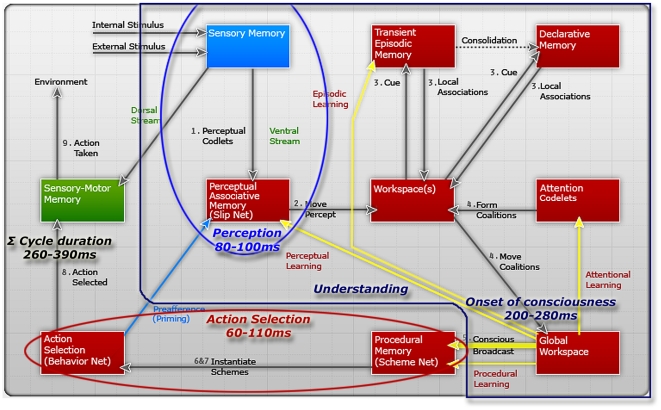
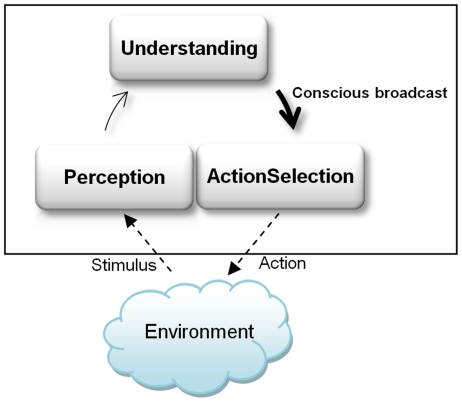
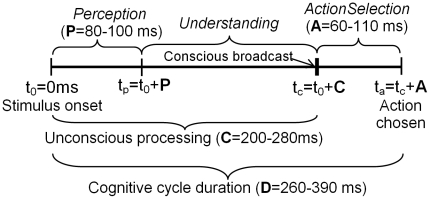
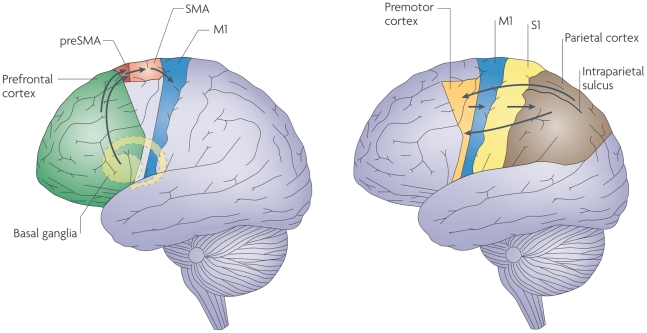
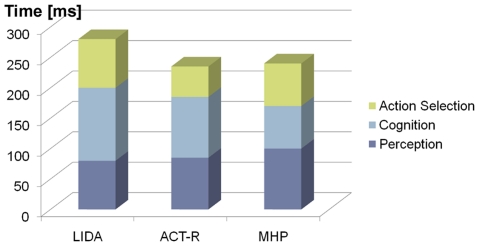
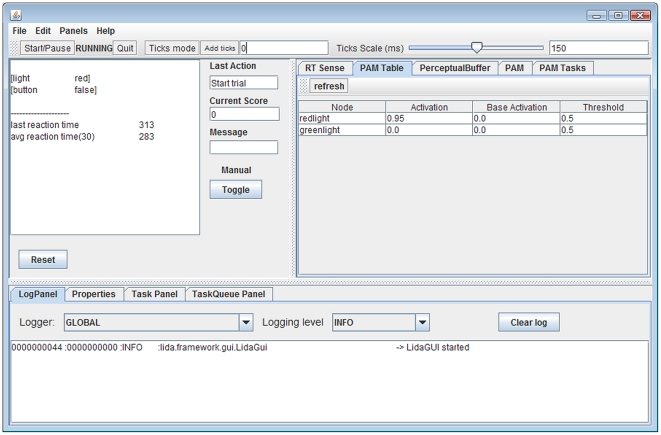
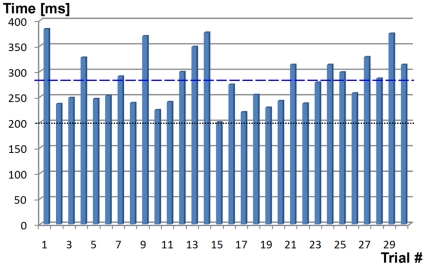
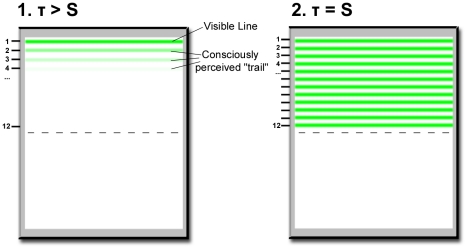
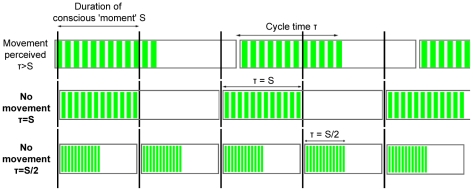
We propose that human cognition consists of cascading cycles of recurring brain events. Each cognitive cycle senses the current situation, interprets it with reference to ongoing goals, and then selects an internal or external action in response. While most aspects of the cognitive cycle are unconscious, each cycle also yields a momentary "ignition" of conscious broadcasting. Neuroscientists have independently proposed ideas similar to the cognitive cycle, the fundamental hypothesis of the LIDA model of cognition. High-level cognition, such as deliberation, planning, etc., is typically enabled by multiple cognitive cycles. In this paper we describe a timing model LIDA's cognitive cycle. Based on empirical and simulation data we propose that an initial phase of perception (stimulus recognition) occurs 80-100 ms from stimulus onset under optimal conditions. It is followed by a conscious episode (broadcast) 200-280 ms after stimulus onset, and an action selection phase 60-110 ms from the start of the conscious phase. One cognitive cycle would therefore take 260-390 ms. The LIDA timing model is consistent with brain evidence indicating a fundamental role for a theta-gamma wave, spreading forward from sensory cortices to rostral corticothalamic regions. This posteriofrontal theta-gamma wave may be experienced as a conscious perceptual event starting at 200-280 ms post stimulus. The action selection component of the cycle is proposed to involve frontal, striatal and cerebellar regions. Thus the cycle is inherently recurrent, as the anatomy of the thalamocortical system suggests. The LIDA model fits a large body of cognitive and neuroscientific evidence. Finally, we describe two LIDA-based software agents: the LIDA Reaction Time agent that simulates human performance in a simple reaction time task, and the LIDA Allport agent which models phenomenal simultaneity within timeframes comparable to human subjects. While there are many models of reaction time performance, these results fall naturally out of a biologically and computationally plausible cognitive architecture.
Overview
The claims and statistics of this paper haven’t been checked yet.
Free: it reads the open-access text and checks the first 5 claims that cite a source we can check. Create a free account to check every claim.
Integrity signals
Registry
Cites
Statistics
Figures
Verification
Claims the paper makes
The claims and statistics of this paper haven’t been checked yet.
Free: it reads the open-access text and checks the first 5 claims that cite a source we can check. Create a free account to check every claim.
Claims other papers make about this one
Each is checked against this paper’s own text: does it say what the citing paper says it does?
The source backs part of the claim, not all of it — or backs it for a different population, condition or comparison.
In the citing paper
“Along these lines, by enabling the generation of inferences with rapidity and reliability, SOHMs could afford approximate models capable of guiding action–perception cycles and decision-making (von Uexküll, 1957; Fuster, 2009; Madl et al., 2011; Vul et al., 2014; Linson et al., 2018; Parr and Friston, 2018b).”
From An Integrated World Modeling Theory (IWMT) of Consciousness (2020) · cites this paper as Madl et al., 2011
Experimental — accuracy not yet measured
Self-check
Percentages, sums and reported differences re-computed from the paper’s own numbers.
The self-check needs the paper’s full text.
Citations
Cites
Baddeley, A. D., & Hitch, G. (1974) · Psychology of Learning and Motivation · doi:10.1016/s0079-7421(08)60452-1 · Cited by 9,860
Barsalou, L. W. (1999) · Behavioral and Brain Sciences · doi:10.1017/s0140525x99002149 · Cited by 6,887
The Embodied Mind: Cognitive Science and Human Experience
Varela, F. J., Rosch, E. H., & Thompson, E. T. (2017) · Project Muse (Johns Hopkins University) · Cited by 5,910
Buzsáki, G. (2006) · doi:10.1093/acprof:oso/9780195301069.001.0001 · Cited by 4,873 · cited 3×
“most exact and reliable data, but they require surgery and cannot be used in healthy humans [39].”
BackgroundThe brainweb: phase synchronization and large-scale integration
Varela, F., Lachaux, J.-P., Rodriguez, E., & Martinerie, J. (2001) · Nature Reviews Neuroscience · doi:10.1038/35067550 · Cited by 4,761 · cited 2×
“(based on [26]).”
BackgroundHandbook of perception and human performance
Boff, K. R., Kaufman, L., & Thomas, J. P. (1986) · Wiley eBooks · Cited by 4,129
(1988) · Cited by 3,656
Self-citationSpeed of processing in the human visual system
Thorpe, S., Fize, D., & Marlot, C. (1996) · Nature · doi:10.1038/381520a0 · Cited by 3,538
Ericsson, K. A., & Kintsch, W. (1995) · Psychological Review · doi:10.1037/0033-295x.102.2.211 · Cited by 3,498 · cited 1×
“Based primarily on global workspace theory [25], the model implements and fleshes out central ideas from a number of psychological and neuropsychological theories including situated (embodied) cognition [26,27], perceptual symbol systems [28], working memory [29], memory by affordances [30], long-term working memory […”
MethodAn Integrated Theory of the Mind.
Anderson, J. R., Bothell, D., Byrne, M. D., Douglass, S., Lebiere, C., & Qin, Y. (2004) · Psychological Review · doi:10.1037/0033-295x.111.4.1036 · Cited by 2,978 · cited 4×
“In other cognitive models, such as ACT-R or EPIC, the cognition phase includes the matching, selection and execution of production rules [64,65].”
MethodInfluential
Research works printed but not linked: 4
- Willis J Todorov A 2006 First Impressions: Making Up Your Mind After a 100-Ms Exposure to a Face. Psychological Science (Wiley-Blackwell) 17 592 598 doi: 10.1111/j.1467-9280.2006.01750.x 16866745 · DOI · Paper page
- Kosinski B Cummings J 1999 The Scientific Method: An Introduction Using Reaction Time. Tested studies for laboratory teaching (ABLE Proceedings) 25 219 234
- Martinez-Conde S Macknik S Martinez MM Alonso J Tse PU 2006 Visual Perception Part 1, Volume 154: Fundamentals of Vision: Low and Mid-Level Processes in Perception. 1st ed. Elsevier Science
- Maes P 1989 How To Do the Right Thing. CONNECTION SCIENCE JOURNAL 1 291 323 · DOI · Paper page
Cited by
Global Workspace Dynamics: Cortical “Binding and Propagation” Enables Conscious Contents
Baars, B. J., Franklin, S., & Ramsoy, T. Z. (2013) · Frontiers in Psychology · doi:10.3389/fpsyg.2013.00200 · Cited by 294
“Global Workspace theory has been applied to numerous empirical findings (e.g., Baars, 1988, 2002; Madl et al., 2011, 2012).”
MethodSelf-citationLIDA: A Systems-level Architecture for Cognition, Emotion, and Learning
Franklin, S., Madl, T., D'Mello, S., & Snaider, J. (2014) · IEEE Transactions on Autonomous Mental Development · doi:10.1109/tamd.2013.2277589 · Cited by 261
“The few emotion models accounting for attention (e.g. [111]) usually only include a basic thresholding mechanism, as opposed to LIDA C ’s detailed attention model that is based on Global Workspace Theory [69, 112].”
BackgroundMethodInfluentialSelf-citationSafron, A. (2020) · Frontiers in Artificial Intelligence · doi:10.3389/frai.2020.00030 · Cited by 133
“…lines, by enabling the generation of inferences with rapidity and reliability, SOHMs could afford approximate models capable of guiding action–perception cycles and decision-making (von Uexküll, 1957; Fuster, 2009; Madl et al., 2011; Vul et al., 2014; Linson et al., 2018; Parr and Friston, 2018b).”
MethodEncoding of event timing in the phase of neural oscillations
Kösem, A., Gramfort, A., & van Wassenhove, V. (2014) · NeuroImage · doi:10.1016/j.neuroimage.2014.02.010 · Cited by 144
“Latency-based descriptions of cognitive functions classically use event-related potentials/fields (ERP and ERF, respectively) to describe the timing at which mental operations take place in cortex (Coles and Rugg, 1995; Madl et al., 2011).”
The Moral brain: a multidisciplinary perspective
Decety, J., & Wheatley, T. (2015) · Choice Reviews Online · doi:10.5860/choice.192126 · Cited by 110
Microcognitive science: bridging experiential and neuronal microdynamics
Petitmengin, C., & Lachaux, J.-P. (2013) · Frontiers in Human Neuroscience · doi:10.3389/fnhum.2013.00617 · Cited by 93
“This means simple cognitive operations, at the level of the perception-action cycle (Fuster, 2004; Madl et al., 2011), and precise measures of their micro-dynamics.”
A LIDA cognitive model tutorial
Franklin, S., Madl, T., Strain, S., Faghihi, U., Dong, D., Kugele, S., Snaider, J., Agrawal, P., & Chen, S. (2016) · Biologically Inspired Cognitive Architectures · doi:10.1016/j.bica.2016.04.003 · Cited by 102
Self-citationPrognostication after cardiac arrest: how EEG and evoked potentials may improve the challenge
Benghanem, S., Pruvost‐Robieux, E., Bouchereau, E., Gavaret, M., & Cariou, A. (2022) · Annals of Intensive Care · doi:10.1186/s13613-022-01083-9 · Cited by 68
“Despite this, attention is a necessary prerequisite for consciousness, but possible dissociation between attention and consciousness has been demonstrated [132, 133].”
BackgroundThe cerebellum for jocks and nerds alike
Popa, L. S., Hewitt, A. L., & Ebner, T. J. (2014) · Frontiers in Systems Neuroscience · doi:10.3389/fnsys.2014.00113 · Cited by 57
“Within such a tight temporal budget it is unlikely that a classical process of error perception and action selection, which requires ∼400 ms, can be implemented (Madl et al., 2011).”
BackgroundSafron, A. (2021) · Entropy · doi:10.3390/e23060783 · Cited by 52
The Global Workspace Theory of Consciousness: Predictions and Results
Baars, B. J. (2017) · The Blackwell Companion to Consciousness · doi:10.1002/9781119132363.ch16 · Cited by 46
Self-citationGlobal Workspace Theory, its LIDA model and the underlying neuroscience
Franklin, S., Strain, S., Snaider, J., McCall, R., & Faghihi, U. (2012) · Biologically Inspired Cognitive Architectures · doi:10.1016/j.bica.2012.04.001 · Cited by 47
“There is considerable empirical evidence from neuroscience suggestive of and consistent with such cognitive cycling in humans (Doesburg, Green, McDonald, & Ward, 2009; Madl, et al., 2011; Massimini et al., 2005; Sigman & Dehaene, 2006; Uchida, Kepecs, & Mainen, 2006; Willis & Todorov, 2006).”
BackgroundSelf-citationEvoked and Event-Related Potentials as Biomarkers of Consciousness State and Recovery
Pruvost‐Robieux, E., Marchi, A., Martinelli, I., Bouchereau, E., & Gavaret, M. (2021) · Journal of Clinical Neurophysiology · doi:10.1097/wnp.0000000000000762 · Cited by 58
Integrated world modeling theory expanded: Implications for the future of consciousness
Safron, A. (2022) · Frontiers in Computational Neuroscience · doi:10.3389/fncom.2022.642397 · Cited by 34
“Perhaps relatedly, an unresolved issue within IWMT is whether consciousness (as experience) corresponds to a series of discrete “snapshots” (Crick and Koch, 2003; Madl et al., 2011; Herzog et al., 2016), like a flipbook or sequential frames in a cartoon/comic (Ha and Schmidhuber, 2018).”
BackgroundA Neurally Controlled Computer Game Avatar With Humanlike Behavior
Gamez, D., Fountas, Z., & Fidjeland, A. K. (2012) · IEEE Transactions on Computational Intelligence and AI in Games · doi:10.1109/tciaig.2012.2228483 · Cited by 51
“A version of this system that is capable of learning has also been developed [19], [20].”
BackgroundSinghal, I., & Srinivasan, N. (2021) · Neuroscience of Consciousness · doi:10.1093/nc/niab020 · Cited by 36
“This coupling is absent for brief periods of time during the period of perceptual switches (van Leeuwen 2007; Madl et al. 2011), and there is possibly no conscious visual experience during a perceptual switch.”
A computational model of attentional learning in a cognitive agent
Faghihi, U., McCall, R. J., & Franklin, S. (2012) · Biologically Inspired Cognitive Architectures · doi:10.1016/j.bica.2012.07.003 · Cited by 41
Self-citationConceptual Commitments of the LIDA Model of Cognition
Franklin, S., Strain, S., McCall, R. J., & Baars, B. J. (2013) · Journal of Artificial General Intelligence · doi:10.2478/jagi-2013-0002 · Cited by 36
Self-citationOut of our skull, in our skin: the Microbiota-Gut-Brain axis and the Extended Cognition Thesis
Boem, F., Ferretti, G., & Caiani, S. Z. (2021) · Biology & Philosophy · doi:10.1007/s10539-021-09790-6 · Cited by 35
The LIDA Model as a Foundational Architecture for AGI
Faghihi, U., & Franklin, S. (2012) · Atlantis thinking machines · doi:10.2991/978-94-91216-62-6_7 · Cited by 39
Self-citationRyan, K., Agrawal, P., & Franklin, S. (2019) · Cognitive Systems Research · doi:10.1016/j.cogsys.2019.09.018 · Cited by 32
Self-citationA cognitive model fleshes out Kahneman’s fast and slow systems
Faghihi, U., Estey, C., McCall, R. J., & Franklin, S. (2014) · Biologically Inspired Cognitive Architectures · doi:10.1016/j.bica.2014.11.014 · Cited by 29
“The LIDA model postulates that CMAS occurs in humans in a fraction of a second (T Madl et al., 2011 ).”
MethodSelf-citationHölken, A., Kugele, S., Newen, A., & Franklin, S. (2023) · Cognitive Systems Research · doi:10.1016/j.cogsys.2023.03.002 · Cited by 26
Self-citationArtificial Motivation for Cognitive Software Agents
McCall, R. J., Franklin, S., Faghihi, U., Snaider, J., & Kugele, S. (2020) · Journal of Artificial General Intelligence · doi:10.2478/jagi-2020-0002 · Cited by 28
“Likewise, most of our agent implementations lacked explicit motivations (for example, Madl et al., 2011; Madl & Franklin, 2012; Faghihi, McCall, & Franklin, 2012), and those that did include motivational constructs, such as feelings or emotions, implemented them in a simplistic way (for example,…”
BackgroundSelf-citationNumber of Autonomous Cognitive Agents in a Neural Network
Kak, S. C. (2022) · Journal of Artificial Intelligence and Consciousness · doi:10.1142/s2705078522500023 · Cited by 24
Petton, M., Perrone‐Bertolotti, M., Mac-Auliffe, D., Bertrand, O., Aguera, P., Sipp, F., Bhattacharjee, M., Isnard, J., Minotti, L., Rheims, S., et al. (2018) · Neuropsychologia · doi:10.1016/j.neuropsychologia.2019.107151 · Cited by 24
A task segment framework to study keylogged translation processes
Martín, R. M., & Apfelthaler, M. (2022) · The International Journal of Translation and Interpreting Research · doi:10.12807/ti.114202.2022.a02 · Cited by 27
Risk Representation, Perception, and Propensity in an Integrated Human Lane-Change Decision Model
Jiang, L., Chen, D., Li, Z., & Wang, Y. (2022) · IEEE Transactions on Intelligent Transportation Systems · doi:10.1109/tits.2022.3207182 · Cited by 19
“The LCD moments were 0.6s before the execution moments to account for human perception and reasoning time [47].”
BackgroundFascinatin’ Rhythm – and Pauses in Translators’ Cognitive Processes
Martín, R. M., & de León, C. M. (2018) · HERMES - Journal of Language and Communication in Business · doi:10.7146/hjlcb.v0i57.106192 · Cited by 23
Perrone‐Bertolotti, M., Tiali, S. E. B., Vidal, J. R., Petton, M., Croizé, A.-C., Deman, P., Rheims, S., Minotti, L., Bhattacharjee, M., Baciu, M., et al. (2020) · NeuroImage · doi:10.1016/j.neuroimage.2020.116574 · Cited by 20
A Cognitive Control-Inspired Approach to Object Tracking
Mazzù, A., Morerio, P., Marcenaro, L., & Regazzoni, C. S. (2016) · IEEE Transactions on Image Processing · doi:10.1109/tip.2016.2553781 · Cited by 17
Kim, B., Erickson, B. A., Fernandez-Nuñez, G., Rich, R., Mentzelopoulos, G., Vitale, F., & Medaglia, J. D. (2023) · eNeuro · doi:10.1523/eneuro.0050-23.2023 · Cited by 17
“Introduction Cognition relies on cyclical processes, from recurrent cycles that occur every day (Madl et al., 2011) to cycles that occur multiple times a second to process sensory information (Blatter and Cajochen, 2007).”
BackgroundSpatial Working Memory in the LIDA Cognitive Architecture
Madl, T., Franklin, S., Chen, K., & Trappl, R. (2013) · Research Explorer (The University of Manchester) · Cited by 17
Self-citationNavigation Map-Based Artificial Intelligence
Schneider, H. (2022) · AI · doi:10.3390/ai3020026 · Cited by 14
“, LIDA architecture [26]), in which the environment is perceived, processing occurs, and then there is an output action.”
BackgroundSpontaneous neuronal avalanches as a correlate of access consciousness
Rabuffo, G., Sorrentino, P., Bernard, C., & Jirsa, V. (2022) · Frontiers in Psychology · doi:10.3389/fpsyg.2022.1008407 · Cited by 15
“It had been proposed that cognition and perception might operate in discrete cycles (VanRullen and Koch, 2003; Madl et al., 2011; VanRullen, 2016).”
BackgroundModeling the role of distributional information in children’s use of phonemic contrasts
Thiessen, E. D., & Pavlik, P. I. (2016) · Journal of Memory and Language · doi:10.1016/j.jml.2016.01.003 · Cited by 13
“Features that are nullified in this manner are no longer used to compute similarity ratings, which facilitates generalization to novel stimuli that vary on ‘‘uninformative” features (e.g., McClelland & Plaut, 1999).”
BackgroundCognitive Cycle in Mind Model CAM
Shi, Z., Wang, X., & Yue, J. (2011) · International Journal of Intelligence Science · doi:10.4236/ijis.2011.12004 · Cited by 12
“It then decides what portion of this situation is most in need of attention.”
BackgroundSELF-SYSTEM IN A MODEL OF COGNITION
Ramamurthy, U., Franklin, S., & Agrawal, P. (2012) · International Journal of Machine Consciousness · doi:10.1142/s1793843012400185 · Cited by 13
“Action that is taken volitionally, that is, as the result of conscious deliberation, is an instance of the action by the Volitional Self.”
BackgroundSelf-citationAn Introduction to Musical Interactions
Choi, I. (2022) · Multimodal Technologies and Interaction · doi:10.3390/mti6010004 · Cited by 11
“In the author’s multimodal musical interaction practices, the timing represented in the LIDA model (Learning Intelligent Distribution Agent) [71,72] offers a useful temporal framework compatible with the cascading flow of action perception cycles in multimodal music performances [73,74].”
MethodBreeding novel solutions in the brain: A model of Darwinian neurodynamics
Szilágyi, A., Zachar, I., Fedor, A., de Vladar, H. P., & Szathmáry, E. (2016) · F1000Research · doi:10.12688/f1000research.9630.2 · Cited by 15
What is an Emotion in the Belief-Desire Theory of Emotion?
Reisenzein, R. (2012) · PhilPapers (PhilPapers Foundation) · Cited by 16
Nivel, E., Þórisson, K. R., Steunebrink, B. R., & Schmidhuber, J. (2015) · Lecture notes in computer science · doi:10.1007/978-3-319-21365-1_13 · Cited by 11
“First, a sequential perceptiondecision-action cycle [1,6,7,8,12] limits drastically the potential for situational awareness and responsiveness: such "cognitive cycles" are difficult to interrupt and, being driven by subjective inference "steps", are decoupled from objective deadlines either imposed or learned.”
BackgroundSupercomplexity: bridging the gap between aesthetics and cognition
Bortolotti, A., Candeloro, G., Palumbo, R., & Sacco, P. L. (2025) · Frontiers in Neuroscience · doi:10.3389/fnins.2025.1552363 · Cited by 11
Evolutionary Advantages of Stimulus-Driven EEG Phase Transitions in the Upper Cortical Layers
Kozma, R., Baars, B. J., & Geld, N. (2021) · Frontiers in Systems Neuroscience · doi:10.3389/fnsys.2021.784404 · Cited by 11
“Under the best possible scenario, it may take ∼ 100 ms or more for the rabbit to perceive the attack, and even longer to combine these events with short term and long term memory (Madl et al., 2011).”
BackgroundSelf-citationAdvances in Biolinguistics: The human language faculty and its biological basis
(2016) · Routledge eBooks · doi:10.4324/9781315709529 · Cited by 10
The emergence of enhanced intelligence in a brain-inspired cognitive architecture
Schneider, H. (2024) · Frontiers in Computational Neuroscience · doi:10.3389/fncom.2024.1367712 · Cited by 12
Goal reasoning as a general form of metacognition in BICA
Samsonovich, A. V. (2014) · Biologically Inspired Cognitive Architectures · doi:10.1016/j.bica.2014.07.003 · Cited by 8
Arbitrary choices, arbitrary results: Three cases of multiverse analysis in L2 research
Maie, R., Eguchi, M., & Uchihara, T. (2024) · Research Methods in Applied Linguistics · doi:10.1016/j.rmal.2024.100124 · Cited by 8
“In this demonstration, we adopted a theoretical proposal of Madl et al. (2011) that unconscious perception of stimuli at least takes 80 ms; hence how long one takes to detect an ungrammatical element in a test sentence and react to the error.”
Deep Learning Architectures Used In Eeg-Based Estimation Of Cognitive workload: A Review
Zenia, N. Z., & Hu, Y. (2021) · IEEE International Conference on Autonomous Systems (ICAS) · doi:10.1109/icas49788.2021.9551143 · Cited by 8
An analogical inductive solution to the grounding problem
Schneider, H. (2022) · Cognitive Systems Research · doi:10.1016/j.cogsys.2022.10.005 · Cited by 8
Content–state dimensions characterize different types of neuronal markers of consciousness
Pérez, P., Manasova, D., Hermann, B., Raimondo, F., Rohaut, B., Bekinschtein, T. A., Naccache, L., Arzi, A., & Sitt, J. D. (2024) · Neuroscience of Consciousness · doi:10.1093/nc/niae027 · Cited by 8
“Further reflecting on Figs 2 and 3 and the inverse relationship of the markers of content with those of the state, we can therefore think that there is a temporal constraint on the functional cognitive architecture theorized under the name of a cognitive cycle (Madl et al. 2011).”
BackgroundKronsted, C., Kugele, S., Neemeh, Z. A., Ryan, K. J., & Franklin, S. (2022) · Frontiers in Psychology · doi:10.3389/fpsyg.2022.846931 · Cited by 9
“Each cognitive cycle typically happens within a few hundred milliseconds (Madl et al., 2011).”
BackgroundSelf-citationA wrinkle in and of time: Contraction of felt duration with a single perceptual switch
Singhal, I., & Srinivasan, N. (2022) · Cognition · doi:10.1016/j.cognition.2022.105151 · Cited by 7
Strain, S., Kugele, S., & Franklin, S. (2014) · IEEE Symposium on Computational Intelligence for Human-like Intelligence (CIHLI) · doi:10.1109/cihli.2014.7013390 · Cited by 7
““quasiperiodicity” in the range of 4-10 Hz in humans [10].”
BackgroundSelf-citationContinuity and the Flow of Time: A Cognitive Science Perspective
Madl, T., Franklin, S., Snaider, J., & Faghihi, U. (2015) · Springer eBooks · doi:10.1007/978-3-319-22195-3_8 · Cited by 7
“The agent pressed this button at the same cycle time in both conditions – at 96ms (Madl et al., 2011), which matches the results of the human participants described above (in contrast to the predictions of the DMH), and suggests that the durations of conscious " moments " in LIDA approximately…”
BackgroundMethodResultInfluentialSelf-citationSpontaneous Modulation of Standard EEG Frequency Bands During a Neurofeedback‐Like Task
Maaz, J., Paban, V., Waroquier, L., & Rey, A. (2025) · Psychophysiology · doi:10.1111/psyp.70163 · Cited by 6
“The frequency of feed-back presentation, whether at 1, 5, or 10 Hz, likely modifies the timing of information processing, potentially influencing the targeted EEG features (Fingelkurts and Fingelkurts 2006; Madl et al. 2011; Michel and Koenig 2018).”
Body Schema in Autonomous Agents
Neemeh, Z. A., Kronsted, C., Kugele, S., & Franklin, S. (2021) · Journal of Artificial Intelligence and Consciousness · doi:10.1142/s2705078521500065 · Cited by 6
“In humans, this begins 60 (cid:1) 110 ms from the initiation of conscious broadcast [Madl et al. , 2011].”
BackgroundSelf-citationEnabling an autonomous agent sharing its minds, describing its conscious contents
Dong, D. (2023) · Cognitive Systems Research · doi:10.1016/j.cogsys.2023.03.001 · Cited by 6
Choi, I. (2018) · Frontiers in Neuroscience · doi:10.3389/fnins.2018.00197 · Cited by 8
“This enables the listener to explore the relationship between actions and audible changes that may be generated. the LIDA model (Madl et al., 2011) describing a cognitive cycle comprised of Perception, Understanding, and Action Selection.”
MethodExplaining Crisis Situations via a Cognitive Model of Attention
Tsochev, G., & Ukov, T. G. (2024) · Systems · doi:10.3390/systems12090364 · Cited by 5
Safron, A. (2023) · Communications in computer and information science · doi:10.1007/978-3-031-28719-0_18 · Cited by 6
Modeling Long-Term Intentions and Narratives in Autonomous Agents
Kronsted, C., Neemeh, Z. A., Kugele, S., & Franklin, S. (2021) · Journal of Artificial Intelligence and Consciousness · doi:10.1142/s2705078521500107 · Cited by 5
“Cognition consist of cycles of recurring events, wherein the rapid nature of the cycles create the fluidity of conscious experience (at an estimated ~10Hz in humans) [Madl et al., 2011].”
BackgroundSelf-citationBellini-Leite, S. D. C., & Pereira, A. (2013) · Journal of Cognitive Science · doi:10.17791/jcs.2013.14.4.335 · Cited by 5
Oblak, A., Milotić, D., Škodlar, B., & Bon, J. (2024) · Journal of Consciousness Studies · doi:10.53765/20512201.31.3.144 · Cited by 5
Reviewing a Model of Metacognition for Application in Cognitive Architecture Design
Ukov, T. G., & Tsochev, G. (2025) · Systems · doi:10.3390/systems13030177 · Cited by 7
Wykorzystanie agentów kognitywnych w budowie zintegrowanego systemu informatycznego zarządzania
Bytniewski, A., & Hernes, M. (2013) · Prace Naukowe / Uniwersytet Ekonomiczny w Katowicach · Cited by 4
Cortical Learning Algorithms with Predictive Coding for a Systems-Level Cognitive Architecture
McCall, R. J., & Franklin, S. (2015) · Cited by 4
Self-citationCogVis: attention-driven cognitive architecture for visual change detection
Deshpande, S. S., Sowmya, A., Yadav, P., Ladha, S. N., Verma, P., Vaiapury, K., Gubbi, J., & Balamuralidhar, P. (2017) · ACM Symposium on Applied Computing · doi:10.1145/3019612.3019857 · Cited by 6
“A second KB stores visual properties of various simple regular and irregular shapes.”
BackgroundNo Sense in Saying ‘There is No Sense Organ for Time’
Singhal, I. (2021) · Timing & Time Perception · doi:10.1163/22134468-bja10026 · Cited by 5
“It seems absurd to think that there can be a sense of time without corresponding conscious experience (Madl et al., 2011; van Leeuwen, 2007).”
Robots and Machine Consciousness
Chella, A. (2022) · The MIT Press eBooks · doi:10.7551/mitpress/13780.003.0029 · Cited by 5
Searching for affect in affective neuroscience: Challenges and opportunities.
Miskovic, V., Kuntzelman, K. M., & Fletcher, N. (2015) · Psychology of Consciousness Theory Research and Practice · doi:10.1037/cns0000033 · Cited by 6
Integrated World Modeling Theory (IWMT) RevisitedPreprint
Safron, A. (2019) · PsyArXiv (OSF Preprints) · doi:10.31234/osf.io/kjngh · Cited by 4
A LIDA-based Model of the Attentional Blink
Madl, T., & Franklin, S. (2012) · PsycEXTRA Dataset · doi:10.1037/e557632013-001 · Cited by 4
Self-citationSchmidgen, J., Heinen, T. V., Schmitt, F. J., Konrad, K., & Bender, S. (2025) · NeuroImage Clinical · doi:10.1016/j.nicl.2025.103845 · Cited by 3
“…to colour in this figure legend, the reader is referred to the web version of this article.) processes are engaged, including sensory processing, attentional allocation, information integration, motor preparation, resource distribution, and top-down modulation (Madl et al., 2011; Tan et al., 2024).”
Structured Reciprocity for Musical Performance with Swarm Agents as a Generative Mechanism
Choi, I. (2018) · Lecture notes in computer science · doi:10.1007/978-3-319-76270-8_48 · Cited by 3
“Section 5 focuses on reciprocity, and section 6 reviews the investigation of indirection and time scale, using the LIDA framework [43, 44] for comparison with temporal studies of cognitive cycles.”
MethodAssimilation and Accommodation
Iordache, O. M. (2018) · Lecture notes in intelligent transportation and infrastructure · doi:10.1007/978-3-030-01243-4_5 · Cited by 3
Interdisciplinary Evolution of the Machine Brain
Wang, W., Cai, H., Deng, X., Lu, C., & Zhang, L. (2021) · Research on intelligent manufacturing · doi:10.1007/978-981-33-4244-6_6 · Cited by 3
Maiuri, C., Karimshoushtari, M., Tango, F., & Novara, C. (2023) · Lecture notes in computer science · doi:10.1007/978-3-031-35891-3_15 · Cited by 3
On Implementing Technomorph Biology for Inefficient Computing
Végh, J. (2025) · Applied Sciences · doi:10.3390/app15115805 · Cited by 4
A Monitoring System for Measuring the Cognitive Cycle via a Continuous Reaction Time Task
Ukov, T. G., Tsochev, G., & Yoshinov, R. (2025) · Systems · doi:10.3390/systems13070597 · Cited by 3
The Dynamical Modeling of Cognitive Robot-Human Centered Interaction
Rabinovich, M. I., & Varona, P. (2012) · Lecture notes in computer science · doi:10.1007/978-3-642-31525-1_20 · Cited by 3
Perceptual and Semantic Processing in Cognitive Robots
Bukhari, S. T. S., & Qazi, W. M. (2021) · Electronics · doi:10.3390/electronics10182216 · Cited by 3
“…[7–11]. challenge becomes even more complex when it is implemented for cognitive robots, because their design rationale considers factors such as internal regularization control, and synchronization of autonomous processes through a cognitive cycle (understanding, attending, and acting) [7 – 11].”
BackgroundUma arquitetura cognitiva para o aprendizado instrumental em agentes inteligentes
Gibaut, W. S. P. (2018) · doi:10.47749/t/unicamp.2018.1064187 · Cited by 3
It’s time to reconsider: the neuropsychology of belief change
Hoffman, B. H., Subramaniam, A., & Hartley, K. (2025) · Trends in Neuroscience and Education · doi:10.1016/j.tine.2025.100261 · Cited by 2
Generative AI Can Be Creative Too
Agrawal, P., Yagnik, A. S., & Dong, D. (2024) · Lecture notes in computer science · doi:10.1007/978-3-031-65572-2_1 · Cited by 2
Cognitive Energy Flow Model Concept for Virtual Student.
Zagorskis, V., Kapanieks, A., Gorbunovs, A., & Kadakovska, Z. (2018) · International Association for Development of the Information Society · Cited by 2
Assessing Selectivity in the Basal Ganglia: The “Gearbox” HypothesisPreprint
Fountas, Z., & Shanahan, M. (2017) · bioRxiv (Cold Spring Harbor Laboratory) · doi:10.1101/197129 · Cited by 3
“This restriction contradicts the majority of the currently proposed cognitive architectures, whose timing assumptions can be found in [45] and are summarised below.”
BackgroundInfluentialThe use of cognitive agent programs in management support
Wuczyński, M. (2020) · Informatyka Ekonomiczna · doi:10.15611/ie.2020.3.06 · Cited by 1
“…memory and, based on the episodic and declarative memory, local links are created and then, using the perceptual memory instances, the current situation model is generated, in other words, the agent understands what phenomena are occurring in the environment (Madl, Baars, and Franklin, 2011).”
BackgroundReggia, J. A. (2025) · Symmetry · doi:10.3390/sym17070992 · Cited by 1
The role of the angular gyrus in memory for encoded perspective and subjective re-experiencing
Zaman, A., Morton, R., Seath, P., White, L. L., Beyer, A.-L., Villanueva, A. M., Hebb, A., Catmur, C., & Russell, C. (2026) · Neuropsychologia · doi:10.1016/j.neuropsychologia.2026.109545 · Cited by 1
A Systematic Review of the Need for Conceptual Models of Imagery Experiences
Ukov, T. G., Sharabov, M., & Tsochev, G. (2025) · Systems · doi:10.3390/systems13121051 · Cited by 1
Animal Cognition, Epistemic Fluency, Social Networks and the Scientific Habit of Mind
Morrison, D. M., & Hu, X. (2012) · International Conference on Machine Learning and Applications · doi:10.1109/icmla.2012.166 · Cited by 1
“Recent models of cognition [3, 4,5] posit a series of continuously repeating processes and subprocesses that constitute what has been called the cognitive cycle.”
BackgroundModeling Cortical Singularities During the Cognitive Cycle Using Random Graph Theory
Kozma, R., & Freeman, W. (2014) · Advances in cognitive neurodynamics · doi:10.1007/978-94-017-9548-7_18 · Cited by 1
Visual priming effects for prehension movements
KINOSHITA, R., Tada, M., & Yatabe, K. (2023) · International Symposium on Affective Science and Engineering · doi:10.5057/isase.2023-c000037 · Cited by 1
Pollard-Wright, H. (2023) · IntechOpen eBooks · doi:10.5772/intechopen.1002799 · Cited by 2
Cognitive architectures and autonomy: Commentary and Response
Duch, W., Tan, A., & Franklin, S. (2012) · Journal of Artificial General Intelligence · doi:10.2478/v10229-011-0016-2 · Cited by 2
Self-citationWHEN TO PAY ATTENTION?: ASYNCHRONY REQUIRES A TRIGGER
Kaur, S. (2011) · Cited by 1
Multiple object categorization and effect of spatial frequenciesPreprint
Šoliūnas, A., Pleskačiauskas, A., & Daktariūnas, A. (2018) · doi:10.7287/peerj.preprints.26666v1 · Cited by 1
González Fernández, C. A. (2023) · AMS Dottorato Institutional Doctoral Theses Repository (University of Bologna) · doi:10.48676/unibo/amsdottorato/11047 · Cited by 5
Metadata
- Authors
- Madl, T., Baars, B. J., & Franklin, S.
- Affiliations
- University of Vienna (AT)
- Neurosciences Institute (US)
- University of Memphis (US)
- Corresponding author
- Madl, Tamas
- Venue
- PLoS ONE
- Publisher
- Public Library of Science (PLoS)
- Published
- 2011-04-25
- Volume
- 6
- Issue
- 4
- Pages
- e14803
- ISSN
- 1932-6203 (ISSN-L)
- PMC
- PMC3081809
- OpenAlex
- W2079798818
- Cited by
- 116
- References
- 116
- Citations by year
- 2026: 2 · 2025: 13 · 2024: 7 · 2023: 8 · 2022: 14 · 2021: 14 · 2020: 4 · 2019: 2 · 2018: 9 · 2017: 6 · 2016: 5 · 2015: 4 · 2014: 8 · 2013: 9 · 2012: 9
- FWCI
- 8.52
- Type
- journal article
- Language
- en
- Open access
- gold
- doi.org
- Licence
- cc-by
- Locations
- PLoS ONE (publishedVersion, cc-by)
- PubMed Central (publishedVersion, cc-by)
- PubMed (publishedVersion)
- DOAJ (DOAJ: Directory of Open Access Journals) (submittedVersion, cc-by-sa)
- Topics
- Physical Sciences › Computer Science › Artificial Intelligence › Psychiatry, Mental Health, Neuroscience
- Life Sciences › Neuroscience › Cognitive Neuroscience › Neural dynamics and brain function
- Life Sciences › Neuroscience › Cognitive Neuroscience › Cognitive Science and Education Research
- Keywords
- cognitive cycle, conscious perception, timing models, stimulus recognition, action selection, theta-gamma oscillations, thalamocortical system, reaction time, cognitive architecture
- MeSH terms
- Brain, Cognition, Consciousness, Decision Making, Humans, Models, Psychological, Movement, Perception, Reaction Time, Time Factors
About these checks
Registry, retraction, Cites and statistics results are computed, not judged, with one exception: a printed reference that no index lists is read once by a model before it counts as a citation error. Claims are extracted by a model and kept only when their quote appears verbatim in the text; each cited source is then checked, with a model’s help, for whether it says what the claim relies on. Those verdicts can be wrong — read the claim’s quote and the cited source before relying on one.
Statistics and arithmetic are recomputed, not judged.
Confidence bands are shown only for fields calibrated on our annotated test set. None is calibrated yet, so no band is shown.
What counts as a claim ›How we measure confidence ›How we check this ›
Are you an author, or do you see a problem with this page? Request a review
Data sources
Bibliographic data: Semantic Scholar, OpenAlex, Crossref.
Contains information from the Semantic Scholar Academic Graph Datasets, made available under the ODC Attribution License (ODC-BY 1.0).
Semantic Scholar’s data is described in: Kinney, R., et al. (2023). The Semantic Scholar Open Data Platform. arXiv:2301.10140.
