

The DOI matches its Crossref record; 29 of the 29 references it cites were found in a registry or an index.
NIH Disease Funding Levels and Burden of Disease
Open accessAbstract
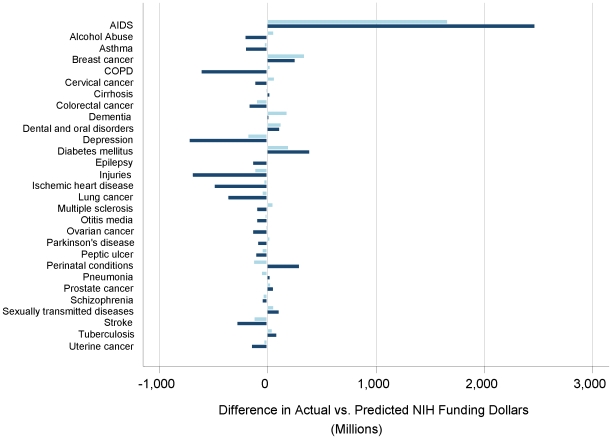
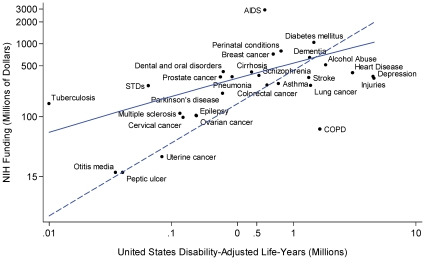
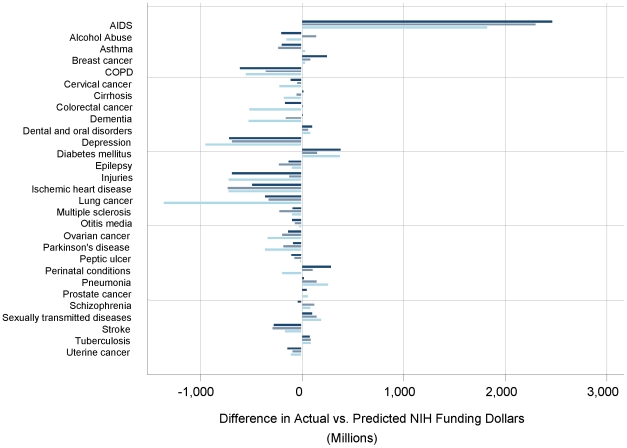
BACKGROUND: An analysis of NIH funding in 1996 found that the strongest predictor of funding, disability-adjusted life-years (DALYs), explained only 39% of the variance in funding. In 1998, Congress requested that the Institute of Medicine (IOM) evaluate priority-setting criteria for NIH funding; the IOM recommended greater consideration of disease burden. We examined whether the association between current burden and funding has changed since that time. METHODS: We analyzed public data on 2006 NIH funding for 29 common conditions. Measures of US disease burden in 2004 were obtained from the World Health Organization's Global Burden of Disease study and national databases. We assessed the relationship between disease burden and NIH funding dollars in univariate and multivariable log-linear models that evaluated all measures of disease burden. Sensitivity analyses examined associations with future US burden, current and future measures of world disease burden, and a newly standardized NIH accounting method. RESULTS: In univariate and multivariable analyses, disease-specific NIH funding levels increased with burden of disease measured in DALYs (p = 0.001), which accounted for 33% of funding level variation. No other factor predicted funding in multivariable models. Conditions receiving the most funding greater than expected based on disease burden were AIDS ($2474 M), diabetes mellitus ($390 M), and perinatal conditions ($297 M). Depression ($719 M), injuries ($691 M), and chronic obstructive pulmonary disease ($613 M) were the most underfunded. Results were similar using estimates of future US burden, current and future world disease burden, and alternate NIH accounting methods. CONCLUSIONS: Current levels of NIH disease-specific research funding correlate modestly with US disease burden, and correlation has not improved in the last decade.
Overview
The claims and statistics of this paper haven’t been checked yet.
Run the check — free, no account needed. It reads the open-access text and checks the sources it cites.
Integrity signals
Registry
Cites
Statistics
Figures
Verification
Claims the paper makes
The claims and statistics of this paper haven’t been checked yet.
Run the check — free, no account needed. It reads the open-access text and checks the sources it cites.
Claims other papers make about this one
Each is checked against this paper’s own text: does it say what the citing paper says it does?
In the citing paper
“historically, psychiatric research has ben underfunded in comparison to public health impact (with the possible exception of AD). 141–144”
From Genetic architectures of psychiatric disorders: the emerging picture and its implications (2012) · cites this paper as [144]
Self-check
Percentages, sums and reported differences re-computed from the paper’s own numbers.
The self-check needs the paper’s full text.
Citations
Cites
Zhang, Q., Wang, C., Zheng, M., Li, Y., Li, J., Zhang, L., Shang, X., & Yan, C. (2014) · Cerebrovascular Diseases · doi:10.1159/000369778 · Cited by 11,609
Projections of Global Mortality and Burden of Disease from 2002 to 2030
Mathers, C. D., & Loncar, D. (2006) · PLoS Medicine · doi:10.1371/journal.pmed.0030442 · Cited by 11,386
Self-citation(1996) · Cited by 6,884
Higgins, S. M. F., Macken, A. P., Cullen, W., Saunders, J., Dunne, C. P., & O’Gorman, C. S. (2013) · PubMed · doi:10.34961/9953 · Cited by 4,807
Global mortality, disability, and the contribution of risk factors: Global Burden of Disease Study
Murray, C. J., & Lopez, A. D. (1997) · The Lancet · doi:10.1016/s0140-6736(96)07495-8 · Cited by 4,492 · cited 1×
“The GBD systematically collects timely disease-specific epidemiologic information and models missing data to estimate a variety of measures of burden [15,16].”
BackgroundGlobal Burden of Disease and Risk Factors
López, A. D., Mathers, C. D., Ezzati, M., Jamison, D. T. T., & Murray, C. J. L. (2006) · World Bank, Washington, DC eBooks · doi:10.1596/978-0-8213-6262-4 · Cited by 2,714
Self-citationNational Center for Biotechnology Information
Gressner, A. M., & Arndt, T. (2019) · Springer Reference Medizin · doi:10.1007/978-3-662-48986-4_301184 · Cited by 1,412
Imaging Studies for Low Back Pain
Clearingh, N. Q. M., & Agency for Healthcare Research and (2008) · Journal of Pain & Palliative Care Pharmacotherapy · doi:10.1080/15360280802537332 · Cited by 653
Impact factor: a valid measure of journal quality?
(2003) · Europe PMC (PubMed Central) · Cited by 584
The Relation between Funding by the National Institutes of Health and the Burden of Disease
Gross, C. P., Anderson, G. F., & Powe, N. R. (1999) · New England Journal of Medicine · doi:10.1056/nejm199906173402406 · Cited by 509
Cited by
Sorted by citations
Kassebaum, N. J., Arora, M., Barber, R. M., Bhutta, Z. A., Brown, J., Carter, A., Casey, D. C., Charlson, F. J., Coates, M. M., Coggeshall, M., et al. (2016) · The Lancet · doi:10.1016/s0140-6736(16)31460-x · Cited by 2,163
How to increase value and reduce waste when research priorities are set
Chalmers, I., Bracken, M. B., Djulbegovic, B., Garattini, S., Grant, J., Gülmezoglu, A. M., Howells, D. W., Ioannidis, J. P. A., & Oliver, S. (2014) · The Lancet · doi:10.1016/s0140-6736(13)62229-1 · Cited by 1,436
Genetic architectures of psychiatric disorders: the emerging picture and its implications
Sullivan, P. F., Daly, M. J., & O'Donovan, M. (2012) · Nature Reviews Genetics · doi:10.1038/nrg3240 · Cited by 1,177
A Review of the Clinical, Economic, and Societal Burden of Treatment-Resistant Depression: 1996–2013
Mrazek, D. A., Hornberger, J. C., Altar, C. A., & Degtiar, I. (2014) · Psychiatric Services · doi:10.1176/appi.ps.201300059 · Cited by 580
The Anatomy of Medical Research: US and International Comparisons
Moses, H., Matheson, D. H. M., Cairns-Smith, S., George, B. P., Palisch, C., & Dorsey, E. R. (2015) · JAMA · doi:10.1001/jama.2014.15939 · Cited by 446
Self-citation
Metadata
- Authors
- Gillum, L. A., Gouveia, C., Dorsey, E. R., Pletcher, M., Mathers, C. D., McCulloch, C. E., & Johnston, S. C.
- Affiliations
- University of California, San Francisco (US)
- Johns Hopkins University (US)
- World Health Organization (CH)
- Corresponding author
- Johnston, S. Claiborne
- ORCID
- Venue
- PLoS ONE
- Publisher
- Public Library of Science (PLoS)
- Published
- 2011-02-24
- Volume
- 6
- Issue
- 2
- Pages
- e16837
- ISSN
- 1932-6203 (ISSN-L)
- PMC
- PMC3044706
- OpenAlex
- W1986799651
- Cited by
- 248
- References
- 29
- Citations by year
- 2026: 9 · 2025: 13 · 2024: 11 · 2023: 13 · 2022: 16 · 2021: 12 · 2020: 16 · 2019: 32 · 2018: 16 · 2017: 8 · 2016: 16 · 2015: 27 · 2014: 22 · 2013: 13 · 2012: 19
- FWCI
- 18.56
- Type
- journal article
- Language
- en
- Open access
- gold
- doi.org
- Locations
- PLoS ONE (publishedVersion, cc-by)
- PubMed Central (publishedVersion, cc-by)
- PubMed (publishedVersion)
- RePEc: Research Papers in Economics (submittedVersion)
- DOAJ (DOAJ: Directory of Open Access Journals) (submittedVersion, cc-by-sa)
- eScholarship (California Digital Library) (submittedVersion)
- eScholarship (California Digital Library) (submittedVersion, cc-by)
- Figshare (submittedVersion, cc-by)
- Funders
- National Institutes of Health
- University of California, San Francisco
- National Center for Research Resources (KL2RR024130, KL2RR024136)
- Topics
- Health Sciences › Medicine › Public Health, Environmental and Occupational Health › Health and Medical Research Impacts
- Social Sciences › Economics, Econometrics and Finance › Economics and Econometrics › Health Systems, Economic Evaluations, Quality of Life
- Social Sciences › Economics, Econometrics and Finance › Economics and Econometrics › Global Health Care Issues
- Keywords
- NIH funding, disease burden, disability-adjusted life years, research prioritization, global burden of disease, depression, chronic obstructive pulmonary disease, injuries
- MeSH terms
- Cross-Sectional Studies, Disease, Epidemiology, Female, Humans, Male, National Institutes of Health (U.S.), Research, Research Support as Topic, United States, Cost of Illness, Quality-Adjusted Life Years, International Classification of Diseases
About these checks
Registry, retraction, Cites and statistics results are computed, not judged, with one exception: a printed reference that no index lists is read once by a model before it counts as a citation error. Claims are extracted by a model and kept only when their quote appears verbatim in the text; each cited source is then checked, with a model’s help, for whether it says what the claim relies on. Those verdicts can be wrong — read the claim’s quote and the cited source before relying on one.
Statistics and arithmetic are recomputed, not judged.
Confidence bands are shown only for fields calibrated on our annotated test set. None is calibrated yet, so no band is shown.
What counts as a claim ›How we measure confidence ›How we check this ›
Are you an author, or do you see a problem with this page? Request a review
