

The DOI matches its Crossref record; 29 of the 29 references it cites were found in a registry or an index.
NIH Disease Funding Levels and Burden of Disease
Open accessAbstract
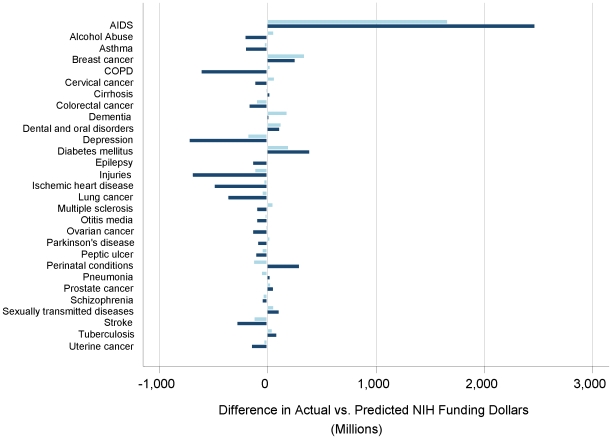
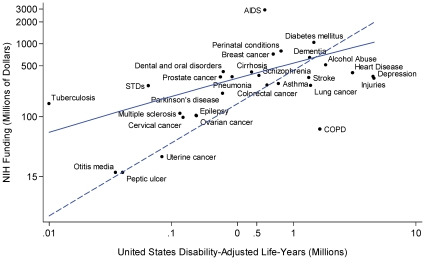
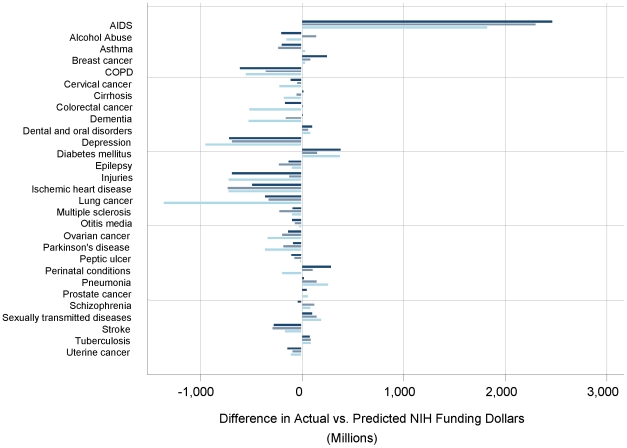
BACKGROUND: An analysis of NIH funding in 1996 found that the strongest predictor of funding, disability-adjusted life-years (DALYs), explained only 39% of the variance in funding. In 1998, Congress requested that the Institute of Medicine (IOM) evaluate priority-setting criteria for NIH funding; the IOM recommended greater consideration of disease burden. We examined whether the association between current burden and funding has changed since that time. METHODS: We analyzed public data on 2006 NIH funding for 29 common conditions. Measures of US disease burden in 2004 were obtained from the World Health Organization's Global Burden of Disease study and national databases. We assessed the relationship between disease burden and NIH funding dollars in univariate and multivariable log-linear models that evaluated all measures of disease burden. Sensitivity analyses examined associations with future US burden, current and future measures of world disease burden, and a newly standardized NIH accounting method. RESULTS: In univariate and multivariable analyses, disease-specific NIH funding levels increased with burden of disease measured in DALYs (p = 0.001), which accounted for 33% of funding level variation. No other factor predicted funding in multivariable models. Conditions receiving the most funding greater than expected based on disease burden were AIDS ($2474 M), diabetes mellitus ($390 M), and perinatal conditions ($297 M). Depression ($719 M), injuries ($691 M), and chronic obstructive pulmonary disease ($613 M) were the most underfunded. Results were similar using estimates of future US burden, current and future world disease burden, and alternate NIH accounting methods. CONCLUSIONS: Current levels of NIH disease-specific research funding correlate modestly with US disease burden, and correlation has not improved in the last decade.
Overview
The claims and statistics of this paper haven’t been checked yet.
Run the check — free, no account needed. It reads the open-access text and checks the sources it cites.
Integrity signals
Registry
Cites
Statistics
Figures
Verification
Claims the paper makes
The claims and statistics of this paper haven’t been checked yet.
Run the check — free, no account needed. It reads the open-access text and checks the sources it cites.
Claims other papers make about this one
Each is checked against this paper’s own text: does it say what the citing paper says it does?
In the citing paper
“historically, psychiatric research has ben underfunded in comparison to public health impact (with the possible exception of AD). 141–144”
From Genetic architectures of psychiatric disorders: the emerging picture and its implications (2012) · cites this paper as [144]
Self-check
Percentages, sums and reported differences re-computed from the paper’s own numbers.
The self-check needs the paper’s full text.
Citations
Cites
Zhang, Q., Wang, C., Zheng, M., Li, Y., Li, J., Zhang, L., Shang, X., & Yan, C. (2014) · Cerebrovascular Diseases · doi:10.1159/000369778 · Cited by 11,609
Projections of Global Mortality and Burden of Disease from 2002 to 2030
Mathers, C. D., & Loncar, D. (2006) · PLoS Medicine · doi:10.1371/journal.pmed.0030442 · Cited by 11,386
Self-citation(1996) · Cited by 6,884
Higgins, S. M. F., Macken, A. P., Cullen, W., Saunders, J., Dunne, C. P., & O’Gorman, C. S. (2013) · PubMed · doi:10.34961/9953 · Cited by 4,807
Global mortality, disability, and the contribution of risk factors: Global Burden of Disease Study
Murray, C. J., & Lopez, A. D. (1997) · The Lancet · doi:10.1016/s0140-6736(96)07495-8 · Cited by 4,492 · cited 1×
“The GBD systematically collects timely disease-specific epidemiologic information and models missing data to estimate a variety of measures of burden [15,16].”
BackgroundGlobal Burden of Disease and Risk Factors
López, A. D., Mathers, C. D., Ezzati, M., Jamison, D. T. T., & Murray, C. J. L. (2006) · World Bank, Washington, DC eBooks · doi:10.1596/978-0-8213-6262-4 · Cited by 2,714
Self-citationNational Center for Biotechnology Information
Gressner, A. M., & Arndt, T. (2019) · Springer Reference Medizin · doi:10.1007/978-3-662-48986-4_301184 · Cited by 1,412
Imaging Studies for Low Back Pain
Clearingh, N. Q. M., & Agency for Healthcare Research and (2008) · Journal of Pain & Palliative Care Pharmacotherapy · doi:10.1080/15360280802537332 · Cited by 653
Impact factor: a valid measure of journal quality?
(2003) · Europe PMC (PubMed Central) · Cited by 584
The Relation between Funding by the National Institutes of Health and the Burden of Disease
Gross, C. P., Anderson, G. F., & Powe, N. R. (1999) · New England Journal of Medicine · doi:10.1056/nejm199906173402406 · Cited by 509
Cited by
Sorted by citations
Kassebaum, N. J., Arora, M., Barber, R. M., Bhutta, Z. A., Brown, J., Carter, A., Casey, D. C., Charlson, F. J., Coates, M. M., Coggeshall, M., et al. (2016) · The Lancet · doi:10.1016/s0140-6736(16)31460-x · Cited by 2,163
How to increase value and reduce waste when research priorities are set
Chalmers, I., Bracken, M. B., Djulbegovic, B., Garattini, S., Grant, J., Gülmezoglu, A. M., Howells, D. W., Ioannidis, J. P. A., & Oliver, S. (2014) · The Lancet · doi:10.1016/s0140-6736(13)62229-1 · Cited by 1,436
Genetic architectures of psychiatric disorders: the emerging picture and its implications
Sullivan, P. F., Daly, M. J., & O'Donovan, M. (2012) · Nature Reviews Genetics · doi:10.1038/nrg3240 · Cited by 1,177
A Review of the Clinical, Economic, and Societal Burden of Treatment-Resistant Depression: 1996–2013
Mrazek, D. A., Hornberger, J. C., Altar, C. A., & Degtiar, I. (2014) · Psychiatric Services · doi:10.1176/appi.ps.201300059 · Cited by 580
The Anatomy of Medical Research: US and International Comparisons
Moses, H., Matheson, D. H. M., Cairns-Smith, S., George, B. P., Palisch, C., & Dorsey, E. R. (2015) · JAMA · doi:10.1001/jama.2014.15939 · Cited by 446
Self-citationPublic R&D Investments and Private-sector Patenting: Evidence from NIH Funding Rules
Azoulay, P., Graff Zivin, J. S., Li, D., & Sampat, B. N. (2019) · The Review of Economic Studies · doi:10.1093/restud/rdy034 · Cited by 349
“This reasoning is supported by research showing that funding levels for particular Institutes are more highly correlated with disease burden than with scientific advances (Gillum et al., 2011).”
Large-scale investigation of the reasons why potentially important genes are ignored
Stoeger, T., Gerlach, M., Morimoto, R. I., & Nunes Amaral, L. A. (2018) · PLOS Biology · doi:10.1371/journal.pbio.2006643 · Cited by 261
The economic burden of traumatic spinal cord injury in Canada
Krueger, H., Noonan, V. K., Trenaman, L., Joshi, P., & Rivers, C. S. (2013) · Chronic diseases and injuries in Canada · doi:10.24095/hpcdp.33.3.01 · Cited by 286
“Despite producing disease-specific cost-of-illness reports in 1995, 1997 and 2000,(28) this information does not appear to be used in current research funding allocations by the NIH.(30,31)”
MethodGender disparity in the funding of diseases by the U.S National Institutes of Health
Mirin, A. A. (2021) · Journal of Women's Health · doi:10.1089/jwh.2020.8682 · Cited by 269
“A study by Gillum et al.23 of 2006 NIH funding did find a correlation between funding and disease burden, but with DALY accounting for only onethird of the funding level variation (not markedly different from the results of the study reported herein).”
ResultViergever, R. F., & Hendriks, T. C. C. (2016) · Health Research Policy and Systems · doi:10.1186/s12961-015-0074-z · Cited by 227
Power, R. A., Tansey, K. E., Buttenschøn, H. N., Cohen‐Woods, S., Bigdeli, T. B., Hall, L. S., Kutalik, Z., Lee, S., Ripke, S., Steinberg, S., et al. (2016) · Biological Psychiatry · doi:10.1016/j.biopsych.2016.05.010 · Cited by 210
Yegros, A., van de Klippe, W., García, M. F. A., & Ràfols, I. (2020) · Health Research Policy and Systems · doi:10.1186/s12961-020-00560-6 · Cited by 176
Carter, A. J. R., & Nguyen, C. N. (2012) · BMC Public Health · doi:10.1186/1471-2458-12-526 · Cited by 143
Climate change and infectious disease: a review of evidence and research trends
de Vuurst, P. V., & Escobar, L. E. (2023) · Infectious Diseases of Poverty · doi:10.1186/s40249-023-01102-2 · Cited by 149
“It is possible that taxonomic bias has impacted the study of climate change and infectious disease by skewing research toward specific disease systems, suggesting an anthropocentric research approach potentially influenced by external forces, such as public health funding and disease burden [31, 32].”
BackgroundMeeting the challenge of COPD care delivery in the USA: a multiprovider perspective
Han, M. K., Martinez, C. H., Au, D. H., Bourbeau, J., Boyd, C. M., Branson, R. D., Criner, G. J., Kalhan, R., Kallstrom, T. J., King, A., et al. (2016) · The Lancet Respiratory Medicine · doi:10.1016/s2213-2600(16)00094-1 · Cited by 110
The relation between research priorities and societal demands: The case of rice
Ciarli, T., & Ràfols, I. (2018) · Research Policy · doi:10.1016/j.respol.2018.10.027 · Cited by 114
“Similarly, in the health literature, scholars tend to talk about the focus of research in relation to health needs across and within countries (Gillum et al., 2011; Evans et al., 2014; Cassi et al., 2017).”
BackgroundWilliams, Z. J., Suzman, E., & Woynaroski, T. G. (2021) · Ear and Hearing · doi:10.1097/aud.0000000000001005 · Cited by 120
“In addition, such estimates are necessary to accurately define the burden of hyperacusis in the ASD population, increasing the recognition of this condition among the research community and providing a justification for policymakers and funding agencies to allocate additional resources to understanding and amelioratin…”
BackgroundHaber, N., Smith, E. R., Moscoe, E., Andrews, K., Audy, R., Bell, W., Brennan, A. T., Breskin, A., Kane, J. C., Karra, M., et al. (2018) · PLoS ONE · doi:10.1371/journal.pone.0196346 · Cited by 97
“We speculate that the proliferation of social media and open access to research may increase ties from popular preferences to research production and selection, and that increased competition for stagnant research funding [46] is likely to exacerbate incentives to have research that stands out over that addressing are…”
BackgroundUsing Pulmonary Imaging to Move Chronic Obstructive Pulmonary Disease beyond FEV1
Coxson, H. O., Leipsic, J. A., Párraga, G., & Sin, D. D. (2014) · American Journal of Respiratory and Critical Care Medicine · doi:10.1164/rccm.201402-0256pp · Cited by 101
Years of life lost due to encounters with law enforcement in the USA, 2015–2016
Bui, A. L., Coates, M. M., & Matthay, E. C. (2018) · Journal of Epidemiology & Community Health · doi:10.1136/jech-2017-210059 · Cited by 97
Determining the research priorities for patients with chronic kidney disease not on dialysis
Hemmelgarn, B. R., Pannu, N., Ahmed, S. B., Elliott, M. J., Tam‐Tham, H., Lillie, E., Straus, S. E., Donald, M., Barnieh, L., Chong, G. C., et al. (2016) · Nephrology Dialysis Transplantation · doi:10.1093/ndt/gfw065 · Cited by 96
“The research agenda to date has largely been driven by researchers, as well as by commercial interests [16, 17], despite efforts to increase patient involvement in research for more than a decade [18, 19].”
BackgroundGlobal Burden of Skin Disease as Reflected in Cochrane Database of Systematic Reviews
Karimkhani, C., Boyers, L. N., Prescott, L., Welch, V., Delamere, F. M., Nasser, M., Zaveri, A., Hay, R. J., Vos, T., Murray, C. J. L., et al. (2014) · JAMA Dermatology · doi:10.1001/jamadermatol.2014.709 · Cited by 87
“An official publication report of all reviews and protocols published by the Cochrane Skin Group (CSG) was also obtained to ensure that no titles were missed.”
BackgroundInfluentialHighsmith, M. J., Kahle, J. T., Miro, R. M., Orendurff, M. S., Lewandowski, A. L., Orriola, J. J., Sutton, B. S., & Ertl, J. P. (2016) · The Journal of Rehabilitation Research and Development · doi:10.1682/jrrd.2015.03.0046 · Cited by 78
“For instance, breast cancer, autoimmune deficiency syndrome, schizophrenia, and Parkinson disease reportedly had comparable prevalence to those with limb loss (1–2 million persons in the United States) [3,55].”
BackgroundMartínez, C. H., Richardson, C. R., Han, M. K., & Cigolle, C. T. (2014) · Annals of the American Thoracic Society · doi:10.1513/annalsats.201405-187oc · Cited by 77
New Evidence on the Allocation of NIH Funds across Diseases
Sampat, B. N., Buterbaugh, K. L., & Perl, M. (2013) · Milbank Quarterly · doi:10.1111/milq.12005 · Cited by 75
“Previous empirical work on the NIH's allocation process (Gillum et al. 2011; Gross, Anderson, and Powe 1999; Lichtenberg 2001; Mushkin 1979) found mixed evidence on NIH's responsiveness to standard measures of disease burden.”
BackgroundSleep and Depression in Older Adults: A Narrative Review
Nielson, S. A., Kay, D. B., & Dzierzewski, J. M. (2023) · Current Psychiatry Reports · doi:10.1007/s11920-023-01455-3 · Cited by 74
Allocation of National Institutes of Health Funding by Disease Category in 2008 and 2019
Ballreich, J. M., Gross, C. P., Powe, N. R., & Anderson, G. F. (2021) · JAMA Network Open · doi:10.1001/jamanetworkopen.2020.34890 · Cited by 71
Kiarashi, J., VanderPluym, J. H., Szperka, C. L., Turner, S. B., Minen, M. T., Broner, S. W., Ross, A. C., Wagstaff, A. E., Anto, M. M., Marzouk, M. A., et al. (2021) · Neurology · doi:10.1212/wnl.0000000000012261 · Cited by 69
US medical specialty global health training and the global burden of disease
Kerry, V. B., Walensky, R. P., Tsai, A. C., Bergmark, R. W., Bergmark, B. A., Rouse, C. D., & Bangsberg, D. R. (2013) · Journal of Global Health · doi:10.7189/jogh.03.020406 · Cited by 64
Trends in Worldwide Research in Hypertension Over the Period 1999–2018
Devos, P., & Ménard, J. (2020) · Hypertension · doi:10.1161/hypertensionaha.120.15711 · Cited by 60
What is a disease? Perspectives of the public, health professionals and legislators
Tikkinen, K. A. O., Leinonen, J. S., Guyatt, G. H., Ebrahim, S., & Järvinen, T. L. N. (2012) · BMJ Open · doi:10.1136/bmjopen-2012-001632 · Cited by 60
Health ROI as a measure of misalignment of biomedical needs and resources
Yao, L., Li, Y., Ghosh, S., Evans, J. A., & Rzhetsky, A. (2015) · Nature Biotechnology · doi:10.1038/nbt.3276 · Cited by 59
Musculoskeletal health: an ecological study assessing disease burden and research funding
Nguyen, A. T., Aris, I. M., Snyder, B. D., Harris, M. B., Kang, J. D., Murray, M. M., Rodriguez, E. K., & Nazarian, A. (2024) · The Lancet Regional Health - Americas · doi:10.1016/j.lana.2023.100661 · Cited by 58
“14,17,39,40,42 Our study addressed the gap in previous research by examining DALYs and including musculoskeletal diseases, making a substantive contribution to the literature.”
BackgroundTryfonidou, M. A., de Vries, G., Hennink, W. E., & Creemers, L. B. (2020) · Advanced Drug Delivery Reviews · doi:10.1016/j.addr.2020.10.012 · Cited by 56
Jun, M., Manns, B., Laupacis, A., Manns, L., Rehal, B., Crowe, S., & Hemmelgarn, B. R. (2015) · Canadian Journal of Kidney Health and Disease · doi:10.1186/s40697-015-0070-9 · Cited by 55
Fürst, T., Silué, K. D., Ouattara, M., N’Goran, D. N., Adiossan, L. G., N'Guessan, Y. T., Zouzou, F., Koné, S., N'Goran, E. K., & Utzinger, J. (2012) · PLoS neglected tropical diseases · doi:10.1371/journal.pntd.0001855 · Cited by 51
“Results from the initial global burden of disease study have been widely used for priority setting in research, policy, and practice, and the DALY became a powerful ‘‘currency’’ in public health (see for example reference [3]).”
Shibayama, S., & Baba, Y. (2015) · Research Policy · doi:10.1016/j.respol.2015.01.012 · Cited by 50
“Criticizing this situation, Holub et al. (1991) stated “where a scientist publishes has become much more important than what he is publishing.”
BackgroundMelgar, E. (2012) · Cited by 55
Association Between Pediatric Clinical Trials and Global Burden of Disease
Bourgeois, F. T., Olson, K. L., Ioannidis, J. P. A., & Mandl, K. D. (2013) · PEDIATRICS · doi:10.1542/peds.2013-2567 · Cited by 52
“Perinatal conditions 523 430 152 179 933 126 420 651 (2) Malignant neoplasms 473 123 77 65 199 4 110 685 (14) Respiratory diseases 366 290 186 70 856 10 691 264 (8) Respiratory infections 247 211 82 127 579 77 264 822 (3) Digestive diseases 208 137 74 16 757 7 695 304 (9) Diabetes mellitus 138 117 49 14 935 542 738 (2…”
Atal, I., Trinquart, L., Ravaud, P., & Porcher, R. (2018) · Journal of Clinical Epidemiology · doi:10.1016/j.jclinepi.2018.01.006 · Cited by 48
Ndugga, N., Lightbourne, T., Javaherian, K., Cabezas, J., Verma, N., Barritt, A. S., & Bataller, R. A. (2017) · BMJ Open · doi:10.1136/bmjopen-2016-013620 · Cited by 47
“There are a few similar studies in other fields of medicine that have investigated research attention and disease burden.(47) Using a similar methodology to ours, these studies used clinicaltrials.”
ResultHagstrom, E. L., Patel, S. S., Karimkhani, C., Boyers, L. N., Williams, H. C., Hay, R. J., Weinstock, M. A., Armstrong, A. W., Dunnick, C. A., Margolis, D. J., et al. (2015) · Journal of the American Academy of Dermatology · doi:10.1016/j.jaad.2015.04.039 · Cited by 43
“When adjusted for inflation, the 2013 NIH budget represents a 23% decrease compared with the prerecession years in 2003.(11) Applications for research grants and training duration have also declined over the past several years, paralleling the state of NIH funding.”
Does Targeted, Disease‐Specific Public Research Funding Influence Pharmaceutical Innovation?
Blume‐Kohout, M. E. (2012) · Journal of Policy Analysis and Management · doi:10.1002/pam.21640 · Cited by 45
The top 100 most cited scientific reports focused on diabetes research
Zhao, X., Guo, L., Lin, Y., Wang, H., Gu, C., Zhao, L., & Tong, X. (2015) · Acta Diabetologica · doi:10.1007/s00592-015-0813-1 · Cited by 42
“Diabetes research was funded by the National Institutes of Health (NIH), which is the US government funding source for biomedical research, at very high levels, and many foundations support diabetes research as well [5, 6].”
BackgroundThe Burden of Burns: An Analysis of Public Health Measures
Ivanko, A., Garbuzov, A., Schoen, J. E., Kearns, R. D., Phillips, B. D., Murata, E., Danos, D., Phelan, H. A., & Carter, J. E. (2024) · Journal of Burn Care & Research · doi:10.1093/jbcr/irae053 · Cited by 41
Head, M., Fitchett, J. R. A., Nageshwaran, V., Kumari, N., Hayward, A. C., & Atun, R. A. (2015) · EBioMedicine · doi:10.1016/j.ebiom.2015.12.016 · Cited by 41
Cross-cultural child and adolescent psychiatry research in developing countries
Atilola, O. (2015) · Cambridge Prisms Global Mental Health · doi:10.1017/gmh.2015.8 · Cited by 42
“Gillum et al. (2011) analyzed the research funding of the NIH and found that infectious diseases and physical noncommunicable diseases (Example: Diabetes) do receive far more funding compared with mental health conditions based on their relative disease burden.”
BackgroundRees, C. A., Monuteaux, M. C., Herdell, V., Fleegler, E. W., & Bourgeois, F. T. (2021) · Archives of Pediatrics and Adolescent Medicine · doi:10.1001/jamapediatrics.2021.3360 · Cited by 40
Estimating the disease burden of ME/CFS in the United States and its relation to research funding
Dimmock, M. E., MIRIN, A. A., & Jason, L. A. (2016) · Journal of Medicine and Therapeutics · doi:10.15761/jmt.1000102 · Cited by 39
“1000102 Volume 1(1): 2-7 these measures because it accounts for both the number of years of premature death and the number of years and the level of debility [5].”
BackgroundWang, L., Wei, W., Miao, R., Xie, L., & Başer, O. (2013) · BMJ Open · doi:10.1136/bmjopen-2012-002348 · Cited by 38
Temporal and geographic trends in celiac disease publications
Narotsky, D. L., Green, P. H. R., & Lebwohl, B. (2012) · European Journal of Gastroenterology & Hepatology · doi:10.1097/meg.0b013e328355a4ab · Cited by 38
Fulfillment of the Brazilian Agenda of Priorities in Health Research
Santos, L. M. P., de Moura, E. C., Barata, R. B., Serruya, S. J., da Motta, M. L., Elias, F. T. S., Angulo-Tuesta, A., de Paula, A. P., de Melo, G., Guimarães, R., et al. (2011) · Health Research Policy and Systems · doi:10.1186/1478-4505-9-35 · Cited by 38
“Recently the NIH disease funding levels was compared to burden of disease [16].”
BackgroundStigma's Effect on Social Interaction and Social Media Activity
Boudewyns, V., Himelboim, I., Hansen, D. L., & Southwell, B. G. (2015) · Journal of Health Communication · doi:10.1080/10810730.2015.1018604 · Cited by 37
Glass, N. E., Riccardi, J., Farber, N. I., Bonne, S. L., & Livingston, D. H. (2019) · The Journal of Trauma: Injury, Infection, and Critical Care · doi:10.1097/ta.0000000000002461 · Cited by 37
National Institutes of Health Funding for Behavioral Interventions to Prevent Chronic Diseases
Calitz, C., Pollack, K. M., Millard, C., & Yach, D. (2015) · American Journal of Preventive Medicine · doi:10.1016/j.amepre.2014.10.015 · Cited by 39
Economic Differences in Direct and Indirect Costs Between People With Epilepsy and Without Epilepsy
Libby, A. M., Ghushchyan, V. H., McQueen, R. B., Slejko, J. F., Bainbridge, J. L., & Campbell, J. D. (2012) · Medical Care · doi:10.1097/mlr.0b013e31826c8613 · Cited by 36
“Burden studies are important contributors toward setting research priorities for federal funding agencies such as the National Institutes of Health.22 Gillum et al22 estimated that epilepsy was only slightly underfunded when compared with other diseases using the measure of disability adjusted life years (DALYs).”
BackgroundElliott, I. S., Sonshine, D. B., Akhavan, S., Shantz, A. S., Caldwell, A. M., Shantz, J. A. S., Gosselin, R. A., & Coughlin, R. R. (2015) · Clinical Orthopaedics and Related Research · doi:10.1007/s11999-015-4254-5 · Cited by 36
“This skewed resource allocation is particularly pronounced in the orthopaedic literature where increased global musculoskeletal disease and trauma in the developing world have not been met with a concomitant increase in attention or funding [2, 17, 30].”
BackgroundJesus, T. S., Landry, M. D., Brooks, D., & Hoenig, H. (2020) · Archives of Physical Medicine and Rehabilitation · doi:10.1016/j.apmr.2019.12.020 · Cited by 32
Taushiba, A., Dwivedi, S., Zehra, F., Shukla, P. N., & Lawrence, A. J. (2023) · Air Quality Atmosphere & Health · doi:10.1007/s11869-023-01321-4 · Cited by 31
State of the evidence: a survey of global disparities in clinical trials
Marshall, I. J., L’Esperance, V., Marshall, I. J., Thomas, J., Noel-Storr, A. H., Soboczenski, F., Nye, B., Nenkova, A., & Wallace, B. (2021) · BMJ Global Health · doi:10.1136/bmjgh-2020-004145 · Cited by 32
Saunders, J. E., Francis, H. W., & Skarzynski, P. H. (2016) · Otology & Neurotology · doi:10.1097/mao.0000000000000942 · Cited by 30
“The Center for Disease Control states that the use of the DALY is ‘‘the best predictor of funding’’ and the NIH Institute of Medicine has recommended the use of the DALY-based burden of disease to set funding criteria (16).”
BackgroundGlobal distribution of research efforts, disease burden, and impact of US public funding withdrawal
Schmallenbach, L., Bley, M., Bärnighausen, T., Sugimoto, C. R., Lerchenmüller, C., & Lerchenmueller, M. (2025) · Nature Medicine · doi:10.1038/s41591-025-03923-0 · Cited by 33
Dementia Prevention and Individual and Socioeconomic Barriers: Avoiding “Lifestyle” Stigma
Wilson, N., & Anstey, K. J. (2023) · The Gerontologist · doi:10.1093/geront/gnad130 · Cited by 29
Public Opinions Toward Diseases: Infodemiological Study on News Media Data
Huang, M. S., ElTayeby, O., Zolnoori, M., & Yao, L. (2018) · Journal of Medical Internet Research · doi:10.2196/10047 · Cited by 28
“In 1999 and 2011, Gross et al [1] and Gillum et al [2] investigated the relationship between National Institutes of Health (NIH) funding and disease burden by studying the number of deaths, disease prevalence and incidence, and length of hospital stay for 29 common diseases and medical conditions.”
Madsen, E. B., & Aagaard, K. (2020) · Quantitative Science Studies · doi:10.1162/qss_a_00077 · Cited by 39
NSFC Health Research Funding and Burden of Disease in China
Xu, G., Zhang, Z., Lv, Q., Li, Y., Ye, R., Xiong, Y., Jiang, Y., & Liu, X. (2014) · PLoS ONE · doi:10.1371/journal.pone.0111458 · Cited by 28
“Utilizing the design and methods in previous studies for evaluating association of NIH funding level and disease burden in USA [6,7], this study evaluated the relationship between NSFC funding levels and measures of disease burden.”
BackgroundMethodInfluentialCleary, E. G., Jackson, M. J., & Ledley, F. D. (2020) · doi:10.36687/inetwp133 · Cited by 28
The Fragile State of the National Institutes of Health Pediatric Research Portfolio, 1992-2015
Gitterman, D. P., Langford, W. S., & Hay, W. W. (2018) · Archives of Pediatrics and Adolescent Medicine · doi:10.1001/jamapediatrics.2017.4931 · Cited by 27
Akiba, C. F., Powell, B. J., Pence, B. W., Muessig, K. E., Golin, C. E., & Go, V. F.-L. (2022) · Implementation Science Communications · doi:10.1186/s43058-022-00365-4 · Cited by 27
Vargas, A. J., Schully, S. D., Villani, J., Ganoza, L. F., & Murray, D. M. (2019) · JAMA Network Open · doi:10.1001/jamanetworkopen.2019.14718 · Cited by 26
Are the Norwegian health research investments in line with the disease burden?
Kinge, J. M., Roxrud, I., Vollset, S. E., Skirbekk, V., & Røttingen, J. (2014) · Health Research Policy and Systems · doi:10.1186/1478-4505-12-64 · Cited by 25
Public R&D Investments and Private-sector Patenting: Evidence from NIH Funding Rules
Azoulay, P., Zivin, J. G., Li, D., & Sampat, B. N. (2015) · National Bureau of Economic Research · doi:10.3386/w20889 · Cited by 24
Is Research Responding to Health Needs?Preprint
Ràfols, I., & Yegros, A. (2017) · SSRN Electronic Journal · doi:10.2139/ssrn.3106713 · Cited by 22
Scientometrics reveals funding priorities in medical research policy
Vanderelst, D. F., & Speybroeck, N. (2012) · Journal of Informetrics · doi:10.1016/j.joi.2012.10.004 · Cited by 23
“Gross et al. (1999),Gillum et al. (2011) and Swingler et al. (2003) found that the level of funding correlated mildly (about 0.6) with the burden carried by a disease.”
BackgroundMethodInfluentialEgunsola, O., Raubenheimer, J., & Buckley, N. A. (2019) · BMJ Open · doi:10.1136/bmjopen-2018-027825 · Cited by 21
“Gillum et al(16) showed a positive correlation between burden of disease (measured using various indicators, including YLL) and the amount of research funding received from the US National Institutes of Health in 2006, although the degree of correlation was less than in 1996.(16) The WHO recommends that individual cou…”
BackgroundCost-effectiveness of CI in developing countries
Magro, I. L., Emmett, S. D., & Saunders, J. E. (2018) · Current Opinion in Otolaryngology & Head & Neck Surgery · doi:10.1097/moo.0000000000000451 · Cited by 21
Assessing the societal impact of publicly funded research
Feller, I. (2017) · The Journal of Technology Transfer · doi:10.1007/s10961-017-9602-z · Cited by 20
Loucaides, E., Fitchett, E. J. A., Sullivan, R. J., & Atun, R. A. (2019) · The Lancet Oncology · doi:10.1016/s1470-2045(19)30662-x · Cited by 20
Naja, F., Shatila, H., Meho, L. I., Alameddine, M. S., Haber, S., Nasreddine, L., Sibai, A. M., & Hwalla, N. C. (2017) · Nutrition Research · doi:10.1016/j.nutres.2017.07.011 · Cited by 20
Chinnery, F. E., Bashevoy, G., Blatch-Jones, A., Douet, L., Puddicombe, S. M., & Raftery, J. P. (2018) · Trials · doi:10.1186/s13063-018-2489-7 · Cited by 20
“Previous studies comparing United States (US) National Institutes of Health (NIH) funding to burden of disease have shown DALYs to be the single best correlate with spend by disease [2].”
BackgroundLujan, H. L., & DiCarlo, S. E. (2020) · Journal of Applied Physiology · doi:10.1152/japplphysiol.00721.2019 · Cited by 23
Neurologic disorders, in-hospital deaths, and years of potential life lost in the USA, 1988–2011
Rosenbaum, B. P., Kelly, M. L., Kshettry, V. R., & Weil, R. J. (2014) · Journal of Clinical Neuroscience · doi:10.1016/j.jocn.2014.05.006 · Cited by 19
“These funding distributions have remained consistent over time and have been similarly demonstrated by others [38–40].”
ResultYoong, S. L., Hall, A. E., Williams, C. M., Skelton, E., Oldmeadow, C. J., Wiggers, J. H., Karimkhani, C., Boyers, L. N., Dellavalle, R. P., Hilton, J., et al. (2015) · Journal of Epidemiology & Community Health · doi:10.1136/jech-2014-205389 · Cited by 19
Modeling timelines for translational science in cancer; the impact of technological maturation
McNamee, L. M., & Ledley, F. D. (2017) · PLoS ONE · doi:10.1371/journal.pone.0174538 · Cited by 19
“This view has spawned initiatives focused on: aligning research funding with disease burden[9]; collective formation, collaboration, and”
BackgroundHealth Research Funding in Mexico: The Need for a Long-Term Agenda
Martínez‐Martínez, E., Zaragoza, M. L. M., Solano, E., Figueroa, B. L. V., Zúñiga, P. U., & Laclette, J. P. (2012) · PLoS ONE · doi:10.1371/journal.pone.0051195 · Cited by 18
“Our study is comparable to parallel efforts to track the flow of financial resources invested on health research reported for other countries [16,17,18,19,20].”
BackgroundMethodResultInfluentialComparative effectiveness and implementation research: Directions for Neurology
Vickrey, B. G., Hirtz, D., Waddy, S. P., Cheng, E. M., & Johnston, S. C. (2011) · Annals of Neurology · doi:10.1002/ana.22672 · Cited by 18
“Suggested priority-setting criteria include potential impact on clinical practice and public health (including when a treatment is perceived as possibly of marginally greater benefit but has a much higher cost or is much more difficult to implement in community practices than in clinical trial settings), whether indus…”
BackgroundSelf-citationTaking the headache out of migraine
Borsook, D., & Dodick, D. W. (2015) · Neurology Clinical Practice · doi:10.1212/cpj.0000000000000171 · Cited by 18
“An analysis of annual NIH research funding relative to disease-specific burdens (disabilityadjusted life years) predicted migraine funding levels similar to schizophrenia and cirrhosis.(31) In 2012, the NIH funded $266 million for schizophrenia, $288 million for cirrhosis, and $18 million for migraine.”
Changing Patterns in Rates and Means of Suicide in California, 2005 to 2013
Matthay, E. C., Galin, J., & Ahern, J. (2017) · American Journal of Public Health · doi:10.2105/ajph.2016.303624 · Cited by 17
Frey, S. M., Rowe, R. K., & Halterman, J. S. (2023) · Current Opinion in Pulmonary Medicine · doi:10.1097/mcp.0000000000000959 · Cited by 16
“Federal research funding awarded by the National Institutes of Health has been associated more with condition-specific disability-adjusted life-years (DALYs) than prevalence [31].”
BackgroundBest, R. K. (2019) · Oxford University Press eBooks · doi:10.1093/oso/9780190918408.001.0001 · Cited by 16
The Second Wave of Public Policy Advocacy for Eating Disorders
Austin, S. B., Hutcheson, R., Wickramatilake, S., & Velasquez, K. (2019) · Psychiatric Clinics of North America · doi:10.1016/j.psc.2019.01.013 · Cited by 15
Fitchett, J. R. A., Head, M., Cooke, M., Wurie, F. B., & Atun, R. A. (2014) · PLoS ONE · doi:10.1371/journal.pone.0105722 · Cited by 15
“[5–6] A recent systematic analysis of infectious disease research investments in the United Kingdom (UK) from 1997 to 2010 and burden of disease in 2004 and 2008 revealed mismatches between the amounts of funds invested and the burden of disease caused by the conditions, raising concerns about the efficiency of alloca…”
BackgroundDodel, R. C., Tinelli, M., Deuschl, G., Petersen, G., Oertel, W. H., & Ahmerkamp‐Böhme, J. (2020) · European Journal of Neurology · doi:10.1111/ene.14584 · Cited by 15
“Funding allocation to brain disorders is not adequate, and is considerably lower compared to that for other, nonneurological, disorders, such as cancer [25,36].”
BackgroundLifetime risk of COPD: what will the future bring?
Mannino, D. M., & Martínez, F. J. (2011) · The Lancet · doi:10.1016/s0140-6736(11)61188-4 · Cited by 15
Partnerships for Meaningful Community Living: Rehabilitation and Recovery‐Informed Practices
Killackey, E., Harvey, C., Amering, M., & Herrman, H. (2015) · Psychiatry · doi:10.1002/9781118753378.ch97 · Cited by 14
Should health research funding be proportional to the burden of disease?
Millum, J. (2022) · Politics Philosophy & Economics · doi:10.1177/1470594x221138729 · Cited by 14
“1 This criticism has prompted multiple analyses of the relationship between NIH funding and measures of disease burden in the US — and occasionally global — population (Gillum et al., 2011; Gross et al., 1999; Sampat et al., 2013; Vargas et al., 2019).”
BackgroundKumar, A., Koley, M., Yegros, A., & Ràfols, I. (2024) · Scientometrics · doi:10.1007/s11192-024-04980-x · Cited by 16
“…of research efforts according to societal needs is an issue that has become increasingly relevant in health and science policies (Gross, 1999; Gillum et al., 2011; Evans et al., 2014; Chalmers et al., 2014; Xu et al., 2014; Wallace & Rafols, 2015; Hsiechen et al., 2017; Confraria & Wang,…”
Matching Taxpayer Funding to Population Health Needs
Hanna, M. S. (2015) · Circulation Research · doi:10.1161/circresaha.114.305585 · Cited by 14
“DALYs have become the standard way to measure burden-of-illness,(16,17) and two previous studies have determined that DALYs are the only independent predictor of how much research funding the National Institutes of Health (NIH) allocates to various diseases and conditions.(4,5) To facilitate future comparisons across…”
BackgroundMethodResultInfluentialCatalá-López, F., Gènova-Maleras, R., Ridao-López, M., Álvarez-Barco, E., Sanfélix‐Gimeno, G., Morant, C., & Peiró, S. (2012) · Medicina Clínica · doi:10.1016/j.medcli.2012.01.028 · Cited by 13
Kim, D. J. (2019) · Preventive Medicine · doi:10.1016/j.ypmed.2019.105781 · Cited by 12
Metadata
- Authors
- Gillum, L. A., Gouveia, C., Dorsey, E. R., Pletcher, M., Mathers, C. D., McCulloch, C. E., & Johnston, S. C.
- Affiliations
- University of California, San Francisco (US)
- Johns Hopkins University (US)
- World Health Organization (CH)
- Corresponding author
- Johnston, S. Claiborne
- ORCID
- Venue
- PLoS ONE
- Publisher
- Public Library of Science (PLoS)
- Published
- 2011-02-24
- Volume
- 6
- Issue
- 2
- Pages
- e16837
- ISSN
- 1932-6203 (ISSN-L)
- PMC
- PMC3044706
- OpenAlex
- W1986799651
- Cited by
- 248
- References
- 29
- Citations by year
- 2026: 9 · 2025: 13 · 2024: 11 · 2023: 13 · 2022: 16 · 2021: 12 · 2020: 16 · 2019: 32 · 2018: 16 · 2017: 8 · 2016: 16 · 2015: 27 · 2014: 22 · 2013: 13 · 2012: 19
- FWCI
- 18.56
- Type
- journal article
- Language
- en
- Open access
- gold
- doi.org
- Locations
- PLoS ONE (publishedVersion, cc-by)
- PubMed Central (publishedVersion, cc-by)
- PubMed (publishedVersion)
- RePEc: Research Papers in Economics (submittedVersion)
- DOAJ (DOAJ: Directory of Open Access Journals) (submittedVersion, cc-by-sa)
- eScholarship (California Digital Library) (submittedVersion)
- eScholarship (California Digital Library) (submittedVersion, cc-by)
- Figshare (submittedVersion, cc-by)
- Funders
- National Institutes of Health
- University of California, San Francisco
- National Center for Research Resources (KL2RR024130, KL2RR024136)
- Topics
- Health Sciences › Medicine › Public Health, Environmental and Occupational Health › Health and Medical Research Impacts
- Social Sciences › Economics, Econometrics and Finance › Economics and Econometrics › Health Systems, Economic Evaluations, Quality of Life
- Social Sciences › Economics, Econometrics and Finance › Economics and Econometrics › Global Health Care Issues
- Keywords
- NIH funding, disease burden, disability-adjusted life years, research prioritization, global burden of disease, depression, chronic obstructive pulmonary disease, injuries
- MeSH terms
- Cross-Sectional Studies, Disease, Epidemiology, Female, Humans, Male, National Institutes of Health (U.S.), Research, Research Support as Topic, United States, Cost of Illness, Quality-Adjusted Life Years, International Classification of Diseases
About these checks
Registry, retraction, Cites and statistics results are computed, not judged, with one exception: a printed reference that no index lists is read once by a model before it counts as a citation error. Claims are extracted by a model and kept only when their quote appears verbatim in the text; each cited source is then checked, with a model’s help, for whether it says what the claim relies on. Those verdicts can be wrong — read the claim’s quote and the cited source before relying on one.
Statistics and arithmetic are recomputed, not judged.
Confidence bands are shown only for fields calibrated on our annotated test set. None is calibrated yet, so no band is shown.
What counts as a claim ›How we measure confidence ›How we check this ›
Are you an author, or do you see a problem with this page? Request a review
