

Subcellular Localization of Hexokinases I and II Directs the Metabolic Fate of Glucose
Open accessThe DOI matches its Crossref record; 30 of the 30 references it cites were found in a registry or an index.
Abstract
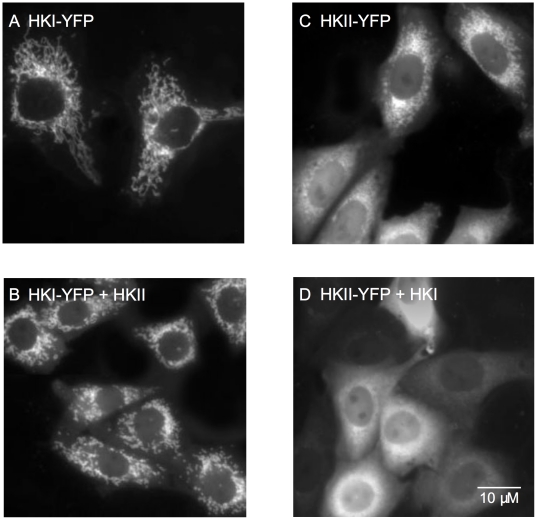
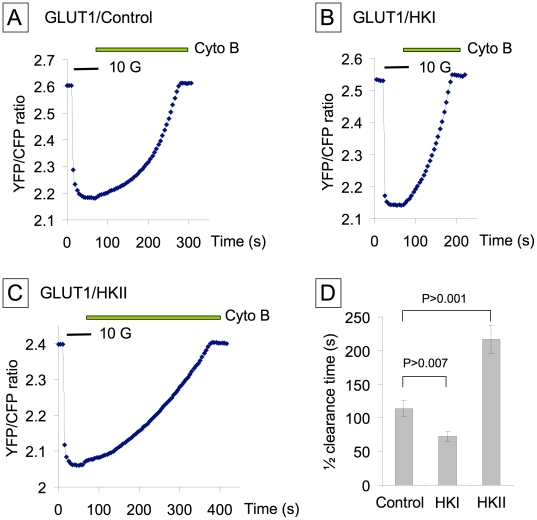
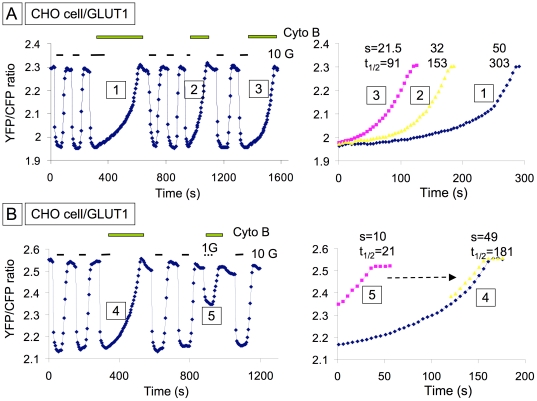
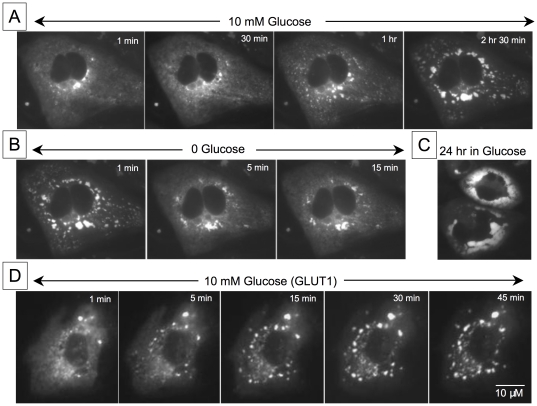
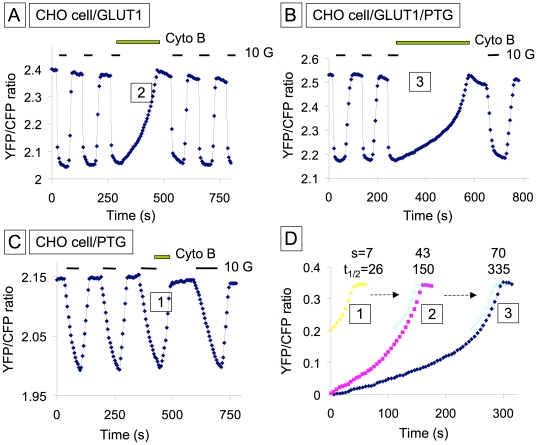
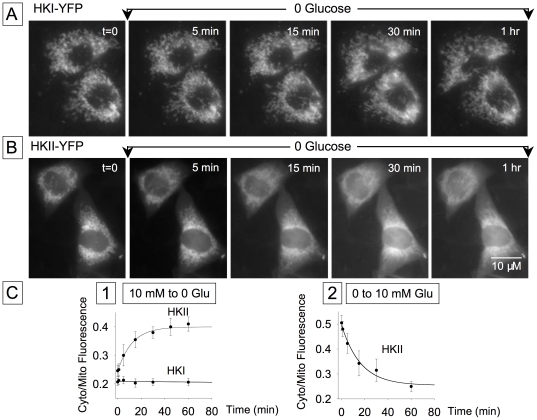
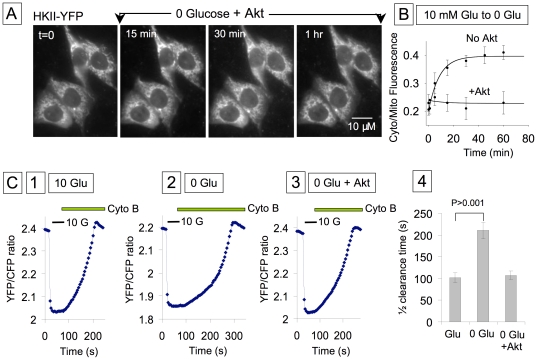
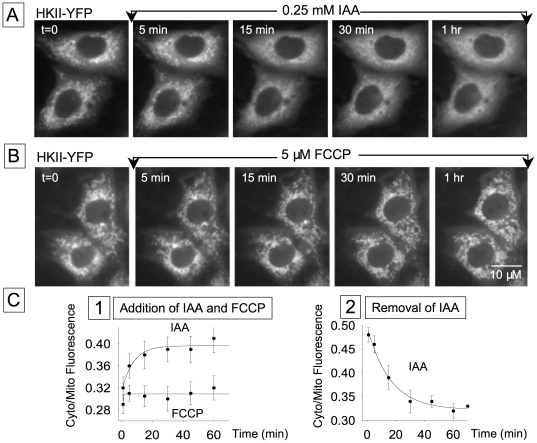
BACKGROUND: The first step in glucose metabolism is conversion of glucose to glucose 6-phosphate (G-6-P) by hexokinases (HKs), a family with 4 isoforms. The two most common isoforms, HKI and HKII, have overlapping tissue expression, but different subcellular distributions, with HKI associated mainly with mitochondria and HKII associated with both mitochondrial and cytoplasmic compartments. Here we tested the hypothesis that these different subcellular distributions are associated with different metabolic roles, with mitochondrially-bound HK's channeling G-6-P towards glycolysis (catabolic use), and cytoplasmic HKII regulating glycogen formation (anabolic use). METHODOLOGY/PRINCIPAL FINDINGS: To study subcellular translocation of HKs in living cells, we expressed HKI and HKII linked to YFP in CHO cells. We concomitantly recorded the effects on glucose handling using the FRET based intracellular glucose biosensor, FLIPglu-600 mM, and glycogen formation using a glycogen-associated protein, PTG, tagged with GFP. Our results demonstrate that HKI remains strongly bound to mitochondria, whereas HKII translocates between mitochondria and the cytosol in response to glucose, G-6-P and Akt, but not ATP. Metabolic measurements suggest that HKI exclusively promotes glycolysis, whereas HKII has a more complex role, promoting glycolysis when bound to mitochondria and glycogen synthesis when located in the cytosol. Glycogen breakdown upon glucose removal leads to HKII inhibition and dissociation from mitochondria, probably mediated by increases in glycogen-derived G-6-P. CONCLUSIONS/SIGNIFICANCE: These findings show that the catabolic versus anabolic fate of glucose is dynamically regulated by extracellular glucose via signaling molecules such as intracellular glucose, G-6-P and Akt through regulation and subcellular translocation of HKII. In contrast, HKI, which activity and regulation is much less sensitive to these factors, is mainly committed to glycolysis. This may be an important mechanism by which HK's allow cells to adapt to changing metabolic conditions to maintain energy balance and avoid injury.
Overview
The claims and statistics of this paper haven’t been checked yet.
Free: it reads the open-access text and checks the first 5 claims that cite a source we can check. Create a free account to check every claim.
Integrity signals
Registry
Cites
Statistics
Figures
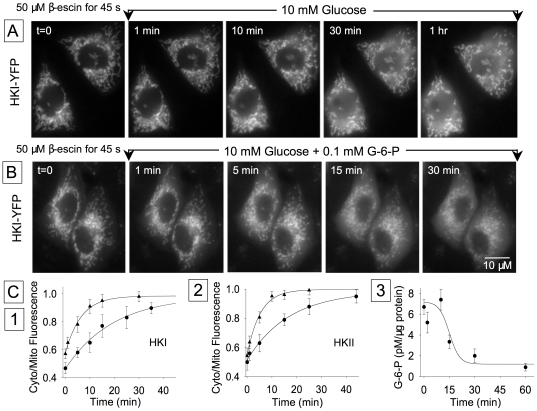
Verification
Claims the paper makes
The claims and statistics of this paper haven’t been checked yet.
Free: it reads the open-access text and checks the first 5 claims that cite a source we can check. Create a free account to check every claim.
Claims other papers make about this one
Each is checked against this paper’s own text: does it say what the citing paper says it does?
The source backs part of the claim, not all of it — or backs it for a different population, condition or comparison.
In the citing paper
“hexokinases I and II can translocate to the mitochondrial outer membrane where their catalytic activities are less sensitive to product inhibition (Azoulay-Zohar et al., 2004; Hashimoto and Wilson, 2002; John et al., 2011).”
From Lipid-Induced Mitochondrial Stress and Insulin Action in Muscle (2012) · cites this paper as John et al., 2011
Experimental — accuracy not yet measuredThe cited source says what the claim attributes to it.
In the citing paper
“Additionally, it has been proposed that HK1 remains associated with mitochondria to promote glycolysis whereas HK2 dynamically translocates between cytosol and mitochondria where it directs the metabolic fate of glucose between anabolic (glycogen synthesis and pentose phosphate shunt) and catabolic (glycolysis) metabolism (Wilson, 2003;John et al., 2011).”
From Human ApoE Isoforms Differentially Modulate Brain Glucose and Ketone Body Metabolism: Implications for Alzheimer's Disease Risk Reduction and Early Intervention (2018) · cites this paper as John et al., 2011
Self-check
Percentages, sums and reported differences re-computed from the paper’s own numbers.
The self-check needs the paper’s full text.
Citations
Cites
Isozymes of mammalian hexokinase: structure, subcellular localization and metabolic function
Wilson, J. E. (2003) · Journal of Experimental Biology · doi:10.1242/jeb.00241 · Cited by 1,085 · cited 6×
“The idea that differing subcellular locations of HKI and HKII are important was postulated by Wilson when he stated that ‘‘the Type I isozyme bound to actively phosphorylating mitochondria facilitates introduction of glucose into glycolysis, with the final stages of glucose metabolism occurring in the mitochondria.”
BackgroundInfluentialGottlob, K., Majewski, N., Kennedy, S., Kandel, E., Robey, R. B., & Hay, N. (2001) · Genes & Development · doi:10.1101/gad.889901 · Cited by 961 · cited 2×
“Since then, Wilson and others [10,11,12,13,14,15,16,17,18] have shown that the interaction of HKs with mitochondria is not static, but is regulated by factors such as glucose, G-6-P and kinases such as Akt and GSK-3.”
BackgroundThe Relationships between Substrates and Enzymes of Glycolysis in Brain
Lowry, O. H., & Passonneau, J. V. (1964) · Journal of Biological Chemistry · doi:10.1016/s0021-9258(18)51741-5 · Cited by 552 · cited 2×
“3A [1]), to allow more time for glycogen synthesis, glucose clearance by metabolism was delayed, occurring very slow initially, followed by rapid clearance similar to that after the short exposure to glucose.”
BackgroundDepre, C., Vanoverschelde, J.-L. J., & Taegtmeyer, H. (1999) · Circulation · doi:10.1161/01.cir.99.4.578 · Cited by 425 · cited 1×
“In adult muscle, fatty acids as well as glucose and glycogen are available as substrates to support oxidative metabolism [5].”
BackgroundAZOULAY-ZOHAR, H., ISRAELSON, A., ABU-HAMAD, S., & SHOSHAN-BARMATZ, V. (2004) · Biochemical Journal · doi:10.1042/bj20031465 · Cited by 408
Pastorino, J. G., Hoek, J. B., & Shulga, N. (2005) · Cancer Research · doi:10.1158/0008-5472.can-05-1925 · Cited by 398 · cited 1×
“Since then, Wilson and others [10,11,12,13,14,15,16,17,18] have shown that the interaction of HKs with mitochondria is not static, but is regulated by factors such as glucose, G-6-P and kinases such as Akt and GSK-3.”
BackgroundRose, I. A., & Warms, J. V. B. (1967) · Journal of Biological Chemistry · doi:10.1016/s0021-9258(18)96139-9 · Cited by 397
Miyamoto, S., Murphy, A. N., & Brown, J. H. (2008) · Cell Death & Differentiation · doi:10.1038/sj.cdd.4402285 · Cited by 339 · cited 3×
“Phosphorylation of residue T473 by Akt in the linker region between the N and C terminal domain of HKII may facilitate its interaction with mitochondria [14].”
BackgroundImaging of the Dynamics of Glucose Uptake in the Cytosol of COS-7 Cells by Fluorescent Nanosensors
Fehr, M., Lalonde, S., Lager, I., Wolff, M. W., & Frommer, W. B. (2003) · Journal of Biological Chemistry · doi:10.1074/jbc.m301333200 · Cited by 295 · cited 1×
“Concomitantly, we measured changes in intracellular glucose using a genetically-encoded intracellular glucose biosensor, FLIPglu-600 mM, which undergoes changes in FRET upon binding glucose [25] and assessed glycogen formation, also in live cells, using a glycogen targeting protein, PTG, tagged with GFP.”
MethodMajewski, N., Nogueira, V., Robey, R. B., & Hay, N. (2004) · Molecular and Cellular Biology · doi:10.1128/mcb.24.2.730-740.2004 · Cited by 289 · cited 2×
“Since then, Wilson and others [10,11,12,13,14,15,16,17,18] have shown that the interaction of HKs with mitochondria is not static, but is regulated by factors such as glucose, G-6-P and kinases such as Akt and GSK-3.”
Background
Cited by
Items 201–267 of 267
Cardoso, S., & Moreira, P. I. (2021) · International Journal of Molecular Sciences · doi:10.3390/ijms222413470 · Cited by 4
“We also observed a significant decrease in the activity of G6PD, the initiating step of the pentose phosphate pathway (PPP), under both dysglycemic conditions (Figure 2c).”
BackgroundInfluentialCalmettes, G., & Weiss, J. N. (2013) · PLoS ONE · doi:10.1371/journal.pone.0081988 · Cited by 4
“In the case of HK, an ROI with a high concentration of mitochondria is compared to an adjacent ROI with few mitochondria [2,3].”
BackgroundSelf-citationMathematical models for the kinetics of some carbohydrate enzymes
Quang, V. L. (2019) · Arrow@dit (Dublin Institute of Technology) · doi:10.13025/17585 · Cited by 4
Sabbir, M. G., Taylor, C. G., & Zahradka, P. C. (2020) · Research Square · doi:10.21203/rs.3.rs-55518/v1 · Cited by 5
Zhang, H., Guo, R., Li, X., Zhang, Y., Zhou, L., Wang, J., Huang, Y., Yuan, Z., Song, L., & Liao, Y. (2025) · CNS Neuroscience & Therapeutics · doi:10.1111/cns.70660 · Cited by 3
“Previous studies reveal that high glucose may affect the activation of NLRP3 by regulating the dissociation of Hexokinase-2 (HK2) from mitochondria and the expression of P2X purino-ceptor 4 (P2RX4) [26–28].”
Multidimensional control of cell structural robustness
Grinev, V. V., Ramanouskaya, T. V., & Gloushen, S. V. (2013) · Cell Biology International · doi:10.1002/cbin.10128 · Cited by 3
“…– as derivative of its synthesis/ degradation (Proctor and Gray, 2008; Vesterlund et al., 2011), of active oxygen species – as derivative of its accumulation/ neutralisation (Kornas et al., 2010), of specific enzyme activity – as derivative of its activation/inhibition (John et al., 2011), etc.”
BackgroundPerturbed Brain Energy Metabolism in Alzheimer’s Disease and Diabetes
Wu, L. (2017) · KU ScholarWorks (University of Kansas) · Cited by 3
Morris, G., & Maes, M. (2021) · Preprints.org · doi:10.20944/preprints202105.0180.v1 · Cited by 3
Garza‐Martinez, L., & Fitzgerald-Bocarsly, P. A. (2025) · Cell Communication and Signaling · doi:10.1186/s12964-025-02525-0 · Cited by 2
“While glucose transporter 1 (Glut1) is the major glucose transporter on T cells, hexokinases hold the key to glycolysis by acting as the rate-limiting step enzymes [115].”
KRAS4A promotes oligomerization of hexokinase 1 on mitochondria
Nuevo‐Tapioles, C., Qin, Z., Bazley, A., Branco, C. M., Hamilton, G., Kong, X., Rothenberg, E., & Philips, M. R. (2026) · Cell Reports · doi:10.1016/j.celrep.2026.117392 · Cited by 2
Barghash, A., & Shanak, S. (2025) · Biomedicines · doi:10.3390/biomedicines13092181 · Cited by 2
“…is the predominant insulin-regulated hexokinase in adult skeletal muscle, and hexokinase I (HK1) also contributes to total hexokinase capacity [46], we measured both isoforms; notably, HK1 was significantly reduced in IGT when compared to NGT, with pathway analysis indicating matched…”
A comparative characterization of macrophages tolerant to NOD1 and TLR4 receptor agonists
Nikolaeva, A. M., Максимчик, П. В., & Pashenkov, M. V. (2021) · Immunologiya · doi:10.33029/0206-4952-2021-42-2-102-111 · Cited by 2
“При активации макрофагов через ПРР происхо - дит быстрое усиление гликолиза , которое связывают с перераспределением молекул гексокиназы -II из ци - тозоля на наружную мембрану митохондрий [39, 40].”
Hexokinase 1b is a novel target for Non–small-cell lung cancerPreprint
Yozgat, Y., Karakoç, E., Şahin, Ö., Çimen, Ş., Rabeh, W. M., Aydın, M. Ş., Mardinoğlu, A., Gürsel, İ., Çakır, A., Şensoy, Ö., et al. (2022) · bioRxiv (Cold Spring Harbor Laboratory) · doi:10.1101/2022.06.27.497447 · Cited by 2
Zhang, H., Li, X., Liao, W., Qin, X., Jiang, Y., Yang, H., Zeng, H., Li, Y., Xie, W., Zhang, Y., et al. (2026) · Cell Death and Disease · doi:10.1038/s41419-026-08459-w · Cited by 1
Yan, J., 方璐, Xi, M., Liu, Z., Zhang, S., Zhang, Y., Zhang, Y., Tc, X., Li, J. J., Huang, Y., et al. (2026) · Environmental Science & Technology · doi:10.1021/acs.est.5c06517 · Cited by 1
Hexokinase regulates Mondo-mediated longevity via the PPP and organellar dynamics
Laboy, R., Ndoci, M., Syed, S. T., Vonolfen, M., Ballhysa, E., Droth, T., Schilling, K., Löhrke, A., Atanassov, I., & Antebi, A. (2025) · eLife · doi:10.7554/elife.89225.4 · Cited by 2
Hinrichs, C. (2015) · NORA - Norwegian Open Research Archives · Cited by 1
The role of NFκB in glucose import and survival of B-cell lymphomas
Sommermann, T. G. (2012) · OPUS FAU (Kooperativer Bibliotheksverbund Berlin-Brandenburg (KOBV), on behalf of the Universitätsbibliothek Erlangen-Nürnberg) · Cited by 1
ApoE2-Mediated Neuroprotective Mechanism Through Up-regulation of Glycolysis
Zhang, X. (2018) · KU ScholarWorks (The University of Kansas) · Cited by 1
Hexokinase regulates Mondo-mediated longevity via the PPP and organellar dynamicsPreprint
Laboy, R., Ndoci, M., Vonolfen, M., Ballhysa, E., Atanassov, I., & Antebi, A. (2023) · eLife · doi:10.7554/elife.89225.1 · Cited by 1
Tian, Z., Wang, S., Fan, Y., Li, B., Zheng, H., Lu, Y., Huang, Z., Wang, M., Zhang, J., Zhao, J., et al. (2024) · Research Square · doi:10.21203/rs.3.rs-3874780/v1 · Cited by 1
Hexokinase regulates Mondo-mediated longevity via the PPP and organellar dynamicsPreprint
Laboy, R., Ndoci, M., Tabrez, S. S., Vonolfen, M., Ballhysa, E., Droth, T., Schilling, K., Löhrke, A., Atanassov, I., & Antebi, A. (2025) · eLife · doi:10.7554/elife.89225.3 · Cited by 1
Ahmed, D., Daraawi, M. A., Humphrey, A., Abdo, O., Roy, D., Sheridan, M.-E., Versey, Z., Mejlaoui, R., Jaworski, A. F., Edwards, A., et al. (2025) · bioRxiv (Cold Spring Harbor Laboratory) · doi:10.64898/2025.12.03.691914 · Cited by 1
Forkink, M. (2015) · Radboud Repository (Radboud University)
The effects of hyperglycemia on glucose metabolism in epithelial ovarian cancer
Kellenberger, L. D. (2016) · The Atrium (University of Guelph)
Mitochondria and effector functions of human CD8* T cells
Fischer, M. (2015) · edoc (University of Basel) · doi:10.5451/unibas-006483297
Unraveling cancer metabolism through flux analysis and metabolic engineering
Tavares, L. C. (2015) · Portuguese National Funding Agency for Science, Research and Technology (RCAAP Project by FCT)
Shashni, B. (2015) · Terrestrial Environment Research Center (University of Tsukuba)
Lindsay, K. J. (2014) · ResearchWorks at the University of Washington (University of Washington)
Pant, M. (2015) · OhioLink ETD Center (Ohio Library and Information Network)
Metabolomics and Proteomics to Understand Fuel Use in Rat Model of High and Low Exercise Capacity.
Overmyer, K. A. (2014) · Deep Blue (University of Michigan)
The c-Rel Transcription Factor Controls Metabolism and Proliferation of Human T Cells
Luo, G. (2017) · ScholarlyCommons (University of Pennsylvania)
BAD-interacting proteins in breast cancer cells
Craik, A. C. (2012) · ERA: Education and Research Archive (University of Alberta) · doi:10.7939/r3536q
Dendritic Cell Response during Chlamydia Infection: A Role for Alpha Enolase
Ryans, K. (2016) · Atlanta University Center Robert W. Woodruff Library (Atlanta University Center Robert W. Woodruff Library)
Rossi, A. (2018) · Padua@research (University of Padova)
Regulation of Inflammatory Macrophage Activation and Tolerance by Modulation of Glucose Metabolism
Langston, P. K. (2019) · Digital Access to Scholarship at Harvard (DASH) (Harvard University)
A systems biology approach to cellular homeostasis, volume changes and regulation of metabolism
Fjeld, G. (2020) · NVA (Nasjonalt vitenarkiv)
Yozgat, Y. (2019) · Sabanci University
Glucose – Schlüsselmolekül des Kohlenhydratstoffwechsels
Müller, M., & Löffler, G. (2022) · Springer eBooks · doi:10.1007/978-3-662-60266-9_14
Coupling Glucose Phosphorylation to Oxygen in Brain Mitochondria: Would It Be a Redox Set Point?
Galina, A. (2023) · Interdisciplinary biotechnological advances · doi:10.1007/978-981-19-8342-9_6
Hexokinase regulates Mondo-mediated longevity via the PPP and organellar dynamicsPreprint
Laboy, R., Ndoci, M., Vonolfen, M., Ballhysa, E., Syed, S. T., Droth, T., Schilling, K., Löhrke, A., Atanassov, I., & Antebi, A. (2024) · eLife · doi:10.7554/elife.89225.2
The Immunometabolism of Natural Killer Cell Responses
Keane, C., Gardiner, C. M., & Finlay, D. K. (2025) · Springer eBooks · doi:10.1007/978-3-662-68816-8_41-1
Zhang, C., Jiang, S., Liu, X., Zhong, S., & Zhang, W. (2025) · Aquaculture Reports · doi:10.1016/j.aqrep.2025.102931
Additional file 1 of Loss of hexokinase 1 sensitizes ovarian cancer to high-dose metformin
Šimčíková, D., Gardáš, D., Hložková, K., Hruda, M., Žáček, P., Rob, L., & Heneberg, P. (2021) · Figshare · doi:10.6084/m9.figshare.17163368
Haug, T. (2020) · OPUS FAU (Kooperativer Bibliotheksverbund Berlin-Brandenburg (KOBV), on behalf of the Universitätsbibliothek Erlangen-Nürnberg)
大腸癌の分子病態 : 癌抑制型マイクロRNA(miR-139-3p)により制御される癌促進型遺伝子の影響
安留龍太郎, & Yasudome, R. (2023) · Kagoshima University Repository
Precision targeting of mTORC1 in tumour-specific CD4+ T cells
Sillito, F. E. (2023) · UCL Discovery (University College London)
BROADCASTING AND POLITICS IN GREECE, 1936-1987
Pucino, V (2019) · Queen Mary Research Online (Queen Mary University of London)
Mikrobielle Regulation von Hexokinase 2 und deren Einfluss auf Entzündung
Hinrichsen, F. C. (2025) · MACAU: Open Access Repository of Kiel University
Flynn, R. J. (2025) · UCL Discovery (University College London)
ZEMB, P. A., & Joulia, F. (2026) · SSRN Electronic Journal · doi:10.2139/ssrn.6068352
Rôle de l'autophagie dans l'émergence des cellules souches cancéreuses : implication du métabolisme
El-Hout, M. (2019) · theses.fr (ABES) · doi:10.70675/881cf980z01caz4a56z8a81zdcebe1247536
Étude de nouvelles fonctions moléculaires et cellulaires de l'Hexokinase 2 dans le cancer
Watzky, M. (2023) · theses.fr (ABES) · doi:10.70675/73163a81z2c2bz4e11zaba1z8dc110d9c697
Zhang, S., Luo, K., Wei, X., Qing, C., Zhang, J., Wei, H., Yan, Y., Yang, Y., Zeng, Z., & Huang, S. (2026) · Journal of Pharmacological Sciences · doi:10.1016/j.jphs.2026.05.007
Gu, Y., Liu, W., Wang, Z., & Kim, S. H. (2026) · Frontiers in Endocrinology · doi:10.3389/fendo.2026.1841754
Wu, R. (2026) · TSpace (University of Toronto)
Linking cellular metabolism to mitochondrial outer membrane potential
Abrantes, K., Beyene, B. G., Bautista, N. A., Fitzgerald, W., Rostovtseva, T. K., Bezrukov, S. M., & Rajendran, M. (2026) · Mitochondrion · doi:10.1016/j.mito.2026.102218
“In particular, glucose levels can affect the mitochondrial localization of HK2 (John et al., 2011), and Sun et al. demonstrated that the protective effects of HK in HEK-293 cells depended on both its mitochondrial localization and catalytic activity (Sun et al., 2008).”
Hong, X. F., Liu, H. C., Qing, S. Z., Chen, S. Q., Zou, J., Lu, C. G., Yu, H. R., Tan, J. X., Gu, Y., & Hong, H. Y. (2026) · Research Square · doi:10.21203/rs.3.rs-11117746/v1
S‑palmitoylation orchestrates spatiotemporal protein organization at biomembranes in cancer
Wang, Y., Peng, Z., Lei, X., Lin, Z., Liao, C., Liu, Q., Wang, J., & Long, Z. (2026) · Journal of the National Cancer Center · doi:10.1016/j.jncc.2026.09.005
Masyutina, A. M., Maximchik, P. V., Chkadua, G. Z., & Pashenkov, M. V. (2023) · doi:10.3389/fimmu.2023.1006002.s001
Farina, S., Voorsluijs, V., Fixemer, S., Bouvier, D., Claus, S., Ellisman, M., Bordas, S. P. A., & Skupin, A. (2023) · doi:10.1371/journal.pcbi.1011464.r004
John, S., Calmettes, G., Xu, S., & Ribalet, B. (2024) · doi:10.1371/journal.pone.0300150.r003
Self-citationChidlow, G., Weng Onn Chan, Wood, J. P. M., & Casson, R. J. (2022) · doi:10.3389/fncel.2022.1036834.s002
Metadata
- Authors
- John, S., Weiss, J. N., & Ribalet, B.
- Affiliations
- University of California, Los Angeles (US)
- Corresponding author
- Ribalet, Bernard
- Venue
- PLoS ONE
- Publisher
- Public Library of Science (PLoS)
- Published
- 2011-03-09
- Volume
- 6
- Issue
- 3
- Pages
- e17674
- ISSN
- 1932-6203 (ISSN-L)
- PMC
- PMC3052386
- OpenAlex
- W2064263174
- Cited by
- 239
- References
- 30
- Citations by year
- 2026: 11 · 2025: 22 · 2024: 16 · 2023: 18 · 2022: 24 · 2021: 20 · 2020: 21 · 2019: 16 · 2018: 16 · 2017: 14 · 2016: 9 · 2015: 16 · 2014: 11 · 2013: 15 · 2012: 8
- FWCI
- 4.54
- Type
- journal article
- Language
- en
- Open access
- gold
- doi.org
- Locations
- PLoS ONE (publishedVersion, cc-by)
- PubMed Central (publishedVersion, cc-by)
- PubMed (publishedVersion)
- DOAJ (DOAJ: Directory of Open Access Journals) (submittedVersion, cc-by-sa)
- eScholarship (California Digital Library) (submittedVersion)
- eScholarship (California Digital Library) (submittedVersion, cc-by)
- Figshare (submittedVersion, cc-by)
- Funders
- National Institutes of Health
- National Heart, Lung, and Blood Institute (R37 HL60025, P01 HL071870, R37HL060025, R01HL071870)
- Topics
- Life Sciences › Biochemistry, Genetics and Molecular Biology › Molecular Biology › Metabolism, Diabetes, and Cancer
- Life Sciences › Biochemistry, Genetics and Molecular Biology › Biochemistry › Glycogen Storage Diseases and Myoclonus
- Life Sciences › Biochemistry, Genetics and Molecular Biology › Cancer Research › Cancer, Hypoxia, and Metabolism
- Keywords
- hexokinase 1, hexokinase 2, subcellular localization, glucose metabolism, glucose-6-phosphate, glycolysis, glycogen synthesis, glycogenolysis, mitochondrial translocation, Akt signaling, glucose biosensor, CHO cells, energy homeostasis
- MeSH terms
- Animals, Carbonyl Cyanide p-Trifluoromethoxyphenylhydrazone, Cell Membrane Permeability, Cricetulus, Cytosol, Glucose, Glycogen, Cricetinae, Hexokinase, Mitochondria, Protein Binding, Subcellular Fractions, Time Factors, Transfection, CHO Cells, Glucose-6-Phosphate, Protein Transport, Proto-Oncogene Proteins c-akt, Glucose Transporter Type 1, Rats
About these checks
Registry, retraction, Cites and statistics results are computed, not judged, with one exception: a printed reference that no index lists is read once by a model before it counts as a citation error. Claims are extracted by a model and kept only when their quote appears verbatim in the text; each cited source is then checked, with a model’s help, for whether it says what the claim relies on. Those verdicts can be wrong — read the claim’s quote and the cited source before relying on one.
Statistics and arithmetic are recomputed, not judged.
Confidence bands are shown only for fields calibrated on our annotated test set. None is calibrated yet, so no band is shown.
What counts as a claim ›How we measure confidence ›How we check this ›
Are you an author, or do you see a problem with this page? Request a review
Data sources
Bibliographic data: Semantic Scholar, OpenAlex, Crossref.
Contains information from the Semantic Scholar Academic Graph Datasets, made available under the ODC Attribution License (ODC-BY 1.0).
Semantic Scholar’s data is described in: Kinney, R., et al. (2023). The Semantic Scholar Open Data Platform. arXiv:2301.10140.
