

The DOI matches its Crossref record; 62 of the 63 references it cites were found in a registry or an index.
Phosphorylation of AMPA Receptors Is Required for Sensory Deprivation-Induced Homeostatic Synaptic Plasticity
Open accessAbstract
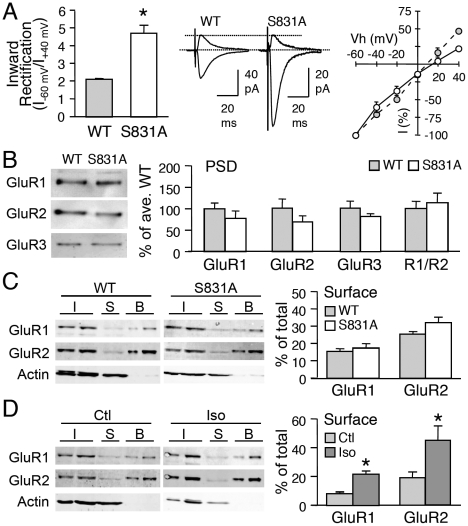
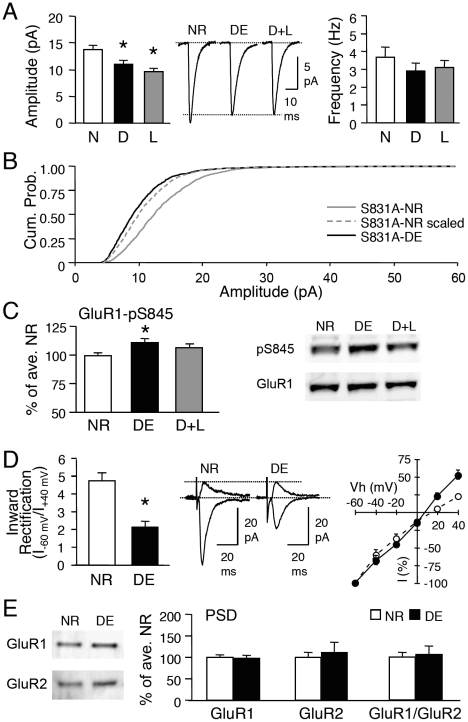
Sensory experience, and the lack thereof, can alter the function of excitatory synapses in the primary sensory cortices. Recent evidence suggests that changes in sensory experience can regulate the synaptic level of Ca(2+)-permeable AMPA receptors (CP-AMPARs). However, the molecular mechanisms underlying such a process have not been determined. We found that binocular visual deprivation, which is a well-established in vivo model to produce multiplicative synaptic scaling in visual cortex of juvenile rodents, is accompanied by an increase in the phosphorylation of AMPAR GluR1 (or GluA1) subunit at the serine 845 (S845) site and the appearance of CP-AMPARs at synapses. To address the role of GluR1-S845 in visual deprivation-induced homeostatic synaptic plasticity, we used mice lacking key phosphorylation sites on the GluR1 subunit. We found that mice specifically lacking the GluR1-S845 site (GluR1-S845A mutants), which is a substrate of cAMP-dependent kinase (PKA), show abnormal basal excitatory synaptic transmission and lack visual deprivation-induced homeostatic synaptic plasticity. We also found evidence that increasing GluR1-S845 phosphorylation alone is not sufficient to produce normal multiplicative synaptic scaling. Our study provides concrete evidence that a GluR1 dependent mechanism, especially S845 phosphorylation, is a necessary pre-requisite step for in vivo homeostatic synaptic plasticity.
Overview
The claims and statistics of this paper haven’t been checked yet.
Run the check — free, no account needed. It reads the open-access text and checks the sources it cites.
Integrity signals
Registry
Cites
Statistics
Figures
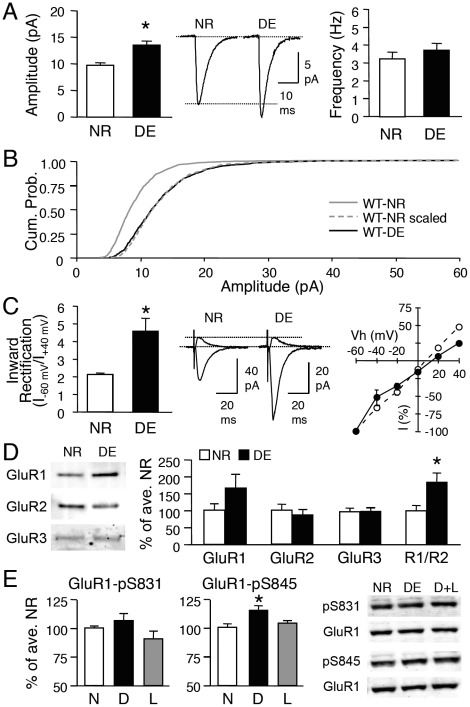
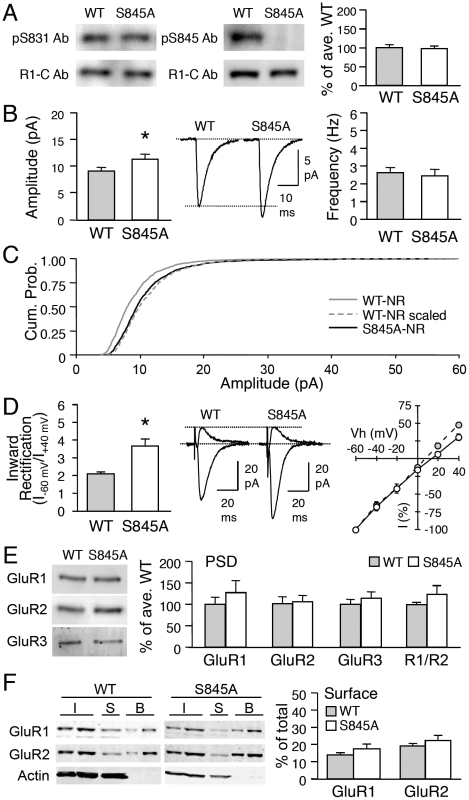
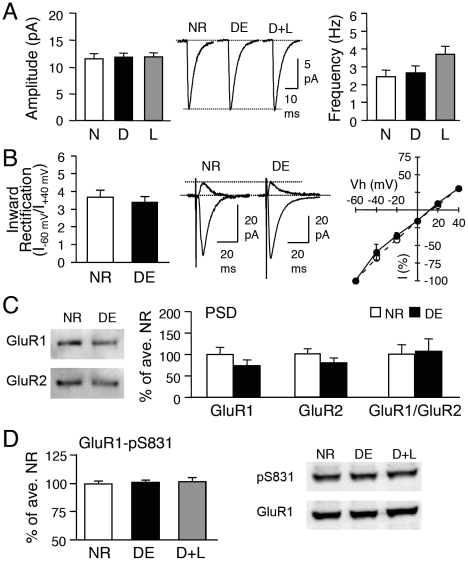
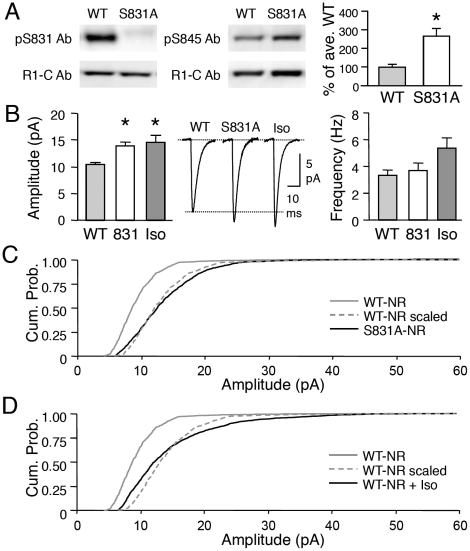
Verification
Claims the paper makes
The claims and statistics of this paper haven’t been checked yet.
Run the check — free, no account needed. It reads the open-access text and checks the sources it cites.
Claims other papers make about this one
Each is checked against this paper’s own text: does it say what the citing paper says it does?
The source backs part of the claim, not all of it — or backs it for a different population, condition or comparison.
In the citing paper
“In contrast, dark rearing increases the abundance of GluA2-lacking receptors and requires GluA1 phosphorylation, suggesting that these two modes of deprivation may induce different forms of compensatory synaptic plasticity (Goel and Lee 2007;Goel et al. 2011).”
From Homeostatic Synaptic Plasticity: Local and Global Mechanisms for Stabilizing Neuronal Function (2012) · cites this paper as Goel et al. 2011
Experimental — accuracy not yet measuredThe cited source says what the claim attributes to it.
In the citing paper
“In contrast, dark rearing increases the abundance of GluA2-lacking receptors and requires GluA1 phosphorylation, suggesting that these two modes of deprivation may induce different forms of compensatory synaptic plasticity (Goel and Lee 2007;Goel et al. 2011).”
From Homeostatic Synaptic Plasticity: Local and Global Mechanisms for Stabilizing Neuronal Function (2012) · cites this paper as Goel et al. 2011
The cited source says what the claim attributes to it.
In the citing paper
“Homeostatic scaling-up has also been observed in the visual cortex in mice in response to visual deprivation, and involves the recruitment of synaptic CP-AMPARs and increased GluA1 S845 phosphorylation (Goel et al., 2006, Goel et al., 2011).”
From The AMPA Receptor Code of Synaptic Plasticity (2018) · cites this paper as Goel et al., 2011
The cited source says what the claim attributes to it.
In the citing paper
“Like in cultured neurons, visual deprivation-induced scaling-up is absent in GluA1 S845A knock-in mutant mice (Goel et al., 2011).”
From The AMPA Receptor Code of Synaptic Plasticity (2018) · cites this paper as Goel et al., 2011
Self-check
Percentages, sums and reported differences re-computed from the paper’s own numbers.
The self-check needs the paper’s full text.
Citations
Cites
Activity-dependent scaling of quantal amplitude in neocortical neurons
Turrigiano, G. G., Leslie, K. R., Desai, N. S., Rutherford, L. C., & Nelson, S. B. (1998) · Nature · doi:10.1038/36103 · Cited by 2,226
Hayashi, Y., Shi, S.-H., Esteban, J. A., Piccini, A., Poncer, J.-C., & Malinow, R. (2000) · Science · doi:10.1126/science.287.5461.2262 · Cited by 1,524
Regulation of distinct AMPA receptor phosphorylation sites during bidirectional synaptic plasticity
Lee, H.-K., Barbarosie, M., Kameyama, K., Bear, M. F., & Huganir, R. L. (2000) · Nature · doi:10.1038/35016089 · Cited by 1,116
Self-citationShi, S.-H., Hayashi, Y., Esteban, J. A., & Malinow, R. (2001) · Cell · doi:10.1016/s0092-8674(01)00321-x · Cited by 1,094
Regulatory phosphorylation of AMPA-type glutamate receptors by CaM-KII during long-term potentiation
Barria, A., Muller, D., Derkach, V., Griffith, L. C., & Soderling, T. R. (1997) · Science · doi:10.1126/science.276.5321.2042 · Cited by 1,049
PKA phosphorylation of AMPA receptor subunits controls synaptic trafficking underlying plasticity
Esteban, J. A., Shi, S.-H., Wilson, C., Nuriya, M., Huganir, R. L., & Malinow, R. (2003) · Nature Neuroscience · doi:10.1038/nn997 · Cited by 894
Self-citationDerkach, V., Barria, A., & Soderling, T. R. (1999) · Proceedings of the National Academy of Sciences · doi:10.1073/pnas.96.6.3269 · Cited by 842
Characterization of multiple phosphorylation sites on the AMPA receptor GluR1 subunit
Roche, K. W., O'Brien, R. J., Mammen, A. L., Bernhardt, J., & Huganir, R. L. (1996) · Neuron · doi:10.1016/s0896-6273(00)80144-0 · Cited by 812
Self-citationLee, H.-K., Takamiya, K., Han, J.-S., Man, H., Kim, C.-H., Rumbaugh, G., Yu, S., Ding, L., He, C., Petralia, R. S., et al. (2003) · Cell · doi:10.1016/s0092-8674(03)00122-3 · Cited by 802
Self-citationFormation of accumbens GluR2-lacking AMPA receptors mediates incubation of cocaine craving
Conrad, K. L., Tseng, K. Y., Uejima, J. L., Reimers, J. M., Heng, L.-J., Shaham, Y., Marinelli, M., & Wolf, M. E. (2008) · Nature · doi:10.1038/nature06995 · Cited by 790
Research works printed but not linked: 1
- TC Thiagarajan, 2002, alpha- and betaCaMKII. Inverse regulation by neuronal activity and opposing effects on synaptic strength., Neuron, 36, 1103
Cited by
Sorted by citations
Items 101–103 of 103
Posttranslational modifications of AMPA receptors in synaptic function and memory
de León-López, C. A. M., Navarro‐Lobato, I., & Khan, Z. U. (2026) · Cellular and Molecular Life Sciences · doi:10.1007/s00018-026-06297-9
Anchored kinase and phosphatase signaling networks in amyloid β-induced synaptic dysfunction
Koek, L. A., Jo, H.-N., Kennedy, M. J., & Dell’Acqua, M. L. (2026) · Molecular Pharmacology · doi:10.1016/j.molpha.2026.100141
Ralph, L. T., Kang, S., Joe, L. A., Tidball, P., Israwi, A. R., Tian, M., Kadia, A., Zhang, L., Jin, F., Ingram, R., et al. (2026) · Hippocampus · doi:10.1002/hipo.70118
Metadata
- Authors
- Goel, A., Xu, L. W., Snyder, K. P., Song, L., Goenaga-Vazquez, Y., Megill, A., Takamiya, K., Huganir, R. L., & Lee, H.-K.
- Affiliations
- University of Maryland, College Park (US)
- University of Miyazaki (JP)
- Johns Hopkins University (US)
- Corresponding author
- Lee, Hey-Kyoung
- Venue
- PLoS ONE
- Publisher
- Public Library of Science (PLoS)
- Published
- 2011-03-31
- Volume
- 6
- Issue
- 3
- Pages
- e18264
- ISSN
- 1932-6203 (ISSN-L)
- PMC
- PMC3069067
- OpenAlex
- W2090738767
- Cited by
- 103
- References
- 63
- Citations by year
- 2026: 4 · 2025: 5 · 2024: 4 · 2023: 3 · 2022: 6 · 2021: 5 · 2020: 5 · 2019: 10 · 2018: 8 · 2017: 4 · 2016: 12 · 2015: 5 · 2014: 7 · 2013: 12 · 2012: 8
- FWCI
- 4.24
- Type
- journal article
- Language
- en
- Open access
- gold
- doi.org
- Locations
- PLoS ONE (publishedVersion, cc-by)
- Europe PMC (PubMed Central) (publishedVersion, cc-by)
- PubMed Central (publishedVersion, cc-by)
- PubMed (publishedVersion)
- DOAJ (DOAJ: Directory of Open Access Journals) (submittedVersion, cc-by-sa)
- Figshare (submittedVersion, cc-by)
- Funders
- Howard Hughes Medical Institute
- National Institutes of Health (NS036715)
- Japan Society for the Promotion of Science (22300122)
- National Eye Institute (R01EY014882)
- National Institute of Neurological Disorders and Stroke (R01NS036715)
- Topics
- Life Sciences › Neuroscience › Cellular and Molecular Neuroscience › Neuroscience and Neuropharmacology Research
- Life Sciences › Biochemistry, Genetics and Molecular Biology › Genetics › Genetics and Neurodevelopmental Disorders
- Life Sciences › Neuroscience › Cognitive Neuroscience › Neural dynamics and brain function
- Keywords
- AMPA receptor phosphorylation, GluR1, homeostatic plasticity, sensory deprivation, Ca2+-permeable AMPA receptors, protein kinase A, excitatory synaptic transmission, visual cortex
- MeSH terms
- Animals, Electrophoresis, Polyacrylamide Gel, Neuronal Plasticity, Phosphorylation, Sensory Deprivation, Synapses, Immunoblotting, Receptors, AMPA, Mice, In Vitro Techniques
About these checks
Registry, retraction, Cites and statistics results are computed, not judged, with one exception: a printed reference that no index lists is read once by a model before it counts as a citation error. Claims are extracted by a model and kept only when their quote appears verbatim in the text; each cited source is then checked, with a model’s help, for whether it says what the claim relies on. Those verdicts can be wrong — read the claim’s quote and the cited source before relying on one.
Statistics and arithmetic are recomputed, not judged.
Confidence bands are shown only for fields calibrated on our annotated test set. None is calibrated yet, so no band is shown.
What counts as a claim ›How we measure confidence ›How we check this ›
Are you an author, or do you see a problem with this page? Request a review
