

Structure-Activity Determinants in Antifungal Plant Defensins MsDef1 and MtDef4 with Different Modes of Action against Fusarium graminearum
Open accessThe DOI matches its Crossref record; 48 of the 48 references it cites were found in a registry or an index.
Abstract
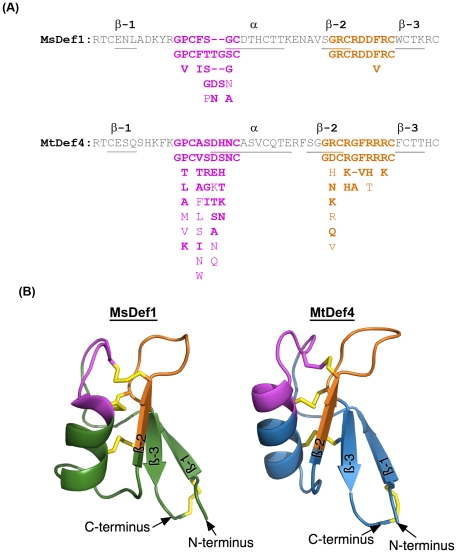
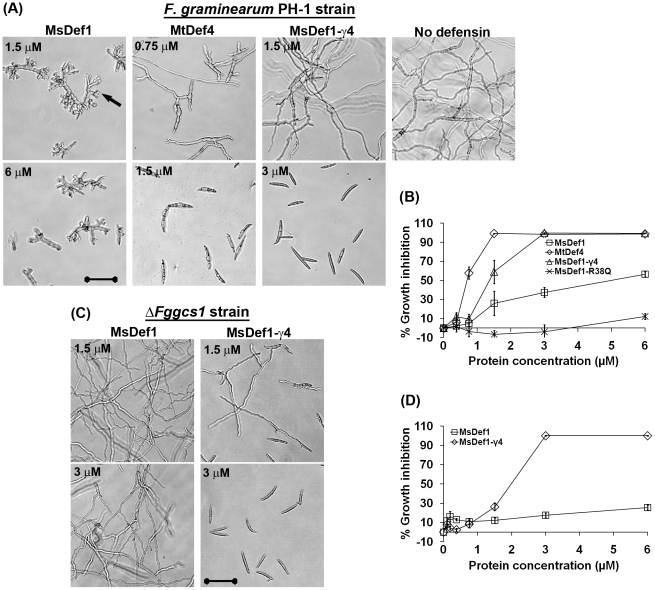
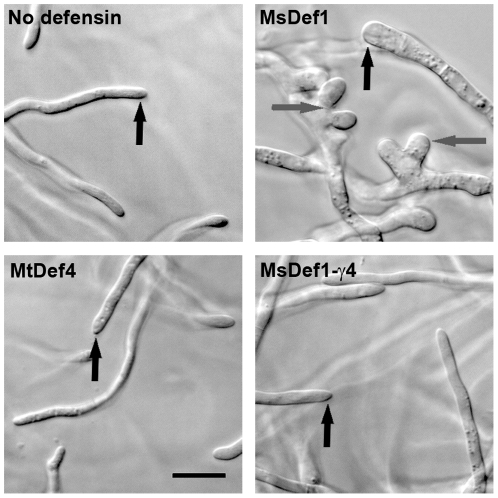
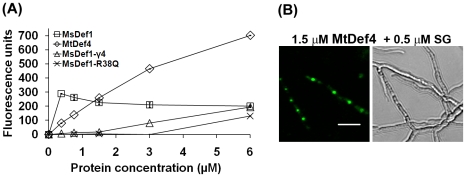
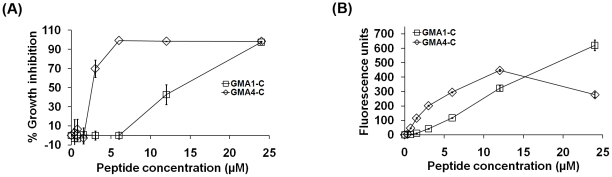
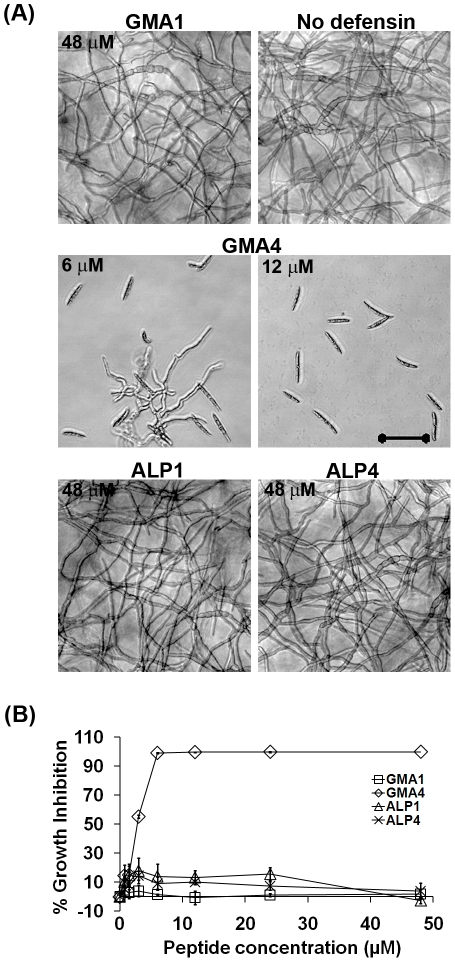
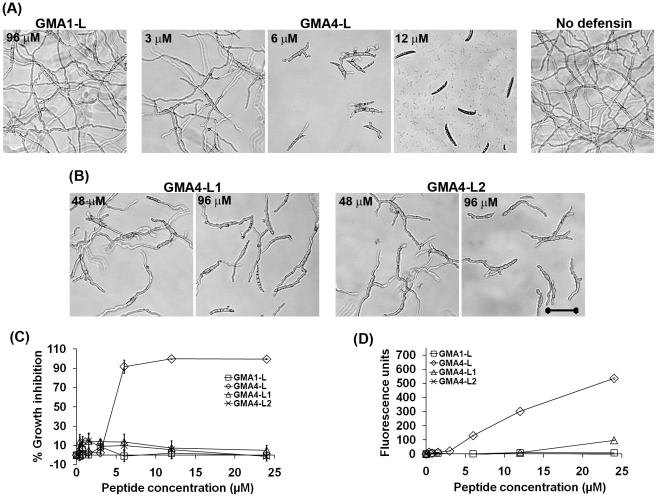
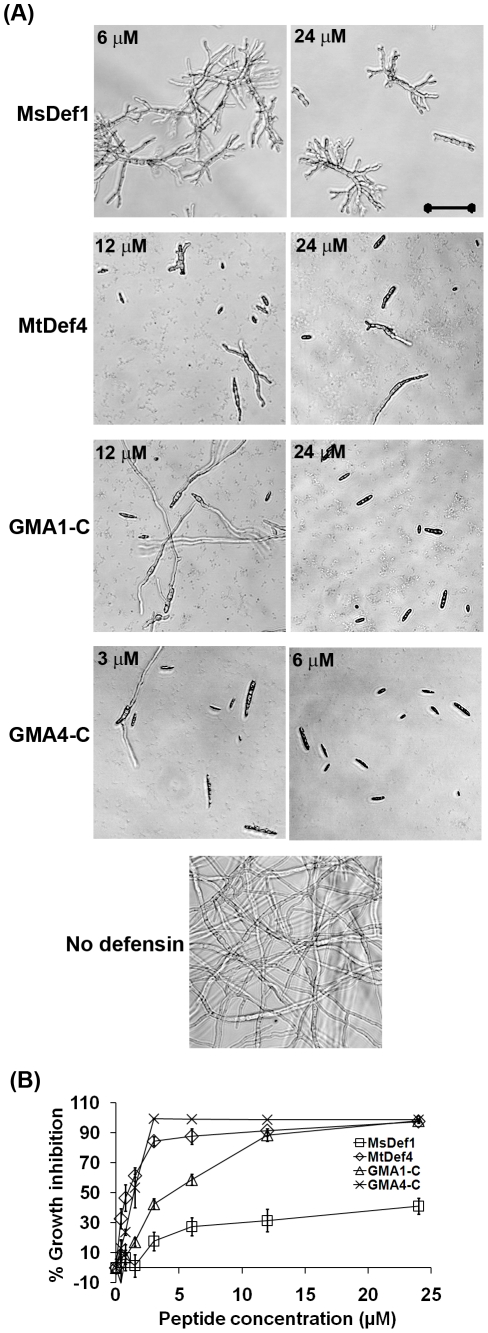
Plant defensins are small cysteine-rich antimicrobial proteins. Their three-dimensional structures are similar in that they consist of an α-helix and three anti-parallel β-strands stabilized by four disulfide bonds. Plant defensins MsDef1 and MtDef4 are potent inhibitors of the growth of several filamentous fungi including Fusarium graminearum. However, they differ markedly in their antifungal properties as well as modes of antifungal action. MsDef1 induces prolific hyperbranching of fungal hyphae, whereas MtDef4 does not. Both defensins contain a highly conserved γ-core motif (GXCX(3-9)C), a hallmark signature present in the disulfide-stabilized antimicrobial peptides, composed of β2 and β3 strands and the interposed loop. The γ-core motifs of these two defensins differ significantly in their primary amino acid sequences and in their net charge. In this study, we have found that the major determinants of the antifungal activity and morphogenicity of these defensins reside in their γ-core motifs. The MsDef1-γ4 variant in which the γ-core motif of MsDef1 was replaced by that of MtDef4 was almost as potent as MtDef4 and also failed to induce hyperbranching of fungal hyphae. Importantly, the γ-core motif of MtDef4 alone was capable of inhibiting fungal growth, but that of MsDef1 was not. The analysis of synthetic γ-core variants of MtDef4 indicated that the cationic and hydrophobic amino acids were important for antifungal activity. Both MsDef1 and MtDef4 induced plasma membrane permeabilization; however, kinetic studies revealed that MtDef4 was more efficient in permeabilizing fungal plasma membrane than MsDef1. Furthermore, the in vitro antifungal activity of MsDef1, MsDef1-γ4, MtDef4 and peptides derived from the γ-core motif of each defensin was not solely dependent on their ability to permeabilize the fungal plasma membrane. The data reported here indicate that the γ-core motif defines the unique antifungal properties of each defensin and may facilitate de novo design of more potent antifungal peptides.
Overview
The claims and statistics of this paper haven’t been checked yet.
Free: it reads the open-access text and checks the first 5 claims that cite a source we can check. Create a free account to check every claim.
Integrity signals
Registry
Cites
Statistics
Figures
Verification
Claims the paper makes
The claims and statistics of this paper haven’t been checked yet.
Free: it reads the open-access text and checks the first 5 claims that cite a source we can check. Create a free account to check every claim.
Claims other papers make about this one
Each is checked against this paper’s own text: does it say what the citing paper says it does?
The source backs part of the claim, not all of it — or backs it for a different population, condition or comparison.
In the citing paper
“More likely, the γ-core provides a structural scaffold, while the surrounding sequence, physicochemical properties, and structural context determine the final antimicrobial phenotype [18,19,20,21,22,23,24,31].”
From Ovotransferrin and Its γ-Core-Containing Peptides Impair Pma1-Dependent Proton Homeostasis in Candida albicans (2026) · cites this paper as [19]
Experimental — accuracy not yet measuredThe cited source says what the claim attributes to it.
In the citing paper
“However, activity is not conferred by the GXC/CXG sequence consensus alone and may depend on the integrity of the motif, its charge and hydrophobicity, the contribution of flanking residues, and preservation of an appropriate conformational context [19,20,21,22].”
From Ovotransferrin and Its γ-Core-Containing Peptides Impair Pma1-Dependent Proton Homeostasis in Candida albicans (2026) · cites this paper as [19]
The cited source says what the claim attributes to it.
In the citing paper
“Experimental studies have further shown that peptides encompassing complete γ-core regions can reproduce antimicrobial properties of their parent molecules.”
From Ovotransferrin and Its γ-Core-Containing Peptides Impair Pma1-Dependent Proton Homeostasis in Candida albicans (2026) · cites this paper as [19]
Self-check
Percentages, sums and reported differences re-computed from the paper’s own numbers.
The self-check needs the paper’s full text.
Citations
Cites
Gapped BLAST and PSI-BLAST: a new generation of protein database search programs
Altschul, S. (1997) · Nucleic Acids Research · doi:10.1093/nar/25.17.3389 · Cited by 73,302 · cited 1×
“A search of the NCBI database using Blast P [23] resulted in the identification of 16 legume-specific plant defensin sequences sharing high sequence homology with MsDef1 (Figure S1A).”
MethodThompson, J. D., Higgins, D. G., & Gibson, T. J. (1994) · Nucleic Acids Research · doi:10.1093/nar/22.22.4673 · Cited by 64,617 · cited 1×
“CLUSTAL W alignment [24] of 18 amino acid sequences of the homologs of MsDef1 identified a consensus c-core motif with the sequence ‘GXCRDD(F/V)RC’ (Figure 1A), whereas similar analysis of 28 MtDef4 homologs identified a consensus c-core motif with the sequence ‘GXC(R/H/K)(G/A/_)(F/V)(R/H/ T)R(R/K)C’ (Figure 1A).”
Antimicrobial peptides of multicellular organisms
Zasloff, M. (2002) · Nature · doi:10.1038/415389a · Cited by 8,457 · cited 1×
“Plants are sessile organisms that are continually challenged by microbial pathogens during their life cycle. To ward off pathogen attack, plants produce a number of cationic antimicrobial peptides. These include defensins that are one of the largest families of antimicrobial peptides found in plants. These basic, cyst…”
BackgroundI-TASSER: a unified platform for automated protein structure and function prediction
Roy, A., Kucukural, A., & Zhang, Y. (2010) · Nature Protocols · doi:10.1038/nprot.2010.5 · Cited by 6,170
I-TASSER server for protein 3D structure prediction
Zhang, Y. (2008) · BMC Bioinformatics · doi:10.1186/1471-2105-9-40 · Cited by 5,124
Plant Defensins: Novel Antimicrobial Peptides as Components of the Host Defense System
Broekaert, W. F., Terras, F., Cammue, B., & Osborn, R. W. (1995) · Plant Physiology · doi:10.1104/pp.108.4.1353 · Cited by 765 · cited 2×
“different modes of antifungal action [16,17].”
BackgroundThomma, B., Cammue, B., & Thevissen, K. (2002) · Planta · doi:10.1007/s00425-002-0902-6 · Cited by 661
Nitrate Nonutilizing Mutants of Fusarium oxysporum and Their Use in Vegetative Compatibility Tests
Correll, J. C. (1987) · Phytopathology · doi:10.1094/phyto-77-1640 · Cited by 628
Analysis of two novel classes of plant antifungal proteins from radish (Raphanus sativus L.) seeds.
Terras, F. R., Schoofs, H. M., De Bolle, M. F., Van Leuven, F., Rees, S. B., Vanderleyden, J., Cammue, B. P., & Broekaert, W. F. (1992) · Journal of Biological Chemistry · doi:10.1016/s0021-9258(19)49534-3 · Cited by 581 · cited 2×
“different modes of antifungal action [16,17].”
BackgroundBacterial viability and antibiotic susceptibility testing with SYTOX green nucleic acid stain
Roth, B. L., Poot, M., Yue, S. T., & Millard, P. J. (1997) · Applied and Environmental Microbiology · doi:10.1128/aem.63.6.2421-2431.1997 · Cited by 579 · cited 1×
“500-fold upon binding to nucleic acids thus allowing quantitative analysis and fluorescence microscopy [27].”
Background
Research works printed but not linked: 1
- Murad AM Pelegrini PB Neto SM Franco OL 2007 Novel findings of defensins and their utilization in construction of transgenic plants. Transgenic Plant Journal 1 39 48
Cited by
The Plant Peptidome: An Expanding Repertoire of Structural Features and Biological Functions
Tavormina, P., De Coninck, B., Nikonorova, N., De Smet, I., & Cammue, B. P. A. (2015) · The Plant Cell · doi:10.1105/tpc.15.00440 · Cited by 400
“…d1, have been well studied and point toward specific interactions with various fungal sphingolipids and phospholipids (Thevissen et al., 2004, 2012; Aerts et al., 2007; Lobo et al., 2007; Ramamoorthy et al., 2007; van der Weerden et al., 2008, 2010; Sagaram et al., 2011, 2013;Muñoz et al., 2014).”
BackgroundThe evolution, function and mechanisms of action for plant defensins
Parisi, K., Shafee, T. M. A., Quimbar, P., van der Weerden, N. L., Bleackley, M. R., & Anderson, M. A. (2019) · Seminars in Cell & Developmental Biology · doi:10.1016/j.semcdb.2018.02.004 · Cited by 231
Antifungal defensins and their role in plant defense
Lacerda, A. F., Vasconcelos, Ã. A. R., Pelegrini, P. B., & Grossi de Sa, M. F. (2014) · Frontiers in Microbiology · doi:10.3389/fmicb.2014.00116 · Cited by 236
“Recently, it was reported that the amino acid residues located in the γ-core motif of MtDef4 are key tools for its antifungal activity and its specificity towards pathogenic fungi (Sagaram et al., 2011).”
BackgroundMethodInfluentialAntifungal Plant Defensins: Mechanisms of Action and Production
Vriens, K., Cammue, B., & Thevissen, K. (2014) · Molecules · doi:10.3390/molecules190812280 · Cited by 229
“, important for antifungal activity [15,47,63]; blue boxes represent peptide fragments that exhibit antifungal activity similar to the parental peptide and hence, are important for antifungal activity [43,47,63,64].”
BackgroundResultInfluentialAntifungal proteins: More than antimicrobials?
Hegedüs, N., & Marx, F. (2013) · Fungal Biology Reviews · doi:10.1016/j.fbr.2012.07.002 · Cited by 193
“Most plant defensins are active against numerous filamentous ascomycetes (Carvalho Ade and Gomes, 2009), including phytopathogenic fungi such as Fusarium graminearum (Sagaram et al., 2011), B.”
Background
Metadata
- Authors
- Sagaram, U. S., Pandurangi, R., Kaur, J., Smith, T. J., & Shah, D. M.
- Affiliations
- Donald Danforth Plant Science Center (US)
- Corresponding author
- Shah, Dilip M.
- Venue
- PLoS ONE
- Publisher
- Public Library of Science (PLoS)
- Published
- 2011-04-13
- Volume
- 6
- Issue
- 4
- Pages
- e18550
- ISSN
- 1932-6203 (ISSN-L)
- PMC
- PMC3076432
- OpenAlex
- W1966880324
- Cited by
- 185
- References
- 47
- Citations by year
- 2026: 11 · 2025: 7 · 2024: 13 · 2023: 7 · 2022: 12 · 2021: 24 · 2020: 15 · 2019: 9 · 2018: 14 · 2017: 7 · 2016: 13 · 2015: 9 · 2014: 12 · 2013: 13 · 2012: 16
- FWCI
- 13.01
- Type
- journal article
- Language
- en
- Open access
- gold
- doi.org
- Locations
- PLoS ONE (publishedVersion, cc-by)
- Europe PMC (PubMed Central) (publishedVersion, cc-by)
- PubMed Central (publishedVersion, cc-by)
- PubMed (publishedVersion)
- DOAJ (DOAJ: Directory of Open Access Journals) (submittedVersion)
- Figshare (submittedVersion, cc-by)
- Funders
- National Science Foundation (0924124)
- Donald Danforth Plant Science Center
- Topics
- Life Sciences › Immunology and Microbiology › Microbiology › Antimicrobial Peptides and Activities
- Life Sciences › Agricultural and Biological Sciences › Plant Science › Plant-Microbe Interactions and Immunity
- Life Sciences › Immunology and Microbiology › Applied Microbiology and Biotechnology › Microbial Natural Products and Biosynthesis
- Keywords
- plant defensins, Fusarium graminearum, antifungal activity, plasma membrane permeabilization, structure-activity relationship, antimicrobial peptides, cysteine-rich peptides, fungal growth inhibition
- MeSH terms
- Amino Acid Sequence, Antifungal Agents, Chromatography, High Pressure Liquid, Fusarium, Models, Molecular, Molecular Sequence Data, Structure-Activity Relationship, Defensins
About these checks
Registry, retraction, Cites and statistics results are computed, not judged, with one exception: a printed reference that no index lists is read once by a model before it counts as a citation error. Claims are extracted by a model and kept only when their quote appears verbatim in the text; each cited source is then checked, with a model’s help, for whether it says what the claim relies on. Those verdicts can be wrong — read the claim’s quote and the cited source before relying on one.
Statistics and arithmetic are recomputed, not judged.
Confidence bands are shown only for fields calibrated on our annotated test set. None is calibrated yet, so no band is shown.
What counts as a claim ›How we measure confidence ›How we check this ›
Are you an author, or do you see a problem with this page? Request a review
How to cite
Cite CoChat for the checks on this page, and the paper for its own findings.
- This page
- CoChat. (2026). Citation check: Structure-Activity Determinants in Antifungal Plant Defensins MsDef1 and MtDef4 with Different Modes of Action against Fusarium graminearum. https://app.cochat.ai/papers/10.1371/journal.pone.0018550
- The paper
- Sagaram, U. S., Pandurangi, R., Kaur, J., Smith, T. J., & Shah, D. M. (2011). Structure-Activity Determinants in Antifungal Plant Defensins MsDef1 and MtDef4 with Different Modes of Action against Fusarium graminearum. PLoS ONE. https://doi.org/10.1371/journal.pone.0018550
Data sources
Bibliographic data: Semantic Scholar, OpenAlex, Crossref.
Contains information from the Semantic Scholar Academic Graph Datasets, made available under the ODC Attribution License (ODC-BY 1.0).
Semantic Scholar’s data is described in: Kinney, R., et al. (2023). The Semantic Scholar Open Data Platform. arXiv:2301.10140.
