

The DOI matches its Crossref record; 65 of the 65 references it cites were found in a registry or an index.
Being Barbie: the size of one’s own body determines the perceived size of the world.
Open accessAbstract
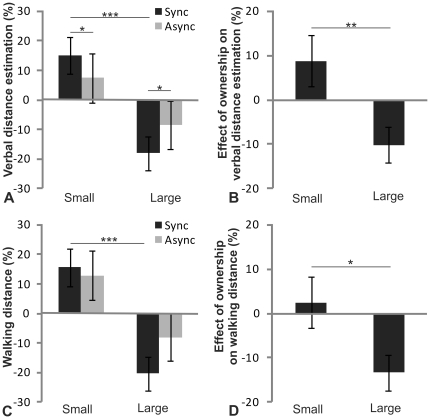
A classical question in philosophy and psychology is if the sense of one's body influences how one visually perceives the world. Several theoreticians have suggested that our own body serves as a fundamental reference in visual perception of sizes and distances, although compelling experimental evidence for this hypothesis is lacking. In contrast, modern textbooks typically explain the perception of object size and distance by the combination of information from different visual cues. Here, we describe full body illusions in which subjects experience the ownership of a doll's body (80 cm or 30 cm) and a giant's body (400 cm) and use these as tools to demonstrate that the size of one's sensed own body directly influences the perception of object size and distance. These effects were quantified in ten separate experiments with complementary verbal, questionnaire, manual, walking, and physiological measures. When participants experienced the tiny body as their own, they perceived objects to be larger and farther away, and when they experienced the large-body illusion, they perceived objects to be smaller and nearer. Importantly, despite identical retinal input, this "body size effect" was greater when the participants experienced a sense of ownership of the artificial bodies compared to a control condition in which ownership was disrupted. These findings are fundamentally important as they suggest a causal relationship between the representations of body space and external space. Thus, our own body size affects how we perceive the world.
Overview
The claims and statistics of this paper haven’t been checked yet.
Run the check — free, no account needed. It reads the open-access text and checks the sources it cites.
Integrity signals
Registry
Cites
Statistics
Figures
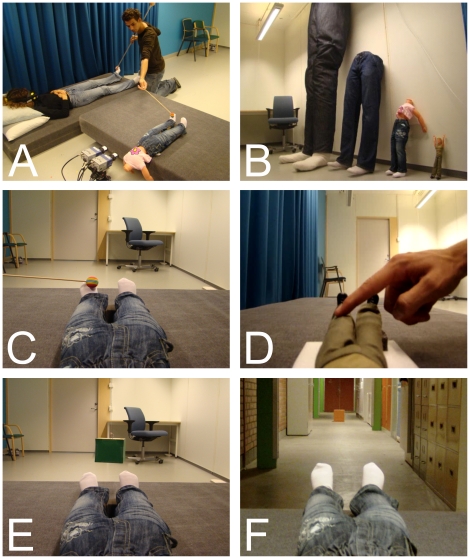
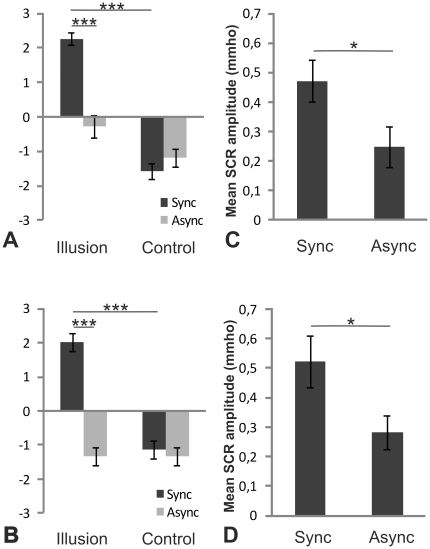
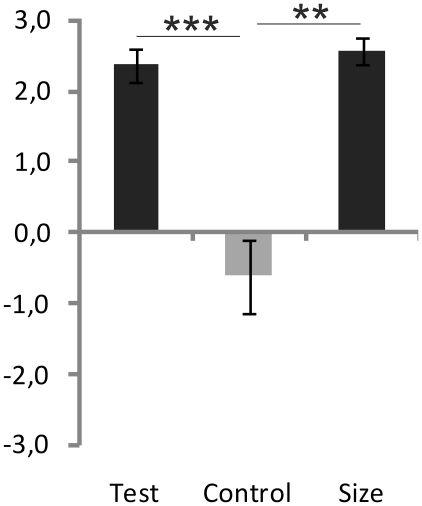
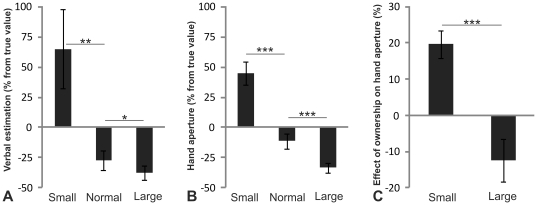
Verification
Claims the paper makes
The claims and statistics of this paper haven’t been checked yet.
Run the check — free, no account needed. It reads the open-access text and checks the sources it cites.
Claims other papers make about this one
Each is checked against this paper’s own text: does it say what the citing paper says it does?
In the citing paper
“The results demonstrated that the visual perception of distance and object sizes is affected by one's own multisensory body representation.”
From Illusory ownership of a virtual child body causes overestimation of object sizes and implicit attitude changes (2013) · cites this paper as [22]
In the citing paper
“It has been argued that body size serves a reference for the external world, and earlier studies using IVR have examined how the perception of one's body size influences the perception of spatial layouts (22).”
From Illusory ownership of a virtual child body causes overestimation of object sizes and implicit attitude changes (2013) · cites this paper as [22]
In the citing paper
“It has been shown that IVR supports global scaling of sizes, where the brain automatically adjusts for the overall size of one's avatar, which is in line with past studies (22).”
From Illusory ownership of a virtual child body causes overestimation of object sizes and implicit attitude changes (2013) · cites this paper as [22]
In the citing paper
“This further extends the findings of [20], [21] that it is possible to generate the illusion of ownership of quite a different body size and shape compared to normal”
From Extending body space in immersive virtual reality: a very long arm illusion (2012) · cites this paper as [20]
Self-check
Percentages, sums and reported differences re-computed from the paper’s own numbers.
The self-check needs the paper’s full text.
Citations
Cites
The Ecological Approach to Visual Perception
Bornstein, M. H., & Gibson, J. J. (1980) · The Journal of Aesthetics and Art Criticism · doi:10.2307/429816 · Cited by 22,935
The Ecological Approach to Visual Perception: Classic Edition
Gibson, J. J. (2014) · doi:10.4324/9781315740218 · Cited by 12,132
Merleau-Ponty, M. (1982) · Routledge eBooks · doi:10.4324/9780203981139 · Cited by 11,945
Separate visual pathways for perception and action
Goodale, M. A., & Milner, A. D. (1992) · Trends in Neurosciences · doi:10.1016/0166-2236(92)90344-8 · Cited by 6,519
Ungerleider, L. G. (1982) · Medical Entomology and Zoology · Cited by 4,531
Rubber hands ‘feel’ touch that eyes see
Botvinick, M., & Cohen, J. (1998) · Nature · doi:10.1038/35784 · Cited by 4,410
Ingle, D., Goodale, M. A., & Mansfield, R. J. W. (1982) · The MIT Press eBooks · Cited by 4,118
Handbook of perception and human performance
Boff, K. R., Kaufman, L., & Thomas, J. P. (1986) · Wiley eBooks · Cited by 4,033
Perception of the Visual World
(1952) · Archives of Ophthalmology · doi:10.1001/archopht.1952.01700030123016 · Cited by 3,748
Warnock, M., Merleau-Ponty, M., & Smith, C. (1964) · The Philosophical Quarterly · doi:10.2307/2217780 · Cited by 3,175
Research works printed but not linked: 2
- WC Gogel, 1961, Accommodation and apparent distance., J Psych, 52, 287
- HH Ehrsson, 2004, That's my hand! Activity in premotor cortex reflects feeling of ownership of a limb., Science, 305, 875, 10.1126/science.1097011 · DOI · Paper page
Cited by
Sorted by citations
Enhancing Our Lives with Immersive Virtual Reality
Slater, M., & Sanchez-Vives, M. V. (2016) · Frontiers in Robotics and AI · doi:10.3389/frobt.2016.00074 · Cited by 1,993
Putting yourself in the skin of a black avatar reduces implicit racial bias
Peck, T. C., Seinfeld, S., Aglioti, S. M., & Slater, M. (2013) · Consciousness and Cognition · doi:10.1016/j.concog.2013.04.016 · Cited by 967
Parsons, T. D. (2015) · Frontiers in Human Neuroscience · doi:10.3389/fnhum.2015.00660 · Cited by 837
Banakou, D., Groten, R., & Slater, M. (2013) · Proceedings of the National Academy of Sciences · doi:10.1073/pnas.1306779110 · Cited by 695
Kilteni, K., Maselli, A., Kording, K. P., & Slater, M. (2015) · Frontiers in Human Neuroscience · doi:10.3389/fnhum.2015.00141 · Cited by 549
Metadata
- Authors
- van der Hoort, B., Guterstam, A., & Ehrsson, H. H.
- Affiliations
- Karolinska Institutet (SE)
- Corresponding author
- Ehrsson, H. Henrik
- Venue
- PLoS ONE
- Publisher
- Public Library of Science (PLoS)
- Published
- 2011-05-25
- Volume
- 6
- Issue
- 5
- Pages
- e20195
- ISSN
- 1932-6203 (ISSN-L)
- PMC
- PMC3102093
- OpenAlex
- W1978014948
- Cited by
- 402
- References
- 62
- Citations by year
- 2026: 17 · 2025: 19 · 2024: 26 · 2023: 14 · 2022: 62 · 2021: 28 · 2020: 35 · 2019: 28 · 2018: 40 · 2017: 35 · 2016: 14 · 2015: 30 · 2014: 25 · 2013: 16 · 2012: 10
- FWCI
- 30.51
- Type
- journal article
- Language
- en
- Open access
- gold
- doi.org
- Locations
- PLoS ONE (publishedVersion, cc-by)
- Europe PMC (PubMed Central) (publishedVersion, cc-by)
- PubMed Central (publishedVersion, cc-by)
- PubMed (publishedVersion)
- RePEc: Research Papers in Economics (submittedVersion)
- DOAJ (DOAJ: Directory of Open Access Journals) (submittedVersion, cc-by-sa)
- Figshare (submittedVersion, cc-by)
- Funders
- James S. McDonnell Foundation
- Stiftelsen för Strategisk Forskning
- Topics
- Physical Sciences › Computer Science › Human-Computer Interaction › Virtual Reality Applications and Impacts
- Life Sciences › Neuroscience › Cognitive Neuroscience › Visual perception and processing mechanisms
- Social Sciences › Psychology › Experimental and Cognitive Psychology › Multisensory perception and integration
- Keywords
- body size, body ownership, body illusions, object size perception, distance perception, visual perception, body schema, body space, external space, self-perception
- MeSH terms
- Adult, Body Image, Female, Humans, Illusions, Male, Surveys and Questionnaires, Self Concept, Size Perception, Visual Perception, Body Size, Young Adult
About these checks
Registry, retraction, Cites and statistics results are computed, not judged, with one exception: a printed reference that no index lists is read once by a model before it counts as a citation error. Claims are extracted by a model and kept only when their quote appears verbatim in the text; each cited source is then checked, with a model’s help, for whether it says what the claim relies on. Those verdicts can be wrong — read the claim’s quote and the cited source before relying on one.
Statistics and arithmetic are recomputed, not judged.
Confidence bands are shown only for fields calibrated on our annotated test set. None is calibrated yet, so no band is shown.
What counts as a claim ›How we measure confidence ›How we check this ›
Are you an author, or do you see a problem with this page? Request a review
