

The DOI matches its Crossref record; 36 of the 38 references it cites were found in a registry or an index.
Reliability of Serum Metabolite Concentrations over a 4-Month Period Using a Targeted Metabolomic Approach
Open accessAbstract
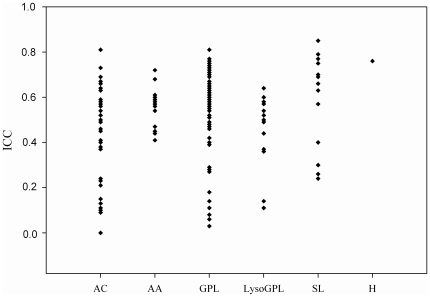
Metabolomics is a promising tool for discovery of novel biomarkers of chronic disease risk in prospective epidemiologic studies. We investigated the between- and within-person variation of the concentrations of 163 serum metabolites over a period of 4 months to evaluate the metabolite reliability expressed by the intraclass-correlation coefficient (ICC: the ratio of between-person variance and total variance). The analyses were performed with the BIOCRATES AbsoluteIDQ™ targeted metabolomics technology, including acylcarnitines, amino acids, glycerophospholipids, sphingolipids and hexose in 100 healthy individuals from the European Prospective Investigation into Cancer and Nutrition (EPIC)-Potsdam study who had provided two fasting blood samples 4 months apart. Overall, serum reliability of metabolites over a 4-month period was good. The median ICC of the 163 metabolites was 0.57. The highest ICC was observed for hydroxysphingomyelin C14:1 (ICC = 0.85) and the lowest was found for acylcarnitine C3:1 (ICC = 0). Reliability was high for hexose (ICC = 0.76), sphingolipids (median ICC = 0.66; range: 0.24-0.85), amino acids (median ICC = 0.58; range: 0.41-0.72) and glycerophospholipids (median ICC = 0.58; range: 0.03-0.81). Among acylcarnitines, reliability of short and medium chain saturated compounds was good to excellent (ICC range: 0.50-0.81). Serum reliability was lower for most hydroxyacylcarnitines and monounsaturated acylcarnitines (ICC range: 0.11-0.45 and 0.00-0.63, respectively). For most of the metabolites a single measurement may be sufficient for risk assessment in epidemiologic studies with healthy subjects.
Overview
The claims and statistics of this paper haven’t been checked yet.
Run the check — free, no account needed. It reads the open-access text and checks the sources it cites.
Integrity signals
Registry
Cites
Statistics
Figures
Verification
Claims the paper makes
The claims and statistics of this paper haven’t been checked yet.
Run the check — free, no account needed. It reads the open-access text and checks the sources it cites.
Claims other papers make about this one
Each is checked against this paper’s own text: does it say what the citing paper says it does?
In the citing paper
“On the basis of a previous evaluation of the reliability of measurements (23), we excluded metabolites below the limit of detection (n = 30) and those with very high analytic variance (n = 6).”
From Amino acids, lipid metabolites, and ferritin as potential mediators linking red meat consumption to type 2 diabetes (2015) · cites this paper as [23]
In the citing paper
“However, FFQs showed good reliability and relative validity to assess meat intake, and investigated metabolites showed good reliability in validation studies (23).”
From Amino acids, lipid metabolites, and ferritin as potential mediators linking red meat consumption to type 2 diabetes (2015) · cites this paper as [23]
Self-check
Percentages, sums and reported differences re-computed from the paper’s own numbers.
The self-check needs the paper’s full text.
Citations
Cites
The Design and Analysis of Clinical Experiments
Fleiss, J. L. (1999) · Wiley eBooks · doi:10.1002/9781118032923 · Cited by 4,819
Fundamentals of Biostatistics.
(1969) · Annals of Internal Medicine · doi:10.7326/0003-4819-70-4-873 · Cited by 4,573
Zelena, E., Dunn, W. B., Broadhurst, D., Francis‐McIntyre, S., Carroll, K. M., Begley, P., O’Hagan, S., Knowles, J. D., Halsall, A., HUSERMET Consortium, et al. (2009) · Analytical Chemistry · doi:10.1021/ac8019366 · Cited by 815
Metabolomics-based methods for early disease diagnostics
Gowda, G. A. N., Zhang, S., Gu, H., Asiago, V. M., Shanaiah, N., & Raftery, D. (2008) · Expert Review of Molecular Diagnostics · doi:10.1586/14737159.8.5.617 · Cited by 705
Mihalik, S. J., Goodpaster, B. H., Kelley, D. E., Chace, D. H., Vockley, J., Toledo, F. G. S., & DeLany, J. P. (2010) · Obesity · doi:10.1038/oby.2009.510 · Cited by 653
A genome-wide perspective of genetic variation in human metabolism
Illig, T., Gieger, C., Zhai, G., Römisch-Margl, W., Wang-Sattler, R., Prehn, C., Altmaier, E., Kastenmüller, G., Kato, B. S., Mewes, H.-W., et al. (2010) · Nature Genetics · doi:10.1038/ng.507 · Cited by 653 · cited 1×
“This metabolomic approach has already been successfully applied in the human KORA cohort study [7,8], and covers acylcarnitines, amino acids, glycerophospholipids, sphingolipids and hexoses, constituting a biologically relevant panel of 163 metabolites.”
MethodAdams, S. H., Hoppel, C. L., Lok, K. H., Zhao, L., Wong, S. W., Minkler, P. E., Hwang, D. H., Newman, J. W., & Garvey, W. T. (2009) · The Journal of Nutrition · doi:10.3945/jn.108.103754 · Cited by 598 · cited 1×
“Increased acylcarnitine concentrations have been associated with type 2 diabetes mellitus previously [18,19].”
BackgroundRecruitment Procedures of EPIC-Germany
Boeing, H., Korfmann, A., & Bergmann, M. M. (1999) · Annals of Nutrition and Metabolism · doi:10.1159/000012787 · Cited by 307
Fleiss, J. L. (1999) · doi:10.1002/9781118032923.ch1 · Cited by 296 · cited 4×
“To address this issue, the present study aimed to evaluate the reliability, expressed by the intraclass-correlation coefficient (ICC) [5], as the ratio of between-person variance and total variance, of 163 targeted metabolites in fasting serum samples over a 4-month period within a sub-sample of the European Prospecti…”
BackgroundMethodInfluentialRömisch‐Margl, W., Prehn, C. P., Bogumil, R., Röhring, C., Suhre, K., & Adamski, J. (2011) · Metabolomics · doi:10.1007/s11306-011-0293-4 · Cited by 292
Research works printed but not linked: 1
- KM Weinberger, 2008, [Metabolomics in diagnosing metabolic diseases]., Ther Umsch, 65, 487
Cited by
Sorted by citations
Floegel, A., Stefan, N., Yu, Z., Mühlenbruch, K., Drogan, D., Joost, H.-G., Fritsche, A., Häring, H.-U., Hrabě de Angelis, M., Peters, A., et al. (2013) · Diabetes · doi:10.2337/db12-0495 · Cited by 988
“measured in participants over a 4-month period, indicating reasonable reliability of the measurements (31).”
BackgroundSelf-citationNovel biomarkers for pre-diabetes identified by metabolomics
Wang‐Sattler, R., Yu, Z., Herder, C., Messias, A. C., Floegel, A., He, Y., Heim, K., Campillos, M., Holzapfel, C., Thorand, B., et al. (2012) · Molecular Systems Biology · doi:10.1038/msb.2012.43 · Cited by 701
Self-citationDunn, W. B., Wilson, I. D., Nicholls, A. W., & Broadhurst, D. (2012) · Bioanalysis · doi:10.4155/bio.12.204 · Cited by 456
Metabolomics for clinical use and research in chronic kidney disease
Hocher, B., & Adamski, J. (2017) · Nature Reviews Nephrology · doi:10.1038/nrneph.2017.30 · Cited by 339
Siskos, A. P., Jain, P., Römisch-Margl, W., Bennett, M., Achaintre, D., Asad, Y., Marney, L., Richardson, L., Koulman, A., Griffin, J. L., et al. (2017) · Analytical Chemistry · doi:10.1021/acs.analchem.6b02930 · Cited by 269
Self-citation
Metadata
- Authors
- Floegel, A., Drogan, D., Wang-Sattler, R., Prehn, C., Illig, T., Adamski, J., Joost, H.-G., Boeing, H., & Pischon, T.
- Affiliations
- German Institute of Human Nutrition (DE)
- Helmholtz Munich (DE)
- Max Delbrück Center (DE)
- Corresponding author
- Floegel, Anna
- ORCID
- Venue
- PLoS ONE
- Publisher
- Public Library of Science (PLoS)
- Published
- 2011-06-15
- Volume
- 6
- Issue
- 6
- Pages
- e21103
- ISSN
- 1932-6203 (ISSN-L)
- PMC
- PMC3115978
- OpenAlex
- W2042418561
- Cited by
- 135
- References
- 38
- Citations by year
- 2026: 4 · 2025: 5 · 2024: 5 · 2023: 5 · 2022: 9 · 2021: 14 · 2020: 9 · 2019: 7 · 2018: 14 · 2017: 15 · 2016: 14 · 2015: 6 · 2014: 13 · 2013: 7 · 2012: 7
- FWCI
- 3.63
- Type
- journal article
- Language
- en
- Open access
- gold
- doi.org
- Locations
- PLoS ONE (publishedVersion, cc-by)
- PubMed Central (publishedVersion, cc-by)
- PubMed (publishedVersion)
- MDC Repository (Max-Delbrueck-Center for Molecular Medicine) (acceptedVersion)
- RePEc: Research Papers in Economics (submittedVersion)
- DOAJ (DOAJ: Directory of Open Access Journals) (submittedVersion, cc-by-sa)
- Figshare (submittedVersion, cc-by)
- Site cant be reached (submittedVersion, cc-by)
- Funders
- Bundesministerium für Bildung und Forschung (01GI0922)
- Topics
- Life Sciences › Biochemistry, Genetics and Molecular Biology › Molecular Biology › Metabolomics and Mass Spectrometry Studies
- Health Sciences › Health Professions › Medical Laboratory Technology › Clinical Laboratory Practices and Quality Control
- Physical Sciences › Environmental Science › Health, Toxicology and Mutagenesis › Health, Environment, Cognitive Aging
- Keywords
- serum metabolites, intraclass correlation coefficient, between-person variation, within-person variability, targeted metabolomics, acylcarnitines, sphingolipids, glycerophospholipids, amino acids, hexoses, biomarkers, chronic disease risk
- MeSH terms
- Female, Humans, Male, Middle Aged, Reproducibility of Results, Serum, Metabolomics
About these checks
Registry, retraction, Cites and statistics results are computed, not judged, with one exception: a printed reference that no index lists is read once by a model before it counts as a citation error. Claims are extracted by a model and kept only when their quote appears verbatim in the text; each cited source is then checked, with a model’s help, for whether it says what the claim relies on. Those verdicts can be wrong — read the claim’s quote and the cited source before relying on one.
Statistics and arithmetic are recomputed, not judged.
Confidence bands are shown only for fields calibrated on our annotated test set. None is calibrated yet, so no band is shown.
What counts as a claim ›How we measure confidence ›How we check this ›
Are you an author, or do you see a problem with this page? Request a review
