

Self-Guided Psychological Treatment for Depressive Symptoms: A Meta-Analysis
Open accessThe DOI matches its Crossref record; 43 of the 43 references it cites were found in a registry or an index.
Abstract
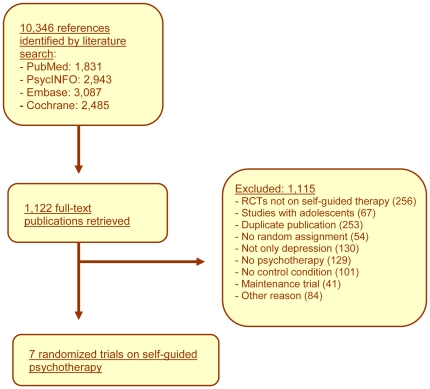
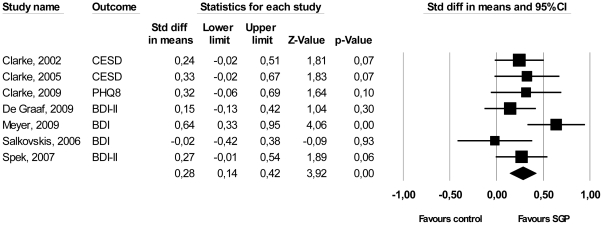
BACKGROUND: A number of trials have examined the effects of self-guided psychological intervention, without any contact between the participants and a therapist or coach. The results and sizes of these trials have been mixed. This is the first quantitative meta-analysis, aimed at organizing and evaluating the literature, and estimating effect size. METHOD: We conducted systematic literature searches in PubMed, PsycINFO and Embase up to January 2010, and identified additional studies through earlier meta-analyses, and the references of included studies. We identified seven randomized controlled trials that met our inclusion criteria, with a total of 1,362 respondents. The overall quality of the studies was high. A post-hoc power calculation showed that the studies had sufficient statistical power to detect an effect size of d = 0.19. RESULTS: The overall mean effect size indicating the difference between self-guided psychological treatment and control groups at post-test was d = 0.28 (p<0.001), which corresponds to a NNT of 6.41. At 4 to 12 months follow-up the effect size was d = 0.23. There was no indication for significant publication bias. CONCLUSIONS: We found evidence that self-guided psychological treatment has a small but significant effect on participants with increased levels of depressive symptomatology.
Overview
The claims and statistics of this paper haven’t been checked yet.
Free: it reads the open-access text and checks the first 5 claims that cite a source we can check. Create a free account to check every claim.
Integrity signals
Registry
Cites
Statistics
Figures
Verification
Claims the paper makes
The claims and statistics of this paper haven’t been checked yet.
Free: it reads the open-access text and checks the first 5 claims that cite a source we can check. Create a free account to check every claim.
Claims other papers make about this one
Each is checked against this paper’s own text: does it say what the citing paper says it does?
The source backs part of the claim, not all of it — or backs it for a different population, condition or comparison.
In the citing paper
“low-intensity interventions, such as guided self-help via written materials, limited professional support, or internet-delivered interventions are effective in non-postpartum patients with MDD, even when depression is severe (Andrews et al. 2010; Bower et al. 2013; Cuijpers et al. 2011).”
From Perinatal Dyadic Psychotherapy for postpartum depression: a randomized controlled pilot trial (2015) · cites this paper as Cuijpers et al. 2011
Experimental — accuracy not yet measuredThe source backs part of the claim, not all of it — or backs it for a different population, condition or comparison.
In the citing paper
“Our finding that usual care with depression monitoring may be an effective intervention is supported by a number of studies which have shown that low-intensity interventions, such as guided self-help via written materials, limited professional support, or internet-delivered interventions are effective in non-postpartum patients with MDD, even when depression is severe (Andrews et al. 2010; Bower”
From Perinatal Dyadic Psychotherapy for postpartum depression: a randomized controlled pilot trial (2015) · cites this paper as Cuijpers et al. 2011
Experimental — accuracy not yet measuredThe source backs part of the claim, not all of it — or backs it for a different population, condition or comparison.
In the citing paper
“online treatment is clearly better than nothing, according to recent studies. [17-19,32]”
From The more it is needed, the less it is wanted: Attitudes toward face-to-face intervention among depressed patients undergoing online treatment (2013) · cites this paper as [18]
Experimental — accuracy not yet measuredThe source backs part of the claim, not all of it — or backs it for a different population, condition or comparison.
In the citing paper
“Effect sizes have been estimated at d=0.44-1.90 for clinician-supported, and d=0.21-0.70 for self-guided, interventions [42-45,47,48].”
From MoodHacker Mobile Web App With Email for Adults to Self-Manage Mild-to-Moderate Depression: Randomized Controlled Trial (2016) · cites this paper as [44]
Experimental — accuracy not yet measuredThe cited source says what the claim attributes to it.
In the citing paper
“This result was mirrored by a meta-analysis on self-guided psychological treatments (not necessarily internet based or computer based) [9], which found an overall effect size of d = 0.28 (95% CI: 0.14-0.42).”
From Internet-based psychological treatments for depression (2012) · cites this paper as [9]
5 more claims about this paper
Create a free account to see every claim other papers make about this one.
Self-check
Percentages, sums and reported differences re-computed from the paper’s own numbers.
The self-check needs the paper’s full text.
Citations
Cites
Measuring inconsistency in meta-analyses
Higgins, J. P. T., Thompson, S. G., Deeks, J. J., & Altman, D. G. (2003) · BMJ · doi:10.1136/bmj.327.7414.557 · Cited by 63,139 · cited 1×
“A value of 0% indicates no observed heterogeneity, and larger values show increasing heterogeneity, with 25% as low, 50% as moderate, and 75% as high heterogeneity [30].”
BackgroundStatistical Power Analysis for the Behavioral Sciences (2nd ed.).
Lachenbruch, P. A., & Cohen, J. (1989) · Journal of the American Statistical Association · doi:10.2307/2290095 · Cited by 37,395
Borenstein, M., Hedges, L. V., Higgins, J. P. T., & Rothstein, H. R. (2009) · doi:10.1002/9780470743386 · Cited by 14,225
Duval, S., & Tweedie, R. (2000) · Biometrics · doi:10.1111/j.0006-341x.2000.00455.x · Cited by 14,099 · cited 1×
“Publication bias was tested by inspecting the funnel plot on primary outcome measures, and by Duval and Tweedie’s trim and fill procedure [31], which yields an estimate of the effect size after the publication bias has been taken into account (as implemented in Comprehensive Meta-analysis, version 2.”
MethodBorenstein, M., Hedges, L. V., Higgins, J. P. T., & Rothstein, H. R. (2021) · doi:10.1002/9781119558378 · Cited by 9,799
Evidence-Based Medicine: How to Practice and Teach EBM
Sackett, D. L. (2000) · Cited by 5,950
Internet-based cognitive behaviour therapy for symptoms of depression and anxiety: A meta-analysis
SPEK, V., CUIJPERS, P., NYKLÍČEK, I., RIPER, H., KEYZER, J., & POP, V. (2007) · Psychological Medicine · doi:10.1017/s0033291706008944 · Cited by 1,586
Self-citationInternet-Based and Other Computerized Psychological Treatments for Adult Depression: A Meta-Analysis
Andersson, G., & Cuijpers, P. (2009) · Cognitive Behaviour Therapy · doi:10.1080/16506070903318960 · Cited by 1,368 · cited 2×
“Finally, a recent meta-analysis on computerized treatments for depression included studies on guided and unguided computerized treatments [15], but did not include other self-help studies and at least three additional studies have been published following the search period for that meta-analysis.”
BackgroundSelf-citationDelivering interventions for depression by using the internet: randomised controlled trial
Christensen, H. (2004) · BMJ · doi:10.1136/bmj.37945.566632.ee · Cited by 928 · cited 1×
“This meant that studies in which telephone support was given were excluded, even if the support was not of a therapeutic nature [17].”
BackgroundSize of Treatment Effects and Their Importance to Clinical Research and Practice
Kraemer, H. C., & Kupfer, D. J. (2006) · Biological Psychiatry · doi:10.1016/j.biopsych.2005.09.014 · Cited by 850 · cited 1×
“As the standardized mean difference is not easy to interpret from a clinical point of view and so we also calculated the numbers-needed-to-be-treated (NNT), using the formulae provided by Kraemer and Kupfer [28].”
Method
Cited by
Items 201–250 of 250
Leung, D. K. Y., Wong, D. H. S., Wong, F. H. C., Wong, S. M. Y., Chan, O. L. H., Wong, G. H. Y., Chan, W. C., & Lum, T. Y. S. (2025) · Journal of Affective Disorders · doi:10.1016/j.jad.2025.119756 · Cited by 2
Böke, B. N., Mettler, J., Bastien, L., Cho, S., & Heath, N. L. (2026) · JMIR Mental Health · doi:10.2196/74205 · Cited by 3
“This is supported by 2 meta-analytic reviews reporting significant effects of self-guided interventions for improving depressive symptoms in general population samples [34,35].”
Desarrollo de un entorno virtual para la inducción emocional.
Miralles, I., Castilla, D., & Botella, C. (2014) · Cited by 5
Zhou, L., Jian, C. H. E. N., Lu, D., Xiaoqun, L. I. U., & Su, L. (2014) · Advances in Psychological Science · doi:10.3724/sp.j.1042.2014.00977 · Cited by 4
Klein, J. P., Berger, T., Hautzinger, M., Lutz, W., Rose, M., Späth, C., Schröder, J., Hohagen, F., & Moritz, S. (2019) · Fortschritte der Neurologie · Psychiatrie · doi:10.1055/a-0849-9838 · Cited by 5
Sampson, E. (2023) · Journal of Psychosocial Nursing and Mental Health Services · doi:10.3928/02793695-20230424-01 · Cited by 2
The Role of Technology in the Treatment of Depression
Pedrelli, P., Bentley, K. H., Howe, E. S., & Shapero, B. G. (2018) · Springer eBooks · doi:10.1007/978-3-319-97241-1_14 · Cited by 2
Aubry, C., Rider, A., Russell, S., Moyer, S. W., & Kinser, P. A. (2021) · The Journal of Perinatal & Neonatal Nursing · doi:10.1097/jpn.0000000000000530 · Cited by 5
Riva, G., Lernia, D. D., Tuena, C., Bernardelli, L., Gutiérrez‐Maldonado, J., Ferrer‐García, M., Meyer, M. L., Shiban, Y., Castelnuovo, G., Pagnini, F., et al. (2021) · PsyArXiv (OSF Preprints) · doi:10.31234/osf.io/r23sa · Cited by 2
Soroko, E., Borzyszkowski, M., Kleka, P., Chmielak, K., Pawlak, Z., & Skory, M. (2023) · PsyArXiv (OSF Preprints) · doi:10.31234/osf.io/dmgsc · Cited by 5
Bullock, H. L., Waddell, K., & Lavis, J. N. (2016) · MacSphere (McMaster University) · Cited by 3
Internettbasert behandling av depresjon
Solem, S., & Ulleberg, E. (2017) · Tidsskrift for Den norske legeforening · doi:10.4045/tidsskr.16.0842 · Cited by 1
Lussier-Valade, M., Ngô, T.-L., & Leblanc, J. (2019) · Santé mentale au Québec · doi:10.7202/1073525ar · Cited by 1
Beshai, S., Bueno, C., & Salimuddin, S. (2023) · Mindfulness · doi:10.1007/s12671-023-02261-x · Cited by 5
“We anticipated 50% eligibility and 50% attrition based on patterns observed in similar studies (Beshai et al., 2020; Cuijpers et al., 2011; Karyotaki et al., 2015).”
Schäffer, F., & Jansen, P. (2024) · Mindfulness · doi:10.1007/s12671-024-02396-5 · Cited by 1
Gratzer, D., Khalid-Khan, F., & Khalid‐Khan, S. (2015) · InTech eBooks · doi:10.5772/60816 · Cited by 1
“It is hoped that ICBT will help act those with negative attitudes toward therapy to seek professional treatment [34].”
BackgroundKAY‐LAMBKIN, F. J., Searl, A., Johnson, M. P., & Baker, A. (2021) · Bulletin of the Menninger Clinic · doi:10.1521/bumc.2021.85.2.204 · Cited by 2
Queirazza, F., Fouragnan, E. F., Steele, J. D., Cavanagh, J., & Philiastides, M. G. (2017) · bioRxiv (Cold Spring Harbor Laboratory) · doi:10.1101/224410 · Cited by 1
“CBT is an effective evidence-based 63 intervention for depressive disorder (4, 5).”
BackgroundBeshai, S. (2020) · PsyArXiv (OSF Preprints) · doi:10.31234/osf.io/967hq · Cited by 1
Bertuzzi, V., Semonella, M., Castelnuovo, G., Andersson, G., & Pietrabissa, G. (2023) · doi:10.2196/preprints.46692 · Cited by 1
Self-citationInternet-based Treatment of Depression in Primary Care: Effectiveness and Feasibility
Kivi, M. (2015) · Gothenburg University Publications Electronic Archive (Gothenburg University)
Wie wirksam sind internetbasierte Programme?
Meyer, B., Jacob, G. A., & Weiss, M. (2014) · NeuroTransmitter · doi:10.1007/s15016-014-0587-7
Cuijpers, P. J. (2015)
Self-citationNovel Platforms for Care Delivery: internet-based interventions and telepsychiatry
Riper, H. M., & Beekman, A. T. F. (2013) · Oxford University Press eBooks · doi:10.1093/med/9780199796816.003.0031
The progression and management of depression and anxiety in chronic hepatitis C patients.
Stewart, B. J. (2015) · Adelaide Research & Scholarship (AR&S) (University of Adelaide)
Internetnutzung bei depressiven Patienten
Laux, G., Florange, C., Schmauß, M., Bonnet, U., Deister, A., & Escafit-Schülke, M.-L. (2017) · NeuroTransmitter · doi:10.1007/s15016-017-6043-8
“Sie erzielen sowohl bei begleiteter als auch bei unbegleiteter Anwendung positive, in randomisierten kontrollierten Studien und Metaanalysen nachgewiesene antidepressive Eekte, wobei die durchschnittlichen Eektstärken bei begleiteter Anwendung höher sind [9, 10, 11] und vergleichbar mit den Eektstärken der konventi…”
BackgroundBibliometric Analysis of Psychological Literature Based on Web of Science Data
Chao, C. (2018) · International Conference on Education, Economics and Management Research (ICEEMR) · doi:10.2991/iceemr-18.2018.133
Robles, V. A. G. (2019) · Tesis Doctorals en Xarxa (Consorci de Serveis Universitaris de Catalunya) · doi:10.6035/14109.2019.233592
Digital begleitet – Telemedizin
Kittlick, C. (2020) · ergopraxis · doi:10.1055/a-1131-2149
Digital begleitet – Tele-Coaching
Kittlick, C. (2020) · physiopraxis · doi:10.1055/a-1158-3238
Hegy, J. K., Brog, N. A., Berger, T., & Znoj, H. (2020) · JMIR Research Protocols · doi:10.2196/21200
“Numerous studies have shown that web-based interventions are an effective treatment option for various psychological problems and demographic groups [14,15].”
Online programs for depression
Batterham, P. J., Calear, A. L., & Kurz, E. (2021) · Elsevier eBooks · doi:10.1016/b978-0-12-817933-8.00012-8
Suman, A., Shouan, A., Singh, S. M., & Kumar, K. (2022) · International Journal of Community Medicine and Public Health · doi:10.18203/2394-6040.ijcmph20220868
Gamifying Interventions: Sweetening Mental Health Interventions for Children
Goh, N. K. L., Goh, T. J., Lim, C. G., & Fung, D. S. S. (2022) · Advances in human and social aspects of technology book series · doi:10.4018/978-1-7998-9732-3.ch013 · Cited by 1
User Experiences and Perceptions of Internet Interventions for Depression
Drozd, F., Andersen, C. E., Haga, S. M., Slinning, K., & Bjørkli, C. A. (2019) · IGI Global eBooks · doi:10.4018/978-1-7998-2351-3.ch016
de Groot, J. J. B., & de Vor, A. (2017) · Bohn Stafleu van Loghum eBooks · doi:10.1007/978-90-368-1922-0_45
Lappalainen, R. I., Keinonen, K., & Lappalainen, P. (2022) · Oxford University Press eBooks · doi:10.1093/oxfordhb/9780197550076.013.28
A literature Review of Internet-Based Cognitive Behavioral Therapy in Japan
Matsumoto, K. (2022) · Anxiety Disorder Research · doi:10.14389/jsad.14.1_29
Tong, L., Panagiotopoulou, O. M., Cuijpers, P. J., & Karyotaki, E. (2023) · SSRN Electronic Journal · doi:10.2139/ssrn.4670508
Self-citationACAR, Ö. F. (2024) · Journal of Social Research and Behavioral Sciences · doi:10.52096/jsrbs.9.20.34
Claro, H. G., Menezes, P. R., Fernandes, I. F. D. A. L., Seward, N., Miranda, J. J., Saidel, M. G. B., Baquete, A. G. D. L., Daley, K., Aschar, S. C. D. A. L., Cruz, D. V., et al. (2024) · Brazilian Journal of Psychiatry · doi:10.47626/1516-4446-2023-3172 · Cited by 1
Böke, B. N., Mettler, J., Bastien, L., Cho, S., & Heath, N. L. (2025) · doi:10.2196/preprints.74205
eHealth for the Treatment of Depression and Insomnia
Taple, B. J., Lattie, E. G., & Stamatis, C. A. (2025) · CBT: science into practice · doi:10.1007/978-3-031-92265-7_8
Hoppen, L., Kuck, N., Bürkner, P.-C., Karin, E., Wootton, B. M., & Buhlmann, U. (2021) · Figshare · doi:10.6084/m9.figshare.14889693
Oxana, M., & Kamila, K. (2025) · Cultural Sociology · doi:10.1177/17499755251397334
Qian, J., Wang, R., Jevitt, C., Sun, S., Wang, M., Sun, Y., Sun, X., & Yu, X. (2026) · Cancer Nursing · doi:10.1097/ncc.0000000000001565 · Cited by 1
Metadata
- Authors
- Cuijpers, P., Donker, T., Johansson, R., Mohr, D. C., van Straten, A., & Andersson, G.
- Affiliations
- Vrije Universiteit Amsterdam (NL)
- Linköping University (SE)
- Northwestern University (US)
- Corresponding author
- Cuijpers, Pim
- Venue
- PLoS ONE
- Publisher
- Public Library of Science (PLoS)
- Published
- 2011-06-21
- Volume
- 6
- Issue
- 6
- Pages
- e21274
- ISSN
- 1932-6203 (ISSN-L)
- PMC
- PMC3119687
- OpenAlex
- W2171936412
- Semantic Scholar
- 93e4beb1b8665d8be72ce045f756d83c8a6d6b3f
- Cited by
- 250
- References
- 43
- Citations by year
- 2026: 1 · 2025: 9 · 2024: 9 · 2023: 14 · 2022: 13 · 2021: 19 · 2020: 14 · 2019: 16 · 2018: 20 · 2017: 41 · 2016: 24 · 2015: 18 · 2014: 21 · 2013: 22 · 2012: 8
- FWCI
- 2.89
- Type
- journal article
- Language
- en
- Open access
- gold
- doi.org
- Locations
- PLoS ONE (publishedVersion, cc-by)
- PubMed Central (publishedVersion, cc-by)
- PubMed (publishedVersion)
- DiVA (Linkoping University) (submittedVersion, other-oa)
- RePEc: Research Papers in Economics (submittedVersion)
- Digital Academic REpository of VU University Amsterdam (Vrije Universiteit Amsterdam) (submittedVersion)
- DOAJ (DOAJ: Directory of Open Access Journals) (submittedVersion, cc-by-sa)
- VU Research Portal (submittedVersion, other-oa)
- Data Archiving and Networked Services (DANS) (submittedVersion, other-oa)
- Funders
- National Center for Research Resources (UL1RR025741)
- Eunice Kennedy Shriver National Institute of Child Health and Human Development (RL1HD058295)
- Topics
- Social Sciences › Psychology › Applied Psychology › Digital Mental Health Interventions
- Social Sciences › Psychology › Experimental and Cognitive Psychology › Anxiety, Depression, Psychometrics, Treatment, Cognitive Processes
- Health Sciences › Medicine › Psychiatry and Mental health › Mental Health Treatment and Access
- Keywords
- depressive symptoms, online intervention, self-help, depression, effect size, follow-up outcomes
- MeSH terms
- Adult, Depression, Female, Humans, Male, Middle Aged, Self Care, Randomized Controlled Trials as Topic, Databases, Factual, Young Adult
About these checks
Registry, retraction, Cites and statistics results are computed, not judged, with one exception: a printed reference that no index lists is read once by a model before it counts as a citation error. Claims are extracted by a model and kept only when their quote appears verbatim in the text; each cited source is then checked, with a model’s help, for whether it says what the claim relies on. Those verdicts can be wrong — read the claim’s quote and the cited source before relying on one.
Statistics and arithmetic are recomputed, not judged.
Confidence bands are shown only for fields calibrated on our annotated test set. None is calibrated yet, so no band is shown.
What counts as a claim ›How we measure confidence ›How we check this ›
Are you an author, or do you see a problem with this page? Request a review
Data sources
Bibliographic data: Semantic Scholar, OpenAlex, Crossref.
Contains information from the Semantic Scholar Academic Graph Datasets, made available under the ODC Attribution License (ODC-BY 1.0).
Semantic Scholar’s data is described in: Kinney, R., et al. (2023). The Semantic Scholar Open Data Platform. arXiv:2301.10140.
