

Self-Guided Psychological Treatment for Depressive Symptoms: A Meta-Analysis
Open accessThe DOI matches its Crossref record; 43 of the 43 references it cites were found in a registry or an index.
Abstract
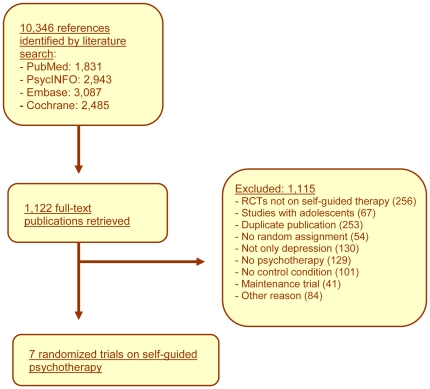
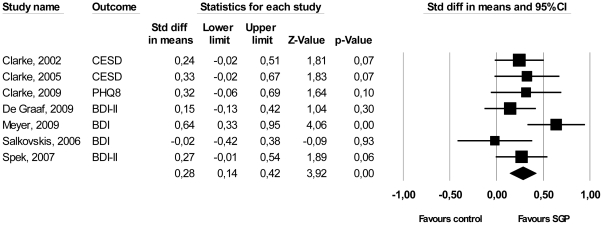
BACKGROUND: A number of trials have examined the effects of self-guided psychological intervention, without any contact between the participants and a therapist or coach. The results and sizes of these trials have been mixed. This is the first quantitative meta-analysis, aimed at organizing and evaluating the literature, and estimating effect size. METHOD: We conducted systematic literature searches in PubMed, PsycINFO and Embase up to January 2010, and identified additional studies through earlier meta-analyses, and the references of included studies. We identified seven randomized controlled trials that met our inclusion criteria, with a total of 1,362 respondents. The overall quality of the studies was high. A post-hoc power calculation showed that the studies had sufficient statistical power to detect an effect size of d = 0.19. RESULTS: The overall mean effect size indicating the difference between self-guided psychological treatment and control groups at post-test was d = 0.28 (p<0.001), which corresponds to a NNT of 6.41. At 4 to 12 months follow-up the effect size was d = 0.23. There was no indication for significant publication bias. CONCLUSIONS: We found evidence that self-guided psychological treatment has a small but significant effect on participants with increased levels of depressive symptomatology.
Overview
The claims and statistics of this paper haven’t been checked yet.
Free: it reads the open-access text and checks the first 5 claims that cite a source we can check. Create a free account to check every claim.
Integrity signals
Registry
Cites
Statistics
Figures
Verification
Claims the paper makes
The claims and statistics of this paper haven’t been checked yet.
Free: it reads the open-access text and checks the first 5 claims that cite a source we can check. Create a free account to check every claim.
Claims other papers make about this one
Each is checked against this paper’s own text: does it say what the citing paper says it does?
The source backs part of the claim, not all of it — or backs it for a different population, condition or comparison.
In the citing paper
“low-intensity interventions, such as guided self-help via written materials, limited professional support, or internet-delivered interventions are effective in non-postpartum patients with MDD, even when depression is severe (Andrews et al. 2010; Bower et al. 2013; Cuijpers et al. 2011).”
From Perinatal Dyadic Psychotherapy for postpartum depression: a randomized controlled pilot trial (2015) · cites this paper as Cuijpers et al. 2011
Experimental — accuracy not yet measuredThe source backs part of the claim, not all of it — or backs it for a different population, condition or comparison.
In the citing paper
“Our finding that usual care with depression monitoring may be an effective intervention is supported by a number of studies which have shown that low-intensity interventions, such as guided self-help via written materials, limited professional support, or internet-delivered interventions are effective in non-postpartum patients with MDD, even when depression is severe (Andrews et al. 2010; Bower”
From Perinatal Dyadic Psychotherapy for postpartum depression: a randomized controlled pilot trial (2015) · cites this paper as Cuijpers et al. 2011
Experimental — accuracy not yet measuredThe source backs part of the claim, not all of it — or backs it for a different population, condition or comparison.
In the citing paper
“online treatment is clearly better than nothing, according to recent studies. [17-19,32]”
From The more it is needed, the less it is wanted: Attitudes toward face-to-face intervention among depressed patients undergoing online treatment (2013) · cites this paper as [18]
Experimental — accuracy not yet measuredThe source backs part of the claim, not all of it — or backs it for a different population, condition or comparison.
In the citing paper
“Effect sizes have been estimated at d=0.44-1.90 for clinician-supported, and d=0.21-0.70 for self-guided, interventions [42-45,47,48].”
From MoodHacker Mobile Web App With Email for Adults to Self-Manage Mild-to-Moderate Depression: Randomized Controlled Trial (2016) · cites this paper as [44]
Experimental — accuracy not yet measuredThe cited source says what the claim attributes to it.
In the citing paper
“This result was mirrored by a meta-analysis on self-guided psychological treatments (not necessarily internet based or computer based) [9], which found an overall effect size of d = 0.28 (95% CI: 0.14-0.42).”
From Internet-based psychological treatments for depression (2012) · cites this paper as [9]
5 more claims about this paper
Create a free account to see every claim other papers make about this one.
Self-check
Percentages, sums and reported differences re-computed from the paper’s own numbers.
The self-check needs the paper’s full text.
Citations
Cites
Measuring inconsistency in meta-analyses
Higgins, J. P. T., Thompson, S. G., Deeks, J. J., & Altman, D. G. (2003) · BMJ · doi:10.1136/bmj.327.7414.557 · Cited by 63,139 · cited 1×
“A value of 0% indicates no observed heterogeneity, and larger values show increasing heterogeneity, with 25% as low, 50% as moderate, and 75% as high heterogeneity [30].”
BackgroundStatistical Power Analysis for the Behavioral Sciences (2nd ed.).
Lachenbruch, P. A., & Cohen, J. (1989) · Journal of the American Statistical Association · doi:10.2307/2290095 · Cited by 37,395
Borenstein, M., Hedges, L. V., Higgins, J. P. T., & Rothstein, H. R. (2009) · doi:10.1002/9780470743386 · Cited by 14,225
Duval, S., & Tweedie, R. (2000) · Biometrics · doi:10.1111/j.0006-341x.2000.00455.x · Cited by 14,099 · cited 1×
“Publication bias was tested by inspecting the funnel plot on primary outcome measures, and by Duval and Tweedie’s trim and fill procedure [31], which yields an estimate of the effect size after the publication bias has been taken into account (as implemented in Comprehensive Meta-analysis, version 2.”
MethodBorenstein, M., Hedges, L. V., Higgins, J. P. T., & Rothstein, H. R. (2021) · doi:10.1002/9781119558378 · Cited by 9,799
Evidence-Based Medicine: How to Practice and Teach EBM
Sackett, D. L. (2000) · Cited by 5,950
Internet-based cognitive behaviour therapy for symptoms of depression and anxiety: A meta-analysis
SPEK, V., CUIJPERS, P., NYKLÍČEK, I., RIPER, H., KEYZER, J., & POP, V. (2007) · Psychological Medicine · doi:10.1017/s0033291706008944 · Cited by 1,586
Self-citationInternet-Based and Other Computerized Psychological Treatments for Adult Depression: A Meta-Analysis
Andersson, G., & Cuijpers, P. (2009) · Cognitive Behaviour Therapy · doi:10.1080/16506070903318960 · Cited by 1,368 · cited 2×
“Finally, a recent meta-analysis on computerized treatments for depression included studies on guided and unguided computerized treatments [15], but did not include other self-help studies and at least three additional studies have been published following the search period for that meta-analysis.”
BackgroundSelf-citationDelivering interventions for depression by using the internet: randomised controlled trial
Christensen, H. (2004) · BMJ · doi:10.1136/bmj.37945.566632.ee · Cited by 928 · cited 1×
“This meant that studies in which telephone support was given were excluded, even if the support was not of a therapeutic nature [17].”
BackgroundSize of Treatment Effects and Their Importance to Clinical Research and Practice
Kraemer, H. C., & Kupfer, D. J. (2006) · Biological Psychiatry · doi:10.1016/j.biopsych.2005.09.014 · Cited by 850 · cited 1×
“As the standardized mean difference is not easy to interpret from a clinical point of view and so we also calculated the numbers-needed-to-be-treated (NNT), using the formulae provided by Kraemer and Kupfer [28].”
Method
Cited by
Cuijpers, P., Cristea, I. A., Karyotaki, E., Reijnders, M., & Huibers, M. J. H. (2016) · World Psychiatry · doi:10.1002/wps.20346 · Cited by 572
Self-citationInternet-based psychological treatments for depression
Johansson, R., & Andersson, G. (2012) · Expert Review of Neurotherapeutics · doi:10.1586/ern.12.63 · Cited by 509
Self-citationPhilippe, T. J., Sikder, N., Jackson, A., Koblanski, M. E., Liow, E., Pilarinos, A., & Vasarhelyi, K. (2022) · JMIR Mental Health · doi:10.2196/35159 · Cited by 436
Gilbody, S., Littlewood, E., Hewitt, C., Brierley, G., Tharmanathan, P., Araya, R., Barkham, M., Bower, P., Cooper, C., Gask, L., et al. (2015) · BMJ · doi:10.1136/bmj.h5627 · Cited by 409
“12 35 In contrast, efficacy trials have shown that more intensively supported treatments generally have moderate effect sizes claimed to be comparable with face to face therapy.”
Karyotaki, E., Kleiboer, A., Smit, F., Turner, D. T., Pastor, A. M., Andersson, G., Berger, T., Botella, C., Breton, J. M., Carlbring, P., et al. (2015) · Psychological Medicine · doi:10.1017/s0033291715000665 · Cited by 408
“…patients work through on their own without guidance) show less promising results than guided web-based interventions that are delivered with support from a coach or therapist (Gellatly et al. 2007; Spek et al. 2007a; Andersson & Cuijpers, 2009; Cuijpers et al. 2011; Richards & Richardson, 2012).”
BackgroundSelf-citationCavanagh, K., Strauss, C., Forder, L., & Jones, F. (2014) · Clinical Psychology Review · doi:10.1016/j.cpr.2014.01.001 · Cited by 340
Cuijpers, P. (2017) · Canadian Psychology / Psychologie canadienne · doi:10.1037/cap0000096 · Cited by 231
Self-citationMeyer, B., Bierbrodt, J., Schröder, J., Berger, T., Beevers, C. G., Weiss, M., Jacob, G., Späth, C., Andersson, G., Lutz, W., et al. (2015) · Internet Interventions · doi:10.1016/j.invent.2014.12.003 · Cited by 188
Self-citationBirney, A. J., Gunn, R., Russell, J. K., & Ary, D. V. (2016) · JMIR mHealth and uHealth · doi:10.2196/mhealth.4231 · Cited by 159
“70 for self-guided, interventions [42-45,47,48].”
Kwakkenbos, L., Jewett, L. R., Baron, M., Bartlett, S. J., Furst, D., Gottesman, K., Khanna, D., Malcarne, V. L., Mayes, M. D., Mouthon, L., et al. (2013) · BMJ Open · doi:10.1136/bmjopen-2013-003563 · Cited by 165
“Overall health status will be assessed with the Patient Reported Outcomes Measurement Information System-29 (PROMIS-29) 37 and functional disability from SSc with the Scleroderma Health Assessment Questionnaire (SHAQ).”
Advancing psychotherapy and evidence‐based psychological interventions
Emmelkamp, P. M. G., David, D., Beckers, T., Muris, P., Cuijpers, P., Lutz, W., Andersson, G., Araya, R., Banos Rivera, R. M., Barkham, M., et al. (2014) · International Journal of Methods in Psychiatric Research · doi:10.1002/mpr.1411 · Cited by 164
“Internet-interventions without any form of support are not effective at all or have only small effects (Cuijpers et al., 2011).”
BackgroundSelf-citationFischer, R., Bortolini, T., Karl, J. A., Zilberberg, M., Robinson, K., Rabelo, A., Gemal, L., Wegerhoff, D., Nguyễn, T. B. T., Irving, B., et al. (2020) · Frontiers in Psychology · doi:10.3389/fpsyg.2020.563876 · Cited by 153
Kerst, A., Zielasek, J., & Gäebel, W. (2019) · European Archives of Psychiatry and Clinical Neuroscience · doi:10.1007/s00406-018-0974-3 · Cited by 186
Høifødt, R. S., Lillevoll, K. R., Griffiths, K. M., Wilsgaard, T., Eisemann, M., Waterloo, K., & Kolstrup, N. (2013) · Journal of Medical Internet Research · doi:10.2196/jmir.2714 · Cited by 154
“Studies generally show small to moderate effects of self-administered, unguided CBT in the treatment of depression [19-23], although in some studies unguided interventions have yielded large treatment effects [24,25].”
ResultKlein, J. P., Berger, T., Schröder, J., Späth, C., Meyer, B., Caspar, F., Lutz, W., Arndt, A., Greiner, W., Gräfe, V., et al. (2016) · Psychotherapy and Psychosomatics · doi:10.1159/000445355 · Cited by 146
“Recent meta-analyses have demonstrated the effectiveness of some Internet interventions for the treatment of depressive symptoms [5, 9–11] .”
BackgroundSelf-citationWilliams, A. D., & Andrews, G. (2013) · PLoS ONE · doi:10.1371/journal.pone.0057447 · Cited by 143
Lappalainen, P., Granlund, A., Siltanen, S., Ahonen, S., Vitikainen, M., Tolvanen, A., & Lappalainen, R. (2014) · Behaviour Research and Therapy · doi:10.1016/j.brat.2014.07.006 · Cited by 138
Baumel, A., Edan, S., & Kane, J. M. (2019) · Translational Behavioral Medicine · doi:10.1093/tbm/ibz147 · Cited by 143
A randomized controlled trial of internet-based therapy in depression
Moritz, S., Schilling, L., Hauschildt, M., Schröder, J., & Treszl, A. (2012) · Behaviour Research and Therapy · doi:10.1016/j.brat.2012.04.006 · Cited by 140
Cuijpers, P., Cristea, I. A., Ebert, D. D., Koot, H. M., Auerbach, R. P., Bruffaerts, R., & Kessler, R. C. (2016) · Depression and Anxiety · doi:10.1002/da.22461 · Cited by 137
“Recr Diagn Type Control Format Nsess RoB Countr Dimidjian et al.[16]—ba Comm Mood CBT other ind 16 3 US Dimidjian et al.[16]—ct Comm Mood BAT other ind 16 3 US Dowrick et al.[17]—cwd Comm Mood CBT cau grp 12 4 UK Dowrick et al.[17]—pst Comm Mood PST cau ind 6 4 UK Ekers et al.[18] Comm Mood BAT cau ind 12 4 UK Elkin e…”
BackgroundProblem-solving therapy for adult depression: An updated meta-analysis
Cuijpers, P., de Wit, L., Kleiboer, A., Karyotaki, E., & Ebert, D. D. (2018) · European Psychiatry · doi:10.1016/j.eurpsy.2017.11.006 · Cited by 134
Self-citationPsychological treatment of depression: A systematic overview of a 'Meta-Analytic Research Domain'
Cuijpers, P., Miguel, C., Harrer, M., Plessen, C. Y., Ciharova, M., Papola, D., Ebert, D., & Karyotaki, E. (2023) · Journal of Affective Disorders · doi:10.1016/j.jad.2023.05.011 · Cited by 136
Self-citationLüdtke, T., Pult, L. K., Schröder, J., Moritz, S., & Bücker, L. (2018) · Psychiatry Research · doi:10.1016/j.psychres.2018.08.113 · Cited by 122
“Several psychological online interventions (POIs) for the treatment of depressive symptoms have been developed and evaluated in the last decade, yielding small to medium effects (Cuijpers et al., 2011; Griffiths et al., 2010; Johansson and Andersson, 2012; Karyotaki et al., 2017; Richards and Richardson, 2012).”
BackgroundO'moore, K. A., Newby, J. M., Andrews, G., Hunter, D. J., Bennell, K., Smith, J., & Williams, A. D. (2018) · Arthritis Care & Research · doi:10.1002/acr.23257 · Cited by 117
Gilbody, S., Brabyn, S., Lovell, K., Kessler, D., Devlin, T., Smith, L., Araya, R., Barkham, M., Bower, P., Cooper, C., et al. (2017) · British Journal of Psychiatry · doi:10.1192/bjp.bp.116.192435 · Cited by 116
Donker, T., Batterham, P. J., Warmerdam, L., Bennett, K., Bennett, A., Cuijpers, P., Griffiths, K. M., & Christensen, H. (2013) · Journal of Affective Disorders · doi:10.1016/j.jad.2013.06.020 · Cited by 115
“The effectiveness of Cognitive Behavioral Therapy (CBT) and Interpersonal Psychotherapy (IPT) have been well established (Cuijpers et al., 2011a, b).”
BackgroundInfluentialThe association between adherence and outcome in an Internet intervention for depression
Fuhr, K., Schröder, J., Berger, T., Moritz, S., Meyer, B., Lutz, W., Hohagen, F., Hautzinger, M., & Klein, J. P. (2018) · Journal of Affective Disorders · doi:10.1016/j.jad.2017.12.028 · Cited by 97
Internet and mobile interventions for depression: Opportunities and challenges: Cuijpers et al .
Cuijpers, P., Kleiboer, A., Karyotaki, E., & Riper, H. (2017) · Depression and Anxiety · doi:10.1002/da.22641 · Cited by 112
“This was confirmed in a large network meta-analysis of almost 200 randomized trials on psychotherapy for adult depression,inwhichnosignificantandclinicallyrelevantdifferencesbetween therapies were found (Cuijpers et al., 2011).”
BackgroundSelf-citationScholten, M. R., Kelders, S. M., & Van Gemert-Pijnen, J. E. (2017) · Journal of Medical Internet Research · doi:10.2196/jmir.7351 · Cited by 97
“Meta-analyses have demonstrated that Web-based interventions for mental health have become reasonably successful treatments against common mental health problems such as depression and anxiety [1-3].”
BackgroundZwerenz, R., Becker, J., Knickenberg, R. J., Siepmann, M., Hagen, K., & Beutel, M. E. (2017) · Psychotherapy and Psychosomatics · doi:10.1159/000481177 · Cited by 108
“They have been found to be effective in numerous randomized controlled trials with samples recruited over the internet, particularly when combined with some degree of basic therapeutic support [6–8] .”
BackgroundInternet interventions for depression: new developments
Schröder, J., Berger, T., Westermann, S., Klein, J. P., & Moritz, S. (2016) · Dialogues in Clinical Neuroscience · doi:10.31887/dcns.2016.18.2/jschroeder · Cited by 105
Deady, M., Mills, K. L., Teesson, M., & Kay-Lambkin, F. (2016) · Journal of Medical Internet Research · doi:10.2196/jmir.5178 · Cited by 105
“The posttreatment effect sizes observed in this study were considerably stronger than previous research; however, at 3- and 6-month follow-ups, effect sizes looked similar to the small and moderate effects found in previous Internet-based trials for single disorder interventions [14,16,19,52,53].”
Taylor, H., Strauss, C., & Cavanagh, K. (2021) · Clinical Psychology Review · doi:10.1016/j.cpr.2021.102078 · Cited by 102
Jacka, F. N., Reavley, N. J., Jorm, A. F., Toumbourou, J. W., Lewis, A. J., & Berk, M. (2013) · Australian & New Zealand Journal of Psychiatry · doi:10.1177/0004867413493523 · Cited by 97
“The evidence for online treatments for both anxiety and depression as an effective alternative to face-to-face treatment is rapidly strengthening (Andrews et al., 2010; Cuijpers et al., 2011).”
BackgroundSchröder, J., Brückner, K., Fischer, A., Lindenau, M., Köther, U., Vettorazzi, E., & Moritz, S. (2014) · Epilepsia · doi:10.1111/epi.12833 · Cited by 96
“28).(10) A subsequent meta-analysis that included 19 studies on computer- and Internet-based interventions for depression (based on several psychological treatment approaches) supported these findings and reported a moderate posttreatment pooled effect size (d = 0.”
ResultLorenzo‐Luaces, L., DeRubeis, R. J., van Straten, A., & Tiemens, B. G. (2017) · Journal of Affective Disorders · doi:10.1016/j.jad.2017.02.010 · Cited by 110
Internet-based cognitive behavior therapy for obsessive compulsive disorder: A pilot study
Andersson, E., Ljótsson, B., Hedman, E., Kaldo, V., Paxling, B., Andersson, G., Lindefors, N., & Rück, C. (2011) · BMC Psychiatry · doi:10.1186/1471-244x-11-125 · Cited by 94
Self-citation(Inter)personal Computing: The Role of the Therapeutic Relationship in E-mental Health
Cavanagh, K., & Millings, A. (2013) · Journal of Contemporary Psychotherapy · doi:10.1007/s10879-013-9242-z · Cited by 88
“However, whilst the magnitude of effects may be smaller, there is still evidence that pure self-help approaches can offer significant benefits (Cuijpers et al. 2011; Spek et al. 2007), and one recent meta-analysis has found no significant relationship between therapist contact time and therapy outcomes in e-mental hea…”
BackgroundMental health related Internet use among psychiatric patients: a cross-sectional analysis
Kalckreuth, S., Trefflich, F., & Rummel-Kluge, C. (2014) · BMC Psychiatry · doi:10.1186/s12888-014-0368-7 · Cited by 84
“So far, promising results have been shown for the effective web-based treatment of many common psychiatric disorders [10,11] particularly for depression [12-21] and anxiety disorders [22-24].”
BackgroundLöbner, M., Pabst, A., Stein, J., Dorow, M., Matschinger, H., Luppa, M., Maroß, A., Kersting, A., König, H.-H., & Riedel-Heller, S. G. (2018) · Journal of Affective Disorders · doi:10.1016/j.jad.2018.06.008 · Cited by 72
Mikocka-Walus, A., Bampton, P., Hetzel, D., Hughes, P., Esterman, A., & Andrews, J. M. (2017) · International Journal of Behavioral Medicine · doi:10.1007/s12529-016-9580-9 · Cited by 78
“context) showed that guided self-help interventions result in effects comparable with face-to-face therapies [39], while unguided self-help produces small, but significant effects [40].”
BackgroundMorgan, A. J., Jorm, A. F., & Mackinnon, A. J. (2012) · British Journal of Psychiatry · doi:10.1192/bjp.bp.111.101394 · Cited by 78
“21 A power analysis indicated that a sample of 393 per condition would give 80% power to detect a small effect size (0.2 standard deviations between conditions) on a continuous outcome measure assuming a correlation of 0.5 between pre-and post-intervention scores.”
InfluentialRomero-Sanchiz, P., Nogueira-Arjona, R., García-Ruiz, A., Luciano, J. V., García Campayo, J., Gili, M., Botella, C., Baños, R., Castro, A., López-Del-Hoyo, Y., et al. (2017) · PLOS ONE · doi:10.1371/journal.pone.0172741 · Cited by 78
Participating in Online Mental Health Interventions: Who Is Most Likely to Sign Up and Why?
Crisp, D. A., & Griffiths, K. M. (2014) · Depression Research and Treatment · doi:10.1155/2014/790457 · Cited by 76
“[12, 14]).”
Systematic review of universal and targeted workplace interventions for depression
Wan Mohd Yunus, W. M. A., Musiat, P., & Brown, J. S. L. (2018) · Occupational and Environmental Medicine · doi:10.1136/oemed-2017-104532 · Cited by 72
Mira, A., Bretón-López, J., García-Palacios, A., Quero, S., Baños, R. M., & Botella, C. (2017) · Neuropsychiatric Disease and Treatment · doi:10.2147/ndt.s130994 · Cited by 71
“18,20,22,23 Regarding the support given in the Internet-based interventions, the literature shows that Internet-based programs without any human support seem to have fewer benefits.”
Beevers, C. G., Pearson, R., Hoffman, J. S., Foulser, A. A., Shumake, J., & Meyer, B. (2017) · Journal of Consulting and Clinical Psychology · doi:10.1037/ccp0000171 · Cited by 69
“Nevertheless, a meta-analysis (Cuijpers et al., 2011) found an average effect size of d 0.”
BackgroundResultInfluentialHorrell, L., Goldsmith, K. A., Tylee, A. T., Schmidt, U. H., Murphy, C. L., Bonin, E.-M., Beecham, J., Kelly, J., Raikundalia, S., & Brown, J. S. L. (2014) · British Journal of Psychiatry · doi:10.1192/bjp.bp.112.121855 · Cited by 68
Lenhard, F., Ssegonja, R., Andersson, E., Feldman, I., Rück, C., Mataix-Cols, D., & Serlachius, E. (2017) · BMJ Open · doi:10.1136/bmjopen-2016-015246 · Cited by 67
Psychotherapies for adult depression: recent developments
Cuijpers, P. (2015) · Current Opinion in Psychiatry · doi:10.1097/yco.0000000000000121 · Cited by 64
“When internet-based therapies are self-guided, without any professional support, the effects are much smaller and most participants do not finish therapy [30].”
BackgroundSelf-citationKlein, J. P., Gerlinger, G., Knaevelsrud, C., Bohus, M., Meisenzahl, E., Kersting, A., Röhr, S., Riedel-Heller, S. G., Sprick, U., Dirmaier, J., et al. (2016) · Der Nervenarzt · doi:10.1007/s00115-016-0217-7 · Cited by 73
Kenter, R. M. F., Cuijpers, P., Beekman, A., & van Straten, A. (2016) · Journal of Medical Internet Research · doi:10.2196/jmir.4861 · Cited by 65
“Previous research showed that self-guided interventions resulted in only small effect sizes on levels of depression [7-9].”
InfluentialSelf-citationPerinatal Dyadic Psychotherapy for postpartum depression: a randomized controlled pilot trial
Goodman, J. H., Prager, J., Goldstein, R., & Freeman, M. (2015) · Archives of Women's Mental Health · doi:10.1007/s00737-014-0483-y · Cited by 64
“…shown that low-intensity interventions, such as guided self-help via written materials, limited professional support, or internet-delivered interventions are effective in non-postpartum patients with MDD, even when depression is severe (Andrews et al. 2010; Bower et al. 2013; Cuijpers et al. 2011).”
The impact of psychological distress tolerance in the treatment of depression
Williams, A. D., Thompson, J., & Andrews, G. (2013) · Behaviour Research and Therapy · doi:10.1016/j.brat.2013.05.005 · Cited by 77
Brog, N. A., Hegy, J. K., Berger, T., & Znoj, H. (2022) · Internet Interventions · doi:10.1016/j.invent.2021.100492 · Cited by 63
“Internet-based self-help interventions have proven to be an effective treatment option for various psychological problems, such as depressive symptoms (Andersson and Titov, 2014; Cuijpers et al., 2011).”
Patients' perspective on self‐management in the recovery from depression
van Grieken, R. A., Kirkenier, A. C. E., Koeter, M. W. J., Nabitz, U. W., & Schene, A. H. (2015) · Health Expectations · doi:10.1111/hex.12112 · Cited by 63
Garagiola, E. R., Lam, Q., Wachsmuth, L. S., Tan, T. Y., Ghali, S., Asafo, S. M., & Swarna, M. (2022) · Behavioral Sciences · doi:10.3390/bs12070220 · Cited by 91
“Self-guided therapy, which refers to psychological treatment and interventions without the guidance of a therapist [53], as well as other self-help tools, in the form of digital technology, is one strategy that can increase accessibility to mental health services.”
BackgroundThe Implementation of Internet Interventions for Depression: A Scoping Review
Drozd, F., Vaskinn, L., Bergsund, H. B., Haga, S. M., Slinning, K., & Bjørkli, C. A. (2016) · Journal of Medical Internet Research · doi:10.2196/jmir.5670 · Cited by 61
“Internet interventions have been proposed as one innovate way to overcome such barriers, and systematic reviews show that people can benefit from both unguided and therapist-supported interventions [5-8].”
Hall, C. L., Davies, E. B., Andrén, P., Murphy, T., Bennett, S., Brown, B. J., Brown, S., Chamberlain, L., Craven, M. P., Evans, A., et al. (2019) · BMJ Open · doi:10.1136/bmjopen-2018-027583 · Cited by 47
Lappalainen, P., Langrial, S., Oinas-Kukkonen, H., Muotka, J., & Lappalainen, R. (2019) · Journal of Contextual Behavioral Science · doi:10.1016/j.jcbs.2019.04.001 · Cited by 57
Internet Interventions for Mental Health and Addictions: Current Findings and Future Directions
Cunningham, J. A., Gulliver, A., Farrer, L., Bennett, K., & Carron‐Arthur, B. (2014) · Current Psychiatry Reports · doi:10.1007/s11920-014-0521-5 · Cited by 69
the members of the Guidelines International Network Implementation Working Group, Vernooij, R. W. M., Willson, M. L., & Gagliardi, A. R. (2015) · Implementation Science · doi:10.1186/s13012-016-0419-1 · Cited by 70
Moritz, S., Schröder, J., Meyer, B., & Hauschildt, M. (2013) · Depression and Anxiety · doi:10.1002/da.21988 · Cited by 53
“Clearly, if incorporated into steppedcare programs, as recommended, for example by Cuijpers et al.,[18] using self-help tools should not fuel fears, heighten concerns, or diminish motivation to enter faceto-face psychotherapy (following the logic: “self-help hasn’t helped me, so neither will real therapy”).”
BackgroundMethodInfluentialSelf-Help for Medically Unexplained Symptoms: A Systematic Review and Meta-Analysis
van Gils, A., Schoevers, R. A., Bonvanie, I. J., Gelauff, J. M., Roest, A. M., & Rosmalen, J. G. M. (2016) · Psychosomatic Medicine · doi:10.1097/psy.0000000000000325 · Cited by 55
“Self-help has shown to be effective for a number of conditions like depression, anxiety, and alcohol abuse (10-12).”
BackgroundInternet-based treatment of depression
Cuijpers, P. J., Riper, H. M., & Andersson, G. (2015) · Current Opinion in Psychology · doi:10.1016/j.copsyc.2014.12.026 · Cited by 62
Self-citationONLINE-TICS: Internet-Delivered Behavioral Treatment for Patients with Chronic Tic Disorders
Haas, M., Jakubovski, E., Kunert, K., Fremer, C., Buddensiek, N., Häckl, S., Lenz-Ziegenbein, M., Musil, R., Roessner, V., Münchau, A. M., et al. (2022) · Journal of Clinical Medicine · doi:10.3390/jcm11010250 · Cited by 60
“A meta-analysis examining self-guided psychological treatment for depressive symptoms indicate that adherence in completely self-guided treatments is considerably lower than in treatments with support [35].”
Klein, J. P., Berger, T., Schröder, J., Späth, C., Meyer, B., Caspar, F., Lutz, W., Greiner, W., Hautzinger, M., Rose, M., et al. (2013) · BMC Psychiatry · doi:10.1186/1471-244x-13-239 · Cited by 51
Self-citationEffects of online intervention for depression on mood and positive symptoms in schizophrenia
Moritz, S., Schröder, J., Klein, J. P., Lincoln, T. M., Andreou, C., Fischer, A., & Arlt, S. (2016) · Schizophrenia Research · doi:10.1016/j.schres.2016.04.033 · Cited by 49
“Meta-analyses show that online interventions for depression exert a small-to-medium effect size in patients with depression when administered unguided (Cuijpers et al., 2011; Richards and Richardson, 2012, Johansson and Andersson, 2012).”
Bachem, R., & Maercker, A. (2016) · Cognitive Behaviour Therapy · doi:10.1080/16506073.2016.1191083 · Cited by 50
“%) compared with typical rate for unguided self-help interventions, which is around one-third (Cuijpers et al., 2011); however, because all our dropouts originated from the intervention group, we had a group-specific attrition rate of 24%.”
BackgroundResultInfluentialBücker, L., Bierbrodt, J., Hand, I., Wittekind, C., & Moritz, S. (2018) · PLoS ONE · doi:10.1371/journal.pone.0198859 · Cited by 50
Developing Cross-Cultural Competencies in Management Education via Cognitive-Behavior Therapy
Mendenhall, M. E., Arnardóttir, A. A., Oddou, G. R., & Burke, L. A. (2013) · Academy of Management Learning and Education · doi:10.5465/amle.2012.0237 · Cited by 52
Telehealth and eHealth interventions for posttraumatic stress disorder
Morland, L. A., Greene, C. J., Rosen, C. S., Kuhn, E. R., Hoffman, J. E., & Sloan, D. M. (2016) · Current Opinion in Psychology · doi:10.1016/j.copsyc.2016.12.003 · Cited by 52
“[15] Cuijpers P, Donker T, Johansson R, Mohr DC, van Straten A, Andersson G: Self-guided psychological treatment for depressive symptoms: a meta-analysis.”
BackgroundHoppen, L. M., Kuck, N., Bürkner, P.-C., Karin, E., Wootton, B. M., & Buhlmann, U. (2021) · BMC Psychiatry · doi:10.1186/s12888-021-03272-5 · Cited by 45
“However, pure self-help interventions result in significant reduction of symptoms as well [24, 25].”
BackgroundUsing the Internet to Provide Psychodynamic Psychotherapy
Johansson, R., Frederick, R. J., & Andersson, G. (2013) · Psychodynamic Psychiatry · doi:10.1521/pdps.2013.41.4.513 · Cited by 45
“We would like to thank our co-workers from the study: Martin Björklund, Christoffer Hornborg, Stina Karlsson, Hugo Hesser, Brjánn Ljótsson, and Andréas Rousseau.”
Self-citationMcCusker, J., Cole, M. G., Yaffe⃰, M. J., Strumpf, E., Sewitch, M. J., Sussman, T., Ciampi, A., Lavoie, K., Platt, R. W., & Belzile, É. (2015) · General Hospital Psychiatry · doi:10.1016/j.genhosppsych.2015.03.007 · Cited by 48
“Sixth, the unsupported Toolkit may have been more effective than expected [45].”
BackgroundBotella, C., Mira, A., Moragrega, I., García-Palacios, A., Bretón-López, J., Castilla, D., Riera López del Amo, A., Soler, C., Molinari, G., Quero, S., et al. (2016) · Neuropsychiatric Disease and Treatment · doi:10.2147/ndt.s93315 · Cited by 42
“54–57 The other objective of this study was to analyze the expectations, satisfaction, and perceived ease of use by the participants in both intervention groups.”
Zwerenz, R., Baumgarten, C., Becker, J., Tibubos, A., Siepmann, M., Knickenberg, R. J., & Beutel, M. E. (2019) · Journal of Medical Internet Research · doi:10.2196/13655 · Cited by 42
“This result, that 1 in every 5 to 8 patients benefitted from the program, is not only comparable with other studies on self-guided interventions [46] but also with results from face-to-face therapies [47].”
Mackie, C., Dunn, N., MacLean, S., Testa, V., Heisel, M., & Hatcher, S. (2017) · Evidence Based Mental Health · doi:10.1136/eb-2017-102764 · Cited by 41
Personalized Telemedicine for Depression in Parkinson’s Disease: A Pilot Trial
Dobkin, R. D., Interian, A., Durland, J. L., Gara, M. A., & Menza, M. A. (2018) · Journal of Geriatric Psychiatry and Neurology · doi:10.1177/0891988718783274 · Cited by 39
Bibliotherapy to decrease stress and anxiety and increase resilience and mindfulness: A pilot trial
Sharma, V., Sood, A., Prasad, K., Loehrer, L., Schroeder, D., & Brent, B. (2014) · EXPLORE · doi:10.1016/j.explore.2014.04.002 · Cited by 39
Sampling bias in an internet treatment trial for depression
Donkin, L., Hickie, I. B., Christensen, H., Naismith, S. L., Neal, B., Cockayne, N. L., & Glozier, N. (2012) · Translational Psychiatry · doi:10.1038/tp.2012.100 · Cited by 38
Intellectual disability and computers in therapy: Views of service users and clinical psychologists
Vereenooghe, L., Gega, L., & Langdon, P. E. (2017) · Cyberpsychology: Journal of Psychosocial Research on Cyberspace · doi:10.5817/cp2017-1-11 · Cited by 37
“This is noteworthy in light of the small effects of mediadelivered CBT as a self-help intervention for the general population (Mayo-Wilson & Montgomery, 2013), especially when offered without therapist support (Cuijpers et al., 2011).”
BackgroundThe Effectiveness of an Internet Intervention Aimed at Reducing Alcohol Consumption in Adults
Zill, J. M., Christalle, E., Meyer, B., Härter, M. C., & Dirmaier, J. (2019) · Deutsches Ärzteblatt international · doi:10.3238/arztebl.2019.0127 · Cited by 52
The peril of self-reported adherence in digital interventions: A brief example
Flett, J. A. M., Fletcher, B. D., Riordan, B. C., Patterson, T., Hayne, H., & Conner, T. S. (2019) · Internet Interventions · doi:10.1016/j.invent.2019.100267 · Cited by 37
“One explanation for these modest effects might be that adherence to digital interventions is low (Cuijpers et al., 2011; Eysenbach, 2005).”
BackgroundDobson, K. S., & Beshai, S. (2013) · Behavior Therapy · doi:10.1016/j.beth.2013.03.002 · Cited by 47
Lokman, S., Leone, S. S., Sommers-Spijkerman, M., van der Poel, A., Smit, F., & Boon, B. (2017) · Journal of Medical Internet Research · doi:10.2196/jmir.6581 · Cited by 36
Beshai, S., Bueno, C., Yu, M., Feeney, J. R., & Pitariu, A. (2020) · Behaviour Research and Therapy · doi:10.1016/j.brat.2020.103724 · Cited by 43
Information technology as the key to accelerating advances in mental health care
Christensen, H. M., & Petrie, K. (2013) · Australian & New Zealand Journal of Psychiatry · doi:10.1177/0004867412471088 · Cited by 37
“Evidence from the last decade indicates that online versions of these programs are effective (Cuijpers et al., 2011).”
BackgroundSaad, A., Bruno, D., Camara, B., D’Agostino, J., & Bolea-Alamanac, B. M. (2021) · JMIR Mental Health · doi:10.2196/27404 · Cited by 36
“Many focused on only 1 mental health condition (eg, depression), studied only 1 digital modality (eg, internet-based cognitive behavioral therapy [iCBT]), or examined interventions that were not truly independent or self-directed [11-15].”
Krieger, T., Meyer, B., Sude, K., Urech, A., Maercker, A., & Berger, T. (2014) · BMC Psychiatry · doi:10.1186/s12888-014-0285-9 · Cited by 32
“28 for online depression programs was found [5].”
BackgroundSchneider, B. C., Schröder, J., Berger, T., Hohagen, F., Meyer, B., Späth, C., Greiner, W., Hautzinger, M., Lutz, W., Rose, M., et al. (2018) · Journal of Affective Disorders · doi:10.1016/j.jad.2018.04.101 · Cited by 32
“Specifically, self-guided cognitive-behavioral (CBT) POIs for depression have overall yielded small effects (d = 0.28 at post-test; Cuijpers et al., 2011).”
BackgroundInfluentialAndersson, E., Hedman‐Lagerlöf, E., Ljótsson, B., Wikström, M., Elveling, E., Lindefors, N., Andersson, G., Kaldo, V., & Rück, C. (2014) · Journal of Obsessive-Compulsive and Related Disorders · doi:10.1016/j.jocrd.2014.12.004 · Cited by 33
“ICBT has been shown to be effective for several other psychiatric and somatic conditions (Hedman, Ljotsson, & Lindefors, 2012) and the treatment effects are in general much better when supported by a therapist (Cuijpers et al. 2011; Cuijpers, Donker, van Straten, Li, & Andersson, 2010).”
BackgroundSelf-citationGonzález-Robles, A., García-Palacios, A., Baños, R., Riera, A., Llorca, G., Traver, F., Haro, G., Palop, V., Lera, G., Romeu, J. E., et al. (2015) · Trials · doi:10.1186/s13063-015-1024-3 · Cited by 31
Brahim, L. O., Lambert, S., Feeley, N., Coumoundouros, C., Schaffler, J. L., McCusker, J., Moodie, E. E. M., Kayser, J. W., Kolne, K., Belzile, É., et al. (2021) · BMC Psychiatry · doi:10.1186/s12888-021-03504-8 · Cited by 46
Dirkse, D., Hadjistavropoulos, H. D., Alberts, N. A., Karin, E., Schneider, L. H., Titov, N., & Dear, B. F. (2020) · Journal of Cancer Survivorship · doi:10.1007/s11764-019-00810-9 · Cited by 29
Kooistra, L., Ruwaard, J., Wiersma, J., van Oppen, P., & Riper, H. (2020) · Journal of Clinical Medicine · doi:10.3390/jcm9020347 · Cited by 30
“Various studies have shown that online interventions, most often based on cognitive behavioral therapy, are effective in treating common mental disorders [9–13]—especially when patients receive professional guidance, for example, via secured e-mail exchange or an online treatment platform [5,9,14,15].”
BackgroundCerga-Pashoja, A., Doukani, A., Gega, L., Walke, J., & Araya, R. (2020) · Psychotherapy Research · doi:10.1080/10503307.2020.1720932 · Cited by 30
“When delivered as standalone self-help, iCBT has a small effect on depression (Cuijpers et al., 2011), as opposed to iCBT delivered as guided self-help, whose effect is large and comparable to that of face-to-face therapy (Cuijpers et al.”
ResultFrewen, P., Rogers, N., Flodrowski, L., & Lanius, R. (2015) · Mindfulness · doi:10.1007/s12671-015-0402-y · Cited by 30
“…are often of a comparable magnitude to those found for the same kinds of interventions when delivered face to face, as has been generally found for internet therapy of other affective disorders (Andersson and Cuijpers 2009; Cowpertwait and Clarke 2013; Cuijpers et al. 2011; Spek et al. 2007).”
BackgroundTurvey, C., & Roberts, L. J. (2015) · International Review of Psychiatry · doi:10.3109/09540261.2015.1087975 · Cited by 36
Kolovos, S., Kenter, R. M. F., Bosmans, J. E., Beekman, A. T. F., Cuijpers, P. J., Kok, R. N., & van Straten, A. (2016) · Journal of Affective Disorders · doi:10.1016/j.jad.2016.04.025 · Cited by 27
Self-citation
Metadata
- Authors
- Cuijpers, P., Donker, T., Johansson, R., Mohr, D. C., van Straten, A., & Andersson, G.
- Affiliations
- Vrije Universiteit Amsterdam (NL)
- Linköping University (SE)
- Northwestern University (US)
- Corresponding author
- Cuijpers, Pim
- Venue
- PLoS ONE
- Publisher
- Public Library of Science (PLoS)
- Published
- 2011-06-21
- Volume
- 6
- Issue
- 6
- Pages
- e21274
- ISSN
- 1932-6203 (ISSN-L)
- PMC
- PMC3119687
- OpenAlex
- W2171936412
- Semantic Scholar
- 93e4beb1b8665d8be72ce045f756d83c8a6d6b3f
- Cited by
- 250
- References
- 43
- Citations by year
- 2026: 1 · 2025: 9 · 2024: 9 · 2023: 14 · 2022: 13 · 2021: 19 · 2020: 14 · 2019: 16 · 2018: 20 · 2017: 41 · 2016: 24 · 2015: 18 · 2014: 21 · 2013: 22 · 2012: 8
- FWCI
- 2.89
- Type
- journal article
- Language
- en
- Open access
- gold
- doi.org
- Locations
- PLoS ONE (publishedVersion, cc-by)
- PubMed Central (publishedVersion, cc-by)
- PubMed (publishedVersion)
- DiVA (Linkoping University) (submittedVersion, other-oa)
- RePEc: Research Papers in Economics (submittedVersion)
- Digital Academic REpository of VU University Amsterdam (Vrije Universiteit Amsterdam) (submittedVersion)
- DOAJ (DOAJ: Directory of Open Access Journals) (submittedVersion, cc-by-sa)
- VU Research Portal (submittedVersion, other-oa)
- Data Archiving and Networked Services (DANS) (submittedVersion, other-oa)
- Funders
- National Center for Research Resources (UL1RR025741)
- Eunice Kennedy Shriver National Institute of Child Health and Human Development (RL1HD058295)
- Topics
- Social Sciences › Psychology › Applied Psychology › Digital Mental Health Interventions
- Social Sciences › Psychology › Experimental and Cognitive Psychology › Anxiety, Depression, Psychometrics, Treatment, Cognitive Processes
- Health Sciences › Medicine › Psychiatry and Mental health › Mental Health Treatment and Access
- Keywords
- depressive symptoms, online intervention, self-help, depression, effect size, follow-up outcomes
- MeSH terms
- Adult, Depression, Female, Humans, Male, Middle Aged, Self Care, Randomized Controlled Trials as Topic, Databases, Factual, Young Adult
About these checks
Registry, retraction, Cites and statistics results are computed, not judged, with one exception: a printed reference that no index lists is read once by a model before it counts as a citation error. Claims are extracted by a model and kept only when their quote appears verbatim in the text; each cited source is then checked, with a model’s help, for whether it says what the claim relies on. Those verdicts can be wrong — read the claim’s quote and the cited source before relying on one.
Statistics and arithmetic are recomputed, not judged.
Confidence bands are shown only for fields calibrated on our annotated test set. None is calibrated yet, so no band is shown.
What counts as a claim ›How we measure confidence ›How we check this ›
Are you an author, or do you see a problem with this page? Request a review
Data sources
Bibliographic data: Semantic Scholar, OpenAlex, Crossref.
Contains information from the Semantic Scholar Academic Graph Datasets, made available under the ODC Attribution License (ODC-BY 1.0).
Semantic Scholar’s data is described in: Kinney, R., et al. (2023). The Semantic Scholar Open Data Platform. arXiv:2301.10140.
