

Effects of Genetic Variants in ADCY5, GIPR, GCKR and VPS13C on Early Impairment of Glucose and Insulin Metabolism in Children
Open accessThe DOI matches its Crossref record; 17 of the 17 references it cites were found in a registry or an index.
Abstract
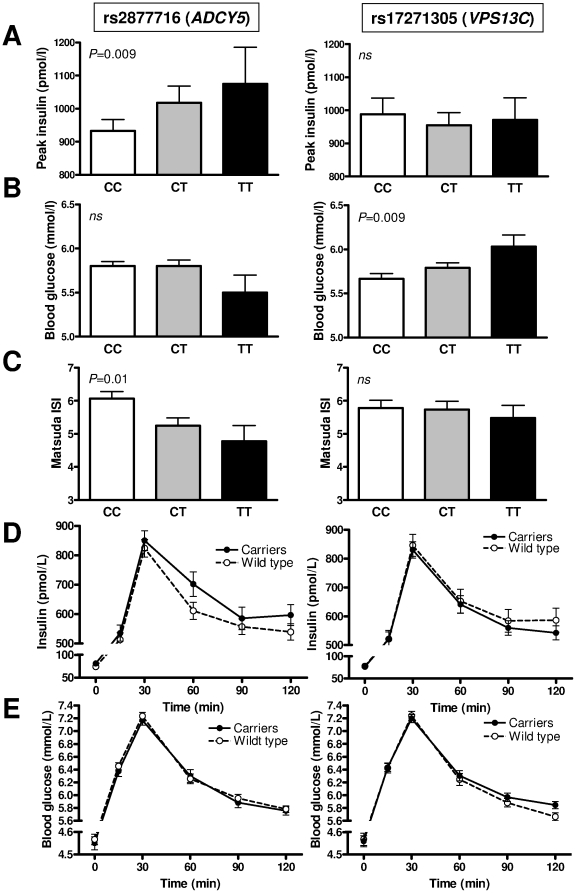
OBJECTIVE: Recent genome-wide association studies identified novel candidate genes for fasting and 2 h blood glucose and insulin levels in adults. We investigated the role of four of these loci (ADCY5, GIPR, GCKR and VPS13C) in early impairment of glucose and insulin metabolism in children. RESEARCH DESIGN AND METHODS: We genotyped four variants (rs2877716; rs1260326; rs10423928; rs17271305) in 638 Caucasian children with detailed metabolic testing including an oGTT and assessed associations with measures of glucose and insulin metabolism (including fasting blood glucose, insulin levels and insulin sensitivity/secretion indices) by linear regression analyses adjusted for age, sex, BMI-SDS and pubertal stage. RESULTS: The major allele (C) of rs2877716 (ADCY5) was nominally associated with decreased fasting plasma insulin (P = 0.008), peak insulin (P = 0.009) and increased QUICKI (P = 0.016) and Matsuda insulin sensitivity index (P = 0.013). rs17271305 (VPS13C) was nominally associated with 2 h blood glucose (P = 0.009), but not with any of the insulin or insulin sensitivity parameters. We found no association of the GIPR and GCKR variants with parameters of glucose and insulin metabolism. None of the variants correlated with anthropometric traits such as height, WHR or BMI-SDS, which excluded potential underlying associations with obesity. CONCLUSIONS: Our data on obese children indicate effects of genetic variation within ADCY5 in early impairment of insulin metabolism and VPS13C in early impairment of blood glucose homeostasis.
Overview
The claims and statistics of this paper haven’t been checked yet.
Free: it reads the open-access text and checks the first 5 claims that cite a source we can check. Create a free account to check every claim.
Integrity signals
Registry
Cites
Statistics
Figures
Verification
Claims the paper makes
The claims and statistics of this paper haven’t been checked yet.
Free: it reads the open-access text and checks the first 5 claims that cite a source we can check. Create a free account to check every claim.
Claims other papers make about this one
Each is checked against this paper’s own text: does it say what the citing paper says it does?
The source backs part of the claim, not all of it — or backs it for a different population, condition or comparison.
In the citing paper
“Human ADCY5 polymorphisms have been associated with metabolic diseases including diabetes and obesity”
From Physiological roles of mammalian transmembrane adenylyl cyclase isoforms (2022) · cites this paper as [172]
Experimental — accuracy not yet measured
Self-check
Percentages, sums and reported differences re-computed from the paper’s own numbers.
The self-check needs the paper’s full text.
Citations
Cites
Type 2 diabetes: principles of pathogenesis and therapy
Stumvoll, M., Goldstein, B. J., & van Haeften, T. W. (2005) · The Lancet · doi:10.1016/s0140-6736(05)61032-x · Cited by 2,662 · cited 1×
“The sequence of events of obesity with subsequent insulin resistance and consequently hyperinsulinemia is understood in that increased post-challenge glucose levels result from the deviation of the hyperbolic relationship between insulin sensitivity and insulin plasma levels and is hence a sign of decompensation of b-…”
BackgroundBarker, D. J. P., Hales, C. N., Fall, C. H. D., Osmond, C., Phipps, K., & Clark, P. M. S. (1993) · Diabetologia · doi:10.1007/bf00399095 · Cited by 2,468 · cited 1×
“. Since lower birth weight itself is a risk factor for type 2 diabetes”
BackgroundKromeyer-Hauschild, K., Wabitsch, M., Kunze, D., Geller, F., Geiß, H. C., Hesse, V., von Hippel, A., Jaeger, U., Johnsen, D., Korte, W., et al. (2001) · Monatsschrift Kinderheilkunde · doi:10.1007/s001120170107 · Cited by 2,175
New genetic loci implicated in fasting glucose homeostasis and their impact on type 2 diabetes risk
DIAGRAM Consortium, Dupuis, J., GIANT Consortium, Global BPgen Consortium, Anders Hamsten on behalf of Procardis Consortium, the MAGIC investigators, Langenberg, C., Prokopenko, I., Saxena, R., Soranzo, N., et al. (2010) · Nature Genetics · doi:10.1038/ng.520 · Cited by 2,166 · cited 5×
“Recent genome wide association studies (GWAS) have identified several genetic loci associated with fasting blood glucose (FBG), 2 h blood glucose (BG) and insulin secretion in adults [1,2].”
InfluentialLongitudinal Study on Pubertal Insulin Resistance
Goran, M. I., & Gower, B. A. (2001) · Diabetes · doi:10.2337/diabetes.50.11.2444 · Cited by 712 · cited 1×
“, hence particularly affecting endocrine/metabolic and cardiovascular signaling. Adjusting analyses for BMI SDS somewhat diminished the magnitude of the effect; although it was still significant. Considering the strong impact of obesity on insulin metabolism, an additional contribution of BMI to hyperinsulinemia may b…”
BackgroundGenetic variation in GIPR influences the glucose and insulin responses to an oral glucose challenge
GIANT consortium, Saxena, R., the MAGIC investigators, Hivert, M.-F., Langenberg, C., Tanaka, T., Pankow, J. S., Vollenweider, P., Lyssenko, V., Bouatia-Naji, N., et al. (2010) · Nature Genetics · doi:10.1038/ng.521 · Cited by 626 · cited 6×
“Recent genome wide association studies (GWAS) have identified several genetic loci associated with fasting blood glucose (FBG), 2 h blood glucose (BG) and insulin secretion in adults [1,2].”
BackgroundResultInfluentialSelf-citationIngelsson, E., Langenberg, C., Hivert, M.-F., Prokopenko, I., Lyssenko, V., Dupuis, J., Mägi, R., Sharp, S., Jackson, A. U., Assimes, T. L., et al. (2010) · Diabetes · doi:10.2337/db09-1568 · Cited by 257 · cited 1×
“performed a detailed characterization with discrimination of insulin processing, secretion and sensitivity [14].”
Self-citationVariants in ADCY5 and near CCNL1 are associated with fetal growth and birth weight
The Genetic Investigation of ANthropometric Traits (GIANT) Consortium, Freathy, R. M., The Meta-Analyses of Glucose and Insulin-related traits Consortium (MAGIC), The Wellcome Trust Case Control Consortium (WTCCC), the Early Growth Genetics (EGG) Consortium, Mook-Kanamori, D. O., Sovio, U., Prokopenko, I., Timpson, N. J., Berry, D. J., et al. (2010) · Nature Genetics · doi:10.1038/ng.567 · Cited by 255
Ahren, B., & Pacini, G. (2004) · European Journal of Endocrinology · doi:10.1530/eje.0.1500097 · Cited by 229 · cited 1×
“The sequence of events of obesity with subsequent insulin resistance and consequently hyperinsulinemia is understood in that increased post-challenge glucose levels result from the deviation of the hyperbolic relationship between insulin sensitivity and insulin plasma levels and is hence a sign of decompensation of b-…”
BackgroundAnalysis of the human VPS13 gene family
Velayos-Baeza, A., Vettori, A., Copley, R. R., Dobson-Stone, C., & Monaco, A. P. (2004) · Genomics · doi:10.1016/j.ygeno.2004.04.012 · Cited by 220 · cited 1×
“The family of VPS13C plays a role in transport of membrane proteins between transGolgi network and the prevacuolar compartment [17] and is highly expressed in beta cells [2].”
BackgroundNew Predictors of the Metabolic Syndrome in Children—Role of Adipocytokines
Körner, A., Kratzsch, J., Gausche, R., Schaab, M., Erbs, S., & Kiess, W. (2007) · Pediatric Research · doi:10.1203/01.pdr.0000262638.48304.ef · Cited by 165 · cited 1×
“metabolic derangement and the increase in insulin levels precedes the deterioration of blood glucose allostasis [16].”
BackgroundSelf-citationVaspin is related to gender, puberty and deteriorating insulin sensitivity in children
Körner, A., Neef, M., Friebe, D., Erbs, S., Kratzsch, J., Dittrich, K., Blüher, S., Kapellen, T. M., Kovacs, P. L., Stümvoll, M., et al. (2010) · International Journal of Obesity · doi:10.1038/ijo.2010.196 · Cited by 85 · cited 1×
“In addition, we included 67 healthy lean controls from our Leipzig Atherobesity Childhood cohort [4].”
MethodSelf-citationAdenylyl Cyclase Isoform V Mediates Renin Release From Juxtaglomerular Cells
Ortiz-Capisano, M. C., Ortiz, P. A., Harding, P., Garvin, J. L., & Beierwaltes, W. H. (2007) · Hypertension · doi:10.1161/01.hyp.0000255172.84842.d2 · Cited by 62 · cited 1×
“The ADCY isoform 5 has been described to mediate renin release [6], influence heart rate [7] and interact with dopamine homeostasis in the central nervous system [8], hence particularly affecting endocrine/metabolic and cardiovascular signaling.”
BackgroundAdenylyl cyclase type 5 protein expression during cardiac development and stress
Hu, C.-L., Chandra, R., Ge, H., Pain, J., Yan, L., Babu, G., Depre, C., Iwatsubo, K., Ishikawa, Y., Sadoshima, J., et al. (2009) · American Journal of Physiology-Heart and Circulatory Physiology · doi:10.1152/ajpheart.00050.2009 · Cited by 45 · cited 1×
“The ADCY isoform 5 has been described to mediate renin release [6], influence heart rate [7] and interact with dopamine homeostasis in the central nervous system [8], hence particularly affecting endocrine/metabolic and cardiovascular signaling.”
Backgroundde Gortari, P., & Mengod, G. (2009) · Brain Research · doi:10.1016/j.brainres.2009.11.009 · Cited by 34
Körner, A., Berndt, J., Stümvoll, M., Kieß, W., & Kovacs, P. L. (2007) · The Journal of Clinical Endocrinology & Metabolism · doi:10.1210/jc.2006-2514 · Cited by 31 · cited 1×
“We previously showed that diabetes susceptibility variants in TCF7L2 were associated with early impairment of glucose tolerance in children before they develop overt diabetes [3].”
BackgroundSelf-citationGlucose levels and genetic variants across transcriptional pathways: interaction effects with BMI
Povel, C. M., Feskens, E. J. M., Imholz, S., Blaak, E. E., Boer, J. M. A., & Dollé, M. E. T. (2010) · International Journal of Obesity · doi:10.1038/ijo.2009.302 · Cited by 21 · cited 1×
“Nevertheless, the variant-effect may manifest in later stages of life, potentially additionally modified by geneenvironment interactions [15], or may be detectable only with advanced stages of disease, which are less prevalent in children.”
Background
Cited by
Dessauer, C. W., Watts, V. J., Ostrom, R. S., Conti, M., Dove, S., & Seifert, R. (2017) · Pharmacological Reviews · doi:10.1124/pr.116.013078 · Cited by 201
“Numerous studies have linked ADCY5 gene polymorphisms to altered glucose metabolism, diabetes, and obesity (Barker et al., 2011; Rees et al., 2011; Wagner et al., 2011; Windholz et al., 2011; Holstein et al., 2013; Ng et al., 2013; Hodson et al., 2014; Knigge et al., 2015).”
BackgroundADCY5 Couples Glucose to Insulin Secretion in Human Islets
Hodson, D. J., Mitchell, R. K., Marselli, L., Pullen, T. J., Gimeno Brias, S., Semplici, F., Everett, K. L., Cooper, D. M. F., Bugliani, M., Marchetti, P., et al. (2014) · Diabetes · doi:10.2337/db13-1607 · Cited by 147
Physiological roles of mammalian transmembrane adenylyl cyclase isoforms
Ostrom, K. F., LaVigne, J. E., Brust, T. F., Seifert, R., Dessauer, C. W., Watts, V. J., & Ostrom, R. S. (2022) · Physiological Reviews · doi:10.1152/physrev.00013.2021 · Cited by 131
The role of GIP in α-cells and glucagon secretion
El, K., & Campbell, J. E. (2020) · Peptides · doi:10.1016/j.peptides.2019.170213 · Cited by 96
VPS13A, a closely associated mitochondrial protein, is required for efficient lysosomal degradation
Muñoz-Braceras, S., Tornero-Écija, A. R., Vincent, O., & Escalante, R. (2019) · Disease Models & Mechanisms · doi:10.1242/dmm.036681 · Cited by 81
Metadata
- Authors
- Windholz, J., Kovacs, P., Tönjes, A., Dittrich, K., Blüher, S., Kiess, W., Stumvoll, M., & Körner, A.
- Affiliations
- University Hospital Leipzig (DE)
- Leipzig University (DE)
- IFB Adiposity Diseases (DE)
- Corresponding author
- Kovacs, Peter
- Venue
- PLoS ONE
- Publisher
- Public Library of Science (PLoS)
- Published
- 2011-07-15
- Volume
- 6
- Issue
- 7
- Pages
- e22101
- ISSN
- 1932-6203 (ISSN-L)
- PMC
- PMC3137620
- OpenAlex
- W2083580872
- Cited by
- 21
- References
- 17
- Citations by year
- 2023: 1 · 2021: 4 · 2020: 2 · 2019: 3 · 2017: 3 · 2016: 3 · 2015: 3 · 2014: 1 · 2013: 1
- FWCI
- 0.40
- Type
- journal article
- Language
- en
- Open access
- gold
- doi.org
- Locations
- PLoS ONE (publishedVersion, cc-by)
- Europe PMC (PubMed Central) (publishedVersion, cc-by)
- PubMed Central (publishedVersion, cc-by)
- PubMed (publishedVersion)
- DOAJ (DOAJ: Directory of Open Access Journals) (submittedVersion, cc-by-sa)
- Figshare (submittedVersion, cc-by)
- Qucosa (Saxon State and University Library Dresden) (submittedVersion, other-oa)
- Funders
- Deutsche Forschungsgemeinschaft (KFO-152, KO3512/1)
- Topics
- Life Sciences › Biochemistry, Genetics and Molecular Biology › Genetics › Genetic Associations and Epidemiology
- Health Sciences › Medicine › Endocrinology, Diabetes and Metabolism › Pancreatic function and diabetes
- Life Sciences › Biochemistry, Genetics and Molecular Biology › Genetics › Diabetes and associated disorders
- Keywords
- ADCY5, GIPR, GCKR, VPS13C, genetic variants, insulin resistance, insulin secretion, glucose homeostasis, children, fasting insulin, QUICKI, Matsuda insulin sensitivity index, obesity
- MeSH terms
- Adenylyl Cyclases, Alleles, Child, Demography, Female, Glucose, Humans, Insulin, Male, Obesity, Proteins, Receptors, Gastrointestinal Hormone, Risk Factors, Genetic Predisposition to Disease, Polymorphism, Single Nucleotide, Adaptor Proteins, Signal Transducing, Genome-Wide Association Study
About these checks
Registry, retraction, Cites and statistics results are computed, not judged, with one exception: a printed reference that no index lists is read once by a model before it counts as a citation error. Claims are extracted by a model and kept only when their quote appears verbatim in the text; each cited source is then checked, with a model’s help, for whether it says what the claim relies on. Those verdicts can be wrong — read the claim’s quote and the cited source before relying on one.
Statistics and arithmetic are recomputed, not judged.
Confidence bands are shown only for fields calibrated on our annotated test set. None is calibrated yet, so no band is shown.
What counts as a claim ›How we measure confidence ›How we check this ›
Are you an author, or do you see a problem with this page? Request a review
Data sources
Bibliographic data: Semantic Scholar, OpenAlex, Crossref.
Contains information from the Semantic Scholar Academic Graph Datasets, made available under the ODC Attribution License (ODC-BY 1.0).
Semantic Scholar’s data is described in: Kinney, R., et al. (2023). The Semantic Scholar Open Data Platform. arXiv:2301.10140.
