

Glucose-Raising Genetic Variants in MADD and ADCY5 Impair Conversion of Proinsulin to Insulin
Open accessThe DOI matches its Crossref record; 37 of the 37 references it cites were found in a registry or an index.
Abstract
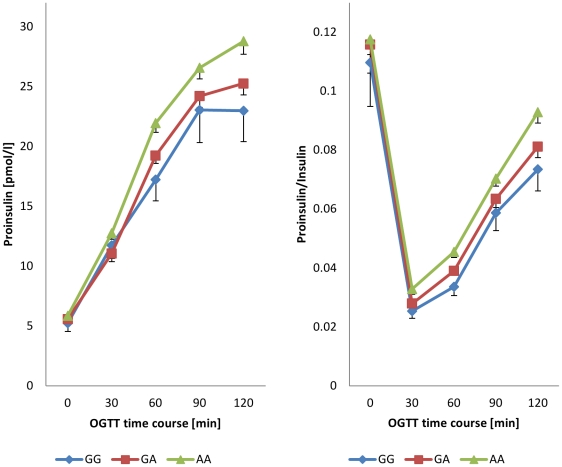
INTRODUCTION: Recent meta-analyses of genome-wide association studies revealed new genetic loci associated with fasting glycemia. For several of these loci, the mechanism of action in glucose homeostasis is unclear. The objective of the study was to establish metabolic phenotypes for these genetic variants to deliver clues to their pathomechanism. METHODS: In this cross-sectional study 1782 non-diabetic volunteers at increased risk for type 2 diabetes underwent an oral glucose tolerance test. Insulin, C-peptide and proinsulin were measured and genotyping was performed for 12 single nucleotide polymorphisms (SNP) in or near the genes GCK (rs4607517), DGKB (rs2191349), GCKR (rs780094), ADCY5 (rs11708067), MADD (rs7944584), ADRA2A (rs10885122), FADS1 (rs174550), CRY2 (rs11605924), SLC2A2 (rs11920090), PROX1 (rs340874), GLIS3 (rs7034200) and C2CD4B (rs11071657). Parameters of insulin secretion (AUC Insulin(0-30)/AUC Glucose(0-30), AUC C-peptide(0-120)/AUC Glucose(0-120)), proinsulin-to-insulin conversion (fasting proinsulin, fasting proinsulin/insulin, AUC Proinsulin(0-120)/AUCInsulin(0-120)) and insulin resistance (HOMA-IR, Matsuda-Index) were assessed. RESULTS: After adjustment for confounding variables, the effect alleles of the ADCY5 and MADD SNPs were associated with an impaired proinsulin-to-insulin conversion (p = 0.002 and p = 0.0001, respectively). GLIS3 was nominally associated with impaired proinsulin-to-insulin conversion and insulin secretion. The diabetogenic alleles of DGKB and PROX1 were nominally associated with reduced insulin secretion. Nominally significant effects on insulin sensitivity could be found for MADD and PROX1. DISCUSSION: By examining parameters of glucose-stimulated proinsulin-to-insulin conversion during an OGTT, we show that the SNP in ADCY5 is implicated in defective proinsulin-to-insulin conversion. In addition, we confirmed previous findings on the role of a genetic variant in MADD on proinsulin-to-insulin conversion. These effects may also be related to neighboring regions of the genome.
Overview
The claims and statistics of this paper haven’t been checked yet.
Free: it reads the open-access text and checks the first 5 claims that cite a source we can check. Create a free account to check every claim.
Integrity signals
Registry
Cites
Statistics
Figures
Verification
Claims the paper makes
The claims and statistics of this paper haven’t been checked yet.
Free: it reads the open-access text and checks the first 5 claims that cite a source we can check. Create a free account to check every claim.
Claims other papers make about this one
Each is checked against this paper’s own text: does it say what the citing paper says it does?
The source backs part of the claim, not all of it — or backs it for a different population, condition or comparison.
In the citing paper
“Human ADCY5 polymorphisms have been associated with metabolic diseases including diabetes and obesity”
From Physiological roles of mammalian transmembrane adenylyl cyclase isoforms (2022) · cites this paper as [171]
Experimental — accuracy not yet measured
Self-check
Percentages, sums and reported differences re-computed from the paper’s own numbers.
The self-check needs the paper’s full text.
Citations
Cites
Statistical power analyses using G∗Power 3.1: tests for correlation and regression analyses
Faul, F., Erdfelder, E., Buchner, A., & Lang, A.-G. (2009) · Behavior Research Methods · doi:10.3758/brm.41.4.1149 · Cited by 37,615
Matthews, D. R., Hosker, J. P., Rudenski, A. S., Naylor, B. A., Treacher, D. F., & Turner, R. C. (1985) · Diabetologia · doi:10.1007/bf00280883 · Cited by 31,502
Finding the missing heritability of complex diseases
Manolio, T. A., Collins, F. S., Cox, N. J., Goldstein, D. B., Hindorff, L. A., Hunter, D. J., McCarthy, M. I., Ramos, E. M., Cardon, L. R., Chakravarti, A., et al. (2009) · Nature · doi:10.1038/nature08494 · Cited by 8,336
Matsuda, M., & DeFronzo, R. A. (1999) · Diabetes Care · doi:10.2337/diacare.22.9.1462 · Cited by 5,621
Katz, A., Nambi, S. S., Mather, K., Baron, A. D., Follmann, D. A., Sullivan, G., & Quon, M. J. (2000) · The Journal of Clinical Endocrinology & Metabolism · doi:10.1210/jcem.85.7.6661 · Cited by 3,931 · cited 1×
“Insulin action can be characterized by insulin sensitivity which can be approximated in several ways [13–16].”
BackgroundNew genetic loci implicated in fasting glucose homeostasis and their impact on type 2 diabetes risk
DIAGRAM Consortium, Dupuis, J., GIANT Consortium, Global BPgen Consortium, Anders Hamsten on behalf of Procardis Consortium, the MAGIC investigators, Langenberg, C., Prokopenko, I., Saxena, R., Soranzo, N., et al. (2010) · Nature Genetics · doi:10.1038/ng.520 · Cited by 2,166 · cited 1×
“Nine variants in or near ADCY5, MADD, ADRA2A, CRY2, FADS1, PROX1, SLC2A2, GLIS3, and C2CD4B have been discovered and 7 already known diabetes-related SNPs in G6PC2, MTNR1B, GCK, DGKB, GCKR, SLC30A8 and TCF7L2, have been confirmed to be associated with FG in a recent metaanalysis [17].”
Use of the oral glucose tolerance test to assess insulin release and insulin sensitivity.
Stumvoll, M., Mitrakou, A., Pimenta, W., Jenssen, T., Yki-Järvinen, H., Van Haeften, T., Renn, W., & Gerich, J. (2000) · Diabetes Care · doi:10.2337/diacare.23.3.295 · Cited by 1,042
Genomics, type 2 diabetes, and obesity
McCarthy, M. I. (2010) · New England Journal of Medicine · doi:10.1056/nejmra0906948 · Cited by 938 · cited 1×
“Most of the approximately 40 known genetic variants conferring increased risk for type 2 diabetes have been discovered by genome-wide association studies (GWAS) [3].”
BackgroundCa2+, cAMP, and phospholipid-derived messengers in coupling mechanisms of insulin secretion
Prentki, M., & Matschinsky, F. M. (1987) · Physiological Reviews · doi:10.1152/physrev.1987.67.4.1185 · Cited by 774
The Unfolded Protein Response: A Pathway That Links Insulin Demand with β-Cell Failure and Diabetes
Scheuner, D., & Kaufman, R. J. (2008) · Endocrine Reviews · doi:10.1210/er.2007-0039 · Cited by 531
Cited by
Dimas, A. S., Lagou, V., Barker, A., Knowles, J. W., Mägi, R., Hivert, M.-F., Benazzo, A., Rybin, D., Jackson, A. U., Stringham, H. M., et al. (2014) · Diabetes · doi:10.2337/db13-0949 · Cited by 366
Self-citationDessauer, C. W., Watts, V. J., Ostrom, R. S., Conti, M., Dove, S., & Seifert, R. (2017) · Pharmacological Reviews · doi:10.1124/pr.116.013078 · Cited by 201
“Numerous studies have linked ADCY5 gene polymorphisms to altered glucose metabolism, diabetes, and obesity (Barker et al., 2011; Rees et al., 2011; Wagner et al., 2011; Windholz et al., 2011; Holstein et al., 2013; Ng et al., 2013; Hodson et al., 2014; Knigge et al., 2015).”
BackgroundADCY5 Couples Glucose to Insulin Secretion in Human Islets
Hodson, D. J., Mitchell, R. K., Marselli, L., Pullen, T. J., Gimeno Brias, S., Semplici, F., Everett, K. L., Cooper, D. M. F., Bugliani, M., Marchetti, P., et al. (2014) · Diabetes · doi:10.2337/db13-1607 · Cited by 147
Physiological roles of mammalian transmembrane adenylyl cyclase isoforms
Ostrom, K. F., LaVigne, J. E., Brust, T. F., Seifert, R., Dessauer, C. W., Watts, V. J., & Ostrom, R. S. (2022) · Physiological Reviews · doi:10.1152/physrev.00013.2021 · Cited by 131
Genome-wide discovery of genetic loci that uncouple excess adiposity from its comorbidities
Huang, L. O., Rauch, A., Mazzaferro, E., Preuss, M. H., Carobbio, S., Bayrak, Ç. S., Chami, N., Wang, Z., Schick, U. M., Yang, N. Y., et al. (2021) · Nature Metabolism · doi:10.1038/s42255-021-00346-2 · Cited by 128
Metadata
- Authors
- Wagner, R., Dudziak, K., Herzberg-Schäfer, S. A., Machicao, F., Stefan, N., Staiger, H., Häring, H.-U., & Fritsche, A.
- Affiliations
- German Center for Diabetes Research (DE)
- Corresponding author
- Fritsche, Andreas
- Venue
- PLoS ONE
- Publisher
- Public Library of Science (PLoS)
- Published
- 2011-08-22
- Volume
- 6
- Issue
- 8
- Pages
- e23639
- ISSN
- 1932-6203 (ISSN-L)
- PMC
- PMC3161735
- OpenAlex
- W2082047193
- Cited by
- 50
- References
- 37
- Citations by year
- 2026: 1 · 2025: 1 · 2024: 2 · 2023: 6 · 2021: 8 · 2020: 3 · 2019: 7 · 2018: 1 · 2017: 3 · 2016: 1 · 2015: 6 · 2014: 6 · 2013: 3 · 2012: 1
- FWCI
- 3.27
- Type
- journal article
- Language
- en
- Open access
- gold
- doi.org
- Locations
- PLoS ONE (publishedVersion, cc-by)
- PubMed Central (publishedVersion, cc-by)
- PubMed (publishedVersion)
- DOAJ (DOAJ: Directory of Open Access Journals) (submittedVersion, cc-by-sa)
- Funders
- Deutsche Forschungsgemeinschaft
- Bundesministerium für Bildung und Forschung
- Topics
- Health Sciences › Medicine › Endocrinology, Diabetes and Metabolism › Pancreatic function and diabetes
- Life Sciences › Biochemistry, Genetics and Molecular Biology › Genetics › Genetic Associations and Epidemiology
- Life Sciences › Biochemistry, Genetics and Molecular Biology › Genetics › Diabetes and associated disorders
- Keywords
- MADD, ADCY5, proinsulin, insulin secretion, insulin resistance, type 2 diabetes risk, single nucleotide polymorphisms, fasting blood glucose, glucose homeostasis, glucokinase, Prox1, GLIS3, CRY2, GLUT2, ADRA2A
- MeSH terms
- Delta-5 Fatty Acid Desaturase, Adenylyl Cyclases, Adult, Blood Glucose, Female, Glucose Tolerance Test, Humans, Male, Proinsulin, Genetic Predisposition to Disease, Polymorphism, Single Nucleotide, Guanine Nucleotide Exchange Factors, Death Domain Receptor Signaling Adaptor Proteins
About these checks
Registry, retraction, Cites and statistics results are computed, not judged, with one exception: a printed reference that no index lists is read once by a model before it counts as a citation error. Claims are extracted by a model and kept only when their quote appears verbatim in the text; each cited source is then checked, with a model’s help, for whether it says what the claim relies on. Those verdicts can be wrong — read the claim’s quote and the cited source before relying on one.
Statistics and arithmetic are recomputed, not judged.
Confidence bands are shown only for fields calibrated on our annotated test set. None is calibrated yet, so no band is shown.
What counts as a claim ›How we measure confidence ›How we check this ›
Are you an author, or do you see a problem with this page? Request a review
How to cite
Cite CoChat for the checks on this page, and the paper for its own findings.
- This page
- CoChat. (2026). Citation check: Glucose-Raising Genetic Variants in MADD and ADCY5 Impair Conversion of Proinsulin to Insulin. https://app.cochat.ai/papers/10.1371/journal.pone.0023639
- The paper
- Wagner, R., Dudziak, K., Herzberg-Schäfer, S. A., Machicao, F., Stefan, N., Staiger, H., Häring, H.-U., & Fritsche, A. (2011). Glucose-Raising Genetic Variants in MADD and ADCY5 Impair Conversion of Proinsulin to Insulin. PLoS ONE. https://doi.org/10.1371/journal.pone.0023639
Data sources
Bibliographic data: Semantic Scholar, OpenAlex, Crossref.
Contains information from the Semantic Scholar Academic Graph Datasets, made available under the ODC Attribution License (ODC-BY 1.0).
Semantic Scholar’s data is described in: Kinney, R., et al. (2023). The Semantic Scholar Open Data Platform. arXiv:2301.10140.
