

Differential Neural Responses to Food Images in Women with Bulimia versus Anorexia Nervosa
Open accessThe DOI matches its Crossref record; 38 of the 39 references it cites were found in a registry or an index.
Abstract
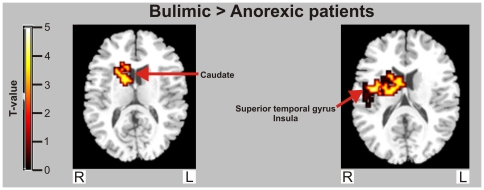
BACKGROUND: Previous fMRI studies show that women with eating disorders (ED) have differential neural activation to viewing food images. However, despite clinical differences in their responses to food, differential neural activation to thinking about eating food, between women with anorexia nervosa (AN) and bulimia nervosa (BN) is not known. METHODS: We compare 50 women (8 with BN, 18 with AN and 24 age-matched healthy controls [HC]) while they view food images during functional Magnetic Resonance Imaging (fMRI). RESULTS: In response to food (vs non-food) images, women with BN showed greater neural activation in the visual cortex, right dorsolateral prefrontal cortex, right insular cortex and precentral gyrus, women with AN showed greater activation in the right dorsolateral prefrontal cortex, cerebellum and right precuneus. HC women activated the cerebellum, right insular cortex, right medial temporal lobe and left caudate. Direct comparisons revealed that compared to HC, the BN group showed relative deactivation in the bilateral superior temporal gyrus/insula, and visual cortex, and compared to AN had relative deactivation in the parietal lobe and dorsal posterior cingulate cortex, but greater activation in the caudate, superior temporal gyrus, right insula and supplementary motor area. CONCLUSIONS: Women with AN and BN activate top-down cognitive control in response to food images, yet women with BN have increased activation in reward and somatosensory regions, which might impinge on cognitive control over food consumption and binge eating.
Overview
The claims and statistics of this paper haven’t been checked yet.
Free: it reads the open-access text and checks the first 5 claims that cite a source we can check. Create a free account to check every claim.
Integrity signals
Registry
Cites
Statistics
Figures
Verification
Claims the paper makes
The claims and statistics of this paper haven’t been checked yet.
Free: it reads the open-access text and checks the first 5 claims that cite a source we can check. Create a free account to check every claim.
Claims other papers make about this one
Each is checked against this paper’s own text: does it say what the citing paper says it does?
The cited source doesn’t support the claim as written.
In the citing paper
“In another study, BN participants displayed low activity in the insula to food images, while AN showed higher activity in the caudate and insula (Brooks et al., 2011).”
From Cortico-striatal-thalamic loop circuits of the salience network: A central pathway in psychiatric disease and treatment (2016) · cites this paper as Brooks et al., 2011
Checked by a reasoning model — may be wrong.
Experimental — accuracy not yet measuredThe source backs part of the claim, not all of it — or backs it for a different population, condition or comparison.
In the citing paper
“Brooks and colleagues [327] found that in response to food-reward outcomes, individuals with anorexia had greater activation of the dorsolateral prefrontal cortex, the cerebellum, and the right pre-cuneus relative to controls.”
From Reward circuitry dysfunction in psychiatric and neurodevelopmental disorders and genetic syndromes: animal models and clinical findings (2012) · cites this paper as [327]
Experimental — accuracy not yet measuredIn the citing paper
“Brooks et al. [327] compared neural responses to food-reward outcomes in individuals with BN and with anorexia nervosa (AN), and found that individuals with BN had relatively greater activation in the dorsolateral prefrontal cortex, the insular cortex, and the pre-central gyrus.”
From Reward circuitry dysfunction in psychiatric and neurodevelopmental disorders and genetic syndromes: animal models and clinical findings (2012) · cites this paper as [327]
In the citing paper
“They also had greater activation of the caudate, superior temporal gyrus, right insula, and supplementary motor area, and greater deactivation in the parietal lobe and dorsal posterior cingulate cortex relative to those with bulimia.”
From Reward circuitry dysfunction in psychiatric and neurodevelopmental disorders and genetic syndromes: animal models and clinical findings (2012) · cites this paper as [327]
Self-check
Percentages, sums and reported differences re-computed from the paper’s own numbers.
The self-check needs the paper’s full text.
Citations
Cites
The Hospital Anxiety and Depression Scale
Zigmond, A. S., & Snaith, R. P. (1983) · Acta Psychiatrica Scandinavica · doi:10.1111/j.1600-0447.1983.tb09716.x · Cited by 47,139
Neural systems of reinforcement for drug addiction: from actions to habits to compulsion
Everitt, B. J., & Robbins, T. W. (2005) · Nature Neuroscience · doi:10.1038/nn1579 · Cited by 3,785 · cited 1×
“Furthermore, activation of the caudate and motor regions (precentral gyrus, SMA) are implicated in addictive behaviour [25,26] and thus might suggest that there are some similarities in neural systems between addiction and binge eating.”
Background“Liking” and “wanting” food rewards: Brain substrates and roles in eating disorders
Berridge, K. C. (2009) · Physiology & Behavior · doi:10.1016/j.physbeh.2009.02.044 · Cited by 1,147 · cited 1×
“Furthermore, activation of the caudate and motor regions (precentral gyrus, SMA) are implicated in addictive behaviour [25,26] and thus might suggest that there are some similarities in neural systems between addiction and binge eating.”
BackgroundThe cognitive control network: Integrated cortical regions with dissociable functions
Cole, M. W., & Schneider, W. (2007) · NeuroImage · doi:10.1016/j.neuroimage.2007.03.071 · Cited by 1,091 · cited 1×
“The DLPFC forms part of the cognitive control network, and is associated with restriction of appetitive responses [27,28,29].”
BackgroundAnxiety, restraint, and eating behavior.
Herman, C. P., & Polivy, J. (1975) · Journal of Abnormal Psychology · doi:10.1037//0021-843x.84.6.666 · Cited by 886 · cited 1×
“Additionally, the women with BN had significantly higher restraint scores (EDE-Q) than those with AN, and the women with BPAN had the highest restraint score, which is in line with observations that people who binge are often relapsing from attempts at restraint [36] But this may also reflect and support a recent find…”
ResultNew insights into symptoms and neurocircuit function of anorexia nervosa
Kaye, W. H., Fudge, J. L., & Paulus, M. (2009) · Nature Reviews Neuroscience · doi:10.1038/nrn2682 · Cited by 843 · cited 1×
“Furthermore, dysregulation of the insula seems to be prominent in the pathophysiology underlying neural activation in people with eating disorders [33,34].”
BackgroundEstimating sample size in functional MRI (fMRI) neuroimaging studies: Statistical power analyses
Desmond, J. E., & Glover, G. H. (2002) · Journal of Neuroscience Methods · doi:10.1016/s0165-0270(02)00121-8 · Cited by 716 · cited 1×
“05 threshold for eighty percent power per voxel [18].”
BackgroundCraig, A. D. (. (2010) · Brain Structure and Function · doi:10.1007/s00429-010-0248-y · Cited by 600 · cited 1×
“The insular cortex functions as an intermediary between the PFC and striatum activation, with dense functional connectivity between these regions, creating an emergent sentience of bodily state [32].”
BackgroundIndividual Differences in Reward Drive Predict Neural Responses to Images of Food
Beaver, J. D., Lawrence, A. D., van Ditzhuijzen, J., Davis, M. H., Woods, A., & Calder, A. J. (2006) · The Journal of Neuroscience · doi:10.1523/jneurosci.0350-06.2006 · Cited by 594 · cited 1×
“Increased motor responses to food images may reflect an anticipated desire for food consumption, as these regions are also activated in healthy people who have fasted and report a craving for food [21,22,23,24].”
BackgroundHow psychotherapy changes the brain – the contribution of functional neuroimaging
Linden, D. E. J. (2006) · Molecular Psychiatry · doi:10.1038/sj.mp.4001816 · Cited by 491 · cited 1×
“As this might alter neural activation [19] independent t-tests were run to check whether differences occurred in neural activation between those were/ were not taking SSRIs.”
Method
Research works printed but not linked: 1
- Brammer M 2003 Statistical analysis of functional magnetic resonance imaging data: current state and recent developments. Stat Methods Med Res 12 373 374 14599001
Cited by
Items 201–256 of 256
Eating Disorders as New Forms of Addiction
Leal, F. J. V., Ramos‐Fuentes, M. I., Santos, L. R., & Álvarez-Mateos, M. C. (2017) · InTech eBooks · doi:10.5772/65248 · Cited by 2
“In contrast to women with AN, the patients with BN had lower activity in the posterior dorsal and parietal lobe of the cingulate cortex, but increased activity in caudate, superior temporal gyrus, right insula, and supplementary motor area [53].”
ResultThe Role of External and Internal Stimuli in the Regulation of Eating Behaviour
Dyck, Z. V. (2015) · Open Repository and Bibliography (University of Luxembourg) · Cited by 2
The type and frequency of metacognitions in women dieting, not dieting, and with anorexia nervosa
Kleinbichler, J. K. (2013) · UC Research Repository (University of Canterbury) · doi:10.26021/6670 · Cited by 3
The role of motivation in eating disorders: understanding sex differences in the circuits
Nasini, S., Casile, A., Bonaldo, B., Mancini, C., Guzzo, S. M., Botticelli, L., & Comai, S. (2025) · Frontiers in Behavioral Neuroscience · doi:10.3389/fnbeh.2025.1644383 · Cited by 1
Bendall, C., Winderlich, J., Anderson, A., Caughey, M., Hoy, J., Coleman, J., & Bennett, C. (2025) · Journal of Eating Disorders · doi:10.1186/s40337-025-01410-y · Cited by 1
“This often results in food avoidance which temporarily eases anxiety around food but reinforces mal-adaptive behaviours [38, 39].”
Neurofunctional areas related to food appetency in anorexia nervosa
Cervantes-Navarrete, J. J., Alcauter, S., Miguel-Bueno, C., Gonzalez-Olvera, J. J., Carrillo‐Mezo, R., Martínez-Gudiño, M. D. L., & Caballero-Romo, A. D. J. (2012) · International journal of psychological research · doi:10.21500/20112084.740 · Cited by 1
The elusive functional bases of appetite control in the brain
Brooks, S. J. (2018) · EBioMedicine · doi:10.1016/j.ebiom.2018.07.018 · Cited by 1
“Moreover, direct comparisons of brain activation in AN and BN provide further insights into the underlying neurobiology at the extremes of appetite control, as shown by a previous fMRI study where women with AN and BN passively viewed appetizing food images [3].”
ResultSelf-citationAttention, inhibition and food: a neuroscientific investigation of eating disorders and obesity
Osimo, S. A. (2018) · SDL · Cited by 1
Brain Stimulation and Behavioral Change
Lucchiari, C., Kelley, N., Vanutelli, M., & Ferrucci, R. (2019) · Frontiers research topics · doi:10.3389/978-2-88945-838-7 · Cited by 1
del Atlántico(España), U. E., Mendoza, A. R. P., Castaño-Castaño, S., & del Atlántico(España), U. E. (2020) · MLS Psychology Research · doi:10.33000/mlspr.v3i1.468 · Cited by 1
Ralph‐Nearman, C., Hooper, M. A., & Filik, R. (2021) · Cognition & Emotion · doi:10.1080/02699931.2021.1987862 · Cited by 1
“However, many current theories debate whether it is the way in which body, food, or perfectionism-related information is processed that is primarily associated with eating disorder symptomatology (e.g., Brooks et al., 2011; Fairburn et al., 2003; Shafran et al., 2007; Treasure & Schmidt, 2013).”
BackgroundInfluentialGrebenshchikova, R. V., Ananyeva, N. I., Пичиков, А. А., Iskhakov, D. N., & Lukina, L. V. (2023) · Diagnostic radiology and radiotherapy · doi:10.22328/2079-5343-2023-14-1-26-36 · Cited by 1
“[8], в центральных передних поясно-полосато-таламических областях при выполнении задач на когнитивную гибкость [9], а также в задних теменных областях, префронтальной коре и островке в ответ на задачи, связанные с оценкой перцептивного и аффективного компонентов образа тела [7].”
Systematic Review of fMRI Studies with Visual Food Stimuli in Anorexia Nervosa
Dąbkowska-Mika, A., Steiger, R., Gander, M., Sevecke, K., & Gizewski, E. R. (2021) · Austin Journal of Nutrition & Metabolism · doi:10.26420/austinjnutrmetab.2021.1115 · Cited by 1
Food Addiction in Anorexia Nervosa
Iceta, S., & Bégin, C. (2024) · Oxford University Press eBooks · doi:10.1093/oso/9780190671051.003.0012 · Cited by 1
Tiefe Hirnstimulation : Neurologische, psychiatrische und philosophische Aspekte
Volkmann, J., Schläpfer, T., Bewernick, B. H., Gippert, S. M., & Galert, T. (2016) · Cited by 1
Romero, B., & Concepción, M. (2015) · Institutional Repository University of Extremadura (University of Extremadura) · Cited by 1
Examining the relationship between information processing strategies and disordered eating behaviour
Ralph‐Nearman, C. (2018) · Nottingham ePrints (University of Nottingham) · Cited by 1
Võsu, S. (2019) · DSpace repository (University of Tartu) · Cited by 1
Luo, L., Luo, Y., Chen, X., Xiao, M., Bian, Z., Leng, X., Li, W., Wang, J., Yue, Y., & Chen, H. (2021) · Research Square · doi:10.21203/rs.3.rs-823131/v1 · Cited by 1
The Use of Magnetic Resonance Imaging (MRI) in Eating Disorders
Cardi, V., Suda, M., & Treasure, J. L. (2014) · Springer eBooks · doi:10.1007/978-3-642-54542-9_18
Self-citationBjörnsdóttir, H. H. (2013)
Rumination and reward processing in anorexia nervosa
Cowdrey, F. A. (2012) · Oxford University Research Archive (ORA) (University of Oxford) · doi:10.5287/ora-n64d6ozp4
Cervantes-Navarrete, J. J., Miguel-Bueno, C., Gonzalez, J. J., Carrillo‐Mezo, R., Martínez-Gudiño, M. D. L., & Caballero-Romo, A. D. J. (2012)
Aspects de recherche en thérapeutique
Rigaud, D., Jiang, T., & Gimenez, A. (2013) · Pratiques en nutrition · doi:10.1016/j.pranut.2012.12.007
Pidurdusliku kontrolli ja tähelepanu kallutatuse hindamine bulimia nervosa patsientidel
Võsu, S. (2016) · DSpace repository (University of Tartu)
Kennedy, J. T. (2013) · OhioLink ETD Center (Ohio Library and Information Network)
The Butterfly effect: An impact of materials related to anorexia in audiovisual media
Kuna, B. (2018) · Nursing and Public Health · doi:10.17219/pzp/84982
Cognitive Processing in Young Women: Inhibition of Return in Eating Disorders
Cobb, A. (2019) · ANU Open Research (Australian National University) · doi:10.25911/5ea9580fda6d7
Imaging of feeding and eating disorders
Kurniadi, N. E., Wierenga, C. E., Berner, L. A., & Kaye, W. H. (2020) · doi:10.1093/med/9780198713005.003.0105
Biology of Binge Eating Related Disorders and Proposal for Integration into Treatment
Morawe, K. (2020) · Digital Commons - DU (University of Denver)
Neurobiological and metabolic mechanisms of binge-eating in anorexia and bulimia nervosa
Westwater, M. L. (2020) · Apollo (University of Cambridge) · doi:10.17863/cam.64461
Mind over food: The influence of mindset on brain, body and behaviour
Franssen, S. (2021) · Research Publications (Maastricht University) · doi:10.26481/dis.20210430sf
Frank, G. (2019) · Faculty Opinions – Post-Publication Peer Review of the Biomedical Literature · doi:10.3410/f.734409463.793558785
Frank, G. (2019) · Faculty Opinions – Post-Publication Peer Review of the Biomedical Literature · doi:10.3410/f.734076201.793558792
Benson, L., & Lowe, M. R. (2022) · iDEA - Drexel University Institutional Repository · doi:10.17918/00001369
(2024) · Elsevier eBooks · doi:10.1016/b978-0-443-18904-3.16001-9
Reward Processing and Reinforcement Learning in Eating Disorders
Johnson, A., Venables, K. M., & Haynos, A. F. (2025) · Oxford University Press eBooks · doi:10.1093/9780197675212.003.0008
Murray, S. B., Zbozinek, T. D., Craske, M., Tadayonnejad, R., Strober, M., Bari, A., O’Doherty, J. P., & Feusner, J. D. (2022) · Figshare · doi:10.6084/m9.figshare.19745451
Murray, S. B., Zbozinek, T. D., Craske, M., Tadayonnejad, R., Strober, M., Bari, A., O’Doherty, J. P., & Feusner, J. D. (2022) · Figshare · doi:10.6084/m9.figshare.19745448
Dąbkowska-Mika, A., Steiger, R., Gander, M., Haid-Stecher, N., Fuchs, M., Sevecke, K., & Gizewski, E. R. (2023) · Figshare · doi:10.6084/m9.figshare.22623439
Foerde, K., Walsh, B. T., Dalack, M., Daw, N. D., Shohamy, D., & STEINGLASS, J. E. (2021) · Figshare · doi:10.6084/m9.figshare.14444845
Neurocognitive and psychopharmacological mechanisms underlying disordered eating
Martin, E. (2023) · University of Birmingham Institutional Research Archive (University of Birmingham)
�씠�젙�� (2018) · YUHSpace (Yonsei University Medical Library)
Mitchell, J. (2023) · Open Access at Essex (University of Essex)
Charlebois, T., Mosco, R., Breithaupt, L. E., Eddy, K. T., Thomas, J. J., Kim, H. S. A., & Tabri, N. (2026) · Journal of Experimental Psychopathology · doi:10.1177/20438087261416658
“Appearance overvaluation, body dissatisfaction, and BMI have each been associated with attentional biases in prior research (Aspen et al., 2013; Brooks et al., 2011; Dobson & Dozois, 2004; Johansson et al., 2005; Ralph-Nearman et al., 2019; Rodgers & DuBois, 2016; Stojek et al., 2018; Tabri &…”
InfluentialTeng, C., Zhang, J., Lin, Z., Shi, X., Wu, X., Zhang, W., Zhang, H., Zhang, N., Guan, C., & Qiao, H. (2026) · Journal of Eating Disorders · doi:10.1186/s40337-026-01559-0
“Previous studies have shown increased activation in the PCG, along with DLPFC and INS in patients with BN during exposure to food stimuli [76].”
Weight Suppression, Brain Reward Response to Food Cues, and Bulimic Behaviours: A Pilot fMRI Study
Singh, S., Jagannathan, K., Childress, A. R., & Lowe, M. R. (2026) · European Eating Disorders Review · doi:10.1002/erv.70127
Investigation of Reward Processing and Habitual Behavior: the Complex Case of Anorexia Nervosa
Hennig, J. (2026) · Qucosa (Saxon State and University Library Dresden)
Mundorf, A., Siebert, A., von der Assen, C., Brünahl, C., & Peterburs, J. (2026) · Frontiers in Psychology · doi:10.3389/fpsyg.2026.1844251
Kot, E. (2025) · ReIn UW (University of Warsaw)
Özaltun, C. (2026) · Istanbul Kent University Institutional Repository
Metadata
- Authors
- Brooks, S. J., O′Daly, O. G., Uher, R., Friederich, H.-C., Giampietro, V., Brammer, M., Williams, S. C. R., Schiöth, H. B., Treasure, J., & Campbell, I. C.
- Affiliations
- Uppsala University (SE)
- King's College London (GB)
- Heidelberg University (DE)
- Corresponding author
- Brooks, Samantha J.
- ORCID
- Venue
- PLoS ONE
- Publisher
- Public Library of Science (PLoS)
- Published
- 2011-07-20
- Volume
- 6
- Issue
- 7
- Pages
- e22259
- ISSN
- 1932-6203 (ISSN-L)
- PMC
- PMC3140495
- OpenAlex
- W2093856632
- Cited by
- 231
- References
- 39
- Citations by year
- 2026: 4 · 2025: 8 · 2024: 12 · 2023: 13 · 2022: 14 · 2021: 16 · 2020: 14 · 2019: 17 · 2018: 22 · 2017: 19 · 2016: 14 · 2015: 16 · 2014: 17 · 2013: 23 · 2012: 21
- FWCI
- 21.35
- Type
- journal article
- Language
- en
- Open access
- gold
- doi.org
- Locations
- PLoS ONE (publishedVersion, cc-by)
- Europe PMC (PubMed Central) (publishedVersion, cc-by)
- PubMed Central (publishedVersion, cc-by)
- PubMed (publishedVersion)
- Liverpool John Moores University (acceptedVersion)
- DOAJ (DOAJ: Directory of Open Access Journals) (submittedVersion, cc-by-sa)
- Research Portal (King's College London) (submittedVersion)
- Funders
- Psychiatry Research Trust
- Uppsala Universitet
- Topics
- Social Sciences › Psychology › Clinical Psychology › Eating Disorders and Behaviors
- Health Sciences › Nursing › Nutrition and Dietetics › Nutrition, Health and Food Behavior
- Life Sciences › Neuroscience › Endocrine and Autonomic Systems › Regulation of Appetite and Obesity
- Keywords
- bulimia nervosa, anorexia nervosa, food images, eating disorders, dorsolateral prefrontal cortex, insula, cerebellum, caudate nucleus, cognitive control, reward processing, binge eating, women
- MeSH terms
- Adolescent, Adult, Anorexia Nervosa, Anxiety, Brain, Bulimia, Cognition, Female, Food, Humans, Magnetic Resonance Imaging, Middle Aged, Photic Stimulation, Thinking, Visual Cortex, Case-Control Studies, Neostriatum, Selective Serotonin Reuptake Inhibitors, Prefrontal Cortex, Young Adult
About these checks
Registry, retraction, Cites and statistics results are computed, not judged, with one exception: a printed reference that no index lists is read once by a model before it counts as a citation error. Claims are extracted by a model and kept only when their quote appears verbatim in the text; each cited source is then checked, with a model’s help, for whether it says what the claim relies on. Those verdicts can be wrong — read the claim’s quote and the cited source before relying on one.
Statistics and arithmetic are recomputed, not judged.
Confidence bands are shown only for fields calibrated on our annotated test set. None is calibrated yet, so no band is shown.
What counts as a claim ›How we measure confidence ›How we check this ›
Are you an author, or do you see a problem with this page? Request a review
Data sources
Bibliographic data: Semantic Scholar, OpenAlex, Crossref.
Contains information from the Semantic Scholar Academic Graph Datasets, made available under the ODC Attribution License (ODC-BY 1.0).
Semantic Scholar’s data is described in: Kinney, R., et al. (2023). The Semantic Scholar Open Data Platform. arXiv:2301.10140.
