

Can oxygen set thermal limits in an insect and drive gigantism
Open accessThe DOI matches its Crossref record; 52 of the 53 references it cites were found in a registry or an index.
Abstract
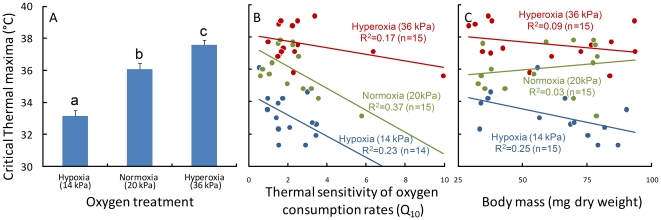
BACKGROUND: Thermal limits may arise through a mismatch between oxygen supply and demand in a range of animal taxa. Whilst this oxygen limitation hypothesis is supported by data from a range of marine fish and invertebrates, its generality remains contentious. In particular, it is unclear whether oxygen limitation determines thermal extremes in tracheated arthropods, where oxygen limitation may be unlikely due to the efficiency and plasticity of tracheal systems in supplying oxygen directly to metabolically active tissues. Although terrestrial taxa with open tracheal systems may not be prone to oxygen limitation, species may be affected during other life-history stages, particularly if these rely on diffusion into closed tracheal systems. Furthermore, a central role for oxygen limitation in insects is envisaged within a parallel line of research focussing on insect gigantism in the late Palaeozoic. METHODOLOGY/PRINCIPAL FINDINGS: Here we examine thermal maxima in the aquatic life stages of an insect at normoxia, hypoxia (14 kPa) and hyperoxia (36 kPa). We demonstrate that upper thermal limits do indeed respond to external oxygen supply in the aquatic life stages of the stonefly Dinocras cephalotes, suggesting that the critical thermal limits of such aquatic larvae are set by oxygen limitation. This could result from impeded oxygen delivery, or limited oxygen regulatory capacity, both of which have implications for our understanding of the limits to insect body size and how these are influenced by atmospheric oxygen levels. CONCLUSIONS/SIGNIFICANCE: These findings extend the generality of the hypothesis of oxygen limitation of thermal tolerance, suggest that oxygen constraints on body size may be stronger in aquatic environments, and that oxygen toxicity may have actively selected for gigantism in the aquatic stages of Carboniferous arthropods.
Overview
The claims and statistics of this paper haven’t been checked yet.
Free: it reads the open-access text and checks the first 5 claims that cite a source we can check. Create a free account to check every claim.
Integrity signals
Registry
Cites
Statistics
Figures
Verification
Claims the paper makes
The claims and statistics of this paper haven’t been checked yet.
Free: it reads the open-access text and checks the first 5 claims that cite a source we can check. Create a free account to check every claim.
Self-check
Percentages, sums and reported differences re-computed from the paper’s own numbers.
The self-check needs the paper’s full text.
Citations
Cites
Feder, M. E., & Hofmann, G. E. (1999) · Annual Review of Physiology · doi:10.1146/annurev.physiol.61.1.243 · Cited by 4,287 · cited 1×
“As CTmax is reached at lower temperatures in aquatic taxa, this is less likely to be a result of thermal damage at the cellular level such as the disruption of membrane structure and problems associated with protein folding [30,31], which would make oxygen limitation more decisive in setting thermal limits in aquatic…”
BackgroundGrimaldi, D. A., & Engel, M. S. (2005) · Cited by 2,618
Pörtner, H.-O. (2010) · Journal of Experimental Biology · doi:10.1242/jeb.037523 · Cited by 1,458 · cited 3×
“The idea of oxygen limitation as a mechanism setting upper thermal limits in animals was first expounded by Winterstein [1] and has since been greatly expanded by Po¨rtner and colleagues [2–5].”
BackgroundMethodPörtner, H. O. (2002) · Comparative Biochemistry and Physiology Part A: Molecular & Integrative Physiology · doi:10.1016/s1095-6433(02)00045-4 · Cited by 1,436 · cited 4×
“We used a dynamic method (acute exposure to changing temperatures) in contrast to most work performed on marine taxa, which used static methods (chronic exposure to constant temperatures [3,5 but see 2]).”
BackgroundMethodInfluentialH., P. (2001) · Naturwissenschaften · doi:10.1007/s001140100216 · Cited by 1,160 · cited 3×
“Given the central role of oxygen in hypotheses on limits to both thermal tolerance and body size [6,13,15–17], we also discuss how the results of our study may improve our understanding of the role of oxygen in setting body size limits in arthropods.”
BackgroundCritical thermal limits depend on methodological context
Terblanche, J. S., Deere, J. A., Clusella-Trullas, S., Janion, C., & Chown, S. L. (2007) · Proceedings of the Royal Society B: Biological Sciences · doi:10.1098/rspb.2007.0985 · Cited by 532 · cited 1×
“As faster rates of warming can result in higher critical thermal maxima [51,52], we employed the same rate of warming as employed in previous studies on terrestrial insects to minimize confounding effects arising from methodological differences in a direct comparison of our results with theirs.”
MethodFrederich, M., & Pörtner, H. O. (2000) · American Journal of Physiology-Regulatory, Integrative and Comparative Physiology · doi:10.1152/ajpregu.2000.279.5.r1531 · Cited by 418 · cited 2×
“As these measurements of oxygen consumption were performed at ecologically realistic temperatures, aerobic scope for feeding, growth and reproduction may be likewise affected by the interplay between external oxygen supply and organismal oxygen demand, although the thermal limits associated with these performance meas…”
BackgroundAnimal temperature limits and ecological relevance: effects of size, activity and rates of change
Peck, L. S., Clark, M. S., Morley, S. A., Massey, A., & Rossetti, H. (2009) · Functional Ecology · doi:10.1111/j.1365-2435.2008.01537.x · Cited by 374 · cited 1×
“As faster rates of warming can result in higher critical thermal maxima [51,52], we employed the same rate of warming as employed in previous studies on terrestrial insects to minimize confounding effects arising from methodological differences in a direct comparison of our results with theirs.”
MethodBerner, R. A., VandenBrooks, J. M., & Ward, P. D. (2007) · Science · doi:10.1126/science.1140273 · Cited by 366
Hoback, W. W., & Stanley, D. W. (2001) · Journal of Insect Physiology · doi:10.1016/s0022-1910(00)00153-0 · Cited by 352 · cited 1×
“Whilst species are likely to have experienced and evolved responses to cope with periods of hypoxia [38], the same may not apply for hyperoxia, putting aquatic larvae at greater risk of oxygen poisoning than terrestrial adults [39].”
Background
Research works printed but not linked: 2
- Winterstein H 1905 Wärmelähmung und Narkose. Z Allg Physiol 5 323 350
- ASTM 1980 Standard practice for conducting acute toxicity tests with fishes, macroinvertebrates and amphibians. American standard for testing and materials, Philadelphia, Pennsylvania, USA 279 280
Cited by
Shrinking of fishes exacerbates impacts of global ocean changes on marine ecosystems
Cheung, W. W. L., Sarmiento, J. L., Dunne, J., Frölicher, T. L., Lam, V. W. Y., Deng Palomares, M. L., Watson, R., & Pauly, D. (2013) · Nature Climate Change · doi:10.1038/nclimate1691 · Cited by 720
Upper thermal limits in terrestrial ectotherms: how constrained are they?
Hoffmann, A. A., Chown, S. L., & Clusella‐Trullas, S. (2013) · Functional Ecology · doi:10.1111/j.1365-2435.2012.02036.x · Cited by 681
Warming-induced reductions in body size are greater in aquatic than terrestrial species
Forster, J., Hirst, A. G., & Atkinson, D. (2012) · Proceedings of the National Academy of Sciences · doi:10.1073/pnas.1210460109 · Cited by 535
Verberk, W. C. E. P., van Noordwijk, C. G. E., & Hildrew, A. G. (2013) · Freshwater Science · doi:10.1899/12-092.1 · Cited by 355
“Controlled measurements of traits, such as sensitivity to pesticides (e.g., Liess et al. 2008), thermal tolerance, and O2 consumption (e.g., Verberk and Bilton 2011), could explain the selective effect of pesticides on assemblages or variation in the preferences of species for a certain thermal…”
BackgroundSelf-citationPörtner, H. (2012) · Marine Ecology Progress Series · doi:10.3354/meps10123 · Cited by 338
Does oxygen limit thermal tolerance in arthropods? A critical review of current evidence
Verberk, W. C. E. P., Overgaard, J., Ern, R., Bayley, M., Wang, T., Boardman, L., & Terblanche, J. S. (2016) · Comparative Biochemistry and Physiology Part A: Molecular & Integrative Physiology · doi:10.1016/j.cbpa.2015.10.020 · Cited by 321
Self-citationImpacts of global warming on Permo-Triassic terrestrial ecosystems
Benton, M. J., & Newell, A. J. (2014) · Gondwana Research · doi:10.1016/j.gr.2012.12.010 · Cited by 293
Rising water temperature in rivers: Ecological impacts and future resilience
Johnson, M. F., Albertson, L. K., Algar, A. C., Dugdale, S. J., Edwards, P. M., England, J., Gibbins, C. N., Kazama, S., Komori, D., MacColl, A. D. C., et al. (2024) · Wiley Interdisciplinary Reviews Water · doi:10.1002/wat2.1724 · Cited by 238
“For example, stonefly larvae increase their respiration rate when exposed to relatively warm Tw (Maison et al., 2022; Verbeck & Bilton, 2011).”
BackgroundMagozzi, S., & Calosi, P. (2015) · Global Change Biology · doi:10.1111/gcb.12695 · Cited by 182
The gill-oxygen limitation theory (GOLT) and its critics
Pauly, D. (2021) · Science Advances · doi:10.1126/sciadv.abc6050 · Cited by 182
Verberk, W. C. E. P., Durance, I., Vaughan, I. P., & Ormerod, S. J. (2016) · Global Change Biology · doi:10.1111/gcb.13240 · Cited by 160
“…experimental work on aquatic ectotherms (Frederich & P€ortner, 2000; P€ortner et al., 2006; Eliason et al., 2011), including those in freshwaters (Moran et al., 2010; Verberk & Bilton, 2011, 2013), has shown how improved water quality and increased water Correspondence: Wilco C. E. P. Verberk, tel.”
BackgroundMethodInfluentialSelf-citationRespiratory control in aquatic insects dictates their vulnerability to global warming
Verberk, W. C. E. P., & Bilton, D. T. (2013) · Biology Letters · doi:10.1098/rsbl.2013.0473 · Cited by 133
Self-citationHarrison, J. F., Greenlee, K. J., & Verberk, W. C. E. P. (2017) · Annual Review of Entomology · doi:10.1146/annurev-ento-020117-043145 · Cited by 141
Self-citationVerberk, W. C. E. P., & Atkinson, D. (2013) · Functional Ecology · doi:10.1111/1365-2435.12152 · Cited by 126
“Additionally, increases in oxygen could enhance oxygen toxicity especially for small aquatic organisms, as they are inherently poor regulators due to the high costs of regulating oxygen uptake (Verberk & Bilton 2011; Fig.”
BackgroundSelf-citationOntogenetic variation in thermal sensitivity shapes insect ecological responses to climate change
Kingsolver, J. G., & Buckley, L. B. (2020) · Current Opinion in Insect Science · doi:10.1016/j.cois.2020.05.005 · Cited by 139
“In marine invertebrates, decreasing heat tolerance with increasing body size across life stages supports the hypothesis that oxygen limits heat tolerance of larger aquatic organisms [23 ], and such effects also occur in aquatic insects [36].”
BackgroundMcDonnell, L. H., & Chapman, L. J. (2015) · Conservation Physiology · doi:10.1093/conphys/cov050 · Cited by 121
“…based on smaller-scale, shorter-term changes observed within and among species in response to environmental variables that are expected to play a significant role in climate change, such as temperature (Stillman, 2003; Calosi et al., 2010; Verberk and Bilton, 2011; Magozzi and Calosi, 2015).”
BackgroundVerberk, W. C. E. P., Sommer, U., Davidson, R. L., & Viant, M. R. (2013) · Integrative and Comparative Biology · doi:10.1093/icb/ict015 · Cited by 103
“Thermal limits in terrestrial insects are usually higher, making protein denaturation more likely (see also Verberk and Bilton 2011; Verberk and Calosi 2012).”
BackgroundMethodResultInfluentialSelf-citationIs the temperature-size rule mediated by oxygen in aquatic ectotherms?
Hoefnagel, K. N., & Verberk, W. C. E. P. (2015) · Journal of Thermal Biology · doi:10.1016/j.jtherbio.2014.12.003 · Cited by 94
Self-citationKearney, M., & White, C. R. (2012) · The American Naturalist · doi:10.1086/667860 · Cited by 103
Can respiratory physiology predict thermal niches?
Verberk, W. C. E. P., Bartolini, F., Marshall, D. J., Pörtner, H., Terblanche, J. S., White, C. R., & Giomi, F. (2015) · Annals of the New York Academy of Sciences · doi:10.1111/nyas.12876 · Cited by 98
Self-citationWhy might they be giants? Towards an understanding of polar gigantism
Moran, A. L., & Woods, H. A. (2012) · Journal of Experimental Biology · doi:10.1242/jeb.067066 · Cited by 95
Thomas, Y., Flye‐Sainte‐Marie, J., Chabot, D., Aguirre‐Velarde, A., Marques, G. M., & Pecquerie, L. (2018) · Journal of Sea Research · doi:10.1016/j.seares.2018.05.001 · Cited by 92
Verheyen, J., Delnat, V., & Stoks, R. (2019) · Environmental Science & Technology · doi:10.1021/acs.est.8b07166 · Cited by 73
Verberk, W. C. E. P., Leuven, R. S. E. W., van der Velde, G., & Gabel, F. (2018) · Functional Ecology · doi:10.1111/1365-2435.13050 · Cited by 68
“This mechanism has been suggested to be oxygen limitation (Chapelle & Peck, 1999; Pörtner, 2010; Verberk et al., 2011), and limits to oxygen provisioning are implicated in setting upper body size limits (e.g. Kaiser et al., 2007; Lane et al., 2017).”
Self-citationThermal physiology of the fingered limpet Lottia digitalis under emersion and immersion
Bjelde, B. E., & Todgham, A. E. (2013) · Journal of Experimental Biology · doi:10.1242/jeb.084178 · Cited by 68
de Beeck, L. O., Verheyen, J., & Stoks, R. (2016) · Environmental Pollution · doi:10.1016/j.envpol.2016.11.014 · Cited by 68
Kearney, M. (2020) · Biological reviews/Biological reviews of the Cambridge Philosophical Society · doi:10.1111/brv.12668 · Cited by 67
“…and, although network limitations may not always exist or occur in the manner expected (Aitkenhead et al., 2020), they may become limiting in certain situations such as low oxygen (Verberk & Bilton, 2011) and may be empirically tied to organismal shape changes (Hirst, Glazier, & Atkinson, 2014).”
BackgroundVerberk, W. C. E. P., & Calosi, P. (2012) · Journal of Thermal Biology · doi:10.1016/j.jtherbio.2012.01.004 · Cited by 65
Self-citationUrbina, M. A., & Glover, C. N. (2013) · Physiological and Biochemical Zoology · doi:10.1086/673727 · Cited by 67
Multiple Physiological Responses to Multiple Environmental Challenges: An Individual Approach
Calosi, P., Turner, L. M., Hawkins, M., Bertolini, C., Nightingale, G., Truebano, M., & Spicer, J. I. (2013) · Integrative and Comparative Biology · doi:10.1093/icb/ict041 · Cited by 64
Semsar-kazerouni, M., & Verberk, W. C. E. P. (2018) · Journal of Thermal Biology · doi:10.1016/j.jtherbio.2018.04.016 · Cited by 63
Self-citationPolyextremophiles and the Constraints for Terrestrial Habitability
Capece, M. C., Clark, E. B., Saleh, J. K., Halford, D., Heinl, N., Hoskins, S., & Rothschild, L. J. (2013) · Cellular origin, life in extreme habitats and astrobiology · doi:10.1007/978-94-007-6488-0_1 · Cited by 63
Oxygen safety margins set thermal limits in an insect model system
Boardman, L., & Terblanche, J. S. (2015) · Journal of Experimental Biology · doi:10.1242/jeb.120261 · Cited by 58
“Unlike in D. cephalotes (Verberk and Bilton, 2011), thermal sensitivity of oxygen consumption rates (Q10) are not correlated with CTmax in B. mori (Fig.”
BackgroundInfluentialOxygen supply limits the heat tolerance of lizard embryos
Smith, C. D., Telemeco, R. S., Angilletta, M. J., & VandenBrooks, J. M. (2015) · Biology Letters · doi:10.1098/rsbl.2015.0113 · Cited by 57
Oxidative stress in abalone: The role of temperature, oxygen and l-proline supplementation
Vosloo, D., Rensburg, L. D. V., & Vosloo, A. (2013) · Aquaculture · doi:10.1016/j.aquaculture.2013.09.031 · Cited by 50
N’Siala, G. M., Calosi, P., Bilton, D. T., Prevedelli, D., & Simonini, R. (2012) · Journal of Experimental Marine Biology and Ecology · doi:10.1016/j.jembe.2012.09.008 · Cited by 50
Self-citationVerberk, W. C. E. P., & Bilton, D. T. (2015) · Journal of Experimental Biology · doi:10.1242/jeb.119560 · Cited by 45
“…comparing juveniles and adults and keeping the gas exchange mechanism constant, we showed very similar levels of heat tolerance for both life stages, suggesting that differences between instars may not result from ontogenetic differences in their thermal physiology (Verberk and Bilton, 2011).”
InfluentialSelf-citationFusi, M., Cannicci, S., Daffonchio, D. G., Mostert, B. P., Pörtner, H., & Giomi, F. (2016) · Scientific Reports · doi:10.1038/srep19158 · Cited by 51
Koopman, K. R., Collas, F. P. L., van der Velde, G., & Verberk, W. C. E. P. (2016) · Hydrobiologia · doi:10.1007/s10750-015-2386-y · Cited by 47
“…in a range of species, such as fish (Mark et al., 2002), crustaceans (Ern et al., 2014, 2015), insects (Klok et al., 2004; Stevens et al., 2010; Verberk & Bilton, 2011, 2013, 2015; Verberk & Calosi, 2012; Neven et al., 2014), bivalves (Pörtner et al., 2006) and marine gastropods (Davenport &…”
Self-citationUpper Thermal Limits of Insects Are Not the Result of Insufficient Oxygen Delivery
McCue, M. D., & Santos, R. D. L. (2013) · Physiological and Biochemical Zoology · doi:10.1086/669932 · Cited by 45
“Despite general support for this theory in aquatic systems, the possibility that oxygen is limiting at upper lethal temperatures in airbreathing animals is less clear (Klok et al. 2004; Angilletta 2009; Stevens et al. 2010; Verberk and Bilton 2011; MacMillan et al. 2012).”
BackgroundA stressful shortness of breath: molting disrupts breathing in the mayfly Cloeon dipterum
Camp, A. A., Funk, D. H., & Buchwalter, D. B. (2014) · Freshwater Science · doi:10.1086/677899 · Cited by 44
“In aquatic insects, this paradigm is supported by studies of acute thermal challenge (Verberk and Bilton 2011, Verberk et al. 2011).”
Dong, Y., & Zhang, S. J. (2016) · Functional Ecology · doi:10.1111/1365-2435.12625 · Cited by 44
“The oxygen availability in air is ~30 times greater than in water (Truchot 1990; Verberk & Bilton 2011; Bjelde & Todgham © 2015 The Authors.”
BackgroundDelnat, V., Tran, T. T., Verheyen, J., Dinh, K. V., Janssens, L., & Stoks, R. (2019) · The Science of The Total Environment · doi:10.1016/j.scitotenv.2019.07.030 · Cited by 43
Pörtner, H., & Giomi, F. (2013) · Journal of Experimental Biology · doi:10.1242/jeb.095232 · Cited by 43
Leiva, F. P., Garcés, C., Verberk, W. C. E. P., Care, M., Paschke, K., & Gebauer, P. (2018) · Marine Biology · doi:10.1007/s00227-018-3406-z · Cited by 41
Self-citationRubalcaba, J. G., & Olalla‐Tárraga, M. Á. (2020) · Journal of Animal Ecology · doi:10.1111/1365-2656.13181 · Cited by 39
On being the wrong size, or the role of body mass in fish kills and hypoxia exposure
Müller, J., Houben, N., & Pauly, D. F. (2023) · Environmental Biology of Fishes · doi:10.1007/s10641-023-01442-w · Cited by 39
“Atmospheric oxygen concentrations have been associated with the evolution of different body size in various classes of animals: insect gigantism occurred in geological periods when the oxygen concentrations were significantly higher than in the present— with records of up to 35% during the later Paleozoic (Harrison et…”
BackgroundFarrell, A. P. (2013) · Journal of Experimental Biology · doi:10.1242/jeb.095471 · Cited by 38
Kim, K. S., Chou, H., Funk, D. H., Jackson, J. K., Sweeney, B. W., & Buchwalter, D. B. (2017) · Journal of Experimental Biology · doi:10.1242/jeb.156919 · Cited by 37
“This finding was also observed (Verberk and Bilton, 2013) in four additional species, and further work (Verberk and Bilton, 2015) showed that in the air-breathing aquatic insect Ilyocoris cimicoides, hypoxic water did not influence heat tolerance, whereas hypoxic water reduced heat tolerance in a…”
ResultEffects of Climate Change on Marine Organisms
Assan, D., Kuebutornye, F. K. A., Mustapha, U. F., Chen, H., & Li, G. (2020) · American Journal of Climate Change · doi:10.4236/ajcc.2020.93013 · Cited by 35
Ju, R., Wei, H., Wang, F., Zhou, X., & Li, B. (2013) · Cell Stress and Chaperones · doi:10.1007/s12192-013-0451-x · Cited by 33
Boardman, L., Sørensen, J. G., Johnson, S., & Terblanche, J. S. (2011) · Frontiers in Physiology · doi:10.3389/fphys.2011.00092 · Cited by 33
How to make progress in projecting climate change impacts
Cheung, W. W. L., Pauly, D. F., & Sarmiento, J. L. (2013) · ICES Journal of Marine Science · doi:10.1093/icesjms/fst133 · Cited by 32
Upper thermal tolerance in aquatic insects
Chown, S. L., Duffy, G. A., & Sørensen, J. G. (2015) · Current Opinion in Insect Science · doi:10.1016/j.cois.2015.09.012 · Cited by 32
Meng, S., Delnat, V., & Stoks, R. (2020) · Environmental Pollution · doi:10.1016/j.envpol.2020.114824 · Cited by 31
Vosloo, D., Vosloo, A., Morillion, E. J., Samuels, J. N., & Sommer, P. (2013) · Journal of Thermal Biology · doi:10.1016/j.jtherbio.2013.07.001 · Cited by 30
Lavin, C. P., Gordó−Vilaseca, C., Costello, M. J., Shi, Z., Stephenson, F., & Grüss, A. (2022) · Environmental Biology of Fishes · doi:10.1007/s10641-022-01270-4 · Cited by 30
Strong differences between two congeneric species in sensitivity to pesticides in a warming world
de Beeck, L. O., Verheyen, J., & Stoks, R. (2017) · The Science of The Total Environment · doi:10.1016/j.scitotenv.2017.10.311 · Cited by 27
“…but is also slow enough so that body temperatures of the test larvae can closely track the increasing water temperature (Dallas and Rivers-Moore, 2012), and lies in the range commonly used to assess thermal tolerance of aquatic insects (e.g. Verberk and Bilton, 2011; Dallas and Rivers-Moore, 2012).”
BackgroundCold tolerance is unaffected by oxygen availability despite changes in anaerobic metabolism
Boardman, L., Sørensen, J. G., Košťál, V., Šimek, P., & Terblanche, J. S. (2016) · Scientific Reports · doi:10.1038/srep32856 · Cited by 27
Chou, H., Pathmasiri, W., Deese-Spruill, J., Sumner, S., Jima, D. D., Funk, D. H., Jackson, J. K., Sweeney, B. W., & Buchwalter, D. B. (2018) · Frontiers in Ecology and Evolution · doi:10.3389/fevo.2018.00027 · Cited by 26
“…hypothesis has been questioned (Klok et al., 2004; Stevens et al., 2010; McCue and De Los Santos, 2013; Verberk et al., 2016), the applicability of OCLTT to aquatic insects has been demonstrated in the context of acute thermal tolerance (Verberk and Bilton, 2011, 2013, 2015; Verberk et al., 2013).”
BackgroundBjelde, B. E., Miller, N. A., Stillman, J. H., & Todgham, A. E. (2015) · Physiological and Biochemical Zoology · doi:10.1086/682220 · Cited by 25
Janssens, L., Verberk, W. C. E. P., & Stoks, R. (2018) · The Science of The Total Environment · doi:10.1016/j.scitotenv.2018.01.179 · Cited by 24
Self-citationOxygen concentration affects upper thermal tolerance in a terrestrial vertebrate
Shea, T. K., DuBois, P. M., Claunch, N. M., Murphey, N. E., Rucker, K. A., Brewster, R., & Taylor, E. N. (2016) · Comparative Biochemistry and Physiology Part A Molecular & Integrative Physiology · doi:10.1016/j.cbpa.2016.05.026 · Cited by 23
Collas, F. P. L., Buijse, A. D., Hendriks, A. J., van der Velde, G., & LEUVEN, R. S. E. W. (2018) · Ecosphere · doi:10.1002/ecs2.2184 · Cited by 23
“Recently, thermal tolerance of several freshwater ectotherms was found to be dependent on oxygen availability (Verberk and Bilton 2011, Verberk and Calosi 2012, Verberk et al. 2016).”
BackgroundGonzález‐Tokman, D., Gil-Pérez, Y., Servín-Pastor, M., Alvarado, F., Escobar, F., Baena‐Díaz, F., García‐Robledo, C., & Martínez‐M, I. (2020) · Journal of Economic Entomology · doi:10.1093/jee/toaa216 · Cited by 22
O’Briain, R., Shephard, S., & Coghlan, B. A. (2017) · Ecohydrology · doi:10.1002/eco.1890 · Cited by 20
“Moreover, this effect is more pronounced in organically polluted systems as increasing temperature and pollution interact to reduce available dissolved oxygen (Moran et al., 2010; Verberk & Bilton, 2011).”
BackgroundChou, H., Pathmasiri, W., Deese-Spruill, J., Sumner, S., & Buchwalter, D. B. (2017) · Journal of Insect Physiology · doi:10.1016/j.jinsphys.2017.07.008 · Cited by 19
Shishido, C. M., Woods, H. A., Lane, S. J., Toh, M. W. A., Tobalske, B. W., & Moran, A. L. (2019) · Proceedings of the Royal Society B Biological Sciences · doi:10.1098/rspb.2019.0124 · Cited by 18
García‐Robledo, C., Baer, C. S., Lippert, K., & Sarathy, V. (2020) · Functional Ecology · doi:10.1111/1365-2435.13666 · Cited by 18
Zhang, H., Zheng, D., Wáng, B., Fang, Y., & Jarzembowski, E. A. (2012) · Chinese Science Bulletin · doi:10.1007/s11434-012-5567-3 · Cited by 18
Effects of experimental warming on two tropical Andean aquatic insects
Gallegos-Sánchez, S., Domínguez, E., Encalada, A. C., & Ríos‐Touma, B. (2022) · PLoS ONE · doi:10.1371/journal.pone.0271256 · Cited by 18
Katzke, J., Barden, P., Dehon, M., Michez, D., & Wappler, T. (2018) · PeerJ · doi:10.7717/peerj.4242 · Cited by 16
The comparative biology of diving in two genera of European Dytiscidae (Coleoptera)
Calosi, P., Bilton, D. T., Spicer, J. I., Verberk, W. C. E. P., Atfield, A. J., & Garland, T. (2011) · Journal of Evolutionary Biology · doi:10.1111/j.1420-9101.2011.02423.x · Cited by 16
“In addition, respiratory performance may underlie heat tolerance in aquatic insects (Verberk & Bilton, 2011).”
BackgroundSelf-citationDuBois, P. M., Shea, T. K., Claunch, N. M., & Taylor, E. N. (2017) · Journal of Thermal Biology · doi:10.1016/j.jtherbio.2017.02.008 · Cited by 15
Szlachcic, E., & Czarnołęski, M. (2021) · Biology · doi:10.3390/biology10090861 · Cited by 14
van Kleef, H. H., Verberk, W. C. E. P., Kimenai, F. F. P., van der Velde, G., & LEUVEN, R. S. E. W. (2015) · Basic and Applied Ecology · doi:10.1016/j.baae.2015.02.007 · Cited by 14
Self-citationReconsidering the Oxygen–Temperature Hypothesis of Polar Gigantism: Successes, Failures, and Nuance
Woods, H. A., & Moran, A. L. (2020) · Integrative and Comparative Biology · doi:10.1093/icb/icaa088 · Cited by 13
Janssens, L., Verberk, W. C. E. P., & Stoks, R. (2021) · Environmental Pollution · doi:10.1016/j.envpol.2021.117019 · Cited by 11
Self-citationGrowth and status of Nile tilapia ( Oreochromis niloticus L.) stock in Lake Chamo, Ethiopia
Tesfaye, M., Tesfaye, G., & Getahun, A. (2021) · Lakes & Reservoirs Science Policy and Management for Sustainable Use · doi:10.1111/lre.12375 · Cited by 11
Szabla, N., Łabęcka, A. M., Antoł, A., Sobczyk, Ł., Angilletta, M. J., & Czarnołęski, M. (2024) · Journal of Insect Physiology · doi:10.1016/j.jinsphys.2024.104671 · Cited by 10
Malison, R. L., DelVecchia, A. G., Woods, H. A., Hand, B. K., Luikart, G., & Stanford, J. A. (2020) · Journal of Experimental Biology · doi:10.1242/jeb.225623 · Cited by 10
Cochran, J. K., Orr, S. E., & Buchwalter, D. B. (2021) · The Science of The Total Environment · doi:10.1016/j.scitotenv.2021.151743 · Cited by 9
Phelan, C., & Rotiberg, B. D. (2013) · Ecology and Evolution · doi:10.1002/ece3.589 · Cited by 9
“Perhaps an effect of body size on oxygen budgets is at work: a higher cost of being underwater for larger larvae might produce such a result (Verberk and Bilton 2011).”
BackgroundOxygen supply limits the heat tolerance of avian embryos
Vimmerstedt, J. C., Pérez, D. J. P., Angilletta, M. J., & VandenBrooks, J. M. (2019) · Biology Letters · doi:10.1098/rsbl.2019.0566 · Cited by 9
Fitzgibbon, Q. P., Ruff, N., & Battaglene, S. C. (2015) · Comparative Biochemistry and Physiology Part A Molecular & Integrative Physiology · doi:10.1016/j.cbpa.2015.02.007 · Cited by 9
Parks, R. (2020) · Western CEDAR (Western Washington University) · Cited by 7
Vilović, I., Schulze‐Makuch, D., & Heller, R. (2023) · Scientific Reports · doi:10.1038/s41598-023-39716-z · Cited by 7
中国已知最大的蜻蜓: 内蒙古侏罗纪的赵氏修复蟌蜓(Hsiufua chaoi Zhang et Wang, gen. et sp. nov.)
郑, 大., 王, 博., 方, 艳., RZEMBOWSKIEdmundA, J. A., & 张, 海. (2013) · Chinese Science Bulletin (Chinese Version) · doi:10.1360/csb2013-58-14-1340 · Cited by 6
Biotic interactions modify the effects of oxygen on insect gigantism
Chown, S. L. (2012) · Proceedings of the National Academy of Sciences · doi:10.1073/pnas.1207931109 · Cited by 6
The effect of ambient oxygen on the thermal performance of a cockroach, Nauphoeta cinerea
Lombardi, E. J., Bywater, C. L., & White, C. R. (2020) · Journal of Experimental Biology · doi:10.1242/jeb.208306 · Cited by 5
Nature-Inspired Malware and Anomaly Detection in Android-Based Systems
Upadhyay, S. (2021) · EAI/Springer Innovations in Communication and Computing · doi:10.1007/978-3-030-90708-2_5 · Cited by 3
Induced Power Scaling Alone Cannot Explain Griffenfly Gigantism
Ellers, O., Gordon, C. M., Hukill, M. T., Kukaj, A., Cannell, A., & Nel, A. (2024) · Integrative and Comparative Biology · doi:10.1093/icb/icae046 · Cited by 3
Kaiser, M. J. (2015) · Springer eBooks · doi:10.1007/978-3-319-17013-8_2 · Cited by 3
Foneron, M. A. U. (2013) · UC Research Repository (University of Canterbury) · doi:10.26021/6527 · Cited by 3
Body Size of Temperate Sea Spiders: No Evidence of Oxygen-Temperature Limitations
Shishido, C. M., Woods, H. A., Tobalske, B. W., Lane, S. J., & Moran, A. L. (2020) · Biological Bulletin · doi:10.1086/709831 · Cited by 2
Trade-Offs of Symbiotic Relationships between Aquatic Hosts and Algae in a Changing World
Small, D. P., & Bishop, C. D. (2016) · WORLD SCIENTIFIC (EUROPE) eBooks · doi:10.1142/9781786340580_0008 · Cited by 2
Cioffi, R. (2017) · PEARL (University of Plymouth) · doi:10.24382/749 · Cited by 2
Multi-Level Effects of Oxygen Exposure in Endothermic Insects
Wilmsen, S. M. (2022) · University of North Texas Digital Library (University of North Texas) · doi:10.12794/metadc1986787 · Cited by 2
McDonnell, L. (2015) · doi:10.82308/3992 · Cited by 2
Metadata
- Authors
- Verberk, W. C. E. P., & Bilton, D. T.
- Affiliations
- University of Plymouth (GB)
- Corresponding author
- Verberk, Wilco C. E. P.
- Venue
- PLoS ONE
- Publisher
- Public Library of Science (PLoS)
- Published
- 2011-07-27
- Volume
- 6
- Issue
- 7
- Pages
- e22610
- ISSN
- 1932-6203 (ISSN-L)
- PMC
- PMC3144910
- OpenAlex
- W2156076762
- Cited by
- 101
- References
- 53
- Citations by year
- 2024: 3 · 2023: 2 · 2022: 3 · 2021: 6 · 2020: 11 · 2019: 4 · 2018: 11 · 2017: 6 · 2016: 6 · 2015: 14 · 2014: 3 · 2013: 18 · 2012: 12
- FWCI
- 9.86
- Type
- journal article
- Language
- en
- Open access
- gold
- doi.org
- Locations
- PLoS ONE (publishedVersion, cc-by)
- Europe PMC (PubMed Central) (publishedVersion, cc-by)
- PubMed Central (publishedVersion, cc-by)
- PubMed (publishedVersion)
- PEARL (University of Plymouth) (submittedVersion)
- DOAJ (DOAJ: Directory of Open Access Journals) (submittedVersion)
- Radboud Repository (Radboud University) (submittedVersion)
- Radboud Repository (Radboud University) (submittedVersion, other-oa)
- Funders
- Nederlandse Organisatie voor Wetenschappelijk Onderzoek (825.09.009)
- Topics
- Physical Sciences › Environmental Science › Ecology › Physiological and biochemical adaptations
- Life Sciences › Agricultural and Biological Sciences › Insect Science › Insect and Arachnid Ecology and Behavior
- Physical Sciences › Environmental Science › Ecology › Crustacean biology and ecology
- Keywords
- oxygen limitation, heat tolerance, critical thermal maximum, Plecoptera, hypoxia, hyperoxia, oxygen toxicity, aquatic larvae, body size limits, oxygen supply and demand
- MeSH terms
- Animals, Body Temperature, Body Weight, Insecta, Larva, Oxygen, Oxygen Consumption, Body Size
About these checks
Registry, retraction, Cites and statistics results are computed, not judged, with one exception: a printed reference that no index lists is read once by a model before it counts as a citation error. Claims are extracted by a model and kept only when their quote appears verbatim in the text; each cited source is then checked, with a model’s help, for whether it says what the claim relies on. Those verdicts can be wrong — read the claim’s quote and the cited source before relying on one.
Statistics and arithmetic are recomputed, not judged.
Confidence bands are shown only for fields calibrated on our annotated test set. None is calibrated yet, so no band is shown.
What counts as a claim ›How we measure confidence ›How we check this ›
Are you an author, or do you see a problem with this page? Request a review
Data sources
Bibliographic data: Semantic Scholar, OpenAlex, Crossref.
Contains information from the Semantic Scholar Academic Graph Datasets, made available under the ODC Attribution License (ODC-BY 1.0).
Semantic Scholar’s data is described in: Kinney, R., et al. (2023). The Semantic Scholar Open Data Platform. arXiv:2301.10140.
