

Can oxygen set thermal limits in an insect and drive gigantism
Open accessThe DOI matches its Crossref record; 52 of the 53 references it cites were found in a registry or an index.
Abstract
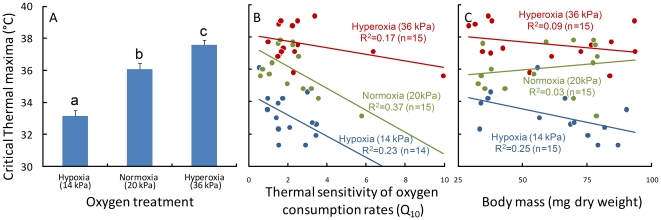
BACKGROUND: Thermal limits may arise through a mismatch between oxygen supply and demand in a range of animal taxa. Whilst this oxygen limitation hypothesis is supported by data from a range of marine fish and invertebrates, its generality remains contentious. In particular, it is unclear whether oxygen limitation determines thermal extremes in tracheated arthropods, where oxygen limitation may be unlikely due to the efficiency and plasticity of tracheal systems in supplying oxygen directly to metabolically active tissues. Although terrestrial taxa with open tracheal systems may not be prone to oxygen limitation, species may be affected during other life-history stages, particularly if these rely on diffusion into closed tracheal systems. Furthermore, a central role for oxygen limitation in insects is envisaged within a parallel line of research focussing on insect gigantism in the late Palaeozoic. METHODOLOGY/PRINCIPAL FINDINGS: Here we examine thermal maxima in the aquatic life stages of an insect at normoxia, hypoxia (14 kPa) and hyperoxia (36 kPa). We demonstrate that upper thermal limits do indeed respond to external oxygen supply in the aquatic life stages of the stonefly Dinocras cephalotes, suggesting that the critical thermal limits of such aquatic larvae are set by oxygen limitation. This could result from impeded oxygen delivery, or limited oxygen regulatory capacity, both of which have implications for our understanding of the limits to insect body size and how these are influenced by atmospheric oxygen levels. CONCLUSIONS/SIGNIFICANCE: These findings extend the generality of the hypothesis of oxygen limitation of thermal tolerance, suggest that oxygen constraints on body size may be stronger in aquatic environments, and that oxygen toxicity may have actively selected for gigantism in the aquatic stages of Carboniferous arthropods.
Overview
The claims and statistics of this paper haven’t been checked yet.
Free: it reads the open-access text and checks the first 5 claims that cite a source we can check. Create a free account to check every claim.
Integrity signals
Registry
Cites
Statistics
Figures
Verification
Claims the paper makes
The claims and statistics of this paper haven’t been checked yet.
Free: it reads the open-access text and checks the first 5 claims that cite a source we can check. Create a free account to check every claim.
Self-check
Percentages, sums and reported differences re-computed from the paper’s own numbers.
The self-check needs the paper’s full text.
Citations
Cites
Feder, M. E., & Hofmann, G. E. (1999) · Annual Review of Physiology · doi:10.1146/annurev.physiol.61.1.243 · Cited by 4,287 · cited 1×
“As CTmax is reached at lower temperatures in aquatic taxa, this is less likely to be a result of thermal damage at the cellular level such as the disruption of membrane structure and problems associated with protein folding [30,31], which would make oxygen limitation more decisive in setting thermal limits in aquatic…”
BackgroundGrimaldi, D. A., & Engel, M. S. (2005) · Cited by 2,618
Pörtner, H.-O. (2010) · Journal of Experimental Biology · doi:10.1242/jeb.037523 · Cited by 1,458 · cited 3×
“The idea of oxygen limitation as a mechanism setting upper thermal limits in animals was first expounded by Winterstein [1] and has since been greatly expanded by Po¨rtner and colleagues [2–5].”
BackgroundMethodPörtner, H. O. (2002) · Comparative Biochemistry and Physiology Part A: Molecular & Integrative Physiology · doi:10.1016/s1095-6433(02)00045-4 · Cited by 1,436 · cited 4×
“We used a dynamic method (acute exposure to changing temperatures) in contrast to most work performed on marine taxa, which used static methods (chronic exposure to constant temperatures [3,5 but see 2]).”
BackgroundMethodInfluentialH., P. (2001) · Naturwissenschaften · doi:10.1007/s001140100216 · Cited by 1,160 · cited 3×
“Given the central role of oxygen in hypotheses on limits to both thermal tolerance and body size [6,13,15–17], we also discuss how the results of our study may improve our understanding of the role of oxygen in setting body size limits in arthropods.”
BackgroundCritical thermal limits depend on methodological context
Terblanche, J. S., Deere, J. A., Clusella-Trullas, S., Janion, C., & Chown, S. L. (2007) · Proceedings of the Royal Society B: Biological Sciences · doi:10.1098/rspb.2007.0985 · Cited by 532 · cited 1×
“As faster rates of warming can result in higher critical thermal maxima [51,52], we employed the same rate of warming as employed in previous studies on terrestrial insects to minimize confounding effects arising from methodological differences in a direct comparison of our results with theirs.”
MethodFrederich, M., & Pörtner, H. O. (2000) · American Journal of Physiology-Regulatory, Integrative and Comparative Physiology · doi:10.1152/ajpregu.2000.279.5.r1531 · Cited by 418 · cited 2×
“As these measurements of oxygen consumption were performed at ecologically realistic temperatures, aerobic scope for feeding, growth and reproduction may be likewise affected by the interplay between external oxygen supply and organismal oxygen demand, although the thermal limits associated with these performance meas…”
BackgroundAnimal temperature limits and ecological relevance: effects of size, activity and rates of change
Peck, L. S., Clark, M. S., Morley, S. A., Massey, A., & Rossetti, H. (2009) · Functional Ecology · doi:10.1111/j.1365-2435.2008.01537.x · Cited by 374 · cited 1×
“As faster rates of warming can result in higher critical thermal maxima [51,52], we employed the same rate of warming as employed in previous studies on terrestrial insects to minimize confounding effects arising from methodological differences in a direct comparison of our results with theirs.”
MethodBerner, R. A., VandenBrooks, J. M., & Ward, P. D. (2007) · Science · doi:10.1126/science.1140273 · Cited by 366
Hoback, W. W., & Stanley, D. W. (2001) · Journal of Insect Physiology · doi:10.1016/s0022-1910(00)00153-0 · Cited by 352 · cited 1×
“Whilst species are likely to have experienced and evolved responses to cope with periods of hypoxia [38], the same may not apply for hyperoxia, putting aquatic larvae at greater risk of oxygen poisoning than terrestrial adults [39].”
Background
Research works printed but not linked: 2
- Winterstein H 1905 Wärmelähmung und Narkose. Z Allg Physiol 5 323 350
- ASTM 1980 Standard practice for conducting acute toxicity tests with fishes, macroinvertebrates and amphibians. American standard for testing and materials, Philadelphia, Pennsylvania, USA 279 280
Cited by
Shrinking of fishes exacerbates impacts of global ocean changes on marine ecosystems
Cheung, W. W. L., Sarmiento, J. L., Dunne, J., Frölicher, T. L., Lam, V. W. Y., Deng Palomares, M. L., Watson, R., & Pauly, D. (2013) · Nature Climate Change · doi:10.1038/nclimate1691 · Cited by 720
Upper thermal limits in terrestrial ectotherms: how constrained are they?
Hoffmann, A. A., Chown, S. L., & Clusella‐Trullas, S. (2013) · Functional Ecology · doi:10.1111/j.1365-2435.2012.02036.x · Cited by 681
Warming-induced reductions in body size are greater in aquatic than terrestrial species
Forster, J., Hirst, A. G., & Atkinson, D. (2012) · Proceedings of the National Academy of Sciences · doi:10.1073/pnas.1210460109 · Cited by 535
Verberk, W. C. E. P., van Noordwijk, C. G. E., & Hildrew, A. G. (2013) · Freshwater Science · doi:10.1899/12-092.1 · Cited by 355
“Controlled measurements of traits, such as sensitivity to pesticides (e.g., Liess et al. 2008), thermal tolerance, and O2 consumption (e.g., Verberk and Bilton 2011), could explain the selective effect of pesticides on assemblages or variation in the preferences of species for a certain thermal…”
BackgroundSelf-citationPörtner, H. (2012) · Marine Ecology Progress Series · doi:10.3354/meps10123 · Cited by 338
Metadata
- Authors
- Verberk, W. C. E. P., & Bilton, D. T.
- Affiliations
- University of Plymouth (GB)
- Corresponding author
- Verberk, Wilco C. E. P.
- Venue
- PLoS ONE
- Publisher
- Public Library of Science (PLoS)
- Published
- 2011-07-27
- Volume
- 6
- Issue
- 7
- Pages
- e22610
- ISSN
- 1932-6203 (ISSN-L)
- PMC
- PMC3144910
- OpenAlex
- W2156076762
- Cited by
- 101
- References
- 53
- Citations by year
- 2024: 3 · 2023: 2 · 2022: 3 · 2021: 6 · 2020: 11 · 2019: 4 · 2018: 11 · 2017: 6 · 2016: 6 · 2015: 14 · 2014: 3 · 2013: 18 · 2012: 12
- FWCI
- 9.86
- Type
- journal article
- Language
- en
- Open access
- gold
- doi.org
- Locations
- PLoS ONE (publishedVersion, cc-by)
- Europe PMC (PubMed Central) (publishedVersion, cc-by)
- PubMed Central (publishedVersion, cc-by)
- PubMed (publishedVersion)
- PEARL (University of Plymouth) (submittedVersion)
- DOAJ (DOAJ: Directory of Open Access Journals) (submittedVersion)
- Radboud Repository (Radboud University) (submittedVersion)
- Radboud Repository (Radboud University) (submittedVersion, other-oa)
- Funders
- Nederlandse Organisatie voor Wetenschappelijk Onderzoek (825.09.009)
- Topics
- Physical Sciences › Environmental Science › Ecology › Physiological and biochemical adaptations
- Life Sciences › Agricultural and Biological Sciences › Insect Science › Insect and Arachnid Ecology and Behavior
- Physical Sciences › Environmental Science › Ecology › Crustacean biology and ecology
- Keywords
- oxygen limitation, heat tolerance, critical thermal maximum, Plecoptera, hypoxia, hyperoxia, oxygen toxicity, aquatic larvae, body size limits, oxygen supply and demand
- MeSH terms
- Animals, Body Temperature, Body Weight, Insecta, Larva, Oxygen, Oxygen Consumption, Body Size
About these checks
Registry, retraction, Cites and statistics results are computed, not judged, with one exception: a printed reference that no index lists is read once by a model before it counts as a citation error. Claims are extracted by a model and kept only when their quote appears verbatim in the text; each cited source is then checked, with a model’s help, for whether it says what the claim relies on. Those verdicts can be wrong — read the claim’s quote and the cited source before relying on one.
Statistics and arithmetic are recomputed, not judged.
Confidence bands are shown only for fields calibrated on our annotated test set. None is calibrated yet, so no band is shown.
What counts as a claim ›How we measure confidence ›How we check this ›
Are you an author, or do you see a problem with this page? Request a review
Data sources
Bibliographic data: Semantic Scholar, OpenAlex, Crossref.
Contains information from the Semantic Scholar Academic Graph Datasets, made available under the ODC Attribution License (ODC-BY 1.0).
Semantic Scholar’s data is described in: Kinney, R., et al. (2023). The Semantic Scholar Open Data Platform. arXiv:2301.10140.
