

The Later Stone Age Calvaria from Iwo Eleru, Nigeria: Morphology and Chronology
Open accessThe DOI matches its Crossref record; 30 of the 30 references it cites were found in a registry or an index.
Abstract
BACKGROUND: In recent years the Later Stone Age has been redated to a much deeper time depth than previously thought. At the same time, human remains from this time period are scarce in Africa, and even rarer in West Africa. The Iwo Eleru burial is one of the few human skeletal remains associated with Later Stone Age artifacts in that region with a proposed Pleistocene date. We undertook a morphometric reanalysis of this cranium in order to better assess its affinities. We also conducted Uranium-series dating to re-evaluate its chronology. METHODOLOGY/PRINCIPAL FINDINGS: A 3-D geometric morphometric analysis of cranial landmarks and semilandmarks was conducted using a large comparative fossil and modern human sample. The measurements were collected in the form of three dimensional coordinates and processed using Generalized Procrustes Analysis. Principal components, canonical variates, Mahalanobis D(2) and Procrustes distance analyses were performed. The results were further visualized by comparing specimen and mean configurations. Results point to a morphological similarity with late archaic African specimens dating to the Late Pleistocene. A long bone cortical fragment was made available for U-series analysis in order to re-date the specimen. The results (∼11.7-16.3 ka) support a terminal Pleistocene chronology for the Iwo Eleru burial as was also suggested by the original radiocarbon dating results and by stratigraphic evidence. CONCLUSIONS/SIGNIFICANCE: Our findings are in accordance with suggestions of deep population substructure in Africa and a complex evolutionary process for the origin of modern humans. They further highlight the dearth of hominin finds from West Africa, and underscore our real lack of knowledge of human evolution in that region.
Overview
The claims and statistics of this paper haven’t been checked yet.
Free: it reads the open-access text and checks the first 5 claims that cite a source we can check. Create a free account to check every claim.
Integrity signals
Registry
Cites
Statistics
Figures
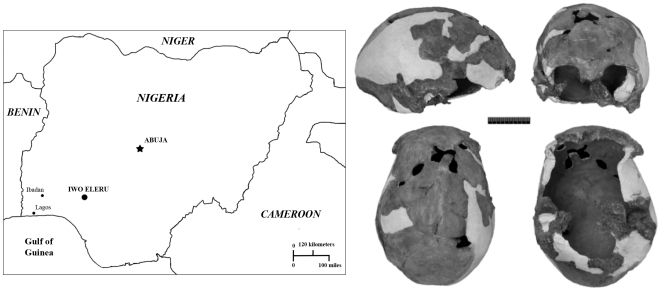
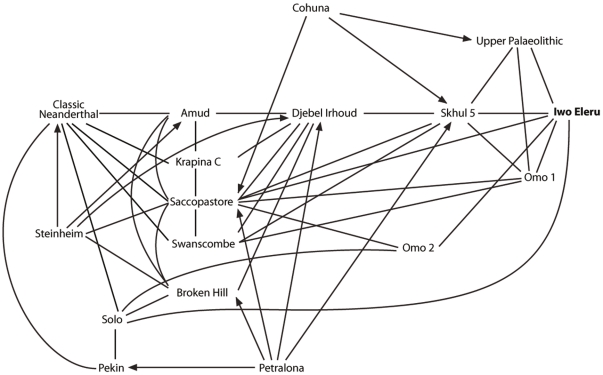
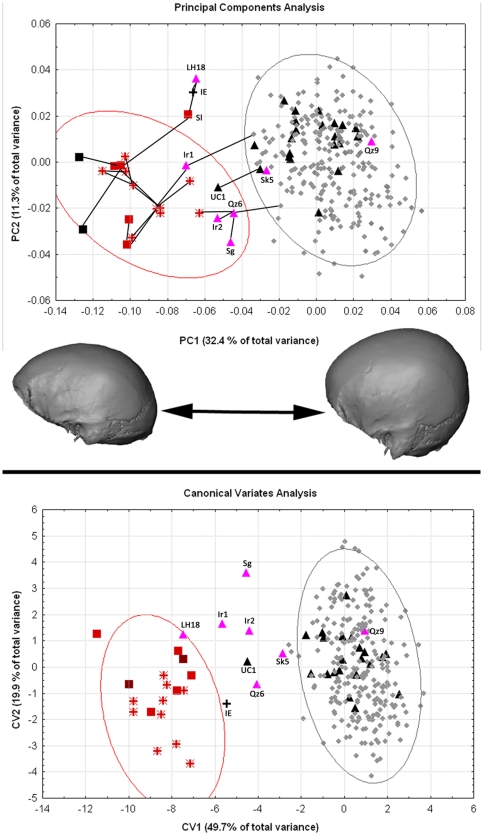
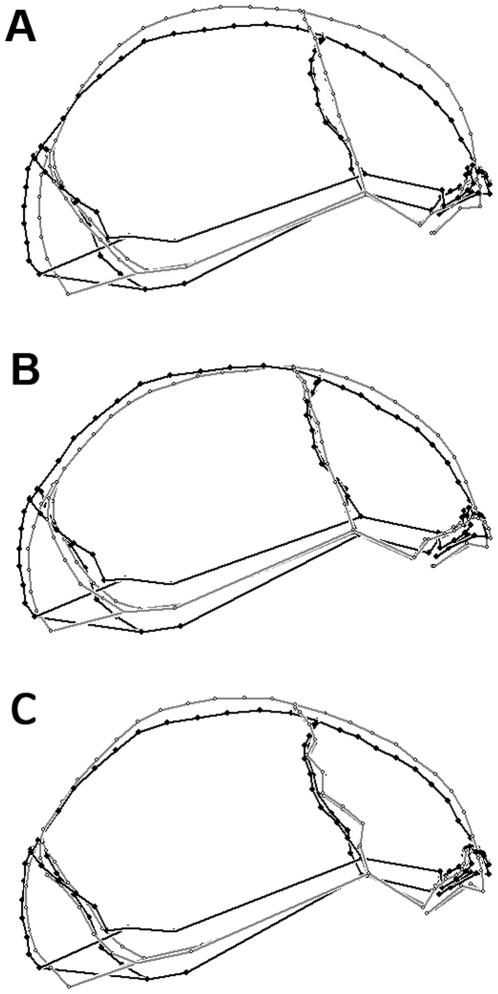
Verification
Claims the paper makes
The claims and statistics of this paper haven’t been checked yet.
Free: it reads the open-access text and checks the first 5 claims that cite a source we can check. Create a free account to check every claim.
Claims other papers make about this one
Each is checked against this paper’s own text: does it say what the citing paper says it does?
The source backs part of the claim, not all of it — or backs it for a different population, condition or comparison.
In the citing paper
“Although comparisons of midline contours suggest H. sapiens affinities for both cranial vaults, multivariate studies indicate somewhat closer affinities for JI2 to recent human samples [40,41].”
From The origin and evolution of Homo sapiens (2016) · cites this paper as [40]
Experimental — accuracy not yet measuredThe source backs part of the claim, not all of it — or backs it for a different population, condition or comparison.
In the citing paper
“These fossils may indicate deep Pleistocene population substructural variation, possibly including hybridization between late H. sapiens and surviving archaic hominin lineages [8,30,40,92], variation which was subsequently lost.”
From The origin and evolution of Homo sapiens (2016) · cites this paper as [40]
Experimental — accuracy not yet measuredThe cited source says what the claim attributes to it.
In the citing paper
“Despite its late date, it showed morphometric shape affinities to the much older Elandsfontein, Ngaloba, and Skhul and Qafzeh fossils [40,41].”
From The origin and evolution of Homo sapiens (2016) · cites this paper as [40]
The cited source says what the claim attributes to it.
In the citing paper
“Its dating was recently confirmed as late Pleistocene (approx.14 ka) but also confirmed was its morphological distinctiveness from recent African crania.”
From The origin and evolution of Homo sapiens (2016) · cites this paper as [40]
Self-check
Percentages, sums and reported differences re-computed from the paper’s own numbers.
The self-check needs the paper’s full text.
Citations
Cites
Landmark methods for forms without landmarks: morphometrics of group differences in outline shape
Bookstein, F. L. (1997) · Medical Image Analysis · doi:10.1016/s1361-8415(97)85012-8 · Cited by 1,584
The Genetic Structure and History of Africans and African Americans
Tishkoff, S. A., Reed, F. A., Friedlaender, F. R., Ehret, C., Ranciaro, A., Froment, A., Hirbo, J. B., Awomoyi, A. A., Bodo, J.-M., Doumbo, O., et al. (2009) · Science · doi:10.1126/science.1172257 · Cited by 1,573
Semilandmarks in Three Dimensions
Gunz, P., Mitteroecker, P., & Bookstein, F. L. (2006) · Developments in Primatology: Progress and Prospects · doi:10.1007/0-387-27614-9_3 · Cited by 779
Modern Morphometrics in Physical Anthropology
(2005) · Springer eBooks · doi:10.1007/0-387-27614-9 · Cited by 707
Contributions to morphometrics
Marcus, L. F., Bello, E., & Garcia-Valdecasas, A. (1993) · doi:10.5962/bhl.title.15368 · Cited by 469
Statistical assessment of bilateral symmetry of shapes
Mardia, K. (2000) · Biometrika · doi:10.1093/biomet/87.2.285 · Cited by 405 · cited 3×
“This is a process known as ‘reflected relabeling’ [25].”
Human cranial anatomy and the differential preservation of population history and climate signatures
Harvati, K., & Weaver, T. D. (2006) · The Anatomical Record Part A: Discoveries in Molecular, Cellular, and Evolutionary Biology · doi:10.1002/ar.a.20395 · Cited by 396 · cited 1×
“Past work has suggested that neurocranial shape reflects population history relatively reliably among modern human populations [14,15].”
Self-citationU-series and ESR analyses of bones and teeth relating to the human burials from Skhul
Grün, R., Stringer, C., McDermott, F., Nathan, R., Porat, N., Robertson, S., Taylor, L., Mortimer, G., Eggins, S., & McCulloch, M. (2005) · Journal of Human Evolution · doi:10.1016/j.jhevol.2005.04.006 · Cited by 338 · cited 1×
“Laser ablation U and U-series analyses were carried out at Australian National University; for the experimental set-up see [35,36] and for applications on human fossils [37,38,13].”
Self-citationGenetic evidence for archaic admixture in Africa
Hammer, M. F., Woerner, A. E., Mendez, F. L., Watkins, J. C., & Wall, J. D. (2011) · Proceedings of the National Academy of Sciences · doi:10.1073/pnas.1109300108 · Cited by 310
Eggins, S. M., Grün, R., McCulloch, M. T., Pike, A. W. G., Chappell, J., Kinsley, L., Mortimer, G., Shelley, M., Murray-Wallace, C. V., Spötl, C., et al. (2005) · Quaternary Science Reviews · doi:10.1016/j.quascirev.2005.07.006 · Cited by 304
Self-citation
Research works printed but not linked: 4
- Stringer CB Harvati K Allsworth-Jones P Grün R Folorunso CA 2010 New research on the Iwo Eleru cranium from Nigeria. Am J Phys Anthropol S50 292
- Pike AWG 2000 Uranium series dating of archaeological bone by thermal ionization mass spectrometry. Oxford D.Phil. Thesis, University of Oxford
- Crevecoeur I Semal P Cornelissen E Brooks AS 2010 The Late Stone Age human remains from Ishango (Democratic Republic of Congo): contribution to the study of the African Late Pleistocene modern human diversity. Am J Phys Anthropol S50 87
- Wolfram Research Inc. 2007 Mathematica Edition, Version 6.0. Champaign, Illinois Wolfram Research, Inc
Cited by
Items 101–178 of 178
Niger-Congo archaeolinguistics, including Bantu
Bostoen, K. A. G., Coutros, P. R., & Schlebusch, C. M. (2025) · Oxford University Press eBooks · doi:10.1093/oxfordhb/9780192868350.013.30 · Cited by 11
Sino-Tibetan archaeolinguistics
Bradley, D. T. C., Li, L., Ning, C., & Martello, R. D. (2025) · Oxford University Press eBooks · doi:10.1093/oxfordhb/9780192868350.013.22 · Cited by 5
Pruvost, C., Huysecom, É., Garnier, A., Hajdas, I., Höhn, A., Lespez, L., Rassé, M., Douze, K., Soriano, S., Fichet, V., et al. (2025) · PLoS ONE · doi:10.1371/journal.pone.0329824 · Cited by 3
Bönnen, M. N. T., Gosling, W. D., & Hooghiemstra, H. (2021) · CRC Press eBooks · doi:10.1201/9781003162766-23 · Cited by 3
Extended Distance-based Phylogenetic Analyses Applied to 3D Homo Fossil Skull EvolutionPreprint
Waddell, P. J. (2014) · arXiv (Cornell University) · doi:10.48550/arxiv.1501.00019 · Cited by 3
Evidence for discrete ochre exploitation 35,000 years ago in West Africa
Dayet, L., Martínez, M. L., Douze, K., Ndiaye, M., Tribolo, C., Rassé, M., Lespez, L., Bourdonnec, F. L., Schmid, V., Davidoux, S., et al. (2025) · Journal of Archaeological Science · doi:10.1016/j.jas.2024.106150 · Cited by 2
Rosas, A., García‐Tabernero, A., Fidalgo, D., Meñe, M. F., Rodríguez‐Berriguete, Á., Ebana, C. E., Ornia, M., Fernández-Martínez, J., & Morales, J. I. (2025) · Quaternary International · doi:10.1016/j.quaint.2025.109849 · Cited by 2
Historical comparative linguistics and language classification
Barlow, R., & Campbell, L. R. (2025) · Oxford University Press eBooks · doi:10.1093/oxfordhb/9780192868350.013.3 · Cited by 3
Bayesian phylogenetics for language prehistory— and archaeology
Heggarty, P., & Powell, A. (2025) · Oxford University Press eBooks · doi:10.1093/oxfordhb/9780192868350.013.11 · Cited by 3
Wichmann, S. (2025) · Oxford University Press eBooks · doi:10.1093/oxfordhb/9780192868350.013.6 · Cited by 3
Archaeolinguistics of Papuan languages
Schapper, A., Gaffney, D., & Brucato, N. (2025) · Oxford University Press eBooks · doi:10.1093/oxfordhb/9780192868350.013.26 · Cited by 3
Following the evolution of Homo sapiens across Africa using a uniparental genetic guide
Cabrera, V. M. (2023) · Medical Research Archives · doi:10.18103/mra.v11i1.3460 · Cited by 5
A Note On The Denisova Cave mtDNA SequencePreprint
Caldararo, N., & Guthrie, M. (2012) · Nature Precedings · doi:10.1038/npre.2012.5360.4 · Cited by 3
Ihò Eléérú [Iwo Eleru], Nigeria
Cerasoni, J. N., Orijemie, E. A., Hallett, E. Y., Farr, L., & Scerri, E. M. L. (2023) · Springer eBooks · doi:10.1007/978-3-031-20290-2_58 · Cited by 2
Archaeolinguistics of the languages of the Andes
Urban, M., Barbieri, C., & Rademaker, K. (2025) · Oxford University Press eBooks · doi:10.1093/oxfordhb/9780192868350.013.33 · Cited by 1
Indo-European archaeolinguistics
Lubotsky, A., & Pronk, T. (2025) · Oxford University Press eBooks · doi:10.1093/oxfordhb/9780192868350.013.18 · Cited by 2
Austronesian archaeolinguistics
Spriggs, M., Geraghty, P., & Liu, Y.-C. (2025) · Oxford University Press eBooks · doi:10.1093/oxfordhb/9780192868350.013.25 · Cited by 3
Vesakoski, O., Salmela, E., & Piezonka, H. (2025) · Oxford University Press eBooks · doi:10.1093/oxfordhb/9780192868350.013.19 · Cited by 5
Rosas, A., García‐Tabernero, A., Fidalgo, D., Morales, J. I., Saladié, P., Meñe, M. F., & Ebana, C. E. (2025) · Quaternary · doi:10.3390/quat8030045 · Cited by 1
“Indeed, the entire vast central part of the continent can be considered a paleontological desert, with the rare exceptions of the Iwo Eleru skull in Nigeria [2] or the Ishango remains in the Democratic Republic of Congo [3].”
Upper Paleolithic: Causes of the Middle Sapienses' Revolution
Rozov, N. S. (2026) · World-systems evolution and global futures · doi:10.1007/978-3-032-06466-0_17 · Cited by 1
Malaria shaped human spatial organization for the past 74 thousand years
Colucci, M., Leonardi, M., Blinkhorn, J., Irish, S. R., Padilla‐Iglesias, C., Kaboth‐Bahr, S., Gosling, W. D., Snow, R. W., Manica, A., & Scerri, E. M. L. (2026) · Science Advances · doi:10.1126/sciadv.aea2316 · Cited by 1
Tracing the origin of our species through palaeogenomics
Geigl, E.-M., Bennett, E. A., & Grange, T. (2015) · BIO Web of Conferences · doi:10.1051/bioconf/20150400005 · Cited by 1
Cabestrero-Rincón, M. A., Balzeau, A., & Lorenzo, C. (2018) · HOMO · doi:10.1016/j.jchb.2018.10.001 · Cited by 3
The latest steps of human evolution: What the hard evidence has to say about it?
Neves, W. A., Senger, M. H., Rocha, G., Valota, L., & Hübbe, M. (2024) · Quaternary Environments and Humans · doi:10.1016/j.qeh.2024.100005 · Cited by 3
Archaeolinguistics and the languages of hunter-gatherers
Evans, N. (2025) · Oxford University Press eBooks · doi:10.1093/oxfordhb/9780192868350.013.13 · Cited by 2
Dunn, M. G. (2025) · Oxford University Press eBooks · doi:10.1093/oxfordhb/9780192868350.013.7 · Cited by 1
Bowern, C., Llamas, B., Miceli, L., Tobler, R., & Veth, P. (2025) · Oxford University Press eBooks · doi:10.1093/oxfordhb/9780192868350.013.27 · Cited by 4
Porr, M. (2015) · ANU Press eBooks · doi:10.22459/lhdt.05.2015.12 · Cited by 2
The Middle Stone Age of Atlantic Africa: A critical review
Pereira, T., Oosterbeek, L., Pleurdeau, D., Camara, A., Bocoum, H., Thiam, D., Alabi, R. A., Koté, L., Toubga, L., Benjamim, M. H., et al. (2023) · L Anthropologie · doi:10.1016/j.anthro.2023.103209 · Cited by 3
Expanded Distance-based Phylogenetic Analyses of Fossil Homo Skull Shape EvolutionPreprint
Waddell, P. J. (2015) · arXiv (Cornell University) · doi:10.48550/arxiv.1512.09115 · Cited by 1
“The data used here are a set of 3D morphometric measurements based on 19 landmarks and 78 semi-landmarks from a set of modern and fossil skulls of the genus Homo (Harvati et al. 2011).”
BackgroundMethodInfluentialUpper Pleistocene population dynamics (Neandertals, Denisovans, Homo sapiens)
Crèvecoeur, I. (2024) · Elsevier eBooks · doi:10.1016/b978-0-323-99931-1.00257-9 · Cited by 1
Professor Thurstan Shaw CBE, FBA, FSA: a personal appreciation and remembrance
MacDonald, K. C. (2013) · Azania Archaeological Research in Africa · doi:10.1080/0067270x.2013.828390
Remembering Stephen G.H. Daniels
Allsworth-Jones, P. (2013) · Azania Archaeological Research in Africa · doi:10.1080/0067270x.2012.752921
“…133 136, http://dx.doi.org/10.1080/0067270X.2012.752921 # 2013 Taylor & Francis associated with a radiocarbon date of 11,2009200 BP (I-1753) indicate the late survival of archaic skeletal features and a more complicated transition to anatomical modernity than is often thought (Harvati et al. 2011).”
BackgroundInfluentialSelf-citationWaddell, P. J. (2016) · arXiv (Cornell University) · doi:10.48550/arxiv.1612.09595
Watson, D. J. (2018) · African Archaeological Review · doi:10.1007/s10437-018-9288-0
Garcea, E. A. A. (2020) · SpringerBriefs in archaeology. Archaeological heritage management/SpringerBriefs in archaeology/Springer briefs in archaeological heritage management · doi:10.1007/978-3-030-47185-9_2
Fahs, B. (2021) · Psychology and Sexuality · doi:10.1080/19419899.2021.1871775 · Cited by 1
Pettersson, U. (2020) · Faculty Opinions – Post-Publication Peer Review of the Biomedical Literature · doi:10.3410/f.737361910.793571755
Stankiewicz, P. (2020) · Faculty Opinions – Post-Publication Peer Review of the Biomedical Literature · doi:10.3410/f.737361910.793574278
Brāzma, A. (2019) · Faculty Opinions – Post-Publication Peer Review of the Biomedical Literature · doi:10.3410/f.733616666.793555011
Rose, J. I. (2022) · Springer textbooks in archaeology and heritage · doi:10.1007/978-3-030-95667-7_8
Africa, Tropical: Middle Stone Age
Niang, K. (2022) · Elsevier eBooks · doi:10.1016/b978-0-323-90799-6.00063-x
Modern Humans Disperse From Africa
Langdon, J. H. (2022) · Springer texts in social sciences · doi:10.1007/978-3-031-14157-7_19
Homo sapiens' birth and ProgRetrogProg evolution by DNA's extreme climate-induced rearrangementPreprint
ÇAKIR, Ş. (2023) · OSF Preprints (OSF Preprints) · doi:10.31219/osf.io/ph247
Palaeogenomics of Extinct and Archaic Hominins
Gilbert, M. T. P., & Lalueza‐Fox, C. (2023) · Wiley eBooks · doi:10.1002/9781119592112.ch32
Biosocial complexity and the skull
White, S., & Menéndez, L. P. (2023) · Elsevier eBooks · doi:10.1016/b978-0-12-821383-4.00008-5
Premo, L. S., & Režek, Ž. (2024) · Journal of Archaeological Method and Theory · doi:10.1007/s10816-024-09682-5
“However, while analyses of morphological ( e.g ., Bailey et al. , 2020; Gunz et al. , 2009; Harvati et al. , 2011) and genetic variation ( e.g ., Bergstrom et al. , 2021; Lipson et al. , 2022; Ragsdale et al. , 2023; Skoglund et al. , 2017) point generally to the structured character of the…”
Archaeolinguistics: Combining archaeology, genes, and language
Robbeets, M. (2025) · Oxford University Press eBooks · doi:10.1093/oxfordhb/9780192868350.013.1 · Cited by 2
Guo, J., Fan, Z., Yang, W., & Wang, C. (2025) · Oxford University Press eBooks · doi:10.1093/oxfordhb/9780192868350.013.24
Iversen, R., & Riede, F. (2025) · Oxford University Press eBooks · doi:10.1093/oxfordhb/9780192868350.013.35
(2025) · Oxford University Press eBooks · doi:10.1093/oxfordhb/9780192868350.002.0006
(2025) · Oxford University Press eBooks · doi:10.1093/oxfordhb/9780192868350.002.0011
Palaeosiberian archaeolinguistics
Potter, B. A., & Vajda, E. J. (2025) · Oxford University Press eBooks · doi:10.1093/oxfordhb/9780192868350.013.21 · Cited by 1
Prehistoric language change in social context
Bakker, P. (2025) · Oxford University Press eBooks · doi:10.1093/oxfordhb/9780192868350.013.8 · Cited by 1
Pagel, M. D. (2025) · Oxford University Press eBooks · doi:10.1093/oxfordhb/9780192868350.013.2 · Cited by 2
Transeurasian archaeolinguistics
Robbeets, M., Hudson, M. J., & Ning, C. (2025) · Oxford University Press eBooks · doi:10.1093/oxfordhb/9780192868350.013.20 · Cited by 2
Robbeets, M., & Hudson, M. J. (2025) · Oxford University Press eBooks · doi:10.1093/oxfordhb/9780192868350.013.37
Robbeets, M., & Hudson, M. J. (2025) · Oxford University Press eBooks · doi:10.1093/oxfordhb/9780192868350.002.0009 · Cited by 1
The relationship between genetics, language, and culture
Mace, R. H. (2025) · Oxford University Press eBooks · doi:10.1093/oxfordhb/9780192868350.013.12
Cultural reconstruction: How to infer the cultural environment of ancestral speakers
Epps, P. L., & Khanina, O. (2025) · Oxford University Press eBooks · doi:10.1093/oxfordhb/9780192868350.013.5 · Cited by 3
Evans, B. (2025) · Oxford University Press eBooks · doi:10.1093/oxfordhb/9780192868350.013.4
Archaeology and language change in the Bronze Age
Hudson, M. J., Bjørn, R., & Spengler, R. N. (2025) · Oxford University Press eBooks · doi:10.1093/oxfordhb/9780192868350.013.15
(2025) · Oxford University Press eBooks · doi:10.1093/oxfordhb/9780192868350.002.0004
(2025) · Oxford University Press eBooks · doi:10.1093/oxfordhb/9780192868350.002.0007
Archaeology and language dynamics in the medieval and early modern eras
Hudson, M. J., Harland, J. M., & Crowther, A. (2025) · Oxford University Press eBooks · doi:10.1093/oxfordhb/9780192868350.013.17 · Cited by 1
Nilo-Saharan archaeolinguistics
Dimmendaal, G. J., & Babiker, H. M. A. (2025) · Oxford University Press eBooks · doi:10.1093/oxfordhb/9780192868350.013.29
Farming and language dispersals consequent upon the oldest developments of food production
Bellwood, P. S. (2025) · Oxford University Press eBooks · doi:10.1093/oxfordhb/9780192868350.013.14
Barbieri, C., & Widmer, P. (2025) · Oxford University Press eBooks · doi:10.1093/oxfordhb/9780192868350.013.36 · Cited by 1
Ancient states and the rise of writing
Haicheng, W. (2025) · Oxford University Press eBooks · doi:10.1093/oxfordhb/9780192868350.013.16
The archaeolinguistics of Kalahari Basin area languages
Güldemann, T., Smith, A. B., & Bajić, V. (2025) · Oxford University Press eBooks · doi:10.1093/oxfordhb/9780192868350.013.31 · Cited by 5
Archaeolinguistics of language families and contact areas of Amazonia
van Gijn, R., Arias, L., & de Souza, J. G. (2025) · Oxford University Press eBooks · doi:10.1093/oxfordhb/9780192868350.013.34 · Cited by 2
Ehret, C., Schoenbrun, D. L., Brandt, S., & Keita, S. O. Y. (2025) · Oxford University Press eBooks · doi:10.1093/oxfordhb/9780192868350.013.28 · Cited by 1
The African Springboard to Final Sapientation and Species Unity
Rozov, N. S. (2026) · World-systems evolution and global futures · doi:10.1007/978-3-032-06466-0_15
The morphological affinities of the fossil cranium from Kabua, Kenya
Bosman, A. M., Buck, L. T., Reyes‐Centeno, H., Lahr, M. M., Stringer, C. B., Grün, R., Shao, Q., & Harvati, K. (2026) · Journal of the Royal Anthropological Institute · doi:10.1111/1467-9655.70137
Self-citationEvolutionary drivers of encephalization and facial reduction in the genus Homo
Hübbe, M., & Harvati, K. (2026) · Nature Communications · doi:10.1038/s41467-026-74739-w
Self-citationMiddle stone age occupation in eastern kerma region of the third cataract, northern Sudan
Khaleel, O., Barbieri, A., Galán, S. S.-D., Haws, J., Carvalho, M. M., Honegger, M., Baykal, Y., Buylaert, J., Wahab, M. A., Mergani, Z., et al. (2026) · Quaternary Science Reviews · doi:10.1016/j.quascirev.2026.110257
Reassessment of the morphological evidence for hominin hybrids in the Levant
White, S., & Stringer, C. B. (2026) · Journal of the Royal Anthropological Institute · doi:10.1111/1467-9655.70216
Self-citation
Metadata
- Authors
- Harvati, K., Stringer, C., Grün, R., Aubert, M., Allsworth-Jones, P., & Folorunso, C. A.
- Affiliations
- Senckenberg Centre for Human Evolution and Palaeoenvironment (DE)
- Natural History Museum (GB)
- Australian National University (AU)
- University of Sheffield (GB)
- University of Ibadan (NG)
- Corresponding author
- Harvati, Katerina
- Venue
- PLoS ONE
- Publisher
- Public Library of Science (PLoS)
- Published
- 2011-09-15
- Volume
- 6
- Issue
- 9
- Pages
- e24024
- ISSN
- 1932-6203 (ISSN-L)
- PMC
- PMC3174138
- OpenAlex
- W1985075107
- Cited by
- 180
- References
- 30
- Citations by year
- 2026: 7 · 2025: 45 · 2024: 6 · 2023: 12 · 2022: 7 · 2021: 13 · 2020: 8 · 2019: 7 · 2018: 12 · 2017: 9 · 2016: 15 · 2015: 14 · 2014: 9 · 2013: 8 · 2012: 8
- FWCI
- 34.79
- Type
- journal article
- Language
- en
- Update notices
- correction (2013-11-07)
- Open access
- gold
- doi.org
- Locations
- PLoS ONE (publishedVersion, cc-by)
- Europe PMC (PubMed Central) (publishedVersion, cc-by)
- PubMed Central (publishedVersion, cc-by)
- PubMed (publishedVersion)
- White Rose Research Online (University of Leeds, The University of Sheffield, University of York) (acceptedVersion)
- Digital Commons - University of South Florida (University of South Florida) (submittedVersion)
- Research Online (University of Wollongong) (submittedVersion)
- RePEc: Research Papers in Economics (submittedVersion)
- DOAJ (DOAJ: Directory of Open Access Journals) (submittedVersion, cc-by-sa)
- Figshare (submittedVersion, cc-by)
- Figshare (submittedVersion)
- ANU Open Research (Australian National University) (submittedVersion, cc-by)
- Griffith Research Online (submittedVersion, cc-by)
- Topics
- Social Sciences › Anthropology › Pleistocene-Era Hominins and Archaeology
- Social Sciences › Arts and Humanities › Archeology (arts and humanities) › Forensic Anthropology and Bioarchaeology Studies
- Life Sciences › Agricultural and Biological Sciences › Ecology, Evolution, Behavior and Systematics › Morphological variations and asymmetry
- Keywords
- Later Stone Age, calvaria, skull, skull morphology, geometric morphometrics, uranium-series dating, Late Pleistocene, skeletal remains, West Africa, human evolution, modern human origins
- MeSH terms
- Animals, Biological Evolution, Female, Fossils, Geography, Humans, Male, Models, Anatomic, Nigeria, Skull, Hominidae, Multivariate Analysis, Imaging, Three-Dimensional, Principal Component Analysis
About these checks
Registry, retraction, Cites and statistics results are computed, not judged, with one exception: a printed reference that no index lists is read once by a model before it counts as a citation error. Claims are extracted by a model and kept only when their quote appears verbatim in the text; each cited source is then checked, with a model’s help, for whether it says what the claim relies on. Those verdicts can be wrong — read the claim’s quote and the cited source before relying on one.
Statistics and arithmetic are recomputed, not judged.
Confidence bands are shown only for fields calibrated on our annotated test set. None is calibrated yet, so no band is shown.
What counts as a claim ›How we measure confidence ›How we check this ›
Are you an author, or do you see a problem with this page? Request a review
Data sources
Bibliographic data: Semantic Scholar, OpenAlex, Crossref.
Contains information from the Semantic Scholar Academic Graph Datasets, made available under the ODC Attribution License (ODC-BY 1.0).
Semantic Scholar’s data is described in: Kinney, R., et al. (2023). The Semantic Scholar Open Data Platform. arXiv:2301.10140.
