

The DOI matches its Crossref record; 36 of the 36 references it cites were found in a registry or an index.
Extending Brain-Training to the Affective Domain: Increasing Cognitive and Affective Executive Control through Emotional Working Memory Training
Open accessAbstract
So-called 'brain-training' programs are a huge commercial success. However, empirical evidence regarding their effectiveness and generalizability remains equivocal. This study investigated whether brain-training (working memory [WM] training) improves cognitive functions beyond the training task (transfer effects), especially regarding the control of emotional material since it constitutes much of the information we process daily. Forty-five participants received WM training using either emotional or neutral material, or an undemanding control task. WM training, regardless of training material, led to transfer gains on another WM task and in fluid intelligence. However, only brain-training with emotional material yielded transferable gains to improved control over affective information on an emotional Stroop task. The data support the reality of transferable benefits of demanding WM training and suggest that transferable gains across to affective contexts require training with material congruent to those contexts. These findings constitute preliminary evidence that intensive cognitively demanding brain-training can improve not only our abstract problem-solving capacity, but also ameliorate cognitive control processes (e.g. decision-making) in our daily emotive environments.
Overview
The claims and statistics of this paper haven’t been checked yet.
Run the check — free, no account needed. It reads the open-access text and checks the sources it cites.
Integrity signals
Registry
Cites
Statistics
Figures
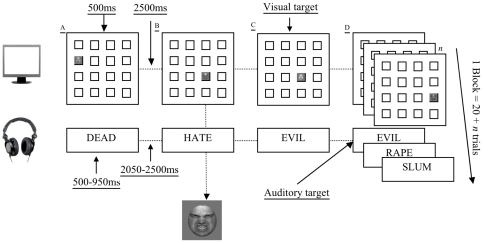
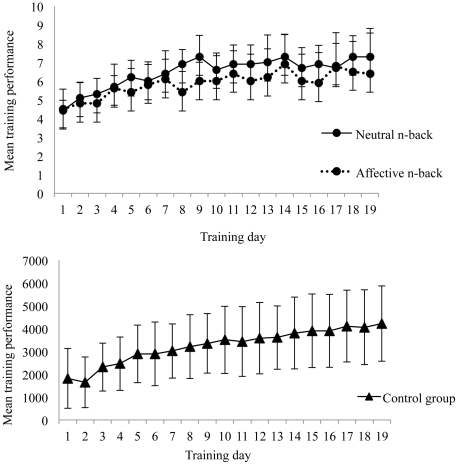
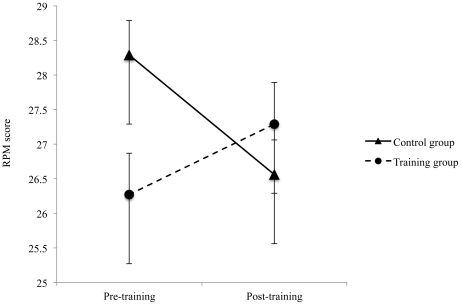
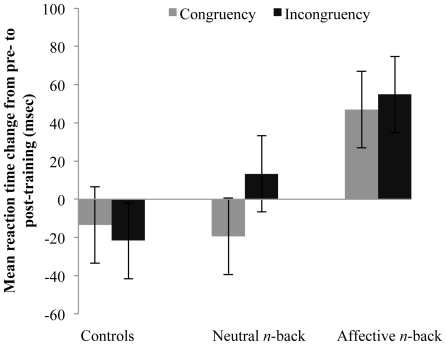
Verification
Claims the paper makes
The claims and statistics of this paper haven’t been checked yet.
Run the check — free, no account needed. It reads the open-access text and checks the sources it cites.
Claims other papers make about this one
Each is checked against this paper’s own text: does it say what the citing paper says it does?
The cited source says what the claim attributes to it.
In the citing paper
“After only the most problematic study has been removed from the analysis (Schweizer et al., 2011), the effects of N-back training on nonverbal ability with treated controls is negligible (g = 0.10).”
From Working Memory Training Does Not Improve Performance on Measures of Intelligence or Other Measures of “Far Transfer”: Evidence From a Meta-Analytic Review (2016) · cites this paper as Schweizer et al., 2011
The cited source says what the claim attributes to it.
In the citing paper
“there is no consensus regarding transfer to inhibitory control measures, with some WM training studies reporting training-related benefits59,60,71,72, yet others failing to find evidence of transfer51,73.”
From Near transfer to an unrelated N-back task mediates the effect of N-back working memory training on matrix reasoning (2022) · cites this paper as [71]
In the citing paper
“Dual n-back working memory training has been associated with improvement on similar dual n-back tasks, other tasks of working memory, and the broader construct of fluid intelligence [5–18]”
From Dual N-back working memory training in healthy adults: A randomized comparison to processing speed training. (2016) · cites this paper as [11]
In the citing paper
“Although near and far transfer effects, albeit mixed, have been demonstrated after dual n-back training in younger (e.g., under 30) and older (e.g., over 60) age groups [5–12,15,17,18] effects were not previously investigated in a middle age-range sample.”
From Dual N-back working memory training in healthy adults: A randomized comparison to processing speed training. (2016) · cites this paper as [11]
In the citing paper
“Importantly, affective executive control appears to improve following systematic training6 7 and to be compromised in individuals suffering from mental health difficulties, including in younger samples.8”
Self-check
Percentages, sums and reported differences re-computed from the paper’s own numbers.
The self-check needs the paper’s full text.
Citations
Cites
Why Most Published Research Findings Are False
Ioannidis, J. P. A. (2005) · PLoS Medicine · doi:10.1371/journal.pmed.0020124 · Cited by 10,505
Why Most Published Research Findings Are False
Ioannidis, J. P. A. (2005) · CHANCE · doi:10.1080/09332480.2005.10722754 · Cited by 4,702 · cited 1×
“, [15]) and that the jury should remain out, pending replication of any given findings by an independent research team.”
BackgroundN-back working memory paradigm: a meta-analysis of normative functional neuroimaging studies.
Owen, A. M., McMillan, K. M., Laird, A. R., & Bullmore, E. (2005) · Human Brain Mapping · doi:10.1002/hbm.20131 · Cited by 3,560
Neuropsychological assessment.
Cipolotti, L., & Warrington, E. K. (1995) · Journal of Neurology Neurosurgery & Psychiatry · doi:10.1136/jnnp.58.6.655 · Cited by 3,267
Working memory span tasks: A methodological review and user’s guide
Conway, A. R. A., Kane, M. J., Bunting, M. F., Hambrick, D. Z., Wilhelm, O., & Engle, R. W. (2005) · Psychonomic Bulletin & Review · doi:10.3758/bf03196772 · Cited by 2,882
Common regions of the human frontal lobe recruited by diverse cognitive demands
Duncan, J., & Owen, A. M. (2000) · Trends in Neurosciences · doi:10.1016/s0166-2236(00)01633-7 · Cited by 2,498
The emotional Stroop task and psychopathology
Williams, J. M. G., Mathews, A., & MacLeod, C. (1996) · Psychological Bulletin · doi:10.1037/0033-2909.120.1.3 · Cited by 2,420
Improving fluid intelligence with training on working memory
Jaeggi, S. M., Buschkuehl, M., Jonides, J., & Perrig, W. J. (2008) · Proceedings of the National Academy of Sciences · doi:10.1073/pnas.0801268105 · Cited by 2,187
Computerized training of working memory in children with ADHD – a randomized, controlled trial
Klingberg, T., Fernell, E., Olesen, P. J., Johnson, M., Gustafsson, P., Dahlström, K., Gillberg, C. G., Forssberg, H., & Westerberg, H. (2005) · Journal of the American Academy of Child & Adolescent Psychiatry · doi:10.1097/00004583-200502000-00010 · Cited by 1,949 · cited 1×
“, ADHD, schizophrenia) and healthy adults [5–8].”
The Architecture of Cognitive Control in the Human Prefrontal Cortex
Koechlin, É., Ody, C., & Kouneiher, F. (2003) · Science · doi:10.1126/science.1088545 · Cited by 1,939
Research works printed but not linked: 1
- M D'Esposito, 2000, Prefrontal cortical contributions to working memory: evidence from event-related fMRI studies., Experimental Brain Research, 133, 3, 10.1007/s002210000395 · DOI
Cited by
Sorted by citations
Do “brain-training” programs work?
Simons, D. J., Boot, W. R., Charness, N., Gathercole, S. E., Chabris, C. F., Hambrick, D. Z., & Stine-Morrow, E. A. L. (2016) · Psychological Science in the Public Interest · doi:10.1177/1529100616661983 · Cited by 1,183
Melby-Lervåg, M., Redick, T. S., & Hulme, C. (2016) · Perspectives on Psychological Science · doi:10.1177/1745691616635612 · Cited by 983
Depression: A cognitive perspective
LeMoult, J., & Gotlib, I. H. (2019) · Clinical Psychology Review · doi:10.1016/j.cpr.2018.06.008 · Cited by 792
Examining emotion regulation in depression: A review and future directions
Joormann, J., & Stanton, C. H. (2016) · Behaviour Research and Therapy · doi:10.1016/j.brat.2016.07.007 · Cited by 749
Improving fluid intelligence with training on working memory: a meta-analysis
Au, J., Sheehan, E., Tsai, N., Duncan, G. J., Buschkuehl, M., & Jaeggi, S. M. (2015) · Psychonomic Bulletin & Review · doi:10.3758/s13423-014-0699-x · Cited by 727
Metadata
- Authors
- Schweizer, S., Hampshire, A., & Dalgleish, T.
- Affiliations
- MRC Cognition and Brain Sciences Unit (GB)
- Western University (CA)
- Corresponding author
- Schweizer, Susanne
- Venue
- PLoS ONE
- Publisher
- Public Library of Science (PLoS)
- Published
- 2011-09-19
- Volume
- 6
- Issue
- 9
- Pages
- e24372
- ISSN
- 1932-6203 (ISSN-L)
- PMC
- PMC3176229
- OpenAlex
- W2057146321
- Cited by
- 198
- References
- 35
- Citations by year
- 2026: 5 · 2025: 15 · 2024: 10 · 2023: 12 · 2022: 13 · 2021: 18 · 2020: 12 · 2019: 16 · 2018: 23 · 2017: 13 · 2016: 13 · 2015: 19 · 2014: 11 · 2013: 11 · 2012: 7
- FWCI
- 11.96
- Type
- journal article
- Language
- en
- Open access
- gold
- doi.org
- Locations
- PLoS ONE (publishedVersion, cc-by)
- Europe PMC (PubMed Central) (publishedVersion, cc-by)
- PubMed Central (publishedVersion, cc-by)
- PubMed (publishedVersion)
- UNSWorks (University of New South Wales, Sydney, Australia) (submittedVersion, cc-by-nc-nd)
- DOAJ (DOAJ: Directory of Open Access Journals) (submittedVersion, cc-by-sa)
- Figshare (submittedVersion, cc-by)
- Funders
- Medical Research Council
- Topics
- Social Sciences › Psychology › Experimental and Cognitive Psychology › Cognitive Abilities and Testing
- Life Sciences › Neuroscience › Cognitive Neuroscience › Neural and Behavioral Psychology Studies
- Social Sciences › Psychology › Experimental and Cognitive Psychology › Cognitive Functions and Memory
- Keywords
- brain training, working memory training, emotional working memory, executive function, affective control, transfer effects, fluid intelligence, emotional Stroop task
- MeSH terms
- Adult, Brain, Cognition, Emotions, Female, Humans, Male, Memory, Short-Term, Photic Stimulation, User-Computer Interface, Young Adult, Executive Function
About these checks
Registry, retraction, Cites and statistics results are computed, not judged, with one exception: a printed reference that no index lists is read once by a model before it counts as a citation error. Claims are extracted by a model and kept only when their quote appears verbatim in the text; each cited source is then checked, with a model’s help, for whether it says what the claim relies on. Those verdicts can be wrong — read the claim’s quote and the cited source before relying on one.
Statistics and arithmetic are recomputed, not judged.
Confidence bands are shown only for fields calibrated on our annotated test set. None is calibrated yet, so no band is shown.
What counts as a claim ›How we measure confidence ›How we check this ›
Are you an author, or do you see a problem with this page? Request a review
