

The DOI matches its Crossref record; 36 of the 36 references it cites were found in a registry or an index.
The Human Endogenous Circadian System Causes Greatest Platelet Activation during the Biological Morning Independent of Behaviors
Open accessAbstract
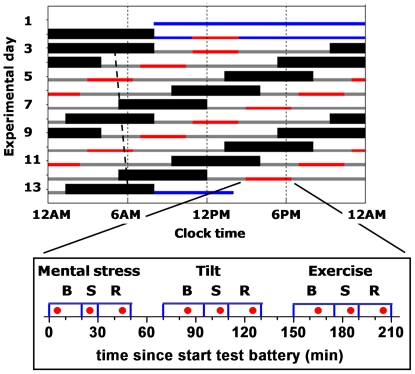
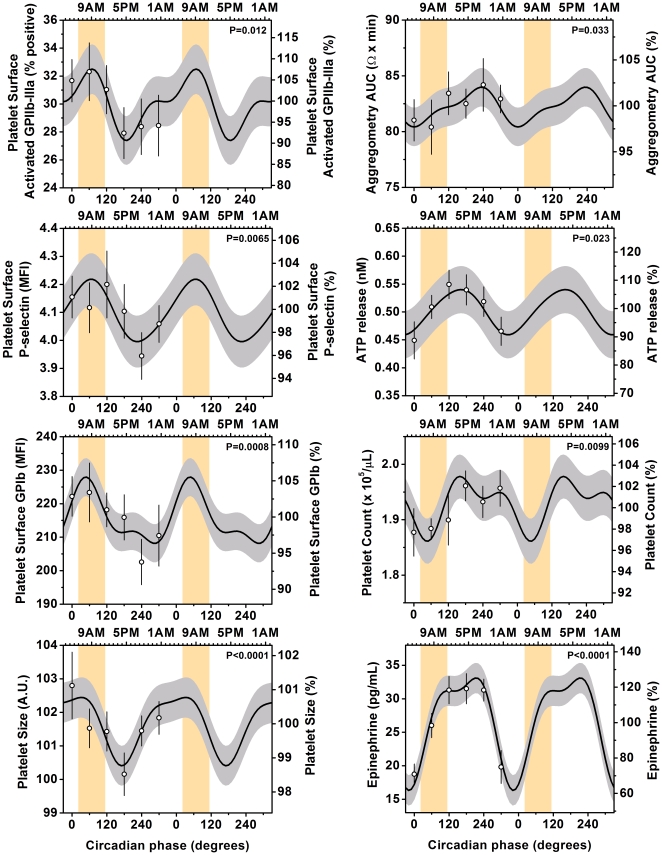
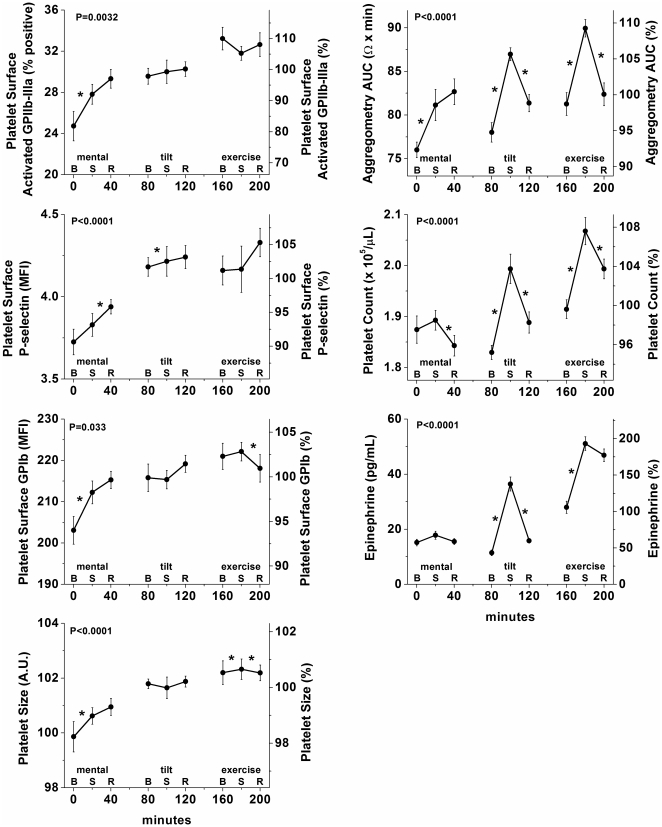
BACKGROUND: Platelets are involved in the thromboses that are central to myocardial infarctions and ischemic strokes. Such adverse cardiovascular events have day/night patterns with peaks in the morning (~9 AM), potentially related to endogenous circadian clock control of platelet activation. The objective was to test if the human endogenous circadian system influences (1) platelet function and (2) platelet response to standardized behavioral stressors. We also aimed to compare the magnitude of any effects on platelet function caused by the circadian system with that caused by varied standardized behavioral stressors, including mental arithmetic, passive postural tilt and mild cycling exercise. METHODOLOGY/PRINCIPAL FINDINGS: We studied 12 healthy adults (6 female) who lived in individual laboratory suites in dim light for 240 h, with all behaviors scheduled on a 20-h recurring cycle to permit assessment of endogenous circadian function independent from environmental and behavioral effects including the sleep/wake cycle. Circadian phase was assessed from core body temperature. There were highly significant endogenous circadian rhythms in platelet surface activated glycoprotein (GP) IIb-IIIa, GPIb and P-selectin (6-17% peak-trough amplitudes; p ≤ 0.01). These circadian peaks occurred at a circadian phase corresponding to 8-9 AM. Platelet count, ATP release, aggregability, and plasma epinephrine also had significant circadian rhythms but with later peaks (corresponding to 3-8 PM). The circadian effects on the platelet activation markers were always larger than that of any of the three behavioral stressors. CONCLUSIONS/SIGNIFICANCE: These data demonstrate robust effects of the endogenous circadian system on platelet activation in humans--independent of the sleep/wake cycle, other behavioral influences and the environment. The 9 AM timing of the circadian peaks of the three platelet surface markers, including platelet surface activated GPIIb-IIIa, the final common pathway of platelet aggregation, suggests that endogenous circadian influences on platelet function could contribute to the morning peak in adverse cardiovascular events as seen in many epidemiological studies.
Overview
The claims and statistics of this paper haven’t been checked yet.
Run the check — free, no account needed. It reads the open-access text and checks the sources it cites.
Integrity signals
Registry
Cites
Statistics
Figures
Verification
Claims the paper makes
The claims and statistics of this paper haven’t been checked yet.
Run the check — free, no account needed. It reads the open-access text and checks the sources it cites.
Claims other papers make about this one
Each is checked against this paper’s own text: does it say what the citing paper says it does?
In the citing paper
“There are also effects of the circadian system on platelet activation, with a morning peak in platelet surface-activated GPIIb-IIIa, the final part of the platelet aggregation pathway (115).”
From Role of the circadian system in cardiovascular disease (2018) · cites this paper as [115]
In the citing paper
“Platelet count and aggregability peaked at a circadian phase equivalent to 3–8 PM”
From The impact of the circadian timing system on cardiovascular and metabolic function (2012) · cites this paper as Scheer et al., 2011
In the citing paper
“platelet size and surface expressions of activated GPIIb-IIIa, P-selectin, and GP1b were all greatest during the biological morning, corresponding to 6 AM to noon”
From The impact of the circadian timing system on cardiovascular and metabolic function (2012) · cites this paper as Scheer et al., 2011
In the citing paper
“The reactivity of the above platelet measures to mental, postural, and physical stress was not significantly influenced by the circadian timing system, and thus, the influence of the circadian timing system and that of behavioral stressors appear to be additive”
From The impact of the circadian timing system on cardiovascular and metabolic function (2012) · cites this paper as Scheer et al., 2011
In the citing paper
“Recent work has demonstrated in healthy humans that platelet size, count, aggregability, and platelet surface expression of activated GPIIb-IIIa, P-selectin, and GP1b—factors involved in the pathway of platelet aggregation and adhesion to subendothelial tissue (Merten et al., 2000; Phillips et al., 1988; Sadler, 1998)—are influenced by the circadian timing system”
From The impact of the circadian timing system on cardiovascular and metabolic function (2012) · cites this paper as Scheer et al., 2011
Self-check
Percentages, sums and reported differences re-computed from the paper’s own numbers.
The self-check needs the paper’s full text.
Citations
Cites
Adverse metabolic and cardiovascular consequences of circadian misalignment
Scheer, F. A. J. L., Hilton, M. F., Mantzoros, C. S., & Shea, S. A. (2009) · Proceedings of the National Academy of Sciences · doi:10.1073/pnas.0808180106 · Cited by 2,351
Self-citationResetting central and peripheral circadian oscillators in transgenic rats
Yamazaki, S., Numano, R., Abe, M., Hida, A., Takahashi, R.-I., Ueda, M., Block, G. D., Sakaki, Y., Menaker, M., & Tei, H. (2000) · Science · doi:10.1126/science.288.5466.682 · Cited by 1,907
Circadian Variation in the Frequency of Onset of Acute Myocardial Infarction
Muller, J. E., Stone, P. H., Turi, Z. G., Rutherford, J. D., Czeisler, C. A., Parker, C., Poole, W. K., Passamani, E., Roberts, R., Robertson, T., et al. (1985) · New England Journal of Medicine · doi:10.1056/nejm198511213132103 · Cited by 1,884
Stability, precision, and near-24-hour period of the human circadian pacemaker
Czeisler, C. A., Duffy, J. F., Shanahan, T. L., Brown, E. N., Mitchell, J. F., Rimmer, D. W., Ronda, J. M., Silva, E. J., Allan, J. S., Emens, J. S., et al. (1999) · Science · doi:10.1126/science.284.5423.2177 · Cited by 1,705
Ruggeri, Z. M. (2002) · Nature Medicine · doi:10.1038/nm1102-1227 · Cited by 1,605
Circadian variation in the frequency of sudden cardiac death.
Muller, J. E., Ludmer, P. L., Willich, S. N., Tofler, G. H., Aylmer, G., Klangos, I., & Stone, P. H. (1987) · Circulation · doi:10.1161/01.cir.75.1.131 · Cited by 1,083
Tofler, G. H., Brezinski, D., Schafer, A. I., Czeisler, C. A., Rutherford, J. D., Willich, S. N., Gleason, R. E., Williams, G. H., & Muller, J. E. (1987) · New England Journal of Medicine · doi:10.1056/nejm198706113162405 · Cited by 1,072
Changes in the platelet membrane glycoprotein IIb.IIIa complex during platelet activation.
Shattil, S. J., Hoxie, J. A., Cunningham, M. C., & Brass, L. F. (1985) · Journal of Biological Chemistry · doi:10.1016/s0021-9258(17)39154-8 · Cited by 942
Circadian clocks in human red blood cells
O'Neill, J. S., & Reddy, A. B. (2011) · Nature · doi:10.1038/nature09702 · Cited by 843
Increased risk of ischaemic heart disease in shift workers
Knutsson, A., Jonsson, B., Akerstedt, T., & Orth-Gomer, K. (1986) · The Lancet · doi:10.1016/s0140-6736(86)91619-3 · Cited by 459
Impact of the human circadian system, exercise, and their interaction on cardiovascular function
Scheer, F. A. J. L., Hu, K., Evoniuk, H., Kelly, E. E., Malhotra, A., Hilton, M. F., & Shea, S. A. (2010) · Proceedings of the National Academy of Sciences · doi:10.1073/pnas.1006749107 · Cited by 332
Self-citationEffect of strenuous exercise on platelet activation state and reactivity.
Kestin, A. S., Ellis, P. A., Barnard, M. R., Errichetti, A., ROSNER, B. A., & Michelson, A. D. (1993) · Circulation · doi:10.1161/01.cir.88.4.1502 · Cited by 311
Self-citationMethods for the Measurement of Platelet Function
Michelson, A. D. (2009) · The American Journal of Cardiology · doi:10.1016/j.amjcard.2008.11.019 · Cited by 274
Self-citationPlatelet GPIIb/IIIa antagonists: the first anti-integrin receptor therapeutics.
Coller, B. S. (1997) · Journal of Clinical Investigation · doi:10.1172/jci119307 · Cited by 272
von Willebrand factor binding to platelet GpIb initiates signals for platelet activation.
Kroll, M. H., Harris, T. S., Moake, J. L., Handin, R. I., & Schafer, A. I. (1991) · Journal of Clinical Investigation · doi:10.1172/jci115468 · Cited by 265
Melatonin Rhythms in Night Shift Workers
Sack, R. L., Blood, M. L., & Lewy, A. J. (1992) · SLEEP · doi:10.1093/sleep/15.5.434 · Cited by 181
Existence of an Endogenous Circadian Blood Pressure Rhythm in Humans That Peaks in the Evening
Shea, S. A., Hilton, M. F., Hu, K., & Scheer, F. A. J. L. (2011) · Circulation Research · doi:10.1161/circresaha.110.233668 · Cited by 179
Self-citationMelatonin, sleep, and circadian rhythms
Scheer, F. A. J. L., & Czeisler, C. A. (2004) · Sleep Medicine Reviews · doi:10.1016/j.smrv.2004.11.004 · Cited by 152
Self-citationPatient Demographic and Clinical Features and Circadian Variation in Onset of Ischemic Stroke
Casetta, I., Granieri, E., Fallica, E., la Cecilia, O., Paolino, E., & Manfredini, R. (2002) · Archives of Neurology · doi:10.1001/archneur.59.1.48 · Cited by 147
Reid, K. J., & Zee, P. P. (2009) · Seminars in Neurology · doi:10.1055/s-0029-1237120 · Cited by 137
Application of Flow Cytometry to Platelet Disorders
Linden, M. D., Frelinger, A. L., Barnard, M. R., Przyklenk, K., Furman, M. I., & Michelson, A. D. (2004) · Seminars in Thrombosis and Hemostasis · doi:10.1055/s-2004-835671 · Cited by 120
Self-citationThe circadian melatonin and cortisol secretion pattern in permanent night shift workers
Roden, M., Koller, M. M., Pirich, K., Vierhapper, H., & Waldhauser, F. (1993) · American Journal of Physiology-Regulatory, Integrative and Comparative Physiology · doi:10.1152/ajpregu.1993.265.1.r261 · Cited by 114
Mechanisms Underlying the Morning Increase in Platelet Aggregation: A Flow Cytometry Study
Andrews, N. P., Gralnick, H. R., Merryman, P. K., Vail, M., & Quyyumi, A. A. (1996) · Journal of the American College of Cardiology · doi:10.1016/s0735-1097(96)00398-1 · Cited by 92
Endogenous Circadian Rhythm in Vasovagal Response to Head-Up Tilt
Hu, K., Scheer, F. A. J. L., Laker, M., Smales, C., & Shea, S. A. (2011) · Circulation · doi:10.1161/circulationaha.110.943019 · Cited by 74
Self-citationDeficiency in core circadian protein Bmal1 is associated with a prothrombotic and vascular phenotype
Somanath, P. R., Podrez, E. A., Chen, J., Ma, Y., Marchant, K., Antoch, M. P., & Byzova, T. V. (2010) · Journal of Cellular Physiology · doi:10.1002/jcp.22314 · Cited by 69
Fontayne, A., Meiring, M., Lamprecht, S., Roodt, J. P., Demarsin, E., Barbeaux, P., & Deckmyn, H. (2008) · Thrombosis and Haemostasis · doi:10.1160/th08-02-0073 · Cited by 69
Relationships between Spleen, Platelets and Factor VIII Levels
Libre, E. P., Cowan, D. H., Watkins, S. P., & Shulman, N. R. (1968) · Blood · doi:10.1182/blood.v31.3.358.358 · Cited by 58
Bedard, P. W., Clerin, V. M., Sushkova, N., Tchernychev, B., Antrilli, T. M., Resmini, C., Keith, J. C., Hennan, J. K., Kaila, N., DeBernardo, S., et al. (2007) · Journal of Pharmacology and Experimental Therapeutics · doi:10.1124/jpet.107.128124 · Cited by 51
P-Selectin/PSGL-1 and Other Interactions between Platelets, Leukocytes, and Endothelium
McEver, R. P. (2007) · Elsevier eBooks · doi:10.1016/b978-012369367-9/50774-6 · Cited by 50
Zar, M. D. L. M. D., Martinuzzo, M. E., Falcón, C., Cardinali, D. P., Carreras, L. O., & Vacas, M. I. (1990) · The Journal of Clinical Endocrinology & Metabolism · doi:10.1210/jcem-70-1-246 · Cited by 48
Prophylactic Aspirin Treatment: The Merits of Timing
Cornélissen, G. (1991) · JAMA · doi:10.1001/jama.1991.03470220044018 · Cited by 45
Glutathione levels in human platelets display a circadian rhythm in vitro
Radha, E., Hill, T. D., Rao, G. H. R., & White, J. G. (1985) · Thrombosis Research · doi:10.1016/0049-3848(85)90319-6 · Cited by 36
CLOCK regulates circadian platelet activity
Ohkura, N., Oishi, K., Sudo, T., Hayashi, H., Shikata, K., Ishida, N., Matsuda, J., & Horie, S. (2008) · Thrombosis Research · doi:10.1016/j.thromres.2008.03.009 · Cited by 32
The clock gene Per2 is required for normal platelet formation and function
Zhao, Y., Zhang, Y., Wang, S., Hua, Z., & Zhang, J. (2010) · Thrombosis Research · doi:10.1016/j.thromres.2010.11.025 · Cited by 25
Holme, S., Heaton, A., Konchuba, A. M., & Hartman, P. (1988) · PubMed · Cited by 24
Agonist-specific refractory states of bovine platelets -disappearance of synergism in aggregation-
Imada, T., Saito, Y., Shimada, H., & Inada, Y. (1983) · Thrombosis Research · doi:10.1016/0049-3848(83)90112-3 · Cited by 9
Cited by
Sorted by citations
Witwer, K. W., Buzás, E. I., Bemis, L., Bora, A., Lässer, C., Lötvall, J. O., Hoen, E. N. M. N., Piper, M. G., Sivaraman, S., Skog, J., et al. (2013) · Journal of Extracellular Vesicles · doi:10.3402/jev.v2i0.20360 · Cited by 2,513
The Functional and Clinical Significance of the 24-Hour Rhythm of Circulating Glucocorticoids
Oster, H., Challet, E., Ott, V., Arvat, E., de Kloet, E. R., Dijk, D.-J., Lightman, S., Vgontzas, A., & Van Cauter, E. (2017) · Endocrine Reviews · doi:10.1210/er.2015-1080 · Cited by 548
Circadian clock control of endocrine factors
Gamble, K. L., Berry, R., Frank, S. J., & Young, M. E. (2014) · Nature Reviews Endocrinology · doi:10.1038/nrendo.2014.78 · Cited by 539
Circadian rhythms and the molecular clock in cardiovascular biology and disease
Crnko, S., Du Pré, B. C., Sluijter, J. P. G., & Van Laake, L. W. (2019) · Nature Reviews Cardiology · doi:10.1038/s41569-019-0167-4 · Cited by 499
Circadian disruption and human health
Fishbein, A. B., Knutson, K. L., & Zee, P. C. (2021) · Journal of Clinical Investigation · doi:10.1172/jci148286 · Cited by 468
Metadata
- Authors
- Scheer, F. A. J. L., Michelson, A. D., Frelinger, A. L., Evoniuk, H., Kelly, E. E., McCarthy, M., Doamekpor, L. A., Barnard, M. R., & Shea, S. A.
- Affiliations
- Brigham and Women's Hospital (US)
- Boston Children's Hospital (US)
- Corresponding author
- Scheer, Frank A. J. L.
- Shea, Steven A.
- ORCID
- Venue
- PLoS ONE
- Publisher
- Public Library of Science (PLoS)
- Published
- 2011-09-08
- Volume
- 6
- Issue
- 9
- Pages
- e24549
- ISSN
- 1932-6203 (ISSN-L)
- PMC
- PMC3169622
- OpenAlex
- W2049166597
- Cited by
- 206
- References
- 36
- Citations by year
- 2026: 11 · 2025: 14 · 2024: 16 · 2023: 18 · 2022: 19 · 2021: 16 · 2020: 14 · 2019: 16 · 2018: 16 · 2017: 13 · 2016: 8 · 2015: 18 · 2014: 14 · 2013: 7 · 2012: 5
- FWCI
- 3.84
- Type
- journal article
- Language
- en
- Open access
- gold
- doi.org
- Locations
- PLoS ONE (publishedVersion, cc-by)
- PubMed Central (publishedVersion, cc-by)
- PubMed (publishedVersion)
- Digital Access to Scholarship at Harvard (DASH) (Harvard University) (submittedVersion, cc-by)
- DOAJ (DOAJ: Directory of Open Access Journals) (submittedVersion, cc-by-sa)
- Funders
- Brigham and Women's Hospital (M01 RR02635)
- Deutsches Krebsforschungszentrum
- National Institutes of Health (NIH-R01, NCRR-GCRC-M01-RR02635, RR‐02635)
- U.S. Public Health Service (NCRR-GCRC-M01-RR02635)
- National Heart, Lung, and Blood Institute (NIH-R01-HL76409, NIH-K24-HL076446, K24HL076446, NIH-P30-HL101299, R01HL076409, P30HL101299)
- National Center for Research Resources (RR02635, M01 RR 02635, GCRC-M01-RR02635, UL1RR025758, M01RR002635)
- Topics
- Life Sciences › Neuroscience › Endocrine and Autonomic Systems › Circadian rhythm and melatonin
- Health Sciences › Medicine › Hematology › Platelet Disorders and Treatments
- Health Sciences › Medicine › Hematology › Blood Coagulation and Thrombosis Mechanisms
- Keywords
- circadian rhythm, platelet activation, morning surge, platelet membrane glycoproteins, GPIIb/IIIa, P-selectin, platelet aggregation, mental arithmetic, physical activity, epinephrine, ATP release, cardiovascular events
- MeSH terms
- Adult, Behavior, Blood Pressure, Body Temperature, Cardiovascular System, Circadian Rhythm, Female, Humans, Light, Male, Stress, Psychological, Temperature, Time Factors, Exercise, Platelet Activation
About these checks
Registry, retraction, Cites and statistics results are computed, not judged, with one exception: a printed reference that no index lists is read once by a model before it counts as a citation error. Claims are extracted by a model and kept only when their quote appears verbatim in the text; each cited source is then checked, with a model’s help, for whether it says what the claim relies on. Those verdicts can be wrong — read the claim’s quote and the cited source before relying on one.
Statistics and arithmetic are recomputed, not judged.
Confidence bands are shown only for fields calibrated on our annotated test set. None is calibrated yet, so no band is shown.
What counts as a claim ›How we measure confidence ›How we check this ›
Are you an author, or do you see a problem with this page? Request a review
