

Effects of 16 Genetic Variants on Fasting Glucose and Type 2 Diabetes in South Asians: ADCY5 and GLIS3 Variants May Predispose to Type 2 Diabetes
Open accessThe DOI matches its Crossref record; 19 of the 19 references it cites were found in a registry or an index.
Abstract
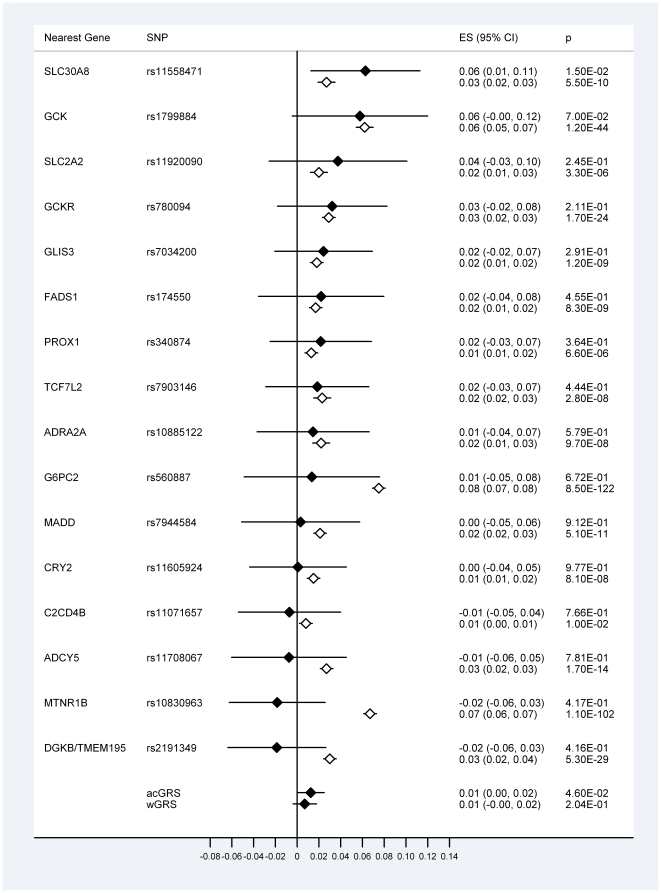
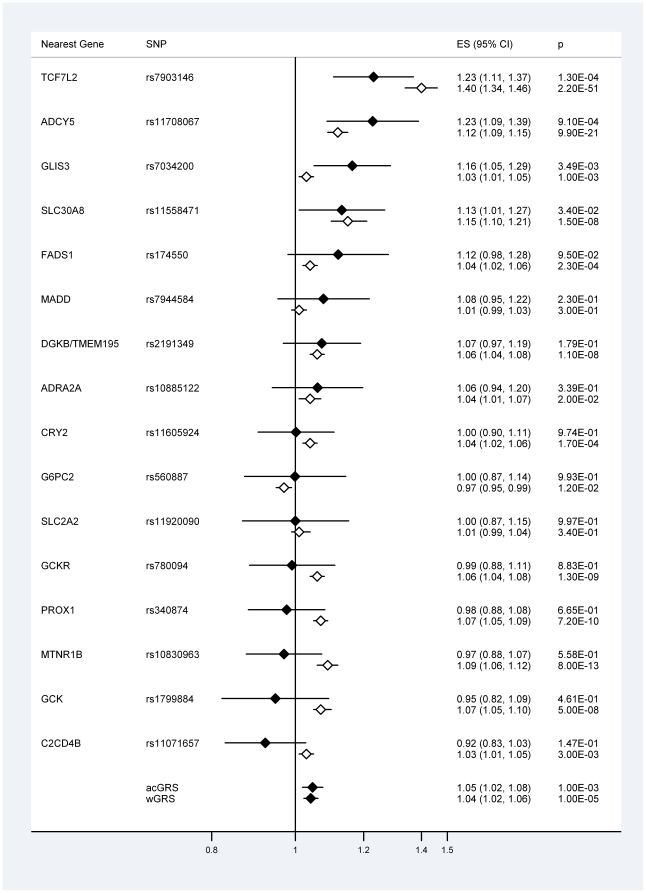
BACKGROUND: The Meta-Analysis of Glucose and Insulin related traits Consortium (MAGIC) recently identified 16 loci robustly associated with fasting glucose, some of which were also associated with type 2 diabetes. The purpose of our study was to explore the role of these variants in South Asian populations of Punjabi ancestry, originating predominantly from the District of Mirpur, Pakistan. METHODOLOGY/PRINCIPAL FINDINGS: Sixteen single nucleotide polymorphisms (SNPs) were genotyped in 1678 subjects with type 2 diabetes and 1584 normoglycaemic controls from two Punjabi populations; one resident in the UK and one indigenous to the District of Mirpur. In the normoglycaemic controls investigated for fasting glucose associations, 12 of 16 SNPs displayed β values with the same direction of effect as that seen in European studies, although only the SLC30A8 rs11558471 SNP was nominally associated with fasting glucose (β = 0.063 [95% CI: 0.013, 0.113] p = 0.015). Of interest, the MTNR1B rs10830963 SNP displayed a negative β value for fasting glucose in our study; this effect size was significantly lower than that seen in Europeans (p = 1.29×10(-4)). In addition to previously reported type 2 diabetes risk variants in TCF7L2 and SLC30A8, SNPs in ADCY5 (rs11708067) and GLIS3 (rs7034200) displayed evidence for association with type 2 diabetes, with odds ratios of 1.23 (95% CI: 1.09, 1.39; p = 9.1×10(-4)) and 1.16 (95% CI: 1.05, 1.29; p = 3.49×10(-3)) respectively. CONCLUSIONS/SIGNIFICANCE: Although only the SLC30A8 rs11558471 SNP was nominally associated with fasting glucose in our study, the finding that 12 out of 16 SNPs displayed a direction of effect consistent with European studies suggests that a number of these variants may contribute to fasting glucose variation in individuals of South Asian ancestry. We also provide evidence for the first time in South Asians that alleles of SNPs in GLIS3 and ADCY5 may confer risk of type 2 diabetes.
Overview
The claims and statistics of this paper haven’t been checked yet.
Free: it reads the open-access text and checks the first 5 claims that cite a source we can check. Create a free account to check every claim.
Integrity signals
Registry
Cites
Statistics
Figures
Verification
Claims the paper makes
The claims and statistics of this paper haven’t been checked yet.
Free: it reads the open-access text and checks the first 5 claims that cite a source we can check. Create a free account to check every claim.
Claims other papers make about this one
Each is checked against this paper’s own text: does it say what the citing paper says it does?
The source backs part of the claim, not all of it — or backs it for a different population, condition or comparison.
In the citing paper
“Human ADCY5 polymorphisms have been associated with metabolic diseases including diabetes and obesity”
From Physiological roles of mammalian transmembrane adenylyl cyclase isoforms (2022) · cites this paper as [170]
Experimental — accuracy not yet measured
Self-check
Percentages, sums and reported differences re-computed from the paper’s own numbers.
The self-check needs the paper’s full text.
Citations
Cites
Haploview: analysis and visualization of LD and haplotype maps
Barrett, J. C., Fry, B., Maller, J., & Daly, M. J. (2005) · Bioinformatics · doi:10.1093/bioinformatics/bth457 · Cited by 14,525
The International HapMap Project
†The International HapMap Consortium, Genotyping centres: Baylor College of Medicine and ParAllele BioScience, Gibbs, R. A., Belmont, J. W., Hardenbol, P., Willis, T. D., Yu, F., Chinese HapMap Consortium, Yang, H., Ch'ang, L.-Y., et al. (2003) · Nature · doi:10.1038/nature02168 · Cited by 6,057
New genetic loci implicated in fasting glucose homeostasis and their impact on type 2 diabetes risk
DIAGRAM Consortium, Dupuis, J., GIANT Consortium, Global BPgen Consortium, Anders Hamsten on behalf of Procardis Consortium, the MAGIC investigators, Langenberg, C., Prokopenko, I., Saxena, R., Soranzo, N., et al. (2010) · Nature Genetics · doi:10.1038/ng.520 · Cited by 2,166 · cited 11×
“Three of the six variants most strongly associated with fasting glucose in the MAGIC study [1](MTNR1B rs10830963, DGKB/TMEM195 rs2191349 and ADCY5 rs11708067) have negative b-values in the current study (Figure 1), and this disparity reached statistical significance for the MTNR1B variant.”
InfluentialPurcell, S., Cherny, S. S., & Sham, P. C. (2003) · Bioinformatics · doi:10.1093/bioinformatics/19.1.149 · Cited by 2,057
Twelve type 2 diabetes susceptibility loci identified through large-scale association analysis
The MAGIC investigators, Voight, B. F., The GIANT Consortium, Scott, L. J., Steinthorsdottir, V., Morris, A. P., Dina, C., Welch, R. P., Zeggini, E., Huth, C., et al. (2010) · Nature Genetics · doi:10.1038/ng.609 · Cited by 1,761 · cited 1×
“6610(28)) with type 2 diabetes, fasting glucose levels and HOMA-B (a measure of b-cell function) but is not associated with HOMA-IR (a measure of insulin resistance) [1,12].”
BackgroundThe Type 1 Diabetes Genetics Consortium, Barrett, J. C., Clayton, D. G., Concannon, P., Akolkar, B., Cooper, J. D., Erlich, H. A., Julier, C., Morahan, G., Nerup, J., et al. (2009) · Nature Genetics · doi:10.1038/ng.381 · Cited by 1,746
Gauderman, W. J., Morrison, J., & Morrison, W. M. (2006) · Medical Entomology and Zoology · Cited by 595
Senée, V., Chelala, C., Duchatelet, S., Feng, D., Blanc, H., Cossec, J.-C., Charon, C., Nicolino, M., Boileau, P., Cavener, D. R., et al. (2006) · Nature Genetics · doi:10.1038/ng1802 · Cited by 376 · cited 1×
“Rare functional mutations within the GLIS3 gene lead to a syndrome of neonatal diabetes and congenital hyperthyroidism [16], and the rs7020673 SNP within the gene is robustly associated with type 1 diabetes [17].”
BackgroundIntegrating ethics and science in the International HapMap Project
The International HapMap Consortium, & Foster, M. W. (2004) · Nature Reviews Genetics · doi:10.1038/nrg1351 · Cited by 330
Variants in ADCY5 and near CCNL1 are associated with fetal growth and birth weight
The Genetic Investigation of ANthropometric Traits (GIANT) Consortium, Freathy, R. M., The Meta-Analyses of Glucose and Insulin-related traits Consortium (MAGIC), The Wellcome Trust Case Control Consortium (WTCCC), the Early Growth Genetics (EGG) Consortium, Mook-Kanamori, D. O., Sovio, U., Prokopenko, I., Timpson, N. J., Berry, D. J., et al. (2010) · Nature Genetics · doi:10.1038/ng.567 · Cited by 255 · cited 1×
“In addition, a SNP within the ADCY5 gene (rs9883204), in LD with the variant investigated in this study, is associated with foetal growth and birth weight [13].”
Background
Cited by
Habib, A. M., Richards, P., Cairns, L. S., Rogers, G. J., Bannon, C. A. M., Parker, H. E., Morley, T. C. E., Yeo, G. S. H., Reimann, F., & Gribble, F. M. (2012) · Endocrinology · doi:10.1210/en.2011-2170 · Cited by 386
Melatonin in type 2 diabetes mellitus and obesity
Karamitri, A., & Jockers, R. (2019) · Nature Reviews Endocrinology · doi:10.1038/s41574-018-0130-1 · Cited by 268
Dessauer, C. W., Watts, V. J., Ostrom, R. S., Conti, M., Dove, S., & Seifert, R. (2017) · Pharmacological Reviews · doi:10.1124/pr.116.013078 · Cited by 201
“Numerous studies have linked ADCY5 gene polymorphisms to altered glucose metabolism, diabetes, and obesity (Barker et al., 2011; Rees et al., 2011; Wagner et al., 2011; Windholz et al., 2011; Holstein et al., 2013; Ng et al., 2013; Hodson et al., 2014; Knigge et al., 2015).”
BackgroundThe Elevated Susceptibility to Diabetes in India: An Evolutionary Perspective
Wells, J. C. K., Pomeroy, E., Walimbe, S. R., Popkin, B. M., & Yajnik, C. S. (2016) · Frontiers in Public Health · doi:10.3389/fpubh.2016.00145 · Cited by 155
“Most risk-alleles appear to exert similar directions and magnitudes effects in European and South Asian populations (17, 18), but it is important to consider whether this applies universally, and whether the frequency of such risk-alleles varies between populations.”
BackgroundADCY5 Couples Glucose to Insulin Secretion in Human Islets
Hodson, D. J., Mitchell, R. K., Marselli, L., Pullen, T. J., Gimeno Brias, S., Semplici, F., Everett, K. L., Cooper, D. M. F., Bugliani, M., Marchetti, P., et al. (2014) · Diabetes · doi:10.2337/db13-1607 · Cited by 147
“ADCY5 is a Ca 2+ -inhibited Type III adenylate cyclase (19;20) and risk allele carriers present with elevated fasting glucose (21), but not impaired insulinogenic index or AUCinsulin/glucose 2 h post-oral glucose load (22-25).”
Background
Metadata
- Authors
- Rees, S. D., Hydrie, M. Z. I., O'Hare, J. P., Kumar, S., Shera, A. S., Basit, A., Barnett, A. H., & Kelly, M. A.
- Affiliations
- Heart of England NHS Foundation Trust (GB)
- Baqai Institute of Diabetology and Endocrinology (PK)
- University of Warwick (GB)
- Corresponding author
- Rees, Simon D.
- Venue
- PLoS ONE
- Publisher
- Public Library of Science (PLoS)
- Published
- 2011-09-20
- Volume
- 6
- Issue
- 9
- Pages
- e24710
- ISSN
- 1932-6203 (ISSN-L)
- PMC
- PMC3176767
- OpenAlex
- W2150088795
- Cited by
- 78
- References
- 19
- Citations by year
- 2026: 5 · 2025: 2 · 2024: 4 · 2023: 2 · 2022: 4 · 2021: 12 · 2020: 2 · 2019: 4 · 2018: 5 · 2017: 8 · 2016: 6 · 2015: 7 · 2014: 7 · 2013: 5 · 2012: 4
- FWCI
- 3.19
- Type
- journal article
- Language
- en
- Open access
- gold
- doi.org
- Locations
- PLoS ONE (publishedVersion, cc-by)
- Europe PMC (PubMed Central) (publishedVersion, cc-by)
- PubMed Central (publishedVersion, cc-by)
- PubMed (publishedVersion)
- Warwick Research Archive Portal (University of Warwick) (acceptedVersion)
- RePEc: Research Papers in Economics (submittedVersion)
- DOAJ (DOAJ: Directory of Open Access Journals) (submittedVersion, cc-by-sa)
- University of Birmingham Research Portal (University of Birmingham) (submittedVersion, other-oa)
- Funders
- Eli Lilly and Company
- Diabetes UK (07/0003512)
- Topics
- Life Sciences › Biochemistry, Genetics and Molecular Biology › Genetics › Genetic Associations and Epidemiology
- Life Sciences › Biochemistry, Genetics and Molecular Biology › Genetics › Diabetes and associated disorders
- Life Sciences › Biochemistry, Genetics and Molecular Biology › Genetics › Genetic Mapping and Diversity in Plants and Animals
- Keywords
- fasting blood glucose, genetic variants, South Asian populations, ADCY5, GLIS3, MTNR1B, SLC30A8, TCF7L2, single nucleotide polymorphisms, genetic association
- MeSH terms
- Adenylyl Cyclases, Asia, Blood Glucose, Demography, Diabetes Mellitus, Type 2, DNA-Binding Proteins, Fasting, Female, Humans, Male, Middle Aged, Repressor Proteins, Transcription Factors, Trans-Activators, Genetic Predisposition to Disease, Polymorphism, Single Nucleotide, White People, Asian People
About these checks
Registry, retraction, Cites and statistics results are computed, not judged, with one exception: a printed reference that no index lists is read once by a model before it counts as a citation error. Claims are extracted by a model and kept only when their quote appears verbatim in the text; each cited source is then checked, with a model’s help, for whether it says what the claim relies on. Those verdicts can be wrong — read the claim’s quote and the cited source before relying on one.
Statistics and arithmetic are recomputed, not judged.
Confidence bands are shown only for fields calibrated on our annotated test set. None is calibrated yet, so no band is shown.
What counts as a claim ›How we measure confidence ›How we check this ›
Are you an author, or do you see a problem with this page? Request a review
How to cite
Cite CoChat for the checks on this page, and the paper for its own findings.
- This page
- CoChat. (2026). Citation check: Effects of 16 Genetic Variants on Fasting Glucose and Type 2 Diabetes in South Asians: ADCY5 and GLIS3 Variants May Predispose to Type 2 Diabetes. https://app.cochat.ai/papers/10.1371/journal.pone.0024710
- The paper
- Rees, S. D., Hydrie, M. Z. I., O'Hare, J. P., Kumar, S., Shera, A. S., Basit, A., Barnett, A. H., & Kelly, M. A. (2011). Effects of 16 Genetic Variants on Fasting Glucose and Type 2 Diabetes in South Asians: ADCY5 and GLIS3 Variants May Predispose to Type 2 Diabetes. PLoS ONE. https://doi.org/10.1371/journal.pone.0024710
Data sources
Bibliographic data: Semantic Scholar, OpenAlex, Crossref.
Contains information from the Semantic Scholar Academic Graph Datasets, made available under the ODC Attribution License (ODC-BY 1.0).
Semantic Scholar’s data is described in: Kinney, R., et al. (2023). The Semantic Scholar Open Data Platform. arXiv:2301.10140.
