

The DOI matches its Crossref record; 37 of the 37 references it cites were found in a registry or an index.
A Prospective Study of Diet Quality and Mental Health in Adolescents
Open accessAbstract
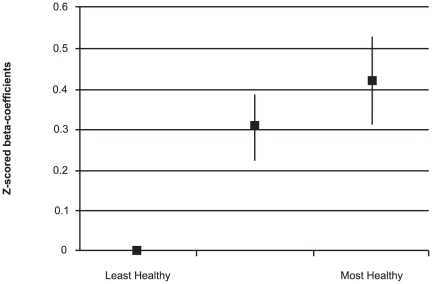
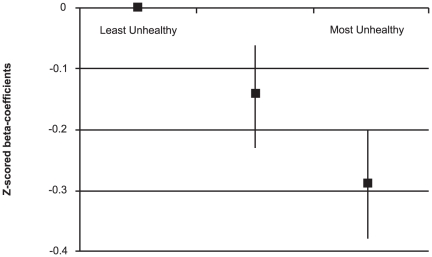
OBJECTIVES: A number of cross-sectional and prospective studies have now been published demonstrating inverse relationships between diet quality and the common mental disorders in adults. However, there are no existing prospective studies of this association in adolescents, the onset period of most disorders, limiting inferences regarding possible causal relationships. METHODS: In this study, 3040 Australian adolescents, aged 11-18 years at baseline, were measured in 2005-6 and 2007-8. Information on diet and mental health was collected by self-report and anthropometric data by trained researchers. RESULTS: There were cross-sectional, dose response relationships identified between measures of both healthy (positive) and unhealthy (inverse) diets and scores on the emotional subscale of the Pediatric Quality of Life Inventory (PedsQL), where higher scores mean better mental health, before and after adjustments for age, gender, socio-economic status, dieting behaviours, body mass index and physical activity. Higher healthy diet scores at baseline also predicted higher PedsQL scores at follow-up, while higher unhealthy diet scores at baseline predicted lower PedsQL scores at follow-up. Improvements in diet quality were mirrored by improvements in mental health over the follow-up period, while deteriorating diet quality was associated with poorer psychological functioning. Finally, results did not support the reverse causality hypothesis. CONCLUSION: This study highlights the importance of diet in adolescence and its potential role in modifying mental health over the life course. Given that the majority of common mental health problems first manifest in adolescence, intervention studies are now required to test the effectiveness of preventing the common mental disorders through dietary modification.
Overview
The claims and statistics of this paper haven’t been checked yet.
Run the check — free, no account needed. It reads the open-access text and checks the sources it cites.
Integrity signals
Registry
Cites
Statistics
Figures
Verification
Claims the paper makes
The claims and statistics of this paper haven’t been checked yet.
Run the check — free, no account needed. It reads the open-access text and checks the sources it cites.
Claims other papers make about this one
Each is checked against this paper’s own text: does it say what the citing paper says it does?
In the citing paper
“These associations are observed across the age range, including in early adolescence, which represents the primary age of onset for mental disorders (292, 310).”
From Diet and the Microbiota–Gut–Brain Axis: Sowing the Seeds of Good Mental Health (2021) · cites this paper as [310]
Self-check
Percentages, sums and reported differences re-computed from the paper’s own numbers.
The self-check needs the paper’s full text.
Citations
Cites
Kessler, R. C., Berglund, P., Demler, O., Jin, R., Merikangas, K. R., & Walters, E. E. (2005) · Archives of General Psychiatry · doi:10.1001/archpsyc.62.6.593 · Cited by 20,391
Merikangas, K. R., He, J.-P., Burstein, M., Swanson, S. A., Avenevoli, S., Cui, L., Benjet, C., Georgiades, K., & Swendsen, J. (2010) · Journal of the American Academy of Child & Adolescent Psychiatry · doi:10.1016/j.jaac.2010.05.017 · Cited by 6,278
Prevalence and Trends in Overweight Among US Children and Adolescents, 1999-2000
Ogden, C. L. (2002) · JAMA · doi:10.1001/jama.288.14.1728 · Cited by 4,060
The PedsQL™: Measurement Model for the Pediatric Quality of Life Inventory
Varni, J. W., Seid, M., & Rode, C. A. (1999) · Medical Care · doi:10.1097/00005650-199902000-00003 · Cited by 3,291
Oxidative stress in psychiatric disorders: evidence base and therapeutic implications
Ng, F., Berk, M., Dean, O., & Bush, A. I. (2008) · The International Journal of Neuropsychopharmacology · doi:10.1017/s1461145707008401 · Cited by 1,069
Self-citationMolteni, R., Barnard, R. J., Ying, Z., Roberts, C. K., & Gómez‐Pinilla, F. (2002) · Neuroscience · doi:10.1016/s0306-4522(02)00123-9 · Cited by 918
Lopez-Garcia, E., Schulze, M. B., Fung, T. T., Meigs, J. B., Rifai, N., Manson, J. E., & Hu, F. B. (2004) · The American Journal of Clinical Nutrition · doi:10.1093/ajcn/80.4.1029 · Cited by 881
Association of Western and Traditional Diets With Depression and Anxiety in Women
Jacka, F. N., Pasco, J. A., Mykletun, A., Williams, L. J., Hodge, A. M., O'Reilly, S. L., Nicholson, G. C., Kotowicz, M. A., & Berk, M. (2010) · American Journal of Psychiatry · doi:10.1176/appi.ajp.2009.09060881 · Cited by 847
Self-citationChrysohoou, C. A., Panagiotakos, D. B., Pitsavos, C. E., Das, U. N., & Stefanadis, C. (2004) · Journal of the American College of Cardiology · doi:10.1016/j.jacc.2004.03.039 · Cited by 770
Twenge, J. M., Gentile, B., DeWall, C. N., Ma, D., Lacefield, K., & Schurtz, D. R. (2009) · Clinical Psychology Review · doi:10.1016/j.cpr.2009.10.005 · Cited by 606
Cited by
Sorted by citations
So depression is an inflammatory disease, but where does the inflammation come from?
Berk, M., Williams, L. J., Jacka, F. N., O’Neil, A., Pasco, J. A., Moylan, S., Allen, N. B., Stuart, A. L., Hayley, A. C., Byrne, M. L., et al. (2013) · BMC Medicine · doi:10.1186/1741-7015-11-200 · Cited by 1,423
Self-citationJacka, F. N., O’Neil, A., Opie, R., Itsiopoulos, C., Cotton, S., Mohebbi, M., Castle, D., Dash, S., Mihalopoulos, C., Chatterton, M. L., et al. (2017) · BMC Medicine · doi:10.1186/s12916-017-0791-y · Cited by 1,093
Self-citationMalhi, G. S., Bassett, D., Boyce, P., Bryant, R., Fitzgerald, P. B., Fritz, K., Hopwood, M., Lyndon, B., Mulder, R., Murray, G., et al. (2015) · Australian & New Zealand Journal of Psychiatry · doi:10.1177/0004867415617657 · Cited by 842
“…or risk for depression, as well as an increased likelihood or risk for depression with higher intakes of unhealthy food products; such studies have been published from countries across the globe in children, adolescents and adults (Jacka et al., 2010, 2011, 2013; SanchezVillegas et al., 2009).”
BackgroundRelationship Between Diet and Mental Health in Children and Adolescents: A Systematic Review
O’Neil, A., Quirk, S. E., Housden, S., Brennan, S. L., Williams, L. J., Pasco, J. A., Berk, M., & Jacka, F. N. (2014) · American Journal of Public Health · doi:10.2105/ajph.2014.302110 · Cited by 734
Self-citationHow and why environmental noise impacts animals: an integrative, mechanistic review
Kight, C. R., & Swaddle, J. P. (2011) · Ecology Letters · doi:10.1111/j.1461-0248.2011.01664.x · Cited by 627
Metadata
- Authors
- Jacka, F. N., Kremer, P. J., Berk, M., de Silva-Sanigorski, A. M., Moodie, M., Leslie, E. R., Pasco, J. A., & Swinburn, B. A.
- Affiliations
- Barwon Health (AU)
- Deakin University (AU)
- Mental Health Research Institute (AU)
- Corresponding author
- Jacka, Felice N.
- Venue
- PLoS ONE
- Publisher
- Public Library of Science (PLoS)
- Published
- 2011-09-21
- Volume
- 6
- Issue
- 9
- Pages
- e24805
- ISSN
- 1932-6203 (ISSN-L)
- PMC
- PMC3177848
- OpenAlex
- W1964594273
- Cited by
- 374
- References
- 36
- Citations by year
- 2026: 19 · 2025: 18 · 2024: 22 · 2023: 20 · 2022: 26 · 2021: 43 · 2020: 36 · 2019: 29 · 2018: 25 · 2017: 24 · 2016: 30 · 2015: 18 · 2014: 20 · 2013: 27 · 2012: 16
- FWCI
- 20.10
- Type
- journal article
- Language
- en
- Open access
- gold
- doi.org
- Locations
- PLoS ONE (publishedVersion, cc-by)
- Europe PMC (PubMed Central) (publishedVersion, cc-by)
- PubMed Central (publishedVersion, cc-by)
- PubMed (publishedVersion)
- Minerva Access (University of Melbourne) (submittedVersion, cc-by)
- RePEc: Research Papers in Economics (submittedVersion)
- DOAJ (DOAJ: Directory of Open Access Journals) (submittedVersion, cc-by-sa)
- Figshare (submittedVersion, cc-by)
- ResearchSpace (University of Auckland) (submittedVersion, cc-by)
- Funders
- Wellcome Trust
- Deakin University
- State Government of Victoria
- Medical Research Council
- National Health and Medical Research Council
- Topics
- Health Sciences › Medicine › Public Health, Environmental and Occupational Health › Nutritional Studies and Diet
- Health Sciences › Nursing › Nutrition and Dietetics › Nutrition, Health and Food Behavior
- Social Sciences › Psychology › Clinical Psychology › Eating Disorders and Behaviors
- Keywords
- diet quality, adolescent mental health, common mental disorders, healthy eating, unhealthy diet, PedsQL, emotional functioning, reverse causality, dieting behavior, body mass index, physical activity, dietary change, prevention of mental disorders
- MeSH terms
- Adolescent, Adult, Child, Cross-Sectional Studies, Diet, Female, Humans, Longitudinal Studies, Male, Mental Health, Prospective Studies
About these checks
Registry, retraction, Cites and statistics results are computed, not judged, with one exception: a printed reference that no index lists is read once by a model before it counts as a citation error. Claims are extracted by a model and kept only when their quote appears verbatim in the text; each cited source is then checked, with a model’s help, for whether it says what the claim relies on. Those verdicts can be wrong — read the claim’s quote and the cited source before relying on one.
Statistics and arithmetic are recomputed, not judged.
Confidence bands are shown only for fields calibrated on our annotated test set. None is calibrated yet, so no band is shown.
What counts as a claim ›How we measure confidence ›How we check this ›
Are you an author, or do you see a problem with this page? Request a review
