

From QUOROM to PRISMA: A Survey of High-Impact Medical Journals' Instructions to Authors and a Review of Systematic Reviews in Anesthesia Literature
Open accessThe DOI matches its Crossref record; 34 of the 34 references it cites were found in a registry or an index.
Abstract
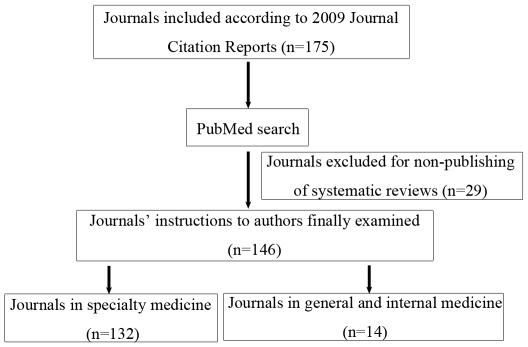
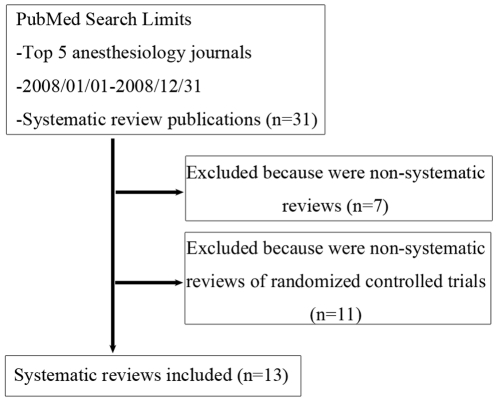
BACKGROUND: The PRISMA (Preferred Reporting Items of Systematic reviews and Meta-Analyses) Statement was published to help authors improve how they report systematic reviews. It is unknown how many journals mention PRISMA in their instructions to authors, or whether stronger journal language regarding use of PRISMA improves author compliance. METHODOLOGY/PRINCIPAL FINDINGS: An Internet-based investigation examined the extent to which 146 leading medical journals have incorporated the PRISMA Statement into their instructions to authors. Results were analyzed using descriptive statistics. Also, systematic reviews published in the leading anesthesiology journals and the QUOROM (QUality Of Reporting Of Meta-analyses) Statement were used to explore the hypothesis that indicating compliance with the QUOROM Statement in the manuscript is associated with improved compliance with the reporting guideline. In a sample of 146 journals publishing systematic reviews, the PRISMA Statement was referred to in the instructions to authors for 27% (40/146) of journals; more often in general and internal medicine journals (7/14; 50%) than in specialty medicine journals (33/132; 25%). In the second part of the study, 13 systematic reviews published in the leading anesthesiology journals in 2008 were included for appraisal. Mention of the QUOROM Statement in the manuscript was associated with higher compliance with the QUOROM checklist (P = 0.022). CONCLUSIONS/SIGNIFICANCE: Most of the leading medical journals used ambiguous language regarding what was expected of authors. Further improvement on quality of reporting of systematic reviews may entail journals clearly informing authors of their requirements. Stronger directions, such as requiring an indication of adherence to a research quality of reporting statement in the manuscript, may improve reporting and utility of systematic reviews.
Overview
The claims and statistics of this paper haven’t been checked yet.
Free: it reads the open-access text and checks the first 5 claims that cite a source we can check. Create a free account to check every claim.
Integrity signals
Registry
Cites
Statistics
Figures
Verification
Claims the paper makes
The claims and statistics of this paper haven’t been checked yet.
Free: it reads the open-access text and checks the first 5 claims that cite a source we can check. Create a free account to check every claim.
Claims other papers make about this one
Each is checked against this paper’s own text: does it say what the citing paper says it does?
The source backs part of the claim, not all of it — or backs it for a different population, condition or comparison.
In the citing paper
“Currently, around 30% of medical journals publishing systematic reviews have endorsed PRISMA statement in their author's guidelines [9].”
From Evaluation of the endorsement of the preferred reporting items for systematic reviews and meta-analysis (PRISMA) statement on the quality of published systematic review and meta-analyses (2013) · cites this paper as [9]
Experimental — accuracy not yet measuredIn the citing paper
“Findings on association between manuscript length and quality of systematic reviews and meta-analyses have been contradictory so far [9], [19].”
In the citing paper
“Instead of, they addressed adherence of published manuscripts to the QUORUM statement, reporting insufficient adherence to several QUORUM items such as “Identifying title” and “Structured abstract” [9].”
In the citing paper
“It has been reported that in 2011, among 146 high-impact medical journals, more than half of general and internal medicine publications, and a quarter of other specialty journals referred to the PRISMA in the instructions for authors [9].”
In the citing paper
“Further, it has been previously reported that mentioning the QUORUM in the manuscript is associated with higher compliance to the QUORUM checklist [9].”
1 more claim about this paper
Create a free account to see every claim other papers make about this one.
Self-check
Percentages, sums and reported differences re-computed from the paper’s own numbers.
The self-check needs the paper’s full text.
Citations
Cites
Preferred Reporting Items for Systematic Reviews and Meta-Analyses: the PRISMA statement
Moher, D., Liberati, A., Tetzlaff, J., Altman, D. G., & for the PRISMA Group (2009) · BMJ · doi:10.1136/bmj.b2535 · Cited by 83,823
Self-citationPreferred Reporting Items for Systematic Reviews and Meta-Analyses: The PRISMA Statement
Moher, D., Liberati, A., Tetzlaff, J., Altman, D. G., & The PRISMA Group (2009) · PLoS Medicine · doi:10.1371/journal.pmed.1000097 · Cited by 64,042 · cited 2×
“In the form of a checklist, the PRISMA group provides advice on how to report research methods and findings, and the checklist specifies a minimum set of items required for a clear and transparent reporting of systematic reviews [8].”
BackgroundMethodSelf-citationPreferred reporting items for systematic reviews and meta-analyses: the PRISMA Statement.
(2009) · PubMed Central · Cited by 44,859
Self-citationLiberati, A., Altman, D. G., Tetzlaff, J., Mulrow, C., Gøtzsche, P. C., Ioannidis, J. P. A., Clarke, M., Devereaux, P. J., Kleijnen, J., & Moher, D. (2009) · PLoS Medicine · doi:10.1371/journal.pmed.1000100 · Cited by 28,164 · cited 1×
“The quality of reporting of systematic reviews is not optimal, yet the clarity of reporting greatly affects the value of systematic review [22,23].”
BackgroundSelf-citationWang, G., Ma, R., Qiao, G., Wada, K., Aizawa, Y., & Satoh, T. (2015) · Integrative Medicine International · doi:10.1159/000368408 · Cited by 18,657
Liberati, A., Altman, D. G., Tetzlaff, J., Mulrow, C., Gotzsche, P. C., Ioannidis, J. P. A., Clarke, M., Devereaux, P. J., Kleijnen, J., & Moher, D. (2009) · BMJ · doi:10.1136/bmj.b2700 · Cited by 17,648
Self-citationMoher, D., Cook, D. J., Eastwood, S., Olkin, I., Rennie, D., & Stroup, D. F. (1999) · The Lancet · doi:10.1016/s0140-6736(99)04149-5 · Cited by 4,826
Self-citationLiberati, A., Altman, D. G., Tetzlaff, J., Mulrow, C., Gøtzsche, P. C., Ioannidis, J. P. A., Clarke, M., Devereaux, P. J., Kleijnen, J., & Moher, D. (2009) · Italian Journal of Public Health · doi:10.2427/5768 · Cited by 3,374
Self-citationThe Effects of Mild Perioperative Hypothermia on Blood Loss and Transfusion Requirement
Rajagopalan, S., Mascha, E., Na, J., & Sessler, D. I. (2008) · Anesthesiology · doi:10.1097/01.anes.0000296719.73450.52 · Cited by 905
Simera, I., Moher, D., Hirst, A., Hoey, J., Schulz, K. F., & Altman, D. G. (2010) · BMC Medicine · doi:10.1186/1741-7015-8-24 · Cited by 590
Self-citation
Cited by
Panic, N., Leoncini, E., de Belvis, G., Ricciardi, W., & Boccia, S. (2013) · PLoS ONE · doi:10.1371/journal.pone.0083138 · Cited by 883
“Currently, around 30% of medical journals publishing systematic reviews have endorsed PRISMA statement in their author’s guidelines [9].”
BackgroundMethodResultInfluentialPage, M. J., & Moher, D. (2017) · Systematic Reviews · doi:10.1186/s13643-017-0663-8 · Cited by 769
Self-citationCarotenoids from microalgae: A review of recent developments
Gong, M., & Bassi, A. (2016) · Biotechnology Advances · doi:10.1016/j.biotechadv.2016.10.005 · Cited by 723
Cooper, C., Booth, A., Varley-Campbell, J., Britten, N., & Garside, R. (2018) · BMC Medical Research Methodology · doi:10.1186/s12874-018-0545-3 · Cited by 561
A Framework for Enhancing the Value of Research for Dissemination and Implementation
Neta, G., Glasgow, R. E., Carpenter, C. R., Grimshaw, J. M., Rabin, B. A., Fernandez, M. E., & Brownson, R. C. (2015) · American Journal of Public Health · doi:10.2105/ajph.2014.302206 · Cited by 205
Koffel, J. B. (2015) · PLOS ONE · doi:10.1371/journal.pone.0125931 · Cited by 159
“These include specialized knowledge in or training on systematic review methods [31, 32], publishing in a higher impact journal [32, 33], previous experience writing systematic reviews [34], use of a reporting guidelines [35, 36], years of professional practice, time taken to write the review, year of publication and…”
BackgroundBlinded by PRISMA: Are Systematic Reviewers Focusing on PRISMA and Ignoring Other Guidelines?
Fleming, P. S., Koletsi, D., & Pandis, N. (2014) · PLoS ONE · doi:10.1371/journal.pone.0096407 · Cited by 115
“This is certainly a positive development, which has led to enhanced reporting of SRs [6], although further work is required [7,8].”
BackgroundPRISMA for Review of Management Literature – Method, Merits, and Limitations – An Academic Review
Mishra, V., & Mishra, M. P. (2023) · Review of management literature · doi:10.1108/s2754-586520230000002007 · Cited by 223
Peters, J. P. M., Hooft, L., Grolman, W., & Stegeman, I. (2015) · PLOS ONE · doi:10.1371/journal.pone.0136540 · Cited by 106
Amponsah, O., Blija, D. K., Ayambire, R. A., Takyi, S. A., Mensah, H., & Braimah, I. (2022) · Land Use Policy · doi:10.1016/j.landusepol.2022.105979 · Cited by 114
Twomey, C., & O'Reilly, G. (2017) · Cyberpsychology, Behavior, and Social Networking · doi:10.1089/cyber.2017.0247 · Cited by 96
Quality of flow diagram in systematic review and/or meta-analysis
Vu-Ngoc, H., Elawady, S. S., Mehyar, G. M., Abdelhamid, A. H., Mattar, O. M., Halhouli, O., Vuong, N. L., Ali, C. D. M., Hassan, U. H., Kien, N. D., et al. (2018) · PLoS ONE · doi:10.1371/journal.pone.0195955 · Cited by 99
Quality of Conduct and Reporting of Meta-analyses of Surgical Interventions
Adie, S., Ma, D., Harris, I. A., Naylor, J. M., & Craig, J. C. (2015) · Annals of Surgery · doi:10.1097/sla.0000000000000836 · Cited by 76
The influence of gradient foreign accentedness and listener experience on word recognition
Porretta, V., Tucker, B. V., & Järvikivi, J. (2016) · Journal of Phonetics · doi:10.1016/j.wocn.2016.05.006 · Cited by 94
Urrútia, G., & Bonfill, X. (2013) · Revista Española de Salud Pública · doi:10.4321/s1135-57272013000200001 · Cited by 70
Restrictions and their reporting in systematic reviews of effectiveness: an observational study
Helbach, J., Pieper, D., Mathes, T., Rombey, T., Zeeb, H., Allers, K., & Hoffmann, F. (2022) · BMC Medical Research Methodology · doi:10.1186/s12874-022-01710-w · Cited by 94
“This is supported by previous research indicating that journals have more frequently included the PRISMA guideline in their instructions to authors [29, 30] and that author compliance has increased [31, 32].”
ResultNawijn, F., Ham, W. H. W., Houwert, R. M., Groenwold, R. H. H., Hietbrink, F., & Smeeing, D. P. J. (2019) · BMC Emergency Medicine · doi:10.1186/s12873-019-0233-6 · Cited by 80
“However, study results regarding the negative association between manuscript length and quality of reporting are inconclusive [16, 19].”
BackgroundResultKinematically Aligned Total Knee Arthroplasty or Mechanically Aligned Total Knee Arthroplasty
Ansari, J. S., Pandit, H. G., & Takahashi, T. (2018) · The Journal of Knee Surgery · doi:10.1055/s-0038-1632378 · Cited by 67
Systematic review and meta-analyses of studies analysing instructions to authors from 1987 to 2017.
Malički, M., Jerončić, A., Aalbersberg, I. J., Bouter, L., & ter Riet, G. (2021) · Nature Communications · doi:10.1038/s41467-021-26027-y · Cited by 53
Tam, W. W. S., Lo, K. K. H., & Khalechelvam, P. (2017) · BMJ Open · doi:10.1136/bmjopen-2016-013905 · Cited by 56
“This percentage is similar to that previously reported for internal and specialty medical journals (27%, 40/146).(17) The findings generally conform to the endorsement of other reporting guidelines.”
ResultSurveys on Reporting Guideline Usage in Dental Journals
Hua, F., Walsh, T., Glenny, A.-M., & Worthington, H. (2016) · Journal of Dental Research · doi:10.1177/0022034516657803 · Cited by 52
“In addition, although most journals in this study commendably provided the website URLs when referring to RGs, the inappropriate use of an obsolete RG (QUOROM) and guideline title (URM) raised red flags (Tao et al. 2011).”
BackgroundSims, M. T., Henning, N. M., Wayant, C. C., & Vassar, M. (2016) · Scandinavian Journal of Trauma, Resuscitation and Emergency Medicine · doi:10.1186/s13049-016-0331-3 · Cited by 51
“Evidence suggests that a few journals continue to refer to the QUOROM statement [18].”
BackgroundTam, W., Tang, A., Woo, B., & Goh, Y. S. (2019) · BMJ Open · doi:10.1136/bmjopen-2018-026271 · Cited by 57
Hendriksma, M., Joosten, M. H. M. A., Peters, J. P. M., Grolman, W., & Stegeman, I. (2017) · PLoS ONE · doi:10.1371/journal.pone.0169316 · Cited by 53
When may systematic reviews and meta-analyses be considered reliable?
Afshari, A., & Wetterslev, J. (2015) · European Journal of Anaesthesiology · doi:10.1097/eja.0000000000000186 · Cited by 49
Microalgal detection by Raman microspectroscopy
Wei, X., Jie, D., Cuello, J. J., Johnson, D. J., Qiu, Z., & He, Y. (2014) · TrAC Trends in Analytical Chemistry · doi:10.1016/j.trac.2013.09.012 · Cited by 43
Librarians as methodological peer reviewers for systematic reviews: results of an online survey
Nardini, H. K. G., Batten, J., Funaro, M. C., García-Milian, R., Nyhan, K., Spak, J. M., Wang, L., & Glover, J. G. (2019) · Research Integrity and Peer Review · doi:10.1186/s41073-019-0083-5 · Cited by 43
STROBE, CONSORT, PRISMA, MOOSE, STARD, SPIRIT, and other guidelines – Overview and application
Grech, V., & Eldawlatly, A. A. (2024) · Saudi Journal of Anaesthesia · doi:10.4103/sja.sja_545_23 · Cited by 46
“[16] Furthermore, a study in 2013 showed that only circa a third of medical journals recommended PRISMA.”
BackgroundLesbian, gay and bisexual individuals experience of mental health services - a systematic review
McNamara, G., & Wilson, C. E. (2020) · The Journal of Mental Health Training Education and Practice · doi:10.1108/jmhtep-09-2019-0047 · Cited by 48
Hiyama, S., Takahashi, T., & Takeshita, K. (2020) · The Journal of Knee Surgery · doi:10.1055/s-0040-1716494 · Cited by 37
Got experience? PMN amplitudes to foreign-accented speech modulated by listener experience
Porretta, V., Tremblay, A., & Bolger, P. (2017) · Journal of Neurolinguistics · doi:10.1016/j.jneuroling.2017.03.002 · Cited by 32
Ibrahim, B., & Mensah, H. (2022) · SN Social Sciences · doi:10.1007/s43545-022-00383-y · Cited by 33
“In spite of the strengths of the PRISMA approach, it fails to capture the results of continual searches used in systematic reviews and as a result undermines the quality of reviews conducted (Tao et al. 2011; Kahale et al. 2021).”
BackgroundReporting Quality of Systematic Reviews/Meta-Analyses of Acupuncture
Liu, Y., Zhang, R., Huang, J., Zhao, X., Liu, D., Sun, W., Mai, Y., Zhang, P., Wang, Y., Cao, H., et al. (2014) · PLoS ONE · doi:10.1371/journal.pone.0113172 · Cited by 29
Walther, M., Valderrábano, V., Wiewiorski, M. J., Usuelli, F. G., Richter, M., Baumfeld, T. S., Kubosch, E. J., Gottschalk, O., & Wittmann, U. (2020) · Foot and Ankle Surgery · doi:10.1016/j.fas.2020.07.011 · Cited by 31
Zhang, X., Lau, C., & Su, Y. (2021) · Early Education and Development · doi:10.1080/10409289.2021.1981065 · Cited by 55
Synthetic phenylethanoid glycoside derivatives as potent neuroprotective agents
Liu, Y., Li, X., Xiong, D., Yu, B., Pu, X., & Ye, X. (2015) · European Journal of Medicinal Chemistry · doi:10.1016/j.ejmech.2015.03.038 · Cited by 27
Self-citationAlcohol consumption and gastric cancer risk: a meta-analysis of prospective cohort studies
Han, X. N., Li, X., Yu, Y., Chen, Y., & Shu, H. (2017) · Oncotarget · doi:10.18632/oncotarget.19177 · Cited by 30
“We followed standard criteria for conducting and reporting the meta-analysis [43].”
MethodSelf-citationYücel, E., Sancar, M., Yücel, A., & Okuyan, B. (2015) · Expert Opinion on Drug Safety · doi:10.1517/14740338.2016.1128413 · Cited by 30
“For example, we failed to find out whether at least two independent reviewers existed in some systematic reviews, although Cochrane, PRISMA, AMSTAR, and other systematic review rules recommend two or sometimes more independent reviewers, with the addition of independent scanners if possible.”
BackgroundMethodInfluentialWharton, T. (2015) · Research on Social Work Practice · doi:10.1177/1049731515622264 · Cited by 25
“In an effort to ensure some consistency in reporting, it is logical to assume that some editors may encourage both authors and reviewers to use particular reporting guidelines, although implementation of such demands seems to vary widely (Simera et al., 2008; Stevens et al., 2014; Tao et al., 2011).”
BackgroundFerguson, J. A., Daley, A., & Parretti, H. M. (2019) · Obesity Reviews · doi:10.1111/obr.12834 · Cited by 24
Farag, A. M., Kuten‐Shorrer, M., Natto, Z. S., Ariyawardana, A., Mejia, L., Albuquerque, R., Carey, B., Chmieliauskaite, M., Miller, C. S., Ingram, M., et al. (2021) · Oral Diseases · doi:10.1111/odi.13817 · Cited by 30
Liu, P., Qiu, Y., Qian, Y., Chen, X., Wang, Y., Cui, J., & Zhai, X. (2017) · Journal of Gastroenterology and Hepatology · doi:10.1111/jgh.13591 · Cited by 20
Carpenter, C. R., & Meisel, Z. F. (2017) · Academic Emergency Medicine · doi:10.1111/acem.13225 · Cited by 19
Sims, M. T., Checketts, J. X., Wayant, C., & Vassar, M. B. (2017) · International Journal of Evidence-Based Healthcare · doi:10.1097/xeb.0000000000000120 · Cited by 24
Goldberg, J., Boyce, L. M., Soudant, C., & Godwin, K. (2022) · Journal of the Medical Library Association JMLA · doi:10.5195/jmla.2022.1273 · Cited by 21
“Since then, additional tools have been developed to improve reporting quality, like Quality of Reporting of Metaanalyses (QUOROM), Preferred Reporting Items for Systematic Reviews and Meta-Analyses (PRISMA), and Meta-analysis of Observational Studies in Epidemiology (MOOSE).”
BackgroundCowman, S. J., Pizer, B. L., & Sée, V. (2021) · PeerJ · doi:10.7717/peerj.11275 · Cited by 20
Farag, A. M., Malacarne, A., Pagni, S. E., & Maloney, G. E. (2020) · Complementary Therapies in Medicine · doi:10.1016/j.ctim.2019.102297 · Cited by 18
Mensah, H., Nalumu, D. J., Simpeh, E. K., & Mensah, A. A. (2022) · SN Social Sciences · doi:10.1007/s43545-022-00395-8 · Cited by 23
Heus, P., Idema, D. L., Kruithof, E., Damen, J. A., Jurgens, M. S., Reitsma, J. B., Moons, K. G. M., & Hooft, L. (2023) · Journal of Clinical Epidemiology · doi:10.1016/j.jclinepi.2023.10.004 · Cited by 20
Improving Hospital Efficiency and Cost Management: A Systematic Review and Meta-Analysis
Almehwari, S. A., Almalki, I. S., Abumilha, B. A., & Altharwi, B. H. (2024) · Cureus · doi:10.7759/cureus.71721 · Cited by 50
Guidelines for reporting health economic research
Haddad, F. S., & McLawhorn, A. S. (2016) · The Bone & Joint Journal · doi:10.1302/0301-620x.98b2.37643 · Cited by 16
Carpenter, C. R., & Pinnock, H. (2017) · Journal of the American Geriatrics Society · doi:10.1111/jgs.14938 · Cited by 15
“Most, although not all, EQUATOR research indicates that adherence to appropriate reporting recommendations standardizes key methodological reporting across journals and specialties,(18,19) although some researchers and journals underemphasize and underuse applicable recommendations.(20,21) Disseminating and using the…”
BackgroundKazerani, M., Davoudian, A., Zayeri, F., & Soori, H. (2017) · Medical Journal of the Islamic Republic of Iran · doi:10.18869/mjiri.31.18 · Cited by 21
“who found that the endorsement of PRISMA can improve both the methodology of the study and the way it is reported (19-21).”
MethodThe STROBE Statement and Neuropsychology: Lighting the Way Toward Evidence-Based Practice
Loring, D. W., & Bowden, S. C. (2013) · The Clinical Neuropsychologist · doi:10.1080/13854046.2012.762552 · Cited by 16
“High-impact medical journals increasingly require use of appropriate reporting guidelines in their instructions to authors (Tao et al., 2011), and neurology journals such as Neurology and The Lancet Neurology require the presentation of clinical research according to appropriate checklists.”
BackgroundToews, I., Binder, N., Wolff, R. F., Toprak, G., von Elm, E. B., & Meerpohl, J. J. (2017) · PLoS ONE · doi:10.1371/journal.pone.0176489 · Cited by 16
Burbank, F. H., Buchfuhrer, M. J., Kopjar, B., & Segawa, C. (2013) · Journal of Parkinsonism and Restless Legs Syndrome · doi:10.2147/jprls.s40356 · Cited by 13
“Materials and methods PRISMA checklist Randomized controlled trial reporting was assessed using the 27-item PRISMA (Preferred Reporting Items for Systematic reviews and Meta-Analyses) checklist(31) and flow diagram (Figure 1).(32,33) Two researchers, blinded to study details, independently searched the PubMed, Embase,…”
The quest for the holy volume therapy
ROBERTIS, E. D., Afshari, A., & Longrois, D. (2016) · European Journal of Anaesthesiology · doi:10.1097/eja.0000000000000441 · Cited by 12
Koch, M., Kniggendorf, A., Meinhardt‐Wollweber, M., & Roth, B. (2017) · Journal of Raman Spectroscopy · doi:10.1002/jrs.5292 · Cited by 11
Urrútia, G., & Bonfill, X. (2013) · Dialnet (Universidad de la Rioja) · doi:10.1590/s1135-57272013000200001 · Cited by 11
Kumari, M. A., Rao, C. V., Triloknadh, S., Harikrishna, N., Venkataramaiah, C., Rajendra, W., Daggupati, T., & Yeguvapalli, S. (2017) · Research on Chemical Intermediates · doi:10.1007/s11164-017-3210-2 · Cited by 13
Belloti, J. C., Okamura, A., Scheeren, J., Faloppa, F., & de Moraes, V. Y. (2019) · PLoS ONE · doi:10.1371/journal.pone.0206895 · Cited by 13
Clinical Epidemiology and Evidence-Based Medicine
Hinchcliff, K. W. (2017) · Elsevier eBooks · doi:10.1016/b978-0-323-44329-6.00006-1 · Cited by 12
Criticism of peer review and ways to improve it
Ahmed, H., & Gasparyan, A. Y. (2013) · Cited by 12
Risk-reduction surgery in pediatric surgical oncology: A perspective
Sandoval, J. A., Fernández‐Pineda, I., & Malkan, A. D. (2016) · Journal of Pediatric Surgery · doi:10.1016/j.jpedsurg.2016.01.004 · Cited by 12
“In 2009, the QUORUM Statement was replaced by the PRISMA Statement (Preferred Reporting Items for Systematic reviews and Meta-Analyses) to also apply to systematic reviews [17–25].”
MethodYao, M., Sun, Y., Dun, R.-L., Lan, T.-Y., Li, J., Lee, H. J., Haraguchi, N., Wang, Y., & Cui, X. (2016) · Chinese Journal of Integrative Medicine · doi:10.1007/s11655-016-2506-1 · Cited by 12
Yang, M., Jiang, L., Wang, A., & Xu, G. (2016) · International Journal of Nursing Practice · doi:10.1111/ijn.12498 · Cited by 11
Sehmbi, H., Retter, S., Shah, U. J., Nguyen, D. L., Martin, J. E., & Uppal, V. (2023) · Canadian Journal of Anesthesia/Journal canadien d anesthésie · doi:10.1007/s12630-023-02510-6 · Cited by 7
“Furthermore, such endorsements are greater for general than specialty journals.(41) These issues May contribute to prevalent suboptimal reporting of NMAs despite established reporting guidelines.”
BackgroundReview article: Reporting Guidelines in the biomedical literature
O’Leary, J. D., & Crawford, M. W. (2013) · Canadian Journal of Anesthesia/Journal canadien d anesthésie · doi:10.1007/s12630-013-9973-z · Cited by 11
“In a sampling of 146 leading biomedical journals in 2011, only 27% of the included journals referred to the PRISMA statement in their ‘‘Instructions to Authors’’, and most of the journals used ambiguous language to describe what was expected of authors for reporting systematic reviews.(62)”
BackgroundOh, J. H., Shin, W. J., Park, S., & Chung, J. S. (2017) · Korean Journal of Anesthesiology · doi:10.4097/kjae.2017.70.4.446 · Cited by 8
“Meta-analysis of anesthesia journals has been considered to be of higher quality than studies published in other specialty journals [23,24].”
BackgroundModelo SERVQUAL para medir la calidad en el servicio en operadores logísticos
Torres, E. D. J. M., Ríos, O. M. E., Hernández, M. M., & León, M. H. L. (2023) · Revista CEA · doi:10.22430/24223182.2234 · Cited by 35
Quality of systematic reviews with meta‐analyses of resveratrol: A methodological systematic review
Lu, C., Ke, L., Zhang, Q., Deng, X., Shang, W., Zhao, X., Li, Y., Xie, Y., & Wang, Z. (2023) · Phytotherapy Research · doi:10.1002/ptr.8025 · Cited by 10
“%) and QUOROM (1, 1.96%; Tao et al., 2011).”
InfluentialLópez‐González, I., Treviño, C. L., & Darszon, A. (2015) · Journal of Cellular Physiology · doi:10.1002/jcp.25112 · Cited by 7
Ruggieri, A. P., Pakhomov, S., & Chute, C. G. (2004) · PubMed · Cited by 6
Misiak, M., & Kurpas, D. (2022) · Advances in Clinical and Experimental Medicine · doi:10.17219/acem/155921 · Cited by 7
Design and assistive technology: a tinder match waiting to happen
Phillips, H., Renda, G., & McDonald, R. L. (2024) · Design Science · doi:10.1017/dsj.2024.2 · Cited by 7
“The PRISMA protocol was initially developed in 2009 to address issues surrounding transparency in the methods and results of the meta-analysis (Tao et al. 2011) and is one of the more frequently cited methods in biomedical research (Sarkis-Onofre et al. 2021).”
MethodJelinek, T., Shumard, A., Modi, J., Smith, C., Nees, D., Hughes, G. K., & Vassar, M. B. (2023) · Rheumatology International · doi:10.1007/s00296-023-05474-4 · Cited by 6
“In 2009, QUOROM was replaced by PRISMA, a more updated guideline for meta-analysis and systematic review studies [28].”
Overtourism: A Systematic Review of Literature
Carvalho, F. L., Guerreiro, M., & Matos, N. (2020) · Advances in hospitality, tourism and the services industry (AHTSI) book series · doi:10.4018/978-1-7998-2224-0.ch002 · Cited by 5
A systematic review of recruitment for older Chinese immigrants into clinical trials
Li, W. W., Wu, Y., & Chen, A. C. (2016) · Digital Scholarship - UNLV (University of Nevada Reno) · doi:10.9741/23736658.1019 · Cited by 5
“Recently, it has been endorsed by more than 146 leading medical journals (Tao et al., 2011) and highly regarded as a standard in the report of systematic reviews and meta-analyses.”
BackgroundNalumu, D. J., Perrotti, D., & Rosa, E. (2025) · Sustainability Science · doi:10.1007/s11625-025-01700-z · Cited by 4
“Despite its strengths, the PRISMA approach has limitations, such as the inability to capture the results of continuous searches used in systematic reviews, which can compromise the quality of the studies conducted (Tao et al. 2011; Kahale et al. 2021).”
Linhares, R. M., Bersot, C. D. A., Pereira, J. E. G., Galhardo, C., Lessa, M. A., & Kietaibl, S. A. (2021) · Surgeries · doi:10.3390/surgeries2030027 · Cited by 4
“This systematic review of the literature was conducted following the Preferred Reporting Items for Systematic Reviews and Meta-Analysis (PRISMA) statement [11].”
MethodRodero, H. M., Sanz‐Valero, J., & Galindo‐Villardón, P. (2017) · The Electronic Library · doi:10.1108/el-01-2017-0002 · Cited by 4
“In spite of this, the quality of both systematic reviews and meta-analysis is still not optimal (Tao et al., 2011).”
BackgroundStandardization Requirements for Digital Forensic Laboratories: A Document Analysis and Guideline
Alshebel, A. K. S. (2020) · Tuwhera (Auckland University of Technology) · Cited by 8
Rumysa, & Islam, A. U. (2025) · SN Business & Economics · doi:10.1007/s43546-025-00941-5 · Cited by 6
“…includes new report - ing guidelines that reflect improvements in identifying, selecting, evaluating, and integrating research, as well as a systematic bibliometric analysis of the manuscripts on behavioral finance using the PRISMA framework (Page et al. 2021 ; Moher et al. 2009; Tao et al. 2011 ).”
Sukmaningsih, A. A. S. A., Suarni, R., Wiratmini, I., Setyawati, I., Sudatri, N. W., & Pangestiningsih, T. W. (2021) · Journal of Physics Conference Series · doi:10.1088/1742-6596/1751/1/012057 · Cited by 3
Golf and Health, More than 18 Holes—A Bibliometric Analysis
García, M. D. M. M., Ruiz–Real, J. L., Gázquez‐Abad, J. C., & Uribe-Toril, J. (2022) · Healthcare · doi:10.3390/healthcare10071322 · Cited by 6
Reporting and Appraisal of Systematic Reviews
Shamseer, L., Shea, B., Hutton, B., & Moher, D. (2022) · Wiley eBooks · doi:10.1002/9781119099369.ch7 · Cited by 2
Self-citationAlmarhabi, A. S., Alkhari, A. E., Binmahfoz, A., Tawhari, A. O., & Almehwari, S. A. (2025) · Cureus · doi:10.7759/cureus.95899 · Cited by 1
“…review was conducted based on Preferred Reporting Items for Systematic Reviews and Meta-Analyses (PRISMA) guidelines for systematic reviews to ensure comprehensive reporting and transparency of published studies that have explored the relationship between dietary management and T2DM [12].”
Han, M. A., Kim, S., Hwang, E. C., & Jung, J. H. (2022) · Epidemiology and Health · doi:10.4178/epih.e2022108 · Cited by 3
“In a sample of 146 journals that published systematic reviews indexed in the 2009 Journal Citation Index, the PRISMA statement was referred to in the instructions for authors in 27% (40 of 146) of journals, 50% in general and internal medicine journals (7 of 14), and 25% in specialty medicine journals (33 of 132) [16].”
BackgroundDevelopment of Reporting Guidelines for Systematic Review for Environmental Epidemiology Studies
Lee, K. J. (2021) · uO Research (University of Ottawa) · doi:10.20381/ruor-25825 · Cited by 2
The Use of Synaptosomes in Studying Autism Spectrum Disorder and Other Neurodevelopmental Disorders
Murtaza, N., Kwan, V., Dave, B. M., & Singh, K. K. (2018) · Neuromethods · doi:10.1007/978-1-4939-8739-9_16
O’Leary, J. D., & Crawford, W. B. S. (2013)
Maximizing research value: adequate reporting and effective (de-)implementation strategies
Heus, P. (2020) · Utrecht University Repository (Utrecht University) · doi:10.33540/8 · Cited by 1
Librarians as methodological peer reviewers for systematic reviews: results of a surveyPreprint
Nardini, H. K. G., Batten, J., Funaro, M. C., García-Milian, R., Nyhan, K., Spak, J. M., Wang, L., & Glover, J. G. (2019) · OSF Preprints (OSF Preprints) · doi:10.31219/osf.io/n7w49
What Do Journals Mean? A Genre-Based Analysis of “Instructions for Authors” in Linguistic Journals
Zhang, X., & Liu, X. (2024) · Open Journal of Modern Linguistics · doi:10.4236/ojml.2024.142007
López-Zambrano, J. H., Zambrano, M., & Cedeño-Valarezo, L. C. (2025) · Revista Científica de Informática ENCRIPTAR · doi:10.56124/encriptar.v8i15.007 · Cited by 1
Corwin, L., Duncan, J., Ward, S., Smith, C., Brewer, D., Hughes, G. K., & Vassar, M. B. (2025) · Gerontology · doi:10.1159/000546516
“This may be an expected finding as the PRISMA statement has largely replaced QUOROM for the reporting of systematic reviews and meta-analyses [26].”
Gardner, T., Fernandez, T., Cox, K., Smith, C., Nees, D., Hughes, G. K., & Vassar, M. B. (2025) · The Journal of Pediatrics · doi:10.1016/j.jpeds.2025.114714
Helbach, J., Pieper, D., Mathes, T., Rombey, T., Zeeb, H., Allers, K., & Hoffmann, F. (2022) · Figshare · doi:10.6084/m9.figshare.20522625
Helbach, J., Pieper, D., Mathes, T., Rombey, T., Zeeb, H., Allers, K., & Hoffmann, F. (2022) · Figshare · doi:10.6084/m9.figshare.20522628
Metadata
- Authors
- Tao, K.-M., Li, X.-Q., Zhou, Q.-H., Moher, D., Ling, C.-Q., & Yu, W.-F.
- Affiliations
- Second Military Medical University (CN)
- Ottawa Hospital Research Institute (CA)
- Corresponding author
- Zhou, Qing-hui
- Venue
- PLoS ONE
- Publisher
- Public Library of Science (PLoS)
- Published
- 2011-11-16
- Volume
- 6
- Issue
- 11
- Pages
- e27611
- ISSN
- 1932-6203 (ISSN-L)
- PMC
- PMC3217994
- OpenAlex
- W1983573532
- Cited by
- 101
- References
- 34
- Citations by year
- 2026: 1 · 2025: 6 · 2024: 4 · 2023: 6 · 2022: 11 · 2021: 7 · 2020: 8 · 2019: 6 · 2018: 4 · 2017: 16 · 2016: 11 · 2015: 8 · 2014: 3 · 2013: 9
- FWCI
- 0.94
- Type
- journal article
- Language
- en
- Open access
- gold
- doi.org
- Locations
- PLoS ONE (publishedVersion, cc-by)
- Europe PMC (PubMed Central) (publishedVersion, cc-by)
- PubMed Central (publishedVersion, cc-by)
- PubMed (publishedVersion)
- RePEc: Research Papers in Economics (submittedVersion)
- DOAJ (DOAJ: Directory of Open Access Journals) (submittedVersion, cc-by-sa)
- Funders
- Ottawa Hospital Research Institute
- Topics
- Social Sciences › Decision Sciences › Statistics, Probability and Uncertainty › Meta-analysis and systematic reviews
- Social Sciences › Library and Information Sciences › Academic Publishing and Open Access
- Health Sciences › Medicine › Public Health, Environmental and Occupational Health › Clinical practice guidelines implementation
- Keywords
- PRISMA statement, reporting guidelines, author guidelines, medical journals, systematic reviews, anesthesiology journals, meta-analysis reporting quality
- MeSH terms
- Systematic Reviews as Topic, Anesthesia, Authorship, Data Collection, Guidelines as Topic, Journalism, Medical, Guideline Adherence, Journal Impact Factor
About these checks
Registry, retraction, Cites and statistics results are computed, not judged, with one exception: a printed reference that no index lists is read once by a model before it counts as a citation error. Claims are extracted by a model and kept only when their quote appears verbatim in the text; each cited source is then checked, with a model’s help, for whether it says what the claim relies on. Those verdicts can be wrong — read the claim’s quote and the cited source before relying on one.
Statistics and arithmetic are recomputed, not judged.
Confidence bands are shown only for fields calibrated on our annotated test set. None is calibrated yet, so no band is shown.
What counts as a claim ›How we measure confidence ›How we check this ›
Are you an author, or do you see a problem with this page? Request a review
Data sources
Bibliographic data: Semantic Scholar, OpenAlex, Crossref.
Contains information from the Semantic Scholar Academic Graph Datasets, made available under the ODC Attribution License (ODC-BY 1.0).
Semantic Scholar’s data is described in: Kinney, R., et al. (2023). The Semantic Scholar Open Data Platform. arXiv:2301.10140.
