

Land Management Practices Associated with House Loss in Wildfires
Open accessThe DOI matches its Crossref record; 40 of the 40 references it cites were found in a registry or an index; 7 of the 54 sources its claims cite were checked for support.
Abstract
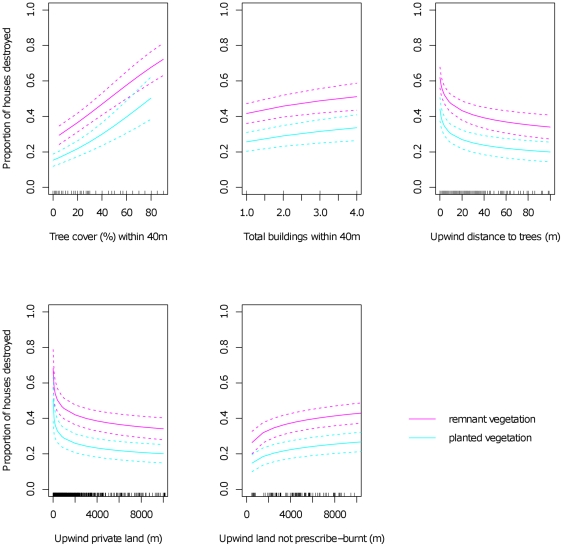
Losses to life and property from unplanned fires (wildfires) are forecast to increase because of population growth in peri-urban areas and climate change. In response, there have been moves to increase fuel reduction--clearing, prescribed burning, biomass removal and grazing--to afford greater protection to peri-urban communities in fire-prone regions. But how effective are these measures? Severe wildfires in southern Australia in 2009 presented a rare opportunity to address this question empirically. We predicted that modifying several fuels could theoretically reduce house loss by 76%-97%, which would translate to considerably fewer wildfire-related deaths. However, maximum levels of fuel reduction are unlikely to be feasible at every house for logistical and environmental reasons. Significant fuel variables in a logistic regression model we selected to predict house loss were (in order of decreasing effect): (1) the cover of trees and shrubs within 40 m of houses, (2) whether trees and shrubs within 40 m of houses was predominantly remnant or planted, (3) the upwind distance from houses to groups of trees or shrubs, (4) the upwind distance from houses to public forested land (irrespective of whether it was managed for nature conservation or logging), (5) the upwind distance from houses to prescribed burning within 5 years, and (6) the number of buildings or structures within 40 m of houses. All fuel treatments were more effective if undertaken closer to houses. For example, 15% fewer houses were destroyed if prescribed burning occurred at the observed minimum distance from houses (0.5 km) rather than the observed mean distance from houses (8.5 km). Our results imply that a shift in emphasis away from broad-scale fuel-reduction to intensive fuel treatments close to property will more effectively mitigate impacts from wildfires on peri-urban communities.
Overview
CoChat Summary
TL;DR
In three severe 2009 Victorian wildfires, a logistic model of 499 houses found that fuel variables closest to houses—especially tree and shrub cover within 40 m—were most strongly associated with house loss. The authors predict that minimizing key fuels at every house could reduce house loss from 35.0% to 4.6%, a 76%–97% reduction, but state this level of treatment is unlikely to be feasible everywhere.
Key findings
- The selected logistic model’s significant fuel variables, in decreasing effect, were: tree and shrub cover within 40 m, whether that vegetation was remnant or planted, upwind distance to trees/shrubs, upwind distance to public forest, upwind distance to prescribed burning within 5 years, and number of buildings within 40 m; all fuel treatments were more effective closer to houses.
- Reducing remnant native vegetation within 40 m from 90% to 5% cover reduced the likelihood of house loss by 43% (about 5% per 10% reduction); predominantly planted rather than remnant vegetation within 40 m was associated with 38% fewer houses destroyed; moving from 0 m to 100 m upwind from trees/shrubs was associated with 26% fewer houses lost.
- Compared with houses 10 m from public forest, 14% fewer houses were lost at 200 m and 26% fewer at 2 km; 15% fewer houses were lost if prescribed burning within 5 years occurred 0.5 km upwind rather than 8.5 km upwind; each additional building or shed within 40 m increased destroyed houses by 3%.
- Minimizing key fuels at every house predicted a reduction from the observed 35.0% of houses destroyed to 4.6% (±1.9% s.e.m.), equating to a 76%–97% reduction (95% CI); the model correctly discriminated burnt and unburnt houses 80% of the time (AUC), and a Hosmer–Lemeshow test was non-significant (P = 0.487).
Methods
- Sampled 499 houses within three wildfires that ignited in Victoria, south-eastern Australia on 7 February 2009 (Kilmore East, Murrindindi, Churchill), stratified by weather, terrain and fuel; house loss was recorded as a binary outcome from post-fire aerial imagery, and 24 potential explanatory variables were measured.
- Used generalized linear modelling with a logit link, stepwise selection by AIC and significance, and an autocovariate to account for spatial autocorrelation among houses within 1 km; goodness of fit was assessed with Hosmer–Lemeshow and AUC.
- Relative effects were predicted from the selected model with other significant variables held at means and FFDI fixed at 100; the maximum-reduction scenario held fuel variables at observed minima.
Limitations
- The paper states that broader applicability can only be confirmed by sampling across a broader range of fuel types and climates; that fuel treatments can be expensive and have undesirable health and environmental impacts; that intensive fuel-reduction is not always appropriate; and that weather strongly influenced fuel effects, so other measures such as architectural solutions, resident education, suppression, safer places and early evacuation must remain part of risk mitigation.
- The paper states that maximum fuel reduction is unlikely to be feasible at every house for logistical and environmental reasons.
- Evident from the text: this is an observational study of three fires in south-eastern Australia, so the reported associations do not by themselves establish causation, and unmeasured confounders may remain despite inclusion of an autocovariate.
Model-written summary. Check it against the paper before relying on it.
Integrity signals
Registry
Cites
Statistics
Figures
Verification
Claims the paper makes
6 Valid · 0 Not valid · 26 Not checked · 54 Own results and interpretations
The cited sources support only part of this claim — read each source’s verdict below.
In the paper
“For example, in the United States of America, 89% of all fuel-reduction treatments undertaken on federal lands were >2.5km from the wildland urban interface [13].”
§ Land Management Practices Associated with House Loss in Wildfires > Introduction
What the sources say
- Partly supportedcites [13] Schoennagel T Nelson CR Theobald DM Carnwath GC Chapman TB 2009 Implementation of National Fire Plan treatments near the wildland-urban interface in the western United States. Proceedings of the National Academy of Sciences of the United States of America 106 10706 10711 19506256 PMC2705595 sourceExperimental — accuracy not yet measured
The 89% figure is only the complement of what the paper reports: Results (p. 2) state that 11% of the total AREA treated (2004–2008 NFP treatments) fell within the WUI plus a 2.5-km buffer (WUI2.5), so 89% of treated area lay >2.5 km from the interface — the paper never states 89% itself. The claim's framing is not supported: the study quantifies hectares of area treated, not the proportion of individual treatments (Abstract/Methods describe 44,613 treatments on 3 million hectares, converted to circular polygons and dissolved into area), it covers all NFP treatments rather than specifically 'fuel-reduction' ones (Methods note the 'fuel reduction' objective was recorded for 80% of area and was not discriminating, so it was not reported separately), and its scope is 11 western states with treatments implemented by 5 federal agencies on BOTH federal and private land (Methods), not 'all federal lands' in the United States. (LLM, conf=0.78)
plain- Asserted: passes — The authors put it forward as true.
- Checkable: passes — It can be checked against evidence.
- Load-bearing: unclear — It is unclear whether the paper’s conclusions depend on it.
- Based: passes — The paper gives a reason why it holds.
- Partly supported
The cited sources support only part of this claim — read each source’s verdict below.
In the paper
“Our finding that fuel management close to houses was more effective than fuel management further from houses can be explained by the behaviour of embers and radiant heat—the principal causes of house loss during wildfires [20], [22], [27].”
§ Land Management Practices Associated with House Loss in Wildfires > Discussion > The relative effects of fuel treatments on house loss
What the sources say
- Supportedcites [20] Cohen JD 2000 Preventing disaster: Home ignitability in the wildland-urban interface. Journal of Forestry 98 15 21 source
The Conclusions (Journal of Forestry, p. 19) say that home ignitions are unlikely unless flames or firebrand ignitions occur within 40 meters, and that fire loss primarily depends on the home and its immediate site. The Management Implications (p. 19) likewise distinguish home ignitability from landscape-scale fuel management. The paper discusses radiant heat from flames and ignition by firebrands, supporting the cited explanation; the comparative effectiveness finding is the citing authors’ own finding. (LLM, conf=0.90)
- Not checked yetcites [22] Maranghides A Mell WE 2011 A case study of a community affected by the Witch and Guejito wildland fires. Fire Technology 47 379 420 source
- Partly supportedcites [27] Chen K McAneney J 2004 Quantifying bushfire penetration into urban areas in Australia. Geophysical Research Letters 31 L12212 sourceExperimental — accuracy not yet measured
The Results (§3, paragraph 8) suggest that airborne embers, rather than radiant heat, were the main cause of home ignition in the two suburbs studied. The Discussion (§4, paragraph 16) also identifies embers as a primary cause of home destruction. The paper therefore supports the ember part of the explanation, but not the description of radiant heat as a principal cause in these cases; it does not compare fuel-management distances. (LLM, conf=0.88)
plainstates a cause- Asserted: passes — The authors put it forward as true.
- Checkable: passes — It can be checked against evidence.
- Load-bearing: passes — The paper’s conclusions depend on it.
- Based: passes — The paper gives a reason why it holds.
- Supported
The sources with a verdict support this claim; the rest weren’t checked yet, have no full text we could read, or their verdicts aren’t rated yet.
In the paper
“These results are consistent with previous research indicating the effects of prescribed burning can diminish within a short period of time (2–6 years) [12], [28], [29] and in severe fire weather conditions [8], [12], [30], which are the conditions when most houses are destroyed [26].”
§ Land Management Practices Associated with House Loss in Wildfires > Discussion > Prescribed burning and house loss
What the sources say
- Supportedcites [8] Keeley JE Fotheringham CJ Moritz MA 2004 Lessons from the October 2003 wildfires in Southern California. Journal of Forestry 102 26 31 source
In 'Lessons Learned' (Lesson 2), our copy states that 'the extent to which landscape level fuel treatments are effective is a function of weather conditions during the fire event' and that 'under extreme weather conditions, there is overwhelming evidence that young fuels, or even fuel breaks, will not act as a barrier to fire spread,' illustrated by the Cedar and Otay fires burning through 7-10-year-old fuels. A later passage in the same section adds that 'under severe weather, lower fuel loads will not stop the spread of fire, but they do reduce fire intensity,' i.e. the treatment effect is curtailed rather than entirely absent — consistent with the hedged claim that effects 'can diminish' in severe fire weather. The 'Shrubland Burning' section reinforces this ('large fires under extreme fire weather conditions are only minimally constrained by the age and spatial patterns of fuels'). (LLM, conf=0.85)
- Not checked yetcites [12] Fernandes PM Botelho HS 2003 A review of prescribed burning effectiveness in fire hazard reduction. International Journal of Wildland Fire 12 117 128 source
- Not checked yetcites [30] Moritz MA Keeley JE Johnson EA Schaffner AA 2004 Testing a basic assumption of shrubland management fire: how important is fuel age? Frontiers in Ecology and the Environment 2 67 72 source
hedgedstates a possible cause- Asserted: passes — The authors put it forward as true.
- Checkable: passes — It can be checked against evidence.
- Load-bearing: passes — The paper’s conclusions depend on it.
- Based: passes — The paper gives a reason why it holds.
- Supported
A result the paper reports from its own data — it cites no other source for it, so there is none to check. The quote shows it is in the paper.
In the paper
“None of the interactions we tested (see Materials and Methods) were significant in the selected model.”
§ Land Management Practices Associated with House Loss in Wildfires > Results > A model to predict house loss
plain- Asserted: passes — The authors put it forward as true.
- Checkable: passes — It can be checked against evidence.
- Load-bearing: unclear — It is unclear whether the paper’s conclusions depend on it.
- Based: passes — The paper gives a reason why it holds.
A result the paper reports from its own data — it cites no other source for it, so there is none to check. The quote shows it is in the paper.
In the paper
“No variables representing terrain were significant in the selected model.”
§ Land Management Practices Associated with House Loss in Wildfires > Results > A model to predict house loss
plain- Asserted: passes — The authors put it forward as true.
- Checkable: passes — It can be checked against evidence.
- Load-bearing: unclear — It is unclear whether the paper’s conclusions depend on it.
- Based: passes — The paper gives a reason why it holds.
45 more claims
Create a free account to see all 86 claims and to verify the 47 references still open.
- Probably not a substantial claim. 30
- It may state two separate claims as one. 7
Claims other papers make about this one
Each is checked against this paper’s own text: does it say what the citing paper says it does?
The cited source says what the claim attributes to it.
In the citing paper
“Number of buildings within 40m was also a significant variable in their analysis.”
From Housing arrangement and vegetation factors associated with single-family home survival in the 2018 Camp Fire, California (2021) · cites this paper as Gibbons et al. (2012)
The cited source says what the claim attributes to it.
In the citing paper
“The relative importance of nearby burning home variables versus surrounding vegetation in explaining outcomes has varied among studies, with Gibbons et al. (2012) reporting canopy cover within 40m of the home to be the strongest predictor.”
From Housing arrangement and vegetation factors associated with single-family home survival in the 2018 Camp Fire, California (2021) · cites this paper as Gibbons et al. (2012)
Citations
Cites
R: A Language and Environment for Statistical Computing
R Core Team (2025) · doi:10.32614/r.manuals · Cited by 352,181
Modern Applied Statistics with S
Venables, W. N., & Ripley, B. D. (2002) · Statistics and Computing · doi:10.1007/978-0-387-21706-2 · Cited by 24,305
Warming and earlier spring increase western U.S. forest wildfire activity.
Westerling, A. L., Hidalgo, H. G., Cayan, D. R., & Swetnam, T. W. (2006) · Science · doi:10.1126/science.1128834 · Cited by 5,176 · cited 2×
“Devastating wildfires provide a window into conditions that may become more common in the future [1,2,3,4,5,6] and therefore represent important learning opportunities for decision-makers.”
BackgroundF. Dormann, C., M. McPherson, J., B. Araújo, M., Bivand, R., Bolliger, J., Carl, G., G. Davies, R., Hirzel, A., Jetz, W., Daniel Kissling, W., et al. (2007) · Ecography · doi:10.1111/j.2007.0906-7590.05171.x · Cited by 3,433 · cited 1×
“to the fitted GLM, which is a covariate representing spatial autocorrelation, following the methodology for non-normally distributed data reported in the appendix to Dormann et al.”
MethodEvaluating the predictive performance of habitat models developed using logistic regression
Pearce, J., & Ferrier, S. (2000) · Ecological Modelling · doi:10.1016/s0304-3800(00)00322-7 · Cited by 2,002 · cited 3×
“We calculated AUC [41] from observed and predicted values for this model using the package Rocr in the R statistical software [37] to determine the probability that true positives rank above false positives.”
MethodInfluentialBasic principles of forest fuel reduction treatments
Agee, J. K., & Skinner, C. N. (2005) · Forest Ecology and Management · doi:10.1016/j.foreco.2005.01.034 · Cited by 1,397 · cited 1×
“many fire-prone regions [10,13,14].”
The wildland urban interface in the United States
Radeloff, V. C., Hammer, R. B., Stewart, S. I., Fried, J. S., Holcomb, S. S., & McKeefry, J. F. (2005) · Ecological Applications · doi:10.1890/04-1413 · Cited by 1,236 · cited 2×
“Devastating wildfires provide a window into conditions that may become more common in the future [1,2,3,4,5,6] and therefore represent important learning opportunities for decision-makers.”
Background(1996) · Choice Reviews Online · doi:10.5860/choice.34-0916 · Cited by 1,061 · cited 3×
“primarily determined by weather, terrain and fuel [11].”
BackgroundMethodChanges in fire and climate in the eastern Iberian Peninsula (Mediterranean basin).
Pausas, J. G. (2004) · Climatic Change · doi:10.1023/b:clim.0000018508.94901.9c · Cited by 798 · cited 2×
“Devastating wildfires provide a window into conditions that may become more common in the future [1,2,3,4,5,6] and therefore represent important learning opportunities for decision-makers.”
BackgroundTrends in global wildfire potential in a changing climate
Liu, Y., Stanturf, J., & Goodrick, S. (2010) · Forest Ecology and Management · doi:10.1016/j.foreco.2009.09.002 · Cited by 791
Cited by
Items 101–200 of 237
Cary, G. J., Davies, I. D., Bradstock, R. A., Keane, R. E., & Flannigan, M. (2016) · Landscape Ecology · doi:10.1007/s10980-016-0420-8 · Cited by 32
“…of understanding fuel treatment effects on landscape area burned by moderate-to-high intensity fire, rather than outcomes for specific, high economic values like houses (Gibbons et al. 2012) or high ecosystem value locations including significant and vulnerable vegetation types (King et al. 2006).”
BackgroundSelf-citationBowman, D. M. J. S., Daniels, L. D., Johnston, F. H., Williamson, G. J., Jolly, W. M., Magzamen, S. L., Rappold, A. G., Brauer, M. D., & Henderson, S. B. (2018) · Fire · doi:10.3390/fire1020027 · Cited by 29
“Mechanical thinning is rarely used in Australia compared with North America, but research following the disastrous Black Saturday fires found that removing trees within 40 m of houses had a larger effect on reducing property losses than treatment with prescribed fire [62].”
BackgroundBioturbation by a reintroduced digging mammal reduces fuel loads in an urban reserve
Ryan, C. M., Hobbs, R. J., & Valentine, L. E. (2020) · Ecological Applications · doi:10.1002/eap.2018 · Cited by 29
“From a human safety perspective, there is a desire to minimize fuel loads in reserves to reduce the risk of wildfire (Gibbons et al. 2012).”
BackgroundZhang, M., Lü, P., Terada, T., Sui, M., Furuta, H., Iida, K., Katayama, Y., Lü, Y., Okamoto, K., Suzuki, M., et al. (2021) · Communications Biology · doi:10.1038/s42003-021-01705-1 · Cited by 34
Spatiotemporal effects of logging and fire on tall, wet temperate eucalypt forest birds
Lindenmayer, D. B., Blanchard, W., Blair, D. P., Westgate, M. J., & Scheele, B. C. (2019) · Ecological Applications · doi:10.1002/eap.1999 · Cited by 28
Self-citationAustralia's forests: Contested past, tenure-driven present, uncertain future
Kanowski, P. J. (2015) · Forest Policy and Economics · doi:10.1016/j.forpol.2015.06.001 · Cited by 32
Cost effectiveness of fire management strategies in southern Australia
Penman, T. D., & Cirulis, B. A. (2019) · International Journal of Wildland Fire · doi:10.1071/wf18128 · Cited by 28
Alexandra, J., & Norman, B. (2020) · Sustainable Earth Reviews · doi:10.1186/s42055-020-00032-3 · Cited by 32
“generalised landscape scale fuel reduction strategies [115].”
A comparison of fuel hazard in recently burned and long-unburned forests and woodlands
Dixon, K. M., Cary, G. J., Worboys, G. L., Seddon, J. A., & Gibbons, P. (2018) · International Journal of Wildland Fire · doi:10.1071/wf18037 · Cited by 28
Self-citationModelling the vulnerability of urban settings to wildland–urban interface fires in Chile
Aguirre, P., León, J., González-Mathiesen, C., Román, R., Penas, M., & Ogueda, A. (2024) · Natural hazards and earth system sciences · doi:10.5194/nhess-24-1521-2024 · Cited by 35
Ezz, A. A. E., Boucher, J., Cotton-Gagnon, A., & Godbout, A. (2022) · Fire Safety Journal · doi:10.1016/j.firesaf.2022.103625 · Cited by 29
Neale, T., Weir, J. K., & McGee, T. K. (2016) · Geoforum · doi:10.1016/j.geoforum.2016.03.008 · Cited by 31
Gazzard, T., Walshe, T. V., Galvin, P., Salkin, O., Baker, M., Cross, B., & Ashton, P. (2019) · International Journal of Wildland Fire · doi:10.1071/wf18131 · Cited by 24
“Contemporary fuel management design principles (Gibbons et al. 2012; Tolhurst et al. 2013; Driscoll et al. 2016; Furlaud et al. 2018) were incorporated into the development of the seven fuel management alternatives, with scheduling aiming to either minimise fuel loads or maximise house loss…”
BackgroundMeldrum, J. R., Barth, C. M., Goolsby, J. B., Olson, S., Gosey, A., White, J. (., Brenkert–Smith, H., Champ, P. A., & Gomez, J. (2022) · Fire · doi:10.3390/fire5010024 · Cited by 30
Guo, D., Saft, M., Hou, X., Webb, J. A., Hairsine, P. B., & Western, A. W. (2023) · Journal of Hydrology · doi:10.1016/j.jhydrol.2023.129979 · Cited by 30
Garden design can reduce wildfire risk and drive more sustainable co-existence with wildfire
Ondei, S., Price, O. F., & Bowman, D. M. J. S. (2024) · npj natural hazards. · doi:10.1038/s44304-024-00012-z · Cited by 27
Modeling Wildfire Incident Complexity Dynamics
Thompson, M. P. (2013) · PLoS ONE · doi:10.1371/journal.pone.0063297 · Cited by 26
What are the associations between thinning and fire severity?
Taylor, C., Blanchard, W., & Lindenmayer, D. B. (2021) · Austral Ecology · doi:10.1111/aec.13096 · Cited by 25
Self-citationIntegrated graph measures reveal survival likelihood for buildings in wildfire events
Chulahwat, A., Mahmoud, H. N., Monedero, S., Vizcaíno, F. J. D., Ramirez, J., Buckley, D., & Cardíl, A. (2022) · Scientific Reports · doi:10.1038/s41598-022-19875-1 · Cited by 27
Hope, B. (2012) · Wildlife research (East Melbourne) · doi:10.1071/wr12110 · Cited by 19
Wildfire survival plans in theory and practice
Eriksen, C., Penman, T. D., Horsey, B., & Bradstock, R. A. (2016) · International Journal of Wildland Fire · doi:10.1071/wf14193 · Cited by 25
Self-citationUsing Bird Ecology to Learn About the Benefits of Severe Fire
Hutto, R. L., Bond, M. L., & DellaSala, D. A. (2015) · Elsevier eBooks · doi:10.1016/b978-0-12-802749-3.00003-7 · Cited by 28
“…achieved through mechanical treatments in small areas immediately adjacent to structures (Cohen, 2000; Cohen and Stratton, 2008; Winter et al., 2009; Stockmann et al., 2010; Gibbons et al., 2012; Syphard et al., 2014), and not through mechanical treatments in more remote wildlands, is important.”
BackgroundEmployment effects of active labor market programs for sick-listed workers
Holm, A., Høgelund, J., Gørtz, M., Rasmussen, K. S., & Houlberg, H. S. B. (2017) · Journal of Health Economics · doi:10.1016/j.jhealeco.2017.01.006 · Cited by 24
McDougall, A. W. W. A. I., Milner, R. N. C., Driscoll, D. A., & Smith, A. L. (2016) · Biodiversity and Conservation · doi:10.1007/s10531-016-1136-4 · Cited by 23
“2009) even though it might be ineffective for both asset protection (Gibbons et al. 2012) and biodiversity conservation (Kelly et al.”
BackgroundSelf-citationVisner, M., Shirowzhan, S., & Pettit, C. J. (2021) · Buildings · doi:10.3390/buildings11020037 · Cited by 23
“Another claim is that prescribed burning in remote areas has little impact on reducing fire risk compared to prescribed burning in residential areas [20], which can be five times more effective [21].”
BackgroundWilliams, B. A., Shoo, L. P., Wilson, K. A., & Beyer, H. L. (2017) · Journal of Applied Ecology · doi:10.1111/1365-2664.12920 · Cited by 22
Diverse land-uses shape new bird communities in a changing rural region
Sambell, C. E., Holland, G. J., Haslem, A., & Bennett, A. F. (2019) · Biodiversity and Conservation · doi:10.1007/s10531-019-01833-5 · Cited by 20
Lucas, C. H., Williamson, G. J., & Bowman, D. M. J. S. (2022) · International Journal of Wildland Fire · doi:10.1071/wf22099 · Cited by 22
Baker, W. L., Hanson, C. T., & DellaSala, D. A. (2023) · Fire · doi:10.3390/fire6110428 · Cited by 22
Subsidized Households and Wildfire Hazards in California
Gabbe, C. J., Pierce, G., & Oxlaj, E. (2020) · Environmental Management · doi:10.1007/s00267-020-01340-2 · Cited by 22
Fighting Fire with Fire: Does a Policy of Broad-Scale Prescribed Burning Improve Community Safety?
Clode, D., & Elgar, M. A. (2014) · Society & Natural Resources · doi:10.1080/08941920.2014.905894 · Cited by 23
Disaster recovery gentrification in post-wildfire landscapes: The case of Paradise, CA
Lambrou, N., Kolden, C. A., & Loukaitou‐Sideris, A. (2025) · International Journal of Disaster Risk Reduction · doi:10.1016/j.ijdrr.2025.105235 · Cited by 34
Vanderduys, E. P., Reside, A. E., Grice, A. C., & Rechetelo, J. (2016) · PLoS ONE · doi:10.1371/journal.pone.0148485 · Cited by 25
Ortega‐Álvarez, R., Zúñiga‐Vega, J. J., Ruiz‐Gutiérrez, V., Benítez, E. B., Mena, I. M., & Felipe, F. R. (2017) · Forest Ecology and Management · doi:10.1016/j.foreco.2017.09.033 · Cited by 18
What environmental and climatic factors influence multidecadal fire frequency?
Lindenmayer, D. B., Taylor, C., Blanchard, W., Zylstra, P., & Evans, M. J. (2023) · Ecosphere · doi:10.1002/ecs2.4610 · Cited by 22
Self-citationBerry, L. E., Lindenmayer, D. B., Dennis, T. E., Driscoll, D. A., & Banks, S. C. (2016) · International Journal of Wildland Fire · doi:10.1071/wf15204 · Cited by 22
Self-citationDisturbance causes variation in sub-canopy fire weather conditions
Wilson, N., Bradstock, R. A., & Bedward, M. (2022) · Agricultural and Forest Meteorology · doi:10.1016/j.agrformet.2022.109077 · Cited by 25
Self-citationHanson, C. T. (2015) · Wildlife Society Bulletin · doi:10.1002/wsb.560 · Cited by 17
“Increased managed wildland fire activities (i.e., allowing lightning fires to burn in more remote areas) could be used more frequently in these forests, while focusing fuel reduction in defensible space areas adjacent to homes (Gibbons et al. 2012, Calkin et al. 2014).”
BackgroundButsic, V., Syphard, A. D., Keeley, J. E., & Bar‐Massada, A. (2016) · Landscape and Urban Planning · doi:10.1016/j.landurbplan.2016.05.002 · Cited by 20
“We did not account for localscale factors such as building construction and defensible space that would be important for structure survival given the exposure (Gibbons et al., 2012).”
BackgroundProgress and prospects for predicting wildfire spread through the wildland-urban interface
Price, O. F., Ondei, S., & Bowman, D. M. J. S. (2025) · International Journal of Disaster Risk Reduction · doi:10.1016/j.ijdrr.2025.105392 · Cited by 21
Seto, D., Jones, C., Trugman, A. T., Varga, K., Plantinga, A. J., Carvalho, L. M. V., Thompson, C. F., Gellman, J., & Daum, K. (2022) · Fire · doi:10.3390/fire5020037 · Cited by 18
Post-wildfire neighborhood change: Evidence from the 2018 Camp Fire
McConnell, K., & Braneon, C. V. (2024) · Landscape and Urban Planning · doi:10.1016/j.landurbplan.2023.104997 · Cited by 21
McNamara, D. J., Mell, W., & Maranghides, A. (2019) · International Journal of Wildland Fire · doi:10.1071/wf19041 · Cited by 17
Cell-free synthesis of the hirudin variant 1 of the blood-sucking leech Hirudo medicinalis
Wüstenhagen, D. A., Lukas, P., Müller, C. R., Aubele, S. A., Hildebrandt, J., & Kubick, S. (2020) · Scientific Reports · doi:10.1038/s41598-020-76715-w · Cited by 16
Assessing drought and drought-related wildfire risk in Kanjiza, Serbia: the SEERISK methodology
Markovič, V. M., Nagy, I. V., Sik, A., Perge, K., László, P., Papathoma-Köhle, M., Promper, C., & Glade, T. (2015) · Natural Hazards · doi:10.1007/s11069-015-1991-4 · Cited by 18
“Drought indices, but also fuel in vegetation (Gibbons et al. 2012), are one of the long-term factors that intensify the occurrence of wildfires through the year (Wotton and Flannigan 1993; Bradstock et al.”
BackgroundPurnomo, D. M. J., Qin, Y., Theodori, M., Zamanialaei, M., Lautenberger, C., Trouvé, A., & Gollner, M. J. (2024) · International Journal of Wildland Fire · doi:10.1071/wf24102 · Cited by 18
Knowledge governance for the Anthropocene: Pluralism, populism, and decision‐making
Clément, S. (2022) · Global Policy · doi:10.1111/1758-5899.13148 · Cited by 19
Collins, L., Guindon, L., Lloyd, C., Taylor, S. W., & White, S. (2024) · Remote Sensing of Environment · doi:10.1016/j.rse.2024.114189 · Cited by 20
Purnomo, D. M. J., Qin, Y., Theodori, M., Zamanialaei, M., Lautenberger, C., Trouvé, A., & Gollner, M. J. (2024) · Proceedings of the Combustion Institute · doi:10.1016/j.proci.2024.105755 · Cited by 22
Craig, C. A., Allen, M. W., Feng, S., & Spialek, M. L. (2019) · International Journal of Disaster Risk Reduction · doi:10.1016/j.ijdrr.2019.101420 · Cited by 20
Ember risk modelling for improved wildfire risk management in the peri-urban fringes
Roberts, M. E., Rawlinson, A. A., & Wang, Z. (2021) · Environmental Modelling & Software · doi:10.1016/j.envsoft.2020.104956 · Cited by 15
Metz, A. J., Fischer, E. C., & Liel, A. B. (2024) · Fire Technology · doi:10.1007/s10694-024-01616-7 · Cited by 15
Limp, Leap or Learn? Developing legal frameworks for climate change adaptation planning in Australia
Macintosh, A., Foerster, A., & McDonald, J. (2013) · UTAS Research Repository · Cited by 26
Early evacuation is the best bushfire risk mitigation strategy for south‐eastern Australia
Venn, T. J., & Quiggin, J. C. (2017) · Australian Journal of Agricultural and Resource Economics · doi:10.1111/1467-8489.12215 · Cited by 15
Evaluating Socioecological Wildfire Effects in Greece with a Novel Numerical Index
Palaiologou, P., Kalabokidis, K. D., Day, M. A., & Kopsachilis, V. (2020) · Fire · doi:10.3390/fire3040063 · Cited by 16
“Peri-urban communities in fire-prone regions around the world are at increasing risk from unplanned fires (wildfires) because of population growth and climate change [200].”
BackgroundDuff, T. J., Cawson, J. G., & Penman, T. D. (2018) · Springer eBooks · doi:10.1007/978-3-319-51727-8_120-1 · Cited by 13
To burn or not to burn: governance of wildfires in Australia
Clément, S., Garmestani, A. S., Beckwith, J. A., & Cannon, P. (2024) · Ecology and Society · doi:10.5751/es-14801-290108 · Cited by 19
The response and management of species sensitive to altered fire regimes
Lindenmayer, D. B., Zylstra, P., DellaSala, D. A., Taylor, C., & Legge, S. (2025) · Nature Reviews Biodiversity · doi:10.1038/s44358-025-00086-1 · Cited by 17
“For example, prescribed burns to reduce fire risk near human settlements 145 have sometimes had disastrous impacts on threatened species 90 .”
Self-citationSetting the Stage for Mixed- and High-Severity Fire
Hanson, C. T., Sherriff, R. L., Hutto, R. L., DellaSala, D. A., Veblen, T. T., & Baker, W. L. (2015) · Elsevier eBooks · doi:10.1016/b978-0-12-802749-3.00001-3 · Cited by 15
“…in policies that would allow more mixed- and high-severity fire in the wildlands away from homes, while focusing on fuel reduction and fire suppression activities adjacent to homes to provide for public safety (Gibbons et al., 2012; Calkin et al., 2014; Moritz et al., 2014; see also Chapter 13).”
BackgroundLindenmayer, D. B., Zylstra, P., Hanson, C. T., Six, D. L., & DellaSala, D. A. (2025) · Biological Conservation · doi:10.1016/j.biocon.2025.111071 · Cited by 17
Self-citationBalancing fire risk and human thermal comfort in fire-prone urban landscapes
MacLeod, T. A., Hahs, A. K., & Penman, T. D. (2019) · PLoS ONE · doi:10.1371/journal.pone.0225981 · Cited by 13
“Additionally, the proximity of houses to bushland has been associated to property loss [11].”
BackgroundEscobedo, F. J., Yadav, K., Cappelluti, O., & Johnson, N. G. (2025) · Landscape and Urban Planning · doi:10.1016/j.landurbplan.2025.105421 · Cited by 14
Lindenmayer, D. B., & Bowd, E. (2022) · Ecological Management & Restoration · doi:10.1111/emr.12564 · Cited by 12
Self-citationStrahan, K., & Gilbert, J. (2021) · Fire · doi:10.3390/fire4030042 · Cited by 20
“conditions, including official bushfire warnings, to avoid dangerous late evacuation [29].”
BackgroundMcNamara, D. J., & Mell, W. (2021) · Fire Technology · doi:10.1007/s10694-021-01170-6 · Cited by 12
Fire management now and in the future: Will today's solutions still apply tomorrow?
Marshall, E., Marcot, B. G., Parkins, K. A., & Penman, T. D. (2024) · The Science of The Total Environment · doi:10.1016/j.scitotenv.2024.177863 · Cited by 10
Mata, L., Garrard, G. E., Kutt, A. S., Wintle, B. C., Chee, Y. E., Backstrom, A., Bainbridge, B., Urlus, J., Brown, G. W., Tolsma, A. D., et al. (2016) · Austral Ecology · doi:10.1111/aec.12431 · Cited by 9
Ellis, M., Taylor, J. E., & Rayner, L. (2015) · Ecological Management & Restoration · doi:10.1111/emr.12168 · Cited by 10
A review of optimization and decision models of prescribed burning for wildfire management
Qi, J., & Zhuang, J. (2024) · Risk Analysis · doi:10.1111/risa.17680 · Cited by 9
“The protection benefit of Rx was calculated based on population density and proximity to residential areas, adopting methodologies from Gibbons et al. (2012) and Pen-man et al. (2014).”
Trends and Gaps in Prescribed Burning Research
Gordon, L., Evans, M. J., Zylstra, P., & Lindenmayer, D. B. (2025) · Environmental Management · doi:10.1007/s00267-025-02119-z · Cited by 12
“…of the ef fi cacy of prescribed burning in mitigating house loss from wild fi re found a small protective effect when analysing a partial dataset (Gibbons et al., 2012), but another analysis of the full dataset found that prescribed burning increased the likelihood of both crown fi re and…”
Self-citationThe role of construction standards on building impact of the 2013 Linksview Wildfire, Australia
Price, O. F., & Roberts, B. (2022) · Fire Safety Journal · doi:10.1016/j.firesaf.2022.103545 · Cited by 10
A proposed strategy for maintaining mature forest habitat in Tasmania's wood production forests
Koch, A. J., & Munks, S. A. (2018) · Ecological Management & Restoration · doi:10.1111/emr.12337 · Cited by 8
Mitigation Strategies for Wildfires
Parkins, K. A., Cawson, J. G., Pickering, B. J., & Penman, T. D. (2022) · The Society of fire protection engineers series · doi:10.1007/978-3-030-94356-1_12 · Cited by 8
Bradshaw, D., & Bradshaw, F. J. (2017) · Australian Journal of Zoology · doi:10.1071/zo16068 · Cited by 8
“2015) and to human life and property that are emerging as a consequence of global warming (DellaSala et al. 2004; Parr and Anderson 2006; Clarke 2008; Boer et al. 2009; Haslem et al. 2011; Pastro et al. 2011; Gibbons et al. 2012; Buizer and Kurz 2016).”
BackgroundBrenkert–Smith, H., Jahn, J. L. S., Vance, E. A., & Ahumada, J. S. (2019) · Fire · doi:10.3390/fire3010002 · Cited by 11
“Both fire science and recent major fires demonstrate that landscape‐scale fuels, fuels directly adjacent to a home [11,12], as well as structures (homes and other buildings) [13,14] and their arrangement [15] all constitute key contributors to WUI disasters, making fuel management at the intersection of wildland and u…”
BackgroundMandated vs. Voluntary Adaptation to Natural Disasters: The Case of U.S. WildfiresPreprint
Baylis, P., & Boomhower, J. P. (2022) · SSRN Electronic Journal · doi:10.2139/ssrn.3998794 · Cited by 7
Estimating WUI exposure probability to a nearby wildfire
Wei, Y., Gannon, B. M., Young, J. D., Belval, E. J., Thompson, M. P., O’Connor, C. D., & Calkin, D. E. (2023) · Fire Ecology · doi:10.1186/s42408-023-00191-6 · Cited by 9
“Page 3/19 Spatial metrics like building density, vegetation cover, and proximity to large areas of wildland fuels are used to identify buildings or neighborhoods that are vulnerable to wild re (Gibbons et al. 2012, BarMassada et al. 2013, Radeloff et al. 2018).”
MethodAn expert system to quantify wildfire hazards in gardens and create effective defensible space
Ondei, S., Williamson, G. J., Foyster, S. M., & Bowman, D. M. J. S. (2025) · International Journal of Disaster Risk Reduction · doi:10.1016/j.ijdrr.2025.105424 · Cited by 7
Mandated versus Voluntary Adaptation to Natural Disasters: The Case of US Wildfires
Baylis, P., & Boomhower, J. P. (2025) · Journal of Political Economy · doi:10.1086/739331 · Cited by 23
DellaSala, D. A., Lindenmayer, D. B., Hanson, C. T., & Furnish, J. (2015) · Elsevier eBooks · doi:10.1016/b978-0-12-802749-3.00011-6 · Cited by 7
Self-citationNolan, R. H., Gibson, R. K., Cirulis, B. A., Holyland, B., Samson, S. A., Jenkins, M. E., Penman, T. D., & Boer, M. M. (2024) · International Journal of Wildland Fire · doi:10.1071/wf22179 · Cited by 6
Eburn, M. (2015) · Emerald Group Publishing Limited eBooks · doi:10.1108/s1059-433720150000068007 · Cited by 6
OBSOLETE: Primary Forest: definition, status and future prospects for global conservation
Kormos, C. (2017) · Elsevier eBooks · doi:10.1016/b978-0-12-409548-9.09711-6 · Cited by 6
DellaSala, D. A., Hanson, C. T., Baker, W. L., Hutto, R. L., Halsey, R. W., Odion, D. C., Berry, L. E., Abrams, R. W., Heneberg, P., & Sitters, H. (2015) · Elsevier eBooks · doi:10.1016/b978-0-12-802749-3.00013-x · Cited by 7
Preventing Human-Caused Wildfire Ignitions on Public Lands: A Review of Best Practices
Edgeley, C. M., Evans, A. M., Devenport, S. E., Kohler, G., Zamudio, Z. M., & DeGrandpre, W. D. (2025) · Forest Science · doi:10.1007/s44391-025-00025-9 · Cited by 17
“…engineering strategies, such as fuel treatments or management of home ignition zone vegetation, are not included in this review as an abundance of studies assessing the state of those sub-fields already exists (e.g., Gibbons et al. 2012; Calkin et al. 2014; Kalies et al. 2016; Davis et al. 2024).”
From biodiversity to bioperversity: from good science to poor environmental policy
Lindenmayer, D. B. (2013) · Pacific Conservation Biology · doi:10.1071/pc130250 · Cited by 5
“Post-fire logging in Victorian wet forests The 2009 wildfires in Victoria were the most destructive in Australian history in terms of the loss of human life and damage to property (Gibbons et al. 2012).”
BackgroundSelf-citationSensitivity of ELMFIRE to real-world input datasets for WUI fire modeling
Purnomo, D. M. J., Zamanialaei, M., Earle, M., Theodori, M., Qin, Y., Lautenberger, C., Trouvé, A., & Gollner, M. J. (2026) · Fire Safety Journal · doi:10.1016/j.firesaf.2026.104651 · Cited by 6
Fire futures for a megadiverse continent
Williams, R. J., & Bowman, D. M. J. S. (2012) · New Phytologist · doi:10.1111/j.1469-8137.2012.04342.x · Cited by 5
Cannon, P., & Clément, S. (2025) · People and Nature · doi:10.1002/pan3.70146 · Cited by 4
“…use of broadscale prescribed burning has also generated debate, with questions emerging over its effectiveness in protecting life and property (c.f. Gibbons et al., 2012; Florec et al., 2020), whether it presents greater risks to human health from poor air quality than wildfires…”
Prescribed burning in Australian forests: characteristics, impacts and effects
Price, O. F. (2023) · CSIRO Publishing eBooks · doi:10.1071/9781486316656.bk08085_ch21 · Cited by 3
Design Bushfire Selection for Bushfire Protection in Adaptation to Global Warming
Douglas, G., & He, Y. (2019) · Frontiers in Mechanical Engineering · doi:10.3389/fmech.2019.00027 · Cited by 3
Muffly, J., & Birchall, S. J. (2023) · International Journal of Disaster Risk Reduction · doi:10.1016/j.ijdrr.2023.103988 · Cited by 4
Impact of Climate Change on Forest Fires in India and Climate Adaptive Management Strategies
Das, S. B., & Dhawan, V. K. (2024) · Disaster Resilience and Green Growth · doi:10.1007/978-981-99-4105-6_9 · Cited by 3
Matey, Y., CALLAFON, R. A. D., & Altıntaş, İ. (2024) · Lecture notes in computer science · doi:10.1007/978-3-031-63751-3_18 · Cited by 3
“This research explores the use of prescribed burns also called Interface burns [3,6] when practiced near residential areas to reduce wildfire risks, emphasizing the crucial role of fire lines, termed "black lines" in QUIC FIRE simulations.”
Tending the Fire: Wildfire Risk Management at the Interface
Evers, C. (2020) · doi:10.15760/etd.7289 · Cited by 3
“In other cases, such as exposure archetype C2 and C5, mitigation efforts should focus more on the areas within and nearby development, which includes restricting development in fire-prone wildlands (Headwaters Economics, 2016) and reducing flammable vegetation surrounding homes (Gibbons et al., 2012).”
BackgroundFactors associated with single-family home survival in the 2018 Camp Fire, CaliforniaPreprint
Knapp, E. E., Valachovic, Y. S., Quarles, S. L., & Johnson, N. G. (2021) · Research Square · doi:10.21203/rs.3.rs-580864/v1 · Cited by 3
Huber-Smith, N. K., Morley, E. S., Krix, D. W., Murray, M. L., Webb, J. K., Martin, L. J., Young, K. P., McLean, C. M., Hingee, M. C., & Murray, B. R. (2023) · Fire · doi:10.3390/fire6110440 · Cited by 2
Avoid getting burned: lessons from the McKinley wildfire in rural Alaska, USA
Schmidt, J. I., Berman, M., & Waigl, C. F. (2024) · International Journal of Wildland Fire · doi:10.1071/wf24014 · Cited by 4
The effectiveness of prescribed burning for protecting houses during wildfires in Australia
Gibbons, P., Gale, M. G., Moritz, M. A., & Cary, G. J. (2025) · Fire Ecology · doi:10.1186/s42408-025-00413-z · Cited by 3
“The loss of houses in Australian wildfires is positively associated with the cover of proximal woody vegetation (Price et al. 2021; Gibbons et al. 2012; Ramsay et al. 1996; Wilson and Ferguson 1986).”
InfluentialSelf-citationFire, forests and fauna (The 2020 Krebs Lecture)
Lindenmayer, D. B. (2020) · Pacific Conservation Biology · doi:10.1071/pc20046 · Cited by 5
Self-citation
Metadata
- Authors
- Gibbons, P., van Bommel, L., Gill, A. M., Cary, G. J., Driscoll, D. A., Bradstock, R. A., Knight, E., Moritz, M. A., Stephens, S. L., & Lindenmayer, D. B.
- Affiliations
- Australian National University (AU)
- University of Wollongong (AU)
- University of California, Berkeley (US)
- Corresponding author
- Gibbons, Philip
- ORCID
- Venue
- PLoS ONE
- Publisher
- Public Library of Science (PLoS)
- Published
- 2012-01-18
- Volume
- 7
- Issue
- 1
- Pages
- e29212
- ISSN
- 1932-6203 (ISSN-L)
- PMC
- PMC3260958
- OpenAlex
- W2126419565
- Cited by
- 237
- References
- 40
- Citations by year
- 2026: 10 · 2025: 16 · 2024: 22 · 2023: 9 · 2022: 18 · 2021: 20 · 2020: 13 · 2019: 16 · 2018: 15 · 2017: 11 · 2016: 19 · 2015: 23 · 2014: 21 · 2013: 17 · 2012: 7
- FWCI
- 18.02
- Type
- journal article
- Language
- en
- Open access
- gold
- doi.org
- Locations
- PLoS ONE (publishedVersion, cc-by)
- PubMed Central (publishedVersion, cc-by)
- PubMed (publishedVersion)
- Adelaide Research & Scholarship (AR&S) (University of Adelaide) (submittedVersion, cc-by)
- Research Online (University of Wollongong) (submittedVersion)
- DOAJ (DOAJ: Directory of Open Access Journals) (submittedVersion, cc-by-sa)
- Figshare (submittedVersion, cc-by)
- Figshare (submittedVersion)
- ANU Open Research (Australian National University) (submittedVersion, cc-by)
- Funders
- Centre of Excellence for Environmental Decisions, Australian Research Council
- Australian Government
- Australian National University
- University of Wollongong
- Australian Research Council
- Topics
- Physical Sciences › Environmental Science › Global and Planetary Change › Fire effects on ecosystems
- Social Sciences › Sociology and Political Science › Disaster Management and Resilience
- Physical Sciences › Environmental Science › Ecology › Rangeland and Wildlife Management
- Keywords
- forest fires, fuel reduction, prescribed burning, peri-urban communities, fire risk reduction, tree and shrub cover, 2009 bushfires, southern Australia, fire-prone regions
- MeSH terms
- Conservation of Natural Resources, Fires, Housing, Humans, Population Dynamics, Trees, Urbanization, Victoria, Logistic Models, Forestry, Ecosystem, Biomass, Climate Change
About these checks
Registry, retraction, Cites and statistics results are computed, not judged, with one exception: a printed reference that no index lists is read once by a model before it counts as a citation error. Claims are extracted by a model and kept only when their quote appears verbatim in the text; each cited source is then checked, with a model’s help, for whether it says what the claim relies on. Those verdicts can be wrong — read the claim’s quote and the cited source before relying on one.
The claim verdicts this report counts are experimental: their accuracy is not yet measured.
A language model drew the claims from the paper on 2026-10-05, under version 3 of the claim definition (model deepseek-v4.1-flash, prompt extract-v3).
A second model labelled each claim on 2026-10-05 (model jev-1.13-20260917, definition revision gold-guideline-v0.2).
Cited sources are checked with a language model’s help (qwen3.8-omni-flash and gpt-6-sol).
Statistics and arithmetic are recomputed, not judged.
Confidence bands are shown only for fields calibrated on our annotated test set. None is calibrated yet, so no band is shown.
What counts as a claim ›How we measure confidence ›How we check this ›
Are you an author, or do you see a problem with this page? Request a review
Data sources
Bibliographic data: Semantic Scholar, OpenAlex, Crossref.
Contains information from the Semantic Scholar Academic Graph Datasets, made available under the ODC Attribution License (ODC-BY 1.0).
Semantic Scholar’s data is described in: Kinney, R., et al. (2023). The Semantic Scholar Open Data Platform. arXiv:2301.10140.
