

Land Management Practices Associated with House Loss in Wildfires
Open accessThe DOI matches its Crossref record; 40 of the 40 references it cites were found in a registry or an index; 7 of the 54 sources its claims cite were checked for support.
Abstract
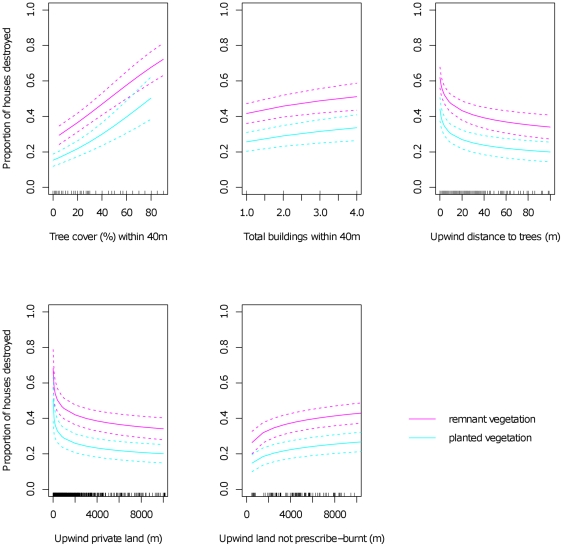
Losses to life and property from unplanned fires (wildfires) are forecast to increase because of population growth in peri-urban areas and climate change. In response, there have been moves to increase fuel reduction--clearing, prescribed burning, biomass removal and grazing--to afford greater protection to peri-urban communities in fire-prone regions. But how effective are these measures? Severe wildfires in southern Australia in 2009 presented a rare opportunity to address this question empirically. We predicted that modifying several fuels could theoretically reduce house loss by 76%-97%, which would translate to considerably fewer wildfire-related deaths. However, maximum levels of fuel reduction are unlikely to be feasible at every house for logistical and environmental reasons. Significant fuel variables in a logistic regression model we selected to predict house loss were (in order of decreasing effect): (1) the cover of trees and shrubs within 40 m of houses, (2) whether trees and shrubs within 40 m of houses was predominantly remnant or planted, (3) the upwind distance from houses to groups of trees or shrubs, (4) the upwind distance from houses to public forested land (irrespective of whether it was managed for nature conservation or logging), (5) the upwind distance from houses to prescribed burning within 5 years, and (6) the number of buildings or structures within 40 m of houses. All fuel treatments were more effective if undertaken closer to houses. For example, 15% fewer houses were destroyed if prescribed burning occurred at the observed minimum distance from houses (0.5 km) rather than the observed mean distance from houses (8.5 km). Our results imply that a shift in emphasis away from broad-scale fuel-reduction to intensive fuel treatments close to property will more effectively mitigate impacts from wildfires on peri-urban communities.
Overview
CoChat Summary
TL;DR
In three severe 2009 Victorian wildfires, a logistic model of 499 houses found that fuel variables closest to houses—especially tree and shrub cover within 40 m—were most strongly associated with house loss. The authors predict that minimizing key fuels at every house could reduce house loss from 35.0% to 4.6%, a 76%–97% reduction, but state this level of treatment is unlikely to be feasible everywhere.
Key findings
- The selected logistic model’s significant fuel variables, in decreasing effect, were: tree and shrub cover within 40 m, whether that vegetation was remnant or planted, upwind distance to trees/shrubs, upwind distance to public forest, upwind distance to prescribed burning within 5 years, and number of buildings within 40 m; all fuel treatments were more effective closer to houses.
- Reducing remnant native vegetation within 40 m from 90% to 5% cover reduced the likelihood of house loss by 43% (about 5% per 10% reduction); predominantly planted rather than remnant vegetation within 40 m was associated with 38% fewer houses destroyed; moving from 0 m to 100 m upwind from trees/shrubs was associated with 26% fewer houses lost.
- Compared with houses 10 m from public forest, 14% fewer houses were lost at 200 m and 26% fewer at 2 km; 15% fewer houses were lost if prescribed burning within 5 years occurred 0.5 km upwind rather than 8.5 km upwind; each additional building or shed within 40 m increased destroyed houses by 3%.
- Minimizing key fuels at every house predicted a reduction from the observed 35.0% of houses destroyed to 4.6% (±1.9% s.e.m.), equating to a 76%–97% reduction (95% CI); the model correctly discriminated burnt and unburnt houses 80% of the time (AUC), and a Hosmer–Lemeshow test was non-significant (P = 0.487).
Methods
- Sampled 499 houses within three wildfires that ignited in Victoria, south-eastern Australia on 7 February 2009 (Kilmore East, Murrindindi, Churchill), stratified by weather, terrain and fuel; house loss was recorded as a binary outcome from post-fire aerial imagery, and 24 potential explanatory variables were measured.
- Used generalized linear modelling with a logit link, stepwise selection by AIC and significance, and an autocovariate to account for spatial autocorrelation among houses within 1 km; goodness of fit was assessed with Hosmer–Lemeshow and AUC.
- Relative effects were predicted from the selected model with other significant variables held at means and FFDI fixed at 100; the maximum-reduction scenario held fuel variables at observed minima.
Limitations
- The paper states that broader applicability can only be confirmed by sampling across a broader range of fuel types and climates; that fuel treatments can be expensive and have undesirable health and environmental impacts; that intensive fuel-reduction is not always appropriate; and that weather strongly influenced fuel effects, so other measures such as architectural solutions, resident education, suppression, safer places and early evacuation must remain part of risk mitigation.
- The paper states that maximum fuel reduction is unlikely to be feasible at every house for logistical and environmental reasons.
- Evident from the text: this is an observational study of three fires in south-eastern Australia, so the reported associations do not by themselves establish causation, and unmeasured confounders may remain despite inclusion of an autocovariate.
Model-written summary. Check it against the paper before relying on it.
Integrity signals
Registry
Cites
Statistics
Figures
Verification
Claims the paper makes
6 Valid · 0 Not valid · 26 Not checked · 54 Own results and interpretations
The cited sources support only part of this claim — read each source’s verdict below.
In the paper
“For example, in the United States of America, 89% of all fuel-reduction treatments undertaken on federal lands were >2.5km from the wildland urban interface [13].”
§ Land Management Practices Associated with House Loss in Wildfires > Introduction
What the sources say
- Partly supportedcites [13] Schoennagel T Nelson CR Theobald DM Carnwath GC Chapman TB 2009 Implementation of National Fire Plan treatments near the wildland-urban interface in the western United States. Proceedings of the National Academy of Sciences of the United States of America 106 10706 10711 19506256 PMC2705595 sourceExperimental — accuracy not yet measured
The 89% figure is only the complement of what the paper reports: Results (p. 2) state that 11% of the total AREA treated (2004–2008 NFP treatments) fell within the WUI plus a 2.5-km buffer (WUI2.5), so 89% of treated area lay >2.5 km from the interface — the paper never states 89% itself. The claim's framing is not supported: the study quantifies hectares of area treated, not the proportion of individual treatments (Abstract/Methods describe 44,613 treatments on 3 million hectares, converted to circular polygons and dissolved into area), it covers all NFP treatments rather than specifically 'fuel-reduction' ones (Methods note the 'fuel reduction' objective was recorded for 80% of area and was not discriminating, so it was not reported separately), and its scope is 11 western states with treatments implemented by 5 federal agencies on BOTH federal and private land (Methods), not 'all federal lands' in the United States. (LLM, conf=0.78)
plain- Asserted: passes — The authors put it forward as true.
- Checkable: passes — It can be checked against evidence.
- Load-bearing: unclear — It is unclear whether the paper’s conclusions depend on it.
- Based: passes — The paper gives a reason why it holds.
- Partly supported
The cited sources support only part of this claim — read each source’s verdict below.
In the paper
“Our finding that fuel management close to houses was more effective than fuel management further from houses can be explained by the behaviour of embers and radiant heat—the principal causes of house loss during wildfires [20], [22], [27].”
§ Land Management Practices Associated with House Loss in Wildfires > Discussion > The relative effects of fuel treatments on house loss
What the sources say
- Supportedcites [20] Cohen JD 2000 Preventing disaster: Home ignitability in the wildland-urban interface. Journal of Forestry 98 15 21 source
The Conclusions (Journal of Forestry, p. 19) say that home ignitions are unlikely unless flames or firebrand ignitions occur within 40 meters, and that fire loss primarily depends on the home and its immediate site. The Management Implications (p. 19) likewise distinguish home ignitability from landscape-scale fuel management. The paper discusses radiant heat from flames and ignition by firebrands, supporting the cited explanation; the comparative effectiveness finding is the citing authors’ own finding. (LLM, conf=0.90)
- Not checked yetcites [22] Maranghides A Mell WE 2011 A case study of a community affected by the Witch and Guejito wildland fires. Fire Technology 47 379 420 source
- Partly supportedcites [27] Chen K McAneney J 2004 Quantifying bushfire penetration into urban areas in Australia. Geophysical Research Letters 31 L12212 sourceExperimental — accuracy not yet measured
The Results (§3, paragraph 8) suggest that airborne embers, rather than radiant heat, were the main cause of home ignition in the two suburbs studied. The Discussion (§4, paragraph 16) also identifies embers as a primary cause of home destruction. The paper therefore supports the ember part of the explanation, but not the description of radiant heat as a principal cause in these cases; it does not compare fuel-management distances. (LLM, conf=0.88)
plainstates a cause- Asserted: passes — The authors put it forward as true.
- Checkable: passes — It can be checked against evidence.
- Load-bearing: passes — The paper’s conclusions depend on it.
- Based: passes — The paper gives a reason why it holds.
- Supported
The sources with a verdict support this claim; the rest weren’t checked yet, have no full text we could read, or their verdicts aren’t rated yet.
In the paper
“These results are consistent with previous research indicating the effects of prescribed burning can diminish within a short period of time (2–6 years) [12], [28], [29] and in severe fire weather conditions [8], [12], [30], which are the conditions when most houses are destroyed [26].”
§ Land Management Practices Associated with House Loss in Wildfires > Discussion > Prescribed burning and house loss
What the sources say
- Supportedcites [8] Keeley JE Fotheringham CJ Moritz MA 2004 Lessons from the October 2003 wildfires in Southern California. Journal of Forestry 102 26 31 source
In 'Lessons Learned' (Lesson 2), our copy states that 'the extent to which landscape level fuel treatments are effective is a function of weather conditions during the fire event' and that 'under extreme weather conditions, there is overwhelming evidence that young fuels, or even fuel breaks, will not act as a barrier to fire spread,' illustrated by the Cedar and Otay fires burning through 7-10-year-old fuels. A later passage in the same section adds that 'under severe weather, lower fuel loads will not stop the spread of fire, but they do reduce fire intensity,' i.e. the treatment effect is curtailed rather than entirely absent — consistent with the hedged claim that effects 'can diminish' in severe fire weather. The 'Shrubland Burning' section reinforces this ('large fires under extreme fire weather conditions are only minimally constrained by the age and spatial patterns of fuels'). (LLM, conf=0.85)
- Not checked yetcites [12] Fernandes PM Botelho HS 2003 A review of prescribed burning effectiveness in fire hazard reduction. International Journal of Wildland Fire 12 117 128 source
- Not checked yetcites [30] Moritz MA Keeley JE Johnson EA Schaffner AA 2004 Testing a basic assumption of shrubland management fire: how important is fuel age? Frontiers in Ecology and the Environment 2 67 72 source
hedgedstates a possible cause- Asserted: passes — The authors put it forward as true.
- Checkable: passes — It can be checked against evidence.
- Load-bearing: passes — The paper’s conclusions depend on it.
- Based: passes — The paper gives a reason why it holds.
- Supported
A result the paper reports from its own data — it cites no other source for it, so there is none to check. The quote shows it is in the paper.
In the paper
“None of the interactions we tested (see Materials and Methods) were significant in the selected model.”
§ Land Management Practices Associated with House Loss in Wildfires > Results > A model to predict house loss
plain- Asserted: passes — The authors put it forward as true.
- Checkable: passes — It can be checked against evidence.
- Load-bearing: unclear — It is unclear whether the paper’s conclusions depend on it.
- Based: passes — The paper gives a reason why it holds.
A result the paper reports from its own data — it cites no other source for it, so there is none to check. The quote shows it is in the paper.
In the paper
“No variables representing terrain were significant in the selected model.”
§ Land Management Practices Associated with House Loss in Wildfires > Results > A model to predict house loss
plain- Asserted: passes — The authors put it forward as true.
- Checkable: passes — It can be checked against evidence.
- Load-bearing: unclear — It is unclear whether the paper’s conclusions depend on it.
- Based: passes — The paper gives a reason why it holds.
45 more claims
Create a free account to see all 86 claims and to verify the 47 references still open.
- Probably not a substantial claim. 30
- It may state two separate claims as one. 7
Claims other papers make about this one
Each is checked against this paper’s own text: does it say what the citing paper says it does?
The cited source says what the claim attributes to it.
In the citing paper
“Number of buildings within 40m was also a significant variable in their analysis.”
From Housing arrangement and vegetation factors associated with single-family home survival in the 2018 Camp Fire, California (2021) · cites this paper as Gibbons et al. (2012)
The cited source says what the claim attributes to it.
In the citing paper
“The relative importance of nearby burning home variables versus surrounding vegetation in explaining outcomes has varied among studies, with Gibbons et al. (2012) reporting canopy cover within 40m of the home to be the strongest predictor.”
From Housing arrangement and vegetation factors associated with single-family home survival in the 2018 Camp Fire, California (2021) · cites this paper as Gibbons et al. (2012)
Citations
Cites
R: A Language and Environment for Statistical Computing
R Core Team (2025) · doi:10.32614/r.manuals · Cited by 352,181
Modern Applied Statistics with S
Venables, W. N., & Ripley, B. D. (2002) · Statistics and Computing · doi:10.1007/978-0-387-21706-2 · Cited by 24,305
Warming and earlier spring increase western U.S. forest wildfire activity.
Westerling, A. L., Hidalgo, H. G., Cayan, D. R., & Swetnam, T. W. (2006) · Science · doi:10.1126/science.1128834 · Cited by 5,176 · cited 2×
“Devastating wildfires provide a window into conditions that may become more common in the future [1,2,3,4,5,6] and therefore represent important learning opportunities for decision-makers.”
BackgroundF. Dormann, C., M. McPherson, J., B. Araújo, M., Bivand, R., Bolliger, J., Carl, G., G. Davies, R., Hirzel, A., Jetz, W., Daniel Kissling, W., et al. (2007) · Ecography · doi:10.1111/j.2007.0906-7590.05171.x · Cited by 3,433 · cited 1×
“to the fitted GLM, which is a covariate representing spatial autocorrelation, following the methodology for non-normally distributed data reported in the appendix to Dormann et al.”
MethodEvaluating the predictive performance of habitat models developed using logistic regression
Pearce, J., & Ferrier, S. (2000) · Ecological Modelling · doi:10.1016/s0304-3800(00)00322-7 · Cited by 2,002 · cited 3×
“We calculated AUC [41] from observed and predicted values for this model using the package Rocr in the R statistical software [37] to determine the probability that true positives rank above false positives.”
MethodInfluentialBasic principles of forest fuel reduction treatments
Agee, J. K., & Skinner, C. N. (2005) · Forest Ecology and Management · doi:10.1016/j.foreco.2005.01.034 · Cited by 1,397 · cited 1×
“many fire-prone regions [10,13,14].”
The wildland urban interface in the United States
Radeloff, V. C., Hammer, R. B., Stewart, S. I., Fried, J. S., Holcomb, S. S., & McKeefry, J. F. (2005) · Ecological Applications · doi:10.1890/04-1413 · Cited by 1,236 · cited 2×
“Devastating wildfires provide a window into conditions that may become more common in the future [1,2,3,4,5,6] and therefore represent important learning opportunities for decision-makers.”
Background(1996) · Choice Reviews Online · doi:10.5860/choice.34-0916 · Cited by 1,061 · cited 3×
“primarily determined by weather, terrain and fuel [11].”
BackgroundMethodChanges in fire and climate in the eastern Iberian Peninsula (Mediterranean basin).
Pausas, J. G. (2004) · Climatic Change · doi:10.1023/b:clim.0000018508.94901.9c · Cited by 798 · cited 2×
“Devastating wildfires provide a window into conditions that may become more common in the future [1,2,3,4,5,6] and therefore represent important learning opportunities for decision-makers.”
BackgroundTrends in global wildfire potential in a changing climate
Liu, Y., Stanturf, J., & Goodrick, S. (2010) · Forest Ecology and Management · doi:10.1016/j.foreco.2009.09.002 · Cited by 791
Cited by
Learning to coexist with wildfire
Moritz, M. A., Batllori, E., Bradstock, R. A., Gill, A. M., Handmer, J., Hessburg, P. F., Leonard, J., McCaffrey, S., Odion, D. C., Schoennagel, T., et al. (2014) · Nature · doi:10.1038/nature13946 · Cited by 1,169
Self-citationAdams, M. A. (2013) · Forest Ecology and Management · doi:10.1016/j.foreco.2012.11.039 · Cited by 315
Workplace interventions to prevent work disability in workers on sick leave
van Vilsteren, M., van Oostrom, S. H., de Vet, H. C., Franche, R.-L., Boot, C. R., & Anema, J. R. (2015) · Cochrane Database of Systematic Reviews · doi:10.1002/14651858.cd006955.pub3 · Cited by 291
Natural hazards in Australia: extreme bushfire
Sharples, J. J., Cary, G. J., Fox-Hughes, P., Mooney, S., Evans, J. P., Fletcher, M.-S., Fromm, M., Grierson, P. F., McRae, R., & Baker, P. (2016) · Climatic Change · doi:10.1007/s10584-016-1811-1 · Cited by 272
Self-citationThe worldwide “wildfire” problem
Gill, A. M., Stephens, S. L., & Cary, G. J. (2013) · Ecological Applications · doi:10.1890/10-2213.1 · Cited by 270
“Woody fuels near houses increased house loss in the 2009 Victorian fires (Gibbons et al. 2012).”
BackgroundSelf-citationHuman–environmental drivers and impacts of the globally extreme 2017 Chilean fires
Bowman, D. M. J. S., Moreira-Muñoz, A., Kolden, C. A., Chávez, R. O., Muñoz, A. A., Salinas, F., González-Reyes, Á., Rocco, R., de la Barrera, F., Williamson, G. J., et al. (2019) · Ambio · doi:10.1007/s13280-018-1084-1 · Cited by 216
The role of defensible space for residential structure protection during wildfires
Syphard, A. D., Brennan, T. J., & Keeley, J. E. (2014) · International Journal of Wildland Fire · doi:10.1071/wf13158 · Cited by 213
“2009), but recent studies suggest that treatments located closer to homes and communities may provide greater protection (Witter and Taylor 2005; Stockmann et al. 2010; Gibbons et al. 2012).”
BackgroundU.S. federal fire and forest policy: emphasizing resilience in dry forests
Stephens, S. L., Collins, B. M., Biber, E., & Fulé, P. Z. (2016) · Ecosphere · doi:10.1002/ecs2.1584 · Cited by 205
“These treatments can complement the use of flame- resistant construction materials and improved land- use planning, which are critical to reduce the risk of losses in the urban–wildland interface (Cohen 2000, Gill and Stephens 2009, Gibbons et al. 2012, Calkin et al. 2014, Moritz et al. 2014).”
BackgroundSelf-citationNonlinear Effects of Stand Age on Fire Severity
Taylor, C., McCarthy, M. A., & Lindenmayer, D. B. (2014) · Conservation Letters · doi:10.1111/conl.12122 · Cited by 193
“Indeed, these fires were one of Australia’s worst natural disasters, where 173 human lives were lost and over 3,000 properties destroyed (Gibbons et al. 2012).”
BackgroundSelf-citationWildfire preparedness, community cohesion and social–ecological systems
Prior, T., & Eriksen, C. (2013) · Global Environmental Change · doi:10.1016/j.gloenvcha.2013.09.016 · Cited by 181
Odion, D. C., Hanson, C. T., Arsenault, A., Baker, W. L., DellaSala, D. A., Hutto, R. L., Klenner, W., Moritz, M. A., Sherriff, R. L., Veblen, T. T., et al. (2014) · PLoS ONE · doi:10.1371/journal.pone.0087852 · Cited by 166
“However, focusing fire risk reduction activities adjacent to homes is needed to protect communities [123], and this may expand opportunities for managed wildland fire–away from towns–for ecological benefits of fire-dependent biota.”
BackgroundSelf-citationFire severity and landscape context effects on arboreal marsupials
Lindenmayer, D. B., Blanchard, W., McBurney, L., Blair, D., Banks, S. C., Driscoll, D., Smith, A. L., & Gill, A. M. (2013) · Biological Conservation · doi:10.1016/j.biocon.2013.07.028 · Cited by 158
“These were the most damaging fires in Australian history in terms of loss of human life and property (Gibbons et al., 2012).”
Self-citationShould We Leave Now? Behavioral Factors in Evacuation Under Wildfire Threat
McLennan, J., Ryan, B., Bearman, C., & Toh, K. (2018) · Fire Technology · doi:10.1007/s10694-018-0753-8 · Cited by 200
“Third, policies of some land management agencies and local governments constrain fire suppression regimes and vegetation management programs [7, 8].”
BackgroundPrice, O. F., & Bradstock, R. A. (2012) · Journal of Environmental Management · doi:10.1016/j.jenvman.2012.08.041 · Cited by 169
“…is required during wildfires burning under severe weather conditions (i.e. strong winds, high temperatures, low humidity) because such conditions promote extreme fire behaviour and pose maximum threats to human assets (Fernandes and Botelho, 2003; Gibbons et al., 2012; Keeley et al., 2009).”
BackgroundResultInfluentialSelf-citationManaging forest fuels using prescribed fire – A perspective from southern Australia
McCaw, W. L. (2012) · Forest Ecology and Management · doi:10.1016/j.foreco.2012.09.012 · Cited by 166
Forest fire management, climate change, and the risk of catastrophic carbon losses
Bowman, D. M. J. S., Murphy, B. P., Boer, M. M., Bradstock, R. A., Cary, G. J., Cochrane, M. A., Fensham, R. J., Krawchuk, M. A., Price, O. F., & Williams, R. J. (2013) · Frontiers in Ecology and the Environment · doi:10.1890/13.wb.005 · Cited by 143
“…fire management strategy for reducing the threat to human life and property may be to focus on heavy localized thinning of forests through mechanical harvesting, prescribed burning, or grazing, regardless of forest regeneration strategies (eg Figure 1; Cochrane et al. 2012; Gibbons et al. 2012).”
BackgroundSelf-citationBradstock, R. A., Cary, G. J., Davies, I. D., Lindenmayer, D. B., Price, O. F., & Williams, R. J. (2012) · Journal of Environmental Management · doi:10.1016/j.jenvman.2012.03.050 · Cited by 149
Self-citationPrescribed burning in south-eastern Australia: history and future directions
Morgan, G. W., Tolhurst, K. G., Poynter, M., Cooper, N., McGuffog, T., Ryan, R., Wouters, M., Stephens, N. C., Black, P. G., Sheehan, D., et al. (2020) · Australian Forestry · doi:10.1080/00049158.2020.1739883 · Cited by 154
“The debate on where best to burn has played out in the public arena in south-eastern Australia, the region in which the majority of wildfire-related deaths and property damage have occurred since European settlement (e.g. Cary et al. 2003; Gibbons et al. 2012).”
BackgroundSyphard, A. D., Brennan, T. J., & Keeley, J. E. (2016) · International Journal of Disaster Risk Reduction · doi:10.1016/j.ijdrr.2016.11.011 · Cited by 146
Empirical Support for the Use of Prescribed Burning as a Fuel Treatment
Fernandes, P. M. (2015) · Current Forestry Reports · doi:10.1007/s40725-015-0010-z · Cited by 152
What Do the Australian Black Summer Fires Signify for the Global Fire Crisis?
Nolan, R. H., Bowman, D. M. J. S., Clarke, H. G., Haynes, K., Ooi, M. K. J., Price, O. F., Williamson, G. J., Whittaker, J., Bedward, M., Boer, M. M., et al. (2021) · Fire · doi:10.3390/fire4040097 · Cited by 143
“The inquiry further recommended that fuel reduction increase in close proximity to developments, as supported by past [51,52] and new analyses (Figure 3).”
ResultSelf-citationFactors Associated with Structure Loss in the 2013–2018 California Wildfires
Syphard, A., & Keeley, J. (2019) · Fire · doi:10.3390/fire2030049 · Cited by 122
Ryan, K. C., & Opperman, T. S. (2013) · Forest Ecology and Management · doi:10.1016/j.foreco.2012.11.003 · Cited by 136
Reduced availability of habitat structures in urban landscapes: Implications for policy and practice
Roux, D. S. L., Ikin, K., Lindenmayer, D. B., Blanchard, W., Manning, A. D., & Gibbons, P. (2014) · Landscape and Urban Planning · doi:10.1016/j.landurbplan.2014.01.015 · Cited by 134
“There is also evidence that intensive local-scale fuel reduction close to properties most at risk to wildfire (e.g. houses along urban fringes) are likely to be more effective at mitigating the impacts of wildfire than widespread fuel reduction strategies (e.g. Gibbons et al., 2012).”
BackgroundSelf-citationDivergent responses of fire to recent warming and drying across south‐eastern Australia
Bradstock, R. A., Penman, T. D., Boer, M. M., Price, O. F., & Clarke, H. G. (2014) · Global Change Biology · doi:10.1111/gcb.12449 · Cited by 128
Self-citationStructural basis for the activation and inhibition of Sirtuin 6 by quercetin and its derivatives
You, W., Zheng, W., Weiss, S., Chua, K. F., & Steegborn, C. (2019) · Scientific Reports · doi:10.1038/s41598-019-55654-1 · Cited by 109
Complex responses of birds to landscape‐level fire extent, fire severity and environmental drivers
Lindenmayer, D. B., Blanchard, W., McBurney, L., Blair, D. P., Banks, S. C., Driscoll, D. A., Smith, A. L., & Gill, A. M. (2014) · Diversity and Distributions · doi:10.1111/ddi.12172 · Cited by 112
“The February 2009 wildfires burned 72,000 ha of montane ash in our study region (Gibbons et al., 2012; Fig.”
BackgroundSelf-citationKey lessons for achieving biodiversity‐sensitive cities and towns
Ikin, K., Roux, D. S. L., Rayner, L., Villaseñor, N. R., Eyles, K., Gibbons, P., Manning, A. D., & Lindenmayer, D. B. (2015) · Ecological Management & Restoration · doi:10.1111/emr.12180 · Cited by 123
Self-citationThe Impact on Structures of the Pedrógão Grande Fire Complex in June 2017 (Portugal)
Ribeiro, L. M., Rodrigues, A., Lucas, D., & Viegas, D. X. (2020) · Fire · doi:10.3390/fire3040057 · Cited by 104
“We can thus say with some certainty that the probability of ignition of a structure by the direct close effect of fire (whether by radiation, convection or conduction) can be drastically reduced if the fuels in its surroundings are eliminated or modified [11,39,41,42].”
BackgroundA wildfire vulnerability index for buildings
Papathoma-Köhle, M., Schlögl, M., Garlichs, C., Diakakis, M., Mavroulis, S. D., & Fuchs, S. (2022) · Scientific Reports · doi:10.1038/s41598-022-10479-3 · Cited by 103
Impact of smoke from prescribed burning: Is it a public health concern?
Haikerwal, A., Reisen, F., Sim, M. R., Abramson, M. J., Meyer, C. P., Johnston, F. H., & Dennekamp, M. (2015) · Journal of the Air & Waste Management Association · doi:10.1080/10962247.2015.1032445 · Cited by 95
“As burns need to be conducted relatively close to communities to be effective (Gibbons et al., 2012), prescribed fires can be major contributors to local air pollution, despite being on much smaller scale than wildfires.”
BackgroundKnapp, E. E., Valachovic, Y. S., Quarles, S. L., & Johnson, N. G. (2021) · Fire Ecology · doi:10.1186/s42408-021-00117-0 · Cited by 84
Alexandre, P. M., Stewart, S. I., Mockrin, M. H., Keuler, N. S., Syphard, A. D., Bar-Massada, A., Clayton, M. K., & Radeloff, V. C. (2016) · Landscape Ecology · doi:10.1007/s10980-015-0257-6 · Cited by 83
“…and others whose investigation of building ignition and building loss to wildfires (Cohen and Butler 1998; Cohen 2000; Nowicki and Schulke 2002; Gibbons et al. 2012; Syphard et al. 2012) has strongly influenced recommendations made to homeowners and fire managers regarding structure protection…”
BackgroundMethodResultInfluentialDefining adequate means of residents to prepare property for protection from wildfire
Penman, T. D., Eriksen, C., Blanchi, R., Chladil, M., Gill, A. M., Haynes, K., Leonard, J., McLennan, J., & Bradstock, R. A. (2013) · International Journal of Disaster Risk Reduction · doi:10.1016/j.ijdrr.2013.09.001 · Cited by 100
“Landscaping of a garden can have significant influence on the probability of a property igniting [1,10].”
BackgroundInfluentialSelf-citationBiomass and growth potential of Eucalyptus regnans up to 100m tall
Sillett, S. C., Pelt, R. V., Kramer, R. D., Carroll, A. L., & Koch, G. W. (2015) · Forest Ecology and Management · doi:10.1016/j.foreco.2015.03.046 · Cited by 88
Penman, T. D., Collins, L., Price, O. F., Bradstock, R. A., Metcalf, S., & Chong, D. M. O. (2013) · Journal of Environmental Management · doi:10.1016/j.jenvman.2013.10.007 · Cited by 85
Self-citationFactors related to building loss due to wildfires in the conterminous United States
Alexandre, P. M., Stewart, S. I., Keuler, N. S., Clayton, M. K., Mockrin, M. H., Bar‐Massada, A., Syphard, A. D., & Radeloff, V. C. (2016) · Ecological Applications · doi:10.1002/eap.1376 · Cited by 87
“Indeed, in Australia, being close to other buildings increases a building’s chance of being lost to wildfires (Gibbons et al. 2012).”
BackgroundAssessing Wildland Fire Risk Transmission to Communities in Northern Spain
Alcasena, F., Salis, M., Ager, A. A., Castell, R., & Vega‐García, C. (2017) · Forests · doi:10.3390/f8020030 · Cited by 86
“Previous efforts on WUI wildfire risk characterization in Mediterranean landscapes have emphasized the importance of flammable vegetation surrounding communities [15], since fuel loadings are directly related to fire intensity and structure loss [16].”
BackgroundSummary of workshop large outdoor fires and the built environment
Manzello, S. L., Blanchi, R., Gollner, M. J., Gorham, D. J., McAllister, S. S., Pastor, E., Planas, E., Reszka, P., & Suzuki, S. (2018) · Fire Safety Journal · doi:10.1016/j.firesaf.2018.07.002 · Cited by 104
Price, O. F., Penman, T. D., Bradstock, R. A., Boer, M. M., & Clarke, H. G. (2015) · Journal of Biogeography · doi:10.1111/jbi.12579 · Cited by 82
“…bioregions (Teague et al., 2010; Anon., 2011) may only have limited effects in reducing the risks from unplanned fires to people and property, unless such treatments are strategically targeted close to the margins of developments and infrastructure (Bradstock et al., 2012a; Gibbons et al., 2012).”
BackgroundSelf-citationUnder What Circumstances Do Wood Products from Native Forests Benefit Climate Change Mitigation?
Keith, H., Lindenmayer, D. B., Macintosh, A., & Mackey, B. (2015) · PLoS ONE · doi:10.1371/journal.pone.0139640 · Cited by 84
Self-citationLogging and fire regimes alter plant communities
Bowd, E., Lindenmayer, D. B., Banks, S. C., & Blair, D. P. (2018) · Ecological Applications · doi:10.1002/eap.1693 · Cited by 78
Self-citationBradshaw, D., Dixon, K. W., Lambers, H., Cross, A. T., Bailey, J. D., & Hopper, S. D. (2018) · International Journal of Wildland Fire · doi:10.1071/wf18067 · Cited by 80
Rebuilding and new housing development after wildfire
Alexandre, P. M., Mockrin, M. H., Stewart, S. I., Hammer, R. B., & Radeloff, V. C. (2015) · International Journal of Wildland Fire · doi:10.1071/wf13197 · Cited by 66
“Firewise) directives to keep the home ignition zone clean is one form of adaptation, while not rebuilding in the same place would be another adaptation as building location greatly affects fire risk (Gibbons et al. 2012; Syphard et al. 2012).”
BackgroundPenman, S. H., Price, O. F., Penman, T. D., & Bradstock, R. A. (2019) · International Journal of Wildland Fire · doi:10.1071/wf18046 · Cited by 66
Self-citationPenman, T. D., Bradstock, R. A., & Price, O. F. (2013) · Environmental Modelling & Software · doi:10.1016/j.envsoft.2013.09.030 · Cited by 69
“4) which is consistent with other empirical and simulation studies (Ager et al., 2010; Gibbons et al., 2012; Safford et al., 2009).”
BackgroundResultSelf-citationPredicting Paradise: Modeling future wildfire disasters in the western US
Ager, A. A., Day, M. A., Alcasena, F., Evers, C., Short, K. C., & Grenfell, I. C. (2021) · The Science of The Total Environment · doi:10.1016/j.scitotenv.2021.147057 · Cited by 79
Price, O. F., & Bradstock, R. A. (2014) · Landscape and Urban Planning · doi:10.1016/j.landurbplan.2014.06.013 · Cited by 79
“However, other studies of house loss tend to highlight an even closer zone from 30 to 60 m (Bhandary & Muller, 2009; Cohen, 2001; Gibbons et al., 2012).”
BackgroundSelf-citationBoer, M. M., Bowman, D. M. J. S., Murphy, B. P., Cary, G. J., Cochrane, M. A., Fensham, R. J., Krawchuk, M. A., Price, O. F., De Dios, V. R., Williams, R. J., et al. (2016) · Environmental Research Letters · doi:10.1088/1748-9326/11/6/065002 · Cited by 63
“Fire is a profound organizing force for ecosystems (Bowman et al 2009), a significant contributor to global biogeochemical cycles (van der Werf et al 2010) and a major influence on human populations in fireprone environments (Gibbons et al 2012, Chuvieco et al 2014, Moritz et al 2014).”
BackgroundSelf-citationOliveira, S., Gonçalves, A., Benali, A., Sá, A. C. L., Zêzere, J. L., & Pereira, J. M. C. (2020) · Forests · doi:10.3390/f11080859 · Cited by 68
Where to prescribe burn: the costs and benefits of prescribed burning close to houses
Florec, V., Burton, M. P., Pannell, D. J., Kelso, J. K., & Milne, G. J. (2019) · International Journal of Wildland Fire · doi:10.1071/wf18192 · Cited by 64
“One argument is that house losses due towildfire can be reducedwhen the fuel load close to houses is reduced (Bar Massada et al. 2011; Gibbons et al. 2012; Penman et al. 2015).”
BackgroundKöksal, K., McLennan, J., Every, D., & Bearman, C. R. (2018) · International Journal of Disaster Risk Reduction · doi:10.1016/j.ijdrr.2018.09.017 · Cited by 71
Resolving future fire management conflicts using multicriteria decision making
Driscoll, D. A., Bode, M., Bradstock, R. A., Keith, D. A., Penman, T. D., & Price, O. F. (2015) · Conservation Biology · doi:10.1111/cobi.12580 · Cited by 59
Self-citationHow much does it cost residents to prepare their property for wildfire?
Penman, T. D., Eriksen, C., Horsey, B., & Bradstock, R. A. (2016) · International Journal of Disaster Risk Reduction · doi:10.1016/j.ijdrr.2016.01.012 · Cited by 60
Self-citationReducing the risk of house loss due to wildfires
Penman, T. D., Nicholson, A. E., Bradstock, R. A., Collins, L., Penman, S. H., & Price, O. F. (2015) · Environmental Modelling & Software · doi:10.1016/j.envsoft.2014.12.020 · Cited by 58
“In the short term, the primary preventative option is educating land owners to prepare their property for wildfire by reducing or removing fuels within their property (Blanchi and Leonard, 2008; Gibbons et al., 2012; Gill, 2005;McGee, 2011) to reduce both the risk of ignitionwithin the property and the severity of sub…”
BackgroundSelf-citationPapakosta, P., Xanthopoulos, G., & Straub, D. (2017) · International Journal of Wildland Fire · doi:10.1071/wf15113 · Cited by 54
The impact of antecedent fire area on burned area in southern California coastal ecosystems
Price, O. F., Bradstock, R. A., Keeley, J. E., & Syphard, A. D. (2012) · Journal of Environmental Management · doi:10.1016/j.jenvman.2012.08.042 · Cited by 51
“This is a similar conclusion to that found in some Australian studies (Gibbons et al., 2012; Price and Bradstock, 2010, 2011), but has also been stated before in California (Regelbrugge, 2000).”
ResultSelf-citationArchetypes of community wildfire exposure from national forests of the western US
Evers, C., Ager, A. A., Nielsen‐Pincus, M., Palaiologou, P., & Bunzel, K. (2018) · Landscape and Urban Planning · doi:10.1016/j.landurbplan.2018.10.004 · Cited by 58
Evaluating benefits and costs of wildland fires: critical review and future applications
Milne, M., Clayton, H., Dovers, S., & Cary, G. J. (2014) · Environmental Hazards · doi:10.1080/17477891.2014.888987 · Cited by 51
“Investigation of household preparedness and recovery have tended to be undertaken by social scientists interested in household risk behaviour and vulnerability (Collins, 2005) and scientists interested in household fuel management (Gibbons et al., 2012).”
BackgroundSelf-citationPrice, O., & Bradstock, R. (2013) · PLoS ONE · doi:10.1371/journal.pone.0073421 · Cited by 50
“Fire behavior may also be influenced by the proximity of other houses [5,9], which may add fuel to the fire.”
BackgroundSelf-citationSyphard, A. D., Rustigian‐Romsos, H., & Keeley, J. E. (2021) · Fire · doi:10.3390/fire4010012 · Cited by 69
“, within the first 40 m) was significantly more important than vegetation cover at farther distances [16].”
BackgroundCost-Effective Prescribed Burning Solutions Vary Between Landscapes in Eastern Australia
Penman, T. D., Clarke, H. G., Cirulis, B. A., Boer, M. M., Price, O. F., & Bradstock, R. A. (2020) · Frontiers in Forests and Global Change · doi:10.3389/ffgc.2020.00079 · Cited by 52
Self-citationOptions for reducing house-losses during wildfires without clearing trees and shrubs
Gibbons, P., Gill, A. M., Shore, N., Moritz, M. A., Dovers, S., & Cary, G. J. (2018) · Landscape and Urban Planning · doi:10.1016/j.landurbplan.2018.02.010 · Cited by 46
“05) associated with house loss during these wildfires as reported in a previous study (Gibbons et al., 2012).”
BackgroundMethodResultInfluentialSelf-citationInfluence of Fuels, Weather and the Built Environment on the Exposure of Property to Wildfire
Penman, T. D., Collins, L., Syphard, A. D., Keeley, J. E., & Bradstock, R. A. (2014) · PLoS ONE · doi:10.1371/journal.pone.0111414 · Cited by 52
“This would include building in low risk areas outside Santa Ana wind corridors [35] and incorporating adequate offsets between vegetation and structures [74,75].”
BackgroundSelf-citationScott, J. H., Thompson, M. P., & Gilbertson-Day, J. W. (2015) · Forest Ecology and Management · doi:10.1016/j.foreco.2015.11.038 · Cited by 50
“Other analyses however suggest that a shift in emphasis away from broad-scale fuel treatments to intensive fuel management near homes is a more efficient way to mitigate wildfire impacts to human communities (Gibbons et al., 2012; Price and Bradstock, 2012, 2014; Syphard et al., 2014).”
BackgroundSome Wildfire Ignition Causes Pose More Risk of Destroying Houses than Others
Collins, K. M., Penman, T. D., & Price, O. F. (2016) · PLoS ONE · doi:10.1371/journal.pone.0162083 · Cited by 51
“House survival from a wildfire is more likely if the vegetation in a 40m zone surrounding a house is well maintained and there are no combustible objects within this zone [21, 28, 87].”
BackgroundRetrofitting for wildfire resilience: What is the cost?
Penman, T. D., Eriksen, C., Horsey, B., Green, A., Lemcke, D., Cooper, P., & Bradstock, R. A. (2016) · International Journal of Disaster Risk Reduction · doi:10.1016/j.ijdrr.2016.10.020 · Cited by 52
Self-citationHaynes, K., Bird, D. K., & Whittaker, J. (2019) · International Journal of Disaster Risk Reduction · doi:10.1016/j.ijdrr.2019.101396 · Cited by 49
Empirical analyses of the factors influencing fire severity in southeastern Australia
Lindenmayer, D. B., Taylor, C., & Blanchard, W. (2021) · Ecosphere · doi:10.1002/ecs2.3721 · Cited by 51
Self-citationIs there an inherent conflict in managing fire for people and conservation?
Bentley, P. D., & Penman, T. D. (2017) · International Journal of Wildland Fire · doi:10.1071/wf16150 · Cited by 45
Post-wildfire rebuilding and new development in California indicates minimal adaptation to fire risk
Kramer, H. A., Butsic, V., Mockrin, M. H., Ramirez‐Reyes, C., Alexandre, P. M., & Radeloff, V. C. (2021) · Land Use Policy · doi:10.1016/j.landusepol.2021.105502 · Cited by 51
“, 2012) in combination with vegetation, accessibility for fire fighters, building materials, and distance from the fire perimeter (Carmel et al., 2009; Gibbons et al., 2012; Syphard et al., 2012).”
BackgroundReid, K., Beilin, R., & McLennan, J. (2018) · Society & Natural Resources · doi:10.1080/08941920.2017.1421734 · Cited by 39
“There is widespread agreement that impacts of this natural hazard are being exacerbated in many regions by both climate change and extension of human settlements into what was previously bushland (Liu, Stanturf, and Goodrick 2010; Bracmort 2012; Gibbons et al. 2012; Gill, Stephens, and Cary 2013).”
BackgroundMandated vs. Voluntary Adaptation to Natural Disasters: The Case of U.S. Wildfires
Baylis, P., & Boomhower, J. P. (2021) · National Bureau of Economic Research · doi:10.3386/w29621 · Cited by 56
“For wildfires, a number of engineering and forestry studies describe the effects of construction materials and vegetation management on structure resilience (Gibbons et al. 2012; Syphard et al. 2012; Syphard, Brennan, and Keeley 2014; Alexandre et al. 2016; Syphard, Brennan, and Keeley 2017; Kramer et al. 2018; Syphar…”
Collins, K. M., Price, O. F., & Penman, T. D. (2018) · Journal of Environmental Management · doi:10.1016/j.jenvman.2018.09.031 · Cited by 41
Dunlop, P. D., McNeill, I. M., Boylan, J. L., Morrison, D. L., & Skinner, T. C. (2014) · International Journal of Wildland Fire · doi:10.1071/wf13141 · Cited by 40
“In addition, recent research suggests that homes can vary in their vulnerability to wildfire in the absence of an active defender, as a consequence of the interaction between the home’s design, the nature of the property surrounding the home and geographical features of the nearby terrain (Gibbons et al. 2012).”
Strahan, K., & Gilbert, J. (2021) · Fire · doi:10.3390/fire4010004 · Cited by 52
“Third, limited development and implementation of adaptive land management practices and increasingly tightened budgets have constrained effective vegetation management [19,20].”
BackgroundThe Economic Value of Fuel Treatments: A Review of the Recent Literature for Fuel Treatment Planning
Hunter, M. E., & Taylor, M. H. (2022) · Forests · doi:10.3390/f13122042 · Cited by 40
Wildland–Urban Interface: Definition and Physical Fire Risk Mitigation Measures, a Systematic Review
Taccaliti, F., Marzano, R., Bell, T. L., & Lingua, E. (2023) · Fire · doi:10.3390/fire6090343 · Cited by 45
Deep graphical regression for jointly moderate and extreme Australian wildfires
Cisneros, D., Richards, J., Dahal, A., Lombardo, L., & Huser, R. (2024) · Spatial Statistics · doi:10.1016/j.spasta.2024.100811 · Cited by 46
“Whilst many areal datasets of Australian burnt areas exist (Matthews et al., 2012; Giglio et al., 2018; Bouguettaya et al., 2022), they are often criticised as the burnt area is aggregated over regular spatial gridboxes.”
BackgroundBiodiversity governance and social-ecological system dynamics: transformation in the Australian Alps
Lockwood, M., Mitchell, M. S., Moore, S. A., & Clément, S. (2014) · Ecology and Society · doi:10.5751/es-06393-190213 · Cited by 37
“…planning, including management plans for protected areas; recovery planning for endangered species; and strategic and environmental impact assessments of development proposals (Geneletti and van Duren 2008, Genter et al. 2008, McGregor et al. 2011, Gregory et al. 2012, Gillson et al. 2013).”
BackgroundSantoso, M. A., Cui, W., Amin, H. M. F., Christensen, E. G., Nugroho, Y. S., & Rein, G. (2021) · International Journal of Wildland Fire · doi:10.1071/wf20117 · Cited by 39
Price, O. F., Whittaker, J., Gibbons, P., & Bradstock, R. A. (2021) · Fire · doi:10.3390/fire4030044 · Cited by 37
“Following the methods of Gibbons, van Bommel [5], this was used to visually estimate the distance to the nearest vegetation, contiguous block of native vegetation [48] (which in every case was eucalypt dry sclerophyll forest) and the percentage cover of vegetation within 40 m of each house for the four compass bearing…”
BackgroundMethodResultInfluentialSelf-citationAn analysis of factors influencing structure loss resulting from the 2018 Camp Fire
Troy, A. R., Moghaddas, J. J., Schmidt, D., Romsos, J. S., Sapsis, D. B., Brewer, W. L., & Moody, T. J. (2022) · International Journal of Wildland Fire · doi:10.1071/wf21176 · Cited by 40
Prowse, T. A. A., Collard, S. J., Blackwood, A., O’Connor, P., Delean, S., Barnes, M. D., Cassey, P., & Possingham, H. P. (2017) · Biological Conservation · doi:10.1016/j.biocon.2017.09.005 · Cited by 38
Duff, T. J., & Penman, T. D. (2021) · Safety Science · doi:10.1016/j.ssci.2021.105196 · Cited by 38
Price, O. F., Borah, R., Bradstock, R. A., & Penman, T. D. (2015) · International Journal of Wildland Fire · doi:10.1071/wf14160 · Cited by 33
“2007; Price and Bradstock 2010, 2012), the contribution of house construction, the surrounding environment and the power of the fire to house loss (Gibbons et al. 2012; Harris et al. 2012; Syphard et al. 2012; Price and Bradstock 2013a), the likelihood of ignition (Penman et al.”
BackgroundSelf-citationMechanical fuel load reduction in Australia: a potential tool for bushfire mitigation
Ximenes, F. A., Stephens, M., Brown, M., Law, B., Mylek, M. R., Schirmer, J., Sullivan, A. L., & McGuffog, T. (2017) · Australian Forestry · doi:10.1080/00049158.2017.1311200 · Cited by 39
Perspectives: Better managing fire in flammable tree plantations
Lindenmayer, D. B., Yebra, M., & Cary, G. J. (2022) · Forest Ecology and Management · doi:10.1016/j.foreco.2022.120641 · Cited by 43
Self-citationMeldrum, J. R., Brenkert–Smith, H., Champ, P. A., Gomez, J., Falk, L. C., & Barth, C. M. (2019) · Fire · doi:10.3390/fire2030046 · Cited by 39
Dynamics in typewriting performance reflect mental fatigue during real-life office work
de Jong, M., Bonvanie, A. M., Jolij, J., & Lorist, M. M. (2020) · PLoS ONE · doi:10.1371/journal.pone.0239984 · Cited by 39
Platt, R. V. (2014) · Applied Geography · doi:10.1016/j.apgeog.2014.03.011 · Cited by 39
“During this time, the structure protection capability of local fire departments was overwhelmed (Graham et al., 2012, 110 pp.).”
BackgroundInfluentialChoice of biodiversity index drives optimal fire management decisions
Giljohann, K. M., Mccarthy, M. A., Kelly, L. T., & Regan, T. J. (2014) · Ecological Applications · doi:10.1890/14-0257.1 · Cited by 34
Potential Impacts of Extreme Heat and Bushfires on Dementia
Farugia, T. L., Cuni-Lopez, C., & White, A. R. (2021) · Journal of Alzheimer’s Disease · doi:10.3233/jad-201388 · Cited by 29
A framework for defining fire danger to support fire management operations in Australia†
Hollis, J. J., Matthews, S., Anderson, W. R., Cruz, M. G., Fox‐Hughes, P., Grootemaat, S., Kenny, B. J., & Sauvage, S. (2024) · International Journal of Wildland Fire · doi:10.1071/wf23141 · Cited by 30
Skowronski, N. S., Haag, S., Trimble, J., Clark, K. L., Gallagher, M. R., & Lathrop, R. G. (2015) · International Journal of Wildland Fire · doi:10.1071/wf14078 · Cited by 29
“For example, a recent study by Gibbons et al. (2012) used the 2009 wildfires in southern Australia as a test case to evaluate which variables are factors in structure loss.”
BackgroundClément, S., Moore, S. A., & Lockwood, M. (2016) · Ecology and Society · doi:10.5751/es-08171-210339 · Cited by 33
“Despite evidence that it does not significantly reduce the risk to human lives or assets unless directly around those assets (Gibbons et al. 2012, Clode and Elgar 2014), the other jurisdictions followed suit.”
BackgroundAlcasena, F., Ager, A. A., Belavenutti, P., Krawchuk, M. A., & Day, M. A. (2022) · Journal of Environmental Management · doi:10.1016/j.jenvman.2022.114650 · Cited by 35
Assessing Wildfire Hazard in the Wildland–Urban Interfaces (WUIs) of Central Portugal
Nunes, A., Figueiredo, A., Pinto, C. D., & Lourenço, L. F. (2023) · Forests · doi:10.3390/f14061106 · Cited by 45
Ben‐Ari, M., & Inbar, M. (2013) · PLoS ONE · doi:10.1371/journal.pone.0056748 · Cited by 34
Paveglio, T. B., Prato, T., & Hardy, M. (2013) · Journal of Environmental Management · doi:10.1016/j.jenvman.2013.08.036 · Cited by 33
“, clustered development, subdivisions or large, disperse properties) or their proximity to geographical features influence wildfire risk (Gibbons et al., 2012; Platt, 2006; Syphard et al., 2007).”
Background
Metadata
- Authors
- Gibbons, P., van Bommel, L., Gill, A. M., Cary, G. J., Driscoll, D. A., Bradstock, R. A., Knight, E., Moritz, M. A., Stephens, S. L., & Lindenmayer, D. B.
- Affiliations
- Australian National University (AU)
- University of Wollongong (AU)
- University of California, Berkeley (US)
- Corresponding author
- Gibbons, Philip
- ORCID
- Venue
- PLoS ONE
- Publisher
- Public Library of Science (PLoS)
- Published
- 2012-01-18
- Volume
- 7
- Issue
- 1
- Pages
- e29212
- ISSN
- 1932-6203 (ISSN-L)
- PMC
- PMC3260958
- OpenAlex
- W2126419565
- Cited by
- 237
- References
- 40
- Citations by year
- 2026: 10 · 2025: 16 · 2024: 22 · 2023: 9 · 2022: 18 · 2021: 20 · 2020: 13 · 2019: 16 · 2018: 15 · 2017: 11 · 2016: 19 · 2015: 23 · 2014: 21 · 2013: 17 · 2012: 7
- FWCI
- 18.02
- Type
- journal article
- Language
- en
- Open access
- gold
- doi.org
- Locations
- PLoS ONE (publishedVersion, cc-by)
- PubMed Central (publishedVersion, cc-by)
- PubMed (publishedVersion)
- Adelaide Research & Scholarship (AR&S) (University of Adelaide) (submittedVersion, cc-by)
- Research Online (University of Wollongong) (submittedVersion)
- DOAJ (DOAJ: Directory of Open Access Journals) (submittedVersion, cc-by-sa)
- Figshare (submittedVersion, cc-by)
- Figshare (submittedVersion)
- ANU Open Research (Australian National University) (submittedVersion, cc-by)
- Funders
- Centre of Excellence for Environmental Decisions, Australian Research Council
- Australian Government
- Australian National University
- University of Wollongong
- Australian Research Council
- Topics
- Physical Sciences › Environmental Science › Global and Planetary Change › Fire effects on ecosystems
- Social Sciences › Sociology and Political Science › Disaster Management and Resilience
- Physical Sciences › Environmental Science › Ecology › Rangeland and Wildlife Management
- Keywords
- forest fires, fuel reduction, prescribed burning, peri-urban communities, fire risk reduction, tree and shrub cover, 2009 bushfires, southern Australia, fire-prone regions
- MeSH terms
- Conservation of Natural Resources, Fires, Housing, Humans, Population Dynamics, Trees, Urbanization, Victoria, Logistic Models, Forestry, Ecosystem, Biomass, Climate Change
About these checks
Registry, retraction, Cites and statistics results are computed, not judged, with one exception: a printed reference that no index lists is read once by a model before it counts as a citation error. Claims are extracted by a model and kept only when their quote appears verbatim in the text; each cited source is then checked, with a model’s help, for whether it says what the claim relies on. Those verdicts can be wrong — read the claim’s quote and the cited source before relying on one.
The claim verdicts this report counts are experimental: their accuracy is not yet measured.
A language model drew the claims from the paper on 2026-10-05, under version 3 of the claim definition (model deepseek-v4.1-flash, prompt extract-v3).
A second model labelled each claim on 2026-10-05 (model jev-1.13-20260917, definition revision gold-guideline-v0.2).
Cited sources are checked with a language model’s help (qwen3.8-omni-flash and gpt-6-sol).
Statistics and arithmetic are recomputed, not judged.
Confidence bands are shown only for fields calibrated on our annotated test set. None is calibrated yet, so no band is shown.
What counts as a claim ›How we measure confidence ›How we check this ›
Are you an author, or do you see a problem with this page? Request a review
Data sources
Bibliographic data: Semantic Scholar, OpenAlex, Crossref.
Contains information from the Semantic Scholar Academic Graph Datasets, made available under the ODC Attribution License (ODC-BY 1.0).
Semantic Scholar’s data is described in: Kinney, R., et al. (2023). The Semantic Scholar Open Data Platform. arXiv:2301.10140.
