

Trypacidin, a Spore-Borne Toxin from Aspergillus fumigatus, Is Cytotoxic to Lung Cells
Open accessThe DOI matches its Crossref record; 51 of the 51 references it cites were found in a registry or an index.
Abstract
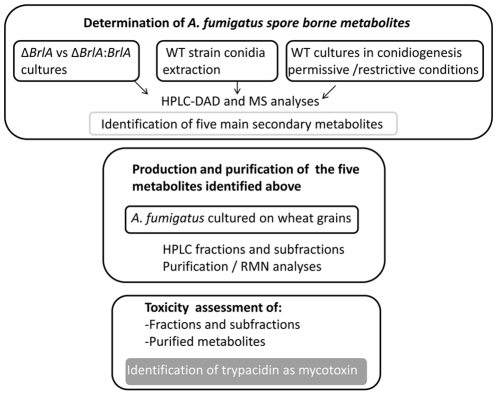
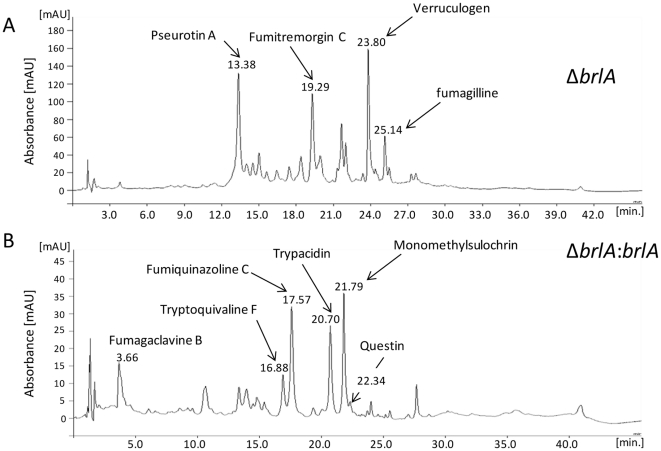
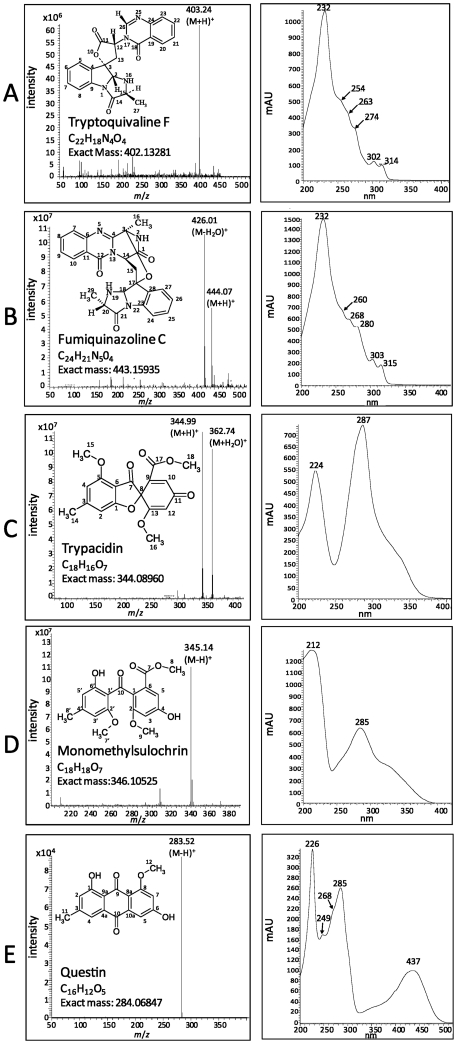
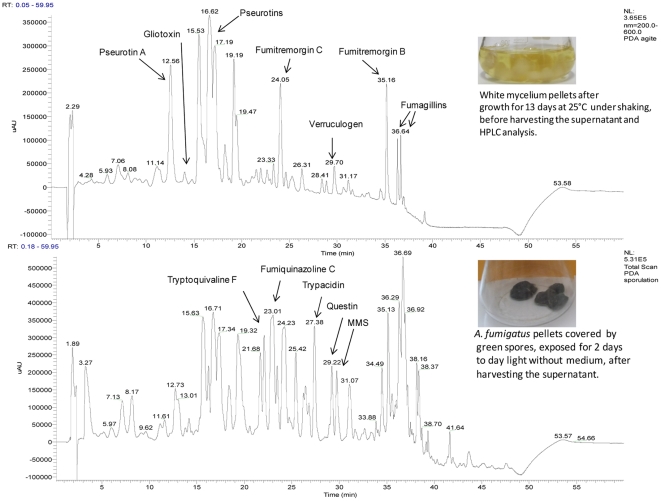
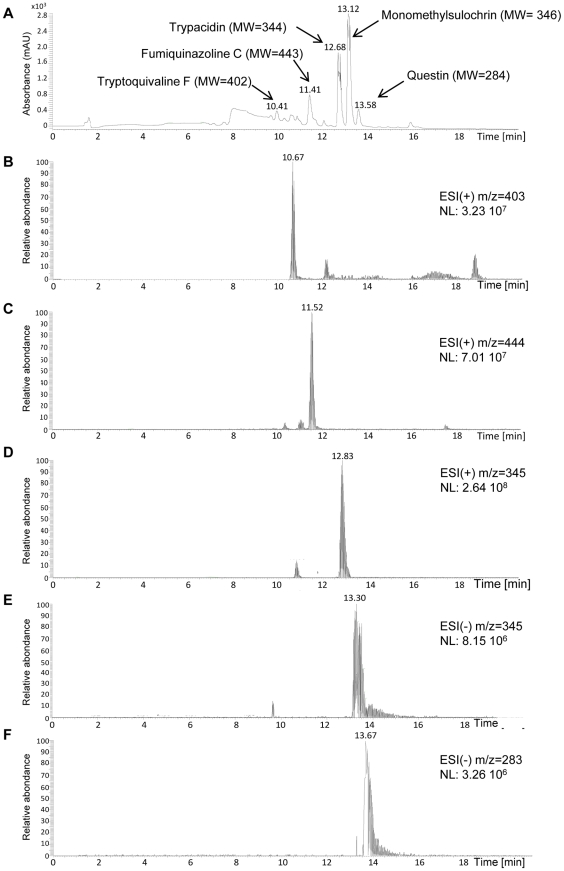
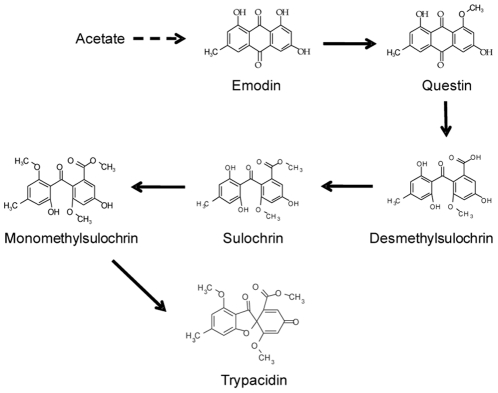
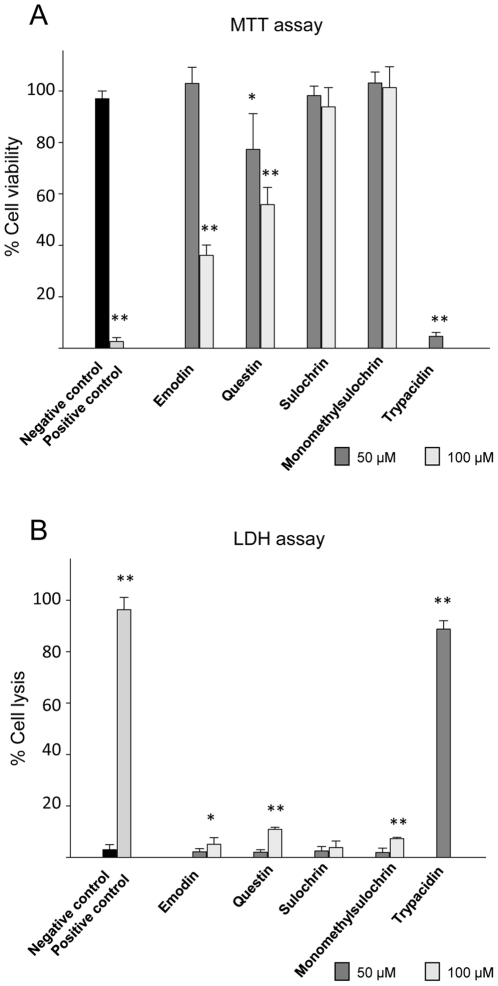
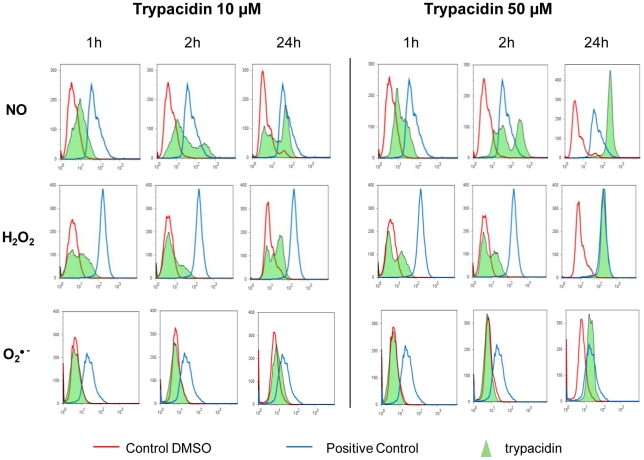
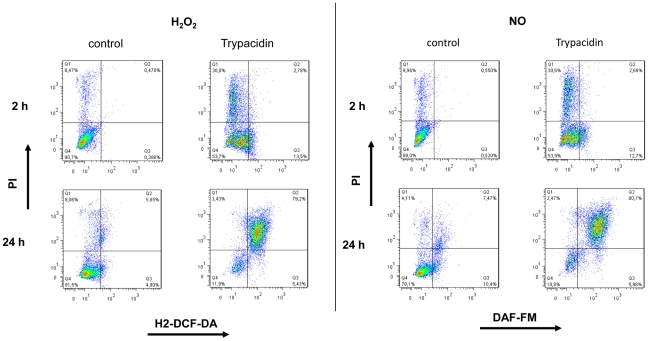
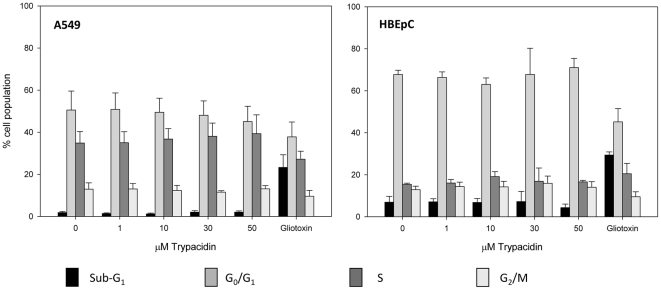
Inhalation of Aspergillus fumigatus conidia can cause severe aspergillosis in immunosuppressed people. A. fumigatus produces a large number of secondary metabolites, some of which are airborne by conidia and whose toxicity to the respiratory tract has not been investigated. We found that spores of A. fumigatus contain five main compounds, tryptoquivaline F, fumiquinazoline C, questin, monomethylsulochrin and trypacidin. Fractionation of culture extracts using RP-HPLC and LC-MS showed that samples containing questin, monomethylsulochrin and trypacidin were toxic to the human A549 lung cell line. These compounds were purified and their structure verified using NMR in order to compare their toxicity against A549 cells. Trypacidin was the most toxic, decreasing cell viability and triggering cell lysis, both effects occurring at an IC₅₀ close to 7 µM. Trypacidin toxicity was also observed in the same concentration range on human bronchial epithelial cells. In the first hour of exposure, trypacidin initiates the intracellular formation of nitric oxide (NO) and hydrogen peroxide (H₂O₂). This oxidative stress triggers necrotic cell death in the following 24 h. The apoptosis pathway, moreover, was not involved in the cell death process as trypacidin did not induce apoptotic bodies or a decrease in mitochondrial membrane potential. This is the first time that the toxicity of trypacidin to lung cells has been reported.
Overview
The claims and statistics of this paper haven’t been checked yet.
Free: it reads the open-access text and checks the first 5 claims that cite a source we can check. Create a free account to check every claim.
Integrity signals
Registry
Cites
Statistics
Figures
Verification
Claims the paper makes
The claims and statistics of this paper haven’t been checked yet.
Free: it reads the open-access text and checks the first 5 claims that cite a source we can check. Create a free account to check every claim.
Claims other papers make about this one
Each is checked against this paper’s own text: does it say what the citing paper says it does?
The source backs part of the claim, not all of it — or backs it for a different population, condition or comparison.
In the citing paper
“Toxic secondary metabolites produced by A. fumigatus (fumigaclavin, trypacidin, helvolic acid, gliotoxin, fumitremorgin, fumagillin, and pseurotin) do impact host cells (433, 440–443).”
From Aspergillus fumigatus and Aspergillosis in 2019 (2019) · cites this paper as [441]
Experimental — accuracy not yet measured
Self-check
Percentages, sums and reported differences re-computed from the paper’s own numbers.
The self-check needs the paper’s full text.
Citations
Cites
Green, D. R., & Reed, J. C. (1998) · Science · doi:10.1126/science.281.5381.1309 · Cited by 8,965
Aspergillus fumigatus and Aspergillosis
Latgé, J.-P. (1999) · Clinical Microbiology Reviews · doi:10.1128/cmr.12.2.310 · Cited by 2,307 · cited 1×
“This fungus causes different pathologies including occupational rhinitis in people working in damp and mouldy places [6], allergic aspergillosis and invasive forms of aspergillosis in immunosuppressed patients [7].”
Genomic sequence of the pathogenic and allergenic filamentous fungus Aspergillus fumigatus
Nierman, W. C., Pain, A., Anderson, M. J., Wortman, J. R., Kim, H. S., Arroyo, J., Berriman, M., Abe, K., Archer, D. B., Bermejo, C., et al. (2005) · Nature · doi:10.1038/nature04332 · Cited by 1,391 · cited 2×
“fumigatus genome putatively involved in secondary metabolism [12,13].”
Pathogenesis of Aspergillus fumigatus in Invasive Aspergillosis
Dagenais, T. R. T., & Keller, N. P. (2009) · Clinical Microbiology Reviews · doi:10.1128/cmr.00055-08 · Cited by 993 · cited 1×
“fumigatus to cause invasive disease are not currently understood [11].”
SMURF: Genomic mapping of fungal secondary metabolite clusters
Khaldi, N., Seifuddin, F. T., Turner, G., Haft, D., Nierman, W. C., Wolfe, K. H., & Fedorova, N. D. (2010) · Fungal Genetics and Biology · doi:10.1016/j.fgb.2010.06.003 · Cited by 771 · cited 1×
“fumigatus [14].”
Fungal secondary metabolites – Strategies to activate silent gene clusters
Brakhage, A. A., & Schroeckh, V. (2011) · Fungal Genetics and Biology · doi:10.1016/j.fgb.2010.04.004 · Cited by 729 · cited 1×
“clusters silent under standard laboratory conditions [46,47], our results do not exclude the possibility of cryptic spore-born products not activated in our culture conditions, but induced in field conditions.”
Transcriptional Regulation of Chemical Diversity in Aspergillus fumigatus by LaeA
Perrin, R. M., Fedorova, N. D., Bok, J. W., Cramer, R. A., Wortman, J. R., Kim, H. S., Nierman, W. C., & Keller, N. P. (2007) · PLoS Pathogens · doi:10.1371/journal.ppat.0030050 · Cited by 352 · cited 2×
“fumigatus genome putatively involved in secondary metabolism [12,13].”
Shen, H.-M., Shi, C.-Y., Shen, Y., & Ong, C.-N. (1996) · Free Radical Biology and Medicine · doi:10.1016/0891-5849(96)00019-6 · Cited by 308 · cited 1×
“These included a porcine renal proximal tubular cell line [39], hepatic stellate cells [40], hepatocytes [41], hepatoma cells HepG2 [42], and colon HT29 cells [43].”
Eduard, W. (2009) · Critical Reviews in Toxicology · doi:10.3109/10408440903307333 · Cited by 251 · cited 1×
“The spores are commonly found in the environment and can exceed 10(4) spores/m(3) in damp buildings or even 10 to 100 times more in waste or compost handling facilities [4].”
Polyphasic taxonomy of Aspergillus fumigatus and related species
Hong, S.-B., Go, S.-J., Shin, H.-D., Frisvad, J. C., & Samson, R. A. (2005) · Mycologia · doi:10.1080/15572536.2006.11832738 · Cited by 234 · cited 1×
“This was also seen in other previous studies [34,35,36].”
Cited by
Aspergillus fumigatus and Aspergillosis in 2019
Latgé, J.-P., & Chamilos, G. (2019) · Clinical Microbiology Reviews · doi:10.1128/cmr.00140-18 · Cited by 1,400
Oxidative Cyclization in Natural Product Biosynthesis
Tang, M.-C., Zou, Y., Watanabe, K., Walsh, C. T., & Tang, Y. (2017) · Chemical Reviews · doi:10.1021/acs.chemrev.6b00478 · Cited by 425
Translating biosynthetic gene clusters into fungal armor and weaponry
Keller, N. P. (2015) · Nature Chemical Biology · doi:10.1038/nchembio.1897 · Cited by 275
Alassane-Kpembi, I., Kolf-Clauw, M., Gauthier, T., Abrami, R., Abiola, F. A., Oswald, I. P., & Puel, O. (2013) · Toxicology and Applied Pharmacology · doi:10.1016/j.taap.2013.05.023 · Cited by 208
Self-citationHow to achieve high-level expression of microbial enzymes: Strategies and perspectives
Liu, L., Yang, H., Shin, H.-D., Chen, R. R., Li, J., Du, G., & Chen, J. (2013) · Bioengineered · doi:10.4161/bioe.24761 · Cited by 170
Metadata
- Authors
- Gauthier, T., Wang, X., Sifuentes Dos Santos, J., Fysikopoulos, A., Tadrist, S., Canlet, C., Artigot, M. P., Loiseau, N., Oswald, I. P., & Puel, O.
- Affiliations
- Université Toulouse III - Paul Sabatier (FR)
- Corresponding author
- Puel, Olivier
- ORCID
- Venue
- PLoS ONE
- Publisher
- Public Library of Science (PLoS)
- Published
- 2012-02-03
- Volume
- 7
- Issue
- 2
- Pages
- e29906
- ISSN
- 1932-6203 (ISSN-L)
- PMC
- PMC3272003
- OpenAlex
- W2008978825
- Cited by
- 97
- References
- 51
- Citations by year
- 2026: 3 · 2025: 4 · 2024: 5 · 2023: 1 · 2022: 6 · 2021: 14 · 2020: 8 · 2019: 12 · 2018: 5 · 2017: 6 · 2016: 11 · 2015: 5 · 2014: 8 · 2013: 7 · 2012: 2
- FWCI
- 5.18
- Type
- journal article
- Language
- en
- Open access
- gold
- doi.org
- Locations
- PLoS ONE (publishedVersion, cc-by)
- PubMed Central (publishedVersion, cc-by)
- PubMed (publishedVersion)
- HAL (submittedVersion, other-oa)
- DOAJ (DOAJ: Directory of Open Access Journals) (submittedVersion, cc-by-sa)
- Figshare (submittedVersion, cc-by)
- Topics
- Life Sciences › Immunology and Microbiology › Applied Microbiology and Biotechnology › Microbial Natural Products and Biosynthesis
- Life Sciences › Agricultural and Biological Sciences › Plant Science › Mycotoxins in Agriculture and Food
- Life Sciences › Pharmacology, Toxicology and Pharmaceutics › Toxicology › Bioactive Compounds and Antitumor Agents
- Keywords
- Aspergillus fumigatus, secondary metabolites, cytotoxicity, A549 cells, bronchial epithelial cells, aspergillosis, oxidative stress, nitric oxide, hydrogen peroxide, necrosis, apoptosis, fungal conidia
- MeSH terms
- Aspergillus fumigatus, Bronchi, Cell Line, Epithelial Cells, Humans, Lung Diseases, Mycotoxins, Spores, Fungal, Molecular Structure, Apoptosis, Oxidative Stress
About these checks
Registry, retraction, Cites and statistics results are computed, not judged, with one exception: a printed reference that no index lists is read once by a model before it counts as a citation error. Claims are extracted by a model and kept only when their quote appears verbatim in the text; each cited source is then checked, with a model’s help, for whether it says what the claim relies on. Those verdicts can be wrong — read the claim’s quote and the cited source before relying on one.
Statistics and arithmetic are recomputed, not judged.
Confidence bands are shown only for fields calibrated on our annotated test set. None is calibrated yet, so no band is shown.
What counts as a claim ›How we measure confidence ›How we check this ›
Are you an author, or do you see a problem with this page? Request a review
Data sources
Bibliographic data: Semantic Scholar, OpenAlex, Crossref.
Contains information from the Semantic Scholar Academic Graph Datasets, made available under the ODC Attribution License (ODC-BY 1.0).
Semantic Scholar’s data is described in: Kinney, R., et al. (2023). The Semantic Scholar Open Data Platform. arXiv:2301.10140.
