

Mood induction in depressive patients: a comparative multidimensional approach.
Open accessThe DOI matches its Crossref record; 70 of the 73 references it cites were found in a registry or an index.
Abstract
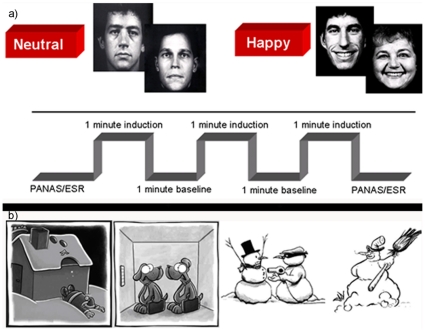
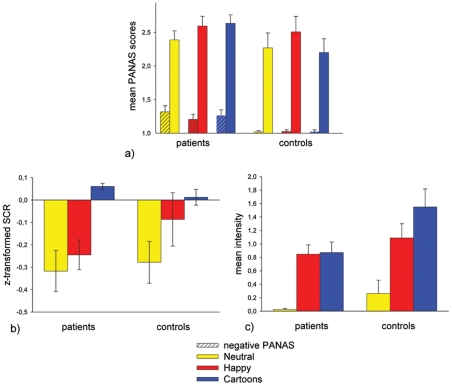
Anhedonia, reduced positive affect and enhanced negative affect are integral characteristics of major depressive disorder (MDD). Emotion dysregulation, e.g. in terms of different emotion processing deficits, has consistently been reported. The aim of the present study was to investigate mood changes in depressive patients using a multidimensional approach for the measurement of emotional reactivity to mood induction procedures. Experimentally, mood states can be altered using various mood induction procedures. The present study aimed at validating two different positive mood induction procedures in patients with MDD and investigating which procedure is more effective and applicable in detecting dysfunctions in MDD. The first procedure relied on the presentation of happy vs. neutral faces, while the second used funny vs. neutral cartoons. Emotional reactivity was assessed in 16 depressed and 16 healthy subjects using self-report measures, measurements of electrodermal activity and standardized analyses of facial responses. Positive mood induction was successful in both procedures according to subjective ratings in patients and controls. In the cartoon condition, however, a discrepancy between reduced facial activity and concurrently enhanced autonomous reactivity was found in patients. Relying on a multidimensional assessment technique, a more comprehensive estimate of dysfunctions in emotional reactivity in MDD was available than by self-report measures alone and this was unsheathed especially by the mood induction procedure relying on cartoons. The divergent facial and autonomic responses in the presence of unaffected subjective reactivity suggest an underlying deficit in the patients' ability to express the felt arousal to funny cartoons. Our results encourage the application of both procedures in functional imaging studies for investigating the neural substrates of emotion dysregulation in MDD patients. Mood induction via cartoons appears to be superior to mood induction via faces and autobiographical material in uncovering specific emotional dysfunctions in MDD.
Overview
The claims and statistics of this paper haven’t been checked yet.
Free: it reads the open-access text and checks the first 5 claims that cite a source we can check. Create a free account to check every claim.
Integrity signals
Registry
Cites
Statistics
Figures
Verification
Claims the paper makes
The claims and statistics of this paper haven’t been checked yet.
Free: it reads the open-access text and checks the first 5 claims that cite a source we can check. Create a free account to check every claim.
Claims other papers make about this one
Each is checked against this paper’s own text: does it say what the citing paper says it does?
The source backs part of the claim, not all of it — or backs it for a different population, condition or comparison.
In the citing paper
“Although the State and Trait Cheerfulness Inventory and the Visual Analog Scale were not designed to measure depression itself, cheerfulness and mood are frequently related to depression (30, 31).”
From Humor interventions in psychotherapy and their effect on levels of depression and anxiety in adult clients, a systematic review (2023) · cites this paper as [31]
Experimental — accuracy not yet measured
Self-check
Percentages, sums and reported differences re-computed from the paper’s own numbers.
The self-check needs the paper’s full text.
Citations
Cites
An inventory for measuring depression
BECK, A. T. (1961) · Archives of General Psychiatry · doi:10.1001/archpsyc.1961.01710120031004 · Cited by 38,032 · cited 1×
“Psychopathological assessment included the Hamilton Depression Scale [35] and Beck’s Depression Inventory [36].”
MethodHamilton, M. (1960) · Journal of Neurology, Neurosurgery & Psychiatry · doi:10.1136/jnnp.23.1.56 · Cited by 32,817 · cited 1×
“Psychopathological assessment included the Hamilton Depression Scale [35] and Beck’s Depression Inventory [36].”
MethodDevelopment and validation of brief measures of positive and negative affect: The PANAS scales.
Watson, D., Clark, L. A., & Tellegen, A. (1988) · Journal of Personality and Social Psychology · doi:10.1037/0022-3514.54.6.1063 · Cited by 32,433 · cited 1×
“Dependent measure for quantifying the subjective mood induction effect was the Positive and Negative Affect Scale (PANAS, [37]) a 5 point unipolar intensity scale, which includes 20 items for factor referenced emotional descriptors for orthogonal positive and negative dimensions.”
Method(1975) · Medical Entomology and Zoology · Cited by 7,245
Depression. Clinical, Experimental, and Theoretical Aspects.
(1968) · Annals of Internal Medicine · doi:10.7326/0003-4819-68-2-502 · Cited by 5,205
Ekman, P., & Friesen, W. V. (1975) · Cited by 4,758
Positive affect facilitates creative problem solving.
Isen, A. M., Daubman, K. A., & Nowicki, G. P. (1987) · Journal of Personality and Social Psychology · doi:10.1037/0022-3514.52.6.1122 · Cited by 2,986 · cited 1×
“In non-clinical samples, positive mood-induction procedures have been demonstrated to improve performance on some types of cognitive tasks, such as creative problem solving [13] and cognitive flexibility [14], while negative mood induction decreased performance [15–17].”
BackgroundThe somatic marker hypothesis and the possible functions of the prefrontal cortex
Damasio, A. R. (1996) · Philosophical Transactions of the Royal Society of London. Series B: Biological Sciences · doi:10.1098/rstb.1996.0125 · Cited by 2,847
Cognitive Therapy and the Emotional Disorders
Jaffe, B. (1977) · Psychosomatics · doi:10.1016/s0033-3182(77)71107-7 · Cited by 2,704 · cited 1×
“This view is also linked to the negativity bias proposed in MDD patients, which proposes that MDD patients selectively focus on negative aspects of experiences and exclude positive aspects of experiences [59].”
BackgroundNegative Symptoms in Schizophrenia: Definition and Reliability
Andreasen, N. C. (1982) · Archives of General Psychiatry · doi:10.1001/archpsyc.1982.04290070020005 · Cited by 2,247 · cited 1×
“Low facial expressiveness has previously been classified as motor [57], affective [58] and social impairment [56].”
Background
Research works printed but not linked: 2
- Ekman P Friesen WV 1978 Facial action coding system (FACS): A technique for the measurement of facial movement. Palo Alto, CA Consulting Psychologists Press
- Ruch W 1997 The FACS in Humor Research. Ekman P Rosenberg EL What the Face Reveals: Basic and Applied Studies of Spontaneous Expression Using the Facial Action Coding System (FACS) Oxford Oxford University Press 109 111
Cited by
Sarchiapone, M., Gramaglia, C., Iosue, M., Carli, V., Mandelli, L., Serretti, A., Marangon, D., & Zeppegno, P. (2018) · BMC Psychiatry · doi:10.1186/s12888-017-1551-4 · Cited by 195
“condition, but not when mood was induced through happy and neutral pictures [73].”
BackgroundDurán, J. I., & Fernández-Dols, J.-M. (2021) · Emotion · doi:10.1037/emo0001015 · Cited by 101
Empathic behavioral and physiological responses to dynamic stimuli in depression
Schneider, D. A., Regenbogen, C., Kellermann, T., Finkelmeyer, A. E., Kohn, N., Derntl, B., Schneider, F. W., & Habel, U. (2012) · Psychiatry Research · doi:10.1016/j.psychres.2012.03.054 · Cited by 105
“, 2005), and even elevated (Guinjoan et al., 1995; Gross and Levenson, 1997; Falkenberg et al., 2012) in depressed patients compared to healthy controls.”
InfluentialSelf-citationHo, N., & Sommers, M. (2013) · Archives of Psychiatric Nursing · doi:10.1016/j.apnu.2013.02.001 · Cited by 81
“Clinicians need to remember that blunted emotional expression is not a reliable indicator of anhedonia (Falkenberg et al., 2012; Rassovsky et al., 2011; Strauss & Herbener, 2011).”
BackgroundA mechanistic account of serotonin’s impact on mood
Michely, J., Eldar, E., Martin, I. M., & Dolan, R. J. (2020) · Nature Communications · doi:10.1038/s41467-020-16090-2 · Cited by 72
Hogarth, L., Hardy, L., Mathew, A. R., & Hitsman, B. (2018) · Experimental and Clinical Psychopharmacology · doi:10.1037/pha0000177 · Cited by 61
Galvanic Skin Response Features in Psychiatry and Mental Disorders: A Narrative Review
Markiewicz, R., Markiewicz-Gospodarek, A., & Dobrowolska, B. B. (2022) · International Journal of Environmental Research and Public Health · doi:10.3390/ijerph192013428 · Cited by 75
“The research indicates that patients with depressive disorders are characterised by reduced skin conductance responses (SCRs) versus persons in the control group [43].”
BackgroundUtilizing Neutral Affective States in Research: Theory, Assessment, and Recommendations
Gasper, K. (2018) · Emotion Review · doi:10.1177/1754073918765660 · Cited by 62
Rachman, L., Liuni, M., Arias, P., Lind, A., Johansson, P., Hall, L., Richardson, D. C., Watanabe, K., Dubal, S., & Aucouturier, J. (2017) · Behavior Research Methods · doi:10.3758/s13428-017-0873-y · Cited by 62
Neural correlates of effective and ineffective mood induction
Kohn, N., Falkenberg, I., Kellermann, T., Eickhoff, S. B., Gur, R. C., & Habel, U. (2014) · Social Cognitive and Affective Neuroscience · doi:10.1093/scan/nst055 · Cited by 45
“Due to the great variety of stimulus materials and the lack of reliability or validity of some methods, direct comparisons of such procedures are limited (Habel et al., 2005; Falkenberg et al., 2012).”
BackgroundResultSelf-citationGalvanic Skin Response in Mood Disorders: A Critical Review
Vahey, R., & Becerra, R. (2015) · Australasian Journal of Paramedicine · Cited by 43
Regenbogen, C., Kellermann, T., Seubert, J., Schneider, D. A., Gur, R. E., Derntl, B., Schneider, F., & Habel, U. (2015) · British Journal of Psychiatry · doi:10.1192/bjp.bp.113.143040 · Cited by 38
Self-citationNylocks, K. M., Rafaeli, E., Bar‐Kalifa, E., Flynn, J. J., & Coifman, K. G. (2018) · Motivation and Emotion · doi:10.1007/s11031-018-9729-8 · Cited by 39
Trapp, W., Kalzendorf, C., Baum, C., Hajak, G., & Lautenbacher, S. (2018) · Psychiatry Research · doi:10.1016/j.psychres.2018.01.005 · Cited by 37
“Third, there is substantial evidence of elevated autonomic arousal following stimuli of any emotional valence (Guinjoan et al., 1995; Falkenberg et al., 2012; Schneider et al., 2012), which makes it even thinkable that immediate attentional responses are independent from emotional content.”
BackgroundInfluentialScheiderer, E. M., Wang, T., Tomko, R. L., Wood, P. K., & Trull, T. J. (2015) · Clinical Psychological Science · doi:10.1177/2167702615573214 · Cited by 33
Sarink, F. S. M., & García-Montes, J. M. (2023) · Frontiers in Psychiatry · doi:10.3389/fpsyt.2022.1049476 · Cited by 21
Pruneti, C. A., Fiduccia, A., & Guidotti, S. (2023) · Journal of Affective Disorders Reports · doi:10.1016/j.jadr.2023.100673 · Cited by 19
Berger, P., Bitsch, F., Nagels, A., Straube, B., & Falkenberg, I. (2018) · Schizophrenia Research · doi:10.1016/j.schres.2018.06.053 · Cited by 18
Self-citationBerger, P., Bitsch, F., Nagels, A., Straube, B., & Falkenberg, I. (2017) · Social Neuroscience · doi:10.1080/17470919.2017.1403375 · Cited by 17
Self-citationReduced Responsiveness to Social Provocation in Autism Spectrum Disorder
Schneider, I., Regenbogen, C., Kohn, N., Zepf, F. D., Bubenzer‐Busch, S., Schneider, F. W., Gur, R. C., & Habel, U. (2015) · Autism Research · doi:10.1002/aur.1446 · Cited by 16
Self-citationWarth, M., Stoffel, M., Winter, F., Jarczok, M. N., Aguilar‐Raab, C., & Ditzen, B. (2020) · Frontiers in Psychiatry · doi:10.3389/fpsyt.2020.00701 · Cited by 14
Chechko, N., Stickel, S., Kellermann, T., Kirner, A., Habel, U., Fernández, G., Schneider, F. W., & Kohn, N. (2018) · European Journal of Neuroscience · doi:10.1111/ejn.14087 · Cited by 15
Self-citationNuevo, R., Montorio, I., Cabrera, I., Márquez, M. O., & Izal, M. (2015) · Anales de Psicología · doi:10.6018/analesps.31.1.162281 · Cited by 16
How Disgust Affects Romantic Attraction: the Influence of Moods on Judgments of Attractiveness
Phelan, N., & Edlund, J. E. (2015) · Evolutionary Psychological Science · doi:10.1007/s40806-015-0031-7 · Cited by 10
Extraversion and neuroticism: Associated responses to a positive mood induction
Fox, A. G., & Moore, M. (2019) · Psychology of Music · doi:10.1177/0305735619838049 · Cited by 12
“The PANAS has been credited as being a valid and reliable way of assessing two important foundations of mood (Falkenberg et al., 2012; Watson et al., 1988).”
BackgroundMethodResultProlonged fasting impairs neural reactivity to visual stimulation
Kohn, N., Wassenberg, A., Toygar, T., Kellermann, T., Weidenfeld, C., Berthold‐Losleben, M., Chechko, N., Orfanos, S., Vocke, S., Laoutidis, Z. G., et al. (2014) · Brain Structure and Function · doi:10.1007/s00429-014-0898-2 · Cited by 11
Self-citationValeriani, G., Bersani, F. S., Liberati, D., Polli, E., Girolami, M. T., Zullo, D., Imperatori, C., Melcore, C., Tomassini, L., Albano, G., et al. (2015) · PubMed · Cited by 15
Alteration of the affective modulation of the startle reflex during antidepressant treatment
Şen, Z. D., Temuçin, Ç. M., Başar, K., Uluğ, B., Gökçen, O., & Özer, S. (2018) · Psychophysiology · doi:10.1111/psyp.13286 · Cited by 7
Fuentes‐Sánchez, N., Garcia-Fernandez, M. E., Escrig, M. A., Eerola, T., & Pastor, M. C. (2024) · Musicae Scientiae · doi:10.1177/10298649241286974 · Cited by 3
“In addition, we did not assess participants’ depression levels, which could influence how music is perceived (Dan et al., 2019; Falkenberg et al., 2012).”
Sympathetic reactivity to emotional stress in women with major depressive disorder
Autler, A. S., Darling, A. M., Skow, R. J., Young, B. E., Fadel, P. J., Saunders, E. F. H., & Greaney, J. L. (2025) · Autonomic Neuroscience · doi:10.1016/j.autneu.2025.103257 · Cited by 3
Depression diagnosis through emotional induction and physiological signals: A systematic review
Liu, J., He, X., Sun, X. S., & Jo, D. (2025) · Neuroscience & Biobehavioral Reviews · doi:10.1016/j.neubiorev.2025.106243 · Cited by 4
The Ripple Effects of Prioritizing Personal Excellence or Pleasure: Impacts on the Surrounding World
Pearce, K. (2017) · uO Research (University of Ottawa) · doi:10.20381/ruor-21100 · Cited by 3
Affective modulation of emotional reactivity in euthymic patients with bipolar disorder
Erdoğan, N. O., Temuçin, Ç. M., Başar, K., Şen, Z. D., & Özer, S. (2024) · International Journal of Psychophysiology · doi:10.1016/j.ijpsycho.2024.112487 · Cited by 1
Junbo, W. A. N. G., Na, Z. H. A. O., Ziyuan, L. I., & Liu, Q. (2025) · Acta Psychologica Sinica · doi:10.3724/sp.j.1041.2025.1323 · Cited by 1
Zorzi, L. D., Ranfaing, S., Roux, C., Honoré, J., & Sequeira, H. (2022) · Journal of Affective Disorders Reports · doi:10.1016/j.jadr.2021.100304 · Cited by 2
Loop, L., Rossignol, M., Galdiolo, S., & Roskam, I. (2018) · Parenting · doi:10.1080/15295192.2018.1405698 · Cited by 1
How Disgust Affects Romantic Attraction: How our Moods Affect our Judgments of Attractiveness
Phelan, N. (2014) · RIT Scholar Works (Rochester Institute of Technology)
Vergleich verschiedener Techniken der Stimmungsinduktion mittels EDA und Selbstbewertung
Plückers, R., Habel, U., Konrad, K., & Lang, J. (2016) · RWTH Publications (RWTH Aachen)
Self-citationEffects of Induced Emotional Changes on Bicep Brachii Muscle Activity
Yang, S., Shin, Y., & Kim, S. (2021) · Physical Therapy Korea · doi:10.12674/ptk.2021.28.2.101
“예를 들어, 운동 장애가 있는 청소년 그 룹에 있어 긍정적 감정요인이 인지적인 수행능력의 증진과의 관련성 을 연구하거나[9], 우울증을 앓고 있는 청소년들의 긍정적 감정 요인이 우울한 증상을 경감하는 것에 효과가 있는지 연구하였다[10].”
Zou, B., Wang, Y., Liu, R., Lyu, X., Feng, L., & Ma, H. (2021) · IEEE International Conference on Bioinformatics and Biomedicine (BIBM) · doi:10.1109/bibm52615.2021.9669618
“Compared with other participants, patients with depression had less sadness response and happy experience in all conditions [10].”
ResultDerntl, B., Schneider, F. W., & Habel, U. (2013) · Springer eBooks · doi:10.1007/978-3-642-29800-4_30
Self-citationDerntl, B., Schneider, F. W., & Habel, U. (2014) · Springer eBooks · doi:10.1007/978-3-642-54542-9_10
Self-citationTendolkar, I., & Vrijsen, J. N. (2024) · Journal of Psychiatry and Cognitive Behaviour · doi:10.29011/2574-7762.000082
Guidotti, S., Fiduccia, A., & Pruneti, C. A. (2024) · Health Psychology Report · doi:10.5114/hpr/189753
“A multidimensional assessment should encompass all the factors that contribute to human behavior, cause emotional distress, and characterize cognitive processes (Falkenberg et al., 2012).”
InfluentialVision, Émotion et Santé Mentale : approche neuroscientifique de la dépression et de l'anxiété
Zorzi, L. D. (2019) · theses.fr (ABES) · doi:10.70675/948f4593z9cfez4024za02fz2d06c28a075e
Biais attentionnels dans l’anxiété et la dépression : approches comportementale et neurovégétative
Ranfaing, S. (2021) · theses.fr (ABES) · doi:10.70675/1709d16cze58ez4c75zb480z92b849a3fcbf
Inducing positive affect and orientations to happiness: Is matching better?
Mageras, K., McGinn, L. K., & Quigley, L. (2026) · Journal of Happiness and Health · doi:10.47602/johah.v6i2.145
“…procedures (MIPs) have served as a key experimental tool, with positive MIPs being used to examine emotional and cognitive reactivity in depression (Falkenberg et al., 2012), test effects of positive mood on treatment processes (van Veen et al., 2024), and augment interventions such as CBT for…”
Noell, G. H., Gansle, K. A., Wheelbarger, E., Sliman, H. M., & Lucia, D. D. (2026) · Behavior and Social Issues · doi:10.1007/s42822-026-00271-7
A PRISMA-compliant systematic review and meta-analysis of the late positive potential in depression
Santopetro, N. J., Thompson, B., Jamal, C. E., Brush, C. J., Schmidt, B., & Hajcak, G. (2026) · Biological Psychology · doi:10.1016/j.biopsycho.2026.109386
Metadata
- Authors
- Falkenberg, I., Kohn, N., Schoepker, R., & Habel, U.
- Affiliations
- Philipps University of Marburg (DE)
- Jülich Aachen Research Alliance (DE)
- RWTH Aachen University (DE)
- Corresponding author
- Falkenberg, Irina
- Venue
- PLoS ONE
- Publisher
- Public Library of Science (PLoS)
- Published
- 2012-01-09
- Volume
- 7
- Issue
- 1
- Pages
- e30016
- ISSN
- 1932-6203 (ISSN-L)
- PMC
- PMC3253810
- OpenAlex
- W2000995453
- Cited by
- 47
- References
- 73
- Citations by year
- 2026: 2 · 2025: 3 · 2024: 4 · 2023: 2 · 2022: 2 · 2021: 4 · 2020: 2 · 2019: 3 · 2018: 9 · 2017: 1 · 2016: 1 · 2015: 6 · 2014: 4 · 2013: 3 · 2012: 1
- FWCI
- 6.00
- Type
- journal article
- Language
- en
- Open access
- gold
- doi.org
- Locations
- PLoS ONE (publishedVersion, cc-by)
- Europe PMC (PubMed Central) (publishedVersion, cc-by)
- PubMed Central (publishedVersion, cc-by)
- PubMed (publishedVersion)
- DOAJ (DOAJ: Directory of Open Access Journals) (submittedVersion, cc-by-sa)
- RWTH Publications (RWTH Aachen) (submittedVersion, cc-by)
- RWTH Publications (RWTH Aachen)
- Funders
- Deutsche Forschungsgemeinschaft (IRTG1328, DFG. IRTG 1328)
- RWTH Aachen University
- Medizinische Fakultät, RWTH Aachen University
- Topics
- Social Sciences › Psychology › Experimental and Cognitive Psychology › Anxiety, Depression, Psychometrics, Treatment, Cognitive Processes
- Life Sciences › Neuroscience › Cognitive Neuroscience › Neural and Behavioral Psychology Studies
- Health Sciences › Medicine › Pharmacology (medical) › Treatment of Major Depression
- Keywords
- mood induction, major depressive disorder, emotional reactivity, emotional dysregulation, facial electromyography, electrodermal activity, cartoons, happy faces, anhedonia, positive affect, negative affect, emotion processing deficits
- MeSH terms
- Adult, Affect, Behavior, Demography, Depressive Disorder, Facial Expression, Female, Galvanic Skin Response, Humans, Male, Neuropsychological Tests, Photic Stimulation, Sex Characteristics, Discriminant Analysis, Case-Control Studies
About these checks
Registry, retraction, Cites and statistics results are computed, not judged, with one exception: a printed reference that no index lists is read once by a model before it counts as a citation error. Claims are extracted by a model and kept only when their quote appears verbatim in the text; each cited source is then checked, with a model’s help, for whether it says what the claim relies on. Those verdicts can be wrong — read the claim’s quote and the cited source before relying on one.
Statistics and arithmetic are recomputed, not judged.
Confidence bands are shown only for fields calibrated on our annotated test set. None is calibrated yet, so no band is shown.
What counts as a claim ›How we measure confidence ›How we check this ›
Are you an author, or do you see a problem with this page? Request a review
Data sources
Bibliographic data: Semantic Scholar, OpenAlex, Crossref.
Contains information from the Semantic Scholar Academic Graph Datasets, made available under the ODC Attribution License (ODC-BY 1.0).
Semantic Scholar’s data is described in: Kinney, R., et al. (2023). The Semantic Scholar Open Data Platform. arXiv:2301.10140.
