

Mood induction in depressive patients: a comparative multidimensional approach.
Open accessThe DOI matches its Crossref record; 70 of the 73 references it cites were found in a registry or an index.
Abstract
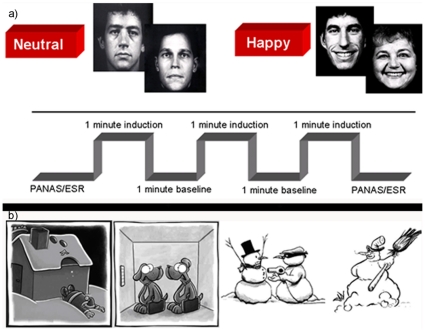
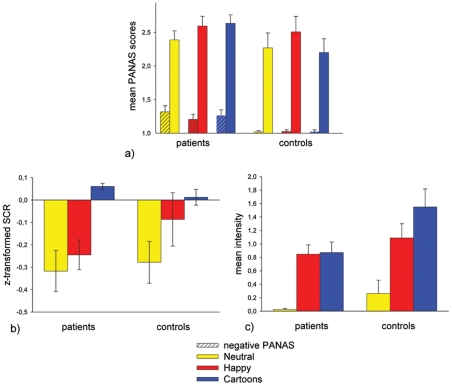
Anhedonia, reduced positive affect and enhanced negative affect are integral characteristics of major depressive disorder (MDD). Emotion dysregulation, e.g. in terms of different emotion processing deficits, has consistently been reported. The aim of the present study was to investigate mood changes in depressive patients using a multidimensional approach for the measurement of emotional reactivity to mood induction procedures. Experimentally, mood states can be altered using various mood induction procedures. The present study aimed at validating two different positive mood induction procedures in patients with MDD and investigating which procedure is more effective and applicable in detecting dysfunctions in MDD. The first procedure relied on the presentation of happy vs. neutral faces, while the second used funny vs. neutral cartoons. Emotional reactivity was assessed in 16 depressed and 16 healthy subjects using self-report measures, measurements of electrodermal activity and standardized analyses of facial responses. Positive mood induction was successful in both procedures according to subjective ratings in patients and controls. In the cartoon condition, however, a discrepancy between reduced facial activity and concurrently enhanced autonomous reactivity was found in patients. Relying on a multidimensional assessment technique, a more comprehensive estimate of dysfunctions in emotional reactivity in MDD was available than by self-report measures alone and this was unsheathed especially by the mood induction procedure relying on cartoons. The divergent facial and autonomic responses in the presence of unaffected subjective reactivity suggest an underlying deficit in the patients' ability to express the felt arousal to funny cartoons. Our results encourage the application of both procedures in functional imaging studies for investigating the neural substrates of emotion dysregulation in MDD patients. Mood induction via cartoons appears to be superior to mood induction via faces and autobiographical material in uncovering specific emotional dysfunctions in MDD.
Overview
The claims and statistics of this paper haven’t been checked yet.
Free: it reads the open-access text and checks the first 5 claims that cite a source we can check. Create a free account to check every claim.
Integrity signals
Registry
Cites
Statistics
Figures
Verification
Claims the paper makes
The claims and statistics of this paper haven’t been checked yet.
Free: it reads the open-access text and checks the first 5 claims that cite a source we can check. Create a free account to check every claim.
Claims other papers make about this one
Each is checked against this paper’s own text: does it say what the citing paper says it does?
The source backs part of the claim, not all of it — or backs it for a different population, condition or comparison.
In the citing paper
“Although the State and Trait Cheerfulness Inventory and the Visual Analog Scale were not designed to measure depression itself, cheerfulness and mood are frequently related to depression (30, 31).”
From Humor interventions in psychotherapy and their effect on levels of depression and anxiety in adult clients, a systematic review (2023) · cites this paper as [31]
Experimental — accuracy not yet measured
Self-check
Percentages, sums and reported differences re-computed from the paper’s own numbers.
The self-check needs the paper’s full text.
Citations
Cites
An inventory for measuring depression
BECK, A. T. (1961) · Archives of General Psychiatry · doi:10.1001/archpsyc.1961.01710120031004 · Cited by 38,032 · cited 1×
“Psychopathological assessment included the Hamilton Depression Scale [35] and Beck’s Depression Inventory [36].”
MethodHamilton, M. (1960) · Journal of Neurology, Neurosurgery & Psychiatry · doi:10.1136/jnnp.23.1.56 · Cited by 32,817 · cited 1×
“Psychopathological assessment included the Hamilton Depression Scale [35] and Beck’s Depression Inventory [36].”
MethodDevelopment and validation of brief measures of positive and negative affect: The PANAS scales.
Watson, D., Clark, L. A., & Tellegen, A. (1988) · Journal of Personality and Social Psychology · doi:10.1037/0022-3514.54.6.1063 · Cited by 32,433 · cited 1×
“Dependent measure for quantifying the subjective mood induction effect was the Positive and Negative Affect Scale (PANAS, [37]) a 5 point unipolar intensity scale, which includes 20 items for factor referenced emotional descriptors for orthogonal positive and negative dimensions.”
Method(1975) · Medical Entomology and Zoology · Cited by 7,245
Depression. Clinical, Experimental, and Theoretical Aspects.
(1968) · Annals of Internal Medicine · doi:10.7326/0003-4819-68-2-502 · Cited by 5,205
Ekman, P., & Friesen, W. V. (1975) · Cited by 4,758
Positive affect facilitates creative problem solving.
Isen, A. M., Daubman, K. A., & Nowicki, G. P. (1987) · Journal of Personality and Social Psychology · doi:10.1037/0022-3514.52.6.1122 · Cited by 2,986 · cited 1×
“In non-clinical samples, positive mood-induction procedures have been demonstrated to improve performance on some types of cognitive tasks, such as creative problem solving [13] and cognitive flexibility [14], while negative mood induction decreased performance [15–17].”
BackgroundThe somatic marker hypothesis and the possible functions of the prefrontal cortex
Damasio, A. R. (1996) · Philosophical Transactions of the Royal Society of London. Series B: Biological Sciences · doi:10.1098/rstb.1996.0125 · Cited by 2,847
Cognitive Therapy and the Emotional Disorders
Jaffe, B. (1977) · Psychosomatics · doi:10.1016/s0033-3182(77)71107-7 · Cited by 2,704 · cited 1×
“This view is also linked to the negativity bias proposed in MDD patients, which proposes that MDD patients selectively focus on negative aspects of experiences and exclude positive aspects of experiences [59].”
BackgroundNegative Symptoms in Schizophrenia: Definition and Reliability
Andreasen, N. C. (1982) · Archives of General Psychiatry · doi:10.1001/archpsyc.1982.04290070020005 · Cited by 2,247 · cited 1×
“Low facial expressiveness has previously been classified as motor [57], affective [58] and social impairment [56].”
Background
Research works printed but not linked: 2
- Ekman P Friesen WV 1978 Facial action coding system (FACS): A technique for the measurement of facial movement. Palo Alto, CA Consulting Psychologists Press
- Ruch W 1997 The FACS in Humor Research. Ekman P Rosenberg EL What the Face Reveals: Basic and Applied Studies of Spontaneous Expression Using the Facial Action Coding System (FACS) Oxford Oxford University Press 109 111
Cited by
Sarchiapone, M., Gramaglia, C., Iosue, M., Carli, V., Mandelli, L., Serretti, A., Marangon, D., & Zeppegno, P. (2018) · BMC Psychiatry · doi:10.1186/s12888-017-1551-4 · Cited by 195
“condition, but not when mood was induced through happy and neutral pictures [73].”
BackgroundDurán, J. I., & Fernández-Dols, J.-M. (2021) · Emotion · doi:10.1037/emo0001015 · Cited by 101
Empathic behavioral and physiological responses to dynamic stimuli in depression
Schneider, D. A., Regenbogen, C., Kellermann, T., Finkelmeyer, A. E., Kohn, N., Derntl, B., Schneider, F. W., & Habel, U. (2012) · Psychiatry Research · doi:10.1016/j.psychres.2012.03.054 · Cited by 105
“, 2005), and even elevated (Guinjoan et al., 1995; Gross and Levenson, 1997; Falkenberg et al., 2012) in depressed patients compared to healthy controls.”
InfluentialSelf-citationHo, N., & Sommers, M. (2013) · Archives of Psychiatric Nursing · doi:10.1016/j.apnu.2013.02.001 · Cited by 81
“Clinicians need to remember that blunted emotional expression is not a reliable indicator of anhedonia (Falkenberg et al., 2012; Rassovsky et al., 2011; Strauss & Herbener, 2011).”
BackgroundA mechanistic account of serotonin’s impact on mood
Michely, J., Eldar, E., Martin, I. M., & Dolan, R. J. (2020) · Nature Communications · doi:10.1038/s41467-020-16090-2 · Cited by 72
Metadata
- Authors
- Falkenberg, I., Kohn, N., Schoepker, R., & Habel, U.
- Affiliations
- Philipps University of Marburg (DE)
- Jülich Aachen Research Alliance (DE)
- RWTH Aachen University (DE)
- Corresponding author
- Falkenberg, Irina
- Venue
- PLoS ONE
- Publisher
- Public Library of Science (PLoS)
- Published
- 2012-01-09
- Volume
- 7
- Issue
- 1
- Pages
- e30016
- ISSN
- 1932-6203 (ISSN-L)
- PMC
- PMC3253810
- OpenAlex
- W2000995453
- Cited by
- 47
- References
- 73
- Citations by year
- 2026: 2 · 2025: 3 · 2024: 4 · 2023: 2 · 2022: 2 · 2021: 4 · 2020: 2 · 2019: 3 · 2018: 9 · 2017: 1 · 2016: 1 · 2015: 6 · 2014: 4 · 2013: 3 · 2012: 1
- FWCI
- 6.00
- Type
- journal article
- Language
- en
- Open access
- gold
- doi.org
- Locations
- PLoS ONE (publishedVersion, cc-by)
- Europe PMC (PubMed Central) (publishedVersion, cc-by)
- PubMed Central (publishedVersion, cc-by)
- PubMed (publishedVersion)
- DOAJ (DOAJ: Directory of Open Access Journals) (submittedVersion, cc-by-sa)
- RWTH Publications (RWTH Aachen) (submittedVersion, cc-by)
- RWTH Publications (RWTH Aachen)
- Funders
- Deutsche Forschungsgemeinschaft (IRTG1328, DFG. IRTG 1328)
- RWTH Aachen University
- Medizinische Fakultät, RWTH Aachen University
- Topics
- Social Sciences › Psychology › Experimental and Cognitive Psychology › Anxiety, Depression, Psychometrics, Treatment, Cognitive Processes
- Life Sciences › Neuroscience › Cognitive Neuroscience › Neural and Behavioral Psychology Studies
- Health Sciences › Medicine › Pharmacology (medical) › Treatment of Major Depression
- Keywords
- mood induction, major depressive disorder, emotional reactivity, emotional dysregulation, facial electromyography, electrodermal activity, cartoons, happy faces, anhedonia, positive affect, negative affect, emotion processing deficits
- MeSH terms
- Adult, Affect, Behavior, Demography, Depressive Disorder, Facial Expression, Female, Galvanic Skin Response, Humans, Male, Neuropsychological Tests, Photic Stimulation, Sex Characteristics, Discriminant Analysis, Case-Control Studies
About these checks
Registry, retraction, Cites and statistics results are computed, not judged, with one exception: a printed reference that no index lists is read once by a model before it counts as a citation error. Claims are extracted by a model and kept only when their quote appears verbatim in the text; each cited source is then checked, with a model’s help, for whether it says what the claim relies on. Those verdicts can be wrong — read the claim’s quote and the cited source before relying on one.
Statistics and arithmetic are recomputed, not judged.
Confidence bands are shown only for fields calibrated on our annotated test set. None is calibrated yet, so no band is shown.
What counts as a claim ›How we measure confidence ›How we check this ›
Are you an author, or do you see a problem with this page? Request a review
Data sources
Bibliographic data: Semantic Scholar, OpenAlex, Crossref.
Contains information from the Semantic Scholar Academic Graph Datasets, made available under the ODC Attribution License (ODC-BY 1.0).
Semantic Scholar’s data is described in: Kinney, R., et al. (2023). The Semantic Scholar Open Data Platform. arXiv:2301.10140.
