

The DOI matches its Crossref record; 27 of the 28 references it cites were found in a registry or an index.
CCL2 Is Associated with a Faster Rate of Cognitive Decline during Early Stages of Alzheimer's Disease
Open accessAbstract
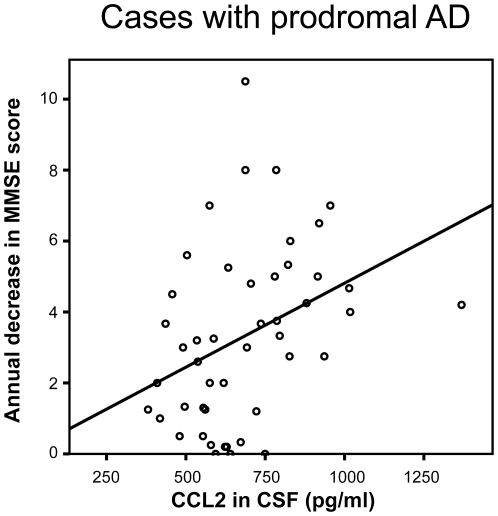
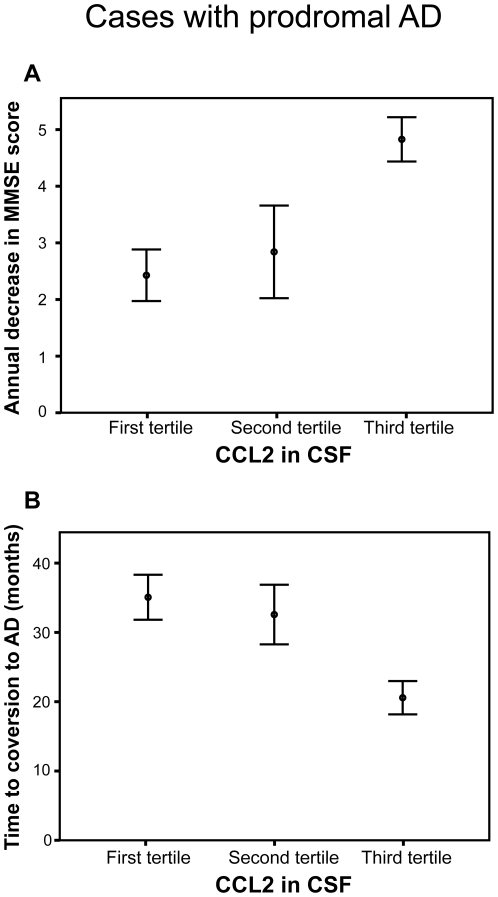
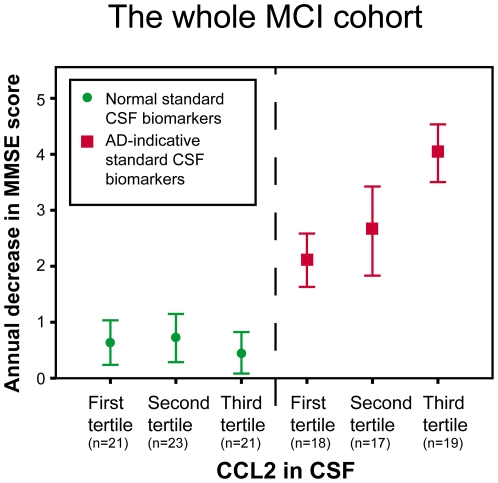
Chemokine (C-C motif) receptor 2 (CCR2)-signaling can mediate accumulation of microglia at sites affected by neuroinflammation. CCR2 and its main ligand CCL2 (MCP-1) might also be involved in the altered metabolism of beta-amyloid (Aβ) underlying Alzheimer's disease (AD). We therefore measured the levels of CCL2 and three other CCR2 ligands, i.e. CCL11 (eotaxin), CCL13 (MCP-4) and CCL26 (eotaxin-3), in the cerebrospinal fluid (CSF) and plasma of 30 controls and 119 patients with mild cognitive impairment (MCI) at baseline. During clinical follow-up 52 MCI patients were clinically stable for five years, 47 developed AD (i.e. cases with prodromal AD at baseline) and 20 developed other dementias. Only CSF CCL26 was statistically significantly elevated in patients with prodromal AD when compared to controls (p = 0.002). However, in patients with prodromal AD, the CCL2 levels in CSF at baseline correlated with a faster cognitive decline during follow-up (r(s) = 0.42, p = 0.004). Furthermore, prodromal AD patients in the highest tertile of CSF CCL2 exhibited a significantly faster cognitive decline (p<0.001) and developed AD dementia within a shorter time period (p<0.003) compared to those in the lowest tertile. Finally, in the entire MCI cohort, CSF CCL2 could be combined with CSF Tau, P-tau and Aβ42 to predict both future conversion to AD and the rate of cognitive decline. If these results are corroborated in future studies, CCL2 in CSF could be a candidate biomarker for prediction of future disease progression rate in prodromal AD. Moreover, CCR2-related signaling pathways might be new therapeutic targets for therapies aiming at slowing down the disease progression rate of AD.
Overview
The claims and statistics of this paper haven’t been checked yet.
Run the check — free, no account needed. It reads the open-access text and checks the sources it cites.
Integrity signals
Registry
Cites
Statistics
Figures
Verification
Claims the paper makes
The claims and statistics of this paper haven’t been checked yet.
Run the check — free, no account needed. It reads the open-access text and checks the sources it cites.
Claims other papers make about this one
Each is checked against this paper’s own text: does it say what the citing paper says it does?
In the citing paper
“In particular, CCL2, a proinflammatory chemokine, is implicated in the chronic neuroinflammation accompanying AD,18 and its cerebrospinal fluid levels predict a faster rate of cognitive decline in AD.19”
From Whole-genome sequencing suggests a chemokine gene cluster that modifies age at onset in familial Alzheimer's disease (2015) · cites this paper as [19]
In the citing paper
“Importantly, the increase of these markers seems to be correlated with the cognitive impairment occurring in AD (Solfrizzi et al., 2006; Westin et al., 2012).”
From Exploring the Therapeutic Potential of Phytochemicals in Alzheimer’s Disease: Focus on Polyphenols and Monoterpenes (2022) · cites this paper as Westin et al., 2012
Self-check
Percentages, sums and reported differences re-computed from the paper’s own numbers.
The self-check needs the paper’s full text.
Citations
Cites
Diagnostic and Statistical Manual of Mental Disorders
Williams, J. B. W., & First, M. B. (2013) · Oxford University Press eBooks · doi:10.1093/acrefore/9780199975839.013.104 · Cited by 109,845
McKhann, G., Drachman, D., Folstein, M., Katzman, R., Price, D., & Stadlan, E. M. (1984) · Neurology · doi:10.1212/wnl.34.7.939 · Cited by 27,915
The Amyloid Hypothesis of Alzheimer’s Disease: Progress and Problems on the Road to Therapeutics
Hardy, J., & Selkoe, D. J. (2002) · Science · doi:10.1126/science.1072994 · Cited by 13,864
Amyloid oligomers exacerbate tau pathology in a mouse model of tauopathy
Selenica, M.-L. B., Brownlow, M., Jimenez, J. P., Lee, D. C., Pena, G., Dickey, C. A., Gordon, M. N., & Morgan, D. (2013) · Neurodegenerative Diseases · doi:10.1159/000337230 · Cited by 10,359
Diagnostic and Statistical Manual of Mental Disorders
Siegel, L. J., & Fletcher‐Janzen, E. (2008) · Wiley eBooks · doi:10.1002/9780470373699.speced0655 · Cited by 8,467
Mild cognitive impairment as a diagnostic entity
Petersen, R. C. (2004) · Journal of Internal Medicine · doi:10.1111/j.1365-2796.2004.01388.x · Cited by 7,864
Blennow, K., de Leon, M. J., & Zetterberg, H. (2006) · The Lancet · doi:10.1016/s0140-6736(06)69113-7 · Cited by 3,134
Cerebrospinal fluid biomarker signature in Alzheimer's disease neuroimaging initiative subjects
Shaw, L. M., Vanderstichele, H., Knapik‐Czajka, M., Clark, C. M., Aisen, P. S., Petersen, R. C., Blennow, K., Soares, H., Simon, A., Lewczuk, P., et al. (2009) · Annals of Neurology · doi:10.1002/ana.21610 · Cited by 2,065
Cerebrospinal fluid and plasma biomarkers in Alzheimer disease
Blennow, K., Hampel, H., Weiner, M., & Zetterberg, H. (2010) · Nature Reviews Neurology · doi:10.1038/nrneurol.2010.4 · Cited by 1,863
Hansson, O., Zetterberg, H., Buchhave, P., Londos, E., Blennow, K., & Minthon, L. (2006) · The Lancet Neurology · doi:10.1016/s1474-4422(06)70355-6 · Cited by 1,700
Self-citationMicroglia in neurodegenerative disease
Perry, V. H., Nicoll, J. A. R., & Holmes, C. (2010) · Nature Reviews Neurology · doi:10.1038/nrneurol.2010.17 · Cited by 1,543
The Clinical Diagnosis of Alzheimer's Disease
Wade, J. P. H., Mirsen, T. R., Hachinski, V. C., Fisman, M., Lau, C. S., & Merskey, H. (1987) · Archives of Neurology · doi:10.1001/archneur.1987.00520130016010 · Cited by 1,416
CSF Biomarkers and Incipient Alzheimer Disease in Patients With Mild Cognitive Impairment
Mattsson, N. (2009) · JAMA · doi:10.1001/jama.2009.1064 · Cited by 1,176
Systemic inflammation and disease progression in Alzheimer disease
Holmes, C., Cunningham, C., Zotova, E., Woolford, J., Dean, C., Kerr, S., Culliford, D., & Perry, V. H. (2009) · Neurology · doi:10.1212/wnl.0b013e3181b6bb95 · Cited by 1,139 · cited 1×
“models have demonstrated that inflammatory events (not related to AD), accompanied by elevated chemokine levels, can lead to a significantly accelerated AD progression [21,22,23].”
BackgroundKitazawa, M., Oddo, S., Yamasaki, T. R., Green, K. N., & LaFerla, F. M. (2005) · The Journal of Neuroscience · doi:10.1523/jneurosci.2868-05.2005 · Cited by 697
Inflammation, microglia, and alzheimer's disease
Cameron, B., & Landreth, G. E. (2009) · Neurobiology of Disease · doi:10.1016/j.nbd.2009.10.006 · Cited by 452
Reimagining Alzheimer's Disease—An Age-Based Hypothesis
Herrup, K. (2010) · Journal of Neuroscience · doi:10.1523/jneurosci.4521-10.2010 · Cited by 408
Maezawa, I., Zimin, P. I., Wulff, H., & Jin, L. (2010) · Journal of Biological Chemistry · doi:10.1074/jbc.m110.135244 · Cited by 293
Sokolova, A., Hill, M. D., Rahimi, F., Warden, L. A., Halliday, G. M., & Shepherd, C. E. (2009) · Brain Pathology · doi:10.1111/j.1750-3639.2008.00188.x · Cited by 249
Sly, L. M., KRZESICKI, R. F., Brashler, J. R., Buhl, A.-L., McKinley, D. D., Carter, D. B., & Chin, J. E. (2001) · Brain Research Bulletin · doi:10.1016/s0361-9230(01)00730-4 · Cited by 180
Mechanisms of microglia accumulation in Alzheimer’s disease: therapeutic implications
Khoury, J. E., & Luster, A. D. (2008) · Trends in Pharmacological Sciences · doi:10.1016/j.tips.2008.08.004 · Cited by 171
Microglial activation in healthy aging
Schuitemaker, A., van der Doef, T. F., Boellaard, R., van der Flier, W. M., Yaqub, M., Windhorst, A. D., Barkhof, F., Jonker, C., Kloet, R. W., Lammertsma, A. A., et al. (2012) · Neurobiology of Aging · doi:10.1016/j.neurobiolaging.2010.09.016 · Cited by 142
Yamamoto, M., Horiba, M., Buescher, J. L., Huang, D., Gendelman, H. E., Ransohoff, R. M., & Ikezu, T. (2005) · The American Journal of Pathology · doi:10.1016/s0002-9440(10)62364-4 · Cited by 137
Chemokines in serum and cerebrospinal fluid of Alzheimer's disease patients
Galimberti, D., Schoonenboom, N. S. M., Scarpini, E. A., & Scheltens, P. (2003) · Annals of Neurology · doi:10.1002/ana.10531 · Cited by 116
Kiyota, T., Yamamoto, M., Xiong, H., Lambert, M. P., Klein, W. L., Gendelman, H. E., Ransohoff, R. M., & Ikezu, T. (2009) · PLoS ONE · doi:10.1371/journal.pone.0006197 · Cited by 114
Struthers, M. D., & Pasternak, A. (2010) · Current Topics in Medicinal Chemistry · doi:10.2174/156802610791561255 · Cited by 93
Memory impairments in healthy aging: Role of aging-induced microglial sensitization.
Barrientos, R. M., Frank, M. G., Watkins, L. R., & Maier, S. F. (2010) · PubMed Central · Cited by 80
Cited by
Sorted by citations
The Amyloid Beta Peptide: A Chemist’s Perspective. Role in Alzheimer’s and Fibrillization
Hamley, I. W. (2012) · Chemical Reviews · doi:10.1021/cr3000994 · Cited by 892
González-Reyes, R. E., Nava-Mesa, M. O., Vargas-Sánchez, K., Ariza-Salamanca, D. F., & Mora-Muñoz, L. (2017) · Frontiers in Molecular Neuroscience · doi:10.3389/fnmol.2017.00427 · Cited by 541
Brosseron, F., Krauthausen, M., Kummer, M., & Heneka, M. T. (2014) · Molecular Neurobiology · doi:10.1007/s12035-014-8657-1 · Cited by 447
Peripheral and central immune system crosstalk in Alzheimer disease — a research prospectus
Bettcher, B. M., Tansey, M. G., Dorothée, G., & Heneka, M. T. (2021) · Nature Reviews Neurology · doi:10.1038/s41582-021-00549-x · Cited by 427
Inflammatory process in Alzheimer's Disease
Meraz-Ríos, M. A., Toral-Rios, D., Franco-Bocanegra, D., Villeda-Hernández, J., & Campos-Peña, V. (2013) · Frontiers in Integrative Neuroscience · doi:10.3389/fnint.2013.00059 · Cited by 427
Metadata
- Authors
- Westin, K., Buchhave, P., Nielsen, H., Minthon, L., Janciauskiene, S., & Hansson, O.
- Affiliations
- Lund University (SE)
- Medizinische Hochschule Hannover (DE)
- Corresponding author
- Hansson, Oskar
- Venue
- PLoS ONE
- Publisher
- Public Library of Science (PLoS)
- Published
- 2012-01-30
- Volume
- 7
- Issue
- 1
- Pages
- e30525
- ISSN
- 1932-6203 (ISSN-L)
- PMC
- PMC3268759
- OpenAlex
- W2135955660
- Cited by
- 277
- References
- 28
- Citations by year
- 2026: 15 · 2025: 15 · 2024: 30 · 2023: 11 · 2022: 29 · 2021: 27 · 2020: 21 · 2019: 20 · 2018: 11 · 2017: 23 · 2016: 10 · 2015: 18 · 2014: 21 · 2013: 21 · 2012: 5
- FWCI
- 13.94
- Type
- journal article
- Language
- en
- Open access
- gold
- doi.org
- Locations
- PLoS ONE (publishedVersion, cc-by)
- Europe PMC (PubMed Central) (publishedVersion, cc-by)
- PubMed Central (publishedVersion, cc-by)
- PubMed (publishedVersion)
- DOAJ (DOAJ: Directory of Open Access Journals) (submittedVersion, cc-by-sa)
- Lund University Publications (Lund University) (submittedVersion, other-oa)
- Funders
- Skåne County Council's Research and Development Foundation
- Vetenskapsrådet
- Swedish Brain Power
- Socialstyrelsen
- Topics
- Life Sciences › Neuroscience › Cellular and Molecular Neuroscience › Alzheimer's disease research and treatments
- Health Sciences › Medicine › Psychiatry and Mental health › Dementia and Cognitive Impairment Research
- Life Sciences › Neuroscience › Neurology › Neuroinflammation and Neurodegeneration Mechanisms
- Keywords
- MCP-1, CCR2, Alzheimer's disease, mild cognitive impairment, cognitive decline, cerebrospinal fluid biomarkers, CCL26, eotaxin, CCL13, conversion to Alzheimer's disease, tau protein, phosphorylated tau, amyloid-beta 42, disease progression prediction, chemokine signaling, neuroinflammation
- MeSH terms
- Aged, Alzheimer Disease, Cognition Disorders, Demography, Female, Follow-Up Studies, Humans, Male, Cohort Studies, Biomarkers, Linear Models, Disease Progression, Chemokine CCL2, Cognitive Dysfunction
About these checks
Registry, retraction, Cites and statistics results are computed, not judged, with one exception: a printed reference that no index lists is read once by a model before it counts as a citation error. Claims are extracted by a model and kept only when their quote appears verbatim in the text; each cited source is then checked, with a model’s help, for whether it says what the claim relies on. Those verdicts can be wrong — read the claim’s quote and the cited source before relying on one.
Statistics and arithmetic are recomputed, not judged.
Confidence bands are shown only for fields calibrated on our annotated test set. None is calibrated yet, so no band is shown.
What counts as a claim ›How we measure confidence ›How we check this ›
Are you an author, or do you see a problem with this page? Request a review
