

The DOI matches its Crossref record; 27 of the 28 references it cites were found in a registry or an index.
CCL2 Is Associated with a Faster Rate of Cognitive Decline during Early Stages of Alzheimer's Disease
Open accessAbstract
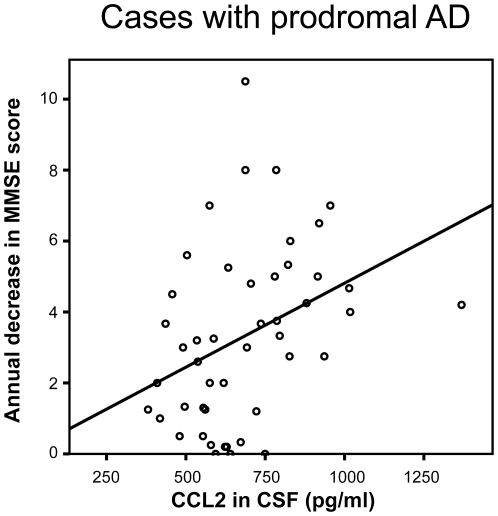
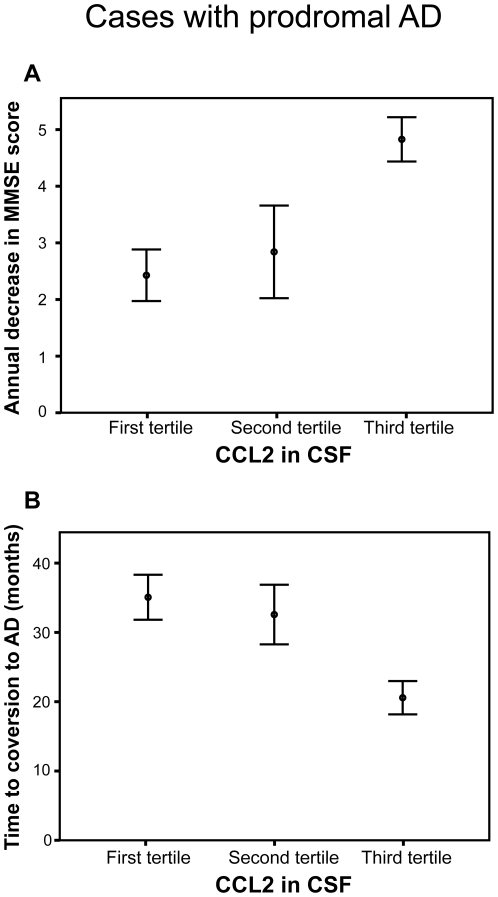
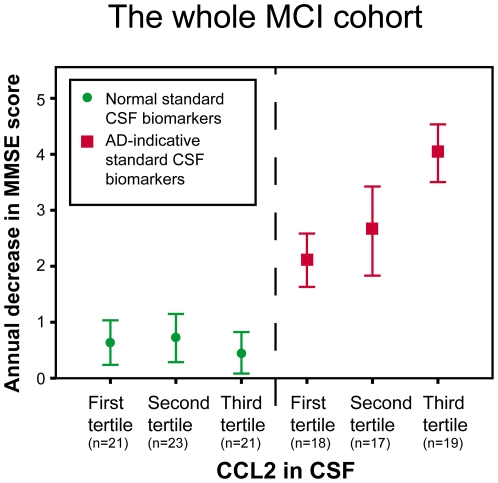
Chemokine (C-C motif) receptor 2 (CCR2)-signaling can mediate accumulation of microglia at sites affected by neuroinflammation. CCR2 and its main ligand CCL2 (MCP-1) might also be involved in the altered metabolism of beta-amyloid (Aβ) underlying Alzheimer's disease (AD). We therefore measured the levels of CCL2 and three other CCR2 ligands, i.e. CCL11 (eotaxin), CCL13 (MCP-4) and CCL26 (eotaxin-3), in the cerebrospinal fluid (CSF) and plasma of 30 controls and 119 patients with mild cognitive impairment (MCI) at baseline. During clinical follow-up 52 MCI patients were clinically stable for five years, 47 developed AD (i.e. cases with prodromal AD at baseline) and 20 developed other dementias. Only CSF CCL26 was statistically significantly elevated in patients with prodromal AD when compared to controls (p = 0.002). However, in patients with prodromal AD, the CCL2 levels in CSF at baseline correlated with a faster cognitive decline during follow-up (r(s) = 0.42, p = 0.004). Furthermore, prodromal AD patients in the highest tertile of CSF CCL2 exhibited a significantly faster cognitive decline (p<0.001) and developed AD dementia within a shorter time period (p<0.003) compared to those in the lowest tertile. Finally, in the entire MCI cohort, CSF CCL2 could be combined with CSF Tau, P-tau and Aβ42 to predict both future conversion to AD and the rate of cognitive decline. If these results are corroborated in future studies, CCL2 in CSF could be a candidate biomarker for prediction of future disease progression rate in prodromal AD. Moreover, CCR2-related signaling pathways might be new therapeutic targets for therapies aiming at slowing down the disease progression rate of AD.
Overview
The claims and statistics of this paper haven’t been checked yet.
Run the check — free, no account needed. It reads the open-access text and checks the sources it cites.
Integrity signals
Registry
Cites
Statistics
Figures
Verification
Claims the paper makes
The claims and statistics of this paper haven’t been checked yet.
Run the check — free, no account needed. It reads the open-access text and checks the sources it cites.
Claims other papers make about this one
Each is checked against this paper’s own text: does it say what the citing paper says it does?
In the citing paper
“In particular, CCL2, a proinflammatory chemokine, is implicated in the chronic neuroinflammation accompanying AD,18 and its cerebrospinal fluid levels predict a faster rate of cognitive decline in AD.19”
From Whole-genome sequencing suggests a chemokine gene cluster that modifies age at onset in familial Alzheimer's disease (2015) · cites this paper as [19]
In the citing paper
“Importantly, the increase of these markers seems to be correlated with the cognitive impairment occurring in AD (Solfrizzi et al., 2006; Westin et al., 2012).”
From Exploring the Therapeutic Potential of Phytochemicals in Alzheimer’s Disease: Focus on Polyphenols and Monoterpenes (2022) · cites this paper as Westin et al., 2012
Self-check
Percentages, sums and reported differences re-computed from the paper’s own numbers.
The self-check needs the paper’s full text.
Citations
Cites
Diagnostic and Statistical Manual of Mental Disorders
Williams, J. B. W., & First, M. B. (2013) · Oxford University Press eBooks · doi:10.1093/acrefore/9780199975839.013.104 · Cited by 109,845
McKhann, G., Drachman, D., Folstein, M., Katzman, R., Price, D., & Stadlan, E. M. (1984) · Neurology · doi:10.1212/wnl.34.7.939 · Cited by 27,915
The Amyloid Hypothesis of Alzheimer’s Disease: Progress and Problems on the Road to Therapeutics
Hardy, J., & Selkoe, D. J. (2002) · Science · doi:10.1126/science.1072994 · Cited by 13,864
Amyloid oligomers exacerbate tau pathology in a mouse model of tauopathy
Selenica, M.-L. B., Brownlow, M., Jimenez, J. P., Lee, D. C., Pena, G., Dickey, C. A., Gordon, M. N., & Morgan, D. (2013) · Neurodegenerative Diseases · doi:10.1159/000337230 · Cited by 10,359
Diagnostic and Statistical Manual of Mental Disorders
Siegel, L. J., & Fletcher‐Janzen, E. (2008) · Wiley eBooks · doi:10.1002/9780470373699.speced0655 · Cited by 8,467
Mild cognitive impairment as a diagnostic entity
Petersen, R. C. (2004) · Journal of Internal Medicine · doi:10.1111/j.1365-2796.2004.01388.x · Cited by 7,864
Blennow, K., de Leon, M. J., & Zetterberg, H. (2006) · The Lancet · doi:10.1016/s0140-6736(06)69113-7 · Cited by 3,134
Cerebrospinal fluid biomarker signature in Alzheimer's disease neuroimaging initiative subjects
Shaw, L. M., Vanderstichele, H., Knapik‐Czajka, M., Clark, C. M., Aisen, P. S., Petersen, R. C., Blennow, K., Soares, H., Simon, A., Lewczuk, P., et al. (2009) · Annals of Neurology · doi:10.1002/ana.21610 · Cited by 2,065
Cerebrospinal fluid and plasma biomarkers in Alzheimer disease
Blennow, K., Hampel, H., Weiner, M., & Zetterberg, H. (2010) · Nature Reviews Neurology · doi:10.1038/nrneurol.2010.4 · Cited by 1,863
Hansson, O., Zetterberg, H., Buchhave, P., Londos, E., Blennow, K., & Minthon, L. (2006) · The Lancet Neurology · doi:10.1016/s1474-4422(06)70355-6 · Cited by 1,700
Self-citation
Cited by
Sorted by citations
The Amyloid Beta Peptide: A Chemist’s Perspective. Role in Alzheimer’s and Fibrillization
Hamley, I. W. (2012) · Chemical Reviews · doi:10.1021/cr3000994 · Cited by 892
González-Reyes, R. E., Nava-Mesa, M. O., Vargas-Sánchez, K., Ariza-Salamanca, D. F., & Mora-Muñoz, L. (2017) · Frontiers in Molecular Neuroscience · doi:10.3389/fnmol.2017.00427 · Cited by 541
Brosseron, F., Krauthausen, M., Kummer, M., & Heneka, M. T. (2014) · Molecular Neurobiology · doi:10.1007/s12035-014-8657-1 · Cited by 447
Peripheral and central immune system crosstalk in Alzheimer disease — a research prospectus
Bettcher, B. M., Tansey, M. G., Dorothée, G., & Heneka, M. T. (2021) · Nature Reviews Neurology · doi:10.1038/s41582-021-00549-x · Cited by 427
Inflammatory process in Alzheimer's Disease
Meraz-Ríos, M. A., Toral-Rios, D., Franco-Bocanegra, D., Villeda-Hernández, J., & Campos-Peña, V. (2013) · Frontiers in Integrative Neuroscience · doi:10.3389/fnint.2013.00059 · Cited by 427
Innate Immunity in the CNS: Redefining the Relationship between the CNS and Its Environment
Lampron, A., ElAli, A., & Rivest, S. (2013) · Neuron · doi:10.1016/j.neuron.2013.04.005 · Cited by 291
Lindqvist, D., Hall, S., Surova, Y., Nielsen, H. M., Janelidze, S., Brundin, L., & Hansson, O. (2013) · Brain Behavior and Immunity · doi:10.1016/j.bbi.2013.07.007 · Cited by 278
Self-citationGlial activation and inflammation along the Alzheimer’s disease continuum
Nordengen, K., Kirsebom, B.-E., Henjum, K., Selnes, P., Gísladóttir, B., Wettergreen, M., Torsetnes, S. B., Grøntvedt, G. R., Waterloo, K. K., Aarsland, D., et al. (2019) · Journal of Neuroinflammation · doi:10.1186/s12974-019-1399-2 · Cited by 274
Stuart, M. J., & Baune, B. T. (2014) · Neuroscience & Biobehavioral Reviews · doi:10.1016/j.neubiorev.2014.02.001 · Cited by 266
How Do Immune Cells Support and Shape the Brain in Health, Disease, and Aging?
Schwartz, M., Kipnis, J., Rivest, S., & Prat, A. (2013) · Journal of Neuroscience · doi:10.1523/jneurosci.3241-13.2013 · Cited by 269
Targeting neuroinflammation in Alzheimer’s disease
Bronzuoli, M. R., Iacomino, A., Steardo, L., & Scuderi, C. (2016) · Journal of Inflammation Research · doi:10.2147/jir.s86958 · Cited by 262
Microglia in Alzheimer's Disease: Exploring How Genetics and Phenotype Influence Risk
McQuade, A., & Blurton-Jones, M. (2019) · Journal of Molecular Biology · doi:10.1016/j.jmb.2019.01.045 · Cited by 244
Advances in the development of new biomarkers for Alzheimer’s disease
Klyucherev, T. O., Olszewski, P., Shalimova, A. A., Chubarev, V. N., Tarasov, V. V., Attwood, M. M., Syvänen, S., & Schiöth, H. B. (2022) · Translational Neurodegeneration · doi:10.1186/s40035-022-00296-z · Cited by 241
Current status of chemokines in the adult CNS
Goazigo, A. R.-L., Steenwinckel, J. V., Rostène, W. H., & Parsadaniantz, S. M. (2013) · Progress in Neurobiology · doi:10.1016/j.pneurobio.2013.02.001 · Cited by 244
Targeting Neuroinflammation to Treat Alzheimer’s Disease
Ardura-Fabregat, A., Boddeke, E., Boza‐Serrano, A., Brioschi, S., Castro‐Gomez, S., Ceyzériat, K., Dansokho, C., Dierkes, T., Gelders, G., Heneka, M. T., et al. (2017) · CNS Drugs · doi:10.1007/s40263-017-0483-3 · Cited by 241
Poor sleep is associated with CSF biomarkers of amyloid pathology in cognitively normal adults
Sprecher, K. E., Koscik, R. L., Carlsson, C. M., Zetterberg, H., Blennow, K., Okonkwo, O. C., Sager, M. A., Asthana, S., Johnson, S. C., Benca, R. M., et al. (2017) · Neurology · doi:10.1212/wnl.0000000000004171 · Cited by 235
Taipa, R., das Neves, S. P., Sousa, A. L., Fernandes, J., Pinto, C., Correia, A. P., Santos, E., Pinto, P. S., Carneiro, P., Costa, P., et al. (2019) · Neurobiology of Aging · doi:10.1016/j.neurobiolaging.2018.12.019 · Cited by 205
Glial Cell-Mediated Neuroinflammation in Alzheimer’s Disease
Al-Ghraiybah, N. F., Wang, J., Alkhalifa, A. E., Roberts, A. B., Raj, R., Yang, E., & Kaddoumi, A. (2022) · International Journal of Molecular Sciences · doi:10.3390/ijms231810572 · Cited by 217
Lee, W., Liao, Y., Wang, Y.-F., Lin, I.-F., Wang, S., & Fuh, J. (2018) · Scientific Reports · doi:10.1038/s41598-018-19807-y · Cited by 197
Ahmad, M. H., Fatima, M., & Mondal, A. C. (2018) · Journal of Clinical Neuroscience · doi:10.1016/j.jocn.2018.10.034 · Cited by 201
Neuroinflammation in Alzheimer's disease: chemokines produced by astrocytes and chemokine receptors.
(2014) · Europe PMC (PubMed Central) · Cited by 177
Cerebrospinal Fluid Biomarkers of Alzheimer’s Disease: Current Evidence and Future Perspectives
McGrowder, D. A., Miller, F. G., Vaz, K., Nwokocha, C. R., Wilson-Clarke, C. F., Anderson, M., Brown, J., Anderson-Jackson, L., Williams, L., Latore, L., et al. (2021) · Brain Sciences · doi:10.3390/brainsci11020215 · Cited by 169
Mathematical model on Alzheimer’s disease
Hao, W., & Friedman, A. (2016) · BMC Systems Biology · doi:10.1186/s12918-016-0348-2 · Cited by 164
Increased CSF biomarkers of angiogenesis in Parkinson disease
Janelidze, S., Lindqvist, D., Francardo, V., Hall, S., Zetterberg, H., Blennow, K., Adler, C. H., Beach, T. G., Serrano, G. E., van Westen, D., et al. (2015) · Neurology · doi:10.1212/wnl.0000000000002151 · Cited by 150
Self-citationBiomarkers used in Alzheimer’s disease diagnosis, treatment, and prevention
Mahaman, Y. A. R., Embaye, K. S., Huang, F., Li, L., Zhu, F., Wang, J.-Z., Liu, R., Feng, J., & Wang, X. (2022) · Ageing Research Reviews · doi:10.1016/j.arr.2021.101544 · Cited by 149
Goldsmith, D. R., Haroon, E., Woolwine, B. J., Jung, M. Y., Wommack, E. C., Harvey, P. D., Treadway, M. T., Felger, J. C., & Miller, A. H. (2016) · Brain Behavior and Immunity · doi:10.1016/j.bbi.2016.03.025 · Cited by 150
Dinel, A., Joffre, C., Trifilieff, P., Aubert, A., Foury, A., Ruyet, P. L., & Layé, S. (2014) · Journal of Neuroinflammation · doi:10.1186/s12974-014-0155-x · Cited by 139
An emerging role for eotaxins in neurodegenerative disease
Huber, A. K., Giles, D. A., Segal, B. M., & Irani, D. N. (2018) · Clinical Immunology · doi:10.1016/j.clim.2016.09.010 · Cited by 133
Cheng, Q., Danao, J., Talreja, S., Wen, P. H., Yin, J., Sun, N., Li, C.-M., Chui, D., Tran, D. T., Koirala, S., et al. (2018) · Journal of Biological Chemistry · doi:10.1074/jbc.ra118.001848 · Cited by 129
Zhang, F., Zhong, R., Li, S., Fu, Z., Cheng, C., Cai, H., & Le, W. (2017) · Frontiers in Aging Neuroscience · doi:10.3389/fnagi.2017.00282 · Cited by 128
Kauwe, J. S. K., Bailey, M. H., Ridge, P. G., Perry, R., Wadsworth, M. E., Hoyt, K. L., Staley, L. A., Karch, C. M., Harari, O., Cruchaga, C., et al. (2014) · PLoS Genetics · doi:10.1371/journal.pgen.1004758 · Cited by 125
A deficiency in CCR2+ monocytes: the hidden side of Alzheimer’s disease
Naert, G., & Rivest, S. (2013) · Journal of Molecular Cell Biology · doi:10.1093/jmcb/mjt028 · Cited by 123
Systemic immune system alterations in early stages of Alzheimer's disease
Zhang, R., Miller, R. G., Madison, C. A., Jin, X., Honrada, R., Harris, W., Katz, J., Forshew, D. A., & McGrath, M. S. (2013) · Journal of Neuroimmunology · doi:10.1016/j.jneuroim.2013.01.002 · Cited by 122
Unger, M. S., Schernthaner, P., Marschallinger, J., Mrowetz, H., & Aigner, L. (2018) · Journal of Neuroinflammation · doi:10.1186/s12974-018-1304-4 · Cited by 115
Welikovitch, L. A., Do Carmo, S., Maglóczky, Z., Malcolm, J. C., Lőke, J., Klein, W. L., Freund, T., & Cuello, A. C. (2020) · Proceedings of the National Academy of Sciences · doi:10.1073/pnas.1914593117 · Cited by 116
Upcoming Candidate Cerebrospinal Fluid Biomarkers of Alzheimer’s Disease
Fagan, A. M., & Perrin, R. J. (2012) · Biomarkers in Medicine · doi:10.2217/bmm.12.42 · Cited by 118
Guedes, J. R., Lao, T., Cardoso, A. L., & El Khoury, J. (2018) · Frontiers in Neurology · doi:10.3389/fneur.2018.00549 · Cited by 115
Dhiman, K., Blennow, K., Zetterberg, H., Martins, R. N., & Gupta, V. B. (2019) · Cellular and Molecular Life Sciences · doi:10.1007/s00018-019-03040-5 · Cited by 117
Wennström, M., Surova, Y., Hall, S., Nilsson, C., Minthon, L., Hansson, O., & Nielsen, H. M. (2015) · PLoS ONE · doi:10.1371/journal.pone.0135458 · Cited by 116
Self-citationMelah, K. E., Lu, S. Y.-F., Hoscheidt, S. M., Alexander, A. L., Adluru, N., Destiche, D. J., Carlsson, C. M., Zetterberg, H., Blennow, K., Okonkwo, O. C., et al. (2016) · Journal of Alzheimer s Disease · doi:10.3233/jad-150897 · Cited by 109
Cai, Y., Zhang, Y., Leng, S., Ma, Y., Jiang, Q., Wen, Q., Ju, S., & Hu, J. (2024) · Neurobiology of Disease · doi:10.1016/j.nbd.2024.106426 · Cited by 120
Mietelska‐Porowska, A., & Wojda, U. (2017) · Journal of Immunology Research · doi:10.1155/2017/4626540 · Cited by 111
Biomarkers in Sporadic and Familial Alzheimer’s Disease
Lista, S., O’Bryant, S. E., Blennow, K., Dubois, B., Hugon, J., Zetterberg, H., & Hampel, H. (2015) · Journal of Alzheimer's Disease · doi:10.3233/jad-143006 · Cited by 106
Ivanovska, M., Abdi, Z., Murdjeva, M., Macedo, D., Maes, A., & Maes, M. (2020) · Pharmaceuticals · doi:10.3390/ph13090230 · Cited by 83
Joly‐Amado, A., Hunter, J., Quadri, Z., Zamudio, F., Rocha-Rangel, P., Chan, D., Kesarwani, A., Nash, K. R., Lee, D. C., Morgan, D., et al. (2020) · Frontiers in Immunology · doi:10.3389/fimmu.2020.00997 · Cited by 105
Bettcher, B. M., Johnson, S. C., Fitch, R., Casaletto, K. B., Heffernan, K. S., Asthana, S., Zetterberg, H., Blennow, K., Carlsson, C. M., Neuhaus, J. M., et al. (2018) · Journal of Alzheimer s Disease · doi:10.3233/jad-170602 · Cited by 105
Inflammatory Cascade in Alzheimer’s Disease Pathogenesis: A Review of Experimental Findings
de Oliveira, J., Kucharska, E., Garcez, M. L., Rodrigues, M. S., Quevedo, J., Moreno‐González, I., & Budni, J. (2021) · Cells · doi:10.3390/cells10102581 · Cited by 110
Garcez, M. L., Mina, F., Bellettini-Santos, T., Carneiro, F. G., Luz, A. P., Schiavo, G. L., Andrighetti, M. S., Scheid, M. G., Bolfe, R. P., & Budni, J. (2017) · Progress in Neuro-Psychopharmacology and Biological Psychiatry · doi:10.1016/j.pnpbp.2017.03.010 · Cited by 102
Cranial Irradiation Alters the Brain’s Microenvironment and Permits CCR2+ Macrophage Infiltration
Morganti, J. M., Jopson, T. D., Liu, S., Gupta, N. M., & Rosi, S. (2014) · PLoS ONE · doi:10.1371/journal.pone.0093650 · Cited by 107
Role of Chemokines in the Development and Progression of Alzheimer’s Disease
Wojcieszak, J., Kuczyńska, K., & Zawilska, J. B. (2022) · Journal of Molecular Neuroscience · doi:10.1007/s12031-022-02047-1 · Cited by 97
“High levels of CCL2 in patients with prodromal AD were associated with a faster cognitive decline (Westin et al. 2012).”
BackgroundDiverse activation of microglia by chemokine (C-C motif) ligand 2 overexpression in brain
Selenica, M. B., Alvarez, J. A., Nash, K. R., Lee, D. C., Cao, C., Lin, X., Reid, P., Mouton, P. R., Morgan, D., & Gordon, M. N. (2013) · Journal of Neuroinflammation · doi:10.1186/1742-2094-10-86 · Cited by 99
Obesity as a risk factor for Alzheimer’s disease: the role of adipocytokines
Letra, L., Santana, I. J., & Seiça, R. M. F. (2014) · Metabolic Brain Disease · doi:10.1007/s11011-014-9501-z · Cited by 92
Increases in a Pro-inflammatory Chemokine, MCP-1, Are Related to Decreases in Memory Over Time
Bettcher, B. M., Neuhaus, J. M., Wynn, M. J., Elahi, F. M., Casaletto, K. B., Saloner, R., Fitch, R., Karydas, A., & Kramer, J. H. (2019) · Frontiers in Aging Neuroscience · doi:10.3389/fnagi.2019.00025 · Cited by 93
Kamila, P., Kar, K., Chowdhury, S., Chakraborty, P., Dutta, R., S, S., Singh S, A., & Prajapati, B. G. (2025) · IBRO Neuroscience Reports · doi:10.1016/j.ibneur.2025.05.005 · Cited by 90
Bettcher, B. M., Fitch, R., Wynn, M. J., Lalli, M. A., Elofson, J., Jastrzab, L., Mitic, L., Miller, Z. A., Rabinovici, G. D., Miller, B. L., et al. (2016) · Alzheimer's & Dementia: Diagnosis, Assessment & Disease Monitoring · doi:10.1016/j.dadm.2016.05.004 · Cited by 89
The Potential Role of Chemokines in Alzheimer’s Disease Pathogenesis
Azizi, G., Hossein‐Khannazer, N., & Mirshafiey, A. (2014) · American Journal of Alzheimer s Disease & Other Dementias® · doi:10.1177/1533317513518651 · Cited by 91
CCL11 is increased in the CNS in chronic traumatic encephalopathy but not in Alzheimer’s disease
Cherry, J. D., Stein, T. D., Tripodis, Y., Alvarez, V. E., Huber, B. R., Au, R., Kiernan, P. T., Daneshvar, D. H., Mez, J., Solomon, T. M., et al. (2017) · PLoS ONE · doi:10.1371/journal.pone.0185541 · Cited by 87
Kynurenine Pathway Metabolites as Biomarkers in Alzheimer’s Disease
Liang, Y., Xie, S., He, Y., Xu, M., Qiao, X., Zhu, Y. H., & Wu, W. (2022) · Disease Markers · doi:10.1155/2022/9484217 · Cited by 92
Decoding Mast Cell-Microglia Communication in Neurodegenerative Diseases
Sandhu, J. K., & Kulka, M. (2021) · International Journal of Molecular Sciences · doi:10.3390/ijms22031093 · Cited by 90
Kempuraj, D., Khan, M. M., Thangavel, R., Xiong, Z., Yang, E., & Zaheer, A. (2013) · Journal of Neuroimmune Pharmacology · doi:10.1007/s11481-013-9439-7 · Cited by 81
Malm, T., Mariani, M., Donovan, L. J., Neilson, L., & Landreth, G. E. (2015) · Journal of Neuroinflammation · doi:10.1186/s12974-014-0229-9 · Cited by 77
Exosomal biomarkers in Down syndrome and Alzheimer's disease
Hamlett, E. D., Ledreux, A., Potter, H., Chial, H. J., Patterson, D., Espinosa, J. M., Bettcher, B. M., & Granholm, A. (2017) · Free Radical Biology and Medicine · doi:10.1016/j.freeradbiomed.2017.08.028 · Cited by 80
Nissou, M.-F., Guttin, A., Zenga, C., Berger, F. R., Issartel, J., & Wion, D. (2014) · Journal of Alzheimer s Disease · doi:10.3233/jad-140411 · Cited by 79
Zhou, F., Sun, Y., Xie, X., & Zhao, Y. (2023) · Alzheimer s Research & Therapy · doi:10.1186/s13195-023-01254-1 · Cited by 81
Lalli, M. A., Bettcher, B. M., Arcila, M. L., Garcia, G., Guzman, C., Madrigal, L., Ramirez, L., Acosta-Uribe, J., Baena, A., Wojta, K. J., et al. (2015) · Molecular Psychiatry · doi:10.1038/mp.2015.131 · Cited by 73
Piccialli, I., Tedeschi, V., Caputo, L., D’Errico, S., Ciccone, R., De Feo, V., Secondo, A., & Pannaccione, A. (2022) · Frontiers in Pharmacology · doi:10.3389/fphar.2022.876614 · Cited by 73
AmeliMojarad, M., & AmeliMojarad, M. (2024) · CNS Neuroscience & Therapeutics · doi:10.1111/cns.14856 · Cited by 73
Culley, D. J., Snayd, M., Baxter, M. G., Xie, Z., Lee, I. H., Rudolph, J. L., Inouye, S. K., Marcantonio, E. R., & Crosby, G. J. (2014) · Frontiers in Aging Neuroscience · doi:10.3389/fnagi.2014.00107 · Cited by 70
Cellular and Molecular Mediators of Neuroinflammation in Alzheimer Disease
Yang, S. (2019) · International Neurourology Journal · doi:10.5213/inj.1938184.092 · Cited by 72
The INTUIT Study: Investigating Neuroinflammation Underlying Postoperative Cognitive Dysfunction
Berger, M., Oyeyemi, D. M., Olurinde, M. O., Whitson, H. E., Weinhold, K. J., Woldorff, M. G., Lipsitz, L. A., Moretti, E., Giattino, C., Roberts, K., et al. (2019) · Journal of the American Geriatrics Society · doi:10.1111/jgs.15770 · Cited by 66
Innate Immune Functions of Astrocytes are Dependent Upon Tumor Necrosis Factor-Alpha
Rodgers, K. R., Lin, Y., Langan, T. J., Iwakura, Y., & Chou, R. C. (2020) · Scientific Reports · doi:10.1038/s41598-020-63766-2 · Cited by 64
Inflammatory Markers in Mild Cognitive Impairment: A Meta-Analysis
Saleem, M., Herrmann, N., Swardfager, W., Eisen, R. B., & Lanctôt, K. L. (2015) · Journal of Alzheimer s Disease · doi:10.3233/jad-150042 · Cited by 64
Dual roles of interleukin-33 in cognitive function by regulating central nervous system inflammation
Rao, X., Hua, F., Zhang, L., Lin, Y., Fang, P., Chen, S., Ying, J., & Wang, X. (2022) · Journal of Translational Medicine · doi:10.1186/s12967-022-03570-w · Cited by 64
Liu, H., Wang, J., Wang, J., Wang, P., & Xue, Y. (2015) · Brain Research · doi:10.1016/j.brainres.2015.05.035 · Cited by 63
Isoglutaminyl cyclase contributes to CCL2-driven neuroinflammation in Alzheimer’s disease
Hartlage‐Rübsamen, M., Waniek, A., Meißner, J., Morawski, M., Schilling, S., Jäger, C., Kleinschmidt, M., Cynis, H., Kehlen, A., Arendt, T., et al. (2015) · Acta Neuropathologica · doi:10.1007/s00401-015-1395-2 · Cited by 62
Pagoni, P., Korologou‐Linden, R., Howe, L. D., Smith, G. D., Ben‐Shlomo, Y., Stergiakouli, E., & Anderson, E. L. (2022) · Brain Behavior and Immunity · doi:10.1016/j.bbi.2022.05.006 · Cited by 61
The role of trimethylamine‐N‐Oxide in the development of Alzheimer's disease
Buawangpong, N., Pinyopornpanish, K., Siri‐Angkul, N., Chattipakorn, N., & Chattipakorn, S. C. (2021) · Journal of Cellular Physiology · doi:10.1002/jcp.30646 · Cited by 59
Chemokines in Alzheimer’s Disease: New Insights Into Prokineticins, Chemokine-Like Proteins
Zuena, A. R., Casolini, P., Lattanzi, R., & Maftei, D. (2019) · Frontiers in Pharmacology · doi:10.3389/fphar.2019.00622 · Cited by 61
Enhanced Chemokine Receptor Expression on Leukocytes of Patients with Alzheimer's Disease
Goldeck, D., Larbi, A., Pellicanò, M., Alam, I., Zerr, I., Schmidt, C., Fülöp, T., & Pawelec, G. (2013) · PLoS ONE · doi:10.1371/journal.pone.0066664 · Cited by 60
Cerebrospinal fluid ratios with Aβ 42 predict preclinical brain β‐amyloid accumulation
Racine, A. M., Koscik, R. L., Nicholas, C. R. N., Clark, L. R., Okonkwo, O. C., Oh, J. M., Hillmer, A. T., Murali, D., Barnhart, T. E., Betthauser, T. J., et al. (2015) · Alzheimer s & Dementia Diagnosis Assessment & Disease Monitoring · doi:10.1016/j.dadm.2015.11.006 · Cited by 58
Zhang, L., Tan, J., Jiang, X., Qian, W., Yang, T., Sun, X., Chen, Z., & Zhu, Q. (2017) · Biological Research · doi:10.1186/s40659-017-0130-y · Cited by 57
Distinct Cytokine and Chemokine Profiles in Autism Spectrum Disorders
Han, Y. M. Y., Cheung, W. K., Wong, C. K., Sze, S. L., Cheng, T. W. S., Yeung, M. K.-C., & Chan, A. S.-Y. (2017) · Frontiers in Immunology · doi:10.3389/fimmu.2017.00011 · Cited by 55
Garcez, M. L., Mina, F., Bellettini‐Santos, T., da Luz, A. P., Schiavo, G. L., Macieski, J. M. C., Medeiros, E. B., Marques, A. O., Magnus, N. Q., & Budni, J. (2018) · Molecular Neurobiology · doi:10.1007/s12035-018-1211-9 · Cited by 54
Li, Y., Eskelund, A., Zhou, H., Budac, D. P., Sánchez, C., & Gulinello, M. E. (2015) · International Journal of Molecular Sciences · doi:10.3390/ijms160715150 · Cited by 56
Glial biomarkers in human central nervous system disease
Garden, G. A., & Campbell, B. M. (2016) · Glia · doi:10.1002/glia.22998 · Cited by 59
Alzheimer’s Disease: A Molecular View of β-Amyloid Induced Morbific Events
Asik, R. M., Suganthy, N., Aarifa, M. A., Kumar, A., Szigeti, K., Máthé, D., Gulyás, B. Z., Archunan, G., & Padmanabhan, P. (2021) · Biomedicines · doi:10.3390/biomedicines9091126 · Cited by 54
Mechanisms of Cognitive Impairment in Depression. May Probiotics Help?
Dobielska, M., Bartosik, N. K., Zyzik, K. A., Kowalczyk, E., & Karbownik, M. S. (2022) · Frontiers in Psychiatry · doi:10.3389/fpsyt.2022.904426 · Cited by 57
Synergistic Actions of Microglia and Astrocytes in the Progression of Alzheimer's Disease
Bouvier, D. S., & Murai, K. K. (2015) · Journal of Alzheimer s Disease · doi:10.3233/jad-143156 · Cited by 52
Asai, H., Ikezu, S., Woodbury, M. E., Yonemoto, G., Cui, L., & Ikezu, T. (2014) · American Journal Of Pathology · doi:10.1016/j.ajpath.2013.11.026 · Cited by 49
Zhou, X., Yao, Z., Peng, Y., Mao, S., Xu, D. M., Qin, X., & Zhang, R. (2018) · Scientific Reports · doi:10.1038/s41598-018-26962-9 · Cited by 51
Neuroimmune interaction in seizures and epilepsy: focusing on monocyte infiltration
Bosco, D. B., Tian, D., & Wu, L. (2020) · FEBS Journal · doi:10.1111/febs.15428 · Cited by 49
Garcez, M. L., Jacobs, K. R., & Guillemin, G. J. (2019) · Neurotoxicity Research · doi:10.1007/s12640-019-00057-3 · Cited by 51
Bupropion pre-treatment of endotoxin-induced depressive symptoms
DellaGioia, N., Devine, L., Pittman, B. P., & Hannestad, J. O. (2012) · Brain Behavior and Immunity · doi:10.1016/j.bbi.2012.10.008 · Cited by 50
Peterson, D., Munger, C., Crowley, J., Corcoran, C., Cruchaga, C., Goate, A. M., Norton, M. C., Green, R. C., Munger, R. G., Breitner, J. C. S., et al. (2014) · Alzheimer's & Dementia · doi:10.1016/j.jalz.2013.02.010 · Cited by 44
Preclinical evaluation of SMM ‐189, a cannabinoid receptor 2‐specific inverse agonist
Presley, C. S., Abidi, A. H., Suryawanshi, S., Mustafa, S. M., Meibohm, B., & Moore, B. M., II (2015) · Pharmacology Research & Perspectives · doi:10.1002/prp2.159 · Cited by 43
McKee, S. E., Grissom, N. M., Herdt, C. T., & Reyes, T. M. (2017) · The FASEB Journal · doi:10.1096/fj.201601172r · Cited by 43
Key inflammatory pathway activations in the MCI stage of Alzheimer’s disease
Pillai, J. A., Maxwell, S., Bena, J., Bekris, L. M., Rao, S. M., Chance, M. R., Lamb, B. T., Leverenz, J. B., & Initiative, A. D. N. (2019) · Annals of Clinical and Translational Neurology · doi:10.1002/acn3.50827 · Cited by 44
Arc Regulates Transcription of Genes for Plasticity, Excitability and Alzheimer’s Disease
Leung, H.-W., Foo, G., & VanDongen, A. M. J. (2022) · Biomedicines · doi:10.3390/biomedicines10081946 · Cited by 41
Ahmed, M. M., Johnson, N. R., Boyd, T. D., Coughlan, C. M., Chial, H. J., & Potter, H. (2021) · Frontiers in Aging Neuroscience · doi:10.3389/fnagi.2021.718426 · Cited by 42
Giloteaux, L., O’Neal, A. J., Castro‐Marrero, J., Levine, S. M., & Hanson, M. R. (2020) · Journal of Translational Medicine · doi:10.1186/s12967-020-02560-0 · Cited by 40
Metadata
- Authors
- Westin, K., Buchhave, P., Nielsen, H., Minthon, L., Janciauskiene, S., & Hansson, O.
- Affiliations
- Lund University (SE)
- Medizinische Hochschule Hannover (DE)
- Corresponding author
- Hansson, Oskar
- Venue
- PLoS ONE
- Publisher
- Public Library of Science (PLoS)
- Published
- 2012-01-30
- Volume
- 7
- Issue
- 1
- Pages
- e30525
- ISSN
- 1932-6203 (ISSN-L)
- PMC
- PMC3268759
- OpenAlex
- W2135955660
- Cited by
- 277
- References
- 28
- Citations by year
- 2026: 15 · 2025: 15 · 2024: 30 · 2023: 11 · 2022: 29 · 2021: 27 · 2020: 21 · 2019: 20 · 2018: 11 · 2017: 23 · 2016: 10 · 2015: 18 · 2014: 21 · 2013: 21 · 2012: 5
- FWCI
- 13.94
- Type
- journal article
- Language
- en
- Open access
- gold
- doi.org
- Locations
- PLoS ONE (publishedVersion, cc-by)
- Europe PMC (PubMed Central) (publishedVersion, cc-by)
- PubMed Central (publishedVersion, cc-by)
- PubMed (publishedVersion)
- DOAJ (DOAJ: Directory of Open Access Journals) (submittedVersion, cc-by-sa)
- Lund University Publications (Lund University) (submittedVersion, other-oa)
- Funders
- Skåne County Council's Research and Development Foundation
- Vetenskapsrådet
- Swedish Brain Power
- Socialstyrelsen
- Topics
- Life Sciences › Neuroscience › Cellular and Molecular Neuroscience › Alzheimer's disease research and treatments
- Health Sciences › Medicine › Psychiatry and Mental health › Dementia and Cognitive Impairment Research
- Life Sciences › Neuroscience › Neurology › Neuroinflammation and Neurodegeneration Mechanisms
- Keywords
- MCP-1, CCR2, Alzheimer's disease, mild cognitive impairment, cognitive decline, cerebrospinal fluid biomarkers, CCL26, eotaxin, CCL13, conversion to Alzheimer's disease, tau protein, phosphorylated tau, amyloid-beta 42, disease progression prediction, chemokine signaling, neuroinflammation
- MeSH terms
- Aged, Alzheimer Disease, Cognition Disorders, Demography, Female, Follow-Up Studies, Humans, Male, Cohort Studies, Biomarkers, Linear Models, Disease Progression, Chemokine CCL2, Cognitive Dysfunction
About these checks
Registry, retraction, Cites and statistics results are computed, not judged, with one exception: a printed reference that no index lists is read once by a model before it counts as a citation error. Claims are extracted by a model and kept only when their quote appears verbatim in the text; each cited source is then checked, with a model’s help, for whether it says what the claim relies on. Those verdicts can be wrong — read the claim’s quote and the cited source before relying on one.
Statistics and arithmetic are recomputed, not judged.
Confidence bands are shown only for fields calibrated on our annotated test set. None is calibrated yet, so no band is shown.
What counts as a claim ›How we measure confidence ›How we check this ›
Are you an author, or do you see a problem with this page? Request a review
