

The DOI matches its Crossref record; 66 of the 66 references it cites were found in a registry or an index.
Rare variants in APP, PSEN1 and PSEN2 increase risk for AD in late-onset Alzheimer’s disease families
Open accessAbstract
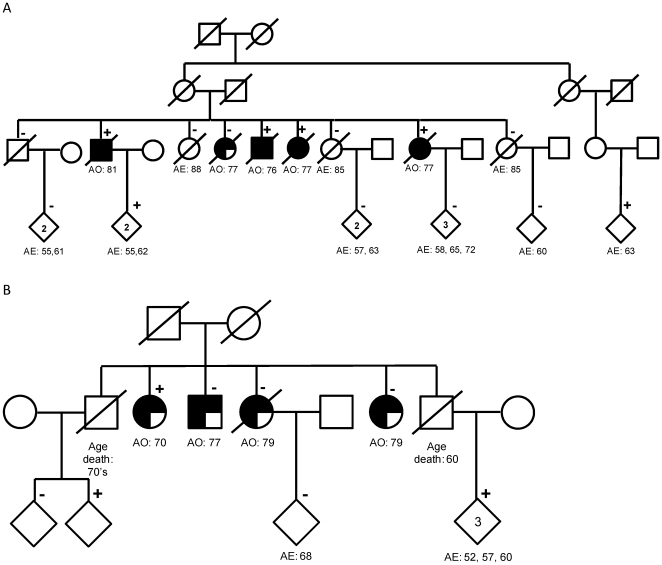
Pathogenic mutations in APP, PSEN1, PSEN2, MAPT and GRN have previously been linked to familial early onset forms of dementia. Mutation screening in these genes has been performed in either very small series or in single families with late onset AD (LOAD). Similarly, studies in single families have reported mutations in MAPT and GRN associated with clinical AD but no systematic screen of a large dataset has been performed to determine how frequently this occurs. We report sequence data for 439 probands from late-onset AD families with a history of four or more affected individuals. Sixty sequenced individuals (13.7%) carried a novel or pathogenic mutation. Eight pathogenic variants, (one each in APP and MAPT, two in PSEN1 and four in GRN) three of which are novel, were found in 14 samples. Thirteen additional variants, present in 23 families, did not segregate with disease, but the frequency of these variants is higher in AD cases than controls, indicating that these variants may also modify risk for disease. The frequency of rare variants in these genes in this series is significantly higher than in the 1,000 genome project (p = 5.09 × 10⁻⁵; OR = 2.21; 95%CI = 1.49-3.28) or an unselected population of 12,481 samples (p = 6.82 × 10⁻⁵; OR = 2.19; 95%CI = 1.347-3.26). Rare coding variants in APP, PSEN1 and PSEN2, increase risk for or cause late onset AD. The presence of variants in these genes in LOAD and early-onset AD demonstrates that factors other than the mutation can impact the age at onset and penetrance of at least some variants associated with AD. MAPT and GRN mutations can be found in clinical series of AD most likely due to misdiagnosis. This study clearly demonstrates that rare variants in these genes could explain an important proportion of genetic heritability of AD, which is not detected by GWAS.
Overview
The claims and statistics of this paper haven’t been checked yet.
Run the check — free, no account needed. It reads the open-access text and checks the sources it cites.
Integrity signals
Registry
Cites
Statistics
Figures
Verification
Claims the paper makes
The claims and statistics of this paper haven’t been checked yet.
Run the check — free, no account needed. It reads the open-access text and checks the sources it cites.
Claims other papers make about this one
Each is checked against this paper’s own text: does it say what the citing paper says it does?
The cited source says what the claim attributes to it.
In the citing paper
“suggesting that rare variants in genes associated with AD pathogenesis could explain a significant proportion of genetic heritability of AD, which is not detected by genomewide association studies (53)”
From Molecular Basis for Increased Risk for Late-onset Alzheimer Disease Due to the Naturally Occurring L28P Mutation in Apolipoprotein E4 (2014) · cites this paper as [53]
The cited source says what the claim attributes to it.
In the citing paper
“A characteristic example involves a mutation screening study that showed that rare variants in amyloid  precursor protein, presenilin 1, and presenilin 2 increased the risk for AD in LOAD families, suggesting that rare variants in genes associated with AD pathogenesis could explain a significant proportion of genetic heritability of AD, which is not detected by genomewide association studies (53)”
From Molecular Basis for Increased Risk for Late-onset Alzheimer Disease Due to the Naturally Occurring L28P Mutation in Apolipoprotein E4 (2014) · cites this paper as [53]
In the citing paper
“In support, sequencing studies have identified rare variants in APP, PSEN1, and PSEN2 that increase risk for LOAD [157].”
From Genetic architecture of Alzheimer's disease (2020) · cites this paper as [157]
Self-check
Percentages, sums and reported differences re-computed from the paper’s own numbers.
The self-check needs the paper’s full text.
Citations
Cites
McKhann, G., Drachman, D., Folstein, M., Katzman, R., Price, D., & Stadlan, E. M. (1984) · Neurology · doi:10.1212/wnl.34.7.939 · Cited by 27,915
A method and server for predicting damaging missense mutations.
Adzhubei, I. A., Schmidt, S., Peshkin, L., Ramensky, V. E., Gerasimova, A., Bork, P., Kondrashov, A. S., & Sunyaev, S. R. (2010) · Nature Methods · doi:10.1038/nmeth0410-248 · Cited by 13,194
Goate, A., Chartier-Harlin, M.-C., Mullan, M., Brown, J., Crawford, F., Fidani, L., Giuffra, L., Haynes, A., Irving, N., James, L., et al. (1991) · Nature · doi:10.1038/349704a0 · Cited by 4,659
Self-citationHarold, D., Abraham, R., Hollingworth, P., Sims, R., Gerrish, A., Hamshere, M. L., Pahwa, J. S., Moskvina, V., Dowzell, K., Williams, A., et al. (2009) · Nature Genetics · doi:10.1038/ng.440 · Cited by 3,326
Self-citationGenome-wide association study identifies variants at CLU and CR1 associated with Alzheimer's disease
the European Alzheimer's Disease Initiative Investigators, Lambert, J.-C., Heath, S., Even, G., Campion, D., Sleegers, K., Hiltunen, M., Combarros, O., Zelenika, D., Bullido, M. J., et al. (2009) · Nature Genetics · doi:10.1038/ng.439 · Cited by 2,234
Initiative, T. A. D. N., Hollingworth, P., CHARGE consortium, EADI1 consortium, Harold, D., Sims, R., Gerrish, A., Lambert, J.-C., Carrasquillo, M. M., Abraham, R., et al. (2011) · Nature Genetics · doi:10.1038/ng.803 · Cited by 1,997
Self-citationNaj, A. C., Jun, G., Beecham, G. W., Wang, L.-S., Vardarajan, B. N., Buros, J., Gallins, P. J., Buxbaum, J. D., Jarvik, G. P., Crane, P. K., et al. (2011) · Nature Genetics · doi:10.1038/ng.801 · Cited by 1,901
Self-citationRole of Genes and Environments for Explaining Alzheimer Disease
Gatz, M., Reynolds, C. A., Fratiglioni, L., Johansson, B., Mortimer, J. A., Berg, S., Fiske, A., & Pedersen, N. L. (2006) · Archives of General Psychiatry · doi:10.1001/archpsyc.63.2.168 · Cited by 1,798
The Clinical Diagnosis of Alzheimer's Disease
Wade, J. P. H., Mirsen, T. R., Hachinski, V. C., Fisman, M., Lau, C. S., & Merskey, H. (1987) · Archives of Neurology · doi:10.1001/archneur.1987.00520130016010 · Cited by 1,416
Genome-wide Analysis of Genetic Loci Associated With Alzheimer Disease
Seshadri, S. (2010) · JAMA · doi:10.1001/jama.2010.574 · Cited by 1,219
Cited by
Sorted by citations
Items 301–320 of 320
Hříbková, H., Pospíšilová, V., Černá, K. A., Váňová, T., Haviernik, J., Sedmík, J., Bernatík, O., Oľha, J., Raška, J., Cesnarikova, S., et al. (2025) · bioRxiv (Cold Spring Harbor Laboratory) · doi:10.1101/2025.06.11.659008
Revealing the nervous system requirements of Alzheimer’s disease risk genes in DrosophilaPreprint
Deger, J. M., Hannan, S. B., Gu, M.-X., Strohlein, C. E., Goodman, L. D., Pasupuleti, S., Shaik, Z., Ma, L.-W., Li, Y.-R., Li, J., et al. (2025) · bioRxiv · doi:10.1101/2025.07.24.666383
Ablation of progranulin augments microglial activation and accelerates prion progression
Li, B., Shi, Y., Hou, W., Guan, H., Li, J., Yi, T., Li, W., Cai, D., Schwarz, P., Aguzzi, A., et al. (2025) · Acta Neuropathologica Communications · doi:10.1186/s40478-025-02128-3
Additional file 5 of A comprehensive analysis of copy number variation in a Turkish dementia cohort
Dehghani, N., Güven, G., Kun‐Rodrigues, C., Gouveia, C., Foster, K., Hanagasi, H., Lohmann, E., Samancı, B., Gurvit, H. I., Bilgiç, B., et al. (2021) · Figshare · doi:10.6084/m9.figshare.15071686
Additional file 2 of A comprehensive analysis of copy number variation in a Turkish dementia cohort
Dehghani, N., Güven, G., Kun‐Rodrigues, C., Gouveia, C., Foster, K., Hanagasi, H., Lohmann, E., Samancı, B., Gurvit, H. I., Bilgiç, B., et al. (2021) · Figshare · doi:10.6084/m9.figshare.15071677
Additional file 1 of A comprehensive analysis of copy number variation in a Turkish dementia cohort
Dehghani, N., Güven, G., Kun‐Rodrigues, C., Gouveia, C., Foster, K., Hanagasi, H., Lohmann, E., Samancı, B., Gurvit, H. I., Bilgiç, B., et al. (2021) · Figshare · doi:10.6084/m9.figshare.15071674
Additional file 3 of A comprehensive analysis of copy number variation in a Turkish dementia cohort
Dehghani, N., Güven, G., Kun‐Rodrigues, C., Gouveia, C., Foster, K., Hanagasi, H., Lohmann, E., Samancı, B., Gurvit, H. I., Bilgiç, B., et al. (2021) · Figshare · doi:10.6084/m9.figshare.15071680
Additional file 4 of A comprehensive analysis of copy number variation in a Turkish dementia cohort
Dehghani, N., Güven, G., Kun‐Rodrigues, C., Gouveia, C., Foster, K., Hanagasi, H., Lohmann, E., Samancı, B., Gurvit, H. I., Bilgiç, B., et al. (2021) · Figshare · doi:10.6084/m9.figshare.15071683
Additional file 6 of A comprehensive analysis of copy number variation in a Turkish dementia cohort
Dehghani, N., Güven, G., Kun‐Rodrigues, C., Gouveia, C., Foster, K., Hanagasi, H., Lohmann, E., Samancı, B., Gurvit, H. I., Bilgiç, B., et al. (2021) · Figshare · doi:10.6084/m9.figshare.15071689
Photo-Secondary Metabolites as a Potential Therapeutic Gateway for Alzheimer’s Disease Management
Kathiresan, D. S., Puthamohan, V. M., Ganesan, S., & Arun Nagendran., N. (2026) · Springer eBooks · doi:10.1007/978-981-95-4751-7_10
Phototherapeutic Compounds: Toward Cognitive Revival in Alzheimer’s Disease
Kathiresan, D. S., Puthamohan, V. M., & Arun Nagendran., N. (2026) · Springer eBooks · doi:10.1007/978-981-95-4751-7_4
RBFOX1 association with age at onset of Alzheimer's disease
Xicota, L., Cheng, R., Andersen, S. L., Zmuda, J. M., Wojczynski, M. K., Feitosa, M. F., Bradley, J. L., Cruchaga, C., Contreras, A. G., Hohman, T. J., et al. (2026) · Alzheimer s & Dementia · doi:10.1002/alz.71188
Self-citationAshford, J. W., Smith, C. J., & Oriá, R. B. (2026) · Springer eBooks · doi:10.1007/978-3-031-52641-1_83-1
Zhang, J.-W., Li, R., Niu, Y.-X., Liu, S., Li, C.-H., Hao, X., Wang, S., Chen, S., & Wang, F. (2026) · Alzheimer s Research & Therapy · doi:10.1186/s13195-026-02016-5
Advancements in the Study of Missense Mutations in ABCA7 in Alzheimer’s Disease
Liu, L., & Zhu, B. (2026) · Journal of Molecular Neuroscience · doi:10.1007/s12031-026-02526-9
Ashford, J. W., Smith, C. J., & Oriá, R. B. (2026) · Springer eBooks · doi:10.1007/978-3-031-96089-5_83
Apolipoprotein E (APOE) in Alzheimer’s Disease: Mechanisms, Modifiers, and Therapeutic Implications
Rehman, S. U. (2026) · Bengal Journal of Psychiatry · doi:10.25259/bjpsy_2_2026
Yang, N. V., Hodgson, D., Jang, T. M., Kim, J., Gottschalk, W. K., Yassine, H. N., Chiba‐Falek, O., & Krauss, R. M. (2026) · bioRxiv (Cold Spring Harbor Laboratory) · doi:10.64898/2026.06.09.731195
Metadata
- Authors
- Cruchaga, C., Chakraverty, S., Mayo, K., Vallania, F. L. M., Mitra, R. D., Faber, K., Williamson, J., Bird, T., Diaz-Arrastia, R., Foroud, T. M., Boeve, B. F., Graff-Radford, N. R., St. Jean, P., Lawson, M., Ehm, M. G., Mayeux, R., Goate, A. M., & for the NIA-LOAD/NCRAD Family Study Consortium
- Affiliations
- Washington University in St. Louis (US)
- Indiana University Indianapolis (US)
- Columbia University (US)
- University of Washington (US)
- The University of Texas Southwestern Medical Center (US)
- Mayo Clinic (US)
- GlaxoSmithKline (United States) (US)
- Corresponding author
- Cruchaga, Carlos
- Goate, Alison M.
- ORCID
- Venue
- PLoS ONE
- Publisher
- Public Library of Science (PLoS)
- Published
- 2012-02-01
- Volume
- 7
- Issue
- 2
- Pages
- e31039
- ISSN
- 1932-6203 (ISSN-L)
- PMC
- PMC3270040
- OpenAlex
- W2023381648
- Cited by
- 320
- References
- 66
- Citations by year
- 2026: 15 · 2025: 14 · 2024: 23 · 2023: 12 · 2022: 20 · 2021: 25 · 2020: 25 · 2019: 10 · 2018: 22 · 2017: 28 · 2016: 26 · 2015: 22 · 2014: 29 · 2013: 32 · 2012: 17
- FWCI
- 21.43
- Type
- journal article
- Language
- en
- Update notices
- correction (2012-05-10)
- Open access
- gold
- doi.org
- Locations
- PLoS ONE (publishedVersion, cc-by)
- Europe PMC (PubMed Central) (publishedVersion, cc-by)
- PubMed Central (publishedVersion, cc-by)
- PubMed (publishedVersion)
- DOAJ (DOAJ: Directory of Open Access Journals) (submittedVersion, cc-by-sa)
- Figshare (submittedVersion, cc-by)
- Funders
- U.S. Department of Veterans Affairs
- Massachusetts General Hospital
- University of Southern California
- University of Pennsylvania (U24 AG026395)
- Northwestern University
- Foundation for Barnes-Jewish Hospital
- University of Washington
- University of Pittsburgh
- Rush University
- National Institutes of Health (5p30ns069329-02, 5r37ag015473-15)
- University of California, Los Angeles
- National Institute on Aging (AG 16208, R37AG15473, R37-AG015473, AG21886, R01AG035083, U24 AG21886, P 50 AG05681, R01AG041797, P50AG008702, P50AG005681, P01 AG0 3991, P01AG003991, AG035083, U24AG026395, P30AG013846, R01AG016208, AG026395, U24AG056270, P01AG026276, U24AG021886)
- National Institute of Mental Health (R01MH060009)
- National Institute of Neurological Disorders and Stroke (P30-NS069329, 1P30NS069329-01)
- Topics
- Life Sciences › Neuroscience › Cellular and Molecular Neuroscience › Alzheimer's disease research and treatments
- Health Sciences › Medicine › Psychiatry and Mental health › Dementia and Cognitive Impairment Research
- Health Sciences › Medicine › Clinical Neurology › Amyotrophic Lateral Sclerosis Research
- Keywords
- late-onset Alzheimer's disease, familial Alzheimer's disease, rare variants, APP, presenilin 1, presenilin 2, MAPT, gene regulatory networks, pathogenic variants, genetic risk, heritability, novel variants, age of onset, penetrance, misdiagnosis, mutation detection
- MeSH terms
- Progranulins, Adult, Aged, Aged, 80 and over, Alzheimer Disease, Female, Humans, Male, Middle Aged, Mutation, Pedigree, Amyloid beta-Protein Precursor, tau Proteins, Genetic Predisposition to Disease, Intercellular Signaling Peptides and Proteins, Presenilin-1, Presenilin-2
About these checks
Registry, retraction, Cites and statistics results are computed, not judged, with one exception: a printed reference that no index lists is read once by a model before it counts as a citation error. Claims are extracted by a model and kept only when their quote appears verbatim in the text; each cited source is then checked, with a model’s help, for whether it says what the claim relies on. Those verdicts can be wrong — read the claim’s quote and the cited source before relying on one.
Statistics and arithmetic are recomputed, not judged.
Confidence bands are shown only for fields calibrated on our annotated test set. None is calibrated yet, so no band is shown.
What counts as a claim ›How we measure confidence ›How we check this ›
Are you an author, or do you see a problem with this page? Request a review
