

Deep Sequencing Analyses of Low Density Microbial Communities: Working at the Boundary of Accurate Microbiota Detection
Open accessThe DOI matches its Crossref record; 31 of the 31 references it cites were found in a registry or an index.
Abstract
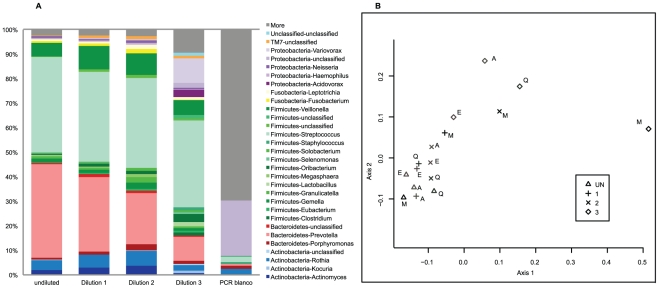
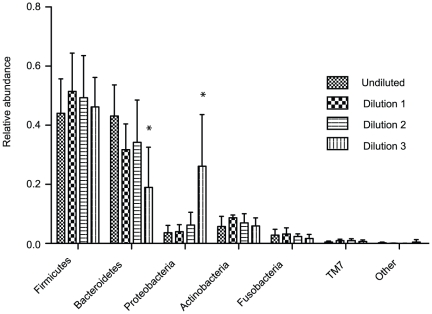
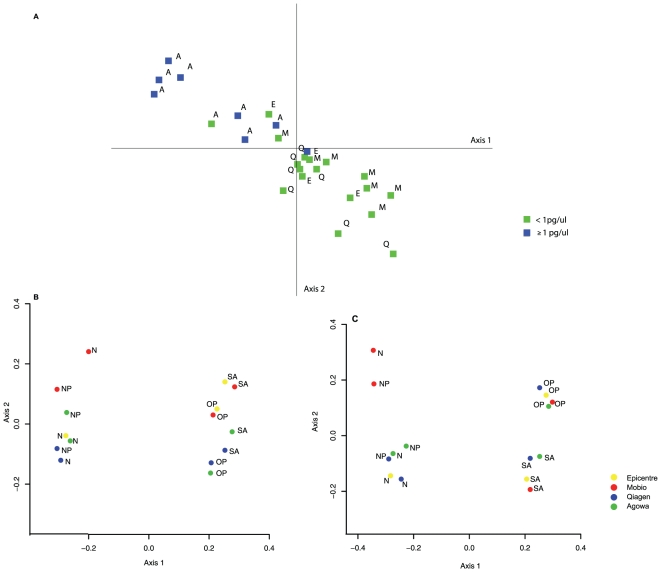
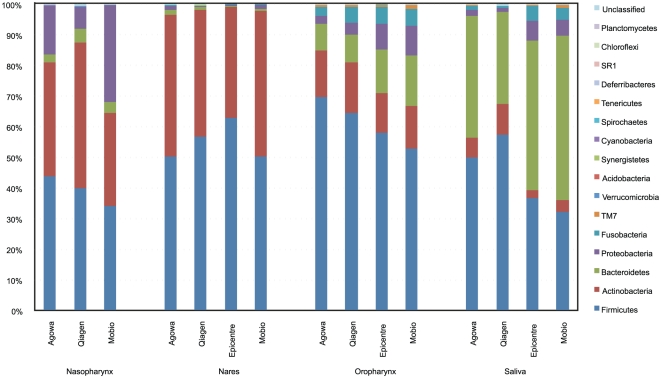
INTRODUCTION: Accurate analyses of microbiota composition of low-density communities (10(3)-10(4) bacteria/sample) can be challenging. Background DNA from chemicals and consumables, extraction biases as well as differences in PCR efficiency can significantly interfere with microbiota assessment. This study was aiming to establish protocols for accurate microbiota analysis at low microbial density. METHODS: To examine possible effects of bacterial density on microbiota analyses we compared microbiota profiles of serial diluted saliva and low (nares, nasopharynx) and high-density (oropharynx) upper airway communities in four healthy individuals. DNA was extracted with four different extraction methods (Epicentre Masterpure, Qiagen DNeasy, Mobio Powersoil and a phenol bead-beating protocol combined with Agowa-Mag-mini). Bacterial DNA recovery was analysed by 16S qPCR and microbiota profiles through GS-FLX-Titanium-Sequencing of 16S rRNA gene amplicons spanning the V5-V7 regions. RESULTS: Lower template concentrations significantly impacted microbiota profiling results. With higher dilutions, low abundant species were overrepresented. In samples of <10(5) bacteria per ml, e.g. DNA <1 pg/µl, microbiota profiling deviated from the original sample and other dilutions showing a significant increase in the taxa Proteobacteria and decrease in Bacteroidetes. In similar low density samples, DNA extraction method determined if DNA levels were below or above 1 pg/µl and, together with lysis preferences per method, had profound impact on microbiota analyses in both relative abundance as well as representation of species. CONCLUSION: This study aimed to interpret microbiota analyses of low-density communities. Bacterial density seemed to interfere with microbiota analyses at < than 10(6) bacteria per ml or DNA <1 pg/µl. We therefore recommend this threshold for working with low density materials. This study underlines that bias reduction is crucial for adequate profiling of especially low-density bacterial communities.
Overview
The claims and statistics of this paper haven’t been checked yet.
Free: it reads the open-access text and checks the first 5 claims that cite a source we can check. Create a free account to check every claim.
Integrity signals
Registry
Cites
Statistics
Figures
Verification
Claims the paper makes
The claims and statistics of this paper haven’t been checked yet.
Free: it reads the open-access text and checks the first 5 claims that cite a source we can check. Create a free account to check every claim.
Claims other papers make about this one
Each is checked against this paper’s own text: does it say what the citing paper says it does?
The cited source says what the claim attributes to it.
In the citing paper
“Once bacterial DNA has been extracted, the quantity can be so low that contamination from environmental DNA invalidates the results154,155.”
From The microbiota of the respiratory tract: gatekeeper to respiratory health (2017) · cites this paper as [155]
Self-check
Percentages, sums and reported differences re-computed from the paper’s own numbers.
The self-check needs the paper’s full text.
Citations
Cites
Schloss, P. D., Westcott, S. L., Ryabin, T., Hall, J. R., Hartmann, M., Hollister, E. B., Lesniewski, R. A., Oakley, B. B., Parks, D. H., Robinson, C. J., et al. (2009) · Applied and Environmental Microbiology · doi:10.1128/aem.01541-09 · Cited by 19,549 · cited 1×
“software platform according to previously described methods (Methods S1) [24].”
MethodUniFrac: a New Phylogenetic Method for Comparing Microbial Communities
Lozupone, C., & Knight, R. (2005) · Applied and Environmental Microbiology · doi:10.1128/aem.71.12.8228-8235.2005 · Cited by 8,227 · cited 5×
“To test the stability of the UniFrac dendogram we calculated Jackknife support values in R (http://onlinelibrary. wiley.com/doi/10.1111/j.1467-9868.2005.00489.x/abstract) and performed random permutations (1000) in Mothur.”
MethodInfluentialFastTree: Computing Large Minimum Evolution Trees with Profiles instead of a Distance Matrix
Price, M. N., Dehal, P. S., & Arkin, A. P. (2009) · Molecular Biology and Evolution · doi:10.1093/molbev/msp077 · Cited by 5,602 · cited 1×
“The phylogenetic dendrogram for the UniFrac analyses was obtained by FastTree [29].”
MethodChimeric 16S rRNA sequence formation and detection in Sanger and 454-pyrosequenced PCR amplicons
Haas, B. J., Gevers, D., Earl, A. M., Feldgarden, M., Ward, D. V., Giannoukos, G., Ciulla, D., Tabbaa, D., Highlander, S. K., Sodergren, E., et al. (2011) · Genome Research · doi:10.1101/gr.112730.110 · Cited by 3,473 · cited 1×
“slayer’’ command [26].”
Interactive Tree Of Life (iTOL): an online tool for phylogenetic tree display and annotation
Letunic, I., & Bork, P. (2007) · Bioinformatics · doi:10.1093/bioinformatics/btl529 · Cited by 3,299 · cited 3×
“Competing Interests: GR, MC and BK are employees of TNO Earth, Environmental and Life Sciences, Zeist.”
MethodInfluentialBacterial Community Variation in Human Body Habitats Across Space and Time
Costello, E. K., Lauber, C. L., Hamady, M., Fierer, N., Gordon, J. I., & Knight, R. (2009) · Science · doi:10.1126/science.1177486 · Cited by 3,231 · cited 2×
“Based on literature [1,5,9,11,21,22], four DNA extraction methods were tested: Epicentre Masterpure TM DNA purification kit (catalogue MCD85201, Epicentre technologies, Madison), Qiagen DNeasy Blood & Tissue Kit (Catalogue 69504, Qiagen, Hilden, Germany), MoBio PowerSoil DNA Extraction Kit (Catalogue 12888-05, Mo Bio…”
BackgroundMethodThe NIH Human Microbiome Project
The NIH HMP Working Group, Peterson, J., Garges, S., Giovanni, M., McInnes, P., Wang, L., Schloss, J. A., Bonazzi, V., McEwen, J. E., Wetterstrand, K. A., et al. (2009) · Genome Research · doi:10.1101/gr.096651.109 · Cited by 2,066 · cited 1×
“Bacterial composition differs greatly between body sites and between individuals, depending on host and environmental parameters such as nutrient availability, humidity, mucosal structure and immune status [1,2,3,4].”
Background[9] TM4 Microarray Software Suite
Saeed, A. I., Bhagabati, N. K., Braisted, J. C., Liang, W., Sharov, V., Howe, E. A., Li, J., Thiagarajan, M., White, J. A., & Quackenbush, J. (2006) · Methods in Enzymology · doi:10.1016/s0076-6879(06)11009-5 · Cited by 1,983 · cited 1×
“Unsupervised data-analyses, hierarchical clustering, Principal Component Analyses and Significant Analyses of Microarrays (SAM) analyses were performed in the MeV software package as part of TM4 microarray software suite [31].”
MethodAn ecological and evolutionary perspective on human–microbe mutualism and disease
Dethlefsen, L., McFall-Ngai, M., & Relman, D. A. (2007) · Nature · doi:10.1038/nature06245 · Cited by 1,660 · cited 1×
“Bacterial composition differs greatly between body sites and between individuals, depending on host and environmental parameters such as nutrient availability, humidity, mucosal structure and immune status [1,2,3,4].”
BackgroundUnravelling the effects of the environment and host genotype on the gut microbiome
Spor, A., Koren, O., & Ley, R. (2011) · Nature Reviews Microbiology · doi:10.1038/nrmicro2540 · Cited by 1,509 · cited 1×
“Bacterial composition differs greatly between body sites and between individuals, depending on host and environmental parameters such as nutrient availability, humidity, mucosal structure and immune status [1,2,3,4].”
Background
Cited by
The microbiota of the respiratory tract: gatekeeper to respiratory health
Man, W. H., de Steenhuijsen Piters, W. A. A., & Bogaert, D. (2017) · Nature Reviews Microbiology · doi:10.1038/nrmicro.2017.14 · Cited by 1,384
Self-citationThe Microbiome Quality Control Project Consortium, Sinha, R., Abu-Ali, G., Vogtmann, E., Fodor, A. A., Ren, B., Amir, A., Schwager, E., Crabtree, J., Ma, S., et al. (2017) · Nature Biotechnology · doi:10.1038/nbt.3981 · Cited by 587
Biesbroek, G., Tsivtsivadze, E., Sanders, E. A. M., Montijn, R., Veenhoven, R. H., Keijser, B. J. F., & Bogaert, D. (2014) · American Journal of Respiratory and Critical Care Medicine · doi:10.1164/rccm.201407-1240oc · Cited by 572
Self-citationImpact of delivery mode-associated gut microbiota dynamics on health in the first year of life
Reyman, M., van Houten, M. A., van Baarle, D., Bosch, A. A. T. M., Man, W. H., Chu, M. L. J. N., Arp, K., Watson, R. L., Sanders, E. A. M., Fuentes, S., et al. (2019) · Nature Communications · doi:10.1038/s41467-019-13014-7 · Cited by 450
Self-citationThe microbiome extends to subepidermal compartments of normal skin
Nakatsuji, T., Chiang, H.-I., Jiang, S. B., Nagarajan, H., Zengler, K., & Gallo, R. L. (2013) · Nature Communications · doi:10.1038/ncomms2441 · Cited by 450
de Steenhuijsen Piters, W. A. A., Heinonen, S., Hasrat, R., Bunsow, E., Smith, B., Suarez-Arrabal, M.-C., Chaussabel, D., Cohen, D. M., Sanders, E. A. M., Ramilo, O., et al. (2016) · American Journal of Respiratory and Critical Care Medicine · doi:10.1164/rccm.201602-0220oc · Cited by 422
“Bacterial High-Throughput Sequencing and Bioinformatic Processing Nasopharyngeal bacterial DNA was isolated as described previously (19, 20).”
MethodSelf-citationThe use of next generation sequencing for improving food safety: Translation into practice
Jagadeesan, B., Gerner-Smidt, P., Allard, M. W., Leuillet, S., Winkler, A., Xiao, Y., Chaffron, S., Van Der Vossen, J., Tang, S., Katase, M., et al. (2019) · Food Microbiology · doi:10.1016/j.fm.2018.11.005 · Cited by 364
Madan, J. C., Koestler, D. C., Stanton, B. A., Davidson, L., Moulton, L. A., Housman, M. L., Moore, J. H., Guill, M. F., Morrison, H. G., Sogin, M. L., et al. (2012) · mBio · doi:10.1128/mbio.00251-12 · Cited by 356
“DNA extraction was performed according to published methods (45)”
MethodReyman, M., van Houten, M. A., Watson, R. L., Chu, M. L. J. N., Arp, K., de Waal, W. J., Schiering, I., Plötz, F. B., Willems, R. J. L., van Schaik, W., et al. (2022) · Nature Communications · doi:10.1038/s41467-022-28525-z · Cited by 343
Self-citationHuman Gut Microbiota: Repertoire and Variations
Lagier, J.-C., Million, M., Hugon, P., Armougom, F., & Raoult, D. (2012) · Frontiers in Cellular and Infection Microbiology · doi:10.3389/fcimb.2012.00136 · Cited by 329
“Nevertheless, an appealing approach that was recently applied to the study of oral microbiota will allow us to detect the minor bacterial populations, which are usually neglected, using dilution to obtain a threshold below 106 bacteria per ml or DNA >1 pg per µl (Biesbroek et al., 2012).”
InfluentialRole of microbial communities in the pathogenesis of periodontal diseases and caries
Mira, A., Simon‐Soro, A., & Curtis, M. A. (2017) · Journal of Clinical Periodontology · doi:10.1111/jcpe.12671 · Cited by 279
Development of Upper Respiratory Tract Microbiota in Infancy is Affected by Mode of Delivery
Bosch, A. A. T. M., Levin, E., van Houten, M. A., Hasrat, R., Kalkman, G., Biesbroek, G., de Steenhuijsen Piters, W. A. A., de Groot, P.-K. C. M., Pernet, P., Keijser, B. J. F., et al. (2016) · EBioMedicine · doi:10.1016/j.ebiom.2016.05.031 · Cited by 276
Self-citationIssues and current standards of controls in microbiome research
Hornung, B. V. H., Zwittink, R. D., & Kuijper, E. J. (2019) · FEMS Microbiology Ecology · doi:10.1093/femsec/fiz045 · Cited by 248
The Impact of Breastfeeding on Nasopharyngeal Microbial Communities in Infants
Biesbroek, G., Bosch, A. A. T. M., Wang, X., Keijser, B. J. F., Veenhoven, R. H., Sanders, E. A. M., & Bogaert, D. (2014) · American Journal of Respiratory and Critical Care Medicine · doi:10.1164/rccm.201401-0073oc · Cited by 241
Self-citationDysbiosis of upper respiratory tract microbiota in elderly pneumonia patients
de Steenhuijsen Piters, W. A. A., Huijskens, E. G. W., Wyllie, A. L., Biesbroek, G., van den Bergh, M. R., Veenhoven, R. H., Wang, X., Trzciński, K., Bonten, M. J., Rossen, J. W. A., et al. (2016) · The ISME Journal · doi:10.1038/ismej.2015.99 · Cited by 235
“Bacterial DNA was quantified for each sample by quantitative PCR (qPCR) as previously described (Bogaert et al., 2011; Biesbroek et al., 2012).”
Self-citationParadigms of Lung Microbiota Functions in Health and Disease, Particularly, in Asthma
Mathieu, E., Escribano-Vazquez, U., Descamps, D., Cherbuy, C., Langella, P., Riffault, S., Remot, A., & Thomas, M. (2018) · Frontiers in Physiology · doi:10.3389/fphys.2018.01168 · Cited by 233
“A major impact of extraction methods on relative abundance and bacterial representation has been reported at densities below 106 bacteria per mL of sample (Biesbroek et al., 2012).”
BackgroundShaping the oral microbiota through intimate kissing
Kort, R., Caspers, M., van de Graaf, A., van Egmond, W., Keijser, B., & Roeselers, G. (2014) · Microbiome · doi:10.1186/2049-2618-2-41 · Cited by 205
“A quantitative 16S rRNA PCR was performed to determine the amount of bacterial template DNA in the samples as described in [15] and a Bacterial 16S rRNA amplicon library was generated spanning variable regions V5-V7 [16].”
MethodSelf-citationvan den Bergh, M. R., Biesbroek, G., Rossen, J. W. A., de Steenhuijsen Piters, W. A. A., Bosch, A. A. T. M., van Gils, E. J. M., Wang, X., Boonacker, C. W. B., Veenhoven, R. H., Bruin, J. P., et al. (2012) · PLoS ONE · doi:10.1371/journal.pone.0047711 · Cited by 208
“We recognize that the microbial communities in the upper respiratory tract are inherently complex and include nonculturable, less abundant commensal bacterial species [39],[40].”
BackgroundSelf-citationJervis-Bardy, J., Leong, L. E. X., Marri, S., Smith, R. J., Choo, J. M., Smith-Vaughan, H. C., Nosworthy, E., Morris, P. S., O’Leary, S., Rogers, G. B., et al. (2015) · Microbiome · doi:10.1186/s40168-015-0083-8 · Cited by 192
“Such a spurious signal can substantially distort community profiles from samples with low bacterial load [4-6].”
BackgroundEstruch, G., Collado, M. C., Peñaranda, D. S., Tomás Vidal, A., Jover Cerdá, M., Pérez Martínez, G., & Martinez-Llorens, S. (2015) · PLOS ONE · doi:10.1371/journal.pone.0136389 · Cited by 191
“Moreover, storage and processing of samples and PCR efficiency can affect the presence and relative abundance of different taxa [30, 50].”
BackgroundWilliams, T. R., Moyne, A.-L., Harris, L. J., & Marco, M. L. (2013) · PLoS ONE · doi:10.1371/journal.pone.0068642 · Cited by 174
“particular, the use of bead-beating improved the extraction of DNA from a wider-variety of bacterial cells, most notably from Gram positive bacteria [55,56].”
BackgroundMarsh, R. L., Kaestli, M., Chang, A. B., Binks, M. J., Pope, C. E., Hoffman, L. R., & Smith-Vaughan, H. C. (2016) · Microbiome · doi:10.1186/s40168-016-0182-1 · Cited by 171
“Low bacterial load was defined as <10(3) GE/μL extracted DNA, as this level was recommended previously for 16S rRNA gene sequencing analyses [24, 25].”
BackgroundMethodResultInfluentialCarvalho, M. D. G., Pimenta, F. C., Moura, I., Roundtree, A., Gertz, R. E., Li, Z., Jagero, G., Bigogo, G., Junghae, M., Conklin, L., et al. (2013) · PeerJ · doi:10.7717/peerj.97 · Cited by 147
“Deep sequencing approaches have revealed that bacterial microbiota complexity varies markedly between the oropharygeal and nasopharyngeal niches, with the more densely colonized oropharynx revealing more bacterial diversity (Charlson et al., 2010; Biesbroek et al., 2012).”
BackgroundThe human gut microbiome, a taxonomic conundrum
Sankar, S. A., Lagier, J., Pontarotti, P., Raoult, D., & Fournier, P. (2015) · Systematic and Applied Microbiology · doi:10.1016/j.syapm.2015.03.004 · Cited by 182
Boeck, I. D., Wittouck, S., Wuyts, S., Oerlemans, E. F. M., van den Broek, M. F. L., Vandenheuvel, D., Vanderveken, O. M., & Lebeer, S. (2017) · Frontiers in Microbiology · doi:10.3389/fmicb.2017.02372 · Cited by 157
“However, Biesbroek et al. (2014) demonstrated the bacterial succession of the nasopharynx microbiota in Dutch children.”
BackgroundMethodResultInfluentialImmunosenescence and pneumococcal disease: an imbalance in host-pathogen interactions.
Krone, C. L., van de Groep, K., Trzciński, K., Sanders, E. A. M., & Bogaert, D. (2014) · The Lancet Respiratory Medicine · doi:10.1016/s2213-2600(13)70165-6 · Cited by 134
Self-citationBowers, R. M., Clum, A., Tice, H., Lim, J., Singh, K., Ciobanu, D., Ngan, C. Y., Cheng, J.-F., Tringe, S. G., & Woyke, T. (2015) · BMC Genomics · doi:10.1186/s12864-015-2063-6 · Cited by 134
Development of the Nasopharyngeal Microbiota in Infants with Cystic Fibrosis
Prevaes, S. M. P. J., de Winter-de Groot, K. M., Janssens, H. M., de Steenhuijsen Piters, W. A. A., Tramper-Stranders, G. A., Wyllie, A. L., Hasrat, R., Tiddens, H. A., van Westreenen, M., van der Ent, C. K., et al. (2016) · American Journal of Respiratory and Critical Care Medicine · doi:10.1164/rccm.201509-1759oc · Cited by 131
Self-citationIntegrating the microbiome as a resource in the forensics toolkit
Clarke, T. H., Gomez, A. M., Singh, H., Nelson, K. E., & Brinkac, L. M. (2017) · Forensic Science International Genetics · doi:10.1016/j.fsigen.2017.06.008 · Cited by 146
Mapping axillary microbiota responsible for body odours using a culture-independent approach
Troccaz, M., Gaïa, N., Beccucci, S., Schrenzel, J., Cayeux, I., Starkenmann, C., & Lazarević, V. (2015) · Microbiome · doi:10.1186/s40168-014-0064-3 · Cited by 150
“Proteobacteria, known to be common water and reagent contaminants [28,29], were the most abundant phylum among putative contaminant OTUs, corresponding to 65% of sequence reads in the control data set.”
BackgroundFecal Microbiota Analysis: An Overview of Sample Collection Methods and Sequencing Strategies
Thomas, V., Clark, J., & Doré, J. (2015) · Future Microbiology · doi:10.2217/fmb.15.87 · Cited by 123
Microbiota in Breast Milk of Chinese Lactating Mothers
Sakwińska, O., Moine, D., Delley, M., Combremont, S., Rezzonico, E., Descombes, P., Vinyes-Parès, G., Zhang, Y., Wang, P., & Thakkar, S. K. (2016) · PLoS ONE · doi:10.1371/journal.pone.0160856 · Cited by 136
“The quantity of bacteria in the set of breast milk samples collected with aseptic protocol was mostly below the limit usually considered sufficient for microbiota profiling based on 16S rRNA gene sequencing (10(6) genome copies/ml) [31].”
MethodEffect of Dust Storms on the Atmospheric Microbiome in the Eastern Mediterranean
Mazar, Y., Cytryn, E., Erel, Y., & Rudich, Y. (2016) · Environmental Science & Technology · doi:10.1021/acs.est.5b06348 · Cited by 122
Dynamics of the nasal microbiota in infancy: A prospective cohort study
Mika, M., Mack, I., Korten, I., Qi, W., Aebi, S., Frey, U., Latzin, P., & Hilty, M. (2015) · Journal of Allergy and Clinical Immunology · doi:10.1016/j.jaci.2014.12.1909 · Cited by 118
“In addition, the nasal swabs were taken by the parents of the study infants, and thus we cannot exclude a potential sampling bias because an inadequately obtained swab possibly interferes with sample processing, particularly given that wewere analyzing low-density communities.(17) Therefore for quality control, we exc…”
BackgroundMethodCharacterization of the nasopharyngeal microbiota in health and during rhinovirus challenge
Allen, E. K., Koeppel, A. F., Hendley, J. O., Turner, S. D., Winther, B., & Sale, M. M. (2014) · Microbiome · doi:10.1186/2049-2618-2-22 · Cited by 118
“8 ng/μL, which is above the recommended threshold for microbiota studies [35].”
BackgroundTrzciński, K., Bogaert, D., Wyllie, A. L., Chu, M. L. J. N., ENDE, A. V. D., Bruin, J. P., van den Dobbelsteen, G., Veenhoven, R. H., & Sanders, E. A. M. (2013) · PLoS ONE · doi:10.1371/journal.pone.0060520 · Cited by 127
“The total bacterial load per sample was determined on DNA templates purified with an Agowa kit (LGC Genomics, Berlin, Germany) using 16S-based qPCR [29] as previously described [30].”
MethodSelf-citationHost DNA depletion efficiency of microbiome DNA enrichment methods in infected tissue samples
Heravi, F. S., Zakrzewski, M., Vickery, K., & Hu, H. (2020) · Journal of Microbiological Methods · doi:10.1016/j.mimet.2020.105856 · Cited by 123
Streptococcus pneumoniae in Saliva of Dutch Primary School Children
Wyllie, A. L., Chu, M. L. J. N., Schellens, M. H. B., van Engelsdorp Gastelaars, J., Jansen, M. D., van der Ende, A., Bogaert, D., Sanders, E. A. M., & Trzciński, K. (2014) · PLoS ONE · doi:10.1371/journal.pone.0102045 · Cited by 111
“Quantification of total bacterial DNA load in raw saliva samples was determined by 16S based real-time quantitative PCR (qPCR) as previously described [22].”
MethodSelf-citationKolmeder, C. A., & de Vos, W. M. (2013) · Journal of Proteomics · doi:10.1016/j.jprot.2013.05.018 · Cited by 124
Zaura, E., Pappalardo, V. Y., Buijs, M. J., Volgenant, C. M. C., & Brandt, B. W. (2020) · Periodontology 2000 · doi:10.1111/prd.12359 · Cited by 129
“…spit samples in PBS. Part 2: different sample types lead to different DNA quality and quantity Serially diluted saliva, upper airway communities: Biesbroek et al (2012)134 Four DNA extraction protocols; N = 32 Roche 454 Chemical/enzymatic lysis, BB, and BB/phenol protocols At low DNA…”
MethodSeven-Valent Pneumococcal Conjugate Vaccine and Nasopharyngeal Microbiota in Healthy Children
Biesbroek, G., Wang, X., Keijser, B. J. F., Eijkemans, R. M. J., Trzciński, K., Rots, N. Y., Veenhoven, R. H., Sanders, E. A. M., & Bogaert, D. (2014) · Emerging Infectious Diseases · doi:10.3201/eid2002.131220 · Cited by 104
“, samples with DNA levels ≥1 pg/μL) were selected for 454 pyrosequencing, as described (16).”
MethodSelf-citationHost plant species determines symbiotic bacterial community mediating suppression of plant defenses
Chung, S. H., Scully, E. D., Peiffer, M. L., Geib, S. M., Rosa, C., Hoover, K., & Felton, G. W. (2017) · Scientific Reports · doi:10.1038/srep39690 · Cited by 102
Comparison of DNA Extraction Methods in Analysis of Salivary Bacterial Communities
Lazarevic, V., Gaïa, N., Girard, M., François, P., & Schrenzel, J. (2013) · PLoS ONE · doi:10.1371/journal.pone.0067699 · Cited by 99
“Variations in DNA extraction methods, such as the use of different cell wall-degrading enzymes, chemical agents, bead sizes, bead-beating time, and DNA purification procedures [33,36,38,39] may affect profiling of the microbiota.”
BackgroundMethodGill, A. C., van de Wijgert, J. H. H. M., Blow, F., & Darby, A. C. (2016) · PLoS ONE · doi:10.1371/journal.pone.0163148 · Cited by 99
Ta, L. D. H., Yap, G. C., Tay, C. J. X., Lim, A. S. M., Huang, C., Chu, C. W., de Sessions, P. F., Shek, L. P., Goh, A. E. N., Bever, H. P. S. V., et al. (2018) · Journal of Allergy and Clinical Immunology · doi:10.1016/j.jaci.2018.01.032 · Cited by 96
Molecular assessment of bacterial vaginosis by Lactobacillus abundance and species diversity
Dols, J. A. M., Molenaar, D., van der Helm, J. J., Caspers, M. P. M., de Kat Angelino-Bart, A., Schuren, F. H. J., Speksnijder, A. G. C. L., Westerhoff, H. V., Richardus, J. H., Boon, M. E., et al. (2016) · BMC Infectious Diseases · doi:10.1186/s12879-016-1513-3 · Cited by 91
“The amount of bacterial template in the isolated DNA samples was determined with a universal quantitative PCR for 16S rRNA gene [17].”
Self-citationCummings, L. A., Kurosawa, K., Hoogestraat, D. R., SenGupta, D. J., Candra, F., Doyle, M., Thielges, S., Land, T. A., Rosenthal, C. A., Hoffman, N. G., et al. (2016) · Clinical Chemistry · doi:10.1373/clinchem.2016.258806 · Cited by 92
The respiratory microbiome: an underappreciated player in the human response to inhaled pollutants?
Adar, S. D., Huffnagle, G. B., & Curtis, J. L. (2016) · Annals of Epidemiology · doi:10.1016/j.annepidem.2016.03.010 · Cited by 88
Kelder, T., Stroeve, J. H. M., Bijlsma, S., Radonjic, M., & Roeselers, G. (2014) · Nutrition & Diabetes · doi:10.1038/nutd.2014.18 · Cited by 86
Self-citationWyllie, A. L., Rümke, L. W., Arp, K., Bosch, A. A. T. M., Bruin, J. P., Rots, N. Y., Wijmenga‐Monsuur, A. J., Sanders, E. A. M., & Trzciński, K. (2016) · Scientific Reports · doi:10.1038/srep34888 · Cited by 92
“The oral cavity however is more microbially rich than the nasopharynx 42 , making pneumococcal detection by culture difficult for oropharyngeal swabs and virtually impossible for saliva 30,31 .”
Self-citationChiu, C.-Y., Chan, Y.-L., Tsai, Y.-S., Chen, S.-A., Wang, C.-J., Chen, K.-F., & Chung, I.-F. (2017) · Scientific Reports · doi:10.1038/s41598-017-02067-7 · Cited by 84
The impact of fixed orthodontic appliances on oral microbiome dynamics in Japanese patients
Kado, I., Hisatsune, J., Tsuruda, K., Tanimoto, K., & Sugai, M. (2020) · Scientific Reports · doi:10.1038/s41598-020-78971-2 · Cited by 101
Microbial biogeography of drinking water: patterns in phylogenetic diversity across space and time
Roeselers, G., Coolen, J. P. M., van der Wielen, P. W. J. J., Jaspers, M. C. M., Atsma, A., de Graaf, B., & Schuren, F. H. J. (2015) · Environmental Microbiology · doi:10.1111/1462-2920.12739 · Cited by 95
Self-citationThe adult nasopharyngeal microbiome as a determinant of pneumococcal acquisition
Cremers, A. J. H., Zomer, A., Gritzfeld, J. F., Ferwerda, G., van Hijum, S. A. F. T., Ferreira, D. M., Shak, J. R., Klugman, K. P., Boekhorst, J., Timmerman, H. M., et al. (2014) · Microbiome · doi:10.1186/2049-2618-2-44 · Cited by 90
The airway microbiome in COPD, bronchiectasis and bronchiectasis‐COPD overlap
Tiew, P. Y., Jaggi, T. K., Chan, L., & Chotirmall, S. H. (2020) · The Clinical Respiratory Journal · doi:10.1111/crj.13294 · Cited by 96
Nasopharyngeal microbial interactions in the era of pneumococcal conjugate vaccination
Dunne, E. M., Smith‐Vaughan, H., Robins-Browne, R. M., Mulholland, K., & Satzke, C. (2013) · Vaccine · doi:10.1016/j.vaccine.2013.03.024 · Cited by 91
“These analyses remain technically challenging, as sample storage conditions, DNA extraction methods, and resulting DNA concentrations can affect assessment of microbial profiles [83,84].”
BackgroundA critical analysis of research methods and experimental models to study the root canal microbiome
Siqueira, J. F., Jr., & Rôças, I. N. (2021) · International Endodontic Journal · doi:10.1111/iej.13656 · Cited by 87
Concordance between upper and lower airway microbiota in infants with cystic fibrosis
Prevaes, S. M. P. J., Piters, W. A. A. D. S., Groot, K. M. D. W., Janssens, H. M., Tramper‐Stranders, G. A., Chu, M. L. J. N., Tiddens, H. A. W. M., van Westreenen, M., van der Ent, C. K., Sanders, E. A. M., et al. (2017) · European Respiratory Journal · doi:10.1183/13993003.02235-2016 · Cited by 72
“The total bacterial load of the samples was established by quantitative PCR using a primer-probe set targeting the bacterial 16S-rRNA gene [24 – 26].”
Self-citationOdendaal, M.-L., Piters, W. A. A. D. S., Franz, E., Chu, M. L. J. N., Groot, J. A., van Logchem, E. M., Hasrat, R., Kuiling, S., Pijnacker, R., Mariman, R., et al. (2024) · Cell · doi:10.1016/j.cell.2024.07.008 · Cited by 84
Self-citationCharacterization of the upper respiratory tract microbiomes of patients with pandemic H1N1 influenza
Chaban, B., Albert, A., Links, M. G., Gardy, J., Tang, P., & Hill, J. E. (2013) · PLoS ONE · doi:10.1371/journal.pone.0069559 · Cited by 69
“Firmicutes, with an increasing presence of Proteobacteria farther from the nose in the nasopharynx [5–8].”
BackgroundResultLazarević, V., Gaïa, N., Girard, M., & Schrenzel, J. (2016) · BMC Microbiology · doi:10.1186/s12866-016-0689-4 · Cited by 73
“Identification of unexpected taxa in datasets derived from low-density microbiota [1–3], diluted mock communities [4], and cultures [5], demonstrated that a variable fraction of sequence reads originated from exogenous DNA.”
BackgroundHang, J., Desai, V., Zavaljevski, N., Yang, Y., Lin, X., Satya, R. V., Martinez, L. J., Blaylock, J. M., Jarman, R. G., Thomas, S. J., et al. (2014) · Microbiome · doi:10.1186/2049-2618-2-31 · Cited by 65
“Qiagen DNeasy kit with additional enzymatic lysis and MO BIO PowerSoil kit with bead beating were both frequently used in metagenomics studies [24,47].”
Does the maternal vaginal microbiota play a role in seeding the microbiota of neonatal gut and nose?
Sakwińska, O., Foata, F., Berger, B. W., Brüssow, H., Combremont, S., Mercenier, A., Dogra, S. K., Soh, S., Chan, J. K. Y., Heong, G. Y. S., et al. (2017) · Beneficial Microbes · doi:10.3920/bm2017.0064 · Cited by 75
Kensara, A. A., Hefni, E., Williams, M. A., Saito, H., Mongodin, E. F., & Masri, R. M. (2020) · Journal of Prosthodontics · doi:10.1111/jopr.13270 · Cited by 70
The excreted microbiota of bats: evidence of niche specialisation based on multiple body habitats
Dietrich, M., Kearney, T., Seamark, E. C. J., & Markotter, W. (2016) · FEMS Microbiology Letters · doi:10.1093/femsle/fnw284 · Cited by 62
“In part, this is due to limited biological content of low-biomass samples, whichmay provide little template DNA to compete for amplification with background contaminant bacterial DNA that are ubiquitous in extraction kits and other laboratory reagents (Biesbroek et al. 2012; Salter et al. 2014).”
Laboratory contamination in airway microbiome studies
Drengenes, C., Wiker, H. G., Kalananthan, T., Nordeide, E., Eagan, T., & Nielsen, R. (2019) · BMC Microbiology · doi:10.1186/s12866-019-1560-1 · Cited by 74
“[14] for example show in their study how the choice of DNA extraction kit will affect the DNA yield and in turn the placement of samples above or below a defined threshold of bacterial load for which contamination becomes a problem.”
BackgroundResultKorten, I., Mika, M., Klenja, S., Kieninger, E., Mack, I., Barbani, M. T., Gorgievski, M., Frey, U., Hilty, M., & Latzin, P. (2016) · mSphere · doi:10.1128/msphere.00312-16 · Cited by 65
“0 ng/ l were excluded from the study, corresponding to less than 1 pg/ l bacterial DNA (10), which was recently recommended as a reliable threshold (41).”
BackgroundEvaluation of Oral Cavity DNA Extraction Methods on Bacterial and Fungal Microbiota
Rosenbaum, J., Usyk, M., Chen, Z., Zolnik, C. P., Jones, H. E., Waldron, L., Dowd, J. B., Thorpe, L. E., & Burk, R. D. (2019) · Scientific Reports · doi:10.1038/s41598-018-38049-6 · Cited by 66
Bacterial Invasion of Pulp Blood Vessels in Teeth with Symptomatic Irreversible Pulpitis
Ricucci, D., Siqueira, J. F., Jr., Abdelsayed, R. A., Lio, S. G., & Rôças, I. N. (2021) · Journal of Endodontics · doi:10.1016/j.joen.2021.09.010 · Cited by 63
Lesaulnier, C., Herbold, C. W., Pelikan, C., Berry, D., Gérard, C., Coz, X. L., Gagnot, S., Niggemann, J., Dittmar, T., Singer, G. A., et al. (2017) · Microbiome · doi:10.1186/s40168-017-0344-9 · Cited by 58
Baker, J. M., Hinkle, K. J., McDonald, R. A., Brown, C. A., Falkowski, N. R., Huffnagle, G. B., & Dickson, R. P. (2021) · Microbiome · doi:10.1186/s40168-021-01055-4 · Cited by 58
“Low-biomass samples—samples with low densities of bacterial cells and therefore low quantities of bacterial DNA—are susceptible to contamination with background-derived signal, which affects the taxonomic composition of low-biomass samples [1, 2].”
BackgroundHow low can we go? The implications of low bacterial load in respiratory microbiota studies
Marsh, R. L., Nelson, M. T., Pope, C. E., Leach, A. J., Hoffman, L. R., Chang, A. B., & Smith‐Vaughan, H. (2018) · Pneumonia · doi:10.1186/s41479-018-0051-8 · Cited by 56
“Background contamination in respiratory microbiota studies Several studies have reported background contamination in microbiota data generated from respiratory specimens with low bacterial load (< 10(6) bacterial cells/mL of specimen) [3, 4, 7, 8, 18, 21].”
BackgroundMethodInfluentialKrawczyk, A. I., Röttjers, L., Fonville, M., Takumi, K., Takken, W., Faust, K., & Sprong, H. (2022) · Microbiome · doi:10.1186/s40168-022-01276-1 · Cited by 53
“Quantification of total bacterial DNA load was determined by 16S rRNA qPCR [38, 41, 42].”
MethodKoenen, M. H., de Groot, R. C. A., de Steenhuijsen Piters, W. A. A., Chu, M. L. J. N., Arp, K., Hasrat, R., de Bruijn, A. C. J. M., Estevão, S. C., van der Vries, E., Langereis, J. D., et al. (2023) · eBioMedicine · doi:10.1016/j.ebiom.2023.104868 · Cited by 48
Self-citationOptimized bacterial DNA isolation method for microbiome analysis of human tissues
Bruggeling, C. E., Garza, D. R., Achouiti, S., Mes, W., Dutilh, B. E., & Boleij, A. (2021) · MicrobiologyOpen · doi:10.1002/mbo3.1191 · Cited by 57
“Bacteria differ in their susceptibility to lysis, resulting in the tendency of some bacteria to lyse too early during the isolation method (Biesbroek et al., 2012; Horz et al., 2010), while other bacteria may require extra steps to release their DNA, for example, by mechanical lysis through bead-…”
BackgroundMethodInfluentialGisler, A., Korten, I., de Hoogh, K., Vienneau, D., Frey, U., Decrue, F., Gorlanova, O., Soti, A. L., Hilty, M., Latzin, P., et al. (2021) · Environmental Research · doi:10.1016/j.envres.2021.111633 · Cited by 50
“There is evidence that decreased within-subject dissimilarity is associated with a reduced susceptibility to respiratory tract infections, but there is no evidence on the association between air pollution and within-subject Ružička dissimilarity (Biesbroek et al., 2014; Bosch et al., 2017).”
BackgroundTreven, P., Mrak, V., Matijašić, B. B., Horvat, S., & Rogelj, I. (2015) · Journal of Dairy Science · doi:10.3168/jds.2014-8519 · Cited by 57
Characterising the respiratory microbiome
Watson, R. L., de Koff, E. M., & Bogaert, D. (2019) · European Respiratory Journal · doi:10.1183/13993003.01711-2018 · Cited by 47
Self-citationHjelmsø, M. H., Mollerup, S., Jensen, R. H., Pietroni, C., Lukjančenko, O., Schultz, A. C., Aarestrup, F. M., & Hansen, A. J. (2019) · PLoS ONE · doi:10.1371/journal.pone.0210368 · Cited by 45
“Sequencing reads mapping to HAdV, EboV and HIV were detected in the negative control and these species were conservatively removed from the dataset prior to further analysis [37].”
BackgroundMethodReyman, M., van Houten, M. A., Arp, K., Sanders, E. A. M., & Bogaert, D. (2019) · Scientific Reports · doi:10.1038/s41598-019-52549-z · Cited by 44
Self-citationKotu, S. P., Mannan, M. S., & Jayaraman, A. (2019) · International Biodeterioration & Biodegradation · doi:10.1016/j.ibiod.2019.104722 · Cited by 45
The effects of variable sample biomass on comparative metagenomics
Chafee, M. E., Maignien, L., & Simmons, S. L. (2015) · Environmental Microbiology · doi:10.1111/1462-2920.12668 · Cited by 39
“In addition, a recent study using 16s rRNA profiling of a single diluted sample indicated that templates with less than 10(6) cells diverged from the source community (Biesbroek et al., 2012), suggesting that similar differences may appear in shotgun metagenomes.”
ResultBoers, S. A., de Zeeuw, M., Jansen, R., van der Schroeff, M. P., van Rossum, A. M. C., Hays, J. P., & Verhaegh, S. J. C. (2018) · European Journal of Clinical Microbiology & Infectious Diseases · doi:10.1007/s10096-017-3178-2 · Cited by 38
Reconstitution and Transmission of Gut Microbiomes and Their Genes between Generations
Rosenberg, E., & Zilber-Rosenberg, I. (2021) · Microorganisms · doi:10.3390/microorganisms10010070 · Cited by 43
Mika, M., Maurer, J., Korten, I., Allemann, A., Aebi, S., Brugger, S. D., Qi, W., Frey, U., Latzin, P., & Hilty, M. (2017) · Microbiome · doi:10.1186/s40168-017-0302-6 · Cited by 43
“0 ng/μl, corresponding to <1 pg/μl bacterial DNA [16], which was recommended as the threshold when working with low-density samples [32], were excluded, as well as samples with <70 sequence reads, and samples with >5.”
BackgroundTick microbial associations at the crossroad of horizontal and vertical transmission pathways
Krawczyk, A. I., Röttjers, S., Coimbra-Dores, M. J., Heylen, D., Fonville, M., Takken, W., Faust, K., & Sprong, H. (2022) · Parasites & Vectors · doi:10.1186/s13071-022-05519-w · Cited by 38
Galeano Niño, J. L., Wu, H., LaCourse, K. D., Srinivasan, H., Fitzgibbon, M., Minot, S. S., Sather, C., Johnston, C. D., & Bullman, S. (2023) · Nature Protocols · doi:10.1038/s41596-023-00888-7 · Cited by 36
Breitenwieser, F., Doll, E. V., Clavel, T., Scherer, S., & Wenning, M. (2020) · Frontiers in Microbiology · doi:10.3389/fmicb.2020.01557 · Cited by 38
“Numerous studies confirm that the method of DNA extraction leads to shifts in the microbiome most probably due to differential lysis of various taxa (Biesbroek et al., 2012; Hart et al., 2015; Panek et al., 2018; Vaidya et al., 2018).”
Claassen-Weitz, S., Gardner‐Lubbe, S., Mwaikono, K. S., du Toit, E., Zar, H. J., & Nicol, M. P. (2020) · BMC Microbiology · doi:10.1186/s12866-020-01795-7 · Cited by 41
“Nasopharyngeal (NP) specimens are one such example as they have bacterial densities of < 10(6) 16S copies/mL [15, 17, 25].”
BackgroundMethodInfluenza-like Illness Exacerbates Pneumococcal Carriage in Older Adults
Miellet, W. R., van Veldhuizen, J., Nicolaie, M. A., Mariman, R., Bootsma, H. J., Bosch, T., Rots, N. Y., Sanders, E. A. M., van Beek, J., & Trzciński, K. (2020) · Clinical Infectious Diseases · doi:10.1093/cid/ciaa1551 · Cited by 37
Self-citationWen, Y. F., Xiao, F., Wang, C., & Wang, Z. (2016) · PubMed · Cited by 35
Mode of delivery modulates the intestinal microbiota and impacts the response to vaccination
de Koff, E. M., van Baarle, D., van Houten, M. A., Reyman, M., Berbers, G. A. M., van den Ham, F., Chu, M. L. J. N., Sanders, E. A. M., Bogaert, D., & Fuentes, S. (2022) · Nature Communications · doi:10.1038/s41467-022-34155-2 · Cited by 37
Self-citationRevealing microbial recognition by specific antibodies
Simón-Soro, Á., D’Auria, G., Collado, M. C., Džunková, M., Culshaw, S., & Mira, A. (2015) · BMC Microbiology · doi:10.1186/s12866-015-0456-y · Cited by 34
“Although PCR and subsequent pyrosequencing was achieved with as few as 5000 sorted bacteria, a larger number of cells is recommended for accurate description of microbial composition [13].”
Marsh, R. L., Smith‐Vaughan, H., Chen, A. C. –., Marchant, J. M., Yerkovich, S. T., Gibson, P. G., Pizzutto, S. J., Hodge, S. J., Upham, J. W., & Chang, A. B. (2019) · CHEST Journal · doi:10.1016/j.chest.2019.01.002 · Cited by 35
Drengenes, C., Eagan, T., Haaland, I., Wiker, H. G., & Nielsen, R. (2021) · BMC Genomics · doi:10.1186/s12864-020-07252-z · Cited by 38
“[1] observed an increase in Firmicutes and decrease in Bacteriodetes across a serially diluted saliva sample, but were unable to explain the direct mechanism behind their observations.”
BackgroundRajar, P., Dhariwal, A., Salvadori, G., Junges, R., Åmdal, H. A., Berild, D., Fugelseth, D., Saugstad, O. D., Lausten‐Thomsen, U., Greisen, G. O., et al. (2022) · Frontiers in Microbiology · doi:10.3389/fmicb.2022.1038120 · Cited by 35
“A threshold of 1 pg DNA/ μl for microbiota detection has previously been proposed (Biesbroek et al., 2012).”
BackgroundClean Low-Biomass Procedures and Their Application to Ancient Ice Core Microorganisms
Zhong, Z.-P., Solonenko, N., Gazitúa, M. C., Kenny, D. V., Mosley‐Thompson, E., Rich, V. I., Etten, J. L. V., Thompson, L. G., & Sullivan, M. B. (2018) · Frontiers in Microbiology · doi:10.3389/fmicb.2018.01094 · Cited by 34
“…exogenous sequences assigned as unexpected taxa from contamination have been detected during the analysis of lowbiomass environmental microbiota (Biesbroek et al., 2012; Lazarevic et al., 2014), cultures (Salter et al., 2014; Lazarevic et al., 2016), and diluted mock microbial communities…”
BackgroundQuality control of microbiota metagenomics by k-mer analysis
Oñate, F. P., Batto, J.-M., Juste, C., Fadlallah, J., Fougeroux, C. E., Gouas, D. A., Pons, N., Kennedy, S., Levenez, F., Dore, J. M., et al. (2015) · BMC Genomics · doi:10.1186/s12864-015-1406-7 · Cited by 31
“However, it is also increasingly clear that this type of analysis is often associated with strong biases, which are difficult to discern and complicated to correct [9].”
BackgroundWyllie, A. L., Pannekoek, Y., Man-Bovenkerk, S., Gastelaars, J. V. E., Ferwerda, B., van de Beek, D., Sanders, E. A. M., Trzciński, K., & ENDE, A. V. D. (2017) · Open Biology · doi:10.1098/rsob.170074 · Cited by 34
Self-citationKrone, C. L., Biesbroek, G., Trzciński, K., Sanders, E. A. M., & Bogaert, D. (2014) · Infection and Immunity · doi:10.1128/iai.01290-13 · Cited by 30
“DNA was isolated from 100 l of the URT lavage fluid with phenol plus bead beating and magnetic bead separation using Agowa reagents as described by Biesbroek et al. (12).”
BackgroundMethodInfluentialSelf-citation
Metadata
- Authors
- Biesbroek, G., Sanders, E. A. M., Roeselers, G., Wang, X., Caspers, M. P. M., Trzciński, K., Bogaert, D., & Keijser, B. J. F.
- Affiliations
- University Medical Center Utrecht (NL)
- Netherlands Organisation for Applied Scientific Research (NL)
- Corresponding author
- Bogaert, Debby
- ORCID
- Venue
- PLoS ONE
- Publisher
- Public Library of Science (PLoS)
- Published
- 2012-03-06
- Volume
- 7
- Issue
- 3
- Pages
- e32942
- ISSN
- 1932-6203 (ISSN-L)
- PMC
- PMC3295791
- OpenAlex
- W2095135825
- Cited by
- 196
- References
- 31
- Citations by year
- 2026: 5 · 2025: 9 · 2024: 12 · 2023: 14 · 2022: 14 · 2021: 27 · 2020: 16 · 2019: 13 · 2018: 11 · 2017: 15 · 2016: 14 · 2015: 17 · 2014: 17 · 2013: 9 · 2012: 3
- FWCI
- 17.69
- Type
- journal article
- Language
- en
- Open access
- gold
- doi.org
- Locations
- PLoS ONE (publishedVersion, cc-by)
- PubMed Central (publishedVersion, cc-by)
- PubMed (publishedVersion)
- TNO Repository (submittedVersion)
- DOAJ (DOAJ: Directory of Open Access Journals) (submittedVersion, cc-by-sa)
- Figshare (submittedVersion, cc-by)
- Data Archiving and Networked Services (DANS) (submittedVersion, other-oa)
- Funders
- Pfizer
- GlaxoSmithKline
- European Commission (241446)
- ZonMw (91610121, 91209010)
- Nederlandse Organisatie voor Wetenschappelijk Onderzoek
- Topics
- Health Sciences › Dentistry › Periodontics › Oral microbiology and periodontitis research
- Life Sciences › Biochemistry, Genetics and Molecular Biology › Molecular Biology › Gut microbiota and health
- Life Sciences › Biochemistry, Genetics and Molecular Biology › Molecular Biology › Genomics and Phylogenetic Studies
- Keywords
- microbiota profiling, 16S rRNA gene sequencing, DNA extraction bias, PCR bias, bacterial density, saliva microbiota, upper airway microbiota, nasopharynx, oropharynx, DNA template concentration
- MeSH terms
- DNA, Bacterial, DNA, Ribosomal, Humans, Nasopharynx, Respiratory System, Host-Pathogen Interactions, Metagenome, Bacterial Load, High-Throughput Nucleotide Sequencing
About these checks
Registry, retraction, Cites and statistics results are computed, not judged, with one exception: a printed reference that no index lists is read once by a model before it counts as a citation error. Claims are extracted by a model and kept only when their quote appears verbatim in the text; each cited source is then checked, with a model’s help, for whether it says what the claim relies on. Those verdicts can be wrong — read the claim’s quote and the cited source before relying on one.
Statistics and arithmetic are recomputed, not judged.
Confidence bands are shown only for fields calibrated on our annotated test set. None is calibrated yet, so no band is shown.
What counts as a claim ›How we measure confidence ›How we check this ›
Are you an author, or do you see a problem with this page? Request a review
Data sources
Bibliographic data: Semantic Scholar, OpenAlex, Crossref.
Contains information from the Semantic Scholar Academic Graph Datasets, made available under the ODC Attribution License (ODC-BY 1.0).
Semantic Scholar’s data is described in: Kinney, R., et al. (2023). The Semantic Scholar Open Data Platform. arXiv:2301.10140.
