

Airway Microbial Diversity is Inversely Associated with Mite-Sensitized Rhinitis and Asthma in Early Childhood
Open accessThe DOI matches its Crossref record; 50 of the 50 references it cites were found in a registry or an index.
Abstract
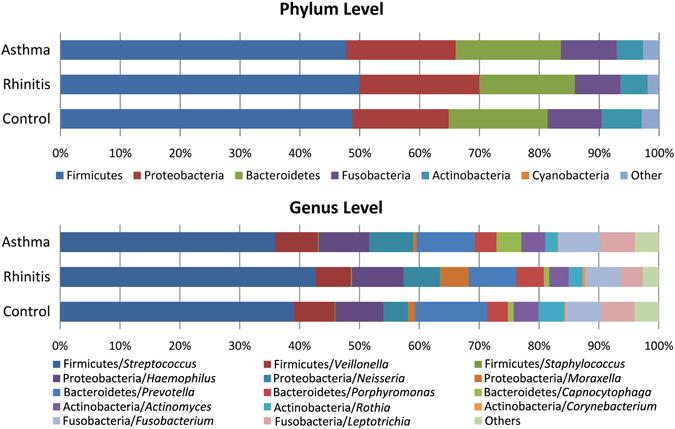
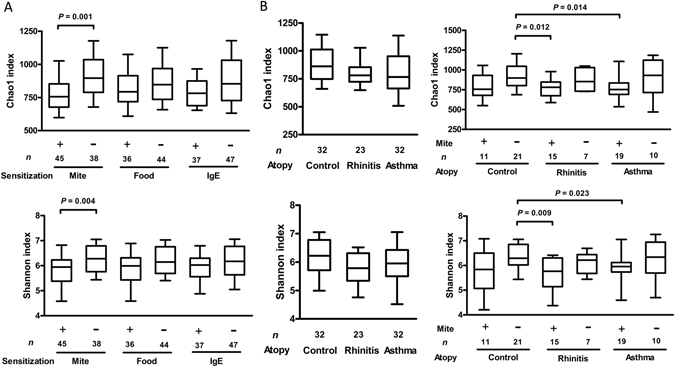
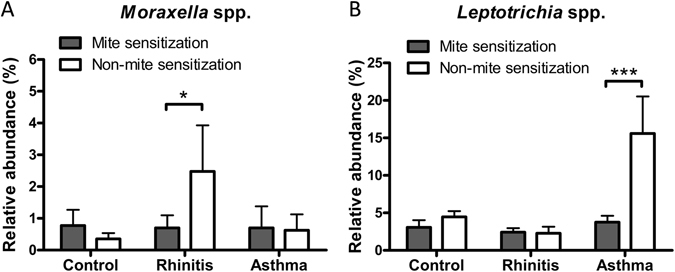
Microbiota plays an important role in regulating immune responses associated with atopic diseases. We sought to evaluate relationships among airway microbiota, serum IgE levels, allergic sensitization and their relevance to rhinitis and asthma. Microbial characterization was performed using Illumina-based 16S rRNA gene sequencing of 87 throat swabs collected from children with asthma (n = 32) and rhinitis (n = 23), and from healthy controls (n = 32). Data analysis was performed using QIIME (Quantitative Insights Into Microbial Ecology) v1.8. Significantly higher abundance of Proteobacteria was found in children with rhinitis than in the healthy controls (20.1% vs. 16.1%, P = 0.009). Bacterial species richness (Chao1 index) and diversity (Shannon index) were significantly reduced in children with mite sensitization but not in those with food or IgE sensitization. Compared with healthy children without mite sensitization, the mite-sensitized children with rhinitis and asthma showed significantly lower Chao1 and Shannon indices. Moraxella and Leptotrichia species were significantly found in the interaction of mite sensitization with rhinitis and asthma respectively. Airway microbial diversity appears to be inversely associated with sensitization to house dust mites. A modulation between airway dysbiosis and responses to allergens may potentially cause susceptibility to rhinitis and asthma in early childhood.
Overview
The claims and statistics of this paper haven’t been checked yet.
Free: it reads the open-access text and checks the first 5 claims that cite a source we can check. Create a free account to check every claim.
Integrity signals
Registry
Cites
Statistics
Figures
Verification
Claims the paper makes
The claims and statistics of this paper haven’t been checked yet.
Free: it reads the open-access text and checks the first 5 claims that cite a source we can check. Create a free account to check every claim.
Claims other papers make about this one
Each is checked against this paper’s own text: does it say what the citing paper says it does?
The source backs part of the claim, not all of it — or backs it for a different population, condition or comparison.
In the citing paper
“Accordingly, modulation between airway dysbiosis and allergen response has been associated with the worsening of allergy symptoms (559, 560).”
From Aspergillus fumigatus and Aspergillosis in 2019 (2019) · cites this paper as [559]
Experimental — accuracy not yet measuredThe source backs part of the claim, not all of it — or backs it for a different population, condition or comparison.
In the citing paper
“Activities such as hiking promote microbial diversity, which is essential for immune resilience, whereas urbanization and limited natural exposure have been associated with increased chronic disease risk [41,42,43,44,45,46,47].”
From The Power of Environment: A Comprehensive Review of the Exposome's Role in Healthy Aging, Longevity, and Preventive Medicine-Lessons from Blue Zones and Cilento (2025) · cites this paper as [43]
Experimental — accuracy not yet measured
Self-check
Percentages, sums and reported differences re-computed from the paper’s own numbers.
The self-check needs the paper’s full text.
Citations
Cites
QIIME allows analysis of high-throughput community sequencing data
Caporaso, J. G., Kuczynski, J., Stombaugh, J., Bittinger, K., Bushman, F. D., Costello, E. K., Fierer, N., Peña, A. G., Goodrich, J. K., Gordon, J. I., et al. (2010) · Nature Methods · doi:10.1038/nmeth.f.303 · Cited by 34,887
Search and clustering orders of magnitude faster than BLAST
Edgar, R. C. (2010) · Bioinformatics · doi:10.1093/bioinformatics/btq461 · Cited by 20,826
Statistical significance for genomewide studies
Storey, J. D., & Tibshirani, R. (2003) · Proceedings of the National Academy of Sciences · doi:10.1073/pnas.1530509100 · Cited by 9,692
McDonald, D., Price, M. N., Goodrich, J., Nawrocki, E. P., DeSantis, T. Z., Probst, A., Andersen, G. L., Knight, R., & Hugenholtz, P. (2012) · The ISME Journal · doi:10.1038/ismej.2011.139 · Cited by 5,064
The human microbiome: at the interface of health and disease
Cho, I., & Blaser, M. J. (2012) · Nature Reviews Genetics · doi:10.1038/nrg3182 · Cited by 3,449
Differential abundance analysis for microbial marker-gene surveys
Paulson, J. N., Stine, O. C., Bravo, H. C., & Pop, M. (2013) · Nature Methods · doi:10.1038/nmeth.2658 · Cited by 2,428
Pathogen Recognition by the Innate Immune System
Kumar, H., Kawai, T., & Akira, S. (2011) · International Reviews of Immunology · doi:10.3109/08830185.2010.529976 · Cited by 2,257
PANDAseq: paired-end assembler for Illumina sequences
Masella, A. P., Bartram, A. K., Truszkowski, J. M., Brown, D. G., & Neufeld, J. D. (2012) · BMC Bioinformatics · doi:10.1186/1471-2105-13-31 · Cited by 2,132
Disordered Microbial Communities in Asthmatic Airways
Hilty, M., Burke, C., Pedro, H., Cardenas, P., Bush, A., Bossley, C., Davies, J., Ervine, A., Poulter, L., Pachter, L., et al. (2010) · PLoS ONE · doi:10.1371/journal.pone.0008578 · Cited by 1,824
Measuring beta diversity for presence–absence data
Koleff, P., Gaston, K. J., & Lennon, J. J. (2003) · Journal of Animal Ecology · doi:10.1046/j.1365-2656.2003.00710.x · Cited by 1,736
Cited by
Aspergillus fumigatus and Aspergillosis in 2019
Latgé, J.-P., & Chamilos, G. (2019) · Clinical Microbiology Reviews · doi:10.1128/cmr.00140-18 · Cited by 1,400
Role of the microbiome in human development
Dominguez-Bello, M. G., Godoy-Vitorino, F., Knight, R., & Blaser, M. J. (2019) · Gut · doi:10.1136/gutjnl-2018-317503 · Cited by 783
“Indeed, it seems possible that some bacterial cells of the uterine cervix 10 may enter with the sperm during fertilisation and reach the egg at the time of fertilisation, implantation or early embryonic development.”
BackgroundLeptotrichia species in human infections II
Eribe, E. R. K., & Olsen, I. (2017) · Journal of Oral Microbiology · doi:10.1080/20002297.2017.1368848 · Cited by 172
“Also, human skin emanation samples and oropharyngeal samples of mite-food-sensitized children with rhinitis and asthma were found to contain Leptotrichia species [31,92].”
BackgroundSokolowska, M., Frei, R., Lunjani, N., Akdis, C. A., & O’Mahony, L. (2018) · Asthma Research and Practice · doi:10.1186/s40733-017-0037-y · Cited by 148
“Indeed, airway microbial diversity appears to be inversely associated with sensitization to house dust mites in early childhood [81, 82].”
BackgroundRecent developments and highlights in mechanisms of allergic diseases: Microbiome
Lunjani, N., Satitsuksanoa, P., Lukasik, Z., Sokolowska, M., Eiwegger, T., & O'Mahony, L. (2018) · Allergy · doi:10.1111/all.13634 · Cited by 120
“with rhinitis, which may be clinically important given the Proteobacteria‐related asthma associations described above.(69) Dysbiosis of the inferior turbinate mucosa microbiota, particularly an increase in”
Background
Metadata
- Authors
- Chiu, C.-Y., Chan, Y.-L., Tsai, Y.-S., Chen, S.-A., Wang, C.-J., Chen, K.-F., & Chung, I.-F.
- Affiliations
- Chang Gung University (TW)
- Chang Gung Memorial Hospital (TW)
- National Yang Ming University (TW)
- Corresponding author
- Chiu, Chih-Yung
- Chung, I.-Fang
- Venue
- Scientific Reports
- Published
- 2017-05-12
- Volume
- 7
- Issue
- 1
- Pages
- 1820-1820
- ISSN
- 2045-2322 (ISSN-L)
- PMC
- PMC5431806
- OpenAlex
- W2613895329
- Cited by
- 84
- References
- 50
- Citations by year
- 2026: 1 · 2025: 9 · 2024: 4 · 2023: 10 · 2022: 20 · 2021: 8 · 2020: 14 · 2019: 8 · 2018: 8 · 2017: 2
- FWCI
- 6.42
- Type
- journal article
- Language
- en
- Open access
- gold
- doi.org
- Licence
- cc-by
- creativecommons.org/licenses/by/4.0 (tdm)
- creativecommons.org/licenses/by/4.0 (vor)
- Locations
- Scientific Reports (publishedVersion, cc-by)
- PubMed Central (publishedVersion, cc-by)
- PubMed (publishedVersion)
- DOAJ (DOAJ: Directory of Open Access Journals) (submittedVersion, cc-by-sa)
- Funders
- Chang Gung University
- Chang Gung Medical Foundation (CMRPG2E0301)
- National Yang-Ming University
- Topics
- Health Sciences › Medicine › Pulmonary and Respiratory Medicine › Asthma and respiratory diseases
- Health Sciences › Medicine › Immunology and Allergy › Allergic Rhinitis and Sensitization
- Physical Sciences › Environmental Science › Health, Toxicology and Mutagenesis › Indoor Air Quality and Microbial Exposure
- Keywords
- airway microbiome, house dust mite sensitization, allergic rhinitis, childhood asthma, atopic sensitization, serum IgE, Proteobacteria, bacterial diversity, dysbiosis, Moraxella, Leptotrichia, food sensitization
- MeSH terms
- Allergens, Animals, Asthma, Child, Preschool, Disease Susceptibility, Female, Humans, Immunization, Male, Mites, Case-Control Studies, Respiratory Mucosa, Biodiversity, Microbiota, Rhinitis, Allergic
About these checks
Registry, retraction, Cites and statistics results are computed, not judged, with one exception: a printed reference that no index lists is read once by a model before it counts as a citation error. Claims are extracted by a model and kept only when their quote appears verbatim in the text; each cited source is then checked, with a model’s help, for whether it says what the claim relies on. Those verdicts can be wrong — read the claim’s quote and the cited source before relying on one.
Statistics and arithmetic are recomputed, not judged.
Confidence bands are shown only for fields calibrated on our annotated test set. None is calibrated yet, so no band is shown.
What counts as a claim ›How we measure confidence ›How we check this ›
Are you an author, or do you see a problem with this page? Request a review
How to cite
Cite CoChat for the checks on this page, and the paper for its own findings.
- This page
- CoChat. (2026). Citation check: Airway Microbial Diversity is Inversely Associated with Mite-Sensitized Rhinitis and Asthma in Early Childhood. https://app.cochat.ai/papers/10.1038/s41598-017-02067-7
- The paper
- Chiu, C.-Y., Chan, Y.-L., Tsai, Y.-S., Chen, S.-A., Wang, C.-J., Chen, K.-F., & Chung, I.-F. (2017). Airway Microbial Diversity is Inversely Associated with Mite-Sensitized Rhinitis and Asthma in Early Childhood. Scientific Reports. https://doi.org/10.1038/s41598-017-02067-7
Data sources
Bibliographic data: Semantic Scholar, OpenAlex, Crossref.
Contains information from the Semantic Scholar Academic Graph Datasets, made available under the ODC Attribution License (ODC-BY 1.0).
Semantic Scholar’s data is described in: Kinney, R., et al. (2023). The Semantic Scholar Open Data Platform. arXiv:2301.10140.
