

The DOI matches its Crossref record; 72 of the 73 references it cites were found in a registry or an index.
Evaluation of Methods for the Extraction and Purification of DNA from the Human Microbiome
Open accessAbstract
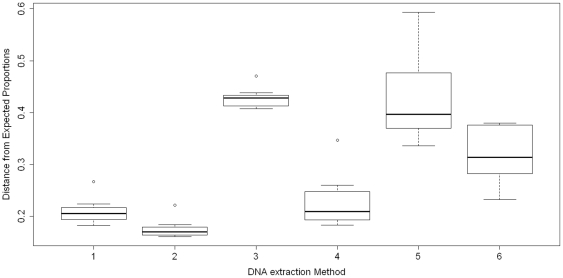
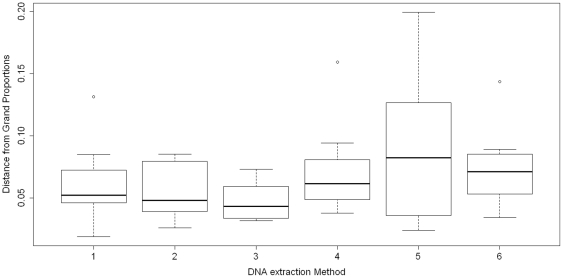
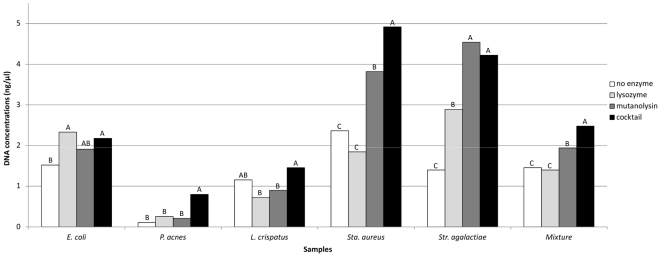
BACKGROUND: DNA extraction is an essential step in all cultivation-independent approaches to characterize microbial diversity, including that associated with the human body. A fundamental challenge in using these approaches has been to isolate DNA that is representative of the microbial community sampled. METHODOLOGY/PRINCIPAL FINDINGS: In this study, we statistically evaluated six commonly used DNA extraction procedures using eleven human-associated bacterial species and a mock community that contained equal numbers of those eleven species. These methods were compared on the basis of DNA yield, DNA shearing, reproducibility, and most importantly representation of microbial diversity. The analysis of 16S rRNA gene sequences from a mock community showed that the observed species abundances were significantly different from the expected species abundances for all six DNA extraction methods used. CONCLUSIONS/SIGNIFICANCE: Protocols that included bead beating and/or mutanolysin produced significantly better bacterial community structure representation than methods without both of them. The reproducibility of all six methods was similar, and results from different experimenters and different times were in good agreement. Based on the evaluations done it appears that DNA extraction procedures for bacterial community analysis of human associated samples should include bead beating and/or mutanolysin to effectively lyse cells.
Overview
The claims and statistics of this paper haven’t been checked yet.
Run the check — free, no account needed. It reads the open-access text and checks the sources it cites.
Integrity signals
Registry
Cites
Statistics
Figures
Verification
Claims the paper makes
The claims and statistics of this paper haven’t been checked yet.
Run the check — free, no account needed. It reads the open-access text and checks the sources it cites.
Claims other papers make about this one
Each is checked against this paper’s own text: does it say what the citing paper says it does?
In the citing paper
“Previous detailed investigations of specific variables in microbiome experiments such as DNA extraction method have, in common with the results we report, enriched for broad classes of Gram-negative rather than Gram-positive bacteria due to technical rather than biological variables9, 24, 27, 28.”
From Assessment of variation in microbial community amplicon sequencing by the Microbiome Quality Control (MBQC) project consortium (2017) · cites this paper as [27]
Self-check
Percentages, sums and reported differences re-computed from the paper’s own numbers.
The self-check needs the paper’s full text.
Citations
Cites
R: A Language and Environment for Statistical Computing
R Core Team (2000) · doi:10.32614/r.manuals · Cited by 355,893
Naive Bayesian Classifier for Rapid Assignment of rRNA Sequences into the New Bacterial Taxonomy
Wang, Q., Garrity, G. M., Tiedje, J. M., & Cole, J. R. (2007) · Applied and Environmental Microbiology · doi:10.1128/aem.00062-07 · Cited by 20,145
Diversity of the Human Intestinal Microbial Flora
Eckburg, P. B., Bik, E. M., Bernstein, C. N., Purdom, E., Dethlefsen, L., Sargent, M., Gill, S. R., Nelson, K. E., & Relman, D. A. (2005) · Science · doi:10.1126/science.1110591 · Cited by 7,913
The gut microbiota as an environmental factor that regulates fat storage
Bäckhed, F., Ding, H., Wang, T., Hooper, L. V., Koh, G. Y., Nagy, A., Semenkovich, C. F., & Gordon, J. I. (2004) · Proceedings of the National Academy of Sciences · doi:10.1073/pnas.0407076101 · Cited by 6,245
Nonparametric Statistical Methods
(1999) · Technometrics · doi:10.1080/00401706.1999.10485954 · Cited by 6,118
Turnbaugh, P. J., Ley, R. E., Hamady, M., Fraser-Liggett, C. M., Knight, R., & Gordon, J. I. (2007) · Nature · doi:10.1038/nature06244 · Cited by 6,091
The gut microbiota shapes intestinal immune responses during health and disease
Round, J. L., & Mazmanian, S. K. (2009) · Nature Reviews Immunology · doi:10.1038/nri2515 · Cited by 5,029
Metagenomic Analysis of the Human Distal Gut Microbiome
Gill, S. R., Pop, M., DeBoy, R. T., Eckburg, P. B., Turnbaugh, P. J., Samuel, B. S., Gordon, J. I., Relman, D. A., Fraser-Liggett, C. M., & Nelson, K. E. (2006) · Science · doi:10.1126/science.1124234 · Cited by 4,699
Vaginal microbiome of reproductive-age women
Ravel, J., Gajer, P., Abdo, Z., Schneider, G. M., Koenig, S. S. K., McCulle, S. L., Karlebach, S., Gorle, R., Russell, J., Tacket, C. O., et al. (2011) · Proceedings of the National Academy of Sciences · doi:10.1073/pnas.1002611107 · Cited by 4,254
Self-citationEvolution of mammals and their gut microbes
Ley, R. E., Hamady, M., Lozupone, C., Turnbaugh, P. J., Ramey, R. R., Bircher, J. S., Schlegel, M. L., Tucker, T. A., Schrenzel, M. D., Knight, R., et al. (2008) · Science · doi:10.1126/science.1155725 · Cited by 3,747
Research works printed but not linked: 1
- J Ravel, 2010, Microbes and Health Sackler Colloquium: Vaginal microbiome of reproductive-age women., Proc Natl Acad Sci U S A
Cited by
Sorted by citations
Byrd, A. L., Belkaid, Y., & Segre, J. A. (2018) · Nature Reviews Microbiology · doi:10.1038/nrmicro.2017.157 · Cited by 2,806
Structure and function of the global topsoil microbiome
Bahram, M., Hildebrand, F., Forslund, S. K., Anderson, J., Soudzilovskaia, N. A., van Bodegom, P. M., Bengtsson‐Palme, J., Anslan, S., Coelho, L. P., Harend, H., et al. (2018) · Nature · doi:10.1038/s41586-018-0386-6 · Cited by 2,638
Shotgun metagenomics, from sampling to analysis
Quince, C., Walker, A. W., Simpson, J. T., Loman, N. J., & Segata, N. (2017) · Nature Biotechnology · doi:10.1038/nbt.3935 · Cited by 2,202
Geller, L. T., Barzily-Rokni, M., Danino, T., Jonas, O. H., Shental, N., Nejman, D., Gavert, N., Zwang, Y., Cooper, Z. A., Shee, K., et al. (2017) · Science · doi:10.1126/science.aah5043 · Cited by 1,817
Salt-responsive gut commensal modulates TH17 axis and disease
Wilck, N., Matus, M. G., Kearney, S. M., Olesen, S. W., Forslund, K., Bartolomaeus, H., Haase, S., Mähler, A., Balogh, A., Markó, L., et al. (2017) · Nature · doi:10.1038/nature24628 · Cited by 1,310
Metadata
- Authors
- Yuan, S., Cohen, D. B., Ravel, J., Abdo, Z., & Forney, L. J.
- Affiliations
- University of Idaho (US)
- University of Maryland, Baltimore (US)
- Corresponding author
- Forney, Larry J.
- Venue
- PLoS ONE
- Publisher
- Public Library of Science (PLoS)
- Published
- 2012-03-23
- Volume
- 7
- Issue
- 3
- Pages
- e33865
- ISSN
- 1932-6203 (ISSN-L)
- PMC
- PMC3311548
- OpenAlex
- W2090110425
- Cited by
- 511
- References
- 73
- Citations by year
- 2026: 16 · 2025: 19 · 2024: 24 · 2023: 29 · 2022: 24 · 2021: 57 · 2020: 50 · 2019: 50 · 2018: 63 · 2017: 60 · 2016: 37 · 2015: 28 · 2014: 32 · 2013: 20 · 2012: 2
- FWCI
- 23.16
- Type
- journal article
- Language
- en
- Open access
- gold
- doi.org
- Locations
- PLoS ONE (publishedVersion, cc-by)
- PubMed Central (publishedVersion, cc-by)
- PubMed (publishedVersion)
- DOAJ (DOAJ: Directory of Open Access Journals) (submittedVersion, cc-by-sa)
- Figshare (submittedVersion, cc-by)
- Funders
- National Institutes of Health (5u01ai070921-07)
- National Institute of Allergy and Infectious Diseases (U01-AI070921)
- Topics
- Physical Sciences › Environmental Science › Ecology › Microbial Community Ecology and Physiology
- Life Sciences › Biochemistry, Genetics and Molecular Biology › Molecular Biology › Gut microbiota and health
- Life Sciences › Biochemistry, Genetics and Molecular Biology › Molecular Biology › Genomics and Phylogenetic Studies
- Keywords
- DNA extraction, human microbiome, mock communities, bead beating, mutanolysin, DNA shearing, 16S rRNA gene, microbial diversity, extraction method comparison, cell lysis
- MeSH terms
- Bacteria, DNA, Bacterial, Humans, Biodiversity
About these checks
Registry, retraction, Cites and statistics results are computed, not judged, with one exception: a printed reference that no index lists is read once by a model before it counts as a citation error. Claims are extracted by a model and kept only when their quote appears verbatim in the text; each cited source is then checked, with a model’s help, for whether it says what the claim relies on. Those verdicts can be wrong — read the claim’s quote and the cited source before relying on one.
Statistics and arithmetic are recomputed, not judged.
Confidence bands are shown only for fields calibrated on our annotated test set. None is calibrated yet, so no band is shown.
What counts as a claim ›How we measure confidence ›How we check this ›
Are you an author, or do you see a problem with this page? Request a review
