

The DOI matches its Crossref record; 45 of the 45 references it cites were found in a registry or an index.
Energy Metabolism during Repeated Sets of Leg Press Exercise Leading to Failure or Not
Open accessAbstract
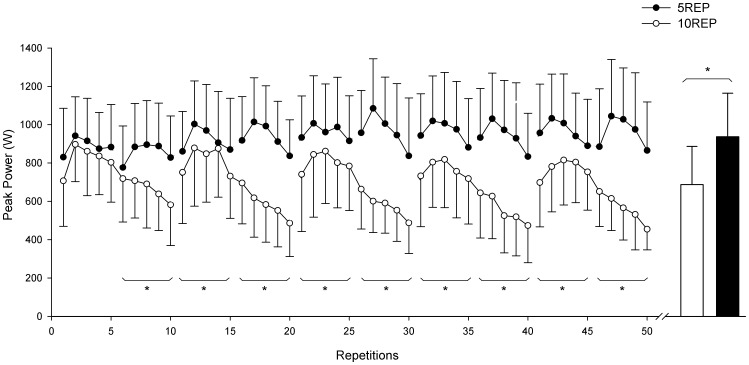
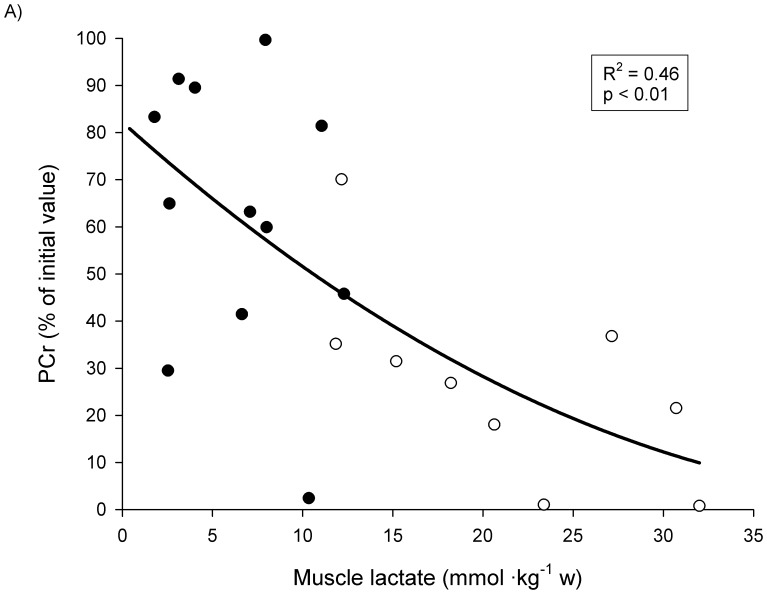
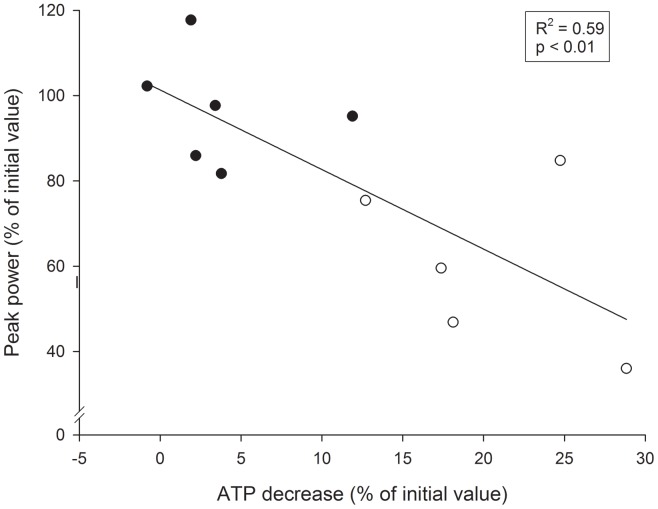
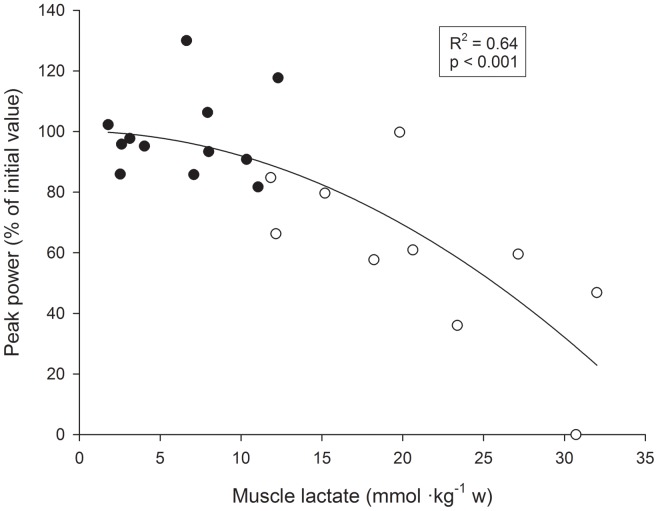
This investigation examined the influence of the number of repetitions per set on power output and muscle metabolism during leg press exercise. Six trained men (age 34 ± 6 yr) randomly performed either 5 sets of 10 repetitions (10REP), or 10 sets of 5 repetitions (5REP) of bilateral leg press exercise, with the same initial load and rest intervals between sets. Muscle biopsies (vastus lateralis) were taken before the first set, and after the first and the final sets. Compared with 5REP, 10REP resulted in a markedly greater decrease (P<0.05) of the power output, muscle PCr and ATP content, and markedly higher (P<0.05) levels of muscle lactate and IMP. Significant correlations (P<0.01) were observed between changes in muscle PCr and muscle lactate (R(2) = 0.46), between changes in muscle PCr and IMP (R(2) = 0.44) as well as between changes in power output and changes in muscle ATP (R(2) = 0.59) and lactate (R(2) = 0.64) levels. Reducing the number of repetitions per set by 50% causes a lower disruption to the energy balance in the muscle. The correlations suggest that the changes in PCr and muscle lactate mainly occur simultaneously during exercise, whereas IMP only accumulates when PCr levels are low. The decrease in ATP stores may contribute to fatigue.
Overview
The claims and statistics of this paper haven’t been checked yet.
Run the check — free, no account needed. It reads the open-access text and checks the sources it cites.
Integrity signals
Registry
Cites
Statistics
Figures
Verification
Claims the paper makes
The claims and statistics of this paper haven’t been checked yet.
Run the check — free, no account needed. It reads the open-access text and checks the sources it cites.
Claims other papers make about this one
Each is checked against this paper’s own text: does it say what the citing paper says it does?
The source backs part of the claim, not all of it — or backs it for a different population, condition or comparison.
In the citing paper
“This implies that when the last repetitions of a set are being performed in the MaxV condition, only moderate levels of velocity loss and metabolic stress occur [ 12 , 32 ] .”
From Effect of Movement Velocity during Resistance Training on Neuromuscular Performance (2014) · cites this paper as [12]
Experimental — accuracy not yet measuredThe source backs part of the claim, not all of it — or backs it for a different population, condition or comparison.
In the citing paper
“Intra‐set VL is correlated with mechanical and metabolic fatigue markers, in addition to proximity to muscular failure (Gorostiaga et al., 2012).”
From Acute systemic and energy metabolism responses to velocity-based resistance training following an oral glucose load in individuals with excess body weight (2026) · cites this paper as Gorostiaga et al., 2012
Experimental — accuracy not yet measuredThe cited source says what the claim attributes to it.
In the citing paper
“The metabolic stress and degree of fatigue induced by the RT protocols used in this investigation are far from those typically associated with exhaustive resistance training [ 12 , 32 ] .”
From Effect of Movement Velocity during Resistance Training on Neuromuscular Performance (2014) · cites this paper as [12]
Self-check
Percentages, sums and reported differences re-computed from the paper’s own numbers.
The self-check needs the paper’s full text.
Citations
Cites
American College of Sports Medicine position stand
Otis, C. L. (1997) · Medical Entomology and Zoology · Cited by 4,407
Progression Models in Resistance Training for Healthy Adults
(2009) · Medicine & Science in Sports & Exercise · doi:10.1249/mss.0b013e3181915670 · Cited by 4,332 · cited 1×
“Regular resistance exercise is an essential component of effective intervention programs designed to improve strength in athletes and adults with chronic diseases and disabilities [1,2].”
BackgroundProgression Models in Resistance Training for Healthy Adults
(2002) · Medicine and Science in Sports and Exercise · doi:10.1097/00005768-200202000-00027 · Cited by 2,979
Colberg, S. R., Sigal, R. J., Fernhall, B., Regensteiner, J. G., Blissmer, B. J., Rubin, R. R., Chasan-Taber, L., Albright, A. L., & Braun, B. (2010) · Diabetes Care · doi:10.2337/dc10-9990 · Cited by 1,955
The AMP‐Activated Protein Kinase: Fuel Gauge of the Mammalian Cell?
Hardie, D. G., & Carling, D. (1997) · European Journal of Biochemistry · doi:10.1111/j.1432-1033.1997.00259.x · Cited by 1,317
Percutaneous Needle Biopsy of Skeletal Muscle in Physiological and Clinical Research
Bergström, J. P. (1975) · Scandinavian Journal of Clinical and Laboratory Investigation · doi:10.3109/00365517509095787 · Cited by 1,173
AMP-activated protein kinase, a metabolic master switch: possible roles in Type 2 diabetes
Winder, W. W., & Hardie, D. G. (1999) · American Journal of Physiology-Endocrinology and Metabolism · doi:10.1152/ajpendo.1999.277.1.e1 · Cited by 1,000
Structure of mammalian AMPK and its regulation by ADP
Xiao, B., Sanders, M. J., Underwood, E., Heath, R., Mayer, F. V., Carmena, D., Jing, C., Walker, P. A., Eccleston, J. F., Haire, L. F., et al. (2011) · Nature · doi:10.1038/nature09932 · Cited by 926
Bogdanis, G. C., Nevill, M. E., Boobis, L. H., & Lakomy, H. K. (1996) · Journal of Applied Physiology · doi:10.1152/jappl.1996.80.3.876 · Cited by 691
Human Muscle Function and Fatigue
Edwards, R. H. T. (1981) · Novartis Foundation symposium · doi:10.1002/9780470715420.ch1 · Cited by 668
Cited by
Sorted by citations
Fragala, M. S., Cadore, E. L., Dorgo, S., Izquierdo, M., Kraemer, W. J., Peterson, M. D., & Ryan, E. D. (2019) · Journal of Strength and Conditioning Research · doi:10.1519/jsc.0000000000003230 · Cited by 1,290
Self-citationThe importance of muscular strength: Training considerations
Suchomel, T. J., Nimphius, S., Bellon, C. R., & Stone, M. H. (2018) · Sports Medicine · doi:10.1007/s40279-018-0862-z · Cited by 940
Pareja‐Blanco, F., Rodríguez‐Rosell, D., Sánchez‐Medina, L., Sanchis‐Moysi, J., Dorado, C., Mora‐Custodio, R., Yáñez‐García, J. M., Morales‐Alamo, D., Pérez‐Suárez, I., Calbet, J. A. L., et al. (2017) · Scandinavian Journal of Medicine & Science in Sports · doi:10.1111/sms.12678 · Cited by 505
Self-citationEgan, B., & Sharples, A. P. (2023) · Physiological Reviews · doi:10.1152/physrev.00054.2021 · Cited by 278
González‐Badillo, J. J., Rodríguez‐Rosell, D., Sánchez‐Medina, L., Gorostiaga, E. M., & Pareja‐Blanco, F. (2014) · European Journal of Sport Science · doi:10.1080/17461391.2014.905987 · Cited by 243
Self-citation
Metadata
- Authors
- Gorostiaga, E. M., Navarro-Amézqueta, I., Calbet, J. A. L., Hellsten, Y., Cusso, R., Guerrero, M., Granados, C., González-Izal, M., Ibañez, J., & Izquierdo, M.
- Affiliations
- Gobierno de Navarra (ES)
- Universidad de Las Palmas de Gran Canaria (ES)
- University of Copenhagen (DK)
- Consorci Institut D'Investigacions Biomediques August Pi I Sunyer (ES)
- Corresponding author
- Gorostiaga, Esteban M.
- Venue
- PLoS ONE
- Publisher
- Public Library of Science (PLoS)
- Published
- 2012-07-13
- Volume
- 7
- Issue
- 7
- Pages
- e40621
- ISSN
- 1932-6203 (ISSN-L)
- PMC
- PMC3396634
- OpenAlex
- W2022174440
- Cited by
- 178
- References
- 45
- Citations by year
- 2026: 12 · 2025: 13 · 2024: 16 · 2023: 14 · 2022: 18 · 2021: 18 · 2020: 27 · 2019: 15 · 2018: 14 · 2017: 10 · 2016: 4 · 2015: 10 · 2014: 6 · 2013: 1
- FWCI
- 13.25
- Type
- journal article
- Language
- en
- Update notices
- correction (2013-01-17)
- Open access
- gold
- doi.org
- Locations
- PLoS ONE (publishedVersion, cc-by)
- Europe PMC (PubMed Central) (publishedVersion, cc-by)
- PubMed Central (publishedVersion, cc-by)
- PubMed (publishedVersion)
- Dipòsit Digital de la Universitat de Barcelona (Universitat de Barcelona) (publishedVersion, cc-by)
- Academica-e (Universidad Pública de Navarra) (acceptedVersion, cc-by)
- Acceda (Universidad de Las Palmas de Gran Canaria) (submittedVersion)
- LA Referencia (Red Federada de Repositorios Institucionales de Publicaciones Científicas) (submittedVersion, cc-by)
- DOAJ (DOAJ: Directory of Open Access Journals) (submittedVersion, cc-by-sa)
- RECERCAT (Consorci de Serveis Universitaris de Catalunya) (submittedVersion, cc-by)
- Topics
- Health Sciences › Medicine › Physiology (medical) › Cardiovascular and exercise physiology
- Health Sciences › Medicine › Orthopedics and Sports Medicine › Sports Performance and Training
- Health Sciences › Nursing › Nutrition and Dietetics › Muscle metabolism and nutrition
- Keywords
- leg press, muscle energy metabolism, muscle fatigue, phosphocreatine, ATP, muscle lactate, inosine monophosphate, output power, vastus lateralis
- MeSH terms
- Adult, Biomechanical Phenomena, Energy Metabolism, Humans, Leg, Male, Nucleotides, Phosphocreatine, Uric Acid, Exercise, Muscle, Skeletal, Lactic Acid, Metabolome
About these checks
Registry, retraction, Cites and statistics results are computed, not judged, with one exception: a printed reference that no index lists is read once by a model before it counts as a citation error. Claims are extracted by a model and kept only when their quote appears verbatim in the text; each cited source is then checked, with a model’s help, for whether it says what the claim relies on. Those verdicts can be wrong — read the claim’s quote and the cited source before relying on one.
Statistics and arithmetic are recomputed, not judged.
Confidence bands are shown only for fields calibrated on our annotated test set. None is calibrated yet, so no band is shown.
What counts as a claim ›How we measure confidence ›How we check this ›
Are you an author, or do you see a problem with this page? Request a review
