

Auditory Processing in High-Functioning Adolescents with Autism Spectrum Disorder
Open accessThe DOI matches its Crossref record; 148 of the 148 references it cites were found in a registry or an index.
Abstract
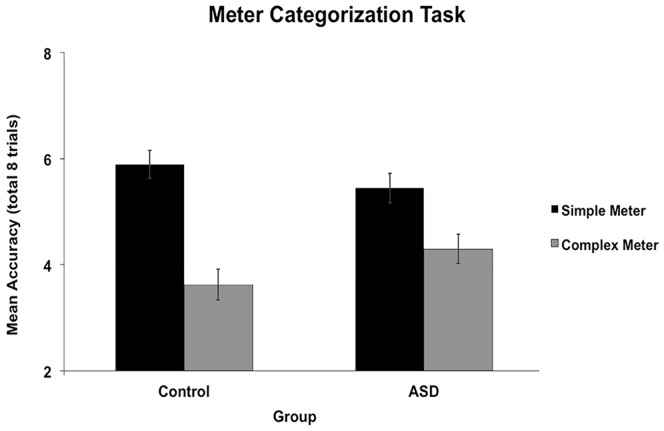
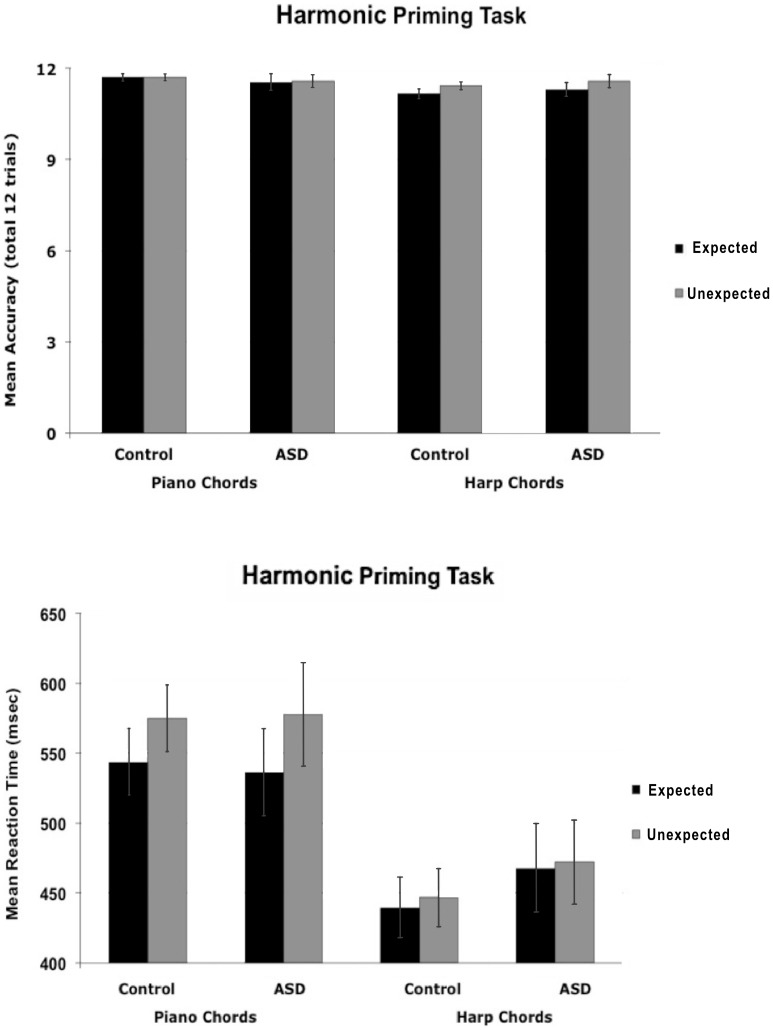
Autism Spectrum Disorder (ASD) is a pervasive developmental disorder including abnormalities in perceptual processing. We measure perception in a battery of tests across speech (filtering, phoneme categorization, multisensory integration) and music (pitch memory, meter categorization, harmonic priming). We found that compared to controls, the ASD group showed poorer filtering, less audio-visual integration, less specialization for native phonemic and metrical categories, and a higher instance of absolute pitch. No group differences were found in harmonic priming. Our results are discussed in a developmental framework where culture-specific knowledge acquired early compared to late in development is most impaired, perhaps because of early-accelerated brain growth in ASD. These results suggest that early auditory remediation is needed for good communication and social functioning.
Overview
The claims and statistics of this paper haven’t been checked yet.
Free: it reads the open-access text and checks the first 5 claims that cite a source we can check. Create a free account to check every claim.
Integrity signals
Registry
Cites
Statistics
Figures


Verification
Claims the paper makes
The claims and statistics of this paper haven’t been checked yet.
Free: it reads the open-access text and checks the first 5 claims that cite a source we can check. Create a free account to check every claim.
Claims other papers make about this one
Each is checked against this paper’s own text: does it say what the citing paper says it does?
In the citing paper
“These hypersensitivities cannot be explained as outcomes of abnormally enhanced sensation (29 -31).”
From Autism as a disorder of prediction (2014) · cites this paper as [29]
Self-check
Percentages, sums and reported differences re-computed from the paper’s own numbers.
The self-check needs the paper’s full text.
Citations
Cites
Proceedings of the National Academy of Sciences of the United States of America
Dowling, J. E., & Wald, G. (2009) · Nutrition Reviews · doi:10.1111/j.1753-4887.1981.tb06752.x · Cited by 17,893
The Proceedings of the National Academy of Sciences
Richards, J. W. (1915) · Science · doi:10.1126/science.42.1074.161 · Cited by 13,983
Lord, C., Rutter, M., & Le Couteur, A. (1994) · Journal of Autism and Developmental Disorders · doi:10.1007/bf02172145 · Cited by 9,065 · cited 1×
“Among the ASD group, 16 participants had diagnoses (ADOS and ADI) [88,89] that were completed at the Offord Centre in Hamilton and 11 confirmed through a letter from their family doctor (diagnosis outside of Hamilton) because ADOS and ADI scores were not available.”
MethodHearing lips and seeing voices
MCGURK, H., & MACDONALD, J. (1976) · Nature · doi:10.1038/264746a0 · Cited by 6,183 · cited 2×
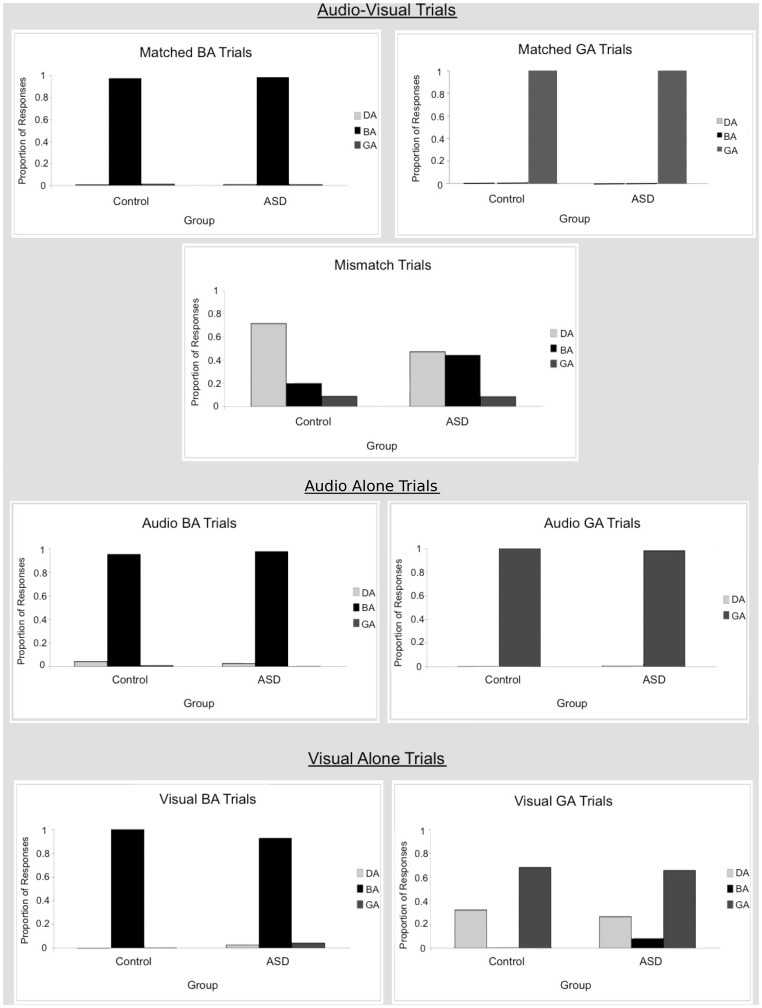
“For example, when presented with a visual ‘‘ga’’ and an audio ‘‘ba’’, people report hearing a third percept ‘‘da’’ which represents a fusion between what they see and what they hear [58].”
THE JOURNAL OF THE AMERICAN MEDICAL ASSOCIATION
(1911) · Journal of the American Medical Association · doi:10.1001/jama.1911.04260070032017 · Cited by 3,361
American Journal of Mental Retardation
Staff (2008) · Encyclopedia of Special Education · doi:10.1002/9780470373699.speced0106 · Cited by 2,972
The weak coherence account: detail-focused cognitive style in autism spectrum disorders
Happé, F., & Frith, U. (2006) · Journal of Autism and Developmental Disorders · doi:10.1007/s10803-005-0039-0 · Cited by 2,884
Philosophical Transactions of the Royal Society B: biological sciences
(2026) · Philosophical Transactions of the Royal Society B Biological Sciences · doi:10.1098/rstb · Cited by 2,876
(1989) · UCL Discovery (University College London) · Cited by 2,724
Quest: A Bayesian adaptive psychometric method
Watson, A. B., & Pelli, D. G. (1983) · Perception & Psychophysics · doi:10.3758/bf03202828 · Cited by 2,410 · cited 1×
“A Bayesian adaptive psychometric procedure [99] was used such that the test ended when the standard deviation of the signal threshold estimate reached 1.”
Method
Cited by
Items 101–168 of 168
Visual representations and verbal schemas: a case study of one student with high‐functioning autism
Buncher, A., Hord, C., Weaver, K., & Gamel, Z. (2018) · Journal of Research in Special Educational Needs · doi:10.1111/1471-3802.12426 · Cited by 4
Conservatory education of a musical savant with autism: a case study in Turkey
Erden, Ş., & Reyhanoğlu, G. (2019) · Advances in Autism · doi:10.1108/aia-11-2018-0046 · Cited by 4
Matsui, T., Uchida, M., Fujino, H., Tojo, Y., & Hakarino, K. (2021) · Clinical Linguistics & Phonetics · doi:10.1080/02699206.2021.1947385 · Cited by 4
Développement et surfonctionnement perceptif d'un adulte porteur d'autisme de haut niveau
Marchand, A. (2015) · Corpus Université Laval (Université Laval) · Cited by 4
Alikadic, L., & Röer, J. P. (2024) · Research in Autism · doi:10.1016/j.rasd.2024.102493 · Cited by 3
Osorio, S., Tan, J. S., Levine, G., Ahlfors, S. P., Graham, S., Mamashli, F., Khan, S., Joseph, R. M., Nayal, Z., Losh, A., et al. (2025) · Autism Research · doi:10.1002/aur.70120 · Cited by 3
Tsuji, Y., Nishiguchi, Y., Noda, A., & Imaizumi, S. (2025) · Multisensory Research · doi:10.1163/22134808-bja10160 · Cited by 3
Nuwer, R. (2021) · The Transmitter · doi:10.53053/rahq7664 · Cited by 3
Topography and Ensemble Activity in the Auditory Cortex of a Mouse Model of Fragile X Syndrome
Wadle, S. L., Ritter, T. C., Wadle, T. T. X., & Hirtz, J. J. (2024) · eNeuro · doi:10.1523/eneuro.0396-23.2024 · Cited by 3
“…are prevalent in ASD, most often described as impaired auditory fi ltering and dif fi culties of understanding speech in noise (Alcántara et al., 2004; Tomchek and Dunn, 2007; Ashburner et al., 2008; Groen et al., 2009; DePape et al., 2012; Schafer et al., 2013; Schelinski and von Kriegstein, 2020).”
BackgroundBrouche, S., Cazalis, F., & Rigal, N. (2024) · Neuropsychiatrie de l Enfance et de l Adolescence · doi:10.1016/j.neurenf.2024.07.004 · Cited by 3
Perceptual inference and learning in autism : a behavioral and neurophysiological approach
Sapey‐Triomphe, L. (2017) · theses.fr (ABES) · doi:10.70675/55c6b1b0zf09fz4daaz89e4z921ee9010244 · Cited by 3
Ma, W., Dai, X., & Zhang, H. (2024) · Journal of Autism and Developmental Disorders · doi:10.1007/s10803-024-06601-1 · Cited by 2
THE PREDICTORS OF SPEECH DEVELOPMENT AT CHILDREN WITH AUTISM
Оstrovska, K., & Ostrovskii, I. (2020) · PSYCHOLOGICAL JOURNAL · doi:10.31108/1.2020.6.10.11 · Cited by 2
Demopoulos, C., Jesson, X., Gerdes, M. R., Jurigova, B. G., Hinkley, L. B. N., Ranasinghe, K. G., Desai, S. S., Honma, S., Mizuiri, D., Findlay, A., et al. (2026) · Journal of Neural Engineering · doi:10.1088/1741-2552/ae93fb · Cited by 2
The Neurodevelopment Of Basic Sensory Processing And Integration In Autism Spectrum Disorder
Brandwein, A. B. (2014) · CUNY Academic Works (City University of New York) · Cited by 2
Gregersen, P. K. (2013) · Wiley eBooks · doi:10.1002/9780470015902.a0005991.pub2 · Cited by 2
The Strengths of Speech Delay: Getting a Grip on the Sensory-Motor Complexity of AutismPreprint
Kapp, S. K. (2023) · Authorea · doi:10.22541/au.168428686.66533786/v1 · Cited by 2
Autisme, perception et mémoire auditives
Erviti, M. (2013) · theses.fr (ABES) · doi:10.70675/23947cf6z5d9bz4ce3z8d35z783a28b25aec · Cited by 2
Conceptual Alignment with Formal Concept Analysis.
Priss, U. E. (2019) · Cited by 1
Chen, Y., Wang, T., Tang, E., & Ding, H. (2025) · Journal of Speech Language and Hearing Research · doi:10.1044/2024_jslhr-23-00554 · Cited by 1
Hsieh, I.-H., & Hsiao, Z.-H. (2025) · BMC Psychology · doi:10.1186/s40359-025-03419-z · Cited by 1
“%) in individuals with autism compared to typically-developing individuals [6, 20, 21].”
Navigating auditory assessment in autistic individuals: a narrative review
Bamiou, D., Di‐Bonaventura, S., & Skuse, D. (2025) · Archives of Disease in Childhood · doi:10.1136/archdischild-2025-328623 · Cited by 1
“19 In some cases, multisensory integration and audio-visual integration are worse in autistic subjects than controls.”
Cacciato‐Salcedo, S., Jaokar, S., Ingham, N. J., Malmierca, M. S., & Petrinovic, M. M. (2026) · Autism Research · doi:10.1002/aur.70275 · Cited by 1
“Broader work on language development and semantic and lexical integration supported viewing speech perception within a wider cognitive–linguistic phenotype rather than as a unitary auditory difference (Arunachalam and Luyster 2016; Bebko et al. 2014; DePape et al. 2012; Stewart et al. 2018).”
Callaway, S. E. (2014) · University of North Texas Digital Library (University of North Texas) · doi:10.12794/metadc500121 · Cited by 2
Lewandowska, O. P. (2019) · TSpace (University of Toronto) · Cited by 1
Speech-in-Noise Processing in Adults with Autism Spectrum Disorder
Anderson, C. D. (2021) · University of North Texas Digital Library (University of North Texas) · doi:10.12794/metadc1833532 · Cited by 1
Truong, D. T. (2014) · OpenCommons at University of Connecticut (University of Connecticut)
Perceptual compensation in individuals with autism spectrum disorders
Langston, E. A. (2014) · Purdue e-Pubs (Purdue University System)
Carmichael, D. A. (2015) · ERA
Sensory Filtering and Cognitive Function in a Valproic Acid Rat Model of Autism
Silva, D., & Theshani, A. (2016) · Scholarship@Western (Western University)
Hemispheric asymmetry in the perception of musical pitch structure
Rosenthal, M. (2014) · Digital Scholarship - UNLV (University of Nevada Reno) · doi:10.34917/7048612
Modelling novice and expert listeners’ ability to detect changes in short melodies
Agres, K., & Meredith, D. (2018) · VBN Forskningsportal (Aalborg Universitet)
Music perception in children with autism spectrum disorder
Jamey, K. (2017) · doi:10.71781/19237
What is the link between autism and synaesthesia
Hughes, J. E. (2019) · Sussex Research Online (University of Sussex)
Geelhand, P. (2019) · Open Collections · doi:10.14288/1.0384568
Real-time 3D Graphic Augmentation of Therapeutic Music Sessions for People on the Autism Spectrum
McGowan, J. J. (2026) · Edinburgh Napier Research Repository (Edinburgh Napier University) · doi:10.17869/enu.2026.2386291
de Korte, M., Cerci, D., & Williamson, V. J. (2018) · White Rose Research Online (University of Leeds, The University of Sheffield, University of York)
The Prosodic Profile of Individuals with Prader-Willi Syndrome
Thome, E. K. (2019)
Reyna, D. M., García, L. I., Castilla, P. C., Coria‐Ávila, G. A., Toledo‐Cárdenas, M. R., Hernández‐Aguilar, M. E., & Manzo, J. (2019) · eNeurobiología · doi:10.25009/eb.v10i23.2540
Пептидная регуляция репаративных процессов в органах иммунной системы при ускоренном старении
Хавинсон, В. Х., Линькова, Н. С., Кветной, И. М., Полякова, В. О., Трофимов, А. В., Sevostyanova, N. N., & Абдулрагимов, Р. И. (2010) · Open Access Repository (Belgorod State National Research University)
Fronsman-Cecil, T. (2022) · Springer eBooks · doi:10.1007/978-3-030-95357-7_8
Reyna, D. M., García, L. I., Coria‐Ávila, G. A., Toledo‐Cárdenas, M. R., Hernández‐Aguilar, M. E., & Manzo, J. (2018) · eNeurobiología · doi:10.25009/eb.v9i20.2532
Música, autisme i prosòdia a la llum d’un estudi de cas
Rosselló, J., Borrellas, E. V., Foz, G. A., & Celma-Miralles, A. (2022) · Llengua societat i comunicació · doi:10.1344/lsc-2022.20.5
Chapter 4. Strengths-Based Model of Neurodiversity and Autism
Fung, L. K. (2021) · American Psychiatric Association Publishing eBooks · doi:10.1176/appi.books.9781615379514.lg04
Introduction to Autism and Music
Heaton, P. F. (2024) · Springer eBooks · doi:10.1007/978-3-031-70403-1_1
Pendekatan Inovatif Terapi Autis melalui Interaksi Musikal Karawitan Jawa
Saepudin, A., Irawati, E., & Raharja, B. (2025) · Jurnal Obsesi Jurnal Pendidikan Anak Usia Dini · doi:10.31004/obsesi.v9i3.6863
“Anak autis terdeteksi ada gangguan pendengaran, perbaikan awal adalah penting karena agar tidak mengganggu interaksi sosialnya (DePape et al., 2012) dan penanganan interaksi sosial anak autis dalam bentuk penanganan dini dan penanganan kelompok dalam berbagai bentuk kegiatan sosial lebih efektif…”
Znaczenie kontaktów z muzyką w świetle współczesnych doniesień nauki
Gdańsku, A. M. I. S. M. W., & Kozłowska-Lewna, A. (2022) · doi:10.71268/9788364615627-2
Koelsch, S. (2025) · Cambridge University Press eBooks · doi:10.1017/9781009366755.016
Koelsch, S. (2025) · Cambridge University Press eBooks · doi:10.1017/9781009366755.020
Boaretto, G. C. (2023) · Repositório Digital de Teses e Dissertações do PPGLin-UESB · doi:10.54221/rdtdppglinuesb.2023.v11i1.259
Tsuji, Y., & Imaizumi, S. (2025) · PsyArXiv (OSF Preprints) · doi:10.31234/osf.io/dyj3c_v2
Listening Effort and Auditory Processing in Adults with Sensorineural Hearing Loss
Zant, O. M. (2025) · University of North Texas Digital Library (University of North Texas) · doi:10.12794/metadc2482465
Dahary, H. (2023) · eScholarship@McGill (McGill) · doi:10.82308/9632
Auditory global-local processing in typical development and autism spectrum disorder
Ouimet, T. (2014) · eScholarship@McGill (McGill) · doi:10.82308/24787
Chiodo, L. (2022) · ORBi (University of Liège)
Woodhouse, J. (2025) · The Plymouth Student Scientist · doi:10.70156/1754-2383.1535
Li, J., Sujawal, M., Bernotaite, Z., Cunnings, I., & Liu, F. (2026) · Psychophysiology · doi:10.1111/psyp.70232
“…in top-down mechanisms, including reduced capacity to segregate concurrent streams, difficulty adjusting perceptual weighting when competing streams are present, and inflexible cognitive resource allocation (DePape et al. 2012; Lepistö et al. 2009; Mamashli et al. 2017; Russo et al. 2009).”
Editorial: The human neuroscience of music therapy in neurodegenerative diseases
Rivi, V., & Yamasaki, T. (2026) · Frontiers in Human Neuroscience · doi:10.3389/fnhum.2026.1800758
Turğut, N., & Çiyiltepe, M. M. (2026) · International Journal of Developmental Disabilities · doi:10.1080/20473869.2026.2645076
Yu, L., Xie, S., Wang, L., & Mottron, L. (2026) · Autism Research · doi:10.1002/aur.70248
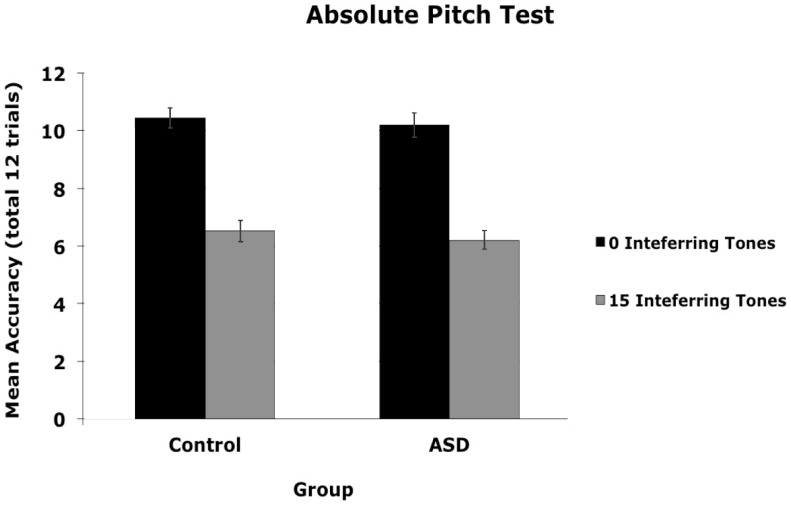
“In the spectral domain, a higher prevalence of absolute pitch (AP), the ability to label a musical note without reference, has been documented in musically untrained autistic individuals compared to the general population (DePape et al. 2012; Heaton, Williams, et al. 2008; Mottron et al. 2013).”
Brouche, S. (2024) · theses.fr (ABES) · doi:10.70675/bf70d134z3677z4719zb982zf6ca37f69ed7
Lab perceptual training and robot-assisted training in improving speech prosody of autistic children
Chen, S., Wang, B. X., Cheung, J. C., Zhou, F., Hong, Y., Li, B., Chan, A., Tang, T. P. Y., Li, B., Chen, Z., et al. (2026) · npj Science of Learning · doi:10.1038/s41539-026-00425-7
“DePape et al. 34 noted that children with moderate language skills — rather than those with high pro fi ciency — were more likely to use f0 range to signal information structure.”
Musical short-term memory of autistic children and its cognitive correlates
Philibert-Lignières, G. (2026) · doi:10.82308/55646
Denis, M., Rosso, M., Fonséca, D. D., & Schön, D. (2026) · bioRxiv (Cold Spring Harbor Laboratory) · doi:10.64898/2026.07.09.737537
Park, S., Lee, H., & Sajid, K. (2026) · Journal of Biology and Life Science · doi:10.5296/jbls.v18i1.24077
Daniel, S., Wimpory, D., Delafield-Butt, J. T., Malloch, S., Holck, U., Geretsegger, M., Tortora, S., Osborne, N., Schögler, B., Koch, S., et al. (2022) · doi:10.3389/fpsyg.2022.793258.s001
Metadata
- Authors
- DePape, A.-M. R., Hall, G. B. C., Tillmann, B., & Trainor, L. J.
- Affiliations
- McMaster University (CA)
- Lyon 1 Université (FR)
- Baycrest Hospital (CA)
- Corresponding author
- Trainor, Laurel J.
- Venue
- PLoS ONE
- Publisher
- Public Library of Science (PLoS)
- Published
- 2012-09-12
- Volume
- 7
- Issue
- 9
- Pages
- e44084
- ISSN
- 1932-6203 (ISSN-L)
- PMC
- PMC3440400
- OpenAlex
- W2050650787
- Cited by
- 139
- References
- 148
- Citations by year
- 2026: 5 · 2025: 13 · 2024: 18 · 2023: 13 · 2022: 14 · 2021: 10 · 2020: 9 · 2019: 14 · 2018: 7 · 2017: 8 · 2016: 1 · 2015: 7 · 2014: 11 · 2013: 6 · 2012: 2
- FWCI
- 4.25
- Type
- journal article
- Language
- en
- Open access
- gold
- doi.org
- Locations
- PLoS ONE (publishedVersion, cc-by)
- Europe PMC (PubMed Central) (publishedVersion, cc-by)
- PubMed Central (publishedVersion, cc-by)
- PubMed (publishedVersion)
- DOAJ (DOAJ: Directory of Open Access Journals) (submittedVersion, cc-by-sa)
- Funders
- Natural Sciences and Engineering Research Council of Canada
- Social Sciences and Humanities Research Council of Canada
- Topics
- Life Sciences › Neuroscience › Cognitive Neuroscience › Autism Spectrum Disorder Research
- Life Sciences › Neuroscience › Cognitive Neuroscience › Neuroscience and Music Perception
- Social Sciences › Psychology › Experimental and Cognitive Psychology › Multisensory perception and integration
- Keywords
- autism spectrum disorder, auditory processing, adolescents, auditory filtering, phoneme categorization, multisensory integration, audiovisual integration, pitch memory, absolute pitch, developmental framework
- MeSH terms
- Acoustic Stimulation, Adolescent, Auditory Perception, Child, Child Development Disorders, Pervasive, Demography, Humans, Male, Music, Phonetics, Speech Perception, Task Performance and Analysis, Signal-To-Noise Ratio
About these checks
Registry, retraction, Cites and statistics results are computed, not judged, with one exception: a printed reference that no index lists is read once by a model before it counts as a citation error. Claims are extracted by a model and kept only when their quote appears verbatim in the text; each cited source is then checked, with a model’s help, for whether it says what the claim relies on. Those verdicts can be wrong — read the claim’s quote and the cited source before relying on one.
Statistics and arithmetic are recomputed, not judged.
Confidence bands are shown only for fields calibrated on our annotated test set. None is calibrated yet, so no band is shown.
What counts as a claim ›How we measure confidence ›How we check this ›
Are you an author, or do you see a problem with this page? Request a review
Data sources
Bibliographic data: Semantic Scholar, OpenAlex, Crossref.
Contains information from the Semantic Scholar Academic Graph Datasets, made available under the ODC Attribution License (ODC-BY 1.0).
Semantic Scholar’s data is described in: Kinney, R., et al. (2023). The Semantic Scholar Open Data Platform. arXiv:2301.10140.
