

A Comprehensive Survey of Retracted Articles from the Scholarly Literature
Open accessThe DOI matches its Crossref record; 77 of the 78 references it cites were found in a registry or an index.
Abstract
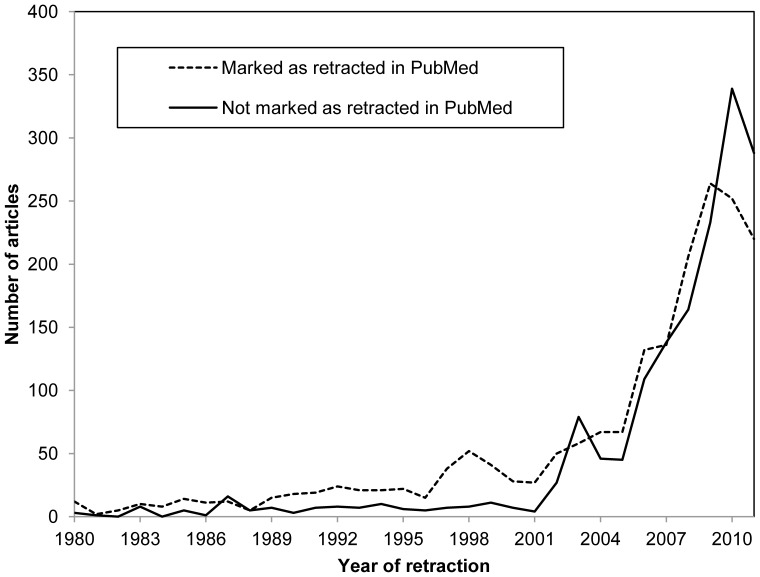
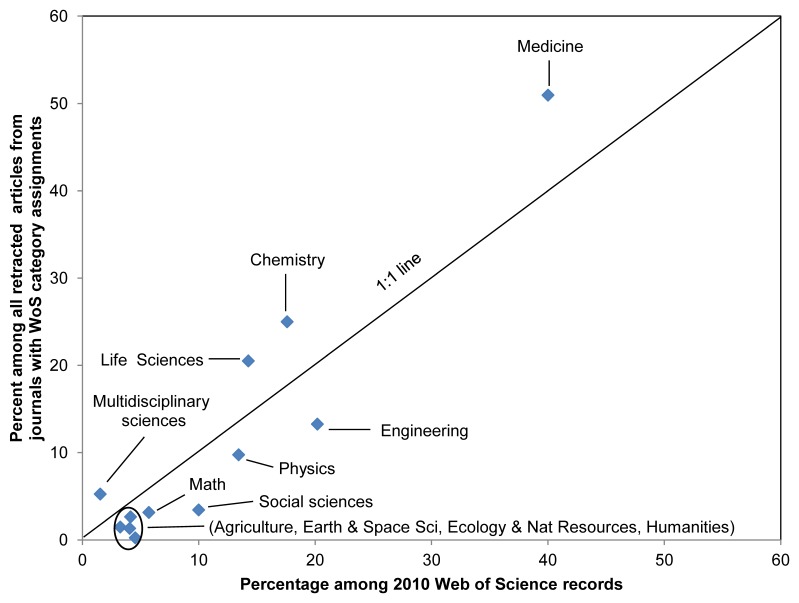
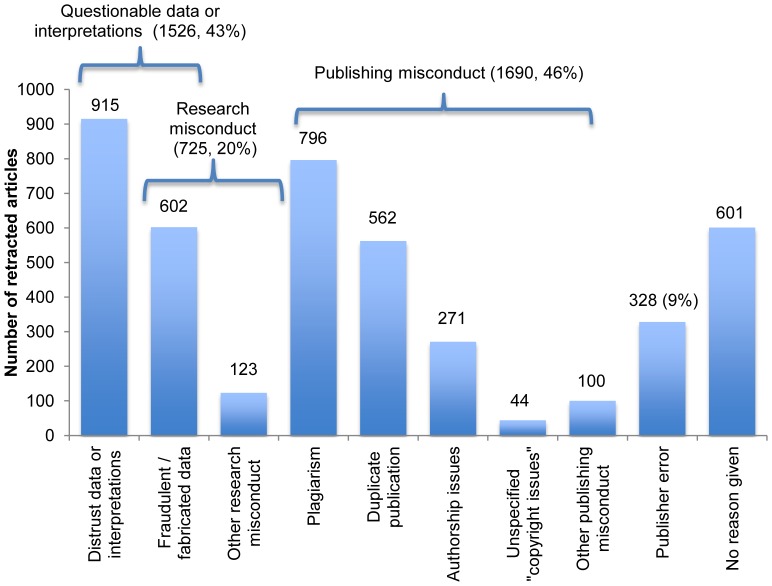
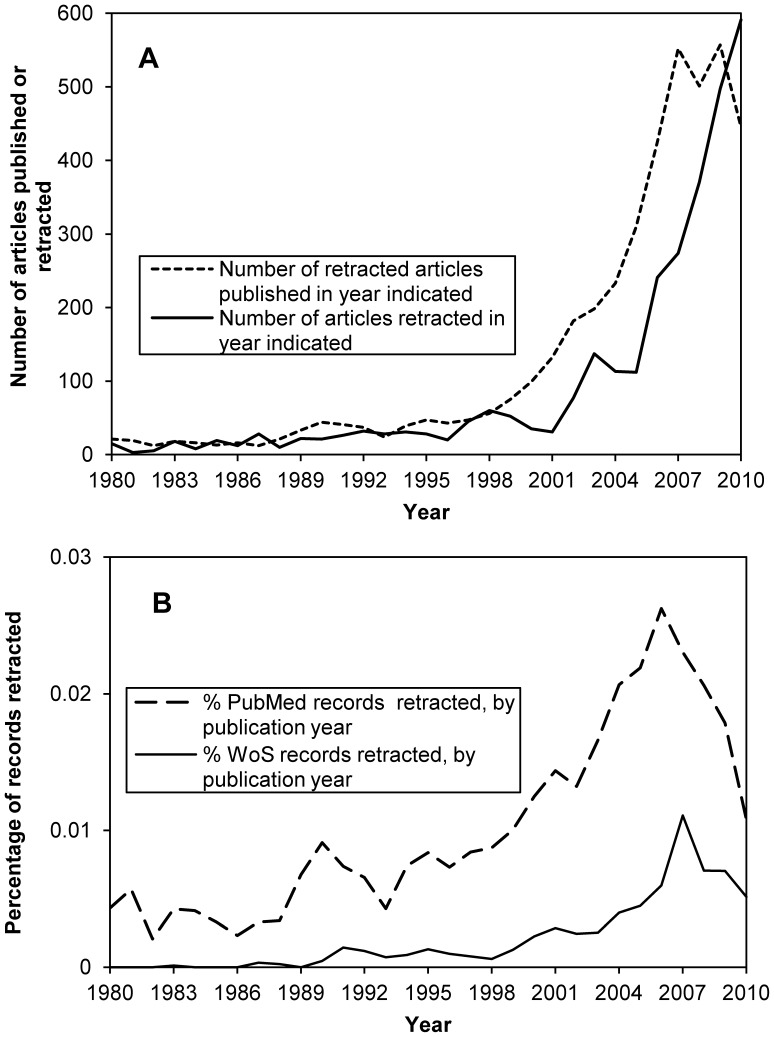
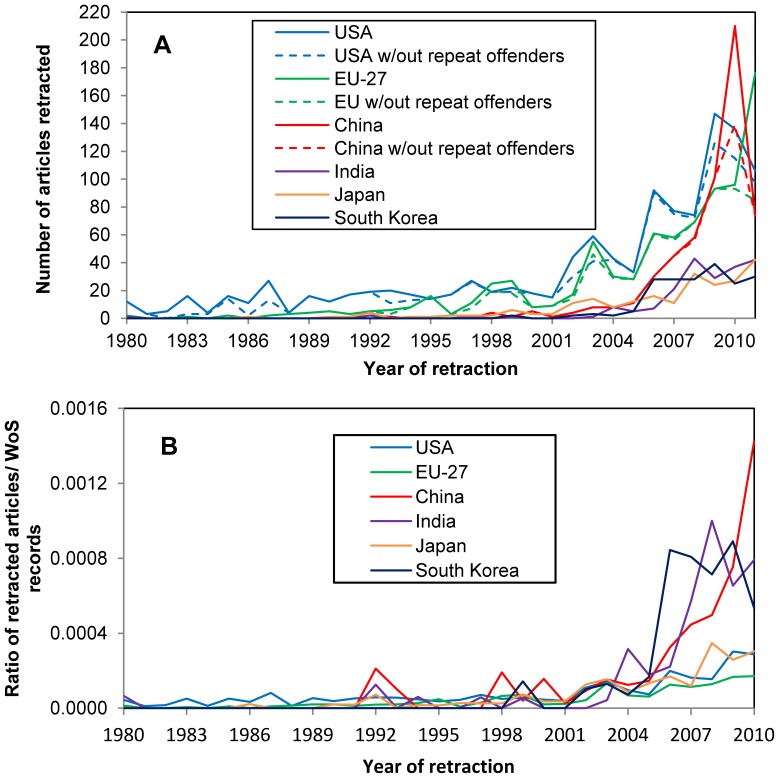
BACKGROUND: The number of retracted scholarly articles has risen precipitously in recent years. Past surveys of the retracted literature each limited their scope to articles in PubMed, though many retracted articles are not indexed in PubMed. To understand the scope and characteristics of retracted articles across the full spectrum of scholarly disciplines, we surveyed 42 of the largest bibliographic databases for major scholarly fields and publisher websites to identify retracted articles. This study examines various trends among them. RESULTS: We found, 4,449 scholarly publications retracted from 1928-2011. Unlike Math, Physics, Engineering and Social Sciences, the percentages of retractions in Medicine, Life Science and Chemistry exceeded their percentages among Web of Science (WoS) records. Retractions due to alleged publishing misconduct (47%) outnumbered those due to alleged research misconduct (20%) or questionable data/interpretations (42%). This total exceeds 100% since multiple justifications were listed in some retraction notices. Retraction/WoS record ratios vary among author affiliation countries. Though widespread, only miniscule percentages of publications for individual years, countries, journals, or disciplines have been retracted. Fifteen prolific individuals accounted for more than half of all retractions due to alleged research misconduct, and strongly influenced all retraction characteristics. The number of articles retracted per year increased by a factor of 19.06 from 2001 to 2010, though excluding repeat offenders and adjusting for growth of the published literature decreases it to a factor of 11.36. CONCLUSIONS: Retracted articles occur across the full spectrum of scholarly disciplines. Most retracted articles do not contain flawed data; and the authors of most retracted articles have not been accused of research misconduct. Despite recent increases, the proportion of published scholarly literature affected by retraction remains very small. Articles and editorials discussing retractions, or their relation to research integrity, should always consider individual cases in these broad contexts. However, better mechanisms are still needed for raising researchers' awareness of the retracted literature in their field.
Overview
The claims and statistics of this paper haven’t been checked yet.
Free: it reads the open-access text and checks the first 5 claims that cite a source we can check. Create a free account to check every claim.
Integrity signals
Registry
Cites
Statistics
Figures
Verification
Claims the paper makes
The claims and statistics of this paper haven’t been checked yet.
Free: it reads the open-access text and checks the first 5 claims that cite a source we can check. Create a free account to check every claim.
Claims other papers make about this one
Each is checked against this paper’s own text: does it say what the citing paper says it does?
The source backs part of the claim, not all of it — or backs it for a different population, condition or comparison.
In the citing paper
“through mid-2018, he was considered one of the most prolifically retracted authors (Grieneisen and Zhang 2012; The Retraction Watch Leaderboard [Internet Archive, 2018 -05 -30] 2018).”
From Continued post-retraction citation of a fraudulent clinical trial report, 11 years after it was retracted for falsifying data (2020) · cites this paper as Grieneisen and Zhang 2012
Experimental — accuracy not yet measuredThe cited source says what the claim attributes to it.
In the citing paper
“It is one of 17 papers by Wataru Matsuyama retracted from 2007 to 2010 (Grieneisen and Zhang 2012; Steen 2011a)”
From Continued post-retraction citation of a fraudulent clinical trial report, 11 years after it was retracted for falsifying data (2020) · cites this paper as Grieneisen and Zhang 2012
The cited source says what the claim attributes to it.
In the citing paper
“The highest percentages of retractions are found in medicine, life sciences, and chemistry journals (Grieneisen and Zhang 2012).”
From Continued post-retraction citation of a fraudulent clinical trial report, 11 years after it was retracted for falsifying data (2020) · cites this paper as Grieneisen and Zhang 2012
Self-check
Percentages, sums and reported differences re-computed from the paper’s own numbers.
The self-check needs the paper’s full text.
Citations
Cites
8 retracted
Purification and ex vivo expansion of postnatal human marrow mesodermal progenitor cells
Reyes, M., Lund, T., Lenvik, T., Aguiar, D., Koodie, L., & Verfaillie, C. M. (2001) · Blood · doi:10.1182/blood.v98.9.2615 · Cited by 1,185 · cited 1×
“highly-cited article [31], had 740 total WoS citations, including 187 for 2009–2012.”
BackgroundRetractedRetracted Science and the Retraction Index
Fang, F. C., & Casadevall, A. (2011) · Infection and Immunity · doi:10.1128/iai.05661-11 · Cited by 405
RetractedRetraction rates are on the rise
Cokol, M., Ozbay, F., & Rodriguez‐Esteban, R. (2008) · The EMBO Reports · doi:10.1038/sj.embor.7401143 · Cited by 149 · cited 2×
“However, studies published from 1992–2011 were somewhat limited in scope due to a sole reliance on the literature indexed in the PubMed database (Table S1), with the largest dataset examined to date comprising only 871 retracted publications [9].”
BackgroundResultRetractedThomas, J. M., Hubbard, W. J., Sooudi, S. K., & Thomas, F. T. (2008) · Immunological Reviews · doi:10.1111/j.1600-065x.2008.00667.x · Cited by 30
RetractedDavis, A. J., Im, Y. J., Dubin, J. S., Tomer, K. B., & Boss, W. F. (2007) · Journal of Biological Chemistry · doi:10.1074/jbc.m611728200 · Cited by 25
RetractedJeong, S. M., Koo, W. H., Choi, S. H., & Baik, H. K. (2005) · Organic Electronics · doi:10.1016/j.orgel.2005.03.010 · Cited by 1
RetractedJeong, S. M., Koo, W. H., Choi, S. H., & Baik, H. K. (2007) · Organic Electronics · doi:10.1016/j.orgel.2007.02.006 · Cited by 1
RetractedHu, X. Y., Xu, Y., Qiao, Y., Wu, D., Sa, Y. L., Fu, Q., Yu, J. J., Zhang, X. R., Zhang, J., Gu, B. J., et al. (2007) · Prostate Cancer and Prostatic Diseases · doi:10.1038/sj.pcan.4501016 · Cited by 1
RetractedFanelli, D. (2009) · PLoS ONE · doi:10.1371/journal.pone.0005738 · Cited by 1,911 · cited 1×
“On one hand, some feel that the rise in retractions reflects a very real and pressing issue: Although retracted publications represent only a miniscule percentage of the total literature [1], [2], surveys of researchers have suggested that only a fraction of research misconduct cases are caught and publicly discredite…”
BackgroundA global map of science based on the ISI subject categories
Leydesdorff, L., & Rafols, I. (2009) · Journal of the American Society for Information Science and Technology · doi:10.1002/asi.20967 · Cited by 506
Research works printed but not linked: 3
- Steen RG (2011) Retractions in the medical literature: Who is responsible for scientific integrity? AMWA J 26: 2– 8.
- Rasmussen LS, Yentis SM, Gibbs N, Kawamoto M, Shafer SL, et al. (2012) Joint Editors-in-Chief request for determination regarding papers published by Dr. Yoshitaka Fujii. 23 pp. Available: http://www.springer.com/cda/content/document/cda_downloaddocument/Fujii_Joint_Editorial_Request_Regarding_Dr_Yoshitaka_Fujii.pdf.
- Elsheikh E, Uzunel M, Nowak G (2011) Retraction. Blood 117: 6740.21546458
Cited by
(2015) · OECD Science, Technology and Industry Policy Papers · doi:10.1787/5jrs2f963zs1-en · Cited by 419
Why has the number of scientific retractions increased?
Steen, R. G., Casadevall, A., & Fang, F. C. (2013) · PLoS ONE · doi:10.1371/journal.pone.0068397 · Cited by 415
“A substantial fraction of all retractions are due to research misconduct [8,9] and there has been an estimated 10-fold increase in retractions for scientific fraud (e.”
BackgroundWhat’s in a p? Reassessing best practices for conducting and reporting hypothesis-testing research
Meyer, K. E., van Witteloostuijn, A., & Beugelsdijk, S. (2017) · Journal of International Business Studies · doi:10.1057/s41267-017-0078-8 · Cited by 318
“Excellence R Us”: university research and the fetishisation of excellence
Moore, S., Neylon, C., Paul Eve, M., Paul O’Donnell, D., & Pattinson, D. (2017) · Palgrave Communications · doi:10.1057/palcomms.2016.105 · Cited by 264
“As various studies have concluded, reported instances of both fraud and error (as measured through retractions) are on the rise (Claxton, 2005; Dobbs, 2006; Steen, 2011; Fang et al., 2012; Grieneisen and Zhang, 2012; Yong, 2012b; Chen et al., 2013; Andrade, 2016).”
BackgroundWhy Growing Retractions Are (Mostly) a Good Sign
Fanelli, D. (2013) · PLoS Medicine · doi:10.1371/journal.pmed.1001563 · Cited by 272
“The rate of multiple retractions caused by single individuals has grown, and this significantly skews all estimations [8].”
BackgroundFanelli, D., Costas, R., & Larivière, V. (2015) · PLOS ONE · doi:10.1371/journal.pone.0127556 · Cited by 268
“limitations of past studies on retractions, including the skewing effects of prolific retractors [36] (see Methods).”
BackgroundResultGaming the Metrics: Misconduct and Manipulation in Academic Research
(2020) · The MIT Press eBooks · doi:10.7551/mitpress/11087.001.0001 · Cited by 198
Moylan, E. C., & Kowalczuk, M. K. (2016) · BMJ Open · doi:10.1136/bmjopen-2016-012047 · Cited by 212
“for retraction (table 2) and has also been a predominant reason for retraction highlighted in other studies.(3) The rise in software to detect plagiarism (alongside develop-”
BackgroundSalager‐Meyer, F. (2013) · Journal of English for Academic Purposes · doi:10.1016/j.jeap.2013.11.003 · Cited by 157
“Moreover, due to the importance of ethical publishing (Greineisen & Zhang, 2012; Scott-Lichter, 2012), promotion of good research conduct should be taught to authors, reviewers, and editors through seminars, workshops, and/or national/regional congresses so as to raise their general…”
BackgroundThe visibility of scientific misconduct: A review of the literature on retracted journal articles
Hesselmann, F., Graf, V., Schmidt, M., & Reinhart, M. (2017) · Current Sociology · doi:10.1177/0011392116663807 · Cited by 153
“According to Retraction Watch the 10 authors with the most retractions are related to 624 retractions (http://retractionwatch.com/the-retraction-watch-leaderboard/, accessed 27 December 2015).”
BackgroundMethodInfluentialTransparent Reporting of Data Quality in Distributed Data Networks
Kahn, M. G., Brown, J. S., Chun, A. T., Davidson, B. N., Meeker, D., Ryan, P. B., Schilling, L. M., Weiskopf, N. G., Williams, A. E., & Zozus, M. N. (2015) · eGEMs (Generating Evidence & Methods to improve patient outcomes) · doi:10.13063/2327-9214.1052 · Cited by 126
Arrison, T., & Nerem, R. M. (2017) · Special Publications · doi:10.1002/9781119067825.ch2 · Cited by 135
“There also has been a remarkable increase in the number of retractions of journal articles, with analyses showing that a significant percentage of these retractions are due to research misconduct (Fang et al., 2012; Steen et al., 2013; Grieneisen and Zhang, 2012).”
InfluentialGross, C. G. (2015) · Annual Review of Psychology · doi:10.1146/annurev-psych-122414-033437 · Cited by 149
“Unlike previous studies of retraction (e.g., Grieneisen & Zhang 2012, Nath et al. 2006, Steen 2011, Wagner & Williams 2011), Fang and colleagues explored the reason for the retraction if none was mentioned in the retraction notice, as was often the case.”
Vuong, Q. (2020) · Learned Publishing · doi:10.1002/leap.1282 · Cited by 126
“The number of such studies has risen considerably over the past decades (Brainard & You, 2018; Cokol, Ozbay, & Rodriguez-Esteban, 2008; Grieneisen & Zhang, 2012; Noorden, 2011).”
BackgroundTemporal characteristics of retracted articles
Bar-Ilan, J., & Halevi, G. (2018) · Scientometrics · doi:10.1007/s11192-018-2802-y · Cited by 107
“Some databases such as PubMed, Medline, Embase have a special filter that allows to restrict the search by ‘‘retracted’’ (Bozzo et al. 2017; Grieneisen and Zhang 2012; King et al. 2017).”
BackgroundInfluentialLei, L., & Zhang, Y. W. (2017) · Science and Engineering Ethics · doi:10.1007/s11948-017-9962-7 · Cited by 116
Linguistic Traces of a Scientific Fraud: The Case of Diederik Stapel
Markowitz, D. M., & Hancock, J. T. (2014) · PLoS ONE · doi:10.1371/journal.pone.0105937 · Cited by 116
“These factors suggest that looking at a broader set of authors and fraudulent research papers [2,33] may be fruitful for illuminating deceptive scientific language across disciplines.”
BackgroundRetracted Publications in the Biomedical Literature from Open Access Journals
Wang, T., Xing, Q.-R., Wang, H., & Chen, W. (2018) · Science and Engineering Ethics · doi:10.1007/s11948-018-0040-6 · Cited by 107
“The percentage of retracted articles in the broad field of Medicine and Life Sciences is higher than the percentage of retracted articles in other fields (Grieneisen and Zhang 2012).”
InfluentialSchneider, J., Ye, D., Hill, A. M., & Whitehorn, A. S. (2020) · Scientometrics · doi:10.1007/s11192-020-03631-1 · Cited by 88
Millar, N., Salager-Meyer, F., & Budgell, B. (2019) · English for Specific Purposes · doi:10.1016/j.esp.2019.02.004 · Cited by 85
Retractions in cancer research: a systematic survey
Bozzo, A., Bali, K., Evaniew, N., & Ghert, M. (2017) · Research Integrity and Peer Review · doi:10.1186/s41073-017-0031-1 · Cited by 83
What studies of retractions tell us
Marcus, A., & Oransky, I. (2014) · Journal of Microbiology & Biology Education · doi:10.1128/jmbe.v15i2.855 · Cited by 81
“In contrast to the results discussed above, a study published the same month as the PNAS paper concluded that most retractions involved honest error, precisely because it relied solely on publisher-provided retraction notices (17).”
Correction: Why Has the Number of Scientific Retractions Increased?
Steen, R. G., Casadevall, A., & Fang, F. C. (2013) · PLoS ONE · doi:10.1371/annotation/0d28db18-e117-4804-b1bc-e2da285103ac · Cited by 73
Fanelli, D., Costas, R., Fang, F. C., Casadevall, A., & Bik, E. M. (2019) · Science and Engineering Ethics · doi:10.1007/s11948-018-0023-7 · Cited by 65
“2012), offer a pool of actual cases whose analyses have yielded important insights (Grieneisen and Zhang 2012; Lu et al.”
BackgroundRetractions in orthopaedic research: A systematic review
Yan, J., MacDonald, A., Baisi, L.-P., Evaniew, N., Bhandari, M., & Ghert, M. (2016) · Bone & Joint Research · doi:10.1302/2046-3758.56.bjr-2016-0047 · Cited by 65
Does retraction after misconduct have an impact on citations? A pre–post study
Candal-Pedreira, C., Ruano-Ravina, A., Fernández, E., Ramos, J., Campos-Varela, I., & Pérez-Ríos, M. (2020) · BMJ Global Health · doi:10.1136/bmjgh-2020-003719 · Cited by 67
“The situation is rendered more serious still by the fact that only a small proportion of cases of scientific misconduct are known (12,13).”
BackgroundRetracted Publications Within Radiology Journals
Rosenkrantz, A. B. (2016) · American Journal of Roentgenology · doi:10.2214/ajr.15.15163 · Cited by 65
“Past studies have evaluated general trends related to retracted publications within the collective scientific literature [4, 8, 9].”
BackgroundEstimating monotonic rates from biological data using local linear regression
Olito, C., White, C. R., Marshall, D. J., & Barneche, D. R. (2017) · Journal of Experimental Biology · doi:10.1242/jeb.148775 · Cited by 67
“This makes it difficult or impossible to evaluate the appropriateness of the methods, and is particularly problematic in a new era that demands scientific transparency and reproducibility (Fang et al., 2012; Grieneisen and Zhang, 2012).”
BackgroundNegative density-dependent parasitism in a group-living carnivore
Albery, G. F., Newman, C., Ross, J. G. B., Macdonald, D. W., Bansal, S., & Buesching, C. D. (2020) · Proceedings of the Royal Society B Biological Sciences · doi:10.1098/rspb.2020.2655 · Cited by 89
Retracted publications and their citation in dental literature: A systematic review
Rapani, A., Lombardi, T., Berton, F., Del Lupo, V., Di Lenarda, R., & Stacchi, C. (2020) · Clinical and Experimental Dental Research · doi:10.1002/cre2.292 · Cited by 62
“Almost 90% of these citations were inappropriate, treating information from the retracted articles as reliable, as shown in previous studies conducted in dental literature and in different fields of medicine (Budd et al., 1999; Faggion Jr et al., 2018; Grieneisen & Zhang, 2012).”
MethodRetractedRibeiro, M. D., & Vasconcelos, S. M. R. (2018) · Scientometrics · doi:10.1007/s11192-017-2621-6 · Cited by 69
“Publishing misconduct, primarily plagiarism and author-initiated duplicate publication, accounted for 47% of the retractions’’ (Grieneisen and Zhang 2012).”
BackgroundResultInfluentialHwang, S. Y., Yon, D. K., Lee, S. W., Kim, M. S., Kim, J. Y., Smith, L., Koyanagi, A., Solmi, M., Carvalho, A. F., Kim, E. Y., et al. (2023) · Journal of Korean Medical Science · doi:10.3346/jkms.2023.38.e333 · Cited by 76
Plagiarism Allegations Account for Most Retractions in Major Latin American/Caribbean Databases
de Almeida, R. M. V. R., Rocha, K. D. A., Catelani, F., Fontes-Pereira, A. J., & Vasconcelos, S. M. R. (2015) · Science and Engineering Ethics · doi:10.1007/s11948-015-9714-5 · Cited by 68
The reproducibility of biomedical research: Sleepers awake!
Bustin, S. A. (2014) · Biomolecular Detection and Quantification · doi:10.1016/j.bdq.2015.01.002 · Cited by 56
Retraction of Neurosurgical Publications: A Systematic Review
Wang, J., Ku, J. C., Alotaibi, N. M., & Rutka, J. T. (2017) · World Neurosurgery · doi:10.1016/j.wneu.2017.04.014 · Cited by 65
The impact of misconduct on the published medical and non-medical literature, and the news media
Zhang, M., & Grieneisen, M. L. (2012) · Scientometrics · doi:10.1007/s11192-012-0920-5 · Cited by 64
Self-citationA survey of retracted articles in dentistry
Nogueira, T. E., Gonçalves, A. S., Leles, C. R., Batista, A. C., & Costa, L. R. (2017) · BMC Research Notes · doi:10.1186/s13104-017-2576-y · Cited by 50
“Systematic identification and assessment of retracted papers in biomedical literature is important to provide information for researchers and readers on this relevant ethical issue, providing guidance and warning against major ethical lapses [22] by thoroughly exploring indexing databases in addition to the “mainstrea…”
BackgroundThe importance of large-diameter trees in the wet tropical rainforests of Australia
Bradford, M., & Murphy, H. T. (2019) · PLoS ONE · doi:10.1371/journal.pone.0208377 · Cited by 62
Collaboration and its influence on retraction based on retracted publications during 1978–2017
Zhang, Q., Abraham, J., & Fu, H. (2020) · Scientometrics · doi:10.1007/s11192-020-03636-w · Cited by 59
“One is searching retracted publications directly, by limiting “‘retracted’” and ‘article’”, “retracted article”, “retract* or withdraw* or fraud* or ‘scientific misconduct’ or deception” in the title (Grieneisen and Zhang 2012; He 2013; Chen et al.”
BackgroundFrampton, G. K., Woods, L., & Scott, D. A. (2021) · PLoS ONE · doi:10.1371/journal.pone.0258935 · Cited by 58
“Retraction rates have been found to vary with the scholarly discipline [8, 16], journal impact factor [3, 4, 6, 14] and country of authorship [5, 7].”
BackgroundWray, K. B., & Andersen, L. E. (2018) · Scientometrics · doi:10.1007/s11192-018-2922-4 · Cited by 53
On the use of blockchain-based mechanisms to tackle academic misconduct
Mohan, V. (2019) · Research Policy · doi:10.1016/j.respol.2019.103805 · Cited by 60
Predatory Publishing: An Emerging Threat to the Medical Literature
Harvey, H. B., & Weinstein, D. F. (2016) · Academic Medicine · doi:10.1097/acm.0000000000001521 · Cited by 52
Berggren, C., & Karabağ, S. F. (2018) · Research Policy · doi:10.1016/j.respol.2018.03.020 · Cited by 58
Foo, J. Y. A. (2011) · Science and Engineering Ethics · doi:10.1007/s11948-010-9212-8 · Cited by 51
Moore, A., Fisher, E., & Eccleston, C. (2022) · British Journal of Anaesthesia · doi:10.1016/j.bja.2022.09.030 · Cited by 57
Ortega, J. L., & Delgado‐Quirós, L. (2024) · Scientometrics · doi:10.1007/s11192-024-05034-y · Cited by 56
“Thus, for instance, the number of studies using WoS began to raise from 2012 (Fanelli, 2013; Grieneisen & Zhang, 2012; Lu et al., 2013), when this database likely started to identify these documents.”
van der Vet, P. E., & Nijveen, H. (2016) · Research Integrity and Peer Review · doi:10.1186/s41073-016-0008-5 · Cited by 50
“Repeat offenders are said to be responsible for roughly half of all retraction cases [4].”
BackgroundInfluentialResearch ethics: a profile of retractions from world class universities
Lievore, C., Rubbo, P., dos Santos, C. B., Picinin, C. T., & Pìlatti, L. A. (2021) · Scientometrics · doi:10.1007/s11192-021-03987-y · Cited by 58
“However, joint efforts are still needed to improve mechanisms and increase researchers’ awareness of misconduct (Brainard, 2018; Grieneisen & Zhang, 2012).”
BackgroundMethodInfluentialShibayama, S., & Baba, Y. (2015) · Research Policy · doi:10.1016/j.respol.2015.01.012 · Cited by 58
Detecting academic fraud using Benford law: The case of Professor James Hunton
Horton, J., Kumar, D. K., & Wood, A. (2020) · Research Policy · doi:10.1016/j.respol.2020.104084 · Cited by 58
A Multidimensional Investigation of the Effects of Publication Retraction on Scholarly Impact
Shuai, X., Rollins, J., Moulinier, I., Custis, T., Edmunds, M., & Schilder, F. (2017) · Journal of the Association for Information Science and Technology · doi:10.1002/asi.23826 · Cited by 48
“After a preliminary investigation of a sample set of retracted papers, we based our retraction classifications schema on Grieneisen and Zhang (2012) and Fang et al. (2012), but streamlined it and factored in our understanding of the generally accepted view of the primary reasons for retraction as…”
MethodResultInfluentialda Silva, J. A. T., & Dobránszki, J. (2017) · Scientometrics · doi:10.1007/s11192-016-2227-4 · Cited by 60
Li, G., Kamel, M., Jin, Y., Xu, M., Mbuagbaw, L., Samaan, Z., Levine, M., & Thabane, L. (2018) · Journal of Multidisciplinary Healthcare · doi:10.2147/jmdh.s151745 · Cited by 45
“One previous study found that two of the top 15 authors with the highest number of retracted articles were in the field of anesthesia, 29 which may partly explain the findings of our study.”
ResultCorrecting the Scientific Record: Retraction Practices in Chemistry and Materials Science
Coudert, F.-X. (2019) · Chemistry of Materials · doi:10.1021/acs.chemmater.9b00897 · Cited by 48
An analysis of the validity of retraction annotation in pubmed and the web of science
Schmidt, M. (2018) · Journal of the Association for Information Science and Technology · doi:10.1002/asi.23913 · Cited by 47
“…WoS)—thus the conceptually difficult 6In this comparison, I omitted Bilbrey, O’Dell, and Creamer (2014) because of the unclear specification as well as Grieneisen and Zhang (2012) because in the latter study retractions and retracted publications are retrieved by a combined single search strategy.”
BackgroundMethodInfluentialA systematic review of retracted publications in emergency medicine
Chauvin, A., De Villelongue, C., Pateron, D., & Yordanov, Y. (2019) · European Journal of Emergency Medicine · doi:10.1097/mej.0000000000000491 · Cited by 47
Rajah-Kanagasabai, C. J., & Roberts, L. D. (2015) · Frontiers in Psychology · doi:10.3389/fpsyg.2015.00535 · Cited by 48
“Across retraction studies, the incidence of retracted papers is consistently reported to be increasing over time (Steen, 2011; Fang et al., 2012; Grieneisen and Zhang, 2012).”
BackgroundCharacteristics of retractions related to faked peer reviews: an overview
Qi, X., Deng, H., & Guo, X. (2017) · Postgraduate Medical Journal · doi:10.1136/postgradmedj-2016-133969 · Cited by 46
Resolving authorship disputes by mediation and arbitration
Faulkes, Z. (2018) · Research Integrity and Peer Review · doi:10.1186/s41073-018-0057-z · Cited by 49
Strong Inference in Mathematical Modeling: A Method for Robust Science in the Twenty-First Century
Ganusov, V. V. (2016) · Frontiers in Microbiology · doi:10.3389/fmicb.2016.01131 · Cited by 49
“A large number of unreproducible studies is paralleled by a recent increase in percentage of retracted peer-reviewed papers (Fang et al., 2012; Grieneisen and Zhang, 2012; Fanelli, 2013; Castillo, 2014).”
BackgroundTeam size and retracted citations reveal the patterns of retractions from 1981 to 2020
Sharma, K. (2021) · Scientometrics · doi:10.1007/s11192-021-04125-4 · Cited by 45
Koo, M., & Lin, S.-C. (2024) · Heliyon · doi:10.1016/j.heliyon.2024.e38620 · Cited by 46
“According to the authors, the proportion of published scholarly literature affected by retraction remained relatively small, and most retracted articles did not contain flawed data [11].”
InfluentialRetractedResearch done wrong: A comprehensive investigation of retracted publications in COVID-19
Shimray, S. R. (2022) · Accountability in Research · doi:10.1080/08989621.2021.2014327 · Cited by 47
“A considerable portion of all retractions are owing to research wrongdoing (Grieneisen and Zhang 2012).”
BackgroundRetraction: The “Other Face” of Research Collaboration?
Tang, L., Hu, G., Sui, Y., Yang, Y., & Cao, C. (2020) · Science and Engineering Ethics · doi:10.1007/s11948-020-00209-1 · Cited by 50
Article retracted, but the message lives on
Greitemeyer, T. (2013) · Psychonomic Bulletin & Review · doi:10.3758/s13423-013-0500-6 · Cited by 50
“Retractions are found in all major scientific disciplines (Grieneisen & Zhang, 2012), and although still relatively rare when compared with the overall number of scientific articles, retraction notices are clearly on the rise.”
BackgroundRetracted Publications in Mental Health Literature: Discovery across Bibliographic Platforms
Bakker, C., & Riegelman, A. (2018) · Journal of Librarianship and Scholarly Communication · doi:10.7710/2162-3309.2199 · Cited by 38
“…such as these have been criticized as “impractical” Volume 6, General IssueJL SC 14 | eP2199 Journal of Librarianship and Scholarly Communication in that they require additional searching on the part of researchers in addition to the initial identification of articles (Grieneisen & Zhang, 2012).”
BackgroundInfluentialReisig, M. D., Holtfreter, K., & Berzofsky, M. (2020) · Accountability in Research · doi:10.1080/08989621.2020.1772060 · Cited by 49
Biomedical retractions due to misconduct in Europe: characterization and trends in the last 20 years
Freijedo-Farinas, F., Ruano‐Raviña, A., Pérez‐Ríos, M., Ross, J. S., & Candal‐Pedreira, C. (2024) · Scientometrics · doi:10.1007/s11192-024-04992-7 · Cited by 51
A survey of retractions in the cardiovascular literature
Audisio, K., Robinson, N. B., Soletti, G. J., Cancelli, G., Dimagli, A., Spadaccio, C., Olaria, R. P., Chadow, D., Rahouma, M., Demetres, M., et al. (2022) · International Journal of Cardiology · doi:10.1016/j.ijcard.2021.12.021 · Cited by 38
Post retraction citations among manuscripts reporting a radiology-imaging diagnostic method
Bolboacă, S. D., Buhai, D.-V., Aluaș, M., & Bulboacă, A. E. (2019) · PLOS ONE · doi:10.1371/journal.pone.0217918 · Cited by 42
Continued citation of retracted radiation oncology literature—Do we have a problem?
Hamilton, D. G. (2019) · International Journal of Radiation Oncology*Biology*Physics · doi:10.1016/j.ijrobp.2018.11.014 · Cited by 42
Current and Evolving Models of Peer Review
Fresco-Santalla, A., & Hernández-Pérez, T. (2014) · The Serials Librarian · doi:10.1080/0361526x.2014.985415 · Cited by 44
Misconduct, Marginality and Editorial Practices in Management, Business and Economics Journals
Karabağ, S. F., & Berggren, C. (2016) · PLoS ONE · doi:10.1371/journal.pone.0159492 · Cited by 45
An analysis of Malaysian retracted papers: Misconduct or mistakes?
Khalid, Y. I. A. M., Abdullah, N., & Abrizah, A. (2018) · Scientometrics · doi:10.1007/s11192-018-2720-z · Cited by 49
A cross-disciplinary and severity-based study of author-related reasons for retraction
Xu, S. B., & Hu, G. (2021) · Accountability in Research · doi:10.1080/08989621.2021.1952870 · Cited by 43
“This result is consistent with the finding of many previous studies (e.g., Brainard, You, and Bonazzi 2018; Fang, Grant Steen, and Casadevall 2012; Grieneisen and Zhang 2012; Ribeiro and Vasconcelos 2018; Vuong 2020; Vuong et al. 2020) that misconduct accounted for the majority of retractions.”
BackgroundResultInfluentialReproducible Research in Computational Chemistry of Materials
Coudert, F. (2017) · Chemistry of Materials · doi:10.1021/acs.chemmater.7b00799 · Cited by 42
Retractions in the Engineering Field: A Study on the Web of Science Database
Rubbo, P., Helmann, C. L., Bilynkievycz dos Santos, C., & Pilatti, L. A. (2019) · Ethics & Behavior · doi:10.1080/10508422.2017.1390667 · Cited by 37
“The number of retractions has increased considerably in the last few years (Almeida et al., 2014; Bosch et al., 2012; Grieneisen & Zhang, 2012; Gross, 2016); the Web of Science database shows 30 retraction notes in 2000 and more than 400 in 2011 (Van Noorden, 2011).”
BackgroundStricker, J., & Günther, A. (2019) · Zeitschrift für Psychologie · doi:10.1027/2151-2604/a000356 · Cited by 48
“…(64.84% in PsycINFO) was similar to the biomedical and life-science literature (67.40% in PubMed; Fang et al., 2012) and similar to estimates derived from a variety of scientific disciplines and databases (47% “publishing misconduct” and 20% “research misconduct”; Grieneisen & Zhang, 2012).”
BackgroundResultInfluentialAnalysis of Retracted Publications in The Biomedical Literature from Turkey
Koçyiğit, B. F., & Akyol, A. (2022) · Journal of Korean Medical Science · doi:10.3346/jkms.2022.37.e142 · Cited by 41
Kwee, R. M., & Kwee, T. C. (2023) · Academic Radiology · doi:10.1016/j.acra.2022.06.025 · Cited by 38
RetractedThe continued citation of retracted publications in dentistry
Theis-Mahon, N. R., & Bakker, C. J. (2020) · Journal of the Medical Library Association · doi:10.5195/jmla.2020.824 · Cited by 33
“02%—the annual number of retracted publications reported in MEDLINE grew 42% between 2013 and 2017 [1].”
BackgroundMargraf, J. (2015) · Psychologische Rundschau · doi:10.1026/0033-3042/a000247 · Cited by 39
“Rückrufe (linke Skala) und Publikationszahlen (rechte Skala) in der Psychologie mit bzw. ohne die Rückrufe der Artikel von D. A. Stapel (Quelle: Armin Günther: Erste Ergebnisse zur Entwicklung von Rückrufen in der Psychologie, unveröffentlichtes Manuskript.”
BackgroundInfluentialPublishers’ Responsibilities in Promoting Data Quality and Reproducibility
Hrynaszkiewicz, I. (2019) · Handbook of experimental pharmacology · doi:10.1007/164_2019_290 · Cited by 43
“Only a small fraction – less than 0.1% (Grieneisen and Zhang 2012) – of published research is retracted, and papers are more likely to be retracted due to misconduct, than honest error (Fang et al. 2012).”
BackgroundInfluentialMott, A., Fairhurst, C., & Torgerson, D. (2019) · Journal of Health Services Research & Policy · doi:10.1177/1355819618797965 · Cited by 36
Citation of Retracted Articles in Engineering: A Study of the Web of Science Database
Rubbo, P., Pilatti, L. A., & Picinin, C. T. (2019) · Ethics & Behavior · doi:10.1080/10508422.2018.1559064 · Cited by 30
“Grieneisen and Zhang (2012); Resnik and Dinse (2013); Almeida, Rocha, Catelani, Fontes-Pereira, and Vasconcelos (2016b); and Rubbo, Helmann, Bilynkievycz Dos Santos, and Pilatti (2017) did not focus solely on one area of research but analyzed the profile of databases.”
BackgroundFerreira, C., Bastille‐Rousseau, G., Bennett, A. M., Ellington, E. H., Terwissen, C., Austin, C., Borlestean, A., Boudreau, M. R., Chan, K., Forsythe, A., et al. (2016) · Biological Reviews · doi:10.1111/brv.12185 · Cited by 34
“…retracted per year increased by a factor of 11.36 from 2001 to 2010, after accounting for repeat offenders and increase in publication volume; Grieneisen & Zhang, 2012) due to combinations of scientific misconduct (e.g. Fanelli, 2009; Ferguson, Marcus & Oransky, 2014; Tanimoto et al., 2014),…”
BackgroundInfluentialCharacteristics of retracted publications related to pain research: a systematic review
Ferraro, M. C., Moore, A., Williams, A. C. D. C., Fisher, E., Stewart, G. B., Ferguson, M. C., Eccleston, C., & O'Connell, N. E. (2023) · Pain · doi:10.1097/j.pain.0000000000002947 · Cited by 40
“Retracted publications are authored widely across the globe but individual countries contribute disproportionately [23,40].”
The landscape of urological retractions: the prevalence of reported research misconduct
Mena, J. D., Ndoye, M., Cohen, A. J., Kamal, P., & Breyer, B. N. (2019) · British Journal of Urology · doi:10.1111/bju.14706 · Cited by 42
Concern noted: a descriptive study of editorial expressions of concern in PubMed and PubMed Central
Vaught, M., Jordan, D. C., & Bastian, H. (2017) · Research Integrity and Peer Review · doi:10.1186/s41073-017-0030-2 · Cited by 34
“They identified EEoCs affecting 58 publications between 2000 and 2011 across 30 journals, with 70% occurring since 2008 [12].”
BackgroundCorrection and retraction practices in library and information science journals
Ajiferuke, I., & Adekannbi, J. O. (2020) · Journal of Librarianship and Information Science · doi:10.1177/0961000618785408 · Cited by 33
“Previous studies have also suggested that among Web of Science records, retraction rates are higher in the hard sciences of Medicine, Chemistry, Life Sciences and Multidisciplinary Sciences than Engineering, Social Sciences, Mathematics, Physics, Agriculture, Arts and Humanities (Grieneisen and Zhang, 2012; Lu et al.,…”
BackgroundInfluentialAcut, D. P., & Antonio, R. P. (2023) · Journal of Technology and Science Education · doi:10.3926/jotse.2151 · Cited by 33
“An article retraction is the removal of an already published article from a journal (Grieneisen & Zhang, 2012).”
BackgroundKamali, N., Abadi, A. T. B., & Rahimi, F. (2020) · Science and Engineering Ethics · doi:10.1007/s11948-020-00274-6 · Cited by 35
Scientific misconduct: the dark side of science
Carafoli, E. (2015) · RENDICONTI LINCEI · doi:10.1007/s12210-015-0415-4 · Cited by 38
“1 Increase of scientific publications in China in the period 2000–2012 (adapted from Hvistendahl 2012) offer publication without ‘‘peer review’’ assessment in exchange for frequently exorbitant ‘‘publishing expenditures’’; agencies which offer to write articles for a fee, advertising the offer with…”
BackgroundInfluentialFalsification, Fabrication, and Plagiarism: The Unholy Trinity of Scientific Writing
Zietman, A. L. (2013) · International Journal of Radiation Oncology*Biology*Physics · doi:10.1016/j.ijrobp.2013.07.004 · Cited by 40
“The number of retracted papers over the same period, however, went up 19-fold! It has been estimated that the majority of the retractions resulted from conscious misdemeanors rather than honest errors (1, 2).”
BackgroundFraud in scientific publications in the European Union. An analysis through their retractions.
Cuenca, G. M., Oliván, J. A. S., & Avilés, R. A. (2021) · Scientometrics · doi:10.1007/s11192-021-03977-0 · Cited by 35
“…analysed retractions on an international scale, providing information on the incidence of misconduct by country (Amos, 2014; Fanelli et al., 2015; Grieneisen & Zhang, 2012; He, 2013; Ribeiro & Vasconcelos, 2018; Steen, 2011; Zhang & Grieneisen, 2013; Zhang et al., 2020), but none of these…”
BackgroundXu, S. B., & Hu, G. (2022) · Learned Publishing · doi:10.1002/leap.1445 · Cited by 32
“Despite the importance of identifying entities liable for retractions, only a few studies (e.g., Grieneisen & Zhang, 2012; van Leeuwen & Luwel, 2014) included accountable entities other than authors of retracted publications.”
BackgroundMethodResultInfluentialGeographical Disparities in Research Misconduct: Analyzing Retraction Patterns by Country
Sebo, P., & Sebo, M. (2025) · Journal of Medical Internet Research · doi:10.2196/65775 · Cited by 31
“These findings align with previous research identifying China, the US, and India as leaders in retraction numbers [2,3], with China’s prominence especially noticeable in recent years [8-10].”
Ending the citation of retracted papers
Cosentino, M., & Veríssimo, D. (2016) · Conservation Biology · doi:10.1111/cobi.12676 · Cited by 32
Detecting errors that result in retractions
Andersen, L. E., & Wray, K. B. (2019) · Social Studies of Science · doi:10.1177/0306312719872008 · Cited by 30
Metadata
- Authors
- Grieneisen, M. L., & Zhang, M.
- Affiliations
- Wenzhou Medical University (CN)
- Corresponding author
- Zhang, Minghua
- Venue
- PLoS ONE
- Publisher
- Public Library of Science (PLoS)
- Published
- 2012-10-24
- Volume
- 7
- Issue
- 10
- Pages
- e44118
- ISSN
- 1932-6203 (ISSN-L)
- PMC
- PMC3480361
- OpenAlex
- W2022493637
- Cited by
- 355
- References
- 78
- Citations by year
- 2026: 15 · 2025: 37 · 2024: 20 · 2023: 30 · 2022: 30 · 2021: 29 · 2020: 23 · 2019: 32 · 2018: 25 · 2017: 26 · 2016: 22 · 2015: 25 · 2014: 20 · 2013: 18 · 2012: 2
- FWCI
- 54.09
- Type
- journal article
- Language
- en
- Open access
- gold
- doi.org
- Locations
- PLoS ONE (publishedVersion, cc-by)
- Europe PMC (PubMed Central) (publishedVersion, cc-by)
- PubMed Central (publishedVersion, cc-by)
- PubMed (publishedVersion)
- RePEc: Research Papers in Economics (submittedVersion)
- DOAJ (DOAJ: Directory of Open Access Journals) (submittedVersion, cc-by-sa)
- Figshare (submittedVersion, cc-by)
- Funders
- California Department of Pesticide Regulation
- Science and Technology Department of Zhejiang Province (2008C03009)
- Topics
- Social Sciences › Education › Academic integrity and plagiarism
- Social Sciences › Library and Information Sciences › Academic Publishing and Open Access
- Social Sciences › Library and Information Sciences › scientometrics and bibliometrics research
- Keywords
- retracted article, research misconduct, questionable research practices, research integrity
- MeSH terms
- Data Collection, Publishing, PubMed
About these checks
Registry, retraction, Cites and statistics results are computed, not judged, with one exception: a printed reference that no index lists is read once by a model before it counts as a citation error. Claims are extracted by a model and kept only when their quote appears verbatim in the text; each cited source is then checked, with a model’s help, for whether it says what the claim relies on. Those verdicts can be wrong — read the claim’s quote and the cited source before relying on one.
Statistics and arithmetic are recomputed, not judged.
Confidence bands are shown only for fields calibrated on our annotated test set. None is calibrated yet, so no band is shown.
What counts as a claim ›How we measure confidence ›How we check this ›
Are you an author, or do you see a problem with this page? Request a review
Data sources
Bibliographic data: Semantic Scholar, OpenAlex, Crossref.
Contains information from the Semantic Scholar Academic Graph Datasets, made available under the ODC Attribution License (ODC-BY 1.0).
Semantic Scholar’s data is described in: Kinney, R., et al. (2023). The Semantic Scholar Open Data Platform. arXiv:2301.10140.
