

A Comprehensive Survey of Retracted Articles from the Scholarly Literature
Open accessThe DOI matches its Crossref record; 77 of the 78 references it cites were found in a registry or an index.
Abstract
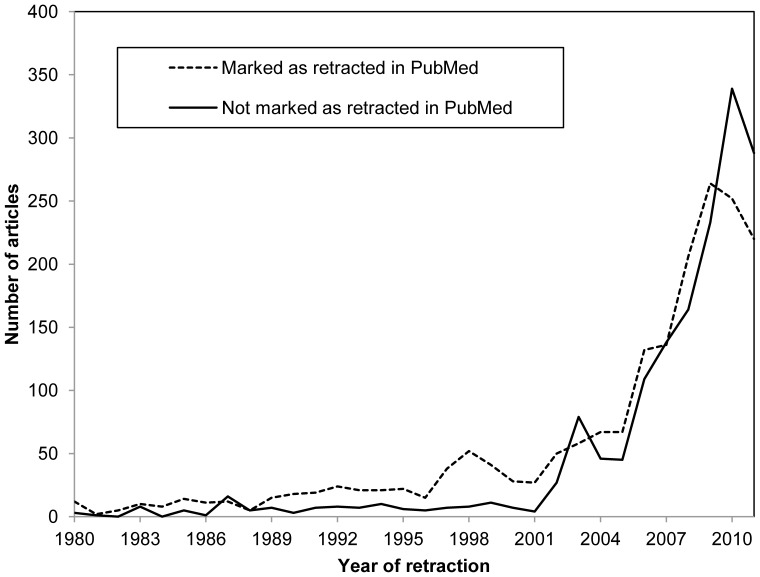
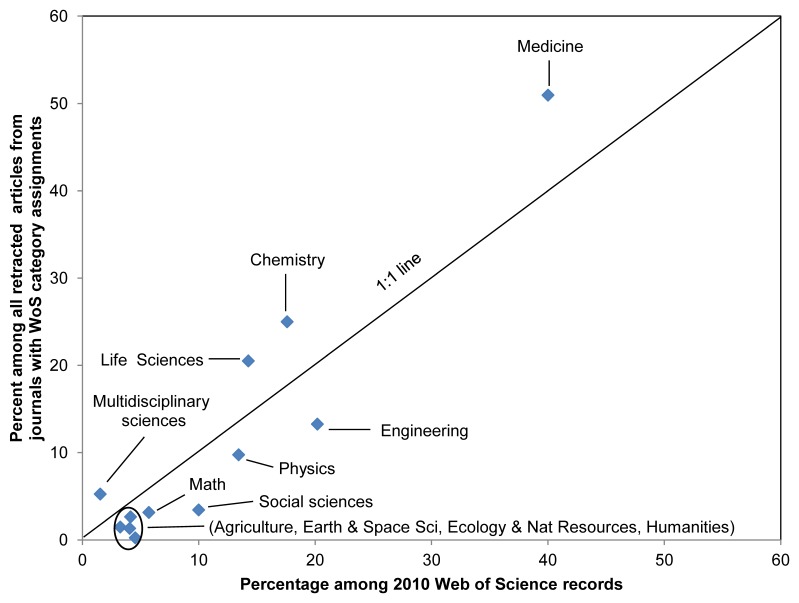
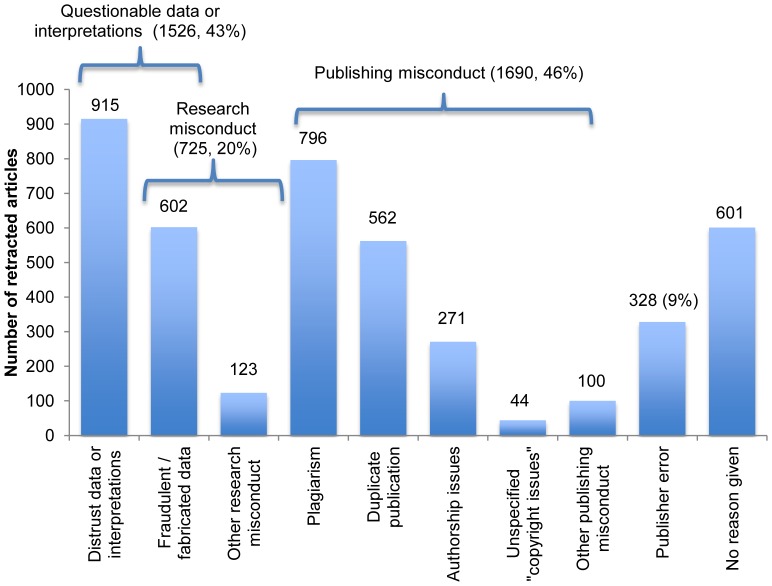
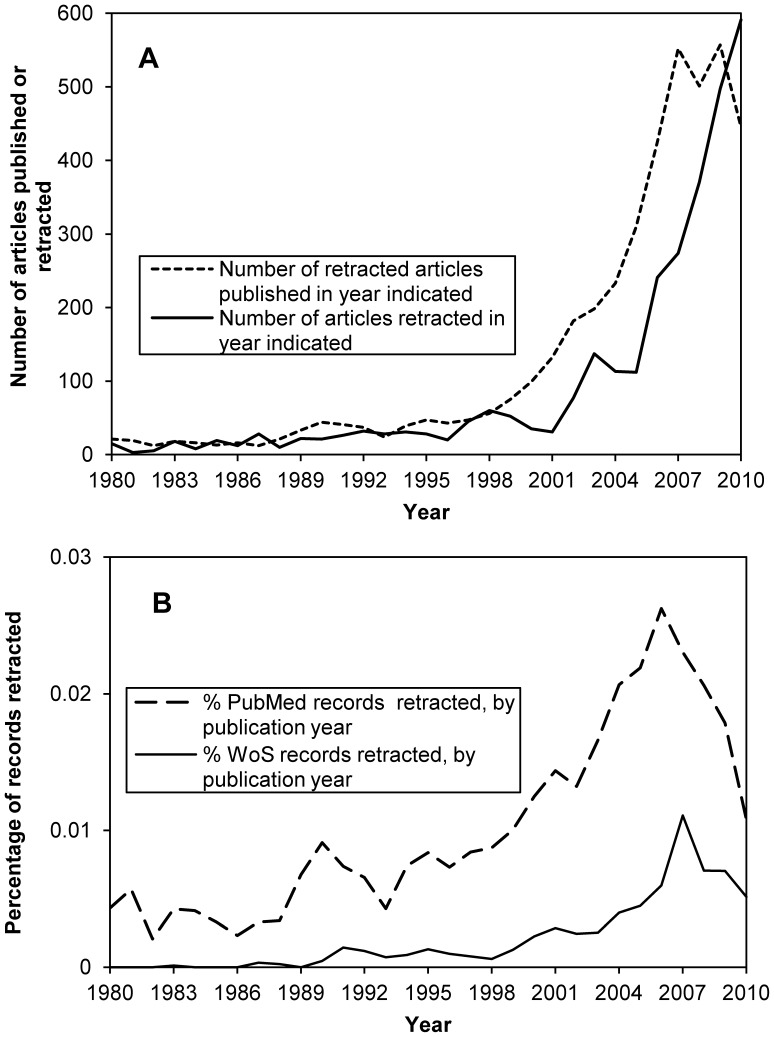
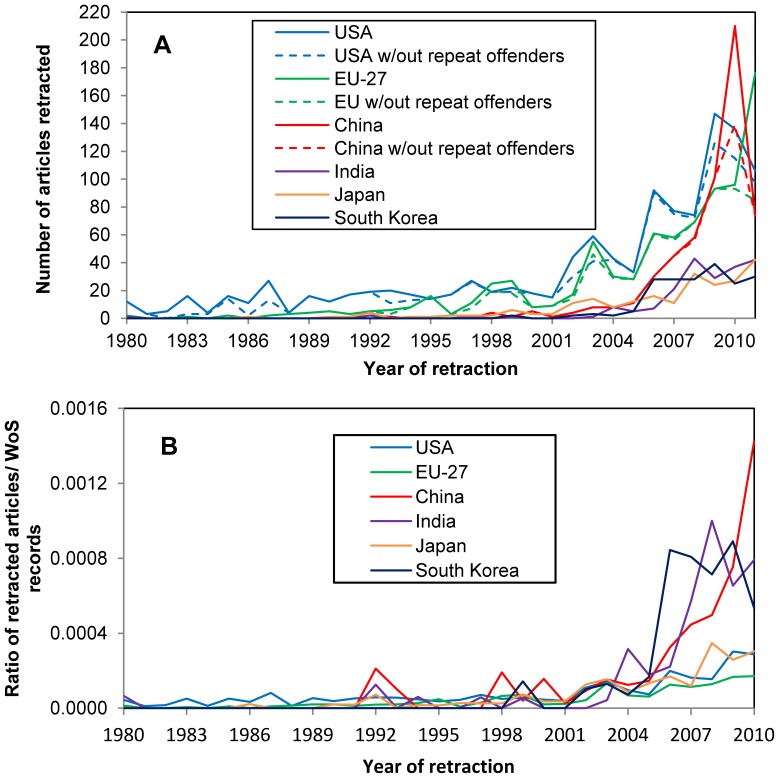
BACKGROUND: The number of retracted scholarly articles has risen precipitously in recent years. Past surveys of the retracted literature each limited their scope to articles in PubMed, though many retracted articles are not indexed in PubMed. To understand the scope and characteristics of retracted articles across the full spectrum of scholarly disciplines, we surveyed 42 of the largest bibliographic databases for major scholarly fields and publisher websites to identify retracted articles. This study examines various trends among them. RESULTS: We found, 4,449 scholarly publications retracted from 1928-2011. Unlike Math, Physics, Engineering and Social Sciences, the percentages of retractions in Medicine, Life Science and Chemistry exceeded their percentages among Web of Science (WoS) records. Retractions due to alleged publishing misconduct (47%) outnumbered those due to alleged research misconduct (20%) or questionable data/interpretations (42%). This total exceeds 100% since multiple justifications were listed in some retraction notices. Retraction/WoS record ratios vary among author affiliation countries. Though widespread, only miniscule percentages of publications for individual years, countries, journals, or disciplines have been retracted. Fifteen prolific individuals accounted for more than half of all retractions due to alleged research misconduct, and strongly influenced all retraction characteristics. The number of articles retracted per year increased by a factor of 19.06 from 2001 to 2010, though excluding repeat offenders and adjusting for growth of the published literature decreases it to a factor of 11.36. CONCLUSIONS: Retracted articles occur across the full spectrum of scholarly disciplines. Most retracted articles do not contain flawed data; and the authors of most retracted articles have not been accused of research misconduct. Despite recent increases, the proportion of published scholarly literature affected by retraction remains very small. Articles and editorials discussing retractions, or their relation to research integrity, should always consider individual cases in these broad contexts. However, better mechanisms are still needed for raising researchers' awareness of the retracted literature in their field.
Overview
The claims and statistics of this paper haven’t been checked yet.
Free: it reads the open-access text and checks the first 5 claims that cite a source we can check. Create a free account to check every claim.
Integrity signals
Registry
Cites
Statistics
Figures
Verification
Claims the paper makes
The claims and statistics of this paper haven’t been checked yet.
Free: it reads the open-access text and checks the first 5 claims that cite a source we can check. Create a free account to check every claim.
Claims other papers make about this one
Each is checked against this paper’s own text: does it say what the citing paper says it does?
The source backs part of the claim, not all of it — or backs it for a different population, condition or comparison.
In the citing paper
“through mid-2018, he was considered one of the most prolifically retracted authors (Grieneisen and Zhang 2012; The Retraction Watch Leaderboard [Internet Archive, 2018 -05 -30] 2018).”
From Continued post-retraction citation of a fraudulent clinical trial report, 11 years after it was retracted for falsifying data (2020) · cites this paper as Grieneisen and Zhang 2012
Experimental — accuracy not yet measuredThe cited source says what the claim attributes to it.
In the citing paper
“It is one of 17 papers by Wataru Matsuyama retracted from 2007 to 2010 (Grieneisen and Zhang 2012; Steen 2011a)”
From Continued post-retraction citation of a fraudulent clinical trial report, 11 years after it was retracted for falsifying data (2020) · cites this paper as Grieneisen and Zhang 2012
The cited source says what the claim attributes to it.
In the citing paper
“The highest percentages of retractions are found in medicine, life sciences, and chemistry journals (Grieneisen and Zhang 2012).”
From Continued post-retraction citation of a fraudulent clinical trial report, 11 years after it was retracted for falsifying data (2020) · cites this paper as Grieneisen and Zhang 2012
Self-check
Percentages, sums and reported differences re-computed from the paper’s own numbers.
The self-check needs the paper’s full text.
Citations
Cites
8 retracted
Purification and ex vivo expansion of postnatal human marrow mesodermal progenitor cells
Reyes, M., Lund, T., Lenvik, T., Aguiar, D., Koodie, L., & Verfaillie, C. M. (2001) · Blood · doi:10.1182/blood.v98.9.2615 · Cited by 1,185 · cited 1×
“highly-cited article [31], had 740 total WoS citations, including 187 for 2009–2012.”
BackgroundRetractedRetracted Science and the Retraction Index
Fang, F. C., & Casadevall, A. (2011) · Infection and Immunity · doi:10.1128/iai.05661-11 · Cited by 405
RetractedRetraction rates are on the rise
Cokol, M., Ozbay, F., & Rodriguez‐Esteban, R. (2008) · The EMBO Reports · doi:10.1038/sj.embor.7401143 · Cited by 149 · cited 2×
“However, studies published from 1992–2011 were somewhat limited in scope due to a sole reliance on the literature indexed in the PubMed database (Table S1), with the largest dataset examined to date comprising only 871 retracted publications [9].”
BackgroundResultRetractedThomas, J. M., Hubbard, W. J., Sooudi, S. K., & Thomas, F. T. (2008) · Immunological Reviews · doi:10.1111/j.1600-065x.2008.00667.x · Cited by 30
RetractedDavis, A. J., Im, Y. J., Dubin, J. S., Tomer, K. B., & Boss, W. F. (2007) · Journal of Biological Chemistry · doi:10.1074/jbc.m611728200 · Cited by 25
RetractedJeong, S. M., Koo, W. H., Choi, S. H., & Baik, H. K. (2005) · Organic Electronics · doi:10.1016/j.orgel.2005.03.010 · Cited by 1
RetractedJeong, S. M., Koo, W. H., Choi, S. H., & Baik, H. K. (2007) · Organic Electronics · doi:10.1016/j.orgel.2007.02.006 · Cited by 1
RetractedHu, X. Y., Xu, Y., Qiao, Y., Wu, D., Sa, Y. L., Fu, Q., Yu, J. J., Zhang, X. R., Zhang, J., Gu, B. J., et al. (2007) · Prostate Cancer and Prostatic Diseases · doi:10.1038/sj.pcan.4501016 · Cited by 1
RetractedFanelli, D. (2009) · PLoS ONE · doi:10.1371/journal.pone.0005738 · Cited by 1,911 · cited 1×
“On one hand, some feel that the rise in retractions reflects a very real and pressing issue: Although retracted publications represent only a miniscule percentage of the total literature [1], [2], surveys of researchers have suggested that only a fraction of research misconduct cases are caught and publicly discredite…”
BackgroundA global map of science based on the ISI subject categories
Leydesdorff, L., & Rafols, I. (2009) · Journal of the American Society for Information Science and Technology · doi:10.1002/asi.20967 · Cited by 506
Research works printed but not linked: 3
- Steen RG (2011) Retractions in the medical literature: Who is responsible for scientific integrity? AMWA J 26: 2– 8.
- Rasmussen LS, Yentis SM, Gibbs N, Kawamoto M, Shafer SL, et al. (2012) Joint Editors-in-Chief request for determination regarding papers published by Dr. Yoshitaka Fujii. 23 pp. Available: http://www.springer.com/cda/content/document/cda_downloaddocument/Fujii_Joint_Editorial_Request_Regarding_Dr_Yoshitaka_Fujii.pdf.
- Elsheikh E, Uzunel M, Nowak G (2011) Retraction. Blood 117: 6740.21546458
Cited by
Items 101–200 of 381
Should research fraud be a crime?
Bhutta, Z. A., & Crane, J. (2014) · BMJ · doi:10.1136/bmj.g4532 · Cited by 27
Repeating probability of authors with retracted scientific publications
Kuroki, T., & Ukawa, A. (2018) · Accountability in Research · doi:10.1080/08989621.2018.1449651 · Cited by 27
“…represent only 0.02% of all publications (Fanelli 2013), a series of surveys has revealed that a small number of scientists with repeated retractions are responsible for a disproportionate number of overall retractions (Fanelli 2013; Grieneisen and Zhang 2012; Steen, Casadevall, and Fang 2013).”
BackgroundInfluentialEthical publishing in intensive care medicine: A narrative review
Wiedermann, C. J. (2016) · World Journal of Critical Care Medicine · doi:10.5492/wjccm.v5.i3.171 · Cited by 27
Heßelmann, F. (2018) · Theoretical Criminology · doi:10.1177/1362480618756365 · Cited by 29
The Future of Empirical Finance
de Prado, M. L. (2015) · The Journal of Portfolio Management · doi:10.3905/jpm.2015.41.4.140 · Cited by 33
“Bailey and López de Prado [2014], Bailey et al.”
Reimagining the peer‐review system for translational health science journals
Smith, E. M. R. (2021) · Clinical and Translational Science · doi:10.1111/cts.13050 · Cited by 30
Retractions of scientific publications: responsibility and accountability
Katavić, V. (2014) · Biochemia Medica · doi:10.11613/bm.2014.024 · Cited by 31
“The surprising thing in the analyses of retracted publications is the number of researchers with multiple retracted publications and the number of retracted publications (or publications found to be fraudulent that are awaiting retraction) they published (15).”
BackgroundRetraction Notices: Who Authored Them?
Xu, S. B., & Hu, G. (2018) · Publications · doi:10.3390/publications6010002 · Cited by 29
“, the entities requesting and/or performing retraction) may also include lawyers, offices of research integrity, institutions that authors of retracted articles are affiliated with, and other entities [6].”
BackgroundInfluentialAcademic Fraud: Solving the Crisis in Modern Academia
Wilson, P. F. (2020) · Exchanges The Interdisciplinary Research Journal · doi:10.31273/eirj.v7i3.546 · Cited by 37
“Geographical distribution depends on whether or not the values are normalized to the total of publications, the US having higher raw values followed by Germany, China and Japan (Fang et al., 2012; Grieneisen and Zhang, 2012) but normalized values have higher retractions values for China and India (Van Noorden, 2010; H…”
BackgroundInfluentialBauwens, T., Reike, D., & Friant, M. C. (2023) · Environmental Innovation and Societal Transitions · doi:10.1016/j.eist.2023.100749 · Cited by 35
Szilagyi, I.-S., Schittek, G. A., Klivinyi, C., Simonis, H., Ullrich, T., & Bornemann‐Cimenti, H. (2022) · Scientometrics · doi:10.1007/s11192-022-04321-w · Cited by 29
“Nevertheless, compared to the total number of publications, only a tiny proportion are retracted (Grieneisen & Zhang, 2012, Aspura et al., 2018).”
BackgroundRetraction Stigma and its Communication via Retraction Notices
Xu, S. B., & Hu, G. (2022) · Minerva · doi:10.1007/s11024-022-09465-w · Cited by 29
“Similarly, many studies (e.g., Grieneisen and Zhang 2012; Xu and Hu in press-a) have reported that reasons for retraction are missing from a considerably large number of retraction notices.”
BackgroundInfluentialChristopher, M. M. (2022) · BMC Veterinary Research · doi:10.1186/s12917-022-03167-x · Cited by 30
“The proportion of retractions due to plagiarism and duplicate publication combined (44%) was similar to that reported in other studies and disciplines (42-48%) [5, 14, 16, 19, 22].”
BackgroundResultInfluentialA bibliometric study of article retractions in technology fields in developing economies countries
Eldakar, M. A. M., & Shehata, A. M. K. (2023) · Scientometrics · doi:10.1007/s11192-023-04823-1 · Cited by 28
“Internation-ally, China, the US, Iran, India, and South Korea, had the top proportion of publications of retracted articles (Christopher, 2022; Gholampour et al., 2022; Grieneisen & Zhang, 2012).”
BackgroundScience map of academic misconduct
Li, M., & Shen, Z. (2024) · The Innovation · doi:10.1016/j.xinn.2024.100593 · Cited by 25
Rossouw, T. M., Matsau, L., & van Zyl, C. (2020) · Journal of Empirical Research on Human Research Ethics · doi:10.1177/1556264620955110 · Cited by 24
“…as well as duplication of articles (70 instances) and authorship issues (22 instances)—can be regarded as an issue that warrants more attention on the African continent as well as globally (Damineni et al., 2015; Grieneisen and Zhang, 2012; Stavale et al., 2019; Wager and Williams, 2011).”
BackgroundMethodResultInfluentialRetracted papers by Iranian authors: causes, journals, time lags, affiliations, collaborations
Ghorbi, A., Fazeli-Varzaneh, M., Ghaderi-Azad, E., Ausloos, M., & Kozak, M. (2021) · Scientometrics · doi:10.1007/s11192-021-04104-9 · Cited by 25
A cross sectional study of retraction notices of scholarly journals of science
Tripathi, M., Sonkar, S. K., & Kumar, S. (2019) · DESIDOC Journal of Library & Information Technology · doi:10.14429/djlit.39.2.14000 · Cited by 28
Retracted articles in rehabilitation: just the tip of the iceberg? A bibliometric analysis
Bordino, M., Ravizzotti, E., & Vercelli, S. (2020) · Archives of Physiotherapy · doi:10.1186/s40945-020-00092-w · Cited by 26
“Though the percentage of articles retracted in the medical/health sector is higher than in other disciplines [18], it has been hypothesized that only a fraction of cases of misconduct are identified and publicly disclosed [19, 20].”
BackgroundRetractedA Framework for Deprecating Datasets: Standardizing Documentation, Identification, and Communication
Luccioni, A. S., Corry, F., Sridharan, H., Ananny, M., Schultz, J., & Crawford, K. (2022) · 2022 ACM Conference on Fairness Accountability and Transparency · doi:10.1145/3531146.3533086 · Cited by 22
Bairi, K. E., Kadmiri, N. E., & Fourtassı, M. (2022) · Accountability in Research · doi:10.1080/08989621.2022.2110866 · Cited by 22
“This is further supported by a large systematic study that analyzed 4,449 retracted scholarly publications and demonstrated that a noticeable percentage of retractions were associated with plagiarism misconduct (Grieneisen and Zhang; 2012).”
ResultSurveying Retracted Studies and Notices Within the Field of Radiation Oncology
Wasiak, J., Hamilton, D. G., Foroudi, F., & Faggion, C. M. (2018) · International Journal of Radiation Oncology*Biology*Physics · doi:10.1016/j.ijrobp.2018.06.028 · Cited by 23
Status of retraction notices for biomedical publications associated with research misconduct
Drimer-Batca, D. A., Iaccarino, J. M., & Fine, A. (2019) · Research Ethics · doi:10.1177/1747016118820496 · Cited by 22
A Framework for Deprecating Datasets: Standardizing Documentation, Identification, and Communication
Luccioni, A. S., Corry, F., Sridharan, H., Ananny, M., Schultz, J., & Crawford, K. (2021) · arXiv · doi:10.48550/arxiv.2111.04424 · Cited by 22
Questionable Research Practices
O’Boyle, E. H., & Götz, M. (2022) · Oxford University Press eBooks · doi:10.1093/oso/9780190938550.003.0010 · Cited by 28
Advice for Plagiarism Whistleblowers
Fox, M., & Beall, J. (2013) · Ethics & Behavior · doi:10.1080/10508422.2013.866047 · Cited by 21
“For example, Grieneisen and Zhang (2012) looked at the justifications stated for 4,232 scientific retractions across a wide range of disciplines.”
BackgroundThe Menace of Misinformation: Faculty Misstatements in Management Education and Their Consequences
Giacalone, R. A., & Promislo, M. D. (2019) · Organizational Behavior Teaching Review · doi:10.1177/1052562919826613 · Cited by 22
The Dynamics of Retraction in Epistemic Networks
LaCroix, T., Geil, A., & O’Connor, C. (2021) · Philosophy of Science · doi:10.1086/712817 · Cited by 26
Agency and responsibility: A linguistic analysis of culpable acts in retraction notices
Hu, G., & Xu, S. B. (2020) · Lingua · doi:10.1016/j.lingua.2020.102954 · Cited by 23
A Survey of Iranian Retracted Publications Indexed in PubMed
Mansourzadeh, M. J., Ghazimirsaeid, J., Motamedi, N., Najafi, A., Abubakar, A. A., & Dehdarirad, H. (2021) · Iranian Journal of Public Health · doi:10.18502/ijph.v50i1.5086 · Cited by 25
“Similar findings were also obtained in a previous study (20) who observed that questionable data or interpretations and plagiarism were the most cited reasons for retractions.”
BackgroundResultIncidence of Data Duplications in a Randomly Selected Pool of Life Science Publications
Oksvold, M. P. (2016) · Science and Engineering Ethics · doi:10.1007/s11948-015-9668-7 · Cited by 20
“However, during the past decade, the number of retraction notices has increased significantly with a more than a tenfold increase relative to the total number of published articles (Grieneisen and Zhang 2012; Van Noorden 2011).”
BackgroundInfluentialDobránszki, J., & da Silva, J. A. T. (2019) · Scientometrics · doi:10.1007/s11192-019-03190-0 · Cited by 21
Analysis of Retracted Manuscripts in Chemistry: Errors vs Misconduct
Sevryugina, Y. V., & Jimenez, R. (2023) · ACS Omega · doi:10.1021/acsomega.3c03689 · Cited by 20
Pupovac, V. (2021) · Scientometrics · doi:10.1007/s11192-021-04140-5 · Cited by 20
“For example, studies that analyzed the frequency of and the reasons for retracting publications reported the presence of ‘serial offenders’ (Grieneisen & Zhang, 2012; Stavale et al., 2019; Steen, 2011; Stretton et al., 2012).”
ResultEducation Journal Editors’ Perspectives on Self-Plagiarism
Bruton, S. V., & Rachal, J. R. (2015) · Journal of Academic Ethics · doi:10.1007/s10805-014-9224-0 · Cited by 21
Why has the number of scientific retractions increased?
Steen, R. G., Casadevall, A., & Fang, F. C. (2015) · American Psychological Association eBooks · doi:10.1037/14805-034 · Cited by 20
Mistry, V., Grey, A., & Bolland, M. J. (2019) · Accountability in Research · doi:10.1080/08989621.2019.1612244 · Cited by 18
“However, these problems are not unique and similar issues have occurred in other studies (Grieneisen and Zhang 2012; Stern et al. 2014; Galbraith 2017).”
BackgroundResultInfluentialDoes ChatGPT Ignore Article Retractions and Other Reliability Concerns?
Thelwall, M., Lehtisaari, M., Katsirea, I., Holmberg, K., & Zheng, E. (2025) · Learned Publishing · doi:10.1002/leap.2018 · Cited by 18
(2020) · Research Integrity and Peer Review · doi:10.1186/s41073-020-0090-6 · Cited by 18
Sebo, P., & Sebo, M. (2025) · Accountability in Research · doi:10.1080/08989621.2025.2484555 · Cited by 25
“…relied on PubMed (Amos 2014; Davis 2012; Decullier et al. 2013; Decullier, Huot, and Maisonneuve 2014; Fang, Steen, and Casadevall 2012; Foo 2011; Grieneisen and Zhang 2012; Rosenkrantz 2016; Steen 2011; Steen, Casadevall, and Fang 2013; Stretton et al. 2012) and WoS (Bilbrey, O’Dell, and…”
Principles and Ethics in Scientific Communication in Biomedicine
Donev, D. (2013) · Acta Informatica Medica · doi:10.5455/aim.2013.21.228-233 · Cited by 18
Ortega, J. L. (2020) · Learned Publishing · doi:10.1002/leap.1339 · Cited by 18
“Grieneisen and Zhang (2012) performed one of the most complete analyses with more than 4,000 retractions.”
BackgroundMeasuring Scientific Misconduct—Lessons from Criminology
Heßelmann, F., Wienefoet, V., & Reinhart, M. (2014) · Publications · doi:10.3390/publications2030061 · Cited by 20
“a prevailing line of research [3–13].”
Retractions in general and internal medicine in a high-profile scientific indexing database
de Almeida, R. M. V. R., Catelani, F., Fontes-Pereira, A. J., & Gave, N. D. S. (2015) · Sao Paulo Medical Journal · doi:10.1590/1516-3180.2014.00381601 · Cited by 18
What’s in a p? Reassessing Best Practices for Conducting and Reporting Hypothesis-Testing Research
Meyer, K. E., van Witteloostuijn, A. C., & Beugelsdijk, S. (2019) · JIBS special collections · doi:10.1007/978-3-030-22113-3_4 · Cited by 24
Preserving the Quality of Scientific Research: Peer Review of Research Articles
Silva, P. U. K. D., & Vance, C. K. (2017) · Fascinating life sciences · doi:10.1007/978-3-319-50627-2_6 · Cited by 22
The Impact Story of Retracted Articles Altmetric it!
Jan, R., & Zainab, T. (2018) · International Symposium on Emerging Trends and Technologies in Libraries and Information Services (ETTLIS) · doi:10.1109/ettlis.2018.8485245 · Cited by 21
Four erroneous beliefs thwarting more trustworthy research
Yarborough, M. A., Nadon, R., & Karlin, D. (2019) · eLife · doi:10.7554/elife.45261 · Cited by 17
A Systematic Review of Retractions in the Field of Cardiothoracic and Vascular Anesthesia
Rong, L. Q., Audisio, K., Rahouma, M., Soletti, G. J., Cancelli, G., & Gaudino, M. F. L. (2021) · Journal of Cardiothoracic and Vascular Anesthesia · doi:10.1053/j.jvca.2021.09.005 · Cited by 18
Balasubramaniam, K. N., Aiempichitkijkarn, N., Kaburu, S., Marty, P. R., Beisner, B. A., Bliss‐Moreau, E., Arlet, M. E., Atwill, E. R., & McCowan, B. (2022) · Scientific Reports · doi:10.1038/s41598-022-15713-6 · Cited by 20
Responsible conduct of research: Global trends, local opportunities
Rossouw, T. M., van Zyl, C., & Pope, A. (2014) · South African Journal of Science · doi:10.1590/sajs.2014/20130103 · Cited by 17
Retractions in the Middle East from 1999 to 2018: a bibliometric analysis
Liu, W., & Lei, L. (2021) · Scientometrics · doi:10.1007/s11192-021-03919-w · Cited by 19
“…retraction has attracted the interest of researchers (Alfaro-Toloza et al., 2013; Almeida et al., 2016a; Budd et al., 1998; Cokol et al., 2007; Fang et al., 2012; Grieneisen & Zhang, 2012; Resnik & Dinse, 2013; Steen, 2010), and the major findings of previous studies can be summarized as follows.”
BackgroundMethodResultInfluentialBrookes, P. S. (2014) · PeerJ · doi:10.7717/peerj.313 · Cited by 16
“retractions in recent years [3], as well as conflicting reports on whether scientific misconduct is a predominant reason for retractions [4, 5].”
BackgroundResearch misconduct: A grand global challenge for the 21st Century
Farthing, M. J. G. (2013) · Journal of Gastroenterology and Hepatology · doi:10.1111/jgh.12500 · Cited by 18
Influence of accessibility (open and toll-based) of scholarly publications on retractions
Shah, T. A., Gul, S., Bashir, S., Ahmad, S., Huertas, A., Oliveira, A., Gulzar, F., Najar, A. H., & Chakraborty, K. (2021) · Scientometrics · doi:10.1007/s11192-021-03990-3 · Cited by 17
Dishonest Conformity in Peer Review
Shibayama, S., & Baba, Y. (2015) · Prometheus · doi:10.1080/08109028.2015.1114745 · Cited by 18
“Similarly, Grieneisen and Zhang (2012) suggest that 47% of retractions are caused by publishing misconduct (e.g. plagiarism, authorship issues), 20% by research misconduct (e.g. falsification, fabrication), and 42% by questionable data or interpretation, and that the number of retractions increased…”
Standard Errors in Quantitative Criminology: Taking Stock and Looking Forward
Sweeten, G. (2020) · Journal of Quantitative Criminology · doi:10.1007/s10940-020-09463-9 · Cited by 19
Schneider, J., Woods, N. D., Proescholdt, R., Fu, Y., & The RISRS Team (2021) · MetArXiv (OSF Preprints) · doi:10.31222/osf.io/ms579 · Cited by 18
The Russian and International Practices of Identification of Irresponsible Journals and Authors
Rostovtsev, A. A. (2017) · Science Editor and Publisher · doi:10.24069/2542-0267-2017-1-30-37 · Cited by 15
Multiple Publications: The Main Reason for the Retraction of Papers in Computer Science
Hidabi, M. A., & Teh, P. L. (2018) · Advances in intelligent systems and computing · doi:10.1007/978-3-030-03402-3_35 · Cited by 18
Tobita, H., & Kiuchi, T. (2024) · Insect Biochemistry and Molecular Biology · doi:10.1016/j.ibmb.2024.104153 · Cited by 16
Sotudeh, H., Barahmand, N., Yousefi, Z., & Yaghtin, M. (2020) · Journal of Information Science · doi:10.1177/0165551520945853 · Cited by 14
“For example, Grieneisen and Zhang [56] surveyed the retracted articles across the full spectrum of scholarly disciplines in 42 of the largest bibliographic databases for major scholarly fields.”
BackgroundFusion of blockchain and IoT in scientific publishing: Taxonomy, tools, and future directions
Tanwar, S., Reebadiya, D., Bhattacharya, P., Nair, A. R., Kumar, N., & Jo, M. (2023) · Future Generation Computer Systems · doi:10.1016/j.future.2022.12.036 · Cited by 14
Responsible conduct of research: enhancing local opportunities
Mwaka, E. (2017) · African Health Sciences · doi:10.4314/ahs.v17i2.36 · Cited by 16
Cronin, B. (2012) · Journal of the American Society for Information Science and Technology · doi:10.1002/asi.22882 · Cited by 14
Retracted systematic reviews continued to be frequently cited: a citation analysis
Wang, Z., Shi, Q., Zhou, Q., Zhao, S., Hou, R., Lu, S., Gao, X., & Chen, Y. (2022) · Journal of Clinical Epidemiology · doi:10.1016/j.jclinepi.2022.05.013 · Cited by 13
RetractedResearch Misconduct Investigations in China’s Science Funding System
Tang, L., Wang, L., & Hu, G. (2023) · Science and Engineering Ethics · doi:10.1007/s11948-023-00459-9 · Cited by 13
“Most of these concur that retractions are disproportionately caused by mis-conduct, biomedical research is the most affected, and China and India are the top two developing countries in terms of retracted articles (Grieneisen & Zhang, 2012; Palla et al., 2020; Tang et al., 2020).”
BackgroundZheng, E., Fang, Z., & Fu, H. (2024) · Information Processing & Management · doi:10.1016/j.ipm.2023.103640 · Cited by 15
Mapping nine decades of research integrity studies (1935–2024): A scientometric analysis
Tang, G. (2025) · Accountability in Research · doi:10.1080/08989621.2025.2470860 · Cited by 16
“After 2010, issues related to retractions became a central focus, with numerous burst references discussing various aspects of this topic (Fang and Casadevall 2011; Grieneisen and Zhang 2012; Steen 2011; Van Noorden 2011; Wager and Williams 2011).”
Motivating and Maintaining Ethics, Equity, Effectiveness, Efficiency, and Expertise in Peer Review
Brain Health Alliance, Craig, A., Lee, C., Bala, N., & Taswell, C. (2022) · Brainiacs Journal of Brain Imaging And Computing Sciences · doi:10.48085/i5b147d9d · Cited by 16
Bontzorlos, V., Johnson, D. H., Poirazidis, Κ., & Roulin, A. (2023) · The European Zoological Journal · doi:10.1080/24750263.2023.2254823 · Cited by 17
“We explored statistical differences between interviewees’ answers using chi-square tests (Rao & Scott 1981, 1984) and subjected major findings to analysis via pivot tables and visualization (Grieneisen et al. 2012).”
MethodScience Means Never Having to Say You’re Sorry? Apologies for Scientific Misconduct
Heßelmann, F., & Reinhart, M. (2019) · Science Communication · doi:10.1177/1075547019860848 · Cited by 13
“Journals exhibit an increasing propensity to retract articles (Fang et al., 2012; Grieneisen & Zhang, 2012; Wager & Williams, 2011), and might gradually become the go-to organizations to address misconduct.”
BackgroundInfluentialFraude scientifique : une menace majeure pour la recherche médicale
Barde, F., Peiffer‐Smadja, N., & Blanchardière, A. D. L. (2020) · La Revue de Médecine Interne · doi:10.1016/j.revmed.2020.02.004 · Cited by 15
Fulton, A., Coates, A., Williams, M., Howe, P., & Hill, A. (2015) · Publications · doi:10.3390/publications3010017 · Cited by 9
Laine, C. M. (2016) · Annals of Internal Medicine · doi:10.7326/m16-2550 · Cited by 13
"Predatory Journals" or "Predatory Scholars?" The Essential Role of the Peer Review Process
Chirico, F. (2017) · The International Journal of Occupational and Environmental Medicine · doi:10.15171/ijoem.2017.1082 · Cited by 12
“Retractions can be due to alleged publishing misconduct (47%), alleged research misconduct (20%), or questionable data/interpretations (42%).(10) In my opinion, this new phenomenon could answer the question why the number of predatory publishers on Beall's list, as reported by Narimani and Dadkhah, grew from 18 in 201…”
BackgroundResearch on retractions: A systematic review and research agenda
Mertkan, Ş., Mills, D., Takır, A., & Sarıkaya, E. E. (2025) · Accountability in Research · doi:10.1080/08989621.2025.2542203 · Cited by 12
“The focus of studies on retractions originating from the global “periph-ery” is particularly notable given the high number of retracted articles authored by scholars from USA and to a lesser extent Europe (e.g., Chambers, Michener, and Falcone 2019; Grieneisen, Zhang, and von Elm 2012).”
Heßelmann, F. (2018) · Identities · doi:10.1080/1070289x.2018.1538065 · Cited by 11
“Over the past 15–20 years, academic research has witnessed more and more instances of scientific misconduct; from ever-more shocking scandals to a steady increase in retractions of problematic articles (e.g. Grieneisen and Zhang 2012).”
BackgroundJournal editors and publishers’ legal obligations with respect to medical research misconduct
Holbeach, N., Freckelton, I. R., & Mol, B. W. (2022) · Research Ethics · doi:10.1177/17470161221147440 · Cited by 12
“…of scientific research and specialities of medical research crossing international borders and journal impact factors (Bennett et al., 2020; Chambers et al., 2019; Chauvin et al., 2019; Dal-Ré, 2019; Freckelton, 2016; Grieneisen and Zhang, 2012: 12–13; Mena et al., 2019; Wang et al., 2019).”
BackgroundBedside to bench: a look at experimental research with a clinical trial checklist
Sipido, K. R., Casadei, B., Holvoet, P., Janssens, S., Luttun, A., & Sampaolesi, M. (2013) · Cardiovascular Research · doi:10.1093/cvr/cvt272 · Cited by 11
Laine, C. M. (2017) · Annals of Internal Medicine · doi:10.7326/l17-0148 · Cited by 10
Article retraction rates in selected MeSH term categories in PubMed published between 2010 and 2020
Alexander, R. L., Peterson, C., Yang, S., & NUGENT, K. M. (2023) · Accountability in Research · doi:10.1080/08989621.2023.2272246 · Cited by 12
“Some academic fields and research topics may also have a small number of researchers who contribute to a significant number of retractions (Grieneisen & Zhang, 2012; Steen, Casadevall, and Fang 2013a).”
InfluentialAmend: an integrated platform of retracted papers and concerned papers
Li, M., Chen, F., Tong, S., Yang, L., & Shen, Z. (2024) · Journal of Data and Information Science · doi:10.2478/jdis-2024-0012 · Cited by 13
“In addition, bibliographic databases may not update article status changes in a timely manner due to varying retrospective policies (Grieneisen & Zhang, 2012).”
A study exploring attributes and nature of the retracted literature on mental disorders
Balhara, Y. P. S., & Mishra, A. K. (2015) · Indian Journal of Medical Ethics · doi:10.20529/ijme.2015.007 · Cited by 17
“has increased in the past few years (5).”
BackgroundInfluentialPredatory Publishing and Academic Integrity
Jimenez, D. F., & Garza, D. N. (2017) · World Neurosurgery · doi:10.1016/j.wneu.2017.05.157 · Cited by 10
Why published research is untrustworthy
Lose, G., & Klarskov, N. (2017) · International Urogynecology Journal · doi:10.1007/s00192-017-3389-1 · Cited by 10
“Of retracted scientific publications, a major proportion are retracted because of misconduct and another major proportion because of unintentional errors or untrustworthy data/interpretation [6].”
BackgroundScientific Truth in a Post-Truth Era: A Review*
Hagiopol, C., & Leru, P. M. (2024) · Science & Education · doi:10.1007/s11191-024-00527-x · Cited by 12
“The portrayal of the average scientist has shifted notably, particularly post-1950, accompanied by a discernible decline in the quality of scientific literature (Altman, 1994; Fang & Casadevall, 2011; Goodstein, 1993; Gopalakrishna et al., 2022; Grieneisen & Zhang, 2012; Gross, 2016).”
InfluentialReckoning with Retractions in Research Funding Reviews: The Case of China
Xu, S. B., & Hu, G. (2025) · Publications · doi:10.3390/publications13030041 · Cited by 9
“…are accountable for most retractions (Bar‑ bour et al., 2017; Lei & Zhang, 2018; S. B. Xu & Hu, 2022a), non‑author entities, such as journal authorities and third parties, have also been found responsible for a considerable number of retractions (Grieneisen & Zhang, 2012; S. B. Xu & Hu, 2022b).”
Wang, P., & Su, J. (2022) · Journal of Information Science · doi:10.1177/01655515221074329 · Cited by 10
“[4] found that ‘Fifteen prolific individuals accounted for more than half of all retractions due to alleged research misconduct’.”
BackgroundInfluentialKhan, K. S., Fawzy, M. M., CHIEN, P. F. W., Geary, M. P., Bueno‐Cavanillas, A., Núñez‐Núñez, M., Zamora, J., Bedaiwy, M. A., Serour, G. I., D’Hooghe, T., et al. (2025) · International Journal of Gynecology & Obstetrics · doi:10.1002/ijgo.16118 · Cited by 11
Santos-d’Amorim, K., Casado, E. S., & dos Santos, R. N. M. (2025) · Scientometrics · doi:10.1007/s11192-025-05343-w · Cited by 10
“Low percentage values were also found in Grieneisen and Zhang (2012) in a global analysis of retracted articles, in Elango (2021) when analyzing retractions of Indian authors in biomedical literature, and in Kocyigit and Akyol (2022) for the same subject but with Turkish authors.”
The propagation of error: retracted articles in marketing and their citations
Moussa, S. (2022) · Italian Journal of Marketing · doi:10.1007/s43039-021-00044-7 · Cited by 10
“The retracted article’s PDF is usually digitally watermarked as “Retracted” (Bar-Ilan & Halevi, 2017; Chen et al., 2013; Grieneisen & Zhang, 2012; Halevi, 2020).”
MethodKassinopoulos, M., Rolandi, N., Alphan, L., Harper, R. M., Oliveira, J. F. A., Scott, C. A., Kozák, L. R., Guye, M., Lemieux, L., & Diehl, B. (2025) · Imaging Neuroscience · doi:10.1162/imag.a.918 · Cited by 10
Retractions in academic publishing: insights from highly ranked global universities
Khan, R., Joshi, A., Kaur, K., Sinhababu, A., & Chakravarty, R. (2024) · Global Knowledge, Memory and Communication · doi:10.1108/gkmc-01-2024-0037 · Cited by 11
Do male leading authors retract more articles than female leading authors?
Zheng, E., Fu, H., Thelwall, M. A., & Fang, Z. (2025) · Journal of Informetrics · doi:10.1016/j.joi.2025.101682 · Cited by 8
We need more research on causes and consequences, as well as on solutions
Fanelli, D. (2014) · Addiction · doi:10.1111/add.12772 · Cited by 9
Lin, Y., & Chen, M. (2022) · English for Specific Purposes · doi:10.1016/j.esp.2022.03.002 · Cited by 9
Are female scientists underrepresented in self-retractions for honest error?
Ribeiro, M. D., Mena‐Chalco, J. P., Rocha, K. D. A., Pedrotti, M., Menezes, P., & Vasconcelos, S. M. R. (2023) · Frontiers in Research Metrics and Analytics · doi:10.3389/frma.2023.1064230 · Cited by 8
“, 2020), research fields (Grieneisen and Zhang, 2012; Ribeiro and Vasconcelos, 2018; Vuong et al., 2020), and countries (Fang et al.”
BackgroundDetecting Duplication in Students’ Research Data: A Method and Illustration
Allen, P., Lourenco, A., & Roberts, L. D. (2015) · Ethics & Behavior · doi:10.1080/10508422.2015.1019070 · Cited by 10
“In a comprehensive review of retraction notices published in 42 scholarly databases between 1980 and 2010, Grieneisen and Zhang (2012) found that retraction rates ranged from .02% to 5.62% across 1,796 unique journal titles, and had increased rapidly in the last 10 years (see also, Steen, 2012). Questionable data or i…”
BackgroundInfluentialAndersen, L. E., & Wray, K. B. (2021) · Episteme · doi:10.1017/epi.2021.25 · Cited by 9
“Some studies on retractions use retraction notices to say something about the causes of retraction and in particular the distribution of the causes of retraction (see, for example, Nath et al. 2006; Fang et al. 2012; Grieneisen and Zhang 2012).”
Background
Metadata
- Authors
- Grieneisen, M. L., & Zhang, M.
- Affiliations
- Wenzhou Medical University (CN)
- Corresponding author
- Zhang, Minghua
- Venue
- PLoS ONE
- Publisher
- Public Library of Science (PLoS)
- Published
- 2012-10-24
- Volume
- 7
- Issue
- 10
- Pages
- e44118
- ISSN
- 1932-6203 (ISSN-L)
- PMC
- PMC3480361
- OpenAlex
- W2022493637
- Cited by
- 355
- References
- 78
- Citations by year
- 2026: 15 · 2025: 37 · 2024: 20 · 2023: 30 · 2022: 30 · 2021: 29 · 2020: 23 · 2019: 32 · 2018: 25 · 2017: 26 · 2016: 22 · 2015: 25 · 2014: 20 · 2013: 18 · 2012: 2
- FWCI
- 54.09
- Type
- journal article
- Language
- en
- Open access
- gold
- doi.org
- Locations
- PLoS ONE (publishedVersion, cc-by)
- Europe PMC (PubMed Central) (publishedVersion, cc-by)
- PubMed Central (publishedVersion, cc-by)
- PubMed (publishedVersion)
- RePEc: Research Papers in Economics (submittedVersion)
- DOAJ (DOAJ: Directory of Open Access Journals) (submittedVersion, cc-by-sa)
- Figshare (submittedVersion, cc-by)
- Funders
- California Department of Pesticide Regulation
- Science and Technology Department of Zhejiang Province (2008C03009)
- Topics
- Social Sciences › Education › Academic integrity and plagiarism
- Social Sciences › Library and Information Sciences › Academic Publishing and Open Access
- Social Sciences › Library and Information Sciences › scientometrics and bibliometrics research
- Keywords
- retracted article, research misconduct, questionable research practices, research integrity
- MeSH terms
- Data Collection, Publishing, PubMed
About these checks
Registry, retraction, Cites and statistics results are computed, not judged, with one exception: a printed reference that no index lists is read once by a model before it counts as a citation error. Claims are extracted by a model and kept only when their quote appears verbatim in the text; each cited source is then checked, with a model’s help, for whether it says what the claim relies on. Those verdicts can be wrong — read the claim’s quote and the cited source before relying on one.
Statistics and arithmetic are recomputed, not judged.
Confidence bands are shown only for fields calibrated on our annotated test set. None is calibrated yet, so no band is shown.
What counts as a claim ›How we measure confidence ›How we check this ›
Are you an author, or do you see a problem with this page? Request a review
Data sources
Bibliographic data: Semantic Scholar, OpenAlex, Crossref.
Contains information from the Semantic Scholar Academic Graph Datasets, made available under the ODC Attribution License (ODC-BY 1.0).
Semantic Scholar’s data is described in: Kinney, R., et al. (2023). The Semantic Scholar Open Data Platform. arXiv:2301.10140.
