

A Comprehensive Survey of Retracted Articles from the Scholarly Literature
Open accessThe DOI matches its Crossref record; 77 of the 78 references it cites were found in a registry or an index.
Abstract
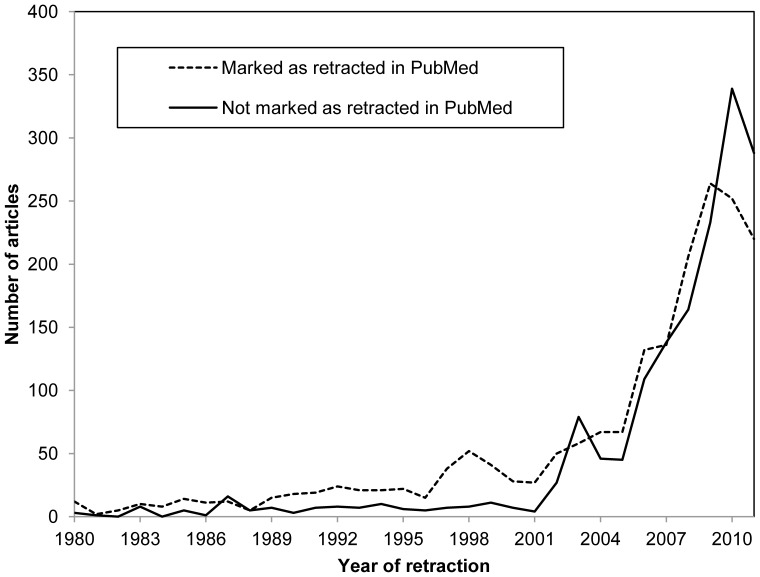
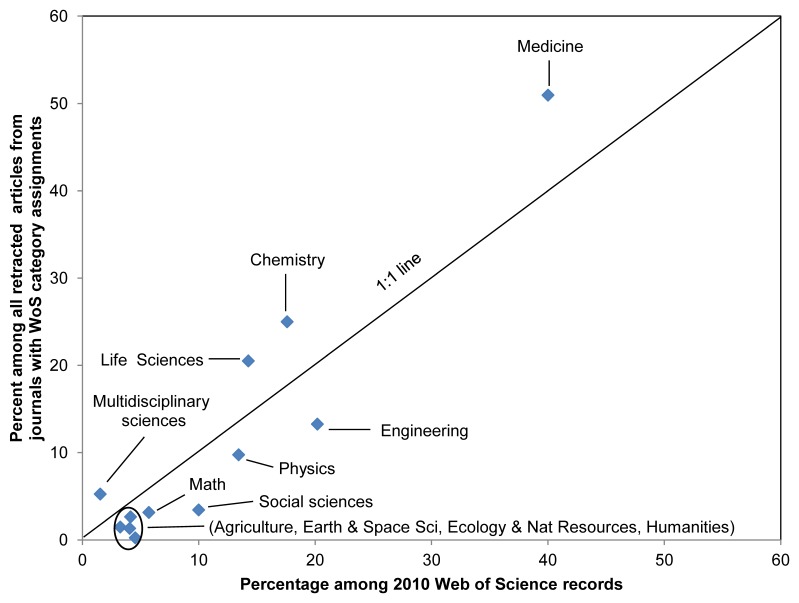
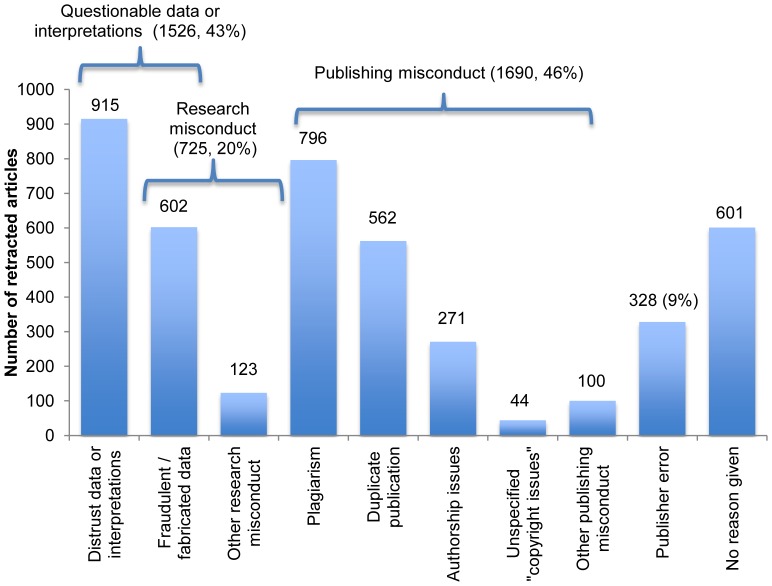
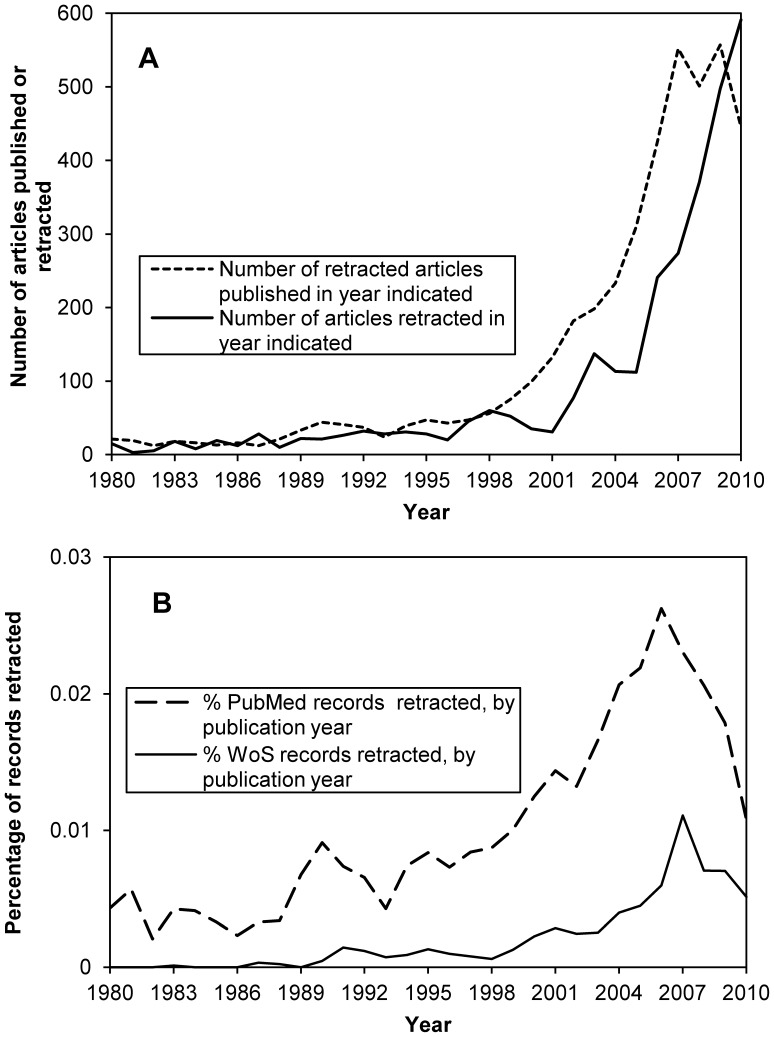
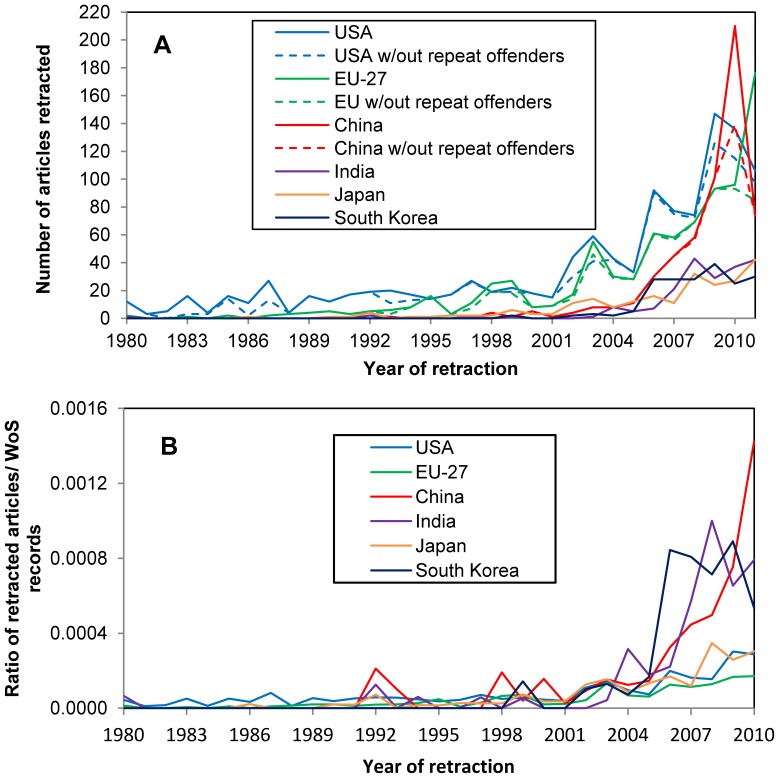
BACKGROUND: The number of retracted scholarly articles has risen precipitously in recent years. Past surveys of the retracted literature each limited their scope to articles in PubMed, though many retracted articles are not indexed in PubMed. To understand the scope and characteristics of retracted articles across the full spectrum of scholarly disciplines, we surveyed 42 of the largest bibliographic databases for major scholarly fields and publisher websites to identify retracted articles. This study examines various trends among them. RESULTS: We found, 4,449 scholarly publications retracted from 1928-2011. Unlike Math, Physics, Engineering and Social Sciences, the percentages of retractions in Medicine, Life Science and Chemistry exceeded their percentages among Web of Science (WoS) records. Retractions due to alleged publishing misconduct (47%) outnumbered those due to alleged research misconduct (20%) or questionable data/interpretations (42%). This total exceeds 100% since multiple justifications were listed in some retraction notices. Retraction/WoS record ratios vary among author affiliation countries. Though widespread, only miniscule percentages of publications for individual years, countries, journals, or disciplines have been retracted. Fifteen prolific individuals accounted for more than half of all retractions due to alleged research misconduct, and strongly influenced all retraction characteristics. The number of articles retracted per year increased by a factor of 19.06 from 2001 to 2010, though excluding repeat offenders and adjusting for growth of the published literature decreases it to a factor of 11.36. CONCLUSIONS: Retracted articles occur across the full spectrum of scholarly disciplines. Most retracted articles do not contain flawed data; and the authors of most retracted articles have not been accused of research misconduct. Despite recent increases, the proportion of published scholarly literature affected by retraction remains very small. Articles and editorials discussing retractions, or their relation to research integrity, should always consider individual cases in these broad contexts. However, better mechanisms are still needed for raising researchers' awareness of the retracted literature in their field.
Overview
The claims and statistics of this paper haven’t been checked yet.
Free: it reads the open-access text and checks the first 5 claims that cite a source we can check. Create a free account to check every claim.
Integrity signals
Registry
Cites
Statistics
Figures
Verification
Claims the paper makes
The claims and statistics of this paper haven’t been checked yet.
Free: it reads the open-access text and checks the first 5 claims that cite a source we can check. Create a free account to check every claim.
Claims other papers make about this one
Each is checked against this paper’s own text: does it say what the citing paper says it does?
The source backs part of the claim, not all of it — or backs it for a different population, condition or comparison.
In the citing paper
“through mid-2018, he was considered one of the most prolifically retracted authors (Grieneisen and Zhang 2012; The Retraction Watch Leaderboard [Internet Archive, 2018 -05 -30] 2018).”
From Continued post-retraction citation of a fraudulent clinical trial report, 11 years after it was retracted for falsifying data (2020) · cites this paper as Grieneisen and Zhang 2012
Experimental — accuracy not yet measuredThe cited source says what the claim attributes to it.
In the citing paper
“It is one of 17 papers by Wataru Matsuyama retracted from 2007 to 2010 (Grieneisen and Zhang 2012; Steen 2011a)”
From Continued post-retraction citation of a fraudulent clinical trial report, 11 years after it was retracted for falsifying data (2020) · cites this paper as Grieneisen and Zhang 2012
The cited source says what the claim attributes to it.
In the citing paper
“The highest percentages of retractions are found in medicine, life sciences, and chemistry journals (Grieneisen and Zhang 2012).”
From Continued post-retraction citation of a fraudulent clinical trial report, 11 years after it was retracted for falsifying data (2020) · cites this paper as Grieneisen and Zhang 2012
Self-check
Percentages, sums and reported differences re-computed from the paper’s own numbers.
The self-check needs the paper’s full text.
Citations
Cites
8 retracted
Purification and ex vivo expansion of postnatal human marrow mesodermal progenitor cells
Reyes, M., Lund, T., Lenvik, T., Aguiar, D., Koodie, L., & Verfaillie, C. M. (2001) · Blood · doi:10.1182/blood.v98.9.2615 · Cited by 1,185 · cited 1×
“highly-cited article [31], had 740 total WoS citations, including 187 for 2009–2012.”
BackgroundRetractedRetracted Science and the Retraction Index
Fang, F. C., & Casadevall, A. (2011) · Infection and Immunity · doi:10.1128/iai.05661-11 · Cited by 405
RetractedRetraction rates are on the rise
Cokol, M., Ozbay, F., & Rodriguez‐Esteban, R. (2008) · The EMBO Reports · doi:10.1038/sj.embor.7401143 · Cited by 149 · cited 2×
“However, studies published from 1992–2011 were somewhat limited in scope due to a sole reliance on the literature indexed in the PubMed database (Table S1), with the largest dataset examined to date comprising only 871 retracted publications [9].”
BackgroundResultRetractedThomas, J. M., Hubbard, W. J., Sooudi, S. K., & Thomas, F. T. (2008) · Immunological Reviews · doi:10.1111/j.1600-065x.2008.00667.x · Cited by 30
RetractedDavis, A. J., Im, Y. J., Dubin, J. S., Tomer, K. B., & Boss, W. F. (2007) · Journal of Biological Chemistry · doi:10.1074/jbc.m611728200 · Cited by 25
RetractedJeong, S. M., Koo, W. H., Choi, S. H., & Baik, H. K. (2005) · Organic Electronics · doi:10.1016/j.orgel.2005.03.010 · Cited by 1
RetractedJeong, S. M., Koo, W. H., Choi, S. H., & Baik, H. K. (2007) · Organic Electronics · doi:10.1016/j.orgel.2007.02.006 · Cited by 1
RetractedHu, X. Y., Xu, Y., Qiao, Y., Wu, D., Sa, Y. L., Fu, Q., Yu, J. J., Zhang, X. R., Zhang, J., Gu, B. J., et al. (2007) · Prostate Cancer and Prostatic Diseases · doi:10.1038/sj.pcan.4501016 · Cited by 1
RetractedFanelli, D. (2009) · PLoS ONE · doi:10.1371/journal.pone.0005738 · Cited by 1,911 · cited 1×
“On one hand, some feel that the rise in retractions reflects a very real and pressing issue: Although retracted publications represent only a miniscule percentage of the total literature [1], [2], surveys of researchers have suggested that only a fraction of research misconduct cases are caught and publicly discredite…”
BackgroundA global map of science based on the ISI subject categories
Leydesdorff, L., & Rafols, I. (2009) · Journal of the American Society for Information Science and Technology · doi:10.1002/asi.20967 · Cited by 506
Research works printed but not linked: 3
- Steen RG (2011) Retractions in the medical literature: Who is responsible for scientific integrity? AMWA J 26: 2– 8.
- Rasmussen LS, Yentis SM, Gibbs N, Kawamoto M, Shafer SL, et al. (2012) Joint Editors-in-Chief request for determination regarding papers published by Dr. Yoshitaka Fujii. 23 pp. Available: http://www.springer.com/cda/content/document/cda_downloaddocument/Fujii_Joint_Editorial_Request_Regarding_Dr_Yoshitaka_Fujii.pdf.
- Elsheikh E, Uzunel M, Nowak G (2011) Retraction. Blood 117: 6740.21546458
Cited by
Items 201–300 of 381
China's medical research integrity
Tian, X., & Song, G.-M. (2015) · The Lancet · doi:10.1016/s0140-6736(15)00410-9 · Cited by 8
Patterns of retractions from 1981-2020 : Does a fraud lead to another fraud?Preprint
Sharma, K. (2020) · arXiv (Cornell University) · doi:10.48550/arxiv.2011.13091 · Cited by 8
“Grieneisen and Zhang (2012) have discussed the reasons and proportion of retractions as research misconduct (20%), questionable data or interpretation (42%), and publishing misconduct (47%).”
BackgroundA comprehensive bibliometric analysis of retracted chapters based on OpenAlex database
Liu, Y., Liu, Y., & Yuan, Z.-H. (2025) · Scientometrics · doi:10.1007/s11192-025-05289-z · Cited by 8
“…have delved into the fundamental patterns of retractions, including the reasons for retraction, time lags in retraction, geographical and national distribution, journal distribution, and disciplinary distribution (Chen et al., 2013; Fang et al., 2012; Grieneisen & Zhang, 2012; Wang et al., 2019).”
Basumatary, B., & Verma, M. K. (2024) · Global Knowledge, Memory and Communication · doi:10.1108/gkmc-04-2024-0228 · Cited by 9
Ethical and efficient research management: A new challenge for an old problem
Giesen-Crouse, E. (2015) · International Journal of Metrology and Quality Engineering · doi:10.1051/ijmqe/2015028 · Cited by 7
Analysing Retraction Notices of Scholarly Journals: A Study
Tripathi, M., Dwivedi, G., Sonkar, S. K., & Kumar, S. (2018) · DESIDOC Journal of Library & Information Technology · doi:10.14429/djlit.38.5.13103 · Cited by 7
Minetto, S., Zanirato, M., Makieva, S., Marzanati, D., Esposito, S., Pisaturo, V., Costa, M., Candiani, M., Papaleo, E., & Alteri, A. (2023) · Frontiers in Public Health · doi:10.3389/fpubh.2023.1210951 · Cited by 7
Systematic examination of post‐ and pre‐citation of Indian‐authored retracted papers
Palla, I. A., Singson, M., & Thiyagarajan, S. (2023) · Learned Publishing · doi:10.1002/leap.1572 · Cited by 7
“…(Grieneisen & Zhang, 2012); error (Hosseini et al., 2018), including unintentional error and publisher error; authorship disputes; fake peer review (Grieneisen & Zhang, 2012; Molckovsky et al., 2011; Nath et al., 2006; Singh et al., 2014; Lei & Zhang, 2018; Vuong, 2020a, 2020b), incorrect methods;…”
BackgroundMethodYuan, Z.-H., & Liu, Y. (2023) · Journal of Data and Information Science · doi:10.2478/jdis-2023-0022 · Cited by 9
CHIEN, P. F. W., Elsuity, M. A., Rashwan, M., Núñez‐Núñez, M., Khan, K. S., Zamora, J., Bueno‐Cavanillas, A., & Fawzy, M. M. (2024) · International Journal of Gynecology & Obstetrics · doi:10.1002/ijgo.15488 · Cited by 7
A systematic review of ENT retractions
Traglia, R. D., Dunne, H., Tysome, J. R., & Smith, M. E. (2024) · European Archives of Oto-Rhino-Laryngology · doi:10.1007/s00405-024-08980-8 · Cited by 7
“In contrast, earlier studies advocate that honest error is more prevalent than misconduct [20, 22].”
Scientific Integrity: The Rules of Academic Research
Schuyt, K. (2019) · Leiden University Press eBooks · doi:10.24415/9789087282301 · Cited by 12
Opposing Responses to Scarcity Emerge from Functionally Unique Sociality Drivers
Kao, A. B., Hund, A. K., Santos, F. P., Young, J.-G., Bhat, D., Garland, J., Oomen, R. A., & McCreery, H. F. (2023) · The American Naturalist · doi:10.1086/725426 · Cited by 7
Peer review: (r)evolution needed
Sipido, K. R., Gal, D., Luttun, A., Janssens, S. P., Sampaolesi, M., & Holvoet, P. (2017) · Cardiovascular Research · doi:10.1093/cvr/cvx191 · Cited by 7
Retractions in primary care journals (2000–2022)
Sebo, P. (2023) · Scientometrics · doi:10.1007/s11192-023-04850-y · Cited by 7
“Finally, a few researchers are authors of a large number of retracted articles (Brainard, 2018; Grieneisen & Zhang, 2012).”
BackgroundScientific integrity and the market for lemons
Cottrell, R. C. (2014) · Research Ethics · doi:10.1177/1747016113494651 · Cited by 6
“The importance of each type has been estimated by examination of the articles whose publication has been withdrawn, either by the authors themselves or by the journal that had published them (Fang et al., 2012; Grieneisen and Zhang, 2012).”
BackgroundLendvai, G. F., & Sasvári, P. (2026) · Journal of Information Science · doi:10.1177/01655515251362383 · Cited by 6
Scientific retractions: causes, processes, and implications for research integrity
Giray, L., Fabros, B. G., & Xavierine, J. (2026) · Naunyn-Schmiedeberg s Archives of Pharmacology · doi:10.1007/s00210-026-05410-w · Cited by 6
“Empirical studies have disproportionately focused on biomedical sciences and high-impact English-language journals, leaving other disciplines and geographic regions comparatively underex-plored (Grieneisen and Zhang 2012; Vuong 2020b).”
Identification of non-conventional small molecule degraders and stabilizers of squalene synthase
Hoock, J., Rossetti, C., Bilgin, M., Depta, L., Enemark‐Rasmussen, K., Christianson, J. C., & Laraia, L. (2023) · Chemical Science · doi:10.1039/d3sc04064j · Cited by 7
Cross-cultural differences in retracted publications of male and female from a global perspective
Li, S., Xu, W., & Yin, J. (2023) · Scientometrics · doi:10.1007/s11192-023-04717-2 · Cited by 7
“And retractions are mostly due to the ethical misconduct, authors misconduct or publishing misconduct (Aspura et al., 2018; Bar-Ilan & Halevi, 2018; Elango et al., 2019; Fang et al., 2012; Grieneisen & Zhang, 2012).”
BackgroundSebo, P., & Sebo, M. (2025) · Accountability in Research · doi:10.1080/08989621.2025.2465621 · Cited by 7
“For example, Grieneisen & Zhang (2012) analyzed 42 bibliographic databases, including PubMed and WoS, to extract 4,449 retracted publications from 1928 to 2011 (Grieneisen and Zhang 2012).”
RetractedLee, C. J. (2013) · Episteme · doi:10.1017/epi.2013.35 · Cited by 6
“Medicine currently accounts for half the retractions in publications across the physical, social, and engineering sciences (Grieneisen and Zhang 2012: 6).”
BackgroundGuarnizo, S. A. G., Barbosa, H. J., Cuero, M. S., Duarte, E. J., Gaitán, F. E., Bravo, J. L. L., Meneses, A., Olaya, J. L., Pacheco, G. F., Rodríguez-Almonacid, C. C., et al. (2016) · Revista de la Academia Colombiana de Ciencias Exactas Físicas y Naturales · doi:10.18257/raccefyn.399 · Cited by 9
“Grieneisen & Zhang (2012) analizaron 3.510 artículos (de libre acceso y con acceso restringido), y encontraron que en el 59,5 % la retractación fue hecha por los editores.”
BackgroundInfluentialHow the retracted publications are managed and used? A South Korean case
Park, J.-C., Lee, J. Y., & Kwon, O. J. (2018) · Leiden Repository (Leiden University) · Cited by 7
Plagiarism Education in Science: The Effect of Instruction on Student Attitudes
Welsh, K. (2019) · International Journal of Bahamian Studies · doi:10.15362/ijbs.v25i0.319 · Cited by 7
Toma, C., Padureanu, L., & Toma, B. (2022) · Publications · doi:10.3390/publications10020018 · Cited by 8
Retractions in Scopus: An Engineering Journal Articles Investigation
Solomon, D., Heckman, C., & Hubbard, D. E. (2022) · Science & Technology Libraries · doi:10.1080/0194262x.2022.2098892 · Cited by 8
Rojas, E. M., Zahn-Muñoz, C., & Solar, R. E. (2025) · Data & Metadata · doi:10.56294/dm2025638 · Cited by 7
Baldridge, A. S., Bellinger, G. C., Fleming, O., Rasmussen, L. V., Whitley, E. W., & Welty, L. J. (2024) · Journal of Clinical and Translational Science · doi:10.1017/cts.2024.533 · Cited by 5
Slaying the undead: How long does it take to kill zombie papers?
Joëts, M., & Mignon, V. (2025) · Research Policy · doi:10.1016/j.respol.2025.105401 · Cited by 6
Characteristics of Global Retracted Publications in Engineering Sciences: A Bibliometric Analysis
Khademizadeh, S., Dakhesh, S., & Lund, B. D. (2025) · Journal of Academic Ethics · doi:10.1007/s10805-025-09595-2 · Cited by 5
“Grieneisen and Zhang ( 2012 ), in examining retracted articles from different sciences, concluded that unlike math, physics, engineering and social sciences, the percentage of retracted articles in medical, Life Science and chemical sciences has grown significantly compared to number of…”
Koppel, L., Lindkvist, A. M., & Tinghög, G. (2025) · Journal of Economic Behavior & Organization · doi:10.1016/j.jebo.2025.107140 · Cited by 5
Sánchez, C., Ortega, J. L., Delgado‐Quirós, L., Becerra-Rodero, E., García, A. C., & Moreno, C. (2026) · Journal of Information Science · doi:10.1177/01655515251398723 · Cited by 6
Retracted articles by Croatian authors: a case study
(2019) · European Science Editing · doi:10.20316/ese.2019.45.19009 · Cited by 6
RetractedAddressing disorder in scholarly communication: Strategies from NISO Plus 2021
Avissar-Whiting, M., Bakker, C., Heckner, H., Massip, S., Schneider, J., Townsend, R., & Woods, N. D. (2021) · Information Services & Use · doi:10.3233/isu-210113 · Cited by 6
“the number of retracted publications is growing, although it remains a very small fraction of the overall corpus [14].”
BackgroundPerry, G. (2016) · Journal of Herpetology · doi:10.1670/16-068 · Cited by 5
Wang, P. (2023) · Conference on Human Information Interaction and Retrieval · doi:10.1145/3576840.3578281 · Cited by 6
“, [9], and was found more serious in medicine and life science [10, 11], but also occurred in computer science [12].”
BackgroundLeclerc, O., & Klausser, N. (2024) · Research Ethics · doi:10.1177/17470161241240241 · Cited by 6
“…2009; Haven et al., 2019; Palla and Singson, 2023; Seadle, 2017; Zuckerman, 2020), the number of retractions (Fanelli, 2013; Fang et al., 2012; Grieneisen and Zhang, 2012; Hesselmann et al., 2017; Palla et al., 2020; Steen et al., 2013; Wray and Andersen, 2018) and the nature of referrals…”
Indicaciones éticas en las revistas de educación indexadas en la WoS
Díaz-Campo, J., & Segado‐Boj, F. (2016) · El Profesional de la Informacion · doi:10.3145/epi.2016.sep.04 · Cited by 10
Bareille, R., Baudouin, B., Carreno, M. P., Fournier, S., Lebret, N., Rémy‐Jouet, I., & Giesen-Crouse, E. (2017) · International Journal of Metrology and Quality Engineering · doi:10.1051/ijmqe/2016029 · Cited by 5
Irreproducible results in preclinical cardiovascular research: opportunities in times of need
Sipido, K. R. (2019) · Cardiovascular Research · doi:10.1093/cvr/cvy312 · Cited by 5
Informetric Analysis on the International Retracted Publication Based on the Web of Science Database
Zhang, C., Ding, K., & Liu, Z. (2019) · Annual International Conference on Social Science and Contemporary Humanity Development (SSCHD) · doi:10.2991/sschd-19.2019.100 · Cited by 5
“Based on Web of Science, this study acquired a large number of retracted publications through heterogeneous multi-source data [4] and effective retrieval strategies [5].”
Background“Research exceptionalism” in the COVID-19 pandemic: an analysis of scientific retractions in Scopus
Rubbo, P., Lievore, C., dos Santos, C. B., Picinin, C. T., Pìlatti, L. A., & Pedroso, B. (2022) · Ethics & Behavior · doi:10.1080/10508422.2022.2080067 · Cited by 6
Context Analysis of Continued Citation of Retracted Manuscripts Published in Anesthesiology Journals
Frasco, P. E., Smith, B. B., Murray, A. W., Khurmi, N. S., Mueller, J. T., & Poterack, K. A. (2022) · Anesthesia & Analgesia · doi:10.1213/ane.0000000000006195 · Cited by 5
“First, in terms of the scope of this study, the authors: (1) limited the analysis to a select number of journals within the specialty, (2) restricted the analysis of digital platforms and publication databases to PubMed, Scopus, Semantic Scholar, and Google Scholar, and (3) relied solely on Retraction Watch as the sou…”
BackgroundMethodInfluentialHow did the scientific publication system respond to the Covid-19 pandemic?
de, A. R. M. V. (2022) · Iberoamerican Journal of Science Measurement and Communication · doi:10.47909/ijsmc.160 · Cited by 5
“After a strong, and concerning increase by the end of the 1990s, retraction rates stabilized at a comparatively high rate of about 4/10k in the 2010s (Brainard, 2018; Fang et al., 2012; Grieneisen & Zhang, 2012; Sharma, 2020).”
BackgroundAn Assessment of Retractions as a Measure of Scientific Misconduct and Impact on Public Health Risks
Abritis, A. J. (2015) · Digital Commons - University of South Florida (University of South Florida) · Cited by 6
China's medical research integrity
Cui, X., Yue, H.-L., & Kan, Q. (2015) · The Lancet · doi:10.1016/s0140-6736(15)61472-6 · Cited by 5
Egregious Plagiarism: More than Misconduct
Fred, H. L., & Scheid, M. S. (2017) · Texas Heart Institute Journal · doi:10.14503/thij-17-6231 · Cited by 5
Nag, S. N., Roy, A., & Sudhier, K. G. (2025) · Global Knowledge, Memory and Communication · doi:10.1108/gkmc-09-2024-0582 · Cited by 4
Do Journalists Update Retracted Science News?
Valinčiūtė, A., & Halffman, W. (2025) · Journalism Practice · doi:10.1080/17512786.2025.2540460 · Cited by 4
“%) are retracted because of publishing errors, such as the accidental duplicate publication of a paper in several journals owned by the same publishing company (Etkin & Oransky, 2016; Grieneisen & Zhang, 2012).”
REGIONAL AND LOCAL JOURNALS IN THE ACADEMIC ECOSYSTEM
Koçyiğit, B. F., Aukenov, N., Yessirkepov, M., & Nurmashev, B. (2025) · Central Asian Journal of Medical Hypotheses and Ethics · doi:10.47316/cajmhe.2025.6.4.01 · Cited by 4
Correcting the scientific record: Legitimation strategies in retraction notices
Lin, Y. (2023) · Pragmatics and Society · doi:10.1075/ps.22008.lin · Cited by 4
Rojas, E. M., & Zahn-Muñoz, C. (2025) · Data & Metadata · doi:10.56294/dm2025655 · Cited by 4
Fulton, A. S., Coates, A. M., Williams, M., Howe, P. R. C., & Hill, A. M. (2018) · Publications · doi:10.3390/publications6030035 · Cited by 4
Namuth, A., Brown, M., Macchione, A. L., & Sacco, D. F. (2023) · ETHICS IN PROGRESS · doi:10.14746/eip.2023.2.4 · Cited by 4
On the Dearth of Retractions in Social Work: A Cross-Sectional Study of Ten Leading Journals
Dunleavy, D. J. (2025) · Metrics · doi:10.3390/metrics2030016 · Cited by 4
“Although retractions have increased over time, some studies suggest that rates are still higher in the biomedical and life sciences, compared to the social sciences and humanities [78].”
Context Analysis of Top Seven Retracted Articles: Should Retraction Watch Revisit the List?
Jan, R., Bano, S., Rehman, I. U., & Mehraj, M. (2018) · Library philosophy and practice · Cited by 8
Engineering Literature Retractions: Applications to Scholarly Communications Training
Solomon, D., & Heckman, C. (2024) · ASEE Annual Conference & Exposition · doi:10.18260/1-2--37068 · Cited by 4
PRINSIP PENTING PUBLIKASI ILMIAH DAN PENCEGAHAN FALSIFIKASI FABRIKASI
Aristya, V. E., & Taryono, T. (2021) · Refleksi Edukatika Jurnal Ilmiah Kependidikan · doi:10.24176/re.v11i2.5348 · Cited by 6
Oakley, B. (2023) · Physiological and Molecular Plant Pathology · doi:10.1016/j.pmpp.2023.102032 · Cited by 5
F1000Research: Tics welcomes you to 21st century biomedical publishing
BLACK, K. J. (2014) · F1000Research · doi:10.12688/f1000research.5664.1 · Cited by 5
COPE Retraction guidelines. Version 2. November 2019
Editorial, A. (2022) · Science Editor and Publisher · doi:10.24069/sep-21-04 · Cited by 3
Scientific misconduct during the pandemic: Retractions in the field of COVID-19
Shueb, S., Abdullah, Y., Gul, S., & Gulzar, R. (2025) · Journal of Information Science · doi:10.1177/01655515251315423 · Cited by 3
Lindkvist, A. M., Koppel, L., Andersson, D., Västfjäll, D., & Tinghög, G. (2026) · Research Policy · doi:10.1016/j.respol.2026.105435 · Cited by 3
Is AI-Produced Humanities Scholarship a Case of Research Misconduct?
Metcalf, T. R. (2026) · Journal of Academic Ethics · doi:10.1007/s10805-026-09745-0 · Cited by 5
“There is no particular reason to believe that the rate of unintentional fabrication or other inaccuracy in human authorship is much lower than it is with LLMs (cf. Grieneisen & Zhang, 2012 ; Heibi & Peroni, 2024).”
Scientific Misconduct and Fraud
Herbst, M. (2021) · The European Legacy · doi:10.1080/10848770.2021.1923247 · Cited by 3
Research Retraction and Its Communication
Xu, S. B., & Hu, G. (2023) · Advances in information quality and management · doi:10.4018/978-1-6684-7366-5.ch030 · Cited by 3
Rapid publication during crises: Analyzing retractions during the Covid-19 pandemic
Toraih, E. A., Elwazir, M. Y., Elshazli, R. M., Hussein, M. H., Fawzy, M., & Elroukh, S. (2025) · Ethics Medicine and Public Health · doi:10.1016/j.jemep.2025.101136 · Cited by 3
Sebo, P. (2025) · PLoS ONE · doi:10.1371/journal.pone.0335059 · Cited by 4
“Although retractions remain relatively rare [2,3,8,9], their impact can be substantial, particularly in high-impact medical journals where retracted findings may have already influenced clinical practice or policy.”
Lievers, W. B. (2013) · Canadian Journal of Information and Library Science · doi:10.1353/ils.2013.0022 · Cited by 3
“The rate of retractions in academic journals has been noted to be increasing, and many of these articles are retracted for methodological, data, or analysis errors (Steen 2011; Grieneisen and Zhang 2012).”
BackgroundFindings of the Survey on Prevention of Plagiarism in Lithuanian Research Journals
Dagienė, E. (2014) · Procedia - Social and Behavioral Sciences · doi:10.1016/j.sbspro.2013.12.975 · Cited by 3
“Plagiarism and self-plagiarism are among those most actively discussed (ŠupakSmolčić & Bilić-Zulle, 2013; Shirazi et al., 2010; Bretag & Mahmud, 2009). Having detected the case of plagiarism, editors and publishers take necessary actions to retract the published article. ‘The first article retracted for plagiarism was…”
BackgroundAcademic Research in Accounting: A Framework for Quality Reviews
Dickins, D. E., & Schneider, D. K. (2016) · Current Issues in Auditing · doi:10.2308/ciia-51423 · Cited by 3
Rikkers, L. F. (2014) · Annals of Surgery · doi:10.1097/sla.0000000000000777 · Cited by 3
Ethical and efficient research management: A new challenge for an old problem
Brunel, N. (2015) · Springer Link (Chiba Institute of Technology) · doi:10.1051/ijmqe/2015028/pdf · Cited by 3
Les manques à l’intégrité scientifique et médicale
Sculier, J. (2015) · Cahiers de psychologie clinique · doi:10.3917/cpc.044.0013 · Cited by 4
Maintaining the Public Trust in Journals with Ethical Publishing
Mycyk, M. B. (2017) · Journal of Medical Toxicology · doi:10.1007/s13181-017-0635-3 · Cited by 3
“When adjusted for repeat offenders, the factor was closer to 11 [9].”
BackgroundManzanas podridas: Malas prácticas de investigación y ciencia descuidadaPreprint
Abril-Ruiz, A. (2019) · PsyArXiv (OSF Preprints) · doi:10.31234/osf.io/z82mh · Cited by 4
Peer reviews. A peer reviewer’s view
Welsby, P. D. (2020) · Postgraduate Medical Journal · doi:10.1136/postgradmedj-2020-138793 · Cited by 3
A COMPARATIVE ANALYSIS OF RETRACTED ARTICLES IN NIGERIA AND SOUTH AFRICA BETWEEN 2016-2020Preprint
Uzobo, E. (2023) · OSF Preprints (OSF Preprints) · doi:10.31219/osf.io/vka69 · Cited by 3
Trends in Retraction of Orthopaedic Research Articles
Guirguis, P. G., Punreddy, A., Botros, M., Raiford, M. E., Humphrey, C. A., Gorczyca, J. T., & Ketz, J. P. (2024) · Journal of Bone and Joint Surgery · doi:10.2106/jbjs.24.00591 · Cited by 2
“However, the studies did differ regarding 1 of the top 3 reasons for retraction: our study found that study error was 1 of the top reasons for retraction, while other studies have identi fi ed misconduct and fraud as the top reasons for retraction 22,25,31,32 .”
Temporal shifts in retraction reasons
Xia, J. (2025) · Journal of Documentation · doi:10.1108/jd-07-2025-0185 · Cited by 2
The future of scholarly communication: rethinking peer review and editorial roles in the digital age
Nkansah, J. O., Ameyaw, E. K., & Amoah, P. A. (2026) · Research Evaluation · doi:10.1093/reseval/rvag009 · Cited by 2
Haubrock, P. J., Kouba, A., Soto, I., Abreo, N. A. S., Vilizzi, L., Błońska, D., Tarkan, A. S., Santis, V. D., Sousa, R., Nogueira, A. B., et al. (2026) · Nature Human Behaviour · doi:10.1038/s41562-026-02575-5 · Cited by 5
Scholarly Publishing and Scientific Reproducibility
Bomzon, A., & Tobin, G. (2021) · Laboratory animal science and medicine · doi:10.1007/978-3-030-66147-2_9 · Cited by 3
Mukherjee, B., & Tiwari, P. (2025) · DESIDOC Journal of Library & Information Technology · doi:10.14429/djlit.20535 · Cited by 3
Haug, C. J., Hofmann, B., Irgens-Jensen, H., Nagel, A., Nydal, R., Rognstad, O.-A., Solberg, B., & Kalleberg, R. (2016) · doi:10.17585/noasp.8.25 · Cited by 2
The Journal of Child Neurology : 28 Years and Still Improving
Brumback, R. A. (2013) · Journal of Child Neurology · doi:10.1177/0883073813478467 · Cited by 2
Reducing the inadvertent spread of retracted science: Shaping a research and implementation agenda
Schneider, J., Woods, N. D., Proescholdt, R., Fu, Y., & The RISRS Team (2021) · doi:10.7490/f1000research.1118522.1 · Cited by 2
Fahimifar, S., Ghorbi, A., & Ausloos, M. (2022) · arXiv (Cornell University) · doi:10.48550/arxiv.2201.09090 · Cited by 2
“…error, self-citations, honorary writing (bringing in the names of those who have not played a role or at least played a minor role) (Budd, Sievert & Schultz, 1998; Foo, 2011; Steen, 2011a; Grieneisen & Zhang, 2012; Marcus & Oransky, 2014; Moylan & Kowalczuk, 2016; Dal-Ré & Ayuso, 2019).”
BackgroundZahn-Muñoz, C., Henríquez, N. A., Viancos, P., & Rojas, E. M. (2025) · Iberoamerican Journal of Science Measurement and Communication · doi:10.47909/ijsmc.250 · Cited by 2
Evaluation of retracted publications related to oral health: a scoping review
Reith, B. M. L. E., & Brand, H. S. (2025) · BDJ · doi:10.1038/s41415-024-8233-7 · Cited by 4
Ridenour, L., Thach, H., & Knudsen, S. E. (2025) · Proceedings of the Association for Information Science and Technology · doi:10.1002/pra2.1340 · Cited by 1
“Grieneisen and Zhang (2012), when analyzing retractions from 1928 to 2011, found that in biomedical science and chemistry, the number of retracted articles exceeded the proportion of publications indexed in Web of Science for those fields.”
Epistemic Virtue, Cognitive Diversity, and the Division of Labor
Bland, S. (2025) · Erkenntnis · doi:10.1007/s10670-025-01033-4 · Cited by 1
“In addition, research papers are retracted for reasons besides being fraudulent; one comprehensive review reports that honest mistakes account for approximately 40% of retracted articles (Grieneisen & Zhang, 2012 ).”
Why social norms matter in science: Determinants of misconduct in German-speaking Europe
Oberhauser, V., Velicu, A., & Rauhut, H. (2025) · Social Science Research · doi:10.1016/j.ssresearch.2025.103292 · Cited by 1
Consequences of undisclosed conflicts of interest in academic publishing
Yang, L. J., Lv, J., Shao, J., Wang, P., Xu, S., & Yang, R. (2026) · Accountability in Research · doi:10.1080/08989621.2026.2616765 · Cited by 1
“The earlier studies attributed the higher retraction in China and the United States to their larger publication output (Grieneisen and Zhang 2012; Koo and Lin 2024).”
Reasons for retractions in potential predatory journals
Xu, S. B., & Hu, G. (2026) · Accountability in Research · doi:10.1080/08989621.2026.2673079 · Cited by 1
“In an early comprehensive analysis, Grieneisen and Zhang (2012) classified reasons for 4,449 retractions into four broad categories: publisher error, author error, other reasons, and unspecified reasons.”
Mañana-Rodríguez, J., Granadino-Goenechea, B., & Bautista-Puig, N. (2026) · Scientometrics · doi:10.1007/s11192-026-05668-0 · Cited by 2
Ling, M. H. (2018) · Advances in Biotechnology & Microbiology · doi:10.19080/aibm.2018.11.555824 · Cited by 1
“Grieneisen & Zhang [17] examined 4232 article retractions from 1928-2011 across 1796 unique journal titles and 3631 (85.”
BackgroundInfluentialPourhoseingholi, M. A., Rahimi-Bashar, F., Fetrat, M. K., & Vahedian‐Azimi, A. (2021) · Hospital Practices and Research · doi:10.34172/hpr.2021.06 · Cited by 2
Haug, C. J., Hofmann, B., Irgens-Jensen, H., Kalleberg, R., Nagel, A., Nydal, R., Rognstad, O.-A., & Solberg, B. (2016) · doi:10.17585/noasp.8.20 · Cited by 1
Metadata
- Authors
- Grieneisen, M. L., & Zhang, M.
- Affiliations
- Wenzhou Medical University (CN)
- Corresponding author
- Zhang, Minghua
- Venue
- PLoS ONE
- Publisher
- Public Library of Science (PLoS)
- Published
- 2012-10-24
- Volume
- 7
- Issue
- 10
- Pages
- e44118
- ISSN
- 1932-6203 (ISSN-L)
- PMC
- PMC3480361
- OpenAlex
- W2022493637
- Cited by
- 355
- References
- 78
- Citations by year
- 2026: 15 · 2025: 37 · 2024: 20 · 2023: 30 · 2022: 30 · 2021: 29 · 2020: 23 · 2019: 32 · 2018: 25 · 2017: 26 · 2016: 22 · 2015: 25 · 2014: 20 · 2013: 18 · 2012: 2
- FWCI
- 54.09
- Type
- journal article
- Language
- en
- Open access
- gold
- doi.org
- Locations
- PLoS ONE (publishedVersion, cc-by)
- Europe PMC (PubMed Central) (publishedVersion, cc-by)
- PubMed Central (publishedVersion, cc-by)
- PubMed (publishedVersion)
- RePEc: Research Papers in Economics (submittedVersion)
- DOAJ (DOAJ: Directory of Open Access Journals) (submittedVersion, cc-by-sa)
- Figshare (submittedVersion, cc-by)
- Funders
- California Department of Pesticide Regulation
- Science and Technology Department of Zhejiang Province (2008C03009)
- Topics
- Social Sciences › Education › Academic integrity and plagiarism
- Social Sciences › Library and Information Sciences › Academic Publishing and Open Access
- Social Sciences › Library and Information Sciences › scientometrics and bibliometrics research
- Keywords
- retracted article, research misconduct, questionable research practices, research integrity
- MeSH terms
- Data Collection, Publishing, PubMed
About these checks
Registry, retraction, Cites and statistics results are computed, not judged, with one exception: a printed reference that no index lists is read once by a model before it counts as a citation error. Claims are extracted by a model and kept only when their quote appears verbatim in the text; each cited source is then checked, with a model’s help, for whether it says what the claim relies on. Those verdicts can be wrong — read the claim’s quote and the cited source before relying on one.
Statistics and arithmetic are recomputed, not judged.
Confidence bands are shown only for fields calibrated on our annotated test set. None is calibrated yet, so no band is shown.
What counts as a claim ›How we measure confidence ›How we check this ›
Are you an author, or do you see a problem with this page? Request a review
Data sources
Bibliographic data: Semantic Scholar, OpenAlex, Crossref.
Contains information from the Semantic Scholar Academic Graph Datasets, made available under the ODC Attribution License (ODC-BY 1.0).
Semantic Scholar’s data is described in: Kinney, R., et al. (2023). The Semantic Scholar Open Data Platform. arXiv:2301.10140.
